Why the Huge Jobs Report?

Financial FAQS

image

MarketWatch

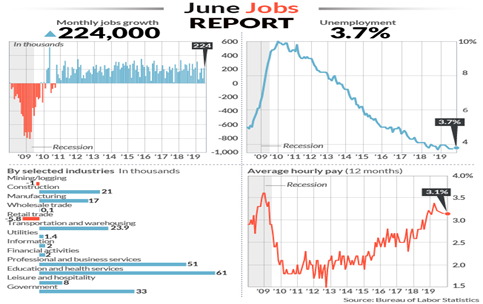
The unemployment rate edged up to 3.7 percent from 3.6 percent as more than 300,000 people entered the labor force in search of work, the Labor Department said Friday. That has confounded those that see slowing economic growth in the second quarter, lowering odds the Fed will begin to lower short term interest rates that have boosted credit card and installment loan payments.

Both the unemployment rate, at 3.7 percent, and the number of unemployed persons, at 6.0 million, changed little in June, said the BLS. And the number of persons employed part time for economic reasons (sometimes referred to as involuntary part-time workers) was essentially unchanged at 4.3 million in June. These individuals, who would have preferred full-time employment, were working part time because their hours had been reduced or they were unable to find full-time jobs.

Why, the ‘huge’ jobs gain?  In fact, these numbers tell us the US economy is still not at full employment, and most of the hiring is in the service sector that doesn’t depend as much on geopolitical and trade uncertainties.

Professional firms hired 51,000 workers; health-care providers added 35,000 jobs and transportation and warehouse companies boosted payrolls by 24,000. Shippers have been steadily adding jobs for years amid a boom in online shopping.

Construction companies hired 21,000 workers, while manufacturers increased employment by 17,000. Both industries had grown more slowly this year and added relatively few workers because of the skilled labor shortage. Transportation and warehousing added another 17,000 jobs.

Because most of the hiring was in the service sector that has lower-paying, less skilled jobs, wage growth and inflation are still tame. The average wage paid to American workers rose just 6 cents to $27.90 an hour. The 12-month rate of hourly wage gains was unchanged at 3.1 percent, which is a low rate of gain at this stage of a recovery.

“Wage growth has tapered off recently despite the tightest labor market in decades, suggesting most workers have gained limited power in wresting higher pay from employers,” said MarketWatch. “Firms are also resorting to more automation to speed up production, keep costs down and get around a shortage of skilled labor.”

And governments continue to hire as they ramp up their own infrastructure projects without waiting for the federal government to act. Local government hiring brought on a 33,000 surge in public-sector payrolls.

So who knows when this business cycle will end—meaning when will US economic activity begin a downward slope? It hasn’t yet, in spite of the ongoing tariff wars and geopolitical uncertainties that have mainly hurt the manufacturing sector with the sharp cutbacks in exports and decline in world trade, as I mentioned in an earlier column.

Harlan Green © 2019

Follow Harlan Green on Twitter: https://twitter.com/HarlanGreen

Posted in Economy, Weekly Financial News | Tagged , , | Leave a comment

Housing Market in Gradual Decline?

The Mortgage Corner

image

Econoday

Happy 4th of July, everyone, even though it looks like we are nearing the end of this housing cycle; and maybe this business cycle as well.  But we can still celebrate what is now the longest recovery from any recession since WWII.

This Case-Shiller Home Price Index may summarize the housing market going forward. Its 3-month average of same-home prices has been declining since last year. The priciest housing markets like Seattle and San Francisco have risen the least, while Las Vegas and Phoenix that were hit the hardest because of overbuilding during the housing bubble show the sharpest increases.

The S&P CoreLogic Case-Shiller U.S. National Home Price NSA Index, covering all nine U.S. census divisions, reported a 3.5% annual gain in April, down from 3.7% in the previous month. The 10-City Composite annual increase came in at 2.3%, up from 2.2% in the previous month. Las Vegas, said the report.

Phoenix and Tampa reported the highest year-over-year gains among the 20 cities. In April, Las Vegas led the way with a 7.1% year-over-year price increase, followed by Phoenix with a 6.0% increase, and Tampa with a 5.6% increase. Nine of the 20 cities reported greater price increases in the year ending April 2019versus the year ending March 2019.

image

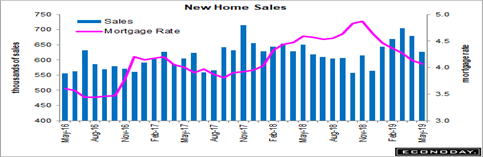
Another marker is new-home sales, which feeds into the GDP report. It plunged in May, down to 626,000 annualized units, vs. 673,000 in April. Prices also fell sharply, down 8.1 percent on the month to a median $308,000. Year-on-year, the median is down 2.7 percent and right in line with the 3.7 percent decline in sales.

The reasons for its weakness are many. Fewer newly-adult Millennials—the largest population cohort—are buying homes because of soaring student debt and fewer entry-level homes on the market.

And consumer confidence is also sinking. The Conference Board’s Confidence Index just declined from 134.1 to 121.5 in June, a huge drop after two months of increases.

“The escalation in trade and tariff tensions earlier this month appears to have shaken consumers’ confidence. Although the Index remains at a high level, continued uncertainty could result in further volatility in the Index and, at some point, could even begin to diminish consumers’ confidence in the expansion.”

Confidence in jobs also showed a slight decline, said the report, and may be a predictor of weakness in Friday’s unemployment report.

This may be a temporary blip, as the Federal Reserve has hinted that it may begin to drop short term interest rates at their July FOMC meeting. And mortgage rates are again at rock-bottom. So more consumers may reverse course and jump back into housing purchases.

image

Econoday

They will face a declining supply, however.  Econoday summarized the current construction industry with these comments: “Residential spending fell 0.6 percent in May and now shows declines each month this year. Compared to May last year, residential spending is down a very steep 11.2 percent. Single-family homes, the dominant category on the residential side, fell in May and are down 7.6 percent on the year. The one residential plus is new multi-family homes which, reflecting demand tied to high costs for single-family homes, are up 9.3 percent.

So if very low interest rates can’t sustain housing sales, what can? We seem to be nearing the end to this recovery from the Great Recession in its record-breaking 11th year.

Harlan Green © 2019

Follow Harlan Green on Twitter: https://twitter.com/HarlanGreen

Posted in Consumers, Economy, Housing, housing market, Weekly Financial News | Tagged , , | Leave a comment

Manufacturing slows as Trade Wars Quicken

Popular Economics Weekly

Trade wars are not really winnable anymore—at least the way President Trump wants to conduct them—or any wars for that matter. This is because we no longer live in a win-lose world where the strong are able to so easily prey on or even conquer the weak and vulnerable. The world has become too populous, and thanks to modern technologies too interlinked for modern economic bullies—like a Trump, or Russia’s Putin, or even China’s Xi Jinping—to succeed for long in their win-lose negotiating tactics based on perceived grievances.

And that is the reason Trump’s trade wars are failing. NAFTA is still NAFTA, because the U.S. depends so heavily on trade with Canada and Mexico. And now there are predictions that his China trade war will fail as well, because his policies are causing so many losses among his Midwest electorate, and now the US manufacturing sector.

Why are we even having trade wars with our allies, as well as adversaries?

We can thank UC Irvine economic professor Peter Navarro, a protectionist, anti-free trade advocate, for convincing President Trump that multi-lateral trade agreements that link us more tightly to our allies are bad for the U.S., including the 12-nation TPP, Trans-Pacific Trade Partnership, that was designed to curb China’s economic expansionism.

So Trump cancelled the TPP and began his trade wars with our allies in Europe, as well as Canada and Mexico, where the U.S. does most of its trade. The result has been slower growth everywhere, as has been cited in many studies.

“Trade growth, a key artery in the global economy, has also slowed markedly, to around 4 percent in 2018 from 5¼ per cent in 2017, said a recent OECD economic outlook report, “with trade restrictions having adverse effects on confidence and investment plans around the world. In Europe, trade growth has stalled, reflecting a slowdown in both external and internal demand. Leading indicators suggest that near-term trade prospects are weak. Survey indicators of new export orders remain low in China and continue to decline in Europe and many Asian economies.”

image

Econoday

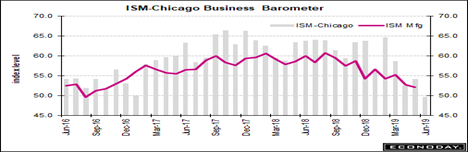
The U.S. has the Chicago ISM Business Barometer of business activity to measure such activity, a survey of more than 80 economic indicators that show a general national trend. It is giving similar results to the OECD outlook; slowing US growth as well.

The MNI Chicago Business Barometer decreased by 4.5 points to 49.7 in June from 54.2 in May, marking the first sub-50 reading since January 2017, said their press release. Business confidence dipped significantly in Q2, with the Barometer averaging 52.2, down 13 percent on the previous quarter and almost 16 percent lower than Q2 2018.

This month’s special question asked firms about the impact of government-imposed tariffs on their business. 80 percent of firms said that they were negatively impacted, with tariffs raising prices of their goods leading to a pullback in orders.

The June ISM manufacturing Index also fell to 51.7, the slowest pace in more than two years, hurt by trade tensions with China and Mexico. “Backlog orders continue to contract, inventories are coming down, delivery times are improving, import buying is flat — all signs of weakness. Another disappointment is a 0.5 point decline in new export orders which are barely growing at 50.5,” said the report.

The LA Times has reported on other damage caused by the trade wars; the sharp decline in Chinese direct investments in US manufacturing that had been growing until last year’s start of the Chinese trade war. Investments shrank to $5 billion in 2018, after $29 billion in plant and equipment in 2017 and $46 billion in 2016, which had been responsible for thousands of new, higher-paying American jobs.

Such win-lose trade tactics are designed to fail, as skilled negotiators have been saying since the end of WWII (e.g., the Marshall Plan), when allies and alliances have been necessary to keep the world peace.

“…win-win negotiation involves working to get the best deal possible for yourself while also working to ensure that your counterpart is satisfied (see also, Win-Win Negotiations: How to Manage Your Counterpart’s Satisfaction), says an article in the Harvard Law School blog. “It means making offers that are good for them and great for you, according to Massachusetts Institute of Technology professor Lawrence Susskind. And it means thinking creatively about how you can get more of what you want by helping the other side get what she wants.”

An Eye-for-an-Eye Makes the Whole World Blind was Mahatma Gandhi’s famous insight, patron saint of non-violence.

Most of the western world has progressed beyond that stage, at least, in this world of super abundance. We no longer suffer from starvation or famine in the developed world, and only by helping those underdeveloped countries still suffering from overpopulation and droughts enter the modern world will we be able to replace the belief in cut-throat competition of the win-lose crowd that sees conflict as the only solution, with the win-win world of cooperation, and a lasting world peace.

Harlan Green © 2019

Follow Harlan Green on Twitter: https://twitter.com/HarlanGreen

Posted in Economy, Macro Economics, Politics, Weekly Financial News | Tagged , , , , | Leave a comment

The Presidential Debates—Will Democracy Survive?

Popular Economics Weekly

image

Graph: Washington Post

Much of the media lament over the first Democratic Presidential debates was whether the Democratic Party had moved too far to the left on immigration and healthcare—whether it was about decriminalizing Central American immigrants crossing the border, or advocating some form of Medicare for all.

Could this allow the reelection of Donald Trump and bring about the decline, if not abolishment, of American democracy as we have known it post-WWII? Russian President-for-life Putin announced at the recent G20 economic summit that liberalism as we know it is now passé.

In an interview with the Financial times, Putin said the “liberal idea,” by which he meant the postwar dominance of democracy, human rights, multiculturalism and tolerance, had become “obsolete.”

Fear not, that isn’t true by a long shot. As much as oligarchs like Putin would like to find more worlds to pilfer, democracy cannot fail unless modern capitalism, the creation of post-WWII democracy, fails. And it won’t fail because it is the manna on which all nations now depend to sustain their citizens. There is no other economic system that will feed its citizens, as even China knows.

Modern capitalism was created out of the New Deal, with its government support of social programs and regulations that prevent capitalism’s worst excesses—such as unregulated capital markets and monopolistic profit-seeking,  causing the record income and wealth inequality that has brought on the discontent and enabled a President Trump.

It therefore behooves the Democratic presidential candidates, at least, to make the changes necessary to bring back some income parity and a greater social safety net, if for no other reason than it would reduce the souring suicide rates and gun violence that no other western democracy experiences.

How do we save a capitalism that doesn’t just cater to oligarchs like a Putin, or even China’s President Xi–who want capitalism that won’t allow dissent, and therefore the innovation necessary to nurture new ideas and inventions?

Senator Elizabeth Warren has thought out many new ways to make capitalism work for the many, and so democracy. The first step is to take back some of that wealth to strengthen the social fabric that was siphoned off to the wealthiest via lower taxes and deregulation causing many industries to become monopsonies—i.e., overly concentrated so they can control their markets, weaken social programs and employees’ bargaining power.

Warren would pay for her programs with a 3% wealth tax on fortunes over $1 billion, and 2 percent on fortunes between $50 million and $1 billion. According to University of California-Berkeley economists, it would raise about $2.75 billion over its first 10 years, all from taxpayers that the Massachusetts senator argues have benefitted too much from a generation of tax-cutting that slashed top federal tax rates almost in half and corporate tax rates by 40 percent, accompanying a surge in inequality in both before-tax and after-tax income.

Other candidates like Senator Kamala Harris and Bernie advocate a return to the 70 percent income tax rate on the highest income earners, and an outright breakup of those corporations literally too big to fail; should we have another Great Recession.

How do these proposals benefit modern capitalism so that it benefits the many, rather than the few? Studies show that without public works programs, labor productivity declines, since not upgrading such as infrastructure slows transportation of goods and services. Reducing public health care and environmental protection sickens more people thus reducing work times. Reducing public educational programs and government R&D reduces overall literacy and scientific innovation, period.

There is good news on that front, as I have noted in past columns. Modern capitalism with its checks and balances has enabled the growth of prosperous middle classes at the heart of liberal democracies. No other economic system is able to produce the quantity of goods and services required for a healthy liberal democracy.

The club of rich democracies is not easy to join, per a recent piece in the Economist, but those who get in tend to stay there. Since the dawn of industrialisation, no advanced capitalist democracy has fallen out of the ranks of high-income countries or regressed permanently into authoritarianism.

This is not a coincidence, say Torben Iversen of Harvard University and David Soskice of the London School of Economics in their recent book, “Democracy and Prosperity”. Rather, they write, in advanced economies democracy and capitalism tend to reinforce each other, as I’ve been saying. It is a reassuring message, but one that will face severe tests in years to come.

In other words, taking government out of modern capitalism makes modern democracies weaker and more vulnerable to predictions from those who fear democracy, like Putin.

Harlan Green © 2019

Follow Harlan Green on Twitter: https://twitter.com/HarlanGreen

Posted in Consumers, Economy, Keynesian economics, Politics, Weekly Financial News | Tagged , , , , , , | Leave a comment

Who Can Still Afford to Buy a Home?

The Mortgage Corner

image

MarketWatch

That question of who can still afford to buy a home is up in the air, as we say, since home sales have been trending lower of late and there is still a housing shortage. MarketWatch’s Andrea Riquier believes housing sales peaked in 2018, dropping below combined sales of 6 million for the first time in two years, per her graph of existing and new-home sales, and won’t go higher this year—in the 11th year of the recovery from the housing bubble.

Sales are falling because Ms. Riquier maintains home buying is still out of the price ranges most young adults can afford for various reasons, including a low inventory of affordable homes for sale, and lower earning potential than in past recoveries for young adults with college degrees still digging out from under student loans.

Yet total existing-home sales’, https://www.nar.realtor/existing-home-sales, completed transactions that include single-family homes, townhomes, condominiums and co-ops, jumped 2.5 percent from April to a seasonally adjusted annual rate of 5.34 million in May, per the NAR.

Total sales are down 1.1 percent from a year ago (5.40 million in May 2018), but when combined with surging May new-home sales of 673,000 reported by the Census Bureau, the total is 6.01 million. So total sales are rising again; maybe because of the recent interest rate decline to post-recession lows?   

NAR chief economist Lawrence Yun said the 2.5 percent jump shows that consumers are eager to take advantage of the favorable conditions. “The purchasing power to buy a home has been bolstered by falling mortgage rates, and buyers are responding.”

Rates are down because the 10-year Treasury bond benchmark yield that most lenders use to set mortgage rates has fallen to 2 percent at this writing, which puts it back to yields that prevailed during the Great Recession, and the 30-year fixed conforming mortgage is holding at 3.50 percent for less than one origination point.

But can builders keep up with the declining inventory of homes for sale? Residential investment has fallen for five straight quarters though the second quarter for starts is up overall with the new May report.

image

Econoday.com

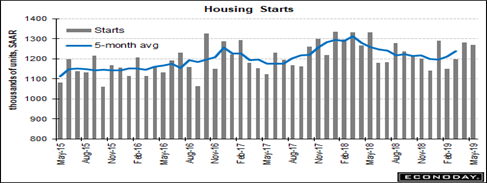
Privately‐owned housing starts in May were at a seasonally adjusted annual rate of 1,269,000, said the Census Bureau. This is 0.9 percent (±12.9 percent) below the revised April estimate of 1,281,000 and is 4.7 percent (±8.9 percent) below the May 2018 rate of 1,332,000. Single‐family housing starts in May were at a rate of 820,000; this is 6.4 percent (±9.5 percent) below the revised April figure of 876,000.

Single-family homes starts were actually very weak in May, in other words, for a 12.5 percent year-on-year decline, as I said. Multi-units, in contrast, are up a yearly 13.7 percent at a 449,000 rate.

So it really looks like more new households are opting to rent, even with record-low interest rates. What else can they do with fewer purchasing options? One problem highlighted by Ms. Riquier is current homeowners are staying longer in their residence, thus reducing the housing supply—up to 10 years in recent surveys, says Riquier, vs. staying put for the more normal average 4 years before moving on..

It sounds like we need those record-low interest rates to keep the housing market alive. All the predictions are they could even go lower this year, but for how long?

Harlan Green © 2019

Follow Harlan Green on Twitter: https://twitter.com/HarlanGreen

Posted in Consumers, Housing, housing market, Weekly Financial News | Tagged , , , | Leave a comment

Answering the Kennedys’ Call to Promote Greater World Peace & Freedom

Introduction

jfk

I was one of 88,000 wide-eyed, mostly white, middle class students that came to hear President John Kennedy speak on March 23, 1962 in Berkeley, California to commemorate the 94th anniversary of the University of California’s founding. We wanted to see and hear what our future might look like. We were ready to believe in Kennedy’s vision that the cold war with Russia could end and lead to more peaceful collaborations.

“…The processes of history are fitful and uncertain and aggravating,” said Kennedy that day. “There will be frustrations and setbacks. There will be times of anxiety and gloom. The specter of thermonuclear war will continue to hang over mankind; and we must heed the advice of Oliver Wendell Holmes of “freedom leaning on her spear” until all nations are wise enough to disarm safely and effectively.”

We need such leaders as JFK with his unifying vision of cooperation over confrontation even more today. That is the most important question for me, a person who lived through the social upheavals and activism of those days. For if we do not find ways to grow that idealism to make the world a better place for all—both social and economic change that will preserve a livable planet and prevent future wars—then I cannot see a hopeful future.

Recognizing the many ways such a spirit of service is restoring communities and hope for a better future is the reason for this essay. In fact, the sense of community and common purpose that prevailed in the sixties via new technologies and shared values in community-building and peace-making is the path that can restore our faith in western democracies imperiled by the rise of authoritarian governments and immensely wealthy oligarchs.

Leaders have emerged in the upcoming presidential election—Senator Elizabeth Warren’s fight to curb Wall Street excesses, Senator Sanders call to right record income inequality—but they are leaders of factions fighting injustices without a unifying vision to bring younger Americans in particular together to make the changes that might save their future, as well.

One 30 year-old in 2013, 50 years after President Kennedy’s death, said “Though his goals were typically big, what he sought from individuals was often rather small. Not everyone was expected to join the Peace Corps or become an astronaut or participate in the Freedom Rides. But citizens were asked to do their part — to think about how they could improve their community or make another person’s life easier — to look past their differences and focus on our common humanity. We badly need this message again. I believe it is one that resonates very deeply with young Americans who are yearning for a time when we can search for new frontiers and once again be part of the same team.” https://www.huffingtonpost.com/scott-d-reich/jfk-millennials_b_4263057.html

Many of us followed paths of alternative service, of selfless service that I learned was the shortest path to inner peace, as well as peace among communities and nations. President Kennedy’s most famous words memorialized worldwide were in his inaugural speech—“Ask not what your country can do for you, ask what you can do for your country.”

JFK gave us the picture of a new future on that beautiful March day in Berkeley, Kennedy promised a peaceful settlement to the cold war with Russia, of scientific research and alternatives for peaceful service that could benefit all nations; while joking that Jackie was having all the fun riding on an elephant in India with Ambassador John Kenneth Galbraith.

“Yet we can have a new confidence today in the direction in which history is moving,” Kennedy continued. “Nothing is more stirring than the recognition of great public purpose. Every great age is marked by innovation and daring–by the ability to meet unprecedented problems with intelligent solutions. In a time of turbulence and change, it is more true than ever that knowledge is power; for only by true understanding and steadfast judgment are we able to master the challenge of history.”

We did not know that the Cuban missile crisis would happen in just seven months—October 16-28, 1962—that could have turned into a nuclear war, if Kennedy and Russian Prime Minister Nikita Khrushchev had not negotiated a peaceful resolution.

JFK’s words may sound like the voice from a distant past to those who have lost their faith in service of any cause, when there is no general prosperity, or hope of a more peaceful post-9/11 world. Treaties are being ripped apart, and allies shunned that would maintain peace because there is no longer a national vision of one for all and all for one.

His vision of a new frontier of possibilities began an era of higher technological growth that has brought the world’s citizens closer together, of global warming threatening cities and countries causing mass migrations, of greater economic cooperation accompanied by greater income inequality in a revolution that hasn’t yet benefited the majority of its citizens.

Keeping that spirit alive is a daunting challenge, needless to say. Today we have a young population that is generating new, diverse communities having survived generational wars between red and blue states, between young and old ages, rich and poor regions that will find their own leaders.

John F Kennedy, Bobby Kennedy, Martin Luther King, Jr., and Cesar Chavez were leaders that gave our generations hope for greater equality and liberty in a new frontier of possibilities. It was a time when communities of the political and economic classes had a consensus that progress was possible, movements formed that swept one up in causes much larger than the individual—the environmental movement, anti-war, or non-violent civil rights’ protests, and a farmworker movement that advanced minority and immigrant rights.

The boundless optimism that Americans such as myself believed could accomplish anything, solve any problem is needed as much today because of the terrible cost of continuing wars, the drug culture, and those regions of America that no longer believe they live in the United States of America.

We of the so-called silent and baby boomer generations dealt with similar obstacles by looking at what we had in common; that we are all created equal, regardless of race, gender or ethnicity, and desired the best for ourselves, our families and communities.

This is important because younger generations; like the 30-year old millennial on the 50th anniversary of JFK’s death; say they want to continue to work. Studies show they wish to make the world they have inherited a better place to live. Their preferences will be influential for no other reason than they are the largest generation ever, born from 1980 to 1996, outnumbering even their baby boomer parents. They are also a much more diverse and tolerant population, which is why they are picking up where we left off in their preference for making worthwhile life choices..

“Almost two-thirds (64 percent) of millennials said they would rather make $40,000 a year at a job they love than $100,000 a year at a job they think is boring,” the Brookings Institution recently noted in a report by Morley Winograd and Michael Hais titled “How Millennials Could Upend Wall Street and Corporate America.”

It cites a 2013 survey of over 1,200 U.S. adults that found Millennials to be the generation most focused on corporate social responsibility when making purchasing decisions.

Almost all Millennials responded with increased trust (91 percent) and loyalty (89 percent), as well as a stronger likelihood to buy from those companies that supported solutions to specific social issues (89 percent). A majority of Millennials reported buying a product that had a social benefit and 84 percent of a generation that accounts for more than $1 trillion in U.S. consumer spending considered a company’s involvement in social causes in deciding what to buy or where to shop. In 2013, 89 percent of all American consumers said they would consider switching brands to one associated with a good cause if price and quality were equal. https://www.brookings.edu/wp-content/uploads/2016/06/Brookings_Winogradfinal.pdf

“The sixties was a period of monumental social and political change, altering virtually every aspect of American life for future generations,” touts a popular CNN documentary film, The Sixties. “No other decade of the Twentieth Century has acquired the mythological status of the 1960s,” said British Historian M J Heale in his book, The Sixties in America, (2001, Edinburgh University Press Ltd, Edinburgh, UK).

The United States had already been through World War II, the Korean War, and was under the threat of nuclear annihilation in a Cold War with the Soviet Union. Yet it was also a period of unprecedented economic and social growth, when many believed in a better future—not only for U.S. citizens, but those in the developing world.

America’s annual economic growth rates in the sixties equaled that of China and the fastest-growing, developing countries today. Annual U.S. Gross Domestic Growth rates—our best measure of national business activity—were as high as 8.9 percent in 1950, and consistently higher than 6 percent through most of the 1960s. Median family incomes grew 214 percent from 1945 to 1975, and haven’t grown faster than inflation since 1975.

It was also a time of protest against all forms of authority—against loyalty oaths that foreswore radical beliefs, against segregation in the schools and workplaces, and a government continually at war. The anti-war protests created Rock-n-Roll music and Bob Dylan; who was a poet as well as a musician that portrayed the times many Americans were living through. He warned of the hardships ahead, as had his mentor, Woody Guthrie, the dust-bowl folksinger who sang for those dispossessed by the Great Depression.

Dylan songs such as Blowin in the Wind portrayed a land without peace: “how many deaths will it take ’till he knows that too many people have died?” and a rebellion against the old order in The Times They Are a-changing when: “your sons and your daughters are beyond your command.

Then the euphoria was gone almost as quickly as it came; times had changed; but not for the better for many in America. Good paying jobs began to disappear; energy shortages and soaring inflation caused deep recessions.

Younger Americans now must deal with a world that seems to have limited possibilities, with the greatest income inequality in the developed world—which means today’s children may not be able to earn more than their parents. Studies show that only half the children born in the 1980s grew up to earn more than their parents. That’s a drop from 92 percent of children born in 1940. They also face a faster, more competitive world with challenging opportunities.

The larger economic picture is that successive recessions since the 1970s have led to catastrophic drug use and high suicide rates in regions of blue-collar America that lost entire industries due to modern economies charging ahead at warp speed. Blue-collar, high school educated Americans once earned enough to enter a middle class standard of living that meant homeownership and upward mobility.

The economic death of these regions has resulted in an un-civil war between its inhabitants that has torn apart communities and created a dysfunctional national government unable to meet the urgent needs that modern times require. The overall health and well-being of Americans has declined; Americans are no longer the tallest people, live the longest, are the best educated in the developed world.

Workers have had to travel farther and move more frequently in search of a decent paying job, and better education. Social scientists such as Harvard sociologist Robert Putnam have studied the breakup of communities in his best-selling book, Bowling Alone, The Collapse and Revival of American Community. “Once we bowled in leagues, usually after work—but no longer,” he said in his portrayal of our fractured society. 

Yet it is possible to rebuild broken communities in such difficult circumstances. The loss of national consensus—which at heart is the belief that Americans share common interests and goals—is at the bottom of most of our problems. It is the antithesis of a well-functioning democracy.

President Kennedy’s speeches moved us because nuclear annihilation was always in the back of our minds. I had read Nevil Shute’s 1957 novel On the Beach. It was a terrifying tale of Australians awaiting the arrival of a deadly radiation cloud spawned by a nuclear war. World War III had just devastated most of the populated world, polluting the atmosphere with nuclear fallout and killing all human and animal life in the Northern Hemisphere. 

The icon of that age was the Peace Symbol designed by Gerald Holcomb, a British conscientious objector in despair over the possibility of nuclear annihilation. He is said to have combined naval signal semaphore codes of N with D that stood for Nuclear Disarmament into the symbol we know today. And perhaps because of the threat of nuclear annihilation hanging over us, we preferred to make love rather than war.

What could be more disheartening than the disappearance of all life? We also lived through the anti-communist witch hunts of the McCarthy era that resulted in the House of Un-American Activities Commission hearings to weed out communists and other subversives, even though membership in the American Communist Party was legal.

But those problems could be solved, because so many believed the cold war and wartime institutions were based on outmoded beliefs and ideologies, as do the young today. Wars were fought because governments saw a world of scarcity, and conflict the only solution. The U.S. with just five percent of the world’s population maintained a large military in order to have access to 25 percent of the world’s resources; such as oil.

That is why many of my generation believed in President Kennedy’s vision of a new frontier of possibilities for peaceful coexistence. All things are possible with the spirit and mind-set that enabled us to serve causes that bettered the lives of others, as opposed to the ‘me first’ narcissism so prevalent in much of American culture today. This dedication to service in peaceful ways was first realized in President Kennedy’s call to form the Peace Corps, where I and more than 200,000 have served.

Brother-in-law Sargent Shriver, the first Director of the Peace Corps and many Great Society programs, added to that vision with his call to service above self, the Peace Corps credo, if one wanted to work to create a more peaceful and just world.

In his acceptance speech at the 1960 Democratic National convention, Kennedy said, “We stand today on the edge of a New Frontier — the frontier of the 1960s, the frontier of unknown opportunities and perils, the frontier of unfilled hopes and unfilled threats. Beyond that frontier are uncharted areas of science and space, unsolved problems of peace and war, unconquered problems of ignorance and prejudice, unanswered questions of poverty and surplus”

President Kennedy also benefited the poor and seniors by signing social legislation raising the minimum wage and increasing Social Security benefits. He heard Martin Luther King Jr.’s call for greater justice for African Americans by ordering his Brother and Attorney General Bobby Kennedy to protect the freedom riders in the South supporting James Meredith’s attempt to enroll at the University of Mississippi.

This work in service is even more important today for the underserved. A better future for young and old is possible because of the lessons we learned; such as the non-violent tactics of Gandhi and Martin Luther King advocating peaceful coexistence. Cesar Chavez’s farm workers adopted those tactics as well, which promoted greater inclusivity and fairness among all races and ethnicities.

Working in service to higher ideals can be a spiritual quest. I learned the basic elements needed to build and strengthen communities because of the opportunities to work as a Peace Corps volunteer, with the US Environmental Protection Agency and Cesar Chavez’s United Farmworkers Union. Implementing the community development principles first realized in those earlier efforts leads to a better understanding of how to organize our own communities and provide aid in other parts of the world that gives them the tools to develop their own communities.

Domestically, we have made progress in confronting some of the inequities of race and color, yet American society is still recovering from a Great Recession; the worst economic downturn since the Great Depression that has yet to benefit the majority of Americans. There is much more that needs to be done to aid the financial recovery of Main Street households, rather than Wall Street financiers. How much time do we have? The Great Depression of the 1930s lasted ten years and didn’t fully recover until World War II.

There are solutions to what may seem like unsolvable problems that came out of that era. The sixties brought out the best and worst of America, because it was a time of transformation; of new-felt social freedoms from old customs and cultures, greater civil rights, the environmental and peace movements. There were also the darker days of Vietnam, the assassinations of JFK, Bobby Kennedy, and Martin Luther King; which caused many Americans to lose faith that change could be beneficial, or even possible.

The differences between those who see a world of limited wealth and unlimited possibilities is understandable when looking at the growing disparities that have disenfranchised large parts of the Midwest and south—whose citizens tend to blame government for their problems, when in fact these states are most dependent on government aid due to their high levels of poverty.

The debate over who benefits from western countries’ capitalist model hasn’t been resolved between the followers of Adam Smith, who saw self-interested behavior as the path to a general prosperity, and Lord John Maynard Keynes’ model of shared wealth via government programs and regulation that was the basis of the New Deal.

Yet there is no country that hasn’t adopted some elements of the capitalist model with all its deficiencies because it is able to generate almost unlimited wealth—for the few, in many cases.

In fact, we no longer live in a world of scarcity with limited resources that was a basis for the eye-for-an-eye belief system Mahatma Gandhi opposed with his tactics of non-violent protest. Survival of the fittest in a world of brutal competition was the life earlier hunter-gatherer and tribal societies faced, as described by evolutionary psychologist Steven Pinker in his best-seller, The Better Angels of Our Nature.

This is no longer the case, even in the developing world. Our modern, technological economies of almost endless innovation and invention have created the possibility of a world of super-abundance, but not how to share it equitably. In fact, many of the most developed countries, including the U.S., are suffering from the effects of overabundance—obesity, high rates of infectious diseases, cancer, higher suicide rates and the overuse of drugs.

A world of super-abundance is more suited to win-win outcomes, a term used in conflict-resolution and business negotiations. It is the opposite of a winner-take-all, win-lose mentality, because the possibility of a non-confrontational solution enables both sides to benefit in some way. That’s easy to see in limited purchase transactions between a buyer and seller, but not in more complex conflicts involving national entities.

All can profit from such abundance, as we find better ways of sharing this wealth. The sixties world believed in a sharing society, even though we had nothing like the super-abundance modern technology has provided. Only a more sharing and caring society can bring about greater peace and less conflict.

Many new developments are helping to solve the inequities generated by the enormous changes—including a new understanding of financial behavior that can mitigate the frequent recessions and growing inequities of the past four decades. It relates to implementing systems that encourage economic cooperation over competition; systems like the Green New Deal that younger leaders are beginning to propose during this presidential election season.

The U.S. became the technology leader in the sixties, a goal that President Kennedy first set at the beginning of his Presidency. We are the first (and only) nation to land on the moon, explore Mars, and send satellites beyond our solar system. But we are just beginning to develop the environmental and health sciences to create a safer, more predictable world, such as new alternative energy sources that help to mitigate the effects of global warming from the overuse of fossil fuels.

And we still fight among ourselves and in foreign wars. This is while earth’s temperature continues to rise; and why it is so necessary to participate in the efforts to restore communities, as well as strengthen organizations that seek a peaceful resolution to the environmental crises and decreased opportunities for the less fortunate.

Such efforts are succeeding because the legacies of those leaders we lost continue to resonate with the best of America. The Kennedys and King instilled the belief that service above self is more important than self-interested behavior underpinning today’s consumer-driven society of unmet wants and needs. They called for participating in the building of a more universal community that transcends loyalty to ethnic origins and political parties.

Writers from M Scott Peck to President Barack Obama since then have touted the importance of community development in bringing people together to accomplish what cannot be done individually.

A well-functioning community is able to live within the normal boundaries of peaceful coexistence. There are the usual disputes, but ways are found to compromise among the factions because a common sense of mission gives them the will to coexist, rather than become polarized into immovable opposites.

The agents of change usually include individuals that believe diversity is an essential component uniting a community or organization. This is what motivates volunteer organizations such as the Peace Corps, and Rotary International that focus on service above self in the poorest communities and countries.

The recent proliferation of non-governmental organizations (NGOs) also helps to address poverty and wealth-sharing issues in the U.S. and underdeveloped world. Rotary International’s 35,000 clubs have 1.2 million members in some 150 countries that include national leaders. More than 23,000 domestic community and non-profit organizations nurture local initiatives to further community goals and aspirations in the U.S.

The National Collaboration for Youth, an interagency council of the nation’s 50 major youth-serving organizations, notes that its member agencies serve more than 40 million young people each year, making this system second only to the public schools in the number of youths served annually. Indeed, nearly 50 percent of eighth graders in the nationally representative sample surveyed by the U.S. Department of Education reported participation in programs sponsored by one of these groups.

There are also more than 36,900 such youth organizations, according to Guidestar.org’s web database, including such long-standing programs as 4-H, Boy Scouts, Girl Scouts, Boys and Girls Clubs, YMCA, YWCA, Girls Incorporated, Camp Fire, Big Brothers/Big Sisters, and Junior Achievement. These organizations are creating the leaders of tomorrow who will bring order to the seeming chaos brought about by the sixties’ tsunami of youthful energy that swept all before it.

How much time is left for Americans to come together in a more peaceful and caring way, a way that allows greater peace of mind and freedom of expression of our better angels? How much time do we have before 50 percent of Miami is under water; hurricanes and cyclones devastate whole regions and even countries, and North Korea or an as yet unknown terror group unleashes a nuclear weapon?

In reality, there are many methods of sharing that would mitigate the effects of growing populations and a changing climate—such as better trade agreements between the developed and developing countries, and the new Paris Accord to reduce global warming that the U.S. and Syria continue to oppose.

How do we build a world community that lives in shared values and recognizes common aspirations? It will take patience and a determined effort to find commonalities between the various races and religions, yet we all belong to Homo sapiens—the one species in charge of Planet Earth. Recognizing those commonalities will provide the vision of that new frontier of possibilities we glimpsed in the sixties; and which inspired many of us to find a path that leads to a better place for America and the world.

We know how much President Kennedy’s vision influenced other countries as well as our own from the countless memorials that honor him. They help to remind us what needs to be done, as much as what has been done. It will happen as the newer generations find their call to serve, just as we found ours.

Harlan Green © 2019

Follow Harlan Green on Twitter: https://twitter.com/HarlanGreen

Posted in Uncategorized | Tagged , , , , , , , , | Leave a comment

How to Provide More Housing For Everyone?

ANSWERING THE KENNEDYS’ CALL

image

thelundreport.org

I said in an earlier column “that part of the solution to the housing and homeless crisis has to be the responsibility of governments.” But the Silicon Valley giants Google, Apple, and Washington State’s Microsoft are finding it necessary to also boost housing supply, for no other reason than to make it affordable for their employees being priced out of their own markets.

San Francisco’s median home price has reached $1.5m, for instance, In January, the Chan Zuckerberg Initiative, the San Francisco Foundation, Facebook, Genentech, and others announced a new $500 million fund to build or preserve more than 8,000 homes in five Bay Area counties over the next five to 10 years, reported the San Jose Mercury News.

And Microsoft has committed $500 million to build affordable housing and tackle homelessness in the Seattle area, while Wells Fargo recently said it would spend $1 billion for affordable housing as part of a broader national philanthropic push.

But Google, said in a blog post cited by the Mercury News it would spend $750 million to build housing on its own land. Aimed at freeing up space for 15,000 homes, the  process could take up to 10 years. Google would work with cities to rezone land that is mostly designated now for office or commercial uses. In 2018, 3,000 homes were built in the South Bay, Google noted.

Regarding the homeless crisis, a recent Project Syndicate article by UC Berkeley economist Laura Tyson, and Lenny Mendonca, Chairman of New America, highlighted just how much government support will be needed to take some of the half million homeless off the streets, a number that has grown sharply just since 2017 as housing rents and prices have soared with the economic recovery.

According to the U.S. Department of Housing and Urban Development (HUD), there were roughly 554,000 homeless people living somewhere in the United States on a given night last year. “A total of 193,000 of those people were “unsheltered,” meaning that they were living on the streets and had no access to emergency shelters, transitional housing, or Safe Havens. Despite a booming stock market and strong economic growth, a large swathe of America is still struggling to make ends meet.”

Affordability is the real problem. “Of 3,007 counties in the US, a worker earning the federal minimum wage of $7.25 per hour can afford a one-bedroom rental in only 12,” said Project Syndicate. “In San Francisco, where the median house price is over $1.5 million, a single mother earning the minimum wage would have to work 120 hours per week to meet her basic needs. And even outside of high-cost regions, nearly two-thirds of US households lack the savings to cover a $500 shock such as a car repair or health-care expense. For these families, one bad turn can result in homelessness.”

The most common-sense solution would be to build more homes for all socio-economic strata, but surveys have shown that a majority of the home owning public thinks in NIMBY (Not-in-My-Backyard) terms; which means the most affordable housing is being built on least-desirable land usually far from population centers.

StrongTowns.org is one such advocate and clearing house for the building of affordable housing under its Mission Statement: “For the United States to be a prosperous country, it must have strong cities, towns and neighborhoods. Enduring prosperity for our communities cannot be artificially created from the outside but must be built from within, incrementally over time.”

For instance, California would need to build around 180,000 more new housing units each year – about 100,000 more than are currently being built – just to keep up with population growth. Since 2010, eight times as many jobs as housing units have been added in San Francisco, where the average cost of building “affordable apartments” has jumped to $425,000. King County, Washington, which includes Seattle, estimates that it would need 14,000 more units to house its homeless population.

Not providing lodgings and services for the homeless can be even more expensive. There are many studies that show how costly it can be to leave the homeless on America’s streets; as much a two times the cost of providing shelter when healthcare and other public costs are incurred.

Many local and state governments have developed what have been called ‘Housing First’ programs to help subsidize the 30 percent of homeless with mental illnesses in particular. Chronically homeless people are regular visitors to emergency rooms, and each visit results in a hefty bill. They also frequently use mental health and addiction treatment services and tend to rack up arrests, leading to costly jail terms.

“Housing First is a homeless assistance approach that prioritizes providing permanent housing to people experiencing homelessness, thus ending their homelessness and serving as a platform from which they can pursue personal goals and improve their quality of life,” said its program statement. “This approach is guided by the belief that people need basic necessities like food and a place to live before attending to anything less critical, such as getting a job, budgeting properly, or attending to substance use issues.”

Philip Mangano, the former homelessness policy czar under President George W. Bush was an early government official that had the foresight to expand housing-first programs — with federal dollars behind them — into cities around the country.

Using data from the 65 cities — of all different sizes and demographics — the cost of keeping people on the street added up to between $35,000 and $150,000 per person per year, said Mangano.

One lack that has yet to become part of this conversation is the dearth of alternative transportation modes that service the Bay Area. Even BART the SF Bay Area’s sole rapid transit system, has yet to encircle the Bay that would connect it to Silicon Valley, which means congested freeways for years to come, and more than 2 hour commutes to Silicon valley jobs for those that live in the more affordable housing market outside the Bay Area.

We must find a way to care for the homeless and those rendered hopeless by the Great Recession, loss of good-paying jobs and record income inequality that has now lasted decades. Or, the richest country on earth risks becoming the poorest provider of care for our citizens, and caretaker of our democracy.

Harlan Green © 2019

Follow Harlan Green on Twitter: https://twitter.com/HarlanGreen
Posted in Consumers, Economy, Housing, housing market, Politics, Weekly Financial News | Tagged , , , , | Leave a comment

Who Pays For the Tariff Wars?

Popular Economics Weekly

It’s unfortunate that we have to keep returning to the most unpleasant of topics— higher taxes. But that’s what the White House is doing with their various Chinese, Mexican, and European tariffs. They seem to be waging an economic war with most of the world; on top of implementing N Korean, Iranian, and Russian sanctions.

Americans pay for it in the end, since it raises the price of items; particularly imports that are taxed as they enter the U.S.  But U.S. exports are also taxed by those same countries in retaliation for our tariffs.

There’s a precedent for the damage such uncoordinated actions cause (i.e., unilateral actions without coordination with allies). The Smoot-Hawley Tariff act of 1930 (also engineered by a Republican administration) taxed imports thus raising their prices and helping to precipitate the Great Depression. There were many other causes as well—record income inequality, and a Federal Reserve that then began to restrict credit with falling prices.

Sound familiar? It’s scary when such histories repeat themselves—mostly out of ignorance of the lessons. And now, an expanding body of research has found that the most recent tariffs has mostly fallen on U.S. consumers and businesses

One of the latest papers published on the topic and cited by a CNBC report, is with economics researchers from the International Monetary Fund, Harvard University, University of Chicago and the Federal Reserve Bank of Boston. “Using price data collected at the U.S. borders and at retailers, the researchers found “nearly complete pass through of tariffs” to America. In other words, little cost is falling on the Chinese manufacturers,” said the CNBC report.

The Harvard report said the Trump administration has imposed import tariffs ranging from 10 to 50 percent on goods including washing machines, solar panels, aluminum, steel, and roughly $250 billion of goods from China. In response, Canada, China, the European Union (EU), and Mexico have imposed retaliatory tariffs. On a scale not seen since the 1920s, the world’s largest economies have passed measures making it far more costly to buy goods from each other.

image

This is frightening, not just because it brings back memories from the Great Depression. Isn’t that also one definition of insanity, doing something over and over again, yet expecting different results?

It is partially the fault of congress that hasn’t pushed back, or authorized legislation that opposes such actions the White House says are “in the interest of national security,” when most of the tariffs are being enacted against our allies, and therefore increase the threat to national security.

In fact, it is the tariffs themselves that pose the greater danger to future growth. We are in the tenth year of the soon-to-be longest economic recovery ever, while interest rates are plunging and nervous investors rush to safe havens like Treasury securities; and restrict their spending, while corporate profits are declining.

This shouldn’t be the time to create more economic uncertainty, in other words, when we are nearing the end of the longest economic expansion in our history.

Harlan Green © 2019

Follow Harlan Green on Twitter: https://twitter.com/HarlanGreen

Posted in Consumers, Economy, Macro Economics, Politics, Weekly Financial News | Tagged , , , | Leave a comment

Saving Capitalism—Part II

Popular Economics Weekly

Nobel laureate Joseph Stiglitz’s plea to save capitalism is important for a number of reasons; foremost is the survival of liberal democracy itself. Modern liberal democracies that we have known since WWII cannot survive if we cannot ‘fix’ modern capitalism to serve the majority rather than minority of its citizens.

“There are many reasons for our plight, including corporate power and greed centered on immediate profits and little regard for the impacts business decisions have on low-income Americans and the environment,” said Stiglitz. “Corporations have translated their economic power into political power, lobbying for policies that give them free rein to despoil the environment; and the swamp President Donald Trump promised to drain has been overflowing.”

It cannot survive without greater government programs to improve lives, and better control of financial markets, advantages that countries like China, the world’s second largest economy, have in competing in world markets for resources, and winning trade competitions.

One answer is what is called Modern Monetary Theory, or MMT, that both progressives and conservatives are talking about. It’s really a reincarnation of the New Deal that enabled America to pay for the Great Depression and WWII with a large amount of government debt, without raising taxes at the time that would have impeded economic growth.

Conservatives have railed against versions of MMT since Roosevelt and his Labor Secretary Francis Perkins created the New Deal—giving millions of jobs to jobless Americans, creating the social safety net and much of the early infrastructure (dams bridges, energy grids) that need updating today.

But it’s now become obvious from their 2017 tax cuts that Republicans love debt as much as anybody when it suits their purpose.

image

Barrons.com

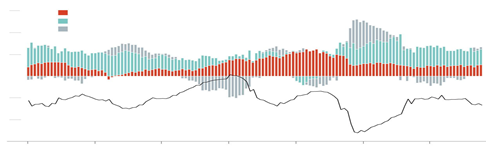
Conservative publication Barron’s Magazine portrays in this graph from 1985 to 2016 the actual U.S. net savings as a percentage of GDP. It highlights the wide fluctuations in the line graph—when there were 4 years of federal budget surpluses 1996-2000 (midgraph), to the low point in net savings during the Great Recession. Foreign net savings are in red, domestic household and business net saving in blue and gray.

MMT is being touted as a possible way to pay for AOC’s Green New Deal, universal health care and other Democratic initiatives that will create jobs for all.

But debt has to be paid back in one form or another. In post-WWII economies, 1) it does get paid back if used in advancing growth that increases revenues, and 2) debt is extremely cheap today with the world awash in excess savings that investors are begging to place where it will give a decent return. Financing U.S. budgets with ‘other people’s money’ is not so risky when there’s no safer place to put it than in U.S. dollar investments.

WWII’s 120 percent of GDP debt was paid down to less than 40 percent in the post-war years with massive growth and productivity-enhancing investments like public highways, the Internet, modern healthcare improvements and government basic research.

We are in a much better position today with a fully-employed economy. But it does subject investors to the vagaries and vacillations of the Treasury bond market, which is the safest haven for investors afraid of an economic downturn that could crater stock prices.

Democracies are also in danger with authoritarian governments springing up in Eastern Europe using Russia and China’s authoritarian examples that control the courts and public media to maintain their power.

However modern capitalism with its checks and balances has enabled the growth of prosperous middle classes at the heart of liberal democracies. No other economic system is able to produce the quantity of goods and services required for a healthy liberal democracy.

Radosław Sikorski, Polish Minister of Foreign Affairs, speaking of recent anti-democratic trends in Eastern Europe at the Wrocław Global Forum, an annual summit organized by the Atlantic Council, the city of Wrocław, Poland, and other partners, noted a startling fact–there is a common assumption that dictatorships may be better at some economic tasks because they do not have to pay attention to public opinion. Yet communist governments in Central and Eastern Europe failed to live up to that supposed economic advantage.

Sikorski explained, “My thesis is this: contrary to received wisdom, dictatorships also have public opinion and dictatorships are usually more cowardly than democrats. That is why fundamental economic reform under dictatorships – in Chile for example – is the exception, not the rule. It is usually the democrats who have to tidy up the mess, including economic mess, left by dictatorships.”

The club of rich democracies is not easy to join, per a recent piece in the Economist, but those who get in tend to stay there. Since the dawn of industrialisation, no advanced capitalist democracy has fallen out of the ranks of high-income countries or regressed permanently into authoritarianism.

This is not a coincidence, say Torben Iversen of Harvard University and David Soskice of the London School of Economics, in their recent book, “Democracy and Prosperity”. Rather, they write, in advanced economies democracy and capitalism tend to reinforce each other, as I’ve been saying. It is a reassuring message, but one that will face severe tests in years to come.

What are those tests? The largest may be how to grow an economy that benefits more of the middle and lower-income classes with greater government-funded programs, such as happened with the New Deal. That obviously hasn’t been the case since 2009 and the recovery from the Great Recession. It is already being tried successfully in many Northern European countries that reward its citizens with a larger social safety net, shorter working hours, and more leisure time.

Professor Stiglitz, Torben Iversen, David Soskice and a growing number of economists show just how liberal democracies have survived multiple wars and global recessions; by modernizing capitalism to fit modern needs. Perhaps “capitalism is the worst economic system, except for all the others,” to paraphrase Winston Churchill’s famous aphorism.

Harlan Green © 2019

Follow Harlan Green on Twitter: https://twitter.com/HarlanGreen
Posted in Economy, Keynesian economics, Politics | Tagged , , , , | Leave a comment

How Strong is 2019 Housing Market—Part II?

The Mortgage Corner

image

FRED

We asked just how strong is the housing market last month with rates beginning to fall again. Lawrence Yun, NAR’s chief economist, said he is not overly concerned about the trending drop in existing-home sales reported in May.

“First, we are seeing historically low mortgage rates combined with a pent-up demand to buy, so buyers will look to take advantage of these conditions,” he said. “Also, job creation is improving, causing wage growth to align with home price growth, which helps affordability and will help spur more home sales.”

And so-called ‘house-flipping’ (homes sold that are owned less than 2 years) is up, meaning housing prices have risen enough that homebuyers are beginning to buy homes they intend to sell in less than 2 years; which also happened in early 2000s when the housing bubble took off. Speculators are hoping to make a quick buck, in other words, as there is a rather severe lack of available inventory in the affordable and mid-price ranges.

That has left a big market for rehab specialists who can get their hands on physically distressed or out-of-date properties for peanuts. The median sales price of flipped homes during the first quarter was $215,000, according to Attom Data Solutions, a real-estate information firm.

ATTOM Data Solutions just released its Q1 2019 Home Flipping report and found that 7.2 percent of all home sales during the first quarter reached a new high flipping rate, the highest since Q1 2010. The 7.2 percent flipping rate is up from 5.9 percent in the previous quarter and up from 6.7 percent a year ago. However, while flippers are flipping, gross profits are stumbling.

“Homes flipped in Q1 2019 sold at an average gross profit of $60,000, down from an average gross flipping profit of $62,000 in the previous quarter and down from $68,000 in Q1 2018 to the lowest average gross flipping profit since Q1 2016’” said the report.

image

attomdata.com

This is further evidence of the lack of affordable housing inventory, even though sales of previously-owned homes have fallen in three out of four months this year. However new-home sales are running about 7 percent higher than last year’s pace, says MarketWatch’s Andrea Riquier. This is while home prices accelerated in April for the first time in a year.

Mortgage applications increased 26.8 percent from one week earlier. Refinance applications are up 48 percent and purchase applications up 20 percent without seasonal adjustments, according to data from the Mortgage Bankers Association’s (MBA) Weekly Mortgage Applications Survey for the week ending June 7, 2019.

Mortgage rates for all loan types fell by a sizeable margin for the second straight week, pulled down by trade tensions with China and Mexico, the financial markets reacting to more bearish communication from several Fed officials, and weaker than expected hiring in May,” said Joel Kan, MBA’s Associate Vice President of Economic and Industry Forecasting. “Despite the less positive outlook, both purchase and refinance applications surged, driven mainly by these lower rates. The refinance index jumped 47 percent to its highest level since 2016.”

No wonder, as the 30-year conforming fixed rate is holding at 3.50 percent for less than a 1 pt. origination fee, as interest rates are back to historic lows last seen during the Fed’s QE programs, as I said. The super-conforming fixed rate with loan amounts to $625,500 also now available at 3.50 percent.

Harlan Green © 2019

Follow Harlan Green on Twitter: https://twitter.com/HarlanGreen

Posted in Housing, housing market, Weekly Financial News | Tagged , , , | Leave a comment