Budget Deficits With the Laffer Curve

Financial FAQs

image

Wikipedia

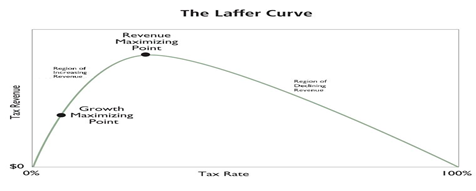
There is an economic theory of sorts that helps us to understand why our political parties can’t agree on how to grow an economy that benefits most Americans. It’s called the Laffer Curve, reputedly first drawn on a napkin by doctoral student Arthur Laffer in a meeting with Dick Cheney, President Ford’s Chief-of-Staff in the 1970s.

Laffer basically claimed that raising taxes was harmful to economic growth, and his pretty picture convinced conservatives who didn’t like taxes of any kind. His ‘claim’ isn’t true, though it had always been behind conservatives’ call to shrink government spending by cutting taxes. It was the higher maximum tax rates of the 1950s and 60s that enabled the US to build our Interstate highway system and land on the moon, for starters.

But cutting taxes just to enrich certain income brackets, without cutting comparable spending has always resulted in burgeoning deficits, as conservatives certainly know, even if they won’t admit it.

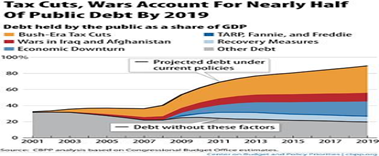
For instance, it purportedly convinced Cheney as GW Bush V.P. that “deficits don’t matter”. Laffer’s claim gave Republicans the cover to lower taxes while increasing spending for President GW Bush’s War on Terror after 9/11, because Laffer asserted it would pay for itself with faster growth. Instead, the Bush tax cuts and increased spending has added a cumulative $4 trillion to the federal debt since then.
image

Washington Monthly

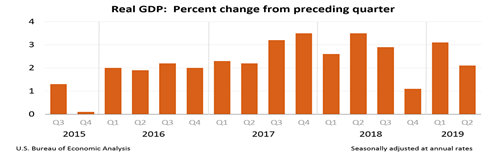
A short spurt of growth happened in 2018 after the 2017 Republican tax cut, but GDP growth is settling back to the 2 percent range that has prevailed since the end of the Great Recession. And there is another consequence—an upcoming $1 trillion budget deficit.

Growth had flagged since 2008 because so many Americans weren’t put back to work, as happened during the Great Depression. Spending was erratic amid continual budget wars between the two political parties impeded productive investments, such as in our badly outmoded infrastructure.

One example: more than one-third of America’s 600,000 plus bridges are badly in need of repair; our energy grid is more than 70 years old and subject to power failures; our drinking water systems are becoming health hazards—Flint, Mich and Newark, NJ are the latest examples; and we have a K-12 educational system that ranks near the bottom of developed countries.

So the Laffer Curve has really done no one good, except to give conservatives talking points with which to maintain the low tax rates of today that have resulted in record federal debt levels.

“There is a strong correlation between cuts in top tax rates and increases in top 1 percent income shares since 1975,” said economists Thomas Piketty, Emmanuel Saez, and Stefanie Stantcheva in a 2011 NBER Working Paper. “But top income share increases have not translated into higher economic growth, consistent with the zero-sum bargaining model.”

The resulting record income inequality from the Laffer-Curve inspired tax cuts has finally reached the same level that prevailed in 1928, and we all know what happened next—the Great Depression.

Harlan Green © 2019

Follow Harlan Green on Twitter: https://twitter.com/HarlanGreen
Posted in Economy, Keynesian economics, Politics, Weekly Financial News | Tagged , , , , , , , | Leave a comment

Housing Sales Higher, % Rates Plunging to Zero?

The Mortgage Corner

image

Calculatedriskblog

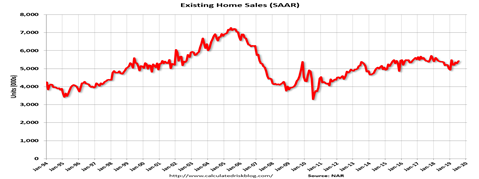
Total July existing-home sales, https://www.nar.realtor/existing-home-sales that include single-family homes, townhomes, condominiums and co-ops, rose 2.5 percent from June to a seasonally adjusted annual rate of 5.42 million in July, according to the National Association of Realtors (NAR). Overall sales are up 0.6 percent from a year ago (5.39 million in July 2018).

image

FRED

It might be that sharply lower interest rates are reviving the housing market. The 30-year conforming fixed rate is now just 3.25 percent for a one point origination fee, the lowest since the Great Recession. This is bringing back more housing in the affordable range for middle-income buyers, but not yet for first-time, entry-level buyers. And there are predictions that interest rates could go lower.

“Falling mortgage rates are improving housing affordability and nudging buyers into the market,” said Lawrence Yun, NAR’s chief economist. However, he added that the supply of affordable housing is severely low. “The shortage of lower-priced homes have markedly pushed up home prices.”

The Pending Home Sales released earlier, www.nar.realtor/pending-home-sales, is a more important indicator of sales’ trend. It is a forward-looking indicator based on contract signings that moved up 2.8 percent to 108.3 in June in the NAR’s pending sales index, from 105.4 in May. Year-over-year contract signings jumped 1.6 percent, snapping a 17-month streak of annual decreases.

Lawrence Yun said the 2.8 percent increase in pending sales can be attributed to the current favorable conditions and predicted the rise is likely the start of a positive trend for home sales.

“Job growth is doing well, the stock market is near an all-time high and home values are consistently increasing. When you combine that with the incredibly low mortgage rates, it is not surprising to now see two straight months of increases,” he said.

Home price appreciation has been much stronger in the lower-price tier compared to homes sold in the upper-price tier, says the NAR, based on the analysis of proprietary deed records data from Black Knight, Inc. and Realtors Property Resource®.

“Homes are selling at a breakneck pace, in less than a month, on average, for existing homes and three months for newly constructed homes,” Yung continued. “Furthermore, homeowners’ equity in real estate has doubled over the past six years to now nearly $16 trillion. But the number of potential buyers exceeds the number of homes available. We need to see sizable growth in inventory, particularly of entry-level homes, to assure wider access to homeownership.”

There is speculation that interest rates might even trend lower, which could continue to boost housing sales, if no recession looms. Harvard economics Professor Kenneth Rogoff said recently that it isn’t out of realm of possibility that more Central Banks might introduce negative interest rate yields, as is already the case in the EU and Japan, to prevent another recession

The Guardian reports that Jyske Bank, Denmark’s third largest, has now begun offering borrowers a 10-year deal at -0.5 percent, while another Danish bank, Nordea, says it will begin offering 20-year fixed-rate deals at 0 percent and a 30-year mortgage at 0.5 percent.

We have come a long way from 1981 when the inflation rate reached 14 percent, and 30-year mortgage rate soared to 18 percent, believe it or not. It is very good news for the U.S. housing market—if our economy continues to perform, that is.

Harlan Green © 2019

Follow Harlan Green on Twitter: https://twitter.com/HarlanGreen

Posted in Consumers, Economy, Housing, housing market, Weekly Financial News | Tagged , , , , | Leave a comment

Will Corporations Become More Responsible?

Popular Economics Weekly

image

Tradingeconomics

It is a sea change in economic thinking when corporate CEOs that belong to the Business Roundtable sign a Statement of Purpose to consider more than maximizing their profits, when maximizing corporate profits at the expense of their employees, social responsibilities, environment, and the public-at-large has been their reigning mindset until now.

They have just announced a Statement on the Purpose of a Corporation, in which they “share a fundamental commitment to all of our Stakeholders”.

The American dream is alive, but fraying,” said Jamie Dimon, Chairman and CEO of JPMorgan Chase & Co. and Chairman of Business Roundtable. “Major employers are investing in their workers and communities because they know it is the only way to be successful over the long term. These modernized principles reflect the business community’s unwavering commitment to continue to push for an economy that serves all Americans.”

While each of our individual companies serves its own corporate purpose, we share a fundamental commitment to all of our stakeholders. We commit to:

  • · Delivering value to our customers. We will further the tradition of American companies leading the way in meeting or exceeding customer expectations.
  • · Investing in our employees. This starts with compensating them fairly and providing important benefits. It also includes supporting them through training and education that help develop new skills for a rapidly changing world. We foster diversity and inclusion, dignity and respect.
  • · Dealing fairly and ethically with our suppliers. We are dedicated to serving as good partners to the other companies, large and small, that help us meet our missions.
  • · Supporting the communities in which we work. We respect the people in our communities and protect the environment by embracing sustainable practices across our businesses.
  • · Generating long-term value for shareholders, who provide the capital that allows companies to invest, grow and innovate. We are committed to transparency and effective engagement with shareholders.

It was in the 1970s that conservative economist Milton Friedman led the charge against Keynesian economics and government regulation that had rescued America from the Great Depression. The New Deal happened because Americans were willing to try anything to bring back jobs during the Great Depression, for fear that capitalism no longer worked.

A 2016 Forbes article described the Roundtable as comprised of 192 CEOs, and one of the most prominent lobbying groups in Washington, D.C. In 2015, the group spent $19.3 million on lobbying, making it the eighth biggest spender that year, according to the Center for Responsive Politics.

Corporate profits have been on a tear for years, reaching a record share of GDP and Gross National Income in 2018 with the corporate tax cuts. What did they do with those profits? Invested it mainly in buybacks to boost share price and CEO incomes.

image

FRED

The result was has been record income inequality, as many manufacturing and other high-paying jobs were exported overseas via the growth of multinational corporations in the name of globalization. The FRED graph above illustrates the growth of corporate profits (blue line) over wages and salaries (red line), particularly since the last two recessions (gray columns).

But now income inequality and corporate social responsibility is in the headlines with the upcoming presidential campaign. Senators Sanders and Warren have been the loudest in calling out corporate “corruption”, a code word for using their power to enrich Wall Street and their stockholders, rather than Main Street.

Is this scaring Big Business enough to fulfill their commitment to serve Main Street, as it did during the Great Depression? The tide seems to be turning, as it is becoming increasingly evident that the record income inequality is causing corporations to rethink the role of capitalism in creating jobs that make America a better place to work and live.

Harlan Green © 2019

Follow Harlan Green on Twitter: https://twitter.com/HarlanGreen
Posted in Economy, Politics, Weekly Financial News | Tagged , , , , | Leave a comment

United We Stand, Divided We Fall

Answering the Kennedys’ Call

image

The day after last Thursday’s DOW Index plunged 800 points, President Trump Tweeted a request that Israel’s Prime Minister Netanyahu block Congresswomen Ilhan Omer and Rashida Tlaib’s visit to Israel and the West Bank.

His action was more than an attempt to distract from economic policies that might be adversely affecting the financial markets. It was just his latest attempt to promote a fear of dark-skinned immigrants, in order to divide and conquer his real or imagined adversaries.

He wanted to stir up as much anti-Islamic sentiment as possible by painting them as the face of the Democratic Party, and Republicans the supporter of Israel, when both political parties staunchly support Israel, the only Democracy in the Middle East.

He is following the precedents of autocratic rulers everywhere that attempt to weaken those that oppose their autocratic behavior. But the United States was founded on the principle that we are equal, regardless of race or creed (though not always in practice).

Patrick Henry, the Revolutionary War patriot, was an early supporter of the United States as a delegate to the Confederate Congresses, though not the Constitutional Convention. His last public speech given in March 1799 said, “Let us trust God, and our better judgment to set us right hereafter. United we stand, divided we fall. Let us not split into factions which must destroy that union upon which our existence hangs.”

The actual proverb, United we stand, divided we fall, is said to originate from an Aesop’s fable of a lion stalking oxen for his dinner, who realize they are only safe by herding together.

England was the predator ‘lion’ at the time that Patrick Henry believed could only be successfully opposed by a United States of America. Modern nations have avoided major conflicts and been kept safe by the same credo since WWII because they were united by alliances.

Any predator—whether a person or country—can only succeed in weakening the U.S. by exacerbating our divisions, whether between Red and Blue states, or white and dark races, or the rich and poor.

And we now have a predator in our White House that wants to instill a fear of immigrants to divide us.

But we can take comfort in what results from predatory behavior. Autocrats seldom last long in the modern world because they lack the one major element in human behavior that has evolved to create modern civilizations—empathy, or the understanding of others that comes from the realization we are all in this together.

Autocracies are considered pariahs by a civilized world, says Stephen Pinker in The Better Angels of Our Nature—Why Violence Has Declined.

In spite of modern populist movements that oppose the migration of darker-skinned populations to more prosperous (light-skinned) countries, the number of democratic countries has risen sharply to more than 90, while the number of autocracies has declined to just 10 in countries with more than 500,000 in population, cites Pinker from a 2009 Marshall & Cole study.

There is a good reason for the growth of modern democracies, continues Dr. Pinker. “Not only are democracies free of despots, but they are richer, healthier, better educated, and more open to international trade and international organizations.”

Democracies make their citizens more prosperous by inducing them to cooperate peacefully rather than quarrel amongst themselves. Patrick Henry’s cry, United We Stand, Divided We Fall, was a plea to oppose any behavior that threatens to weaken the United States of America—whether it is by fomenting trade wars, or culture wars.

Harlan Green © 2019

Follow Harlan Green on Twitter: https://twitter.com/HarlanGreen

Posted in Politics, Uncategorized | Tagged , , , , | Leave a comment

Retail Sales, Consumers Healthy For How Long?

Financial FAQs

image

Consumers now power more than 70 percent of economic activity with the slowdown in manufacturing. Consumers are keeping this economic recovery afloat. There is no question this is because rising incomes and plenty of available jobs have raised consumer confidence, which has now reached skyscraper levels.

“After a sharp decline in June, driven by an escalation in trade and tariff tensions, Consumer Confidence rebounded in July to its highest level this year,” said Lynn Franco, Senior Director of Economic Indicators at The Conference Board. “Consumers are once again optimistic about current and prospective business and labor market conditions. In addition, their expectations regarding their financial outlook also improved. These high levels of confidence should continue to support robust spending in the near-term despite slower growth in GDP.”

The consumer held up second-quarter GDP posting robust and inflation-adjusted annual spending growth of 4.3 percent, according to Econoday, “a mark that would be difficult to match let alone exceed in Q3 but that’s a possibility given the strong jump out of the gate for July retail sales.”

image

Bloomberg

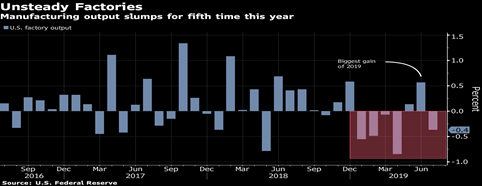
Manufacturing isn’t helping, as the trade wars have hurt exports that are the mainstay of manufactured products. The Federal Reserve report on industrial production showed a weakening in factory output for the fifth time this year, according to Bloomberg:

“It is the latest sign of fragility in the manufacturing sector as goods producers face the persistent headwinds of the U.S.-China trade war and tepid global demand. The latest escalation of U.S. trade tensions with China and renewed recession fears may further depress manufacturing output in the coming months.”

Consumers might continue to spend for the rest of this year if consumer sentiment holds up, as I said last week. The latest JOLTS report (Job Openings and Labor Turnover Survey) says there were 1.65 million more job openings (7.35 million) than the 5.7 million new hires in July.

It’s hard to see this recovery continuing into next year, however. Both consumers and corporations will rush to load up on goods and services during the holiday season with Trump’s postponement of the 10 percent additional tax (oops, I meant tariff) on $300 billion of China’s imports until December 15.

But after December? The rest of the world is hurting with the disruption of world trade from the trade wars and growing protectionism. Erecting barriers to trade is the one surefire way to bring on another recession, as we learned in 1930 with the enactment of the Smoot-Hawley tariff act. Germany’s export-led economy is already teetering on the edge of recession, as is Great Britain with its Brexit stalemate.

Another sign of hurt is the continuing plunge of the 10-year US Treasury bond yield to 1.57 percent this morning, while former Fed Chair Greenspan recently said there is no limit to how low it can go.

It is not a sign that investors are confident about future growth when lenders come begging to borrowers—are in fact willing to pay borrowers in the case of negative interest rates, rather than be paid.

Harlan Green © 2019

Follow Harlan Green on Twitter: https://twitter.com/HarlanGreen

Posted in Uncategorized | Leave a comment

How Low Can Interest Rates Go?

Popular Economics Weekly

image

Calculatedriskblog

Why are interest rates so low—not just in the US? It’s been below 0 percent in the northern EU countries and Japan for years because there is little worldwide inflation, which means there’s not sufficient demand for the things people and businesses buy that would boost inflation and interest rates higher.

The housing market is usually an infallible indicator of inflation trends. The S&P Case-Shiller Home Price Index, for instance, shows housing prices rising 3.4 percent annually in May, when it was rising at 5 percent over the past several years. It’s a 3-month average of same-home sales that smooths out some of the bumps due to the difficulties in collecting national sales data that always qualify the price estimates with + or – double figure brackets.

The above Case-Shiller graph highlights the percentage changes. Its huge dip occurred during the Great Recession that busted the housing bubble. Its highest point since then was in 2014, and it began to dip below 5 percent in early 2018.

There’s not much the Central Banks can do about the falling interest rates, since they are already so low. They equivocate as much as the financial markets, which tells us things could get worse. The stock market is swinging wildly as more investors flee to save haven investments like bonds, which drives down interest rates further.

For one thing, JP Morgan says a recession could occur in 9 months if Trump can’t resolve the China trade war soon (Hong Kong unrest, for starters?). And economists are beginning to conjecture that if the inverted yield curve—with 1.65 percent 10-yr Treasury yield below the 2-2.5 percent fed funds rate and 2-year bond yields—remains inverted for too long, 1) banks could cut back their lending sharply, tightening credit markets, and 2) investor confidence will fall as more flee from stocks to bonds, while corporations cut back on capex spending due to future uncertainty.

It certainly looks like housing prices might continue to decline, in spite of still record-low mortgage rates, and even though mostly higher-priced homes are being built these days.

The conforming 30-year fixed mortgage rate has now fallen to 3.25 percent, the lowest I’ve seen it in my 30+ years as a Mortgage Banker, though the Prime rate on which most installment and credit card rates are based is at 5.25 percent. Prime dropped 0.25 percent in concert with the last week’s 0.25 percent Federal Reserve rate reduction, but stay tuned on further Prime rate drops, if consumers cut back on their spending.

Consumers might continue to spend for the rest of this year if consumer sentiment holds up, because the job market is still expanding. The latest JOLTS report (Job Openings and Labor Turnover Survey) says there were 1.65 million more job openings (7.35 million) than the 5.7 million new hires in July.

Why do I see interest rates, and inflation declining further? There’s a worldwide decline in foreign trade that totaled $17.7 trillion in 2017, on which most economies depend. And tariffs will become more reciprocal as other countries retaliate with their own import tariffs. It should be obvious to all by now that tariffs are really a tax on imports, and financial markets know this.

So the financial markets are telling us this isn’t the right time to raise taxes.

Harlan Green © 2019

Follow Harlan Green on Twitter: https://twitter.com/HarlanGreen
Posted in Consumers, Economy, Housing, housing market, Weekly Financial News | Tagged , , , , | Leave a comment

Trade Protectionism = Recession?

Popular Economics Weekly

image

FRED

BEIJING (AP) — China’s government has threatened unspecified “necessary countermeasures” if Trump’s planned tariff hike goes ahead said the AP. And it followed up the threat by devaluing their Yuan by more than 7 percent against the dollar, say news reports.

President Trump Thursday had suddenly tweeted that he would levy a 10 percent tariff on $300 million of Chinese imports last week, after what he perceived to be Chinese backtracking on their good faith efforts to negotiate. It completely unsettled financial markets, causing the DOW to plunge more than 600 points Friday and almost 1,000 points today from a rally spurred by the Federal Reserve rate cut on Wednesday, and today’s counterpunch by the Chinese—though some commentators remarked that investors should have seen it coming.

The beefed-up tariffs on Chinese imports add to an existing 25 percent tax Trump has already placed on Chinese goods. As the New York Times notes, the United States is now “taxing nearly everything China sends to the United States, from iPhones to New Balance sneakers to children’s books.”

Republicans and Trump seem to have a bad case of historical amnesia. Historians generally agree it was the Smoot-Hawley Tariff Act of 1930 that helped to precipitate the Great Depression. The US lost some 50 percent of its foreign trade as a result. Other governments reciprocated with higher tariffs, just as the China is doing with Midwest farmers, and now their devaluation that makes their exports cheaper. They are also threatening to ban the export of rare earth minerals used in high-tech manufacturing components, of which China is the world’s major supplier.

China’s Commerce Ministry said Trump’s announcement is a violation of his agreement with President Xi Jinping in June to revive negotiations aimed at ending their fight over Beijing’s trade surplus and technology ambitions. The ministry had earlier said if the U.S. measures took effect, “China will have to take necessary countermeasures to resolutely defend its core interests.”

What is really happening between the lines? One Chinese minister posited that China had slowed negotiations for any meaningful trade agreement to a crawl until after the 2020 election, when it will know with more certainty who to deal with over the longer term.

Whereas President Trump sudden announcement must mean he is trying to divert media attention away from his other problems. To name a few: Trump hadn’t vetted Republican Congressman Daniel Radcliffe, who had to withdraw from consideration for the CIA Chief after it was obvious he wasn’t’ qualified for the job; Senate Majority Leader “Moscow Mitch” McConnell is drawing fire from all sides for refusing to allow a Senate bill to come to the floor that protects upcoming elections from foreign interference; and lastly, all signs are pointing to a gradually slowing economy precisely because of the ongoing trade war.

It is not a pretty picture, but empty bluster and posturing rarely is. We now have the makings of a currency devaluation war, says former Fed Vice Chair Alan Blinder, when other countries may now want to also devaluate their currencies. Such a result could lead to plummeting prices worldwide, and what else…?

The Chinese know the clock is ticking on the Trump administration and Republicans who continue to blindly support him, when congress is by law the real maker or breaker of trade agreements. Who will step up that actually knows the “Art of the Deal?”

Harlan Green © 2019

Follow Harlan Green on Twitter: https://twitter.com/HarlanGreen
Posted in Economy, Politics, Uncategorized, Weekly Financial News | Tagged , , | Leave a comment

Manufacturing, Foreign Trade Faltering

Financial FAQs

image

US manufacturers grew in July at the slowest pace in three years thanks to festering U.S. trade disputes that have hurt exports and undermined the global economy. It was the lowest number since August 2016, as the FRED graph shows.

“The July PMI registered 51.2 percent, a decrease of 0.5 percentage point from the June reading of 51.7 percent,” reported Timothy R. Fiore, CPSM, C.P.M., Chair of the Institute for Supply Management® (ISM®) Manufacturing Business Survey Committee.

“The manufacturing New Orders Index registered 50.8 percent, an increase of 0.8 percentage point from the June reading of 50 percent”, said Fiore: which means orders are stagnant; neither increasing or decreasing. “The Production Index registered 50.8 percent, a 3.3-percentage point decrease compared to the June reading of 54.1 percent. The Employment Index registered 51.7 percent, a decrease of 2.8 percentage points from the June reading of 54.5 percent.”

It’s possible the December 2017 tax cuts prolonged higher manufacturing growth through 2018, but the FRED graph shows that new orders had already begun to rise in the fall of 2016, when real Q3 GDP growth exceeded 4 percent, in part due to a roaring housing market, and consumer spending heartened by falling long term interest rates and strong job growth.

image

MarketWatch

MarketWatch gives a “gentleman’s C” for July’s unemployment report just out that showed a slowdown in payroll growth and downward revisions to past months. Nonfarm payroll rose 164,000, but much of the strength came for a second month from government payrolls which, reflecting the heavy government spending that’s underway, rose 16,000 to top June’s 14,000 rise.

Manufacturing also posted a strong gain of 16,000 which easily tops the consensus range even if the hours in the sector fell in the month, says Econoday. Payroll gainers include a second straight 38,000 rise for business services “which points to demand for contractors and temporary workers, as well as an 18,000 rise for financial activities.” On the downside is yet again retail which fell 4,000 in the month to extend its very severe contraction.

Trump and the Republicans are blaming the current growth slowdown on the overpriced US Dollar, because they believe an expensive Dollar in relation to foreign currencies is the culprit that is hurting manufacturing and exports, hence their push to lower the Federal Reserve overnight rate that could lower its value against other currencies.

The Fed did drop their rate on Wednesday one-quarter percent to a range of 2-2.25 percent, but it’s really trade wars that are reducing economic growth worldwide, which is now very dependent on the cross-border exchange of goods and services.

Dropping short term rates at or below the inflation rate will boost inflation, but it can’t be the cure-all for slower growth. It can’t be a substitute for making productive investments like infrastructure that should be a priority.

Fed Chair Greenspan and President Bush/Cheney kept interest rates too low in order to finance their wars on terror in early 2000 while cutting taxes. But it resulted in asset inflation and the housing bubble, as I said last week. Will that happen again, unless we begin to use our dollars in more productive ways, rather than to pay for tax cuts for the one percent?

Harlan Green © 2019

Follow Harlan Green on Twitter: https://twitter.com/HarlanGreen

Posted in Economy, Politics, Weekly Financial News | Tagged , , , | Leave a comment

What Happened to Main Street—Part II?

Popular Economics Weekly

image

FRED

Corporate responsibility is back in the air with a vengeance; not only from Senators Elizabeth Warren and Bernie Sanders who constantly remind us on the campaign trail that corporate misbehavior has tilted the “playing field” of economic benefits too much in corporations’ favor.

Now Jamie Gamble, a former corporate attorney, has touched the third rail of corporate behavior—business ethics. He has written an as yet unpublished essay that asserts corporate executives “are legally obligated to act like sociopaths,” according to Andrew Sorkin of the New York Times.

“The corporate entity is obligated to care only about itself and to define what is good as what makes it more money,” Gamble is quoted as saying in his essay. “Pretty close to a textbook case of antisocial personality disorder. And corporate persons are the most powerful people in our world.”

I call it the third rail because it’s a topic that comes up for discussion only when a crisis is brewing, or election, though economic futurists like Hazel Henderson have been writing about the need to train business executives on higher business ethics for decades; in books like, Building a Win-Win World, (Berrett-Koehler, 1996).

“When I published “Should Business Solve Societies’ Problems? In the Harvard Business Review in 1968,” said Henderson, “there were few MBA courses on business ethics. By 1995 such courses were standard and often compulsory.”

Ethical behavior leads to what she calls “win-win” corporate behavior, defined as cooperative outcomes that benefit not just corporate executives and their shareholders as happened with the recent Republican tax cuts.

Simply put, such sociopathic behavior benefits just the few with its pre-occupation with maximizing quarterly profits, rather than benefiting the employees and market customers it also services, while adding to the ‘hidden’ public costs of maintaining a clean environment and public infrastructure that it depends on.

These are what are termed the social costs of doing business that Senator Elizabeth Warren intoned in her first campaign to become a Massachusetts Senator:

“You built a factory out there? Good for you. But I want to be clear: you moved your goods to market on the roads the rest of us paid for; you hired workers the rest of us paid to educate; you were safe in your factory because of police forces and fire forces that the rest of us paid for. You didn’t have to worry that marauding bands would come and seize everything at your factory, and hire someone to protect against this, because of the work the rest of us did.

“Now look, you built a factory and it turned into something terrific, or a great idea? God bless. Keep a big hunk of it. But part of the underlying social contract is you take a hunk of that and pay forward for the next kid who comes along.”

In fact, Jamie Gamble has formulated a list of ethical rules he wants corporation executives and shareholders to adopt, and be liable for if they are not adhered to.  They should include:

· Their “relationship with their employees.”

· With “their communities in which they produce and sell.”

· Their “relationships with customers.”

· Their “effects on the environment.”

· And “effects on future generations.”

It is not surprising that Gamble’s ethical rules also meet the definition of sustainable economic growth, which is growth for the long term that benefits more than the few, because it is the “win-win” path that maintains strong and lasting economic growth without the frequent down cycles and economic crises that have wreaked so much economic and social damage in recent decades.

Harlan Green © 2019

Follow Harlan Green on Twitter: https://twitter.com/HarlanGreen
Posted in Consumers, Economy, Politics, Uncategorized | Tagged , , , , , | Leave a comment

Economic Growth Is Slowing

Financial FAQs

image

BEA.gov

Gross domestic product, the official report card on the economy, grew at a 2.1 percent annual pace from the start of April to the end of June, the government said Friday. GDP slowed from a 3.1 percent gain in the first three months of the year.

American consumers don’t seem to care about signs of slowing growth in manufacturing and housing, as most can find good jobs and rising wages, and they are flush with cash. The BEA reports disposable personal income increased $193.4 billion, or 4.9 percent, in the second quarter, compared with an increase of $190.6 billion, or 4.8 percent, in the first quarter. Real disposable personal income (after inflation is factored in) increased 2.5 percent, compared with an increase of 4.4 percent in Q1.

But they are becoming more cautious about the future as the personal saving rate — personal saving as a percentage of disposable personal income – is at 8.1 percent in the second quarter, compared with 8.5 percent in the first quarter, which are highs for this recovery.

The increase in real GDP in the second quarter reflected positive contributions from personal consumption expenditures (PCE), federal government spending, and state and local government spending that were partly offset by negative contributions from private inventory investment, exports, nonresidential fixed investment and residential fixed investment, said the BEA. Imports, which are a subtraction in the calculation of GDP, increased.

(So)The deceleration in real GDP in the second quarter reflected downturns in inventory investment, exports, and nonresidential fixed investment. These downturns were partly offset by accelerations in PCE and federal government spending.

Economists had been predicting the slowdown for some time, as businesses are investing less this year. Manufacturing is the culprit, as no one wants to invest more in plant and equipment with the ongoing trade wars, as we have been saying. There is too much economic uncertainty in China and the EU, and growth in the rest of the world is slowing, according to the IMF.

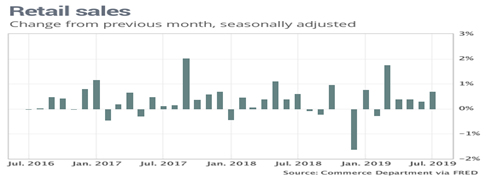
The surge in consumer spending was also predicted by the jump in retail sales reported last week. Retail sales rose in June for the fourth month in a row, quieting concerns that the trade wars and weaker manufacturing output would also drag down consumer spending. The most surprising strength in the report was a 0.7 percent jump in auto sales, which the only component of manufacturing seeing steady growth. Nonretailers (Internet), which continue to feed off of traditional retailers such as department stores, was also surprising with a 1.7 percent for the second month in a row.

image

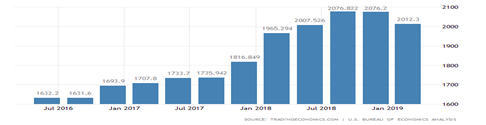
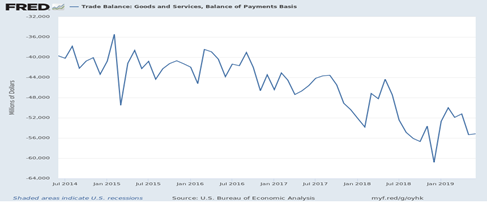
So any further decline in GDP growth will probably be due to a slower accumulation of inventories and capital investments (as seen in the above capital-goods orders graph) and a growing negative imbalance in exports vs. imports.

If the Trump administration and Republicans would realize the damage confrontational trade wars and other fear-mongering policies do to GDP growth, they would end such tactics. But it is obvious they only see an upside in their continuing confrontation with allies and adversaries alike, which should come back to haunt them next year when the inevitable worldwide growth slowdown impacts US, and the Presidential election.

And guess what?  The price index for gross domestic purchases increased 2.2 percent in the second quarter, compared with an increase of 0.8 percent in the first quarter, which is a sign of looming inflation, and makes it more likely the Fed will not want to lower their short term interest rates anytime soon.

Harlan Green © 2019

Follow Harlan Green on Twitter: https://twitter.com/HarlanGreen

Posted in Consumers, Economy, Macro Economics, Politics, Weekly Financial News | Tagged , , | Leave a comment