Housing Prices Rising Too Fast

The Mortgage Corner

image

Graph: Marketwatch

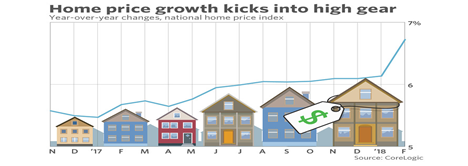
Housing prices are rising too fast to be sustainable over the long term says CoreLogic, a leading global property information, analytics provider. So buyers should be aware such unsustainable price rises could lead us into another housing bubble.

CoreLogic just released its Home Price Index (HPI) and HPI Forecast for February 2018, which shows home prices rose both year over year and month over month. Prices increased nationally year over year by 6.7 percent — from February 2017 to February 2018 — and on a month-over-month basis, home prices increased by a very large 1 percent in February 2018 — compared with January 2018 — according to the CoreLogic HPI.

“A number of western states have had hot housing markets,” said Dr. Frank Nothaft, chief economist for CoreLogic. “Idaho, Nevada, Utah and Washington all had home prices up more than 11 percent over the last year. With the recent rise in mortgage rates, affordability has fallen sharply in these states. We expect home-price growth to slow over the next 12 months, dropping to 5 to 6 percent in Idaho, Utah and Washington, and slowing to 9.6 percent in Nevada.”

Then why the expectation for a slowdown in price rises over the next year? Disposable personal income (after taxes) is rising just 2.5 percent per year, which means fewer households are even eligible to buy or refinance a home in this market. Corelogic is therefore signaling that some housing markets are becoming overvalued, which means values are rising10 percent higher than the “long-term sustainable level.”

According to CoreLogic Market Condition Indicators (MCI) data, an analysis of housing values in the country’s 100 largest metropolitan areas based on housing stock, 34 percent of metropolitan areas have an overvalued housing market as of February 2018. The MCI analysis categorizes home prices in individual markets as undervalued, at value or overvalued, by comparing home prices to their long-run, sustainable levels, which are supported by local market fundamentals (such as disposable income). 

And the Federal Reserve wants to continue to raise their interest rates. The Fed raised their overnight rate to between 1.5 to 1.75 percent last Wednesday. This is with rising new and existing-home sales, which is keeping inventory levels low. There is just a 3.2 months’ supply of existing homes for sale.

But the construction of single-family homes has picked up, which should ease some of the housing crunch. Econoday and the Commerce Department reported construction spending has been soft of late in the commercial sector, inching only 0.1 percent higher in February after posting no change in January, but gains are being posted for new single-family homes, up 0.9 percent for a second straight month and a year-on-year February increase of 9.5 percent. Multi-family homes, where spending has been weak, bounced back a monthly 1.2 percent for a yearly 0.9 percent increase.
image

Graph: Calculated Risk

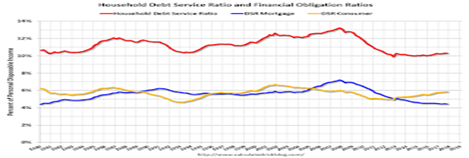
In sum, the future of housing sales may be determined by household debt loads. Current debt loads are still low while still recovering from the Great Recession. The blue line in the above graph that dates back to 1980 is mortgage debt as a percentage of personal disposable income, and it has been declining, whereas the yellow line of other consumer debt, such as credit card and installment loans, has been rising. That may reflect the low mortgage rates, but also fewer household able to qualify for mortgages, even with still record-low interest rates.

Harlan Green © 2018

Follow Harlan Green on Twitter: https://twitter.com/HarlanGreen

Posted in Consumers, Housing, housing market, Weekly Financial News | Tagged , , , | Leave a comment

Q4 GDP Growth Up 2.9% Q/Q

Financial FAQs

image

Graph: Econoday

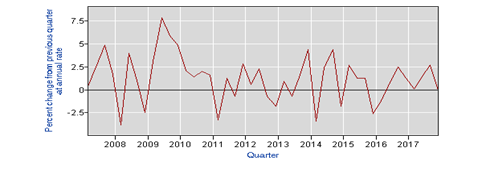
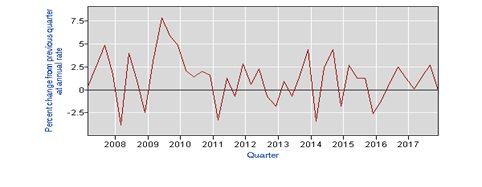
Fourth quarter Gross Domestic Product, the total value of the country’s production of purchases of domestically-produced goods and services by individuals, businesses, foreigners and government entities, rose to 2.9 percent from 2.6 percent in its third and final revision by the Commerce Department, finishing off 2017 with a bang and raising total 2017 GDP growth to 2.6 percent.

It was mostly consumer spending, up 4 percent, but personal incomes are rising faster as well, which will boost spending and continued good growth in 2018. This is because Real Disposable Income (less inflation and taxes) rose 0.4 percent pushing the annual increase to more than 2 percent.

image

Graph: Econoday

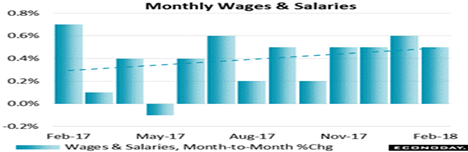
“The strongest news in the report comes from the wages & salaries component of personal income which posted a fourth straight sharp gain,” reports Econoday, “at 0.5 percent. This helped total income which rose 0.4 percent for a third straight month and also helped the savings rate which rose 2 tenths to a still modest 3.4 percent.”

This measure includes all forms of compensation including employer contributions to medical insurance and pensions and has been showing more life than average hourly earnings, which is part of the monthly employment report and is the most closely watched of all wage measures.

This did nothing to inflation, as the GDP’s price index rose 2.3 percent Q/Q, but is up just 1.8 percent annually, as is the Fed’s preferred Personal Consumption (PCE) index. So still no inflation, even though wage and salaries are beginning to surge, and labor costs account for 2/3rds of product costs.

The Fed has said it will probably raise their interest rate twice more this year, which will put the Prime Rate at 5.25 percent, raising credit card rates and crimping consumer borrowing.

But with wages soaring, that may not slow down consumer spending or the growing foreign trade deficit. The goods deficit from countries such as China is now $75B/per in February and growing. So why is this administration pushing for trade tariffs, which is already instigating a trade war, and making those same goods more expensive to Americans?

No one believes this will reduce the trade deficit, either, as the manufactured goods we export will become more expensive, as well, reducing the demand for exports.

Harlan Green © 2018

Follow Harlan Green on Twitter: https://twitter.com/HarlanGreen
Posted in Consumers, Economy, Weekly Financial News | Tagged , , , , | Leave a comment

Manufacturing Leading 2018 US Growth For How Long?

Popular Economics Weekly

image

Graph: Econoday

US manufacturing looks to lead US economic activity this year. Why? Durable goods orders are growing incredibly fast, which are any products that last more than 3 years. This means aircraft and military goods, as well as appliances and other household goods.

The blue columns of the graph track monthly order totals for durable goods which came in at $247.7 billion in February for a jump of 3.1 percent compared with January. The green line tracks shipments of durables which totaled $249.7 billion for a 0.9 percent increase which is very sizable for this measure.

A subset of these factory orders are core capital goods, which boost labor productivity (i.e., goods produced per worker hour) that has been lagging for years. Capital goods get the most attention as demand for these, from machinery to computers points to increasing fixed investment as businesses put new equipment in place to meet what they expect will be rising demand ahead.

image

And very convincing strength comes from core capital goods orders (i.e., nondefense ex-aircraft that boost manufacturing productivity) where year-on-year growth, moved up nearly 2 percentage points to 8.0 percent, says Econoday. One caveat is that orders for primary metals surged a monthly 2.7 percent in a gain that may reflect, based on reports from regional and private surveys, rising prices for steel and aluminum.

That is a sign that the ongoing tariff negotiations mean rising prices for manufactured and consumer goods. Let’s not forget that most of the world’s trade agreements are centered on reducing prices by locating production of these goods where they are most cheaply produced. Adding tariffs only adds to their costs, and American consumers with their limited incomes will suffer as we import most of our consumer products.

But Americans working in industries that use steel and aluminum products will also be affected by rising prices, which has to reduce demand for their products, as well.

It’s worth noting that these prices were already climbing ahead of possible steel and aluminum tariffs announced earlier this month. Fabrication orders rose 0.8 percent in February with machinery, which is at the very heart of the capital-goods group, rising 1.6 percent.

So it seems the cost of equalizing our trade agreements will on balance do little to correct our trade imbalance, because as products become more expensive they reduce demand for those products. That is, unless the salaries of US workers and consumers increase at the same rate. But then aren’t we back to the feared wage-and-price spirals of the 1970s that caused record inflation?

The way to increase demand for anything is to lower their costs, not raise them, which our current low-tariff agreements have been doing.

Harlan Green © 2018

Follow Harlan Green on Twitter: https://twitter.com/HarlanGreen

Posted in Consumers, Economy, Macro Economics, Politics, Weekly Financial News | Tagged , , , , | Leave a comment

Housing Sales, Leading Growth Indicator, Higher

The Mortgage Corner

Higher new and existing-home sales, and continued economic growth are the reason the Fed raised their overnight rate into a range between 1.5 to 1.75 percent on Wednesday. Even with consistently low inventory levels and faster price growth, existing-home sales bounced back in February after two straight months of declines, according to the National Association of Realtors.

And The Conference Board Leading Economic Index (LEI) for the U.S. that measures future growth possibilities increased 0.6 percent in February to 108.7 (2016 = 100), following a 0.8 percent increase in January, and a 0.7 percent increase in December. It points to accelerating growth this year.

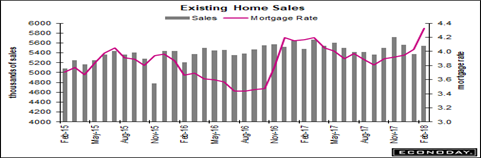
Total existing-home sales, https://www.nar.realtor/existing-home-sales , which are completed transactions that include single-family homes, townhomes, condominiums and co-ops, grew 3.0 percent to a seasonally adjusted annual rate of 5.54 million in February from 5.38 million in January. After last month’s increase, sales are now 1.1 percent above a year ago.

image

Graph: Econoday

Lawrence Yun, NAR chief economist, says sales were uneven across the country in February but did increase nicely overall. “A big jump in existing sales in the South and West last month helped the housing market recover from a two-month sales slump,” he said. “The very healthy U.S. economy and labor market are creating a sizeable interest in buying a home in early 2018. However, even as seasonal inventory gains helped boost sales last month, home prices – especially in the West – shot up considerably. Affordability continues to be a pressing issue because new and existing housing supply is still severely subpar.”

New-home sales are also surging, up 2.2 percent annually in February reports the Commerce Department, and 9.4 percent in 2017 overall. Inventories are also up to a 5.9-month supply and the median sales price in February was $326,800, nearly 10 percent higher than a year ago.

image

Graph: Econoday

And, “The U.S. LEI rose again, despite a sharp downturn in stock markets and weakness in housing construction in February,” said Ataman Ozyildirim, Director of Business Cycles and Growth Research at The Conference Board. “The LEI points to robust economic growth throughout 2018. Its six-month growth rate has not been this high since the first quarter of 2011. While the Federal Reserve is on track to continue raising its benchmark rate for the rest of the year, the recent weakness in residential construction and stock prices – important leading indicators – should be monitored closely.”

What recent weakness? Single-family starts, which are key to restocking the new home market, rose 2.9 percent to a 902,000 rate which is up 2.9 percent from this time last year.

Director Ozyildirim was really talking about the fears of a trade war with Trump’s tariffs on China and Japan about to be enacted. The administration is exempting Australia, Brazil, S Korea, Great Britain, EU, Mexico and Canada at the moment.

Total housing inventory at the end of February rose 4.6 percent to 1.59 million existing homes available for sale, said the NAR, but is still 8.1 percent lower than a year ago (1.73 million) and has fallen year-over-year for 33 consecutive months. Unsold inventory is at a 3.4-month supply at the current sales pace (3.8 months a year ago).

What about future interest rates? Fed Chairman Powell wants to toe the “middle ground” on rates, which means raising them slowly this year, as he sees no inflation at all on the horizon. The problem with raising interest rates with so little inflation is it crimps household spending and so growth. This particular set of conditions—raising interest rates with little inflation—has always been the precursor to a recession.

Harlan Green © 2018

Follow Harlan Green on Twitter: https://twitter.com/HarlanGreen

Posted in Consumers, Economy, Housing, housing market, Weekly Financial News | Tagged , , , , | Leave a comment

POTUS’s Reptilian Brain

Popular Economics Weekly

image

Does this description sound familiar? “Territoriality, hierarchical structure of power, control, ownership, wars, jealousy, anger, fear, hostility, worry, stuck or frozen with fear, aggressiveness, conflict, extremist behavior, competitiveness, cold-blooded, dog-eat-dog beliefs, might is right, and survival of the fittest,” is one definition of reptilian behavior.

It also describes the behavior of President Donald Trump. Psychotherapists have been attempting to explain POTUS’s behavior in psychological terms. Many have said he suffers from NPD, or Narcissistic Personality Disorder, defined in the DSM V treatment manual, as “… grandiosity, seeking excessive admiration, and a lack of empathy (Ronningstam & Weinberg, 2013).”

But why not turn to the biological sciences to describe President Trump’s behavior? The human brain is most simplistically described as having 3 parts; the earliest reptilian brain that contains our brute survival mechanisms; the mammalian limbic brain is the center of emotions and empathy; and neo-cortex the thinking part that modulates urges emanating from the other regions of the brain because of its ability to reason and judge.

A more basic way to define the reptilian brain is it contains the fight, flight, or freeze commands when an animal or human feels threatened. I am reminded of the behavior of pet Pythons, the largest of our snakes, who have literally turned on their owners—some eaten, others strangled, even though said Pythons were supposedly domesticated.

The most common explanation given by Herpetologists for such ‘aberrant’ behavior is that some pet Pythons were just biding their time when handled by their owners—they were measuring the size of their owner to know if they could be ingested. So they were following their basic instincts, as Trump is want to do. There have been cases of adult humans being attacked and fully ingested by Burmese Pythons—the largest Pythons—in the wild, as well.

What else could explain the behavior of this President whose success can only be attributed to a lifetime of lies and deceptions; who has ‘ingested’ those working closest to him by destroying their reputations, if they displease or are no longer of use to him?

The human species is mammalian because we give live birth to our offspring. But mammals evolved originally from reptiles; hence we still have the earliest reptilian brain that has been called the “lizard brain” because it provides the basic elements we need to survive.

This also explains POTUS’s authoritarian behavior, as perhaps that of the most extreme autocrats; Hitler, Stalin, and Vladimir Putin, who have literally killed their opponents.

The question is how much longer Americans will tolerate such reptilian behavior.

Harlan Green © 2018

Follow Harlan Green on Twitter: https://twitter.com/HarlanGreen
Posted in Uncategorized | Tagged , , , | Leave a comment

Single Family Construction, Consumer Sentiment, Higher

The Mortgage Corner

The US economy is booming, even with trade wars looming, and Putin attacking democratic institutions everywhere. The good news is interest rates and inflation are still extremely low, and consumers ebullient over their current status.

Why not, with the unemployment rate down to 4 percent, and 313,000 new nonfarm payroll jobs just created in February? Also the Labor Department’s JOLTS survey reported there were a far higher-than-expected 6.312 million job openings though it included downward revisions to prior months. All in all, openings are a huge 729,000 above hires which came in at 5.583 million.

This probably explains the high number of single-family housing starts—more jobs mean more demand for housing with housing inventories at multi-year lows. Single-family starts, which are key to restocking the new home market, rose 2.9 percent to a 902,000 rate which is up 2.9 percent from this time last year. And single-family completions rose 3.0 percent in the month to 895,000 and will offer immediate supply to the market.

image

Graph: Econoday

The booming labor market also explains why the U of Michigan’s consumer sentiment survey jumped 2 points to 102, the highest reading in 14 years. Current conditions, where strength hints at ongoing gains for both consumer spending and employment, reports Econoday, is up nearly 8 points to 122.8 and reflects growing confidence in the lower income bracket. Expectations, which is the other component of the index, is actually down 1.4 points to 90.0 and reflects income doubts among the higher bracket.

But beware of consumers’ ebulliance, as they are tapped out, even with the upcoming tax break in April from the higher standard tax deduction. Their personal savings rate is down to a mere 3.2 percent, with might explain the declining retail sales numbers after robust holiday sales in November.

image

Graph: Econoday

Retail sales have fallen over the past 3 months from their November high. Department stores were especially weak in February, down 0.9 percent, reports Econoday. What isn’t a surprise is a 4th straight month of decline at vehicle dealers, down 0.9 percent in a drop that re-emphasizes the effect of the spike in the hurricane season which pulled sales forward because so many vehicles were lost due to the floods.

But nonstore retailers jumped a monthly 1 percent. Building materials are also positive, up 1.9 percent that reverses a 1.7 percent decline in January, which is why we see the rise in single-family home construction during this winter season.

Slowing consumer spending and the ultra-low savings rate should tell the Fed there is no incipient inflation. Consumers now account for three-quarters of economic activity, so how can there be higher inflation, if consumers are unable to push prices higher?

Stay tuned, as mortgage rates are still at the low end. The 30-year conforming fixed rate is holding @ 4.0 percent for a 1 point origination fee. But the Fed will probably raise their short term rates on Tuesday, anyway.

Harlan Green © 2018

Follow Harlan Green on Twitter: https://twitter.com/HarlanGreen
Posted in Consumers, Economy, Housing, housing market, Weekly Financial News | Tagged , , , , | Leave a comment

Where is Inflation, and Higher Growth?

Financial FAQs

The drumbeat for a higher inflation target is picking up. The Chicago Fed’s Charles Evans recently advocated a less hawkish Fed stanch on maintaining the 2 percent inflation target with few signs of inflation even on the horizon.

Elizabeth Sawhill, a Senior Fellow at Brookings in a New York Times Op-ed, on the heels of February’s almost record 313,000 job creation number, is also saying that higher inflation would be desirable after many years of too low inflation.

“In fact, a high-pressure economy, with wages and prices a little higher than we’ve become used to, might actually do a lot of good for the people who need it most,” said Sawhill. “Working families need a tight labor market — and higher wages — to get ahead. It would be a costly mistake to raise rates too much or too soon.”

I have been saying this for years, as we know that higher growth and higher inflation go hand-in-hand, which in turn boosts wages. The Fed’s preferred PCE and retail CPI indexes have largely remained below 2 percent since 2008, while the GDP growth rate has also averaged 2 percent.

image

Graph: tradingeconomics.com

Why don’t we have higher growth? Because higher GDP growth requires that corporate profits reach those that will invest or spend them, including governments, working folk, and corporations have been better at buying back their own stock rather than investing their profits, as I’ve also been saying in past columns. While governments have been living on austerity budgets since the Great Recession.

“We are in the midst of a big fiscal and monetary experiment, says Sawhill. “And as with any experiment, the consequences are unknown. What we do know is that the costs of the Great Recession were enormous — at least $4 trillion in lost income, or about $30,000 per household, according to my calculations. The biggest losses were experienced by those in the bottom and middle portions of the income distribution who lost jobs and saw much of the equity in their homes destroyed.”

image

The best way to boost growth and wages is to boost labor productivity, which is a measure of the amount produced per hours worked, and largely depends on capital investment.  The productivity chart above portrays it’s fluctuations over the years with Q4 2017 showing no change in labor productivity at all.

How do we improve productivity?  It is very basic economic theory–improve capital investment. Taxing those that don’t invest their profits in productive uses—the wealthiest among us and corporations—would allow governments to spend more on education, infrastructure, environmental protection, R&D, health care; need I go on? By doing so, we boost extremely low labor productivity, and even a slight boost in productivity can boost everyone’s standard of living.

So it really means reversing the politics du jour in Washington that is paid for by Big Business lobbyists, and the Fed policy of raising interest rates before there are any real signs of inflation.

Harlan Green © 2018

Follow Harlan Green on Twitter: https://twitter.com/HarlanGreen

Posted in Uncategorized | Tagged , , , , | Leave a comment

Where is the Inflation, Higher Growth?

Financial FAQs

The drumbeat for a higher inflation target is picking up. The Chicago Fed’s Charles Evans recently advocated a less hawkish Fed stanch on maintaining the 2 percent inflation target with few signs of inflation even on the horizon.

Elizabeth Sawhill, a Senior Fellow at Brookings in a New York Times Op-ed, on the heels of February’s almost record 313,000 job creation number, is also saying that higher inflation would be desirable after many years of too low inflation.

“In fact, a high-pressure economy, with wages and prices a little higher than we’ve become used to, might actually do a lot of good for the people who need it most,” said Sawhill. “Working families need a tight labor market — and higher wages — to get ahead. It would be a costly mistake to raise rates too much or too soon.”

I have been saying this for years, as we know that higher growth and higher inflation go hand-in-hand, which in turn boosts wages. The Fed’s preferred PCE and retail CPI indexes have remained below 2 percent since 2008, while the GDP growth rate has also averaged just 2 percent.

image

Graph: tradingeconomics.com

Why don’t we have higher growth? Because higher GDP growth requires that corporate profits reach those that will invest or spend them, including governments, working folk, and corporations have been better at buying back their own stock rather than investing their profits, as I’ve also been saying in past columns. While governments have been living on austerity budgets since the Great Recession.

“We are in the midst of a big fiscal and monetary experiment, says Sawhill. “And as with any experiment, the consequences are unknown. What we do know is that the costs of the Great Recession were enormous — at least $4 trillion in lost income, or about $30,000 per household, according to my calculations. The biggest losses were experienced by those in the bottom and middle portions of the income distribution who lost jobs and saw much of the equity in their homes destroyed.”

image

What is the best way to boost growth and wages? It is very basic economic theory. By taxing those that don’t invest their profits in productive uses—the wealthiest among us and corporations—which would allow governments to spend more on education, infrastructure, environmental protection, R&D, health care; need I go on? By doing so, we boost extremely low labor productivity, when even a slight boost in productivity can boost everyone’s standard of living.

So it really means reversing the politics du jour in Washington that is paid for by Big Business lobbyists, and the Fed policy of raising interest rates before there are any real signs of inflation.

Harlan Green © 2018

Follow Harlan Green on Twitter: https://twitter.com/HarlanGreen

Posted in Consumers, Economy, Macro Economics, Politics, Weekly Financial News | Tagged , , , | Leave a comment

A Gangbusters February Employment Report

Popular Economics Weekly

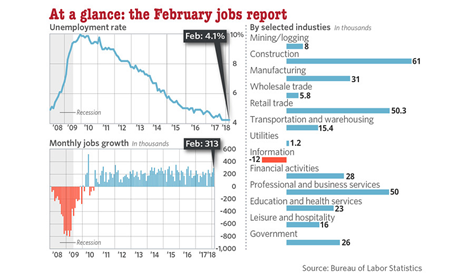
The U.S. added 313,000 new jobs in February, the biggest gain in a year and a half and clear evidence that a strong economy has plenty of room to keep expanding, said Marketwatch. The unemployment rate of 4.1 percent remained at a 17-year low.

And despite the big increase in hiring, wage growth did not keep up. Hourly pay rose 4 cents to $26.75 an hour, but the yearly increase in wages tapered off. The 12-month increase in pay slipped to 2.6 percent from a revised 2.8 percent in January.

image

Graph: Marketwatch

Construction companies hired 61,000 people to mark the biggest increase in 11 years. Retailers added 50,000 jobs, as did professional-oriented businesses. And manufacturers filled 31,000 positions. Workers also put more time in on the job, reversing a weather-induced decline in the first month of the year.

What’s more, the economy added 54,000 more jobs in January and December than previously reported. Altogether, the economy has gained an average of 242,000 new jobs in the past three months. That’s much stronger than the 182,000 monthly average in 2017.

Hourly pay is still not rising fast enough to cause inflation. We have to watch the 10-year T Bill for any signs of future inflation. Its yield is still below 3 percent, so the Fed might not raise their rate as quickly. The Chicago Fed’s Charles Evans just suggested the Fed could wait until mid-year before hiking short term rates.

But effects of the steel and aluminum tariff hikes will be the big unknown for inflation. If this initiates a trade war with the EU and China, in particular, all bets are off for continued high growth as rising primary metal prices will boost inflation with a vengeance, and endanger the jobs of those 6 million workers that make products from those metals.

image

Graph: Marketwatch

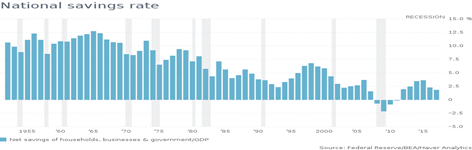
There is also a problem with our national savings rate. Marketwatch’s Rex Nutting points out it has sunk to a post-WWII low, which means more foreign investment than ever is needed to fund our balance of payments problem; something better trade agreements won’t cure. Because Americans still like to import more consumer goods than they export manufacturing goods and services, as I said yesterday.

Consumer products and automobiles are the primary drivers of the current $566 billion trade deficit. In 2017, the United States imported $602 billion in generic drugs, televisions, clothing, and other household items. It only exported $198 billion of consumer goods. The imbalance added $404 billion to the deficit. America imported $359 billion worth of automobiles and parts, while only exporting $158 billion.

So there are many caveats to continued strong jobs growth in 2018. Firstly we can’t have a trade war, and secondly, foreign investors still must buy enough US stocks, bonds, and Treasury securities to keep long term interest rates stable.

Harlan Green © 2018

Follow Harlan Green on Twitter: https://twitter.com/HarlanGreen
Posted in Consumers, Economy, Macro Economics, Weekly Financial News | Tagged , , , , | Leave a comment

Whither Go Interest Rates?

The Mortgage Corner

Existing-home resales weakened in January as the NAR’s pending home sales index fell sharply and is pointing to trouble for final sales of existing homes where the year-on-year rate for January had already fallen back below the zero line to minus 4.8 percent. Econoday reports new home sales also disappointed in January, sinking below the zero line on a year-over-year basis to minus 1.0 percent. 

image

Graph: Econoday

This has to be a consequence of the slight uptick in mortgage rates that have been at historical lows for more than 2 years. Many homeowners and buyers simply can’t afford this slight rise in mortgage rates, even though the conforming 30-year fixed rate is still at 4.0 percent for a 1-pt. origination fee, and 0 pts. @ 4.25 percent.

image

Higher interest rates usually follow higher inflation, but the only inflation is showing up in stock (and bond) prices, which is where most corporate profits are flowing these days; into investor and CEO pockets, rather than into consumers’ pockets. It is why one-quarter of the American workforce earns below the poverty line of $10/hour for a family of four.

It would help to see a rise in minimum wages. But the national minimum wage has been stuck at 7.25 percent since 2009, due to congressional inaction. This is the result of more than 30 years of trickle-down economics that has pushed most of America’s wealth to the top 10 percent of income earners.

In 2012, the top 10 percent of earners took home 50 percent of all income. That’s the highest percent in the last 100 years. The top 1 percent took home 20 percent of the income, according to a study by economists Emmanuel Saez and Thomas Piketty.

So what has really happened is housing prices are now rising twice as fast as household incomes, thanks to such low interest rates. That is where we see inflation; but not in household incomes which need to rise faster if housing is to remain affordable.

Harlan Green © 2018

Follow Harlan Green on Twitter: https://twitter.com/HarlanGreen
Posted in Consumers, Economy, Housing, housing market, Politics, Weekly Financial News | Tagged , , , , | Leave a comment