
I said last week there’s no longer any doubt the US economy has made a soft landing because the economy grew 3.3 percent in Q4 2023 and 3.1 percent for the year.
The first look at employment in January gave even better news. Year 2024 is off to a roaring start with 353,000 jobs created and the unemployment rate still at 3.7 percent. It has now remained below 4 percent for two years. And December’s job total increased to 333,000 nonfarm payroll jobs.
This means last year’s growth surge was no fluke, and maybe 2024 will be the beginning of the ‘Roaring 2020’s’ decade I believe has already begun. Why not? President Biden is thinking big with his Bidenomics policies that are expanding both the industrial and service sectors of the economy with policies that will take years to build out. It’s also growing health care services, cutting drug prices, and creating more jobs than ever before.
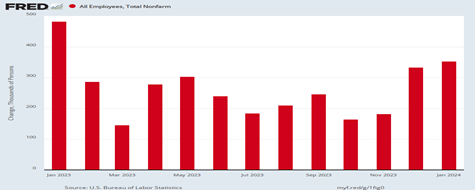
“Total nonfarm payroll employment rose by 353,000 in January, and the unemployment rate remained at 3.7 percent, the U.S. Bureau of Labor Statistics reported today. Job gains occurred in professional and business services, health care, retail trade, and social assistance. Employment declined in the mining, quarrying, and oil and gas extraction industry.”
Professional and business services added 74,000 jobs in January, employment in health care rose by 70,000, retail trade employment increased by 45,000. General merchandise retailers added 24,000 jobs, while electronics and appliance retailers lost 3,000 jobs.
The manufacturing is also recovering as manufacturing employment edged up in January (+23,000), government employment continued to trend up in January (+36,000), below the average monthly gain of 57,000 in 2023. Jobs gained in federal government (+11,000), and continued to trend up in local government, excluding education (+19,000).
The original Roaring 20’s occurred 100 years ago in the 1920s and was the beginning of our industrial revolution. This decade could be the beginning of a new revolution. It’s already being called the Information, or Internet Revolution.
This is while inflation, as measured by the most comprehensive inflation indicator for Personal Consumption Expenditures (PCE), has been rising at just 2 percent for the past two months!
Consumer spending has been the main engine of growth, which “reflected increases in services (led by health care) and goods (led by recreational goods and vehicles),” said the BEA.
And there’s another reason for the Fed to move quickly on cutting their interest rates. A New York community bank is raising concerns of further bank failures as happened last year.
MarketWatch reported New York Community Bancorp Inc.’s stock on Thursday triggered the steepest drop in regional-bank stocks since the collapse of Silicon Valley Bank in March 2023.
“The bank stunned markets with its fourth-quarter earnings that showed an unexpected loss, a buildup of its reserves and challenges in the office-space sector with one of two troubled loans. The bank also said it would cut its dividend by more than two-thirds to build up capital to meet regulatory requirements as a larger Category IV bank with assets of $100 billion to $250 billion.”
It’s signaling that interest rates are now harming further recovery, especially in the office sector of the commercial real estate market that regional banks cater to.
This should require the Fed, which supervises commercial banks, to expedite their rate cuts to avoid further bank failures, rather than worry about future inflation shocks.
Harlan Green © 2024
Follow Harlan Green on Twitter: https://twitter.com/HarlanGreen


 Populareconomicsblog