
Popular Economics Weekly
“The time to repair the roof is when the sun is shining. [State of the Union Address January 11 1962]” President John F Kennedy
Two of our largest domestic economies are heeding President Kennedy’s words, “when the sun is shining”; it’s time to begin paying our national debt during this record-breaking stock market run that is currently benefiting the wealthiest Americans.
We are drowning in a federal debt that is endangering our good faith and credit while crowding out domestic spending on the public services that make life more bearable for ordinary Americans. We have a federal debt that is now 120% of the annual output of the U.S. economy (Gross Domestic Product).
New York City’s Mayor Zohran Mamdani, and California Governor Gavin Newsom have announced that it’s possible to balance a budget. Maybe that’s something Republicans should also heed if they want to remain relevant to America’s future by offering more than tax cuts and bloated military budgets.
New York City is the largest U.S. city with an 8.5 million population, and the State of California has the fourth largest economy in the world behind the U.S., China and Japan.
Mayor Mamdani announced the $124.7 billion Fiscal Year (FY) 2027 Executive Budget, putting New York City on firm financial footing while protecting the services working people rely on. “Through strong fiscal management, Mayor Mamdani balanced the budget through a combination of aggressive savings, new tax revenue, partnership with Albany and critical new investments.”
California’s 2026-27 budget, as revised by Governor Gavin Newsom on May 14, 2026, “projects no deficit for that year and the next budget year (2027-28), with a structural deficit eliminated through July 2028.”
It’s a sign that Americans in Democratic states at least want to move on from the trickle-down economic policies that Republicans have practiced since 1980, resulting in five recessions including the Great Recession on their watch.
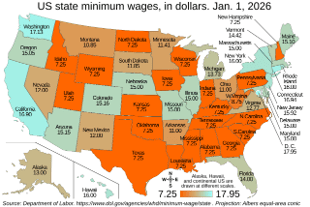
It has perpetrated the greatest income and wealth inequality of all—red states depriving their own citizens of a livable minimum wage and social services that make their lives bearable, with no minimum wage higher than the national minimum wage of $7.25 per hour (portrayed in the Wikipedia map), or state taxes to pay their bills and provide adequate health care.
That’s a reason most Republican-led, so-called red states, have fallen far behind in growth compared to Democrat-led blue states –many with surplus tax revenues that go to many of the red states in the form of benefit payments to balance their budgets.
California, for instance, has the largest tax ‘imbalance’ in the nation. Varying estimates show Californians pay between $83billion and $275billion more to the IRS than the federal government returns to the state in the form of Social Security, healthcare, military contracts, and disaster aid.
Whereas red states like Kentucky require $Billions from the federal coffers to meet their budget needs. For instance, 10 red states have no Medicaid health insurance for their low-income residents.
The results show the glaring damage the minimal, ‘bare bones’ red state budgets wreak on the health and safety of their citizens. Red states exhibit higher premature mortality rates and higher incidences of death from major internal causes, such as heart disease, cancer, and stroke. Blue state citizens on average live longer.
NIH research shows a clear partisan health divide in the United States, with “blue” (Democratic-leaning) states consistently outperforming “red” (Republican-leaning) states across major public health metrics, including life expectancy, infant mortality, and preventable chronic illnesses.
The New York City and California examples show that state and federal governments know how to balance a budget that benefits all Americans, not just the wealthiest. The Clinton Administration even created four consecutive years of budget surpluses in the 1990st that paid down the federal debt.
A consensus is building that our national debt must be dealt with. Balancing a budget is the responsible way to deal with it, not the trickle-down economic policies that have created such monstrous debt from the many Republican tax cuts that have deprived red states’ citizens of a decent standard of living.
Harlan Green © 2026
Follow Harlan Green on Twitter: https://twitter.com/HarlanGreen


