Financial FAQs
“Although output growth slowed in November, recent readings have been impressively strong, and the PMI surveys still point to GDP rising at an annualized rate of about 3% in the fourth quarter.” S&P Global
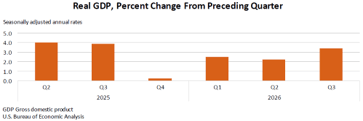
Fourth quarter GDP growth is projected to be above 3 percent. So, where’s the upcoming recession everyone seems to be worried about?
Recession worries are dying down with all the enthusiasm about A.I. investment that seem to be keeping the financial markets happy and consumers buying during the holidays, according to both the S&P Global manufacturing and service center surveys.
The annual federal budget deficit is now- $2trillion, in part because inflation is still above 3 percent. And will enough money be left to run government operations that take care of ordinary Americans without literally busting the federal budget?
We are now in an investment bubble of sorts as well that has powered this growth, and it’s almost all about computers and chips that go into the A.I. data centers; or Goggle, Meta, and Microsoft’s own A.I. products that are competing with Anthropic, OpenAI, ChatGPT and the like.
It’s a classic bubble in that supply is outdistancing demand for the products A.I. is continually generating and will continue to do so into next year. So, the question will be when will the investment cash and loans begin to pay off that would keep the highly interlocked investments from defaulting, as happened to the intertwined Japanese companies in the Keiretsu alliances?
These Japanese companies had elected to hold onto many of the bad loans when their investment bubble burst because they were part of a web of investments that affected other companies that might fail as well. It resulted in almost a decade of deflation and lowered standard of living for ordinary Japanese.
Hence the panic around Nvidia being at the center of so much of the current growth that could affect growth in other manufacturing and service sectors that S&P measures in its Global Outlook.
We know what happens when these overinvested bubbles burst in the U.S.—whether the oversupply was in fiberoptic cables (dot-com), or housing; millions of jobs are lost, a possibility that is mentioned in the S&P report.
“A key concern is the elevated cost of living and resulting pressures on affordability, and the survey price gauges remain at levels consistent with inflation running well above the Fed’s 2% target in the coming months, despite some moderation of the rate of inflation in November,” said Chris Williamson, Chief Business Economist at S&P Global Market Intelligence
And that brings us to the greatest threat brought on by this asset bubble that the Federal Reserve must mitigate—rising interest rates.
The housing bubble burst because Alan Greenspan’s Fed had kept interest rates low to pay for the Iraq war and Bush II tax cuts, so he began almost a year of interest rate hikes to tame the out of control inflation because of it, which burst the housing bubble and caused massive defaults of the negatively amortized liar loans that supported it.
So if this Fed doesn’t act in December and into next year to tame the inflation surge behind higher interest rates, which means tightening credit for consumers as well as businesses when some of the A. I. investments are sure to fail, we can have the same result today.
The Fed must of necessity bring down inflation to remain credible. How much of the U.S. economy will be affected?
Harlan Green © 2026
Follow Harlan Green on Twitter: https://twitter.com/HarlanGreen


