
What’s Next?

Financial FAQs

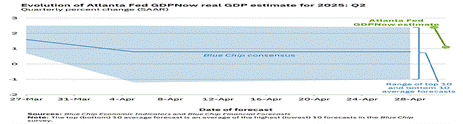
The GDPNow model estimate for real GDP growth (seasonally adjusted annual rate) in the second quarter of 2025 is 1.1 percent on May 1, down from 2.4 percent on April 30.”
AtFedGDPNow

What’s next for economic growth? Predictions for Q2 are all over the map since the first quarter GDP went negative with -0.3% GDP growth because businesses boosted their imports ahead of future price hikes caused by the tariffs, and imports are subtracted from exports in the Gross Domestic Product calculation.

The Atlanta Fed’s GDPNow Q2 growth estimate of +1.1 percent gives us an idea of what’s to come. It has already fallen sharply from +2.4 percent because of the negative Q1 surprise, as well as the drop in consumer spending (PCE) and real private fixed investment (e.g., factories), all signs of further slowing.

I see stagflation on the economic horizon, rather than an actual recession since wherever the import taxes being negotiated end up to be, it will raise prices. And the service sector of our economy is still expanding, that includes the leisure, healthcare and transportation sectors.

The Institute for Supply Management said that its service-sector PMI rose to 51.6% in April from 50.8% in the prior month in the largest sector of our economy. The measure of new orders rose to 52.3% in April from 50.4 in the prior month. And the measure of prices paid for services for inputs jumped to 65.1 from 60.9 in the prior month, which is the inflation component of stagflation.

However, Q2 growth is uncertain because no one knows what the tariffs will be (i.e., import taxes). If Q2 GDP should also contract it could indicate we are in a recession, since two consecutive quarters of negative GDP growth have been one tell of a recession.

Torsten Slok, Apollo Global’s chief economist interviewed on CNBC’s Squawk Box predicts if the high tariffs that were. put in place earlier this month remain in effect, odds of a two-quarter contraction in economic output stand at 90 percent, with gross domestic product dropping by 4 percentage points.

But Trump knows this so he will probably bring the tariffs down to the 10 percent minimum already being levied on all 180 countries in the world (that include penguin only islands).

Trump has probably calculated this will ultimately bring in enough tax revenues to enable the tax cuts he wants enacted for his Oligarchs. The rest of Americans will suffer, however, as the budget negotiations will demand spending cuts to everything else except the military and immigration services

So we shouldn’t ignore a recession possibility, since China is the elephant in the room, and could derail everything, since it accounts for most of the holiday season imports, for starters. And any manufacturing renaissance will be years in the offing.

Declining Gross Domestic Product growth isn’t the only measure of recession. The National Bureau of Economic Research (NBER), the official caller of recessions, adds several other indicators, such as when nonfarm payrolls, personal incomes, and industrial production have peaked in a business cycle.

The NBER, a board of top economists, makes the recession call by looking at peaks and troughs of business activity. The last recession was caused by the COVID-19 pandemic shutdown and came after the longest post WWII expansion in history, said the NBER.

The committee has determined that a peak in monthly economic activity occurred in the U.S. economy in February 2020. The peak marks the end of the expansion that began in June 2009 and the beginning of a recession. The expansion lasted 128 months, the longest in the history of U.S. business cycles dating back to 1854.”

And small businesses, who thought Trump would bring some relief from regulations as well as lower prices, do not like what they are seeing, I said last week. The National Federation of Independent Business on Tuesday said its Small Business Optimism Index dropped 3.3 points in March to 97.4, falling just below its 51-year average of 98.

Marketplace, a public radio show, said the U.S. Chamber of Commerce sent a letter to the Trump administration this week saying that tariffs pose “significant risks to U.S. employment” and may soon do “irreparable harm” to many small businesses.  

The Chamber, which represents businesses of all sizes, is asking the administration to lift tariffs on any goods that “cannot be made in the U.S.,” establish a tariff exclusion process and automatically exempt small business importers from tariffs.

The problem is that President Trump believes he can use tariffs to wall us off from our allies and trading partners. But wanna be autocrats, such as Trump, are terrible at running economies. The best examples are Turkey’s President Erdogan or Putin, whose economies still suffer from double-digit inflation.

They make decisions for the wrong reasons, because they don’t have to please everyone, just their Oligarchs. But an era of stagflation as happened in the 1970s could cause as much suffering, so stay tuned. Whether recession or prolonged stagflation, it won’t be pretty. 

Harlan Green © 2025

Follow Harlan Green on Twitter: https://twitter.com/HarlanGreen

Posted in Consumers, COVID-19, Politics, Weekly Financial News | Tagged , , , , , , , , , | Leave a comment

Whose Economy Is It Now?

Popular Economics Weekly

“Total nonfarm payroll employment increased by 177,000 in April, and the unemployment rate was unchanged at 4.2 percent, the U.S. Bureau of Labor Statistics reported today. Employment continued to trend up in health care, transportation and warehousing, financial activities, and social assistance. Federal government employment declined.”

MarketWatch

Even though the U.S. economy contracted in the first quarter of 2025 for the first time in three years, nonfarm payroll jobs increased 177,000 in April, as employers aren’t ready to cut their workforce at the start of the second quarter, even though many businesses have stopped ordering foreign goods for the holidays because no tariff agreements have been made or are even in negotiation, especially with China.

The universal April 2 tariff announcements on all 180 countries in the world have already begun to hurt manufacturing, as the manufacturing sector lost 1,000 jobs. Reuters reports the Institute for Supply Management’s manufacturing PMI dropped to a five-month low of 48.7 last month, as tariffs are already raising prices on strained supply chains, keeping prices at the factory gate elevated and encouraging some firms to lay off workers.

Gene Seroka, executive director of the Port of Los Angeles, said Tuesday on CNBC’s “Squawk Box” that he expects incoming cargo volume to slide by more than a third next week compared with the same period in 2024, especially with China that makes of 45 percent of Los Angeles Port imports.

According to our own port optimizer, which measures the loadings in Asia, we’ll be down just a little bit over 35% next week compared to last year. And it’s a precipitous drop in volume with a number of major American retailers stopping all shipments from China based on the tariffs,” Seroka said.

But the Education/Health sector added 70,000 jobs, Transporting/warehouse added 29,000 jobs, so the service sector is still healthy. There seems to hope that Trump will have some kind of tariff agreements in 90 days, but with whom and when means domestic production will be affected, since so many US businesses import parts as well as iPhones.

So looking ahead, the employment picture won’t look so good. Reuters also reported that the Labor Department report showed initial claims for state unemployment benefits jumped 18,000 to a seasonally adjusted 241,000 for the week ended April 26. The number of people receiving benefits after an initial week of aid soared 83,000 to a seasonally adjusted 1.916 million during the week ending April 19. Global outplacement firm Challenger, Gray & Christmas said that planned job cuts fell 62 percent to 105,441 last month. Layoffs were, however, 63 percent higher.

It looks like the April unemployment report is a picture of what was, not what is to come. Consumers are also eating out less. The NYTimes reports McDonald’s among other large food vendors have reported weaker sales in the first three months of the year.

PepsiCo cut its full-year guidance outlook assuming that demand for its beverages and snacks will soften. Chipotle, the burrito giant, reported that its same-store sales fell for the first time since 2020 in the most recent quarter. Both companies attributed the results to customers’ feeling apprehensive about the economy.”

It will become more difficult to hide the wholesale destruction the Trump administration is about to wreak on the U.S. economy, not only due to the tariffs, but because Trump and Republicans have weakened most of the laws and congressional mandates that affect economic growth, such as cutting much of the funding for President Biden’s New, New Deal, so that all now depends on the gut instincts of one man who believes he can run the country and the world.

Harlan Green © 2025

Follow Harlan Green on Twitter: https://twitter.com/HarlanGreen
Posted in Consumers, COVID-19, Economy, Politics, Weekly Financial News | Tagged , , , , , , , , , | Leave a comment

It’s Trump’s Economy Now

Popular Economics Weekly

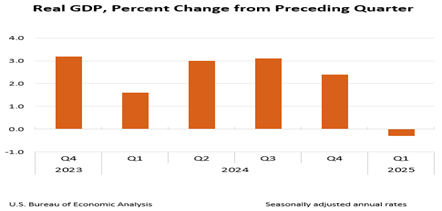
“Real gross domestic product (GDP) decreased at an annual rate of -0.3 percent in the first quarter of 2025 (January, February, and March), according to the advance estimate released by the U.S. Bureau of Economic Analysis. In the fourth quarter of 2024, real GDP increased 2.4 percent.”

BEA.gov

It’s President Trump’s economy now after the first 100 days of his second term.

The U.S. economy contracted in the first quarter of 2025 for the first time in three years, reflecting a surge in imports ahead of President Donald Trump’s tariffs and a slowdown in consumer spending.

The BEA graph of economic growth from Q4 2023 tells us all we need to know to compare President Biden’s economic record and Trump’s misrepresentations and lies of his economic record as president. Biden had an average growth rate of +3.2 percent over his term vs. Trump’s -0.3 percent contraction in the first quarter 2025. And it can’t get much better, because worldwide tariff wars take a long time to settle.

Is this what Americans wanted in re-electing Donald Trump, who has proven once again after failed casinos, Trump University, and countless lawsuits, he has never been a successful businessman?

The real question is how could so many Americans been fooled into thinking Trump knew what he was doing?

Some supporters believed that because economic growth was positive in Trump’s first term he could repeat his performance. But in fact, it followed President Obama’s eight years of investments that boosted the recovery from the 2008 Great Recession, the worst recession since the Great Depression.

How could it have been different, since Trump based his whole economic policy on his most blatant lie, that tariffs were not a tax on imports that would be paid by American importers and consumers, hence were not inflationary when he promised to bring down the price of groceries on ‘Day 1’.

Americans can now look behind Trump’s curtain of lies with the first actual reading on Trump’s economic record. Joe Biden’s economy was one of the strongest since World War Two, aided by the passing of bipartisan legislation that renewed our infrastructure, mitigated climate change and strengthened our social safety net, legislation that was equivalent to Roosevelt’s New Deal.

We can also see clearly that Elon Musk’s DOGE is attempting to tear all of this down by illegally firing the government employees and cutting the funds that congress appropriated to implement Biden’s New, New Deal

The American public can also see Republicans’ real goal in the current budget negotiations—continuing to grow the wealth of its Oligarchs by cutting taxes, while taking away the services that benefit all Americans.

Economic growth will continue to shrink, in other words. The ADP National Employment Report of private job creation just out for April shrank to 62,000 from 147,000 jobs in March, presaging what will happen with the upcoming official U.S. unemployment report for April.

Consumers have also pulled back their spending, a sure indicator of a possible recession. And the Conference Board just reported another record drop in consumer confidence.

“Consumer confidence declined for a fifth consecutive month in April, falling to levels not seen since the onset of the COVID pandemic,” said Stephanie Guichard, Senior Economist, Global Indicators at The Conference Board. “The decline was largely driven by consumers’ expectations. The three expectation components—business conditions, employment prospects, and future income—all deteriorated sharply, reflecting pervasive pessimism about the future.”

We must now face the fact that President Trump has already damaged the most powerful economy and country in the world with his lies and incompetence.

What’s next? He answered in an interview with The Atlantic,“The first time, I had two things to do — run the country and survive; I had all these crooked guys,” Trump said. “And the second time, I run the country and the world.”

Really? The American public is already answering President Reagan’s famous dictum, “Are you better off today than you were four years ago.” with a resounding NO!

Harlan Green © 2025

Follow Harlan Green on Twitter: https://twitter.com/HarlanGreen

Posted in Consumers, COVID-19, Economy, Politics, Weekly Financial News | Tagged , , , , , , , , , , | Leave a comment

A Place of Tolerance and Understanding

Answering Kennedy’s Call

“I believe our political divide can be repaired. But our leaders must act with moral clarity and take their cues from the good people of this nation, who in times of tragedy always seem to find our better angels.” Pennsylvania Governor Josh Shapiro

Pennsylvania Governor Shapiro wrote the above appeal just days after an arsonist invaded and attempted to burn down the Governor’s residence. Governor Shapiro attributed the attack to “the political division and violence in America today.”

He also gave thanks for the good people, whose “…prayers, blessings and messages of support we’ve received have lifted us up and shown us the way forward in the wake of a traumatic event.”

How do we find the “better angels” of our nature; was there a time when Americans were less partisan, more united in purpose?

There are many explanations and explainers of the political divide that led to red states vs. blue states and Donald Trump’s re-election. A major economic reason was the migration of many manufacturing jobs overseas, and politics shifting to the right after the stagflation of the 1970s while Fed Chair Paul Volcker’s Federal Reserve raised the Fed Funds rate to 20 percent, causing several recessions .

The loss of manufacturing jobs resulted in a very angry rust-belt populace and a huge surge in drug use and suicides among white males living there that was first documented in the best-selling Deaths of Despair and the Future of Capitalism by Nobel Laureate Angus Deaton and his wife, Ann Case.

The result is the share of Americans still living middle class lives in 2023 has shrunk to 51 percent from 61 percent in 1971 due to the loss of those jobs as well as Republican legislatures and the Supreme Court limiting labor unions’ collective bargaining power to replace them.

PEW

The loss of jobs led to the current economic divide, GW Bush’s war on drugs and the highest incarceration rate in the world. The hollowed out American middle class became a predominantly consumer society living on cheaper imports mostly employed in lower paying service sector jobs, whether as professionals in high tech or recreation and leisure activities.

Best-selling author Robert Putnam in Bowling Alone: The Collapse and Revival of American Community attributed the growing political divide to the consequent breakup of communities as they moved away from their birthplace or original communities in search of better jobs.

Whereas our neighbor Canada with a similar population mix had greater income equality by maintaining a predominately middle-class society, in part because it had strong labor unions. A 2023 Pollara survey of 3,000 Canadians 18 and older found that a much larger 78 per cent of Canadians consider themselves middle class, including 39 per cent of those earning less than $20,000, and 92 per cent of those earning more than $150,000.

Australia with a similar population mix is also considered a much more egalitarian society. Approximately 56 percent of the population self-identify as middle class, while 43 percent identify as working class and 1.4 percent as upper class. Other surveys suggest that around 58 percent of the population is in the middle-income class. The HILDA survey indicates that a significant portion, roughly 80 percent, of Australians are classified as middle class based on one measure.

Just the fact that most of their inhabitants considered themselves in the middle-class contributed to their sense of wellbeing.

We can also begin to restore our sense of wellbeing by growing our middle class once again with a simple but profound change—heeding Governor Shapiro’s appeal to find political leaders who will work to raise the national minimum wage above $7.25 per hour that was last raised in 2009.

Many of the poorest red states in the south and Midwest rust belt don’t even have a minimum wage, so they must adhere to our national minimum wage. Yet we know blue states such as California and New York have raised their minimum wage above $15 per hour, attracting a more creative and productive work force.

Working towards greater income equality that other developed countries have maintained with a strong middle class would help to bring Americans together again.

“William Penn founded our commonwealth as a place where all would be welcome — a place of tolerance and understanding where people of different faiths could live together in peace,” said Shapiro.

Where better to find such a leader who will take his cues from the good people and listen to our better angels than the Governor of Pennsylvania, in the state that was the original home of the Declaration of Independence and U.S. Constitution.

Harlan Green © 2025

Follow Harlan Green on Twitter: https://twitter.com/HarlanGreen
Posted in Consumers, COVID-19, Economy, Politics, Weekly Financial News | Tagged , , , , , , , , | 1 Comment

Trump’s 2.0 100 Days

Popular Economics Weekly

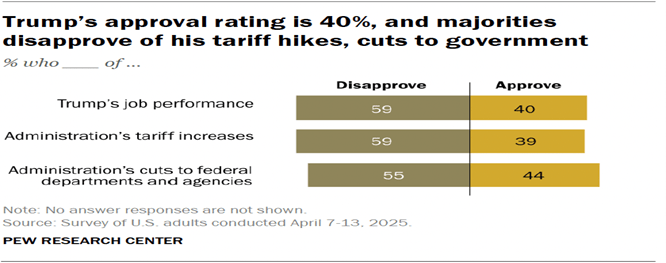
With President Donald Trump’s second term approaching its 100-day mark, 40% of Americans approve of how he’s handling the job – a decline of 7 percentage points from February,” PEW Research.

PEW

The big mystery is why Donald Trump is repeating the same mistakes he made in his first 100 days in office—chaotic tariff wars, illegal downsizing of congress-mandated agencies, threats of cuts to social security, Medicare and Medicaid services— that have hurt his ratings, as happened in Trump 1.0.

The answer is the continued support of his base; MAGA Republicans vs. that of all Americans, says PEW Research.

Seven-in-ten or more Republicans and Republican-leaning independents approve of:

  • · Trump’s job performance (75%)
  • · The administration’s cuts to government (78%)
  • · Increased tariffs (70%)
  • · Ending diversity, equity and inclusion (DEI) policies in the federal government (78%)

Among Trump’s predecessors dating back to Ronald Reagan, the only other leader who did not enjoy majority approval at his 100-day mark was Bill Clinton (49% approval in April 1993), according to PEW.

Why? For starters, Trump’s supporters seem to believe that executive orders can replace laws and tariff negotiations, though such tactics don’t work well in a democracy based on laws enforced by an independent judiciary.

Whose tariff policies that are based on mostly false premises has Trump followed —e.g., calculating trade imbalances solely on goods but not service sector trades? Some blame Peter Navarro, his chief tariff advisor, while Trump has admired President William Mckinley’s use of tariffs in 1890 that enriched Robber Barons in the first Gilded Age.

But Hitler also raised import tariffs in the 1930s to shield and build Germany’s domestic manufacturing base that fueled his war machine, all in the quest for more ‘Lebensraum.’ Trump scares me when he maintains his lie that tariffs don’t cause inflation, while he talks about creating more Lebensraum by wanting to acquire Greenland, the Panama Canal, and even Canada.

There is a darker vein as well, the racial purity efforts (e.g., white supremacy) that was a mainstay of Hitler’s Nazi Party that is reflected in Trump’s attempts to purge all mention of DEI programs in both government and private (e.g., educational) institutions.

I like a Fortune Magazine report from 2017 on candidate Trump’s past negotiating tactics: “The legal actions provide clues to the leadership style the billionaire businessman would bring to bear as commander in chief. He sometimes responds to even small disputes with overwhelming legal force. He doesn’t hesitate to deploy his wealth and legal firepower against adversaries with limited resources, such as homeowners. He sometimes refuses to pay real estate brokers, lawyers and other vendors.”

Trump’s attempts to act like a strong man aren’t panning out, in other words, mainly because autocratic regimes are antithetical to strong economies, which require a citizenry that has the freedom to innovate. It’s the same reason Americans don’t like Putin, China’s Xi, or dictators in general.

Polls show there are still Americans that would rather have an autocrat such as Trump to make decisions for them. But the price they pay is living in mostly Republican-controlled red states where living standards are much lower.

It’s a lesson Americans have had to learn more than once—that knowing truth from fiction, making one’s own decisions rather than following opinions of the herd, or cult figures, is the world most Americans prefer to live and prosper in.

Harlan Green © 2025

Follow Harlan Green on Twitter: https://twitter.com/HarlanGreen
Posted in Consumers, COVID-19, Economy, Macro Economics, Politics, Weekly Financial News | Tagged , , , , , , , , , , | Leave a comment

Immigrants the Lifeblood of U.S. Economy

The Mortgage Corner

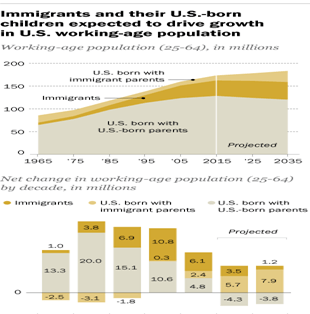
“For most of the past half-century, adults in the U.S. Baby Boom generation – those born after World War II and before 1965 – have been the main driver of the nation’s expanding workforce. But as this large generation heads into retirement, the increase in the potential labor force will slow markedly, and immigrants will play the primary role in the future growth of the working-age population (though they will remain a minority of it).” PEW RESEARCH

PEW

I wrote in 2017 during Donald Trump’s first term as president that the stakes are enormous if Republicans succeed in removing most of the estimated 11 million undocumented worker (only half of which are from Mexico and the Latin countries), and cut legal immigration in half, as they have promised to do, economic growth will plummet, since it is mainly based on growth of the working age population, as well as labor productivity, which has also fallen since 2000.

America has always had a labor shortage. It’s the reason we have needed immigrants and led in technology to keep our production levels high. And as the 2017 PEW study above highlights, immigrants have been at the core of our national workforce.

This is while the Trump administration continues to trip over itself in every economic sector, repeating the same mistakes it made during Trump’s first term. This is not only with its tariff policy—negotiating with China to lower their tariffs, though China says they are not currently in talks—but is especially true with its immigration policy that is designed to please its MAGA base.

It’s pleasing no one else. Former Labor Secretary Robert Reich reports on Substack that one American was detained by ICE in Arizona for 10 days until his relatives produced papers proving his citizenship, because ICE didn’t believe he was American. Meanwhile, ICE handcuffed and deported a group of German teenagers vacationing in Hawaii because they turned up without a hotel pre-booked, which ICE found “suspicious.”

The number of adults in the prime working ages of 25 to 64 – 173.2 million in 2015 – will rise to 183.2 million in 2035, according to Pew Research Center projections. That total growth of 10 million over two decades will be lower than the total in any single decade since the Baby Boomers began pouring into the workforce in the 1960s. The growth rate of working-age adults will also be markedly reduced, says the study.

The Biden administration’s record growth was based in large part because of the immigration surge that Trump is attempting to reverse, that Trump characterized as criminals to stir up his MAGA base. There was no crime wave; records show immigrants commit fewer crimes than American citizens.

So Trump is creating a worker shortage when he wants to bring back manufacturing. Who will replace the immigrants? We need to develop more labor-saving technologies, which means developing better computer chips that Biden has is already funding with Research and Development grants and the CHIPs Act, but will take time to develop.

Trump has no plan of his own, other than slash the government programs that would create newer technologies, nor is anything being done at the congressional level, except pushing for more tax cuts. This was his only accomplishment during the first Trump administration.

It’s a sad day when Trump, Republicans and his MAGA supporters see immigrants as threats when they are the only readily available resource that will grow our economy.

Harlan Green © 2025

Follow Harlan Green on Twitter: https://twitter.com/HarlanGreen

Posted in Consumers, COVID-19, Economy, Politics, Weekly Financial News | Tagged , , , , , , , , | Leave a comment

Higher Tariffs = Stagflation

Financial FAQs

“Any tariff causes consumers to shift from imported goods to domestically produced alternatives that are more expensive, inferior in quality, or just not quite what they want. But with a low tariff domestic alternatives will be only a little bit worse than the imports they replace; with a high tariff many of the domestic goods consumers buy will be a lot worse than the imports they replace. Nobel Laureate Paul Krugman

Federal Reserve Chairman Jerome Powell said in his latest remarks that the Trump tariffs were much higher than the Fed had expected. It has unsettled the financial markets so much that Fed officials don’t know whether it’s smarter to lower or raise interest rates.

Conference Board

The Conference Board’s Index of Leading Economic Indicators (LEI) gives one read of our economic future for the rest of the year. And it’s pointing to stagflation rather than recession.

“The US LEI for March pointed to slowing economic activity ahead,” said Justyna Zabinska-La Monica, Senior Manager, Business Cycle Indicators, at The Conference Board. “March’s decline was concentrated among three components that weakened amid soaring economic uncertainty ahead of pending tariff announcements: 1) consumer expectations dropped further, 2) stock prices recorded their largest monthly decline since September 2022, and 3) new orders in manufacturing softened.

The stock and bond markets continued to decline on the Monday after Easter—the DOW down -972 points. So, no sign of an economic resurrection there. The stagnation component is because Trump is fighting an imagined immigration war that is reducing our workforce, which is causing a labor shortage during a time of full employment. The two to three million surge in new immigrants during Biden’s term made US the fastest growing economy in the world.

And the tariff war will cause supply bottlenecks once again as it did during the COVID-19 pandemic, which is when it caused the inflation component of stagflation to skyrocket and the Fed to raise interest rates to combat it.

It’s becoming more obvious what Trump means by using his “gut’ to make decisions. It’s why his “batshitcrazy” tariff decisions, in the words of Paul Krugman, are causing such chaos. Foreign governments can’t make decisions on gut instincts and so are pulling their U.S. investments, causing the stock and bond selloffs. Gold is the current flight to quality shelter in lieu of the traditional bond play.

That means he lives by his own Laws of the Jungle, where might Trumps right, and he only knows how to bully rather than reason. So it’s no surprise that Trump lurches from one tariff proposal to another without researching any of its effects, causing world markets to lose faith in the full faith and credit of the U.S. Dollar and Treasury bonds.

Adam Posen, a former official at both the Federal Reserve and the Bank of England, said in a speech this week that the U.S. could suffer the biggest “stagflationary” shock in decades. And that is scary. We mustn’t forget what the 1970s were like; skyhigh inflation and double-digit interest rates to tame it, or even the post-pandemic era.

“We may get recession, we may not, but we are going to get inflation either way,” he said, as cited by MarketWatch. Even if Trump strikes deals with various countries, tariffs are likely to remain in place (at least 10 percent). These measures would raise prices, increase inflation and slow the economy — the recipe for a period of stagflation.

Harlan Green © 2025

Follow Harlan Green on Twitter: https://twitter.com/HarlanGreen
Posted in Consumers, COVID-19, Economy, Politics, Weekly Financial News | Tagged , , , , , , , , | Leave a comment

How Much LONGER Do We Wait?

The Mortgage Corner

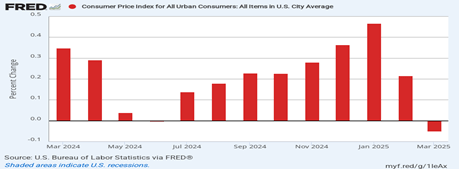
“The Consumer Price Index for All Urban Consumers (CPI-U) decreased 0.1 percent on a seasonally adjusted basis in March, after rising 0.2 percent in February, the U.S. Bureau of Labor Statistics reported today. Over the last 12 months, the all items index increased 2.4 percent before seasonal adjustment.”

FREDcpi

Will home sales pick up at all this year? It could happen. Because inflation is declining at the moment, thanks to the tariff chaos. That’s because economic growth is slowing as the supply bottlenecks increase for autos, auto parts, construction materials and just about everything else that is imported.

This will ultimately drive-up prices, unless ultimately resolved, or we have a recession.

Fed Chair Powell said recently that the tariffs are causing too much uncertainty for the Fed to act one way or the other now, which is reflected in the sudden drop in the Consumer Price Index inflation in the above graph. There is the fear of recession in the air, which is discouraging home buyers as well.

It’s also keeping much needed new home construction on the sidelines. “Policy uncertainty is having a negative impact on home builders, making it difficult for them to accurately price homes and make critical business decisions,said NAHB Chief Economist Robert Dietz. “The April HMI data indicates that the tariff cost effect is already taking hold, with the majority of builders reporting cost increases on building materials due to tariff

Privately-owned housing starts in March were at a seasonally adjusted annual rate of 1,324,000. This is 11.4 percent below the revised February estimate of 1,494,000 but is 1.9 percent above the March 2024 rate of 1,299,000.

Housing should be aided by moderating consumer inflation but fixed mortgage rates are still hovering close to 7 percent. Housing construction is attempting to fill the supply void. But prices won’t improve because of the tariffs on Canadian lumber and metals such as aluminum, for starters.

Meanwhile housing costs continue to go up. Newsweek reports that between March 2024 and March 2025, the biggest year-over-year price jumps were reported in the cost of natural gas (up 147.6 percent), copper wire and cable (up 13.4 percent), softwood lumber (up 12.6 percent) and construction sand, gravel and crushed stone (up 8.3 percent).

Who can still afford to buy a home? The NAR’s 2025 Home Buyers and Sellers Generational Trends report found that the combined share of younger boomers (ages 60–69) and older boomers (ages 70–78) rose to 42% of all home buyers in the past year. Millennials dropped to 29% of all buyers – down notably from 38% a year ago. Generation X buyers (ages 45–59) held steady at 24%.

So first-time, entry-level homebuyers are being left out of the market at present. Home sales would pick up if the Fed Governors would realize how lower rates would energize buyers. I believe the Fed could lower rates in June, just in case the supply bottlenecks really begin to grind activity to a halt. Everyone seems to be waiting to see what President Trump’s grand plan may be, other than to intimidate every other country on the planet (which won’t work).

So, the tariffs are making home buying even less affordable. It looks like we will have to wait until the Fed begins to cut interest rates again and we see lower mortgage rates.

With the crazies in charge, who knows when?

Harlan Green © 2025

Follow Harlan Green on Twitter: https://twitter.com/HarlanGreen

Posted in Consumers, COVID-19, Economy, Housing, housing market, Weekly Financial News | Tagged , , , , , , , , , | Leave a comment

Republicans’ Unchecked Greed

Popular Economics Weekly

George Will, the conservative pundit, gave the best description of Trump’s incompetence in a Washington Post Op-Ed: “It is urgent for Americans to think and speak clearly about President Trump’s inability to do either. This seems to be not a mere disinclination but a disability. It is not merely the result of intellectual sloth but of an untrained mind bereft of information and married to stratospheric self-confidence.”

George Will was only partially right in 2017, when he reacted to Trump’s flailing first term attempts to run our government. His administration’s seeming incompetence is motivated by unchecked greed. And it is wrecking the fastest growing economy in the developed world that was inherited from the Biden administration.

They are choosing to remain ignorant of the most basic economic facts in their attempt to extend Trump’s 2018 Tax Cut and Jobs Act during the current debate on passing the budget for the fiscal year. The financial markets are making them pay for their ignorance, which will hurt his red state supporters most.

“The budget plan that House Republicans passed today paves the way to take Medicaid health coverage and food assistance through SNAP away from millions of people, to partially pay for huge tax giveaways for wealthy households and businesses that will drive up deficits and fiscal risk,” said Sharon Parrott, President of the Center for Budget and Policy Priorities, a non-partisan economic think tank,

What are the markets saying? It’s the wrong time to have a budget debate, “when the President’s tariffs, chaotically crafted and applied, have caused business uncertainty to soar and raised the risk of a recession, higher unemployment, and surging prices,” said CBPP’s Parrott.

CBPP.org

This is also at a time of record income inequality when the income gains of the top one percent dwarf that of the bottom 20 percent per the above graph.

Professors Thomas Piketty and Emmanuel Saez were the first to examine 100 years of income tax returns that highlighted the wide swings in income equality. They found that the periods of greatest inequality were just before a major recession, such as the Great Recession and the Great Depression itself, I said in an earlier blog post.

What does that tell US when we are at another period of greatest equality? More than just red staters will be harmed, as the full faith and credit of the U.S. of A is endangered with the record national debt of $36 trillion and growing.

This happened during the Great Recession as well, triggered by GW Bush’s tax cuts at a time when the Clinton Administration had just created four years of budget surpluses that were frittered away with GW’s tax cuts and the wars on terror.

“Add to the budget plan and constantly shifting tariff policy the Administration’s chaotic and deeply harmful executive action agenda — which is wrecking Social Security and other core government functions, unlawfully stopping funding for public services and investments, hollowing out and politicizing the civil service, and undermining basic governance — and you have a triple threat agenda that will make millions of families far worse off,” continued Parrott.

Can it get even worse? Our national debt is not sustainable. Yahoo Finance just reported in an April 14 report, that S&P Global Ratings hinted that it could lower the US credit rating, currently at AA+, by another notch if any of a number of things happen to make the US’s fiscal situation worse.

“The outcome of the US government’s budget process and policy negotiations over the coming months will help determine policies that inform our view of US sovereign creditworthiness,” S&P said. “These discussions could affect our view of the US’s fiscal profile.”

So, there’s a good reason Greed is one of the seven deadly sins, maybe the deadliest if its Republican practitioners cause another Great Recession or Depression.

Harlan Green © 2025

Follow Harlan Green on Twitter: https://twitter.com/HarlanGreen

Posted in Consumers, COVID-19, Economy, Politics, Weekly Financial News | Tagged , , , , , , , , , , | Leave a comment

Why a Recession?

Financial FAQs

The GDPNow model estimate for real GDP growth (seasonally adjusted annual rate) in the first quarter of 2025 is -2.4 percent on April 9, up from -2.8 percent on April 3.

AtlantaFed

The Atlanta Federal Reserve’s GDPNow graph of estimated first quarter economic growth is still the best representation of where US economic growth is headed, I said last week. It has plunged from +3 percent where it was during the Biden administration, to a range from -2 to -3 percent of GDP contraction since March 4, 2025.

Why? Trump’s tariff wars. Here’s the latest headline from MarketWatch on the automobile tariffs, for instance. GM, Ford and Stellantis face extra $5,000 cost for each car made in America, thanks to Trump’s tariff on parts

The Big Three automakers also are dealing with an average tariff cost of nearly $9,000 for each finished vehicle that’s imported, according to a new study by the Center for Automotive Research.

Its key findings were:

  • · Increased cost of $107.7 billion to all U.S. Automakers.
  • · Increased cost of $41.9 billion to the D3 Automakers.
  • · Impact to D3 production volume of 6.8 million vehicles.

Trump has delegated himself emergency powers that really belong to congress to enact his tariffs, when there is no emergency. President Biden’s tariffs were already doing the job of protecting American workers and industries. The manufacturing sector had added 700,000 jobs and were building new factories because of the bipartisan CHIPs, Infrastructure, and Inflation Reduction Acts enacted during Biden’s administration.

This President is really driving economic growth off a cliff not because of a huge persecution complex (it’s an act), but to enrich himself and his Oligarchs. He maintains the taxes collected from the tariffs will offset more tax cuts, when he has done no research (or chosen to ignore what is available) on the effects of a worldwide tariff war.

Trump’s wrecking ball mentality is even alarming the Oligarchs. Ray Dalio, Founder and Chief Investment Officer of Bridgewater Associates, the world’s largest hedge fund, said recently on CNBC, “We have a breakdown of the monetary order. Such times are very much like the 1930s…I’ve studied history, and this repeats over and over again.”

What did he mean? The US bond and currency markets were collapsing. US Treasury Bond yields soared 0.5 percent in a week, and the US Dollar’s value in relation to other currencies plunged. Foreign investors were losing faith in our economy at a time when Republicans want to add approximately $5.8 trillion to our national debt with their tax cuts, and record debt holdings by foreign investors.

Those foreign investors determine how much that additional debt will cost, or they may not want to buy some of that debt in the form of more US Treasuries or Mortgage-backed securities. Former Treasury Secretary Lawrence Summers has said it’s making US look like a third world country.

That’s enough bad news to scare anybody, as even small businesses are now worried. “The implementation of new policy priorities has heightened the level of uncertainty among small business owners over the past few months.” said NFIB Chief Economist Bill Dunkelberg.  “Small business owners have scaled back expectations on sales growth as they better understand how these rearrangements might impact them.”

Surveys show consumers are now beginning to save rather than spend, also a sign of a possible recession. Their spending behavior has reversed from the past four years under President Biden when we were the world’s fastest growing economy.

MarketWatch cites Primerica, for instance, a firm specializing in life insurance and securities, who conducted a survey in late December of people with household incomes ranging from $30,000 to $130,000, or roughly the middle 60% of Americans.

“Despite increases in income, about 73% of middle-income Americans said they are cutting back on nonessential purchases due to the high cost of living, and 84% are eating at home more frequently.”

That is why Republicans and DOGE are on a cost-cutting spree. But Elon Musk appeared to dramatically lower DOGE’s savings goal, projecting $150 billion for the year—far short of his earlier trillion-dollar figure at a recent cabinet meeting, said Fortune Magazine. However, questions remain about the savings claimed by the team, with critics pointing to inflated numbers, retracted claims, and a growing list of controversial cuts.

This is why we are hearing horror stories about the cutbacks from social security and Medicaid services, with maybe more to come. We are no longer the economy to be envied, if Republicans in their greed destroy the faith and credit of the U.S. government.

Harlan Green © 2025

Follow Harlan Green on Twitter: https://twitter.com/HarlanGreen

Posted in Consumers, COVID-19, Economy, Politics, Weekly Financial News | Tagged , , , , , , , , , , | Leave a comment