Inflation Week is Here

Financial FAQs

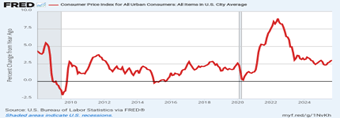
The Consumer Price Index for All Urban Consumers (CPI-U) increased 0.3 percent on a seasonally adjusted basis in June, after rising 0.1 percent in May, the U.S. Bureau of Labor Statistics reported today. Over the last 12 months, the all items index increased 2.7 percent before seasonal adjustment.” BLS.GOV

FREDcpi

June is the month that the Trump tariffs are beginning to raise the price of imported goods, which is pushing the inflation rate higher..

The first inflation report is the Consumer Price Index (CPI) on retail goods and services (see graph). It rose to 2.7 percent in June from a four-year low of 2.4 percent, which is why the Fed is still on hold with further rate cuts. It fears that lowering their Fed funds short-term rate could trigger an inflation panic, since it would speed up economic activity.

This would in turn panic bond holders who fear higher inflation and demand higher rates that control mortgages and yields on Treasury securities that fund the national debt, when annual debt payments are already $1 trillion.

Gas prices and housing costs rose. Prices fell for new and used vehicles, hotels and airfares. So, the inflation problem is mainly with imported goods, while the service sector price declines showed that consumers are dining out and traveling less because of the uncertainties generated by a tariff war.

Why should consumers spend more when the prices of cars and other durable goods that last more than three years, and are mostly either manufactured overseas or the parts are imported, will be hit by the tariffs? And don’t forget Trump wants to dock every country in the world that exports to us with at least a 10 percent tariff rate

This is before the appeal by the Trump administration of the Foreign Trade Court ruling that all reciprocal tariffs must be approved by congress is decided! How is anyone to know what the final tariffs will be, in that case?

There is more to come this week with wholesale inflation (Producer Price Index) and the Fed’s favorite, Personal Consumption Expenditure index (PCE), to follow.

So why are the financial markets rallying to new highs as we speak? It is blind faith, in my opinion, that TACO Trump will chicken out again on the higher import taxes just announced on the likes of Japan, the EU, and even Brazil where we already have a trade surplus from exporting more to Brazil more than we import.

Is it that Trump loves the drama and can’t resist firing broadsides at what he doesn’t like? Or, more likely he desperately needs to collect import taxes to bring down the huge national debt brought on with the tax cuts, but without causing more inflation, something he promised to bring down on ‘Day One’.

How can he keep his promise to lower inflation while he keeps hounding the Fed to lower interest rates sooner (that would boost inflation)? He can’t, in a word, because of his need to cut taxes. So he is raising taxes on everyone else dependent on imports.

Harlan Green © 2025

Follow Harlan Green on Twitter: https://twitter.com/HarlanGreen
Posted in Consumers, COVID-19, Economy, Politics, Weekly Financial News | Tagged , , , , , , , , | Leave a comment

Consumers Aren’t Buying It

Popular Economics Weekly

Photo: Emma Da Silva/Getty Images

MarketWatch

“Total U.S. consumer credit growth slowed to a $5.1 billion gain in May, down from a $16.9 billion rise in the prior month, the Federal Reserve said Tuesday. 

That translates to a 1.2% annual rate in May, down from a 4% rise in the prior month.” Greg Robb, MarketWatch

President Trump waited for stocks to rally before announcing his latest tariff broadsides on world markets, such as the 50 percent tariff on Brazilian imports. But the result is consumers are shopping less and less. So Trump shouldn’t be paying attention just to the financial markets if he wants to know what might happen over the rest of his term.

Retail sales fell 0.9% in May, the biggest drop in two years. Car sales spiked earlier this year as consumers sought to avoid higher prices from planned tariffs. But sales have slowed sharply since April, said MarketWatch.

The labor market is also slowing. Initial unemployment claims, an early indicator of its direction, have been increasing. The number of people receiving unemployment benefits increased 10,000 to a seasonally adjusted 1.965 million during the week ending June 28, the highest level since November 2021.

Consumer spending drives most economic growth (70%), so if they falter economic growth will slow. And stagnant growth is the component of a possible stag-flation that will result, just as it did in the 1970s with the oil shortages.

We now must wait for the other shoe to drop, which is the effect of the tariff taxes on inflation, which will surely increase later this year, given the supply shortages to follow.

Everyone now knows that TACO Trump is using the shock and awe tactics of so-called reciprocal tariffs, which are blatantly illegal per the Foreign Trade Court ruling now on appeal, to get more concessions from trading partners.

Trump’s problem is that neither consumers nor businesses like uncertainty, yet this is the only way Trump has ever known how to negotiate. His long history of lawsuits and bankruptcies have been the result. And once again he leaves it to the courts to sort out the messes he is now creating for all Americans.

Will it be worth it to those that elected Trump, and will be most affected?

Harlan Green © 2025

Follow Harlan Green on Twitter: https://twitter.com/HarlanGreen
Posted in Consumers, COVID-19, Economy, Politics, Weekly Financial News | Tagged , , , , , , , , , | Leave a comment

Where Was FEMA?

Financial FAQs

“On July 4, the day Trump signed the bill, flash floods devastated central Texas, leaving more than 100 people dead and about 160 still missing. Local officials immediately blamed cuts to the National Weather Service (NWS) for the disaster, but reviews showed that NWS meteorologists had predicted the storm accurately and had sent out three increasingly urgent warnings at 1:14 a.m., 4:03 a.m., and 6:06 a.m.” Heather Cox Richardson, Letters from an American

CNN

The Texas flash flood caught authorities flat-footed, but not the National Weather Service. It is GW Bush’s Katrina Hurricane response fiasco all over again.

I am re-posting excerpts from Historian Heather Cox Richardson’s Substack blog of what really happened in the Guadalupe River, Texas flash flood disaster. It is the most recent example of the cost in lives of the DOGE cost cutting frenzy and Trump administration’s mismanagement, that is also costing lives. This is apparently what we can expect from Trump and the incompetents he has picked to run our government over the next 3.5 years.

“But four hours passed before the police department in the City of Kerrville issued a warning. It wasn’t until 7:32 that the city urged people along the Guadalupe River to move to higher ground immediately. The missing link between the NWS and public safety personnel appears to have been the weather service employee in charge of coordinating between them. He took an unplanned early retirement under pressure from the “Department of Government Efficiency” and has not been replaced.

Then, as Gabe Cohen and Michael Williams of CNN reported, search and rescue teams from the Federal Emergency Management Agency (FEMA) could not respond to the disaster because Homeland Security Secretary Kristi Noem, whose department is in charge of FEMA, had recently tried to cut spending by requiring her personal sign-off on any expenditure over $100,000. That order meant FEMA couldn’t put crews in place ahead of the storm, or respond immediately. Noem didn’t sign off on the deployment of FEMA teams until Monday, more than 72 hours after the flooding started.

Tricia McLaughlin, a spokesperson for the Department of Homeland Security, told Cohen and Williams that Noem did not authorize FEMA deployment because DHS used other search and rescue teams. “FEMA is shifting from bloated, DC-centric dead weight to a lean, deployable disaster force that empowers state actors to provide relief for their citizens,” McLaughlin told CNN in a statement. “The old processes are being replaced because they failed Americans in real emergencies for decades.”

DHS is rooting out waste, fraud, abuse, and is reprioritizing appropriated dollars. Secretary Noem is delivering accountability to the U.S. taxpayer, which Washington bureaucrats have ignored for decades at the expense of American citizens,” McLaughlin said. Noem has called for the elimination of FEMA.

Meanwhile, FEMA’s acting director, David Richardson, has been nowhere to be found, making no public appearances, statements, or postings on social media since the disaster, and not visiting the site. Former FEMA officials told Thomas Frank of Politico that Richardson’s absence suggests Noem is controlling the FEMA response. Trump appointed Richardson after his team fired his first appointee, Cameron Hamilton, for telling Congress he did not think FEMA should be scrapped.

The day after he took office in May, Richardson, who has no experience with emergency management, told staff: “Don’t get in my way…because I will run right over you. I will achieve the president’s intent…. I, and I alone in FEMA, speak for FEMA,” he said.

Even as rescuers were still at work today in Texas, DHS cancelled a $3 million grant that had been awarded in New York to make sure the NWS can communicate effectively with local officials.”

I maintain it’s what we can look forward to when our government is run by a convicted felon who only trusts those most loyal to him rather than our constitution. Is this what a majority of Americans expected to protect them?

Harlan Green © 2025

Follow Harlan on Twitter: https://twittter.com/HarlanGreen

Posted in Uncategorized | Tagged , , , | Leave a comment

No Art of the Trade Deal

Financial FAQs

“The point is that Trump doesn’t feel bound by trade deals America has made in the past. Why should anyone expect him to honor any new deals he makes, or claims to make, now?

Huffington Post

“Obviously this behavior isn’t unique to tariffs. Many domestic institutions, from law firms to universities, have discovered that attempting to appease Trump buys you at best a few weeks’ respite before he comes back for more.” Paul Krugman

Nobel Laureate Paul Krugman won his Nobel Prize for his research in International Trade, so his remarks on Donald Trump’s behavior in negotiating trade deals is a good way to understand what Donald Trump has done his whole life—bullied people and institutions—because that’s all he knows how to do.

And Krugman fears it will mean Trump will continue his tariff wars, regardless of the outcomes. This certainly means some level of stagflation; higher inflation with slower economic growth, according to most economists and even Wall Streeters. Maybe not on the level of the 1970s stagflation induced by the OPEC Arab Oil Embargo.

It’s Trump’s paranoid personality if you can call it that. It’s the reason he is the con man who has lied and obfuscated his whole life and could only negotiate with lawsuits. He doesn’t really know how to negotiate so that both parties win, and therefore it is a stable relationship between parties. He only wants to overpower a perceived enemy, much like Putin or Xi, real dictators who torture and kill and their own people to maintain power.

I have written about Trump’s poor negotiating skills in past Huffington Post articles and elsewhere. Author Tony Schwarz was the first to seriously write about Trump in Trump: The Art of the Deal, his biography that created the myth that Trump was a skilled wheeler-dealer.

But it wasn’t real, Schwartz said later to New Yorker Magazine’s Jane Mayer in a famous 2016 interview.

“I put lipstick on a pig,” he said. “I feel a deep sense of remorse that I contributed to presenting Trump in a way that brought him wider attention and made him more appealing than he is.” He went on, “I genuinely believe that if Trump wins and gets the nuclear codes there is an excellent possibility it will lead to the end of civilization.”

The just announced reciprocal tariffs on Japan and Korea area a good example, says Krugman. President Trump sent out tariff letters to U.S. trading partners on Monday as he had promised, starting with Japan and South Korea before targeting Malaysia, Indonesia and other countries.

He has labeled them “reciprocal” tariffs because of his perceived unfairness of their tariff policies, but Japan and South Korea charge little or no tariffs on U.S. imports because of long standing agreements, says Krugman, so have little to negotiate.

How were the South Koreans supposed to end unfair trade practices that exist only in Trump’s imagination?” says Krugman?

Then why is Trump proposing tariffs on them anyway?

“The only possible out here would be a series of fake deals, in which countries pretend to have offered significant concessions and Trump claims to have won big victories. Some people still think that will happen — the new tariffs aren’t supposed to take effect until Aug. 1. But the tone of those letters and Trump’s clear obsession with tariffs make me doubt that he’ll call the tariffs off, in part because of my last observation: Attempts to mollify Trump always end up emboldening him to demand more.”

Then why does Trump do it and cause what will be more huge financial market dips with the loss of more $trillions in equities, many trade disruptions, and alienation of our allies?

Being ‘reciprocal’ has nothing to do with it. Trump will charge at least a 10 percent tariff on the imports from all countries because he needs the import taxes to pay down the huge budget deficit that’s been generated by his Big Beautiful Bill that Congress has just passed.

Therefore his real objective, rather than fairness, is to extract as many concessions as possible from every other country in the world that is dependent on imports to the U.S, regardless of the economic consequences.

Isn’t that what he really wants, to pay for more tax cuts for Trump and the Oligarchs, which will mean the wholesale disruption of world trade, regardless of the possible destruction of our own economy burdened with an unsustainable national debt?

Harlan Green © 2025

Follow Harlan on Twitter: https://twittter.com/HarlanGreen

Posted in Consumers, COVID-19, Economy, Politics, Weekly Financial News | Tagged , , , , , , , , , | Leave a comment

Trump’s Terrible Tax Bill

Popular Economics Weekly

The Guardian

President Trump and Republicans terrible tax bill signed on July 4 will impoverish more Americans, worsen our health, with fewer protections from natural disasters and foreign threats.

The bill raises the debt ceiling by $3-4 trillion, coming at a time when U.S. national debt exceeds $36 trillion. And at least 12 million more people will lose health insurance by 2034, according to the nonpartisan Congressional Budget Office’s tally of the bill.

The Trump administration is attempting in every way possible to make Americans sicker with the $1 billion cut to health programs in Trump’s terrible tax bill by firing the health experts as well as the cutting their funding for research. To heap even more misery on those in most need of its services, he appointed Robert Kennedy, Jr., who made his name as a vaccine-denier, to run the Department of Health and Human Services.

Trump is doing the same damage to old-age and pension benefits by slashing the workforce and budget of social security, which will make the already underfunded social security system less secure for our retired and senior citizens.

Trump’s terrible tax bill will result in American workers becoming less productive because less healthy while cutbacks to President Biden’s Inflation Reduction Act will remove environmental safeguards that protect Americans from the increasing frequency of hurricanes and wildfires.

The latest example is the Kerr County, Texas Christian girl’s camp weather disaster that may have swept away more than 47 girls and their families from a sudden flash flood with little advance warning by the U.S. Weather Service, which is also being downsized with firings and budget cuts and closing of local Weather Service offices.

And Trump is attempting to pay for his terrible tax bill with an illegal tariff war without congressional consent that will make products more expensive and supplies difficult to find, slowing economic growth, while alienating our allies that have helped to keep Americans safer.

We will need all the foreign help we can get as Republicans proved with the 9/11 Twin Towers attack that they are not very good at protecting Americans from foreign attackers.

In fact, the welfare of most Americans has never been a serious concern for Republicans, which is why Republican-run red states are the poorest states in the union that are most dependent on blue state financial aid.

Former Senate Majority Leader Mitch McConnell when asked about his thoughts on the program cuts in Trump’s terrible tax bill has said “They will get used to it.” And Iowa Senator Joni Earnst at a contentious town hall meeting defending the cuts in Medicaid and SNAP programs said, “We are all going to die.”

In acting like the convicted felon he is, Trump is disregarding laws and the constitution in a single-minded drive to make himself and his Oligarchs wealthier and working Americans poorer.

The passing of Trump’s terrible tax bill means Republicans care little for most Americans and chose a leader who only cares for himself.

Harlan Green © 2025

Follow Harlan Green on Twitter: https://twitter.com/HarlanGreen
Posted in Consumers, COVID-19, Economy, Politics, Weekly Financial News | Tagged , , , , , , , | Leave a comment

A Better Jobs Report?

Popular Economics Weekly

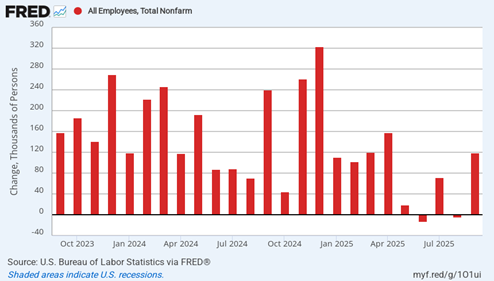
“Total nonfarm payroll employment increased by 147,000 in June, and the unemployment rate changed little at 4.1 percent, the U.S. Bureau of Labor Statistics reported today. Job gains occurred in state government and health care. Federal government continued to lose jobs.” BLS.GOV

FREDpayrolls

We have one more month of employment data to give us an idea where the U.S. economy is headed during the Trump administration. There were 74,000 private payroll jobs and 73,000 state and local government jobs added, and more federal government job losses.

The results of the June unemployment report were strong enough to perhaps discourage any Fed rate cuts until the fall. Trump is outraged at the Fed’s intransigence because he hopes cutting interest rates will boost growth in combination with his big ugly bill that takes attention away from the huge boost in tariffs he requires to help pay for it that will slow growth and raise inflation—i.e., equals stagflation.

An average 130,000 private payroll jobs per month were created in Trump’s first six months (last six bars in above graph). Whereas President Biden created 15.2 million jobs during his four years, or 327,000 jobs per month and GDP growth averaged 3.2 percent over his four-year term.

Democrats have always been better with the budget math, since President Biden focused on recovering from the COVID-19 pandemic with his New Deal legislation while Republicans have been obsessed with cutting back the stimulus programs to pay for the tax cuts for their wealthiest supporters.

Jobs were created in state and local jobs while the federal government lost jobs from the DOGE efficiency drive. So, the question is can state and local governments take up the hiring slack from the shrinking of federal payrolls?

Republicans are about to pass the ugliest federal budget in history that that is projected to add at least $3 trillion to the annual budget deficit and create $38 trillion to total federal debt. Medicaid is the biggest loser with the Congressional Budget Office predicting that some 11 million could lose their Medicaid coverage because of state cut backs on payment subsidies and various new regulation requirements.

It is extremely bad economics to use a worldwide tariff war to attempt to pay for huge budget deficits in the name of more tax cuts that mostly benefit the wealthiest. High tariffs not only disrupt supply chains, as happened during the COVID-19 pandemic because countries attempt to evade the tariffs, but it means alienating friends by treating them as enemies and walling off America from the rest of the world.

That last happened in 1930 and led to the Great Depression. No single country can be self-sufficient in our modern, globalized world. Strength comes with alliances, weakness with alienation and isolation that benefits the few at the expense of the many.

Harlan Green © 2025

Follow Harlan Green on Twitter: https://twitter.com/HarlanGreen

Posted in Consumers, COVID-19, Economy, Politics, Weekly Financial News | Tagged , , , , , , , , , , | Leave a comment

Too Many Vacant Jobs?

Financial FAQs

The number of job openings was little changed at 7.8 million in May, the U.S. Bureau of Labor Statistics reported today. Over the month, both hires and total separations were little changed at 5.5 million and 5.2 million, respectively. Within separations, quits (3.3 million) and layoffs and discharges (1.6 million) changed little.” BLS.GOV

Calculated Risk

The Labor Department’s monthly JOLTS report can be confusing. When the BLS uses the term “little changed”, they mean changes that barely move the needle of the approximately 5 million jobs created and lost each month in the U.S. economy.

But there were still 7.8 million vacant jobs in May needing workers, according to the Labor Department’s JOLTS report, whereas ADP, a U.S. private payrolls data collector, just reported companies eliminated 33,000 jobs last month, marking the first decline since March 2023.

We are now seeing a weakening in the jobs market that consumers are beginning to worry about in the various consumer confidence surveys and are already cutting back on their spending that drives most (70%) of economic growth.

The above graph shows job openings (black line), hires (dark blue), Layoff, Discharges and other (red column), and Quits (light blue column) from the JOLTS. The difference between hirings and separations approximates the monthly number of jobs created.

How do we square the conflicting payroll data with the official U.S, unemployment report that follows end of the month? Private employers reduced jobs in June for the first time in more than two years, as U.S. trade wars created a “hesitancy to hire and a reluctance to replace departing workers,” said ADP chief economist Dr. Nela Richardson.

The service industries that fill the leisure activity, dining, professional services and transportation sectors lost 66,000 jobs, while the goods producers, such as construction and manufacturing gained 32,000 jobs.

That shouldn’t be a surprise, because large parts of the service industries rely on lower paid immigrants, many of them undocumented, and suddenly many are no longer to be found. The Department of Homeland Security may have rounded up some 100,000 to date but want to deport 3 million a year.

This will devastate the U.S. economy, because the service industries employ most (80 percent) of American workers. Why are Republicans ignoring that fact in the big beautiful (or ugly) bill that was sent back to the House to finalize?

Instead of being employed and supporting the American economy, the undocumented (mostly from the other Americas) will be incarcerated in concentration camps while being processed for deportation, much like the Nazis did in World War Two.

It’s not surprising since it’s Donald Trump’s Republican Party now that includes many Neo-Nazis (remember the Charlottesville torch carriers) among his MAGA supporters.

And companies that depend on imports must reckon with whatever the final tariffs rates will be. Trump has only announced one agreement with the UK to date, and a tentative agreement with Vietnam. The tariffs on Vietnamese imports with be raised to 20 percent, which includes products that have been rerouted from China to avoid Chinese tariffs. So the Vietnamese tariff hike may have an outsize effect.

Trump can continue to postpone the inevitable by delaying the tariff hikes for as long as possible with his TACO negotiating style (Trump Always Chickens Out). But Americans are not so foolish and will restrain their spending until we know who will ultimately pay for the higher tariffs.

Harlan Green © 2025

Follow Harlan on Twitter: https://twittter.com/HarlanGreen

Posted in Consumers, COVID-19, Economy, Macro Economics, Politics, Weekly Financial News | Tagged , , , , , , , | Leave a comment

Worried Consumers Shop Less

Popular Economics Weekly

Disposable personal income (DPI)—personal income less personal current taxes—decreased $125.0 billion (0.6 percent) and personal consumption expenditures (PCE) decreased $29.3 billion (0.1 percent).”

BEA.GOV

We are seeing one of the classic signs of a looming recession—consumers are spending less and saving more, and they power 70 percent of economic activity. Though their savings are usually held in lending institutions, it doesn’t pack the same economic punch (i.e., from the multiplier effect of consumption on other parts of the economy).

The personal consumption expenditures (PCE) for May from the Bureau of Economic Activity (BEA) showed the personal savings rate has risen to 4.8 percent (black line in graph), while personal consumption expenditures decreased -0.1%, Personal savings had been increasing since early 2025. No surprise, since that is when Trump’s tariff plans were first announced.

Why are they spending less? One of the reasons cited by the consumer sentiment surveys is too much future uncertainty. Not so surprising with inflation worries still high, and the on again, off again tariff announcements that probably mean even higher prices.

The PEW Centers most recent survey said the public again sees inflation as one of the top problems facing the nation, with 62 percent saying inflation is a very big problem for the country – only slightly down from the 65 percent who said this last year (2024).

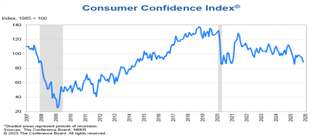
The Conference Board Consumer Confidence Index® deteriorated by 5.4 points in June, falling to 93.0 (1985=100) from 98.4 in May. “Consumer confidence weakened in June, erasing almost half of May’s sharp gains,” said Stephanie Guichard, Senior Economist, Global Indicators at The Conference Board. “The decline was broad-based across components, with consumers’ assessments of the present situation and their expectations for the future both contributing to the deterioration.”

The University of Michigan’s Consumer sentiment survey surged 16% from May in its first increase in six months but remains well below the post-election bounce seen in December 2024 when last year’s economic growth was 3 percent, the highest in the developed world, and jobs were still plentiful.

“Despite June’s gains, however, sentiment remains about 18% below December 2024, right after the election; consumer views are still broadly consistent with an economic slowdown and an increase in inflation to come,” said Survey Director Joanne Hsu.

From the same month one year ago, the PCE price index for May increased 2.3 percent. Excluding food and energy, the PCE price index increased 2.7 percent from one year ago. It’s at least a sign of stagflation if the spending slowdown continues, since the PCE report also shows signs of higher inflation that the Fed is worried about.

No wonder consumers are more worried. Bloomberg research reveals AI could replace 53 percent of the white-collar market research analyst tasks and 67 percent of sales representative tasks, while managerial roles face only 9 to 21% automation risk.

The World Economic Forum’s 2025 Future of Jobs Report reveals that 41 percent of employers worldwide intend to reduce their workforce in the next five years due to AI automation. Industries like technology, finance, and consulting are highlighted as particularly vulnerable.

It really looks like Republicans are trying as hard as possible to start a recession. They are shrinking the workforce by deporting undocumented immigrants who work with their hands and thus would be needed to fill some of the 400,000 vacant manufacturing jobs.

And passing Trump’s Big Beautiful Bill will create an unsustainable debt load, keeping interest rates high.

So though Biden suffered through higher inflation, it was because of the $trillions in New Deal legislation that caused 3.2 percent GDP growth during his term. The Trump administration has managed just a -0.5 GDP growth rate in his first quarter in office.

This is what happens when Republican tax cuts transfer even more wealth to the Oligarchs from middle and working class Americans.

Harlan Green © 2025

Follow Harlan Green on Twitter: https://twitter.com/HarlanGreen

Posted in Consumers, COVID-19, Economy, Politics, Weekly Financial News | Tagged , , , , , , , , | Leave a comment

First Quarter Growth Revised Lower

Financial FAQs

“Real gross domestic product (GDP) decreased at an annual rate of -0.5 percent in the first quarter of 2025 (January, February, and March), according to the third estimate released by the U.S. Bureau of Economic Analysis. In the fourth quarter of 2024, real GDP increased 2.4 percent.” BEA.GOV

We won’t know yet if we can stay out of a recession because first quarter GDP was revised downward in its final (third) estimate, but Americans have been stocking up on cheaper imports before the tariffs kick in, just in case.

Real GDP was revised down 0.3 percentage point from the second estimate (-0.2%), primarily because of downward revisions to consumer spending and exports. This was before the April 2 tariffs and retaliatory tariffs hit consumers.

But the final (third) revision of Q1 GDP showed inflation already rising because of the rush to buy before April 2. The price index for gross domestic purchases increased 3.4 percent in the first quarter, a revised +0.1 percentage point from the previous estimate. The personal consumption expenditures (PCE) price index increased 3.7 percent, and the PCE price index excluding food and energy increased 3.5 percent, both +0.1 percentage point higher than previously estimated.

So, what are consumers and businesses to do while waiting for the final outcome of the tariff wars? (If there will be a grand finale, that is.) Trump is using the tariffs to not only pay for the huge deficit that his Big Beautiful Tax bill will create, but as a way to bully other countries to do all manner of things, like get NATO to up its military spending, and China to import more U.S. exports.

The general consensus is that tariffs will ultimately end up being about 10 percent for most countries (30 percent for Chinese imports), up from 4 percent in recent history. The financial markets are rallying again because of Trump’s TACO (Trump Always Chickens Out) negotiating techniques—suddenly raising retaliatory tariffs, then cancelling them. It can’t prevent higher prices, since so much of what we consume is imported.

Things might look brighter for a while, like in the second quarter just coming to a close in June. The Atlanta Fed’s GDPNow estimate of second quarter growth is still holding at 3.4 percent because of continued investment in AI and other high-tech innovations in its most recent Nowcast. But we won’t see the first estimate of second quarter GDP growth until July 30.

The GDPNow model estimate for real GDP growth (seasonally adjusted annual rate) in the second quarter of 2025 is 3.4 percent on June 18, down from 3.5 percent on June 17. After this morning’s housing starts report from the US Census Bureau, the nowcast of second-quarter real residential fixed investment growth decreased from -2.8 percent to -4.4 percent.

Higher fixed investment is good for growth, of course, yet we are also seeing increases in weekly initial jobless claims that come close to Great Recession and COVID-19 pandemic numbers. The number of jobless workers collecting longer term unemployment benefits rose by 37,000 to 1.97 million, marking the highest level since November 2021.

That’s because much of the high-tech and AI investment will be replacing White-collar workers. We now must wait until July 30, as I said, for Q2 growth numbers come out from the Bureau of Economic Analysis. That’s a long time to wait these days, since so much can happen.

Stocks and bonds are rallying because corporate profits are higher, as well as the hope that TACO Trump won’t level any more retaliatory tariffs. The Foreign Trade Court has said the retaliatory tariffs aren’t legal. So maybe that’s what the markets are betting on—no more tariff increases. Most analysts are predicting the new 10 percent tariff level will shave approximately 1.5 percent from GDP growth this year, however.

Harlan Green © 2025

Follow Harlan on Twitter: https://twittter.com/HarlanGreen

Posted in Uncategorized | Tagged , , , , , , , , | Leave a comment

Interest Rates Coming Down?

The Mortgage Corner

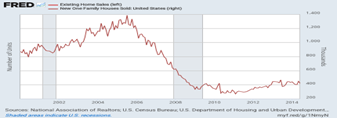
“Existing-home sales rose in May, according to the National Association of REALTORS®. Sales elevated in the Northeast, Midwest and South, but retreated in the West. Year-over-year, sales progressed in the Northeast and Midwest but contracted in the South and West.” NAR

CalculatedRisk

President Trump is now putting on a full court press to convince the Fed Governors to cut interest rates. There are some good reasons to lower interest rates, including the fact that home sales are at levels that last prevailed during the 2008-09 Great Recession (see above graph).

But his “Big Beautiful Bill” will add an additional $3 trillion to the federal debt that means almost $1 billion in annual interest payments. Trump has said he wants rates to be cut as much as one point (-1.0%) from the current 4.25% Fed Funds overnight rate that adjusts the Prime Rate controlling credit card and auto loan payments.

Any rate cuts would give a huge boost to financial markets as well that have been held back by the high borrowing costs for both consumers and businesses.

Fed President Powell speaks to congress this week and Trump wants congressional Republicans to grill him on why he hasn’t lowered interest rates further.

This is because Powell said at his recent press conference, “For the time being, we are well-positioned to wait to learn more about the likely course of the economy before considering any adjustments to our policy stance.”

Two of the Fed Governors appointed by President Trump are already leaning in his direction. Chris Waller and Michelle Bowman said after the bank stood pat last week that they would be open to a rate cut at the July 29-30 meeting, according to MarketWatch’s Jeffry Bartash.

And we mustn’t forget housing sales have been flat since January 2023 when the Fed began to raise their short-term rates. That’s why the National Association of Realtors have also been lobbying for lower interest rates.

“The relatively subdued sales are largely due to persistently high mortgage rates. Lower interest rates will attract more buyers and sellers to the housing market,” said NAR Chief Economist Lawrence Yun. “Increasing participation in the housing market will increase the mobility of the workforce and drive economic growth. If mortgage rates decrease in the second half of this year, expect home sales across the country to increase due to strong income growth, healthy inventory, and a record-high number of jobs.”

There’s also another reason why interest rates may fall further in July; fears that tariff wars may induce a recession. The Federal Reserve’s release of its minutes from the last FOMC meeting didn’t have much to say about the continuing tariff wars, because nothing has yet been negotiated—just some retaliatory pauses and a written understanding with the UK.

That puts the Fed in a very difficult position. We now know why President Trump has attempted to disguise the fact that it is an import tax. The Court of International Trade has ruled that Trump’s retaliatory tariffs (i.e., import taxes) are illegal.

Hence Chairman Powell’s concern that a recession may be on the horizon was mentioned in last week’s FOMC minutes. “The staff viewed the possibility that the economy would enter a recession to be almost as likely as the baseline forecast.”

We know from past history (i.e., Trump’s first term) that higher tariffs cause higher inflation, which Trump denies will happen again (because it was a campaign promise), and Powell, et.al., have worked hard to get inflation down to its current level.

We also now have reports that imports have declined almost 40 percent in the west coast, which handle most Chinese supplies. Long Beach and Los Angeles posted month-over-month drops of 31.6 percent and 29.9%, while Tacoma and Seattle fell over 40%.

So, there is a good case to be made that interest rates should be coming down, for both good and bad reasons. It does look like Republicans’ “Big Beautiful Bill” will pass, regardless of the consequences. And who doesn’t like lower interest rates?

But Republicans are playing with fire by endangering the “full faith and credit” of the U.S. in wanting to finance it with another $3 trillion in debt.

Harlan Green © 2025

Follow Harlan Green on Twitter: https://twitter.com/HarlanGreen
Posted in Consumers, COVID-19, Economy, Housing, Politics, Weekly Financial News | Tagged , , , , , , , , , | Leave a comment