U.S. Will Badly Need Immigrants

Popular Economics Weekly

For most of the past half-century, adults in the U.S. Baby Boom generation – those born after World War II and before 1965 – have been the main driver of the nation’s expanding workforce, reports the PEW Research Center. But as this large generation heads into retirement, the increase in the potential labor force will slow markedly, and immigrants will play the primary role in the future growth of the working-age population (though they will remain a minority of it).

image

Graph: PEW Research

The stakes are enormous if Republicans succeed in removing most of the estimated 11 million undocumented worker (only half of which are from Mexico and the Latin countries), and cut legal immigration in half, as they have promised to do. Economic growth will plummet, since it is mainly based on growth of the working age population, as well as labor productivity, which has also fallen since 2000.


image

The causes of the drop in labor productivity are largely because of the fall in capex spending, the investment in new plants and equipment, which has fallen by half since 2010, in large part because of the Great Recession, but also because corporations have chosen to move so many jobs overseas where labor is cheaper, rather than investing domestically to improve the productivity of American workers.


image

Graph: Econoday

The plunge in capex has been most noticeable last year, perhaps because of uncertainty over economic growth in what is the 7th year of this long growth cycle, or uncertainty about results of the President election. Such expectations can be self-reinforcing in these anecdotal surveys, of course, given the poor 1.9 percent GDP growth in 2016.

The ISM manufacturing survey, which tracks anecdotal assessments from a national sample of purchasers, made big headlines in the week with a 4.7 point jump in its new orders index to 65.1. This level of order growth was last exceeded in August 2009 and follows two prior 60 readings.

The number of adults in the prime working ages of 25 to 64 – 173.2 million in 2015 – will rise to 183.2 million in 2035, according to Pew Research Center projections. That total growth of 10 million over two decades will be lower than the total in any single decade since the Baby Boomers began pouring into the workforce in the 1960s. The growth rate of working-age adults will also be markedly reduced, says the study.

So the Trump administration has to be careful of what they wish for, if they want to boost economic growth domestically.

Harlan Green © 2017

Follow Harlan Green on Twitter: https://twitter.com/HarlanGreen

Posted in Consumers, Economy, Weekly Financial News | Tagged , , , , , | Leave a comment

A Gangbusters Jobs Report Tomorrow?

Financial FAQs

It looks like tomorrow’s unemployment report could be the best of the New Year.  That’s because ADP’s February private payroll estimate is 298,000, a yuge number. This would make tomorrow’s jobs report the biggest gain since October 2015 and one of the very largest of this recovery from what was the Great Recession, let us not forget. ADP isn’t always followed closely but its call last month for outsized growth in January payrolls did prove correct with January’s 227,000 payroll growth, says Econoday.

image

Graph: Econoday

The reason? It may be rising factory orders, a major component of the even stronger manufacturing sector. The ISM, which tracks anecdotal assessments from a national sample of purchasers, surprised economists this week with a 4.7 point jump in its new orders index to 65.1.

This level of order growth was last exceeded in August 2009 and follows two prior 60 readings as tracked by the green line of the graph, said Econoday. This is rare strength. Among regional reports, the most closely watched one, the Philly Fed, has been making similar headlines with its new orders index surging 12 points to a 38 level that was last witnessed way back in 1987.

image

Graph: Econoday

But such anecdotal evidence may not be enough to boost overall GDP growth, as the stronger dollar is holding down exports. Data on goods trade show a major widening in the deficit, to $69.2 billion during January. Foreign buyers showed little interest in U.S. goods in the month as exports of capital goods fell sharply and pulled total exports down 0.3 percent to $126 billion as tracked on the graph, said Econoday.

Whereas imported goods jumped 2.3 percent to $195 billion and once again were fed by America’s appetite for foreign consumer goods and foreign vehicles, which subtracts from GDP growth. So ongoing strength in the dollar, as tracked in reverse by the red line, will hold back exports by making U.S. products more expensive to foreign buyers and lift imports by making foreign products less expensive to U.S. buyers.

image

Is this all about the ‘Trump’ enthusiasm effect, which to date has nothing to show for it but executive orders and Tweet storms? He has historically low approval ratings for a new president (at least among Democrats and Independents), and has been unable to start his term with a burst of substantial legislation, as Barack Obama did, and as I said last week.

So the jobs surge may be temporary, unless the Trump administration begins to focus on jobs legislation, rather than attacks on their perceived enemies. That is still the question, with so many intelligence scandals and conflicts of interest surrounding him. President Trump has to first prove he can lead his own party.

Harlan Green © 2017

Follow Harlan Green on Twitter: https://twitter.com/HarlanGreen

Posted in Consumers, Economy, Politics, Weekly Financial News | Tagged , , , | Leave a comment

2017 Manufacturing Off To Good Start

Popular Economics Weekly

What is happening with manufacturing? The ISM manufacturing index jumped 1.7 points in February to a 57.7 level that beats the consensus by 1.3 points. This is the strongest rate of monthly growth in composite activity since August 2014. So does it mean Trump can keep his promise of bringing back those blue collar jobs lost to the likes of China?

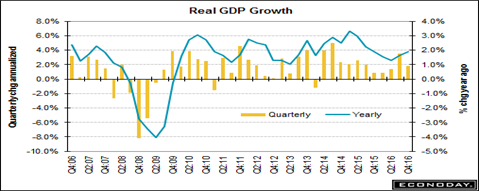
It’s in spite of higher dollar exchange rates that have boosted consumer spending because of cheaper import prices, which dropped GDP growth in Q4 and the year, to 1.9 percent. (Import sales subtract from GDP growth.) So what gives? Is it the Trump euphoria over his promise to cut taxes and regulations?

image

Graph: Econoday

The report in fact is filled with superlatives led by a 4.7 point jump in new orders to 65.1. This rate of monthly growth was last matched in December 2013 and last exceeded in August 2009. Backlog orders jumped 7.5 points to 57.5 in a reading last exceeded in March 2014. Production is also very strong, up 1.5 points to a 62.9 level that is the best since March 2011.This is while consumer confidence index continues to make new post-election highs and new cycle highs at a 114.8 February level, which beats consensus estimates and makes for a strong 3.2 point gain from January.

But beware, says Econoday, “This report perhaps is the greatest expression yet of post-election strength in anecdotal surveys, strength that has yet however to find its way to actual government data on the factory sector which have been consistently soft.”

The data includes just released auto sales, softer at 17.5 million units. Wrightson ICAP had estimated a seasonally adjusted annualized sales pace of 17.7 million.  That would still be a little below the December/January average of 17.9 million, but would represent an increase of roughly 1 percent in both month-to-month and YOY terms.  And it would be about 1.4 percent above the actual 2016 total of 17.46 million, which was a record high.

image

Graph: Econoday

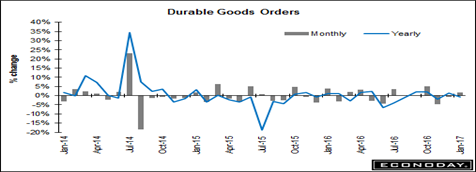
Then there is the January durable goods report for items that last 3 or more years. It shows the usual volatility behind which are sagging numbers for key readings, said Econoday. Aircraft, both domestic and defense, skewed durable goods orders sharply higher in January, up 1.8 percent to hit the consensus. Not hitting the consensus, however, are orders that exclude aircraft as well as all other transportation equipment. This reading fell 0.2 percent to come in well below Econoday’s low estimate for a 0.2 percent gain.

The worst news in the report is a 0.4 percent decline in orders for core capital goods (nondefense ex-aircraft). This ends 3 months of strength for this reading and pulls the rug out from expectations for a first-quarter business investment boom as indicated by business confidence readings.

And longer term investments happen when core capital expenditures are on the increase. So will the manufacturing boom continue?

Harlan Green © 2017

Follow Harlan Green on Twitter: https://twitter.com/HarlanGreen

Posted in Consumers, Economy, Weekly Financial News | Tagged , , , , , | Leave a comment

Slower Q4 Growth, (But) Higher Consumer Confidence

Financial FAQs

The growth in the U.S. economy in the final quarter of Barack Obama’s presidency was left at 1.9 percent, held down by a bigger trade deficit even as consumer spending rebounded strongly. In fact, Q4 GDP growth slowed in part because consumers are spending more, thus boosting imports (which is subtracted from GDP), while exports have been weaker because of the stronger US dollar.

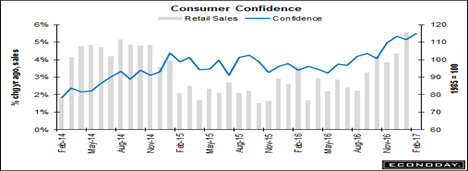
This is while consumer confidence index continues to make new post-election highs and new cycle highs at a 114.8 February level, which beats consensus estimates and makes for a strong 3.2 point gain from January.

 image

Graph: Econoday

But how long will this Trump ‘enthusiasm effect’ last, with his historically low approval ratings for a new president (at least among Democrats and Independents), as well as his failure to start his term with a burst of substantial legislation, as Barack Obama did, writes New York Times Op-ed columnist David Leonhardt?

“The political scientist Matt Glassman in a recent tweetstorm had the best summary I’ve seen,” said Leonhardt. “First, it is radically unusual that party Senators are opposing the President AT ALL. It’s basically unprecedented,” Glassman wrote. “In a normal presidency, party Senators would be on TV constantly, pushing the President’s message and defending his policies.”

The government’s second look at gross domestic product in the fourth quarter showed a bigger increase in purchases by consumers than initially reported: 3 percent vs. 2.5 percent. What Americans spend has the biggest influence by far on GDP (as much as two-thirds of GDP), and the official scorecard for the U.S. economy.

Yet the increase in what consumers spent was offset by somewhat smaller gains in business investment and local and state spending, revised government figures reveal. As a result, GDP was unchanged from the original estimate.

Consumer confidence is rising in tandem with retail sales. Retail sales are making a breakout of their own. It’s an upward revision to what was already a strong December, now at a 1.0 percent surge. This goes in the books as the best December since 2004, reports Econoday. Retail sales have now posted five straight monthly gains in a streak that was last matched 3 years ago, back in early 2014.

image

Graph: Econoday

The Conference Board’s Consumer Confidence report included an 8 tenths dip in those saying jobs are currently hard to get to a very low 20.3 percent, a reading that points to strength for the February employment report coming this Friday. Expectations for future jobs are also strengthening with more, 20.4 percent, more opening up and fewer, at 13.6 percent, seeing less jobs ahead.

Strength in jobs sentiment also makes for strength in income expectations where the spread between optimists and pessimists (18.3 vs 8.2 percent) is a very healthy 10.1 percentage points.

Other details include an uptick in buying plans for autos and no change in inflation expectations, which are at 4.9 percent, soft for this particular confidence reading. Higher confidence has to be the major reason consumers have opened their pocket books, but how long will this last? Much of it is due to initial enthusiasm that President Trump can carry out his agenda announced in last night’s congressional speech.

That is the question, with so many intelligence scandals and conflicts of interest surrounding him. He has to first prove he can lead his own party, which isn’t the case at present.

Harlan Green © 2017

Follow Harlan Green on Twitter: https://twitter.com/HarlanGreen

Posted in Consumers, Economy, Politics, Weekly Financial News | Tagged , , , | Leave a comment

Higher New Home Sales, Mortgage Lending

The Mortgage Corner

We wrote last week about unusually restrictive mortgage standards for conforming stalwarts Fannie Mae and Freddie Mac that are still wards of the US Treasury. Now we’ve learned that they are still doing almost record loan volumes. This is while new-home sales continue to soar in 2017, with continued prospects for growth if builders can find more construction workers—with as many as 50 percent undocumented that may be deported under President Trump’s new deportation orders.

And the National Association of Homebuilders reports they are lacking 200,000 construction workers, which building firms say would enable them to build more affordable housing. But despite the worker shortage, sales of newly built, single-family homes rose 3.7 percent in January to a seasonally adjusted annual rate of 555,000 units, per newly released data by the U.S. Department of Housing and Urban Development and the U.S. Census Bureau.

“This increase in new home sales is in line with our forecast for a steady, gradual recovery of the housing market,” said Granger MacDonald, chairman of the National Association of Home Builders (NAHB). “However, the pace of growth may be hampered by supply-side headwinds, such as shortages of lots and labor.”

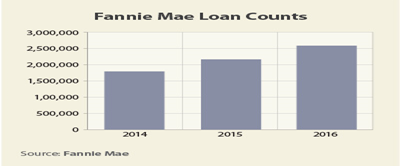
The combined volume of single-family loans purchased by the government-sponsored enterprises (GSEs) Fannie Mae and Freddie Mac totaled $909.2 billion, up nearly 24 percent from the 2015 mark of $733 billion, an analysis of GSE’s annual reports shows, per mortgage magazine Scotsman Guide.

image

Graph: Scotsman Guide

The GSE combined loan counts for 2016 totaled 4.2 million, up more than 13 percent from the 3.7 million loans originated in 2015. Fannie and Freddie are the most important sources of liquidity in the single-family mortgage market. The GSEs purchase and securitize more than half of all residential loans in the U.S., making their activity an indicator of mortgage origination trends.

image

In other words, Fannie and Freddie are the most important sources of liquidity in the single-family mortgage market. Fannie Mae saw the more significant gains over 2015. Fannie’s 2016 loan volume of $512.6 billion was 34 percent higher than in 2014, and its loan count rose by nearly 18 percent, to 2.5 million loans. Notably, Fannie experienced an 84 percent year-over-year surge in refinance activity in the fourth quarter, to 459,000 refis, up from 249,000 in 2015.

This is largely due to the historically low interest rates, even though entry-level homebuyers are still having a difficult time finding affordable homes. And “We can expect further growth in new home sales throughout the year, spurred on by employment gains and a rise in household formations,” said NAHB Chief Economist Robert Dietz. “As the supply of existing homes remains tight, more consumers will turn to new construction.”

The inventory of new home sales for sale was 265,000 in January, which is a 5.7-month supply at the current sales pace. The median sales price of new houses sold was $312,900.

Most analysts believe that refinance activity will drop off sharply in 2017 as interest rates rise, a factor that will lower the GSE counts as well as loan counts for other loan programs. The Mortgage Bankers Association predicted that overall single-family originations will fall to $1.56 trillion in 2017, down from $1.89 trillion in 2016. Aside from Fannie and Freddie loans, this forecast includes the government-loan programs, such as VA and FHA, reports Scotsman Guide.  

Harlan Green © 2017

Follow Harlan Green on Twitter: https://twitter.com/HarlanGreen
Posted in Consumers, Economy, Housing, housing market, Politics | Tagged , , , , , , | Leave a comment

Home Sales Reach 10-year High

Financial FAQs

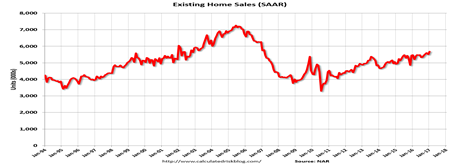
Existing-home sales ran at a seasonally adjusted annual pace of 5.69 million, the National Association of Realtors said Wednesday. That was 3.3 percent above an upwardly-revised 5.51 million in December and 3.8 percent higher than a year ago.

Total existing-home sales , which are completed transactions that include single-family homes, townhomes, condominiums and co-ops, expanded 3.3 percent to a seasonally adjusted annual rate of 5.69 million in January from an upwardly revised 5.51 million in December 2016. January’s sales pace is 3.8 percent higher than a year ago (5.48 million) and surpasses November 2016 (5.60 million) as the strongest since February 2007 (5.79 million), which marked the end of the housing bubble.

image

Graph: Calculated Risk

Lawrence Yun, NAR chief economist, says January’s sales gain signals resilience among consumers even in a rising interest rate environment. “Much of the country saw robust sales activity last month as strong hiring and improved consumer confidence at the end of last year appear to have sparked considerable interest in buying a home,” he said. “Market challenges remain, but the housing market is off to a prosperous start as homebuyers staved off inventory levels that are far from adequate and deteriorating affordability conditions.”

But in fact interest rates have risen substantially only for the less than perfect credit holders, as my recent column has highlighted—those with credit scores below 700 with less than 20 percent down payment, and debt-to-income ratios below 30 percent.

The median existing-home price for all housing types in January was $228,900, up 7.1 percent from January 2016 ($213,700). This is yuge. January’s price increase was the fastest since last January (8.1 percent) and marks the 59th consecutive month of year-over-year gains.

Total housing inventory at the end of January rose 2.4 percent to 1.69 million existing homes available for sale, but is still 7.1 percent lower than a year ago (1.82 million) and has fallen year-over-year for 20 straight months. Unsold inventory is at a 3.6-month supply at the current sales pace (unchanged from December 2016).

It is a record low housing inventory of homes for sale, and means that housing construction hasn’t been able to keep up with the demand for housing, another reason prices are rising so fast and first-time homebuyers are having such a hard time finding affordable housing.

Then we have overly restrictive mortgage qualification standards, mainly because Fannie Mae and Freddie Mac, the main guarantors of conforming mortgages are still ‘owned’ by the US Treasury, which has imposed draconian fees on prospective borrowers with less than perfect credit scores.

NAR President William E. Brown talks about this problem that could possibly drag down inventory for would-be buyers even further in coming months. “Supply and demand imbalances continue to be burdensome in many markets, and now Fannie Mae is supporting a Wall Street firm’s investment in single-family rentals,” he said. “This will only further hamper tight supply and put major investors in direct competition with traditional buyers. Instead, the GSEs should lower overly burdensome fees (link is external) and help qualified borrowers become homeowners.”

“Competition is likely to heat up even more heading into the spring for house hunters looking for homes in the lower- and mid-market price range,” added Yun. “NAR and realtor.com®’s new ongoing research — the Realtors® Affordability Distribution Curve and Score — revealed that the combination of higher rates and prices led to households in over half of all states last month being able to afford less of all active inventory on the market based on their income.”

First-time buyers were 33 percent of sales in January, which is up from 32 percent both in December and a year ago. NAR’s 2016 Profile of Home Buyers and Sellersreleased in late 2016 — revealed that the annual share of first-time buyers was 35 percent.

Much will depend on whether Janet Yellen’s Fed can continue to keep interest rates at their still historic lows. Conforming 30-year fixed rates are still obtainable at interest rates as low as 3.50 percent for those with credit scores above 740—those almost perfect credit score holders. It will be more difficult for the rest, unless the US Treasury eases its death grip on Fannie and Freddie, which would allow many more—as many as 1.1 million more to qualify for an affordable home, according to the Urban Institute.

Harlan Green © 2017

Follow Harlan Green on Twitter: https://twitter.com/HarlanGreen
Posted in Housing, housing market, Politics, Weekly Financial News | Tagged , , , , , , | Leave a comment

Mortgage Market Still Obstructs Lower Income Borrowers

The Mortgage Corner

Earlier this month, researchers at the Urban Institute’s Housing Finance Policy Center published some of their research on lending standards. Drawing on data from the Home Mortgage Disclosure Act, they found that lower-credit applicants accounted for only 33 percent of all applicants in 2015. That compares to 62 percent in 2006, at the height of the bubble, and 50 percent in 2000, when market conditions were generally considered balanced.

image

Graph: Urban Institute

What determines a “lower-credit applicant’, according to the Urban Institute? A FICO score below 700, a loan-to-value ratio less than 78 percent, and debt to income ratio less than 30 percent. That means prospective homeowners and borrowers are either easily discouraged, or other factors that tighter credit criteria are at play, since 700 is still a good credit score and even a 10 percent down payment with 45 to 50 percent debt to income ratios usually mean a credit-worthy borrower in today’s housing markets.

Of course it makes sense that borrowers with “less than perfect credit” would have a more difficult time qualifying for a mortgage. But why 7 years into this recovery would so many lower credit applicants still have problems qualifying?

There are a number of factors, including higher home prices, of course. And incomes are not rising as they should even with this low inflation environment, while mortgage rates remain historically low—still below 4 percent for conforming 30-year fixed rates—an incredible boon for prospective homebuyers given the low inflation environment..

In fact, it’s not so much that lending standards are stricter. Rather, thanks to the government ownership of conventional mortgage giants Fannie Mae and Freddie Mac, mortgages have become more expensive because of so-called fee addon’s with “less than perfect” credit scores below 700, which Fannie Mae and Freddie Mac have tacked on more recently.

Why discourage what are very credit-worthy borrowers in normal times? Costs go up exponentially with credit scores below 720 for Fannie Mae and Freddie Mac guaranteed mortgages—as much as 2.5 points, which translates to an equivalent 0.625 percent rate increase.

It seems that the US Treasury has been trying to discourage all but the most credit-worthy borrowers, all in the name of down-sizing the GSEs. In fact the Obama Treasury Department has made no secret of wanting to close down Fannie and Freddie, which is why it has been taking all of its profits since a 2012 modification to Treasury’s conservation agreement, rather than allowing them to build up their capital base.

image

Graph: Calculated Risk

Yet delinquency rates are almost back to historical levels. Fannie Mae reported that the Single-Family Serious Delinquency rate barely increased to 1.23 percent in November, up from 1.21 percent in October. Big Deal! The serious delinquency rate is down from 1.58 percent in November 2015. But that is close to the long term delinquency rate that is just under 1 percent. The definition of serious delinquency is mortgage loans that are “three monthly payments or more past due or in foreclosure”.  

The Urban Institute’s Laurie Goodman, co-director of the Housing Finance Policy Center, sees the decline in lower-credit applicants as clearly problematic, and symptomatic of an overly-tight mortgage market, although it’s not clear whether would-be applicants are holding back because they are aware they may not qualify, or for some other reason, such as not having enough money for a down payment or losing interest in homeownership.

Earlier Urban analysis suggested that tight lending meant that 1.1 million mortgages that would have been made in 2001 were “killed” – never written – in 2015. The real answer to this problem of what is really a defacto denial of credit to lower income homebuyers is to pry Fannie Mae and Freddie Mac from the greedy grasp of Treasury and return them to the private marketplace.

There are many forms that could take, but it means Congress and the Trump Administration has to show some initiative.

Harlan Green © 2017

Follow Harlan Green on Twitter: https://twitter.com/HarlanGreen
Posted in Consumers, Housing, housing market, Weekly Financial News | Tagged , , , , , | Leave a comment

Housing Construction Boosted By Low Rates

The Mortgage Corner

Housing starts returned to trend, reports the National Association of Home Builders, dropping 2.6 percent to a seasonally adjusted annual rate of 1.246 million units, according to newly released data from the U.S. Department of Housing and Urban Development and the U.S. Census Bureau. Multifamily production fell 10.2 percent to 423,000 units after an unusually high December 2016 reading, whereas single-family starts ticked up 1.9 percent to 823,000 units.

But year-on-year both components are very positive, up 6.2 percent for single-family homes and at a very strong 19.8 percent for multi-units. And with interest rates still at historical lows, 2017 should be a very good year for new-home starts and sales.

image

Graph: Calculated Risk

“Some pull back in housing production is unsurprising after an overly strong multifamily reading last month,” said NAHB Chief Economist Robert Dietz. “As we move forward in 2017, we can expect the multifamily sector to continue to stabilize and single-family production to move forward at a gradual but consistent pace.”

Regionally in January, combined single- and multifamily housing production rose 55.4 percent in the Northeast and 20 percent in the South. Starts fell by 17.9 percent in the Midwest and 41.3 percent in the West, where skyrocketing housing prices have slowed sales.

Speaking of the western region, the California Association of Realtors reports rising wages and seasonal price declines held California’s housing affordability steady in fourth-quarter 2016, even while interest rates rose moderately.

The percentage of home buyers who could afford to purchase a median-priced, existing single-family home in California in fourth-quarter 2016 remained at 31 percent, unchanged from the third quarter of 2016 but was up from 30 percent in fourth-quarter 2015, according to C.A.R.’s Traditional Housing Affordability Index (HAI).

This is the 15th consecutive quarter that the index has been below 40 percent and is near the mid-2008 low level of 29 percent. California’s housing affordability index hit a peak of 56 percent in the third quarter of 2012, when both housing prices and interest rates were lower.

I project that mortgage rates will remain low, in what is becoming an interesting anomaly. Mortgage rates have fallen of late, while Treasury bond yields have been rising in anticipation of rising inflationary pressures if Republicans do increase federal spending.

Per Market Watch, Sean Becketti, chief economist of Freddie Mac, said something unusual is going on — the 30-year mortgage isn’t moving in line with the yield on the benchmark 10-year Treasury, as it has for the past 46 years.

Since Dec. 29, the 30-year has dropped 17 basis points, but the yield on the 10-year bond has stayed the same, he says. “While we expect mortgage rates to fall into line with Treasury yields shortly, this just may be a year full of surprises,” he said.

Mortgage rates slipped for a second week even as they retain most of the rise since Donald Trump was elected president, but not much. The 30-year fixed conforming rate is still at 3.75 percent for 1 origination point, 4.0 percent with no origination points.

Why? Banks are flush with cash and investors are snapping up mortgage-backed securities in search of higher yields. And while Fannie Mae and Freddie Mac continue as US Treasury wards, they provide as much security as Treasury bonds, but with a much better yield.

Just do the numbers—30-year Treasury yields have hovered around 3 percent, vs. 3.75 to 4 percent yields on Fannie and Freddie mortgage-backed securities.

But the future of Fannie and Freddie are not certain. New Treasury Secretary Steven Mnuchin has said he would like to see the GSEs privatized. Economists have predicted that if that happened it could raise mortgage rates from 0.4 to as much as 1 percent.

That’s how valuable even an implicit government guarantee of such securities means, since banks would demand higher yields to be part of a consolidate secondary market. And let us not even try to imagine what life would be like for homeowners if Fannie Mae and Freddie Mac disappeared. They are responsible for more than 60 percent of all home mortgage originations at present.

Harlan Green © 2017

Follow Harlan Green on Twitter: https://twitter.com/HarlanGreen

Posted in Consumers, Housing, housing market, Weekly Financial News | Tagged , , , , , , , | 1 Comment

Retail Sales and Consumer Prices Show Real Life

Financial FAQs

Retail sales rose 0.4 percent last month following a much bigger gain in December than originally reported, the government said Wednesday. Economists polled had forecast a 0.2 percent increase. Retail sales are now up more than 5 percent annually, approaching more normal spending. December spending was also revised upward to 1 percent from an already strong 0.6 percent.

image

Graph: Econoday

And gas prices are rising along with consumer spending, which is boosting retail prices. The headline year-on-year Consumer Price Index, reflecting easy energy comparisons with 2016, is moving higher, well above the Fed’s general 2 percent target at 2.5 percent. This is up 4 tenths in the month and is the highest in nearly 5 years. The core rate is also up, at a year-on-year 2.3 percent for a 1 tenth gain.

This shows an economy returning to a more normal 3 percent GDP growth rate, as well. The question now is what does this mean for jobs and the workers to fill them, as we are already near full employment.

image

Graph: Econoday

Every major retail sector reported higher sales except for auto dealers, whose business tends to tail off after the Christmas shopping season. Auto purchases account for about one-fifth of all retail spending. And if autos and gasoline are excluded U.S. retail sales rose a robust 0.7 percent, the Commerce Department said.

Outlets such as Best Buy that sell electronics and appliances saw a 1.6 percent rise in sales, the largest gain in a year and a half. Stores that sell clothing and sporting goods also posted sales gains of 1 percent or more. Even department stores, whose sales fell sharply in 2016, got into the act. Department-store receipts surged 1.2 percent in January to mark the biggest increase in more than a year.

image

Graph: NFIB

One clue to where additional jobs may come is the National Federation of Independent Business survey for small businesses, which account for more than 60 percent of the hires these days. And their confidence has soared since Donald Trump’s election with his promise of lower taxes and regulations.

A majority of small business owners are making no secret of their love for freer markets. “The continued surge in optimism is a welcome sign that economic growth is coming, said NFIB Chief Economist Bill Dunkelberg. “The very positive expectations that we see in our data have already begun translating into hiring and spending in the small business sector.” 

Job openings and job creation plans both posted small gains, pushing the NFIB Jobs Report into a strong, positive direction. Dunkelberg, as well said the data could signal higher GDP growth in 2017. 

The recent growth in optimism looks similar to the surge in the Index in 1983, which was followed by years of economic prosperity, said the NFIB. After eight years of struggling with government barriers, small business owners are hopeful that policy proposals from the new administration and Congress will spur economic growth in a similar manner, said NFIB President and CEO Juanita Duggan.

However, one still uncertain factor is the direction of interest rates. Both mortgage rates and Treasury yields are still at historic lows, but how long will that last with faster growth?

Fed Chair Janet Yellen surprised markets with her congressional testimony yesterday when she told lawmakers that waiting too long to raise interest rates would be “unwise.” This comment, along with assurances that the Fed will raise rates at one of its coming meetings, inspired a sharp selloff in Treasury securities. Bond yields rise as prices fall.

The yield on the 10-year Treasury note rose five basis points to 2.52 percent today, while the yield on the two-year note gained 3.3 basis points to 1.27 percent. The yield on the 30-year Treasury bond rose 4.8 basis points to 3.10 percent. But these rates are still at historical lows, and would have to rise another 1 to 2 percent to accommodate inflation rates that have historically accompanied higher growth rates.

Harlan Green © 2017

Follow Harlan Green on Twitter: https://twitter.com/HarlanGreen
Posted in Consumers, Economy, Weekly Financial News | Tagged , , , , , , | Leave a comment

Let’s Make America More Equal Again!


workers

Popular Economics Weekly

As defeated Democrats mull over what slogan can equal or overcome President Trump’s “Make America Great Again”, I have a suggestion, one that might even enthuse populist Republicans. Let’s make American more equal again, just as it was in the 1960s and 70s, when we had a thriving middle class in which its children could hope to exceed their parents’ station in life.

After all, it was our thriving middle class that kept the more extreme elements of both political parties and persuasions at bay, so that Republicans and Democrats actually talked to each other. And a middle class will only thrive where there is less income inequality, something that most well-meaning Americans support.

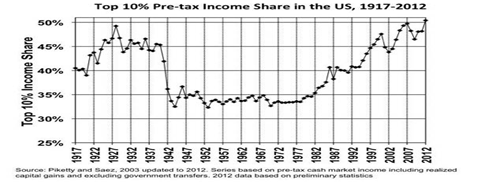
But that was then and we live in now, when most children of the baby boomers now retiring do not hope to do better than their parents. Household incomes have stagnated since the 1970s, and the top income earners since the Great Recession now have garnered almost all of the increase.

image

Graph: Gallup poll

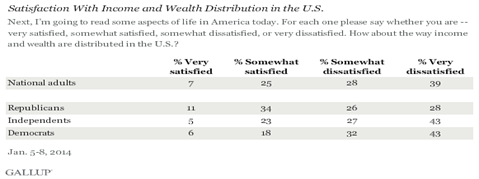
That is why two out of three Americans are dissatisfied with the way income and wealth are currently distributed in the U.S. This includes three-fourths of Democrats and 54 percent of Republicans, according to a recent Gallup poll.

The Great Recession was brought on by Wall Street’s excesses, and the deregulation boom of the Clinton and GW Bush presidential reigns. So why not create programs that Make America More Equal Again?


image

Graph: Saez-Piketty

Overall, the share of Americans living in middle-class households has declined from 61 percent in 1971 to 50 percent, reports a recent Pew Research study. The hollowing out of the middle class has been a source of consternation among many economists, politicians and the public at large, says those surveyed. They say as Americans move toward the economic extremes it is harder to find common ground, and a common sense of what it means to be an American.

Much of that inequality is in the Midwestern rust belt states that lost those blue collar manufacturing jobs during the globalization and multi-nationalization of US corporations that President Trump promised to bring back again.

So President Trump was no dummy in recognizing this fact. Then how could Democrats be so blasé and oblivious to this fact among their former supporters? Everyone saw it coming; the disenfranchisement of whole segments of working class voters that had descended into depression and drug use in those formerly blue and Democrat-voting states.

There have been many suggestions of how to bring back higher-paying jobs, but candidate Trump seems to have fastened on just three—building more infrastructure, destroying multi-lateral trade agreements like the TPP and NAFTA, as well as limiting immigration inflows to make more jobs available to those suffering American workers.

The first suggestion has been backed by both Democrats and Republicans, and now that President Trump wants it Republicans will stop opposing infrastructure spending, even if it busts the federal budget.

However, building more immigration and trade barriers won’t create greater equality, nor will opposition to minimum wage laws, such as advocated by the Trump pick for new Labor Secretary—CEO of fast food chains Andrew Puzder. Because most immigrant jobs are low-paying, jobs that Americans don’t want anyway. And higher trade barriers for the purpose of bringing jobs home will raise the prices of imported goods, cancelling out much of the income boost from higher-paying jobs.

What won’t work either is the blatant voter and collective bargaining-suppression laws enacted, or about to be enacted in the 25 all-red states with absolute Republican majorities. Such a blatant suppression of minority voters and the wages of working class Americans will suppress their wages, hardly the road to greater equality.

What also won’t work are the attempts to destroy Obama’s Affordable Care Act that have boosted the buying power of at least 20 million working class voters by reducing overall medical costs, as well as Dodd-Frank regulations that have suppressed some of the excessive profit-taking of Wall Street at the expense of State Street.

The same poll updated a long-time Gallup trend, finding that 54 percent of Americans are satisfied, and 45 percent dissatisfied, with the opportunity for an American “to get ahead by working hard.” This measure has remained roughly constant over the past three years, but Americans are much less optimistic about economic opportunity now than before the recession and financial crisis of 2008 unfolded. Prior to that, at least two in three Americans were satisfied, including a high of 77 percent in 2002.

So there are many reasons for Democrats and even truly populist Republicans to support programs that increase income equality. But they can’t be about building more walls. A robust and more politically temperate American middle class can only include Americans of all nationalities and ethnicities.

Harlan Green © 2017

Follow Harlan Green on Twitter: https://twitter.com/HarlanGreen
Posted in Consumers, Economy, Politics, Weekly Financial News | Tagged , , , , , | Leave a comment