A Greater Lawlessness—On Tyranny

Financial FAQs

image

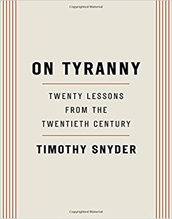
Have we elected a tyrant as President? It’s hard to believe the clownish behavior and blatant lies of President Donald Trump could make him a tyrant, but author and history Professor Timothy Snyder says he has all the makings of a tyrant in On Tyranny, a pamphlet-size book making the rounds of talk shows.

It has 20 valuable lessons on how to avoid tyrannical governments, such as is happening now in Washington with one political party possibly controlling all three branches of government, if Supreme Court nominee Neil Gorsuch is confirmed—and why this is leading to the greatest lawlessness in our history with the Trump administrations and a Republican Party that is not only quiescent to his blatant law breaking, but in some ways has aided and abetted it.

“As they know,” Snyder begins in his Prologue, “Aristotle warned that inequality brought instability, while Plato believed that demagogues exploited free speech to install themselves as tyrants.”

We now have the greatest income inequality since 1929, and it led to the Great Recession and political polarization we have today. President Donald Trump would not have been possible, if incomes hadn’t declined so drastically for those dissatisfied white voters from the rust-belt.

And then there was the Russian meddling in our media with thousands of bots sending out fake social media news, Tweets, and Wikileaks exploiting the hacked Democrat’s emails, not to speak of Breitbart propaganda campaign of inflaming the alt-right, all white nationalists.

Professor Snyder listed three of the most important lessons on HBO’s Bill Maher show.

#1) “Don’t obey in advance—Most of the power of authoritarianism is freely given. In times like these, individuals think ahead about what a more repressive government will want, and then offer themselves without being asked.”

How could that happen? How could West Virginians in the heart of what was formerly coal country vote more than 2 to 1 for Donald Trump over Hillary Clinton in a historically Democratic state?

And this is leading to the acquiescence in the rollback of environmental laws that will allow more and dirtier coal mining, as well as coal-powered plants, when more than 250 coal plants have already closed, with cheaper natural gas replacing coal.

It is mainly out of ignorance of what was in their best interests. Coal now occupies but a minor position in W Virginia’s economy with natural gas and renewable energies having replaced it since 1980, according to Nobel Economist Paul Krugman.

#2) “Defend Institutions—It is institutions that help us to preserve decency. So choose an institution you care about—a court, a newspaper, a law, a labor union—and take its side.”

Sound familiar? What has Donald Trump been attacking—the courts, the media (“enemies of the people”), laws that prevent conflicts of interest, and labor union laws that protect worker safety. I might add scientific facts, as he has said he believes global warming a “hoax”. So in effect Trump is attacking all of the institutions that preserve decency and a functioning democracy.

“Institutions do not protect themselves. They fall one after the other unless each is defended from the beginning,” said Snyder.

#3) “Above all believe in truth,” as without truth there is no trust, and without trust there are no effective laws, which leads to tyranny. And candidate, now President Donald Trump, has made a point of blatant lying, meaning he wants his followers to believe whatever he says rather than objective facts such as global warming, or size of the audience that attended his inauguration.

This can only be because his followers have acquiesced in advance, either out of ignorance of the actual facts, or because they will follow him regardless of the consequences to themselves and the nation.

We can only preserve democracy and defeat tyranny in all its forms—including fascism, racism, discrimination, propaganda, oligarchies, if we learn from history. “History does not repeat, but it does instruct,” says Professor Snyder in On Tyranny, a must read for anyone wanting to understand the rise of President Trump.

Harlan Green © 2017

Follow Harlan Green on Twitter: https://twitter.com/HarlanGreen
Posted in Economy, Politics, Uncategorized | Tagged , , , , , | Leave a comment

Job Claims Down, GDP Revised Up, And 2017?

Financial FAQs

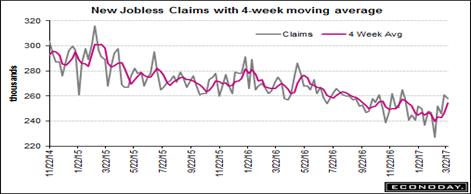
Initial weekly jobless claims for unemployment benefits, the best predictor of employment trends, continues downward, but with some upward blips of late that are probably due to still severe weather in the northeast (snow) and south (tornadoes). And the revised fourth quarter GDP growth estimate was up slightly, with signs that 2017 could be better.

Wrightson-ICAP says, “The number of unemployment insurance beneficiaries has fallen sharply in recent weeks, from an average of 2.064 million in January and February to 1.990 million in the week of March 11.  The combination of that slide and the dramatic improvement in the job-availability numbers in the Conference Board’s record consumer confidence report earlier this week suggests that the national unemployment rate might slip a notch from February’s 4.7 percent level.”

image

Graph: Econoday

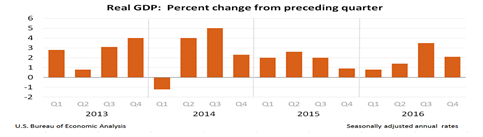
So we could finally be approaching full employment, last seen in early 2000 before the Great Recession bust, even though there are still some 7 million adult workers either working part time, or looking for work? Q4 GDP growth rose to 2.1 percent, but down from a 3.5 percent increase in Q3.

“The increase in real GDP in the fourth quarter reflected positive contributions from PCE, private inventory investment, residential fixed investment, nonresidential fixed investment, and state and local government spending that were partly offset by negative contributions from exports and federal government spending. Imports, which are a subtraction in the calculation of GDP, increased,” said the BEA report.

This is while corporate profits surged 22.3 percent year-over-year in Q4, another sign that growth should pick up this year. Why? Well, corporations will hopefully want to expand production, which means more jobs and capex investments. But that hasn’t happened yet, as business investment isn’t increasing at present, and hasn’t for more than 1 year.

image

Graph: Econoday

Capital expenditure among the 1,000 largest companies took a step back last year, declining $74 million from 2015, on average. The decline built on the $11 million average decline in 2015 after four years of spending growth ending in 2014. Much of it is due to the decline in oil and gas production, as there is already a glut of fossil fuel supplies which has kept oil prices at the $50/barrel level or lower for several years now.

What does all this mean for 2017 growth? At risk of sounding too repetitive, I maintain Congress and the Trump administration must be on the same page if they want to get anything done. Trying to push the repeal of Obamacare up front didn’t work. And tax reform may have the same problem if the tax breaks only go to the wealthiest, as would have happened with the repeal of Obamacare.

Nor will cutting back on environmental regulations, gas mileage requirements, scientific research and development spur growth, since most job growth and innovation these days is in the green industries. We know trickle-down economics has never worked. What is needed is more direct job creation with such as an infrastructure bill.

But is that possible with all the senseless bickering of Republicans because their cherished dream of repealing Obamacare didn’t happen?

Harlan Green © 2017

Follow Harlan Green on Twitter: https://twitter.com/HarlanGreen
Posted in Consumers, Economy, Keynesian economics, Weekly Financial News | Tagged , , | Leave a comment

A Greater Lawlessness—Part II, The Trump Presidency

Populareconomics

Popular Economics Weekly

Rachel Maddow on last night’s MSNBC show provided evidence that the Trump White House has been lying from day-one of the Trump Presidency. The White House had denied it asked that tanks and other armaments be included in the inauguration parade, when Freedom of Information Pentagon documents surfaced recently that showed Trump officials had requested that military weapons be included in the parade.

This is but more evidence that the Trump campaign is determined to cover up and/or deny culpability for any of their misdeeds, whether real or imagined.

Rachel then concluded that the Trump White House could not be counted on to provide truthful information on any subject to the media, whom Trump had declared were “enemies of the people”, after all. So it is up to the public media to look for the facts elsewhere.

And now we know the Trump campaign, and possibly Trump himself, had done much more than that in its misinformation campaign during the run up to the November election, which in some ways puts Russia’s kompromat campaign of slander and fake news against Hillary Clinton to shame.

More-and-more evidence is surfacing that it was the compromising of FBI Director Comey that led to Hillary’s downfall. The so-called conspiracy that was one of the misdeeds being investigated by South Manhattan Attorney General Preete Bahara when he was suddenly fired. It was about the collusion of Trump campaign officials with the NYPD, and Manhattan FBI officials that had possession of Anthony Weiner’s laptop in their investigation of his internet sexting escapades with women.

A January Huffington Post article documented what was a “domestic conspiracy” to elect Donald Trump. It in effect said information presently public and available confirms that Erik Prince, Rudy Giuliani, and Donald Trump conspired to intimidate FBI Director James Comey into interfering in, and thus directly affecting, the 2016 presidential election. This conspiracy was made possible with the assistance of officers in the New York Police Department and agents within the New York field office of the Federal Bureau of Investigation.

The report went on to say, “As reported by the New York Times, FBI Director James Comey released his now-infamous October 27th letter in substantial part because he had determined that “word of the new emails [found on Anthony Weiner’s computer]…was sure to leak out.” Comey worried that if the leak occurred at a time when the nature and evidentiary value of the “new” emails was unknown, he “risked being accused of misleading Congress and the public ahead of an election.”

By October 27th, the FBI had had access to Weiner’s computer—which it originally received from NYPD—since October 3rd, during which interval the Bureau had both the time and IT know-how to determine that the “new” emails in its possession were in fact duplicate emails from accounts already revealed to the Bureau by Clinton, her aide Huma Abedin, and the State Department.

However, when Comey was briefed on the case by agents from the New York field office on October 26th, he discovered that not only had this IT work not been done, but in fact no warrant to seize the full emails had been sought, no permission to read the emails had been requested from cooperating witnesses Weiner and Abedin, and indeed nothing but a summary of the emails’ “meta-data” (non-content header information) had been prepared by his agents.”

And when they discovered there were emails from Hillary to her aid Huma Abedin and Weiner’s wife that were also included on the laptop, they immediately began pushing Comey to reveal the links that might possibly be material evidence in his probe of Hillary’s use of a private email server.

And both polling, poll analysis, and internet meta-data (see below) confirm that the Comey Letter was sufficient to hand Trump the 77,143 combined votes in Wisconsin, Michigan, and Pennsylvania that won him the election. We know from the statements made by Giuliani, and from numerous statements made by Trump on the campaign trail, that both men believed the Clinton email server case could be leveraged to ensure Clinton’s defeat in November. It turns out they were correct.

I first began writing about the greater lawlessness among Republicans wanting to maintain power in the face of a declining party membership in 2002, when it became obvious that the GW Bush administration was cooking the CIA findings on Iraq’s weapons of mass destruction to justify their invasion and coopting of Iraq’s oil fields. The underlying reason was once again greed, led by Vice President Cheney’s oil company friends who thought they would be able to control Iraq’s vast oil reserves.

Then they turned the Iraqi economy into a conservative dream, a tariff-less free enterprise entity that allowed cheaper US imports to put many Iraqi companies out of business, and was a major reason for the Sunni-led uprising and civil war that ensued.

We now know that on January 12th, the DOJ announced that the Inspector General would be investigating the sequence of events comprising the Prince-Giuliani-Trump conspiracy. Inspector General Horowitz noted that within his brief was investigation of the series of leaks that occurred between the NYPD, the FBI, and outside entities—including, we can surmise based on context, the Trump campaign.

Harlan Green © 2017

Follow Harlan Green on Twitter: https://twitter.com/HarlanGreen

Posted in Politics, Uncategorized | Tagged , , , , , , , | Leave a comment

Consumer Confidence Highest In 16 Years

Financial FAQs

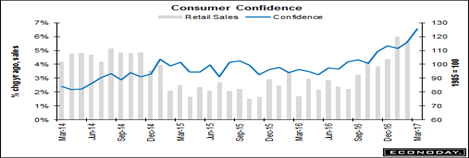
The Conference Board’s Consumer Confidence Index soared to its highest level in 16 years. Its Consumer Confidence Index®, which had already increased in February, improved again in March. The Index now stands at 125.6 (1985=100), up from 116.1 in February. The Present Situation Index rose from 134.4 to 143.1 and the Expectations Index increased from 103.9 last month to 113.8.

image

Graph: Econoday

“Consumer confidence increased sharply in March to its highest level since December 2000 (Index, 128.6),” said Lynn Franco, Director of Economic Indicators at The Conference Board. “Consumers’ assessment of current business and labor market conditions improved considerably. Consumers also expressed much greater optimism regarding the short-term outlook for business, jobs and personal income prospects. Thus, consumers feel current economic conditions have improved over the recent period, and their renewed optimism suggests the possibility of some upside to the prospects for economic growth in the coming months.”

But the survey was completed before Republicans pulled the Obamacare repeal bill. And if Congress can’t agree on passage of tax reform legislation, which will be just as controversial, then such optimism could turn into pessimism that has haunted past deadlocked Congresses.

And interest rates are falling, even with the Federal Reserve predicting it might continue to boost short term rates. For instance, the 10-year Treasury yield has dropped to 2.35 percent, unheard of except when economic growth has slowed to a crawl, or a recession is looming.

This is what happens when the so-called Treasury yield curve flattens. Then there is less room for banking profits, since short term rates the Fed controls are basically banks’ cost of doing business, and longer term rates are what they earn when they lend money.

Consumers were significantly more optimistic about the short-term outlook. The percentage of consumers expecting business conditions to improve over the next six months increased from 23.9 percent to 27.1 percent, while those expecting business conditions to worsen declined from 10.5 percent to 8.4 percent.

Consumers’ outlook for the labor market was also more upbeat. The proportion expecting more jobs in the months ahead increased from 20.9 percent to 24.8 percent, while those anticipating fewer jobs declined from 13.6 percent to 12.2 percent. The percentage of consumers expecting their incomes to increase improved from 19.2 percent to 21.5 percent, while the proportion expecting a decrease declined from 8.1 percent to 7.0 percent.

But these heightened expectations can only be fulfilled with a Trump team that knows what it is doing, which President Trump will eventually realize requires skilled and knowledgeable people to run the various government agencies, rather than the ideologues he has been appointing to date that are intent on “de-constructing” government, to use the words of Breitbart’s Steve Bannon, now his chief White House strategist.

Harlan Green © 2017

Follow Harlan Green on Twitter: https://twitter.com/HarlanGreen
Posted in Consumers, Economy, Politics, Weekly Financial News | Tagged , , , , | Leave a comment

New Home Sales Surge, Existing Sales Not So Much

The Mortgage Corner

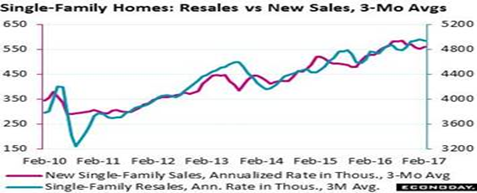
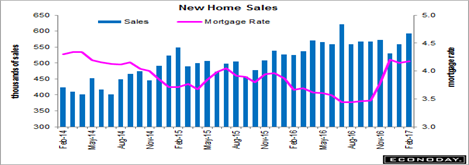
New home sales shot 6.1 percent higher in February to a 592,000-annualized rate and is near the 600,000 top estimate of economists. Sales appeared to have gotten a boost from builder concessions as the median price fell a monthly 3.9 percent to $296,200 for a year-on-year rate that’s suddenly in the negative column at minus 4.9 percent.

And existing home sales were down 3.7 percent in February to a 5.480 million annualized rate, below January’s 5.55 million rate. Details are mostly weak including a 3.0 percent decline for single-family sales to a 4.890 million rate and a sharp 9.2 percent drop for condos to a 590,000 rate. But that could be the end-of-winter blahs, as year-on-year, single-family sales are up 5.8 percent with condos not up so much at 1.7 percent.


image

Graph: Econoday

Strength in new-home sales was centered in the Midwest where the sales rate surged 21,000 to 89,000 and easily surpassing 11,000 gains for the both the West, at 157,000, and the South at 313,000. Sales in the Northeast fell sharply in last week’s existing home sales report and are down 9,000 to a very low 33,000 annualized rate in today’s new-home report.

But that could also be due to the month’s severe storms, including at least one Nor’easter that brought up to 2 feet of snow to some parts of New England.

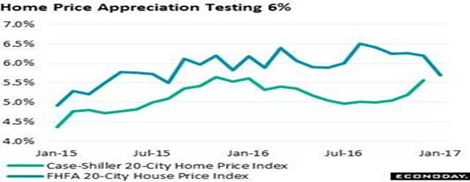
What is happening with some conforming prices from FHFA not rising at all in February? In a note by Econoday, the Federal Housing Finance Authority’s house price index came in unchanged in January with year-on-year appreciation falling a steep 5 tenths to 5.7 percent. This is the weakest month-to-month result in more than 4 years and the weakest year-on-year rate since August 2015, and at a time when supply is pointing to very strong conditions, at only 3.8 months for resales which is down 6 weeks from this time last year.

image

And days on the market are very tight, at 45 vs 59 days a year ago. A highlight of the coming week will be Case-Shiller’s report which tracks resale prices and which, in another housing puzzle, now appears to be violently converging with FHFA.

Another indicator of housing sales, the Pending Home Sales Index, a forward-looking indicator based on contract signings, decreased 2.8 percent to 106.4 in January from an upwardly revised 109.5 in December 2016. Although last month’s index reading is 0.4 percent above last January, it is the lowest since then.

It was insufficient supply levels that led to a lull in contract activity in the Midwest and West, which dragged down pending home sales in January to their lowest level in a year, according to the National Association of Realtors.

Lawrence Yun, NAR chief economist, says home shoppers in January faced numerous obstacles in their quest to buy a home. “The significant shortage of listings last month along with deteriorating affordability as the result of higher home prices and mortgage rates kept many would-be buyers at bay,” he said. “Buyer traffic is easily outpacing seller traffic in several metro areas and is why homes are selling at a much faster rate than a year ago. Most notably in the West, it’s not uncommon to see a home come off the market within a month.”

All this means that rather than a housing bubble, we are still in a housing shortage with affordable housing the main victim. And any improvement in supply largely depends on mortgage rates remaining low, despite further Federal Reserve rate hikes and a Trump administration spending spree. So I predict we have no more than a one year window for such low rates to remain.

Harlan Green © 2017

Follow Harlan Green on Twitter: https://twitter.com/HarlanGreen
Posted in Consumers, Housing, housing market, Weekly Financial News | Tagged , , , , , | Leave a comment

A Greater Lawlessness—Self Interest vs. The Common Interest

Popular Economics Weekly

Are we at the beginning of an era of Greater Lawlessness, or nearing the end, with the greatest law breaking we may have seen in our lifetime? And are we at the beginning or end of the greatest wealth accumulation by the wealthiest, of another Gilded Age that last happened in 1900, at the beginning of the Industrial Age?

In a potentially bombshell report, CNN reported Wednesday night that the FBI has information that suggests members of President Donald Trump’s team may have colluded with Russian operatives to coordinate the release of damaging information in an effort to torpedo Hillary Clinton’s presidential campaign.

FBI Director James Comey had already testified in televised House hearings that the Trump campaign team was under criminal investigation for collusion with Russian intelligence operatives in trying to undermine the legitimacy of US elections and democracy in general.

Such interference by Russian and even Wikileaks has led to the election of possibly the most corrupt President in US history, with his refusal to divest himself of his assets that are creating countless conflicts of interest, as well as blatantly ignoring the emoluments clause of the US Constitution that prohibits presidents from being compensated by foreign governments.

How did the US, leader of the free and democratic world since WWII, become so weak and vulnerable that Russian hackers could help to elect Donald Trump, an openly pro-Putin ally who wants to implement the Kremlin’s own foreign policies and subvert those of the democratic western world?

We have had major lawbreaking by Presidents before with Nixon’s Watergate, which was a break into Democratic National Committee headquarters to steal their election plans. Sound familiar?

Then there was President Reagan and the Iran-Contra Affair in the 1980s, which entailed the secret shipping of some $8 million in weapons to Khomeini’s Iranian government to aid them in their Iraq war, and more than 250 criminal convictions of Reagan era office holders for law breaking.

This was in part because President Reagan considered government the problem, and therefore its laws and regulations to be subverted or ignored when inconvenient to his goals.

What were those goals? It’s in fact a long story, but one that can be summarized easily. Such a greater lawlessness of elected representatives and presidents in particular, began with the concerted push to transfer greater wealth to the already wealthy begun in the 1970s and catalogued best in Jacob Hacker & Paul Pierson’s Winner-Take-All Politics. It was the beginning of massive tax cuts, and gutting of labor protection laws, the backbone of middle class prosperity, which weakened labor’s ability to both organize and bargain collectively, and resulted in the massive globalization of the labor force.

These policies were implemented under the rationale that self-interest trumped the common interest championed by governments, and therefore those laws that supported public interest should be subordinate to private interests. Its ideologues and supporters advocated an economic program called trickle-down economics that maintained the owners of capital knew best how to run a country and create the greatest prosperity for all with only the most minimal government regulations and protections, in order to maintain US leadership as a world power.

This led to the abuses of the housing bubble and wholesale loss of middle class wealth from overleveraged Wall Street, a shadow banking system, and failure of financial institutions such as Lehman Brothers that bankrupted millions of ordinary workers.

It led to the Great Recession, which did as much damage to the US economy as the much longer Great Depression, but without the leadership of an FDR and Francis Perkins, his Labor Secretary, who created most of the modern social safety net, including social security and the Fair Labor Standards Act, the first minimum wage and overtime laws for American workers.

image

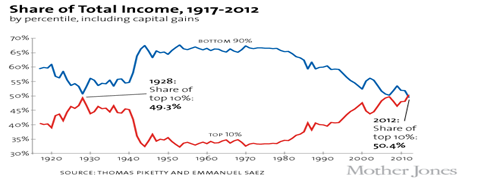
It has also led to the greatest income inequality since the beginning of the Great Depression in 1929, which in turn led to the polarized electorate we have today. There is very little left of the middle class created after WWII that grew due to New Deal legislation that protected unions and collective bargaining, funded early education and government research that gave US the technological edge.

Under the aegis of a revolt against globalization, we have instead elected those who believe healthcare should be restricted only to those that can afford it, a government so diminished that it no longer is able to protect the environment, educate all in public schools and tuition-free public universities, or protect the public from Wall Street excesses, (which means another recession is inevitable).

All this could only have happened with the greater lawlessness we have today that a president and White House make no attempt to hide. President Trump seems to believe in the Mafia code, a code that trusts only his family and closest associates, where the only honor is the honor among thieves, some of whom are turning out to be Russian oligarchs whose stolen wealth he is more than happy to launder in his various real estate holdings.

CNN, basing its report on unnamed U.S. officials, said the evidence is largely circumstantial and is not yet conclusive, though the investigation is ongoing and is now focusing on the possibility of that collusion. The FBI’s information is based on “human intelligence, travel, business and phone records and accounts of in-person meetings,” CNN said.

Rep. Adam Schiff (D-Calif.) went a step further Wednesday, telling MSNBC “there is more than circumstantial evidence now” of collusion with Vladimir Putin’s Russia.

So is this the beginning, or the end of an era of rampant lawlessness that began almost 50 years ago, and that few of the lawbreakers have paid for, from Presidents to Wall Street financiers?

Maybe the various investigations will help is to understand what has happened to the no longer United States of America?

Harlan Green © 2017

Follow Harlan Green on Twitter: https://twitter.com/HarlanGreen
Posted in Economy, Keynesian economics, Politics, Weekly Financial News | Tagged , , , , , , , , | Leave a comment

New Home Sales Surge

The Mortgage Corner

New home sales shot 6.1 percent higher in February to a 592,000 annualized rate that easily beats the Econoday consensus for 565,000 and is near the top estimate of 600,000. Sales seemed to have a boost from builder concessions as the median price fell a monthly 3.9 percent to $296,200 and down 4.9 percent year-on-year.

image

Graph: Econoday

Strength is centered in the Midwest where the sales rate surged 21,000 to 89,000 and easily surpassing 11,000 gains for the both the West, at 157,000, and the South at 313,000. Sales in the Northeast fell sharply in yesterday’s existing home sales report and are down 9,000 to a very low 33,000 annualized rate in today’s report.

“February’s increase in new home sales is consistent with builders’ growing confidence in the housing market,” said Granger MacDonald, chairman of the National Association of Home Builders (NAHB). “Builders are encouraged by heightened consumer activity and by the expectation that regulatory costs will decline in the year ahead.”

And mortgage rates have continued to fall of late in the face of pessimism that Trump’s campaign promises, including tax cuts and infrastructure investments, might not be enacted anytime soon. The 30-year fixed conforming rate has dropped to 3.75 percent for 1 origination point.

In fact, House Speaker Paul Ryan has admitted the infrastucture may not come up for a vote until 2018, and any tax reductions seem to be dependent on repeal of Obamacare, which now has even more opposition as Repubs keep eliminating more benefits to please their Libertarian Freedom Caucus members.

image

This is while existing home sales were down 3.7 percent in February to a 5.480 million annualized rate, also below the Econoday consensus for 5.555 million. Details are mostly weak including a 3.0 percent decline for single-family sales to a 4.890 million rate and a sharp 9.2 percent drop for condos to a 590,000 rate.

But we have just ended the winter season, and year-on-year, single-family sales are up 5.8 percent with condos fading and barely over zero at 1.7 percent. Overall year-on-year sales are up a solid 5.4 percent with the median price of $228,400 up a healthy 7.7 percent. Supply has been very thin but is improving, with 1.750 million resales on the market for a 4.2 percent gain from January.

But existing-home inventories are very low at 3.8 months vs January’s 3.5 months. Days on the market are very short, at 45 vs 59 days a year ago. This means there is no housing inventory in many parts of the country, so the surge in new-home construction should continue as homebuilders race to fulfill the rising demand for housing.

Harlan Green © 2017

Follow Harlan Green on Twitter: https://twitter.com/HarlanGreen
Posted in Consumers, Housing, housing market, Politics, Weekly Financial News | Tagged , , , | Leave a comment

Leading Indicators Signal Strong Growth Ahead, If…

Popular Economics Weekly

The Republican Congress needs to abandon its obsession with repealing Obamacare, since Republicans will never agree on a replacement, and many Senate Republicans have just announced they oppose the current Republican House Trumpcare proposal.

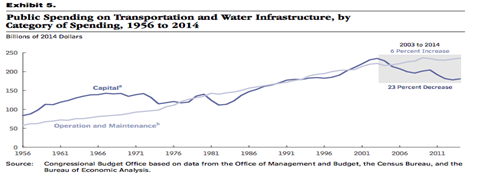
Instead they need to focus on passing an infrastructure bill that will rebuild public and private infrastructure that the American Society of Civil Engineers (ASCE) says is now behind more the $4.5 trillion in maintenance alone, such as highways, harbors, wastewater facilities and bridges.

image

Graph: CBO

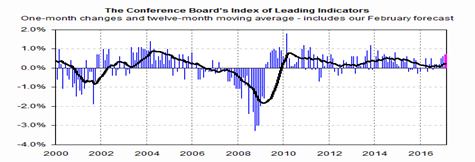
The Conference Board’s Index of Leading Economic Indicators is one of several anecdotal surveys (i.e., opinions) that aren’t yet borne out by actual activity. The Conference Board said its leading economic index rose 0.6 percent in February — the third straight gain of that magnitude — to reach its highest level in more than a decade.

image

Graph: ICAP

“Widespread gains across a majority of the leading indicators point to an improving economic outlook for 2017, although GDP growth is likely to remain moderate,” said Ataman Ozyildirim, director of business cycles and growth research at The Conference Board.

The improvement in the LEI over the past several months is said to be due to optimism that Congress can pass a massive infrastructure bill, as well as reducing regulations. But can Trump keep his promise to invest in infrastructure, when his new proposed budget cuts road spending by nearly half a billion dollars, and includes no new infrastructure spending?

The American Society of Civil Engineers (ASCE) estimates the US needs to spend some $4.5 trillion by 2025 to improve the state of the country’s roads, bridges, dams, airports, schools, and more in its 2017 Infrastructure Report Card.

For instance, out of the 614,387 bridges in the US, more than 200,000 are more than 50 years old. The report estimates it would cost some $123 billion just to fix the bridges in the US, and many of the one million drinking water pipes have been in use for almost 100 years. The aging system makes water breaks more prevalent, which means there are about two trillion gallons of treated water lost each year.

And even more important to our security and economic well-being, the majority of the transmission and distribution lines were built in the mid-20th century and have a life expectancy of about 50 years, meaning that they are already outdated. So between 2016 to 2025, there’s an investment gap of about $177 billion for infrastructure that supports electricity, like power plants and power lines, reports the ASCE. 

Need we say more about the importance of a major infrastructure bill, which is far more important to Americans that the ideological debate over Obamacare and healthcare in general?

Harlan Green © 2017

Follow Harlan Green on Twitter: https://twitter.com/HarlanGreen
Posted in Consumers, Economy, Politics, Weekly Financial News | Tagged , , , | 4 Comments

Single-Family Construction Exploding

Popular Economics Weekly

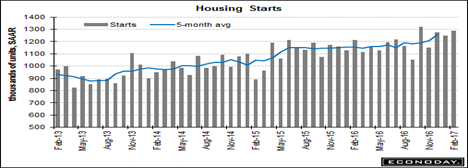
Starts on new houses climbed 3 percent in February to the second-highest level since 2007, reflecting pent-up demand in a steadily growing economy that builders are aiming to address. And builder optimism continues to rise to new levels.

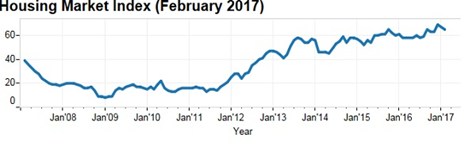
In a sign that first-time homebuyers may finally find more affordable housing, the NAHB/Wells Fargo housing market index is up a very sharp 6 points in March to 71 for the best reading of the economic cycle, and a 12-year high. Home builders peg current sales at an index of 78, up 7 points from February, and see future sales also at 78, for a 5 point gain.

image

Graph: NAHB

“While builders are clearly confident, we expect some moderation in the index moving forward,” said NAHB Chief Economist Robert Dietz. “Builders continue to face a number of challenges, including rising material prices, higher mortgage rates, and shortages of lots and labor.”

The pace of so-called housing starts rose to an annual rate of 1.29 million last month, with construction on single-family homes also hitting the highest level since before the Great Recession. And permits for single-family homes, where building costs and sale prices are the highest, rose 3.1 percent in February to an 832,000 rate that, in good news for a thinly supplied new home market, is up 13.5 percent year-on-year. This is offset, however, by a downturn in multi-family units where permits fell 22 percent in the month to a 381,000 rate that is down a yearly 11.2 percent.

image

Graph: Econoday

And we will be seeing supply relief for single-family homes even though completions, in a detail that home builders will note, fell 6.5 percent to a 754,000 rate. Nevertheless, new supply is coming as homes under construction rose 1.3 percent to 1.091 million for the highest reading since the great bubble in October 2007, said the NAHB in it press release.

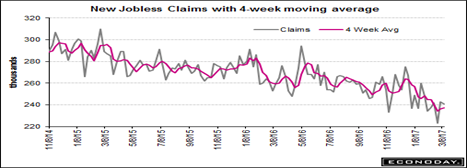
And in a sign that job availability is still tight, initial jobless claims remain low. Initial jobless claims are holding at trend, down 2,000 in the March 11 week to 241,000, reports Econoday. The 4-week average, little changed at 237,250, is down nearly 10,000 from mid-February in what offers a favorable signal for the March employment report that comes at the end of the month.

image

Graph: Econoday

So we have a surging housing market for single-family homes in particular, a sign that homebuyers—including first timers—are feeling more confident about their jobs.

In fact, job openings in the Labor Department’s Job Openings and Labor Turnover Survey (JOLTS) came in at 5.626 million in January and remain strong and right at their 2-year trend.

But there was an acceleration is hiring, which rose 2.6 percent in the month to 5.440 million for one of the best readings of the economic cycle. This is while the quits rate, up 1 tenth to 2.2 percent, hints at improved confidence among workers while the layoff rate remains low and unchanged at 1.1 percent.

No wonder the Federal Reserve has turned optimistic as well. Janet Yellen said in her latest press release after the Fed raised its fed funds rate another one-quarter percent that we were entering a virtuous cycle of robust growth that was neither too hot (i.e., inflationary), nor too cold (more jobs were being created).

Harlan Green © 2017

Follow Harlan Green on Twitter: https://twitter.com/HarlanGreen

Posted in Consumers, Housing, housing market, Weekly Financial News | Tagged , , , , | Leave a comment

Retail Sales, Inflation, Interest Rates Rising

Financial FAQs

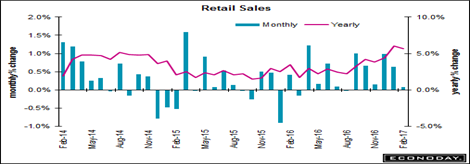
Gasoline prices pulled down February’s retail sales, falling 0.6 percent after rising 2.1 percent in January. But when excluding volatile autos and gasoline prices, sales rose 0.2 percent vs January’s very strong 1.1 percent. And control group sales, which are another core measure, inched only 0.1 percent in the month but follow an outstanding 0.8 percent gain in January, one that initially posted at 0.4 percent, says Econoday.

image

Graph: Econoday

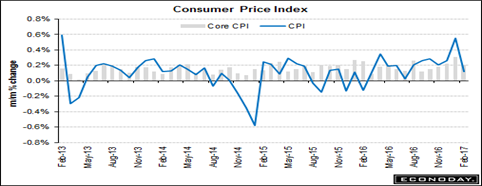
And strong retail sales are helping to push retail inflation higher, with the Consumer Price Index for retail goods and services now at 2.7 percent. This has to be why the Federal Reserve on Wednesday just increased its benchmark short-term interest rate for the second time in three months and signaled two more rate hikes this year. The Fed policy committee voted 9-to-1 to raise interest rates to a range of 0.75 to 1 percent.

image

Graph: Econoday

The overall year-on-year CPI rate continues to climb, up 2 tenths to 2.7 percent that is well above the general 2 percent Federal Reserve target rate that was last matched nearly 5 years ago, in March 2012. But the core rate, which excludes energy, is steady at 2.2 percent.

So inflation is hardly a problem, and the Fed may be acting too quickly when economies will only grow more with higher prices, hence higher inflation. Because this means companies can raise their prices, hence profits. They can then expand their production of goods and services. This should be a no-brainer, so it is puzzling why the Fed is acting now, when it’s not even clear when and how the Trump administration will be able to enact their growth agenda.

In fact, it is mainly because gas and energy prices are stable that inflation hasn’t been rising faster. Energy prices fell a very sharp 1.0 percent in the month of February with gasoline down 3.0 percent. Yet year-on-year rates are still very strong, at plus 15.2 percent for overall energy and plus 30.7 percent for gasoline. These are the gains that are pushing up the headline year-on-year inflation rate.

Harlan Green © 2017

Follow Harlan Green on Twitter: https://twitter.com/HarlanGreen
Posted in Consumers, Economy, Weekly Financial News | Tagged , , , , , | Leave a comment