Top Economics Blog: PopularEconomics.com

Populareconomics

BusinessEconomics.com 2016 Award Winner: Top Economics Blog PopularEconomics.com

http://www.businesseconomics.com/business-economics-award-winners-2016.html

In determining the awards we received recommendations for 6,856 sites from 57,204 people who voted on our site. When we determined the sites that should be given the awards, we looked at the quality of content, usability, timeliness of content and the extent to which much of the content is accessible to all web users. We are delighted that your website met all of these criteria and was judged to provide an excellent service to internet users.

Many congratulations on being awarded the BusinessEconomics.com award for 2016 as detailed above. This year BusinessEconomics.com has given out three awards in each of the following 37 categories of Business, Economics and Finance sites making 111 awards in total.

1) Top Financial news sites
2) Top Economics news sites
3) Top Business news sites
4) Top Economics blogs
5) Top Finance blogs
6) Top  Business blogs
7) Top MBA sites
8) Top Economics Education sites
9) Top Finance Education sites
10) Top Business Education sites
11) Top Stocks sites
12) Top Bonds sites
13) Top  Foreign Exchange sites
14) Top Commodities sites
15) Top Futures sites
16) Top Options sites
17) Top Emerging Markets sites
18) Top Commercial Banking sites
19) Top investment Banking sites
20) Top Mutual Fund sites
21) Top Insurance sites
22) Top Mergers and Acquisitions sites
23) Top Exchange Traded Fund sites
24) Top Sovereign Wealth Fund sites
25) Top Hedge Fund sites
26) Top Private Equity sites
27) Top Islamic Finance sites
28) Top Economics data sites
29) Top Business data sites
30) Top Finance Data sites
31) Top Economics Research sites
32) Top Finance Research sites
33) Top Business Research sites
34) Top Economics job sites
35) Top Finance job sites
36) Top Business job sites
37) Top Personal Finance sites

BusinessEconomics.com specializes in providing students, University lecturers and professionals working in the areas of Business, Economics and Finance with links and reviews of high quality websites that they may find useful in their academic and professional lives. The site and the resources to fund this year’s awards is provided by advertising revenue and some sponsorship of our pages, the details of which are contained in the link below.

Again many congratulations on your award. We feel it is important that websites that provide an excellent user experience, with good educational value and information are recognised. This is the third year of the awards which are already established as the most important in the Business, Economics and Finance categories.

Best wishes

Keith Pilbeam

www.BusinessEconomics.com

Posted in Uncategorized | Tagged | Leave a comment

Housing Construction, Sales Strong, Interest Rates Still Ultra-Low

Populareconomics

The Mortgage Corner

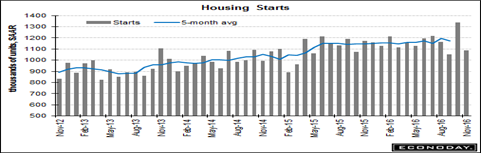
Housing starts are being hit by huge swings. November starts fell 18.7 percent in November to a much lower-than-expected 1.090 million annualized rate following an upward revised gain of 27.4 percent to 1.340 million in October, says Econoday. But that’s to be expected with winter weather already hitting the Midwest and eastern states. na

This is while interest rates have barely budged since the Fed raised its short term rates 0.25 percent to s range of 0.50 to 0.75 percent. That’s why housing construction and builder sentiment remain strong. The 30-year conforming fixed rate remains below 4 percent– 3.875 percent for one origination point (i.e., one percent) in California.

And existing-home sales are at record highs for this cycle. Existing-home sales ran at a seasonally adjusted annual 5.61 million pace, the National Association of Realtors said Thursday. That was up 0.7 percent from a downwardly-revised pace of 5.57 million in October and marks the highest since February 2007.

Lawrence Yun, NAR chief economist, says it’s been an outstanding three-month stretch for the housing market as 2016 nears the finish line. “The healthiest job market since the Great Recession and the anticipation of some buyers to close on a home before mortgage rates accurately rose from their historically low level have combined to drive sales higher in recent months,” he said. “Furthermore, it’s no coincidence that home shoppers in the Northeast — where price growth has been tame all year — had the most success last month.”

November’s existing sales rate was 15.4 percent higher compared to a year ago, the first month when new regulations, known as the “Know Before You Owe”, or TRID disclosures that added extra days to disclosure times went into effect, snarling closing times.

image

Single-family starts fell 4.1 percent in November to a seasonally adjusted annual rate of 828,000 units while multifamily production dropped 45.1 percent to 262,000 units. However, the best news in the report is a 15.4 percent gain in housing completions to a 1.216 million rate which follows a 6.3 percent jump in the prior month. Houses authorized but not started are also up, 3.0 percent higher to 138,000. Gains here will help ease what is very tight supply for new homes.

“Single-family starts declined from a robust level in October but still remain very solid,” said NAHB Chief Economist Robert Dietz. “Though rising mortgage rates could be a headwind for housing, we expect single-family production to continue on a long-run, gradual growth trend. Meanwhile, the multifamily sector, which has been volatile in recent months, is expected to level off at a solid rate as that market finds balance between supply and demand.”

image

Graph: Marketwatch

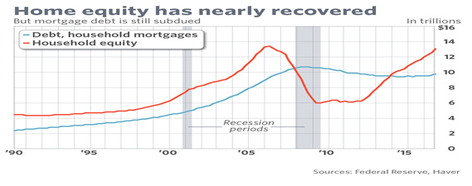
Rising household wealth is one reason housing sales have returned to 2007 levels, as household net worth rose to a new all-time high and home equity rose to just a hair below its level in 2006, before the housing bubble burst, said the Federal Reserve in its quarterly flow of funds report.

NAR Chief Economist Lawrence Yun believes housing sales could go even higher if housing starts continue to increase. The “big obstacle,” said Yun, is the ongoing “housing shortage,” which is pushing prices to record levels, as well. There were 4.0 months of supply at the current pace of sales, the 18th month in which inventory was tighter compared to its level a year ago.”

But inflation is on the rise, which will boost housing prices further and perhaps encourage more construction, as well. The median existing-home price across the country was $234,900, up 6.8 percent compared to November 2015. This means those with little or no equity in their homes will see their financial position improve, thus adding to future economic growth.

Harlan Green © 2016

Follow Harlan Green on Twitter: https://twitter.com/HarlanGreen

Posted in Consumers, Economy, Housing, Weekly Financial News | Tagged , , , , | Leave a comment

Janet Yellen and The Fed’s Rate Hike(s)

The Mortgage Corner

The Federal Reserve on Wednesday raised a key U.S. interest rate for the first time in a year and signaled a more aggressive approach in 2017, when incoming president Donald Trump plans a so-called ‘full-throttle’ strategy to jack up the American economy.

Some economists think the tax cuts and increased spending plans put forward by the Trump team may trigger higher inflation and force the central bank to raise rates more aggressively. Others think the Fed may be able to accommodate some stimulus without reacting sharply, said observers of the Fed’s action.

Fed officials did not give many hints in their latest forecast for the economy. They still expect GDP growth to average 2 percent over the next three years, although the Trump Team forecasts 4 percent growth for years to come with their spending plans. The Fed also predicts unemployment will stay close to the 4.6 percent rate seen in November.

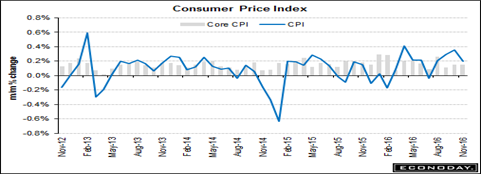
And inflation does seem to be picking up, even though at the consumer level it remains low. The Consumer Price Index that measures retail prices rose 0.2 percent in November with the year-on-year rate up 1 tenth to plus 1.7 percent. The core rate, which excludes food and energy, also rose 0.2 percent with this year-on-year unchanged at 2.1 percent.

image

Graph: Econoday

This is not enough inflation to generate additional growth. Inflation levels in the Clinton and GW Bush administrations were in the 3 to 4 percent range before 4 percent GDP growth kicked in.

And the Trump economic team must also be promising higher inflation with higher growth projections, since they want to finance much of the stimulus with additional borrowing without raising taxes to support that debt, as the GW Bush administration did to finance its spending for the invasion and occupation of Iraq and Afghanistan.

Wall Street Economist Greg Ip disagrees that Trump’s plans won’t cause pain. “Donald Trump’s tax cuts would result in $6 trillion in lost revenue over the next decade, according to several independent analyses. His advisers disagree. They claim Mr. Trump’s entire program, including trade, regulation and energy, not just taxes, would generate so much growth there would be almost no increase in the deficit.

Their math doesn’t add up, Ip says. “It rests on aggressive, tenuous or flawed assumptions: that deficits caused by tax cuts don’t raise interest rates; that removing regulations adds directly to gross domestic product; that oil and gas companies will rush to drill on newly opened federal land regardless of energy prices; and that protectionism expands the economy even if U.S. companies and workers are already working flat out.”

We therefore should assume higher inflation will come with more stimulus spending, not always a bad thing if it creates enough new jobs in an economy already near full employment. That also means the Fed may keep its promise to raise their interest rates further next year.

Harlan Green © 2016

Follow Harlan Green on Twitter: https://twitter.com/HarlanGreen

Posted in Consumers, Economy, housing market, Politics, Weekly Financial News | Tagged , , , | Leave a comment

Trump Voters and The Drug Epidemic

Popular Economics Weekly

Why should so many rust-belt citizens vote for President-Elect Donald Trump, who is patently against the interest of working class voters? I am speaking of his promise to revoke Obamacare, which will make the 20-30 million dependent on it poorer and sicker. And his selection of Oklahoma Attorney General Pruitt to run the EPA, who we know wants to roll back environmental regulations, making everyone warmer, or House Speaker Ryan, who really wants to abolish Medicare as we know it and turn it into a voucher plan.

A recent Penn State study tells us why so many of the poorest and displaced white, blue collar workers voted for him. It was the desperation of depressed families and communities rampant with drug and alcohol abuse, in part from the loss of jobs and the identities that went with holding a decent paying job that would trust a strong white male with authoritative tendencies who made enough pie-in-the-sky promises over a female President with 30 years experience in government.

One can say that such desperation leads to an irrational kind of anger, against anything that looks like the old order. Yet it was the old, white male order that created both the Great Recession—because GW Bush’s trickle-down economics cut regulations as well as taxes of the wealthiest, frittering away the budget surpluses of President Clinton’s last 4 years in office—and obstructed a robust recovery by opposing almost any stimulus spending, even shutting down the government in 2011.

The Penn State study showed how hopeless was the situation to the inhabitants now isolated from the modern multi-ethnic, multi-racial, multi-national economy. Most of those industrial, high-paying blue collar jobs are gone, replaced by high tech machines and little effort was made to replace them or rebuild those communities.

image

Graph: Econoday

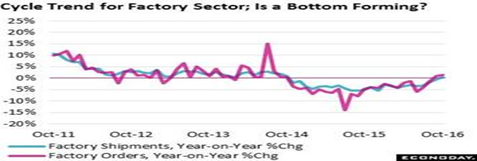
The factory sector has been contracting since October 2014, but has recently shown signs of strength. Factory orders surged 2.7 percent in October. Both commercial and defense, were major positives, but the strength was well distributed with the monthly gain excluding all aircraft at a very strong 0.7 percent.

Donald Trump got significantly more votes in areas with high rates of drug addiction, alcohol abuse and suicide, according to the study done by Shannon Monnat, a Penn State researcher who specializes in rural issues.

“I think Trump’s anti-free trade message resonated in these places and his rhetoric was very simple — Make America great again,” Monnat said. “And you have to understand that in some of these places that have experienced widespread decline in manufacturing and extraction and the types of jobs that pay livable wages, people there really feel like America is not so great anymore. I think the message that he was the change candidate really resonated with people in these places.”

According to Swayne’s article, the mortality rate from drugs, alcohol and suicide is 36 deaths per 100,000 people in the least economically distressed parts of the country. The rate is 49 deaths per 100,000 in the most economically distressed areas.

There is now some hope for the rust belt if Trump can carry through on his infrastructure rebuilding promise. After two years in contraction, factory orders year-on-year rates are again positive, at 1.3 percent, and for shipments, at 0.4 percent. October details included a useful 0.4 percent rise in shipments and a 0.7 percent jump in unfilled orders that ended a long run of contraction for this reading.

We hope the factory sector and manufacturing in general can recover in those areas most affection by high addiction rates, as the CDC reported in a 2007 report that more people now die from heroin overdose that gun homicides in those same rust-belt areas. And opioid deaths continued to surge in 2015, surpassing 30,000 for the first time in recent history, according to CDC data released Thursday. That marks an increase of nearly 5,000 deaths from 2014. Deaths involving powerful synthetic opiates, like fentanyl, rose by nearly 75 percent from 2014 to 2015.

Harlan Green © 2016

Follow Harlan Green on Twitter: https://twitter.com/HarlanGreen

Posted in Economy, Keynesian economics, Politics, Weekly Financial News | Tagged , , , , , , , | Leave a comment

Why Are Consumers Happier?

Financial FAQs

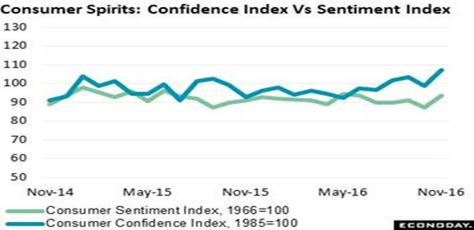
Why are consumers much happier during these holidays? The University of Michigan’s consumer sentiment index for November jumped 6.6 points to a six-month high while the Conference Board’s consumer confidence index jumped 6.3 points to 107.1 for its best reading of the cycle, since July 2007.

image

Graph: Econoday

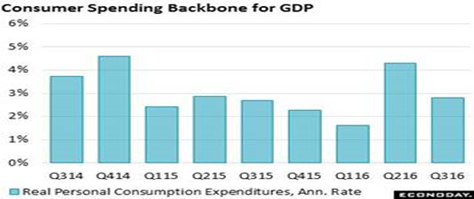
It has to be in part the record-low unemployment rate of 4.6 percent for starters, and rising wages now that minimum wages are rising in major metropolitan areas, as well as whole states like California and Washington. Econoday says the second Q3 GDP growth estimate included a sizable upgrade for consumer spending, up 7 tenths to an annualized and inflation-adjusted 2.8 percent. This is down from the second-quarter’s 4.3 percent rate but the average of these two is the best in nearly two years.

image

It’s in the service sector that employment is growing fastest. In another sign of strength for the economy, the ISM non-manufacturing index jumped 2.4 points in November to a 57.2 reading that tops most forecasts.

Employment for the ISM survey, where growth was soft in October, shot more than 5 points higher to an outsized 58.2. Averaging recent scores for this reading puts the trend at a softer but still very respectable mid-50s rate. New orders are very strong, at 57.0, with export orders also at 57.0 in a reminder of the importance of foreign demand for the nation’s service sector. Business activity is a highlight of November’s report at 6l.7.

This is one reason boosting minimum wages is so important. Most jobs are being created in the lower-paying service sector, which now employs some 80 percent of workers, and has been a major reason for the tepid 2 percent growth rate average of the economy since the end of the Great Recession.

Manufacturing has been hit hardest, and there is some doubt that Prez-elect Trump will be able to fulfill his promise to bring manufacturing jobs back that were lost. So we will have to rely on the non-manufacturing industries listed below for future growth in jobs and wages.

“The 14 non-manufacturing industries reporting growth in November in the survey said Anthony Nieves, CPSM, C.P.M., CFPM, chair of the Institute for Supply Management® (ISM®) Non-Manufacturing Business Survey Committee. — listed in order — are: Agriculture, Forestry, Fishing & Hunting; Retail Trade; Arts, Entertainment & Recreation; Transportation & Warehousing; Other Services; Management of Companies & Support Services; Construction; Finance & Insurance; Professional, Scientific & Technical Services; Accommodation & Food Services; Information; Health Care & Social Assistance; Wholesale Trade; and Mining. The two industries reporting contraction in November are: Real Estate, Rental & Leasing; and Public Administration.”

That’s why economists and the Fed believe it is more important to look at the personal income and consumption expenditure figures in such as the Econoday graph above to know where future growth in incomes (and higher demand) will come from.

Harlan Green © 2016

Follow Harlan Green on Twitter: https://twitter.com/HarlanGreen

Posted in Consumers, Economy, Uncategorized, Weekly Financial News | Tagged , , , , , | Leave a comment

4.6% Unemployment–178,000 Payroll Jobs in November

Popular Economics Weekly

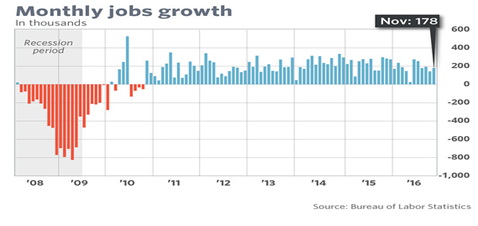
Nonfarm payrolls rose 178,000 in November to just beat out expectations with revisions no factor, says Econoday. A sharp downward revision to October, now at 142,000, was offset by a nearly as sharp upward revision to September, now at 208,000. And the unemployment rate fell a very sharp 3 tenths to 4.6 percent for the lowest reading in nine years, since August 2007.

image

Graph: Marketwatch

But the dip in the unemployment rate is tied, not to greater growth in employment, but to a dip in the participation rate, down 1 tenth to 62.7 percent, and drop in the labor force of 226,000 (I.e., that many quit or stopped looking for work.)

And a headline negative in the report is a slight drop of 0.1 percent decline in average hourly earnings, the first negative reading of the year and more than reversing October’s very strong 0.4 percent gain and driving down the year-on-year rate from a cycle high of 2.8 percent back down to 2.5 percent where it last was in August. But Wrightson-ICAP believes this was due to a shorter work month, whereas December’s longer month will probably boost it up to 3.0 percent.

Payrolls growth was led in November by another major gain for professional & services, up 63,000, and a 14,000 gain for the temporary help subcomponent. Gains in these readings point to demand for short-term labor in lieu of finding full-time labor. Construction is another positive, up 19,000 and reflecting strength in residential building. Construction over the past 3 months added 59,000 jobs, largely in residential construction.

This highlights the boost in new-home construction I wrote about in an earlier column. Housing starts surged 25.5 percent in October to a 1.323 million annualized rate. This is the best rate of the cycle since August 2007 with the monthly percentage gain the strongest since 1982. It and other recent good news, such as much higher retail sales, could mean something like a 4 percent GDP growth rate in Q4 this year.

In a side note, housing construction is booming because housing prices are accelerating, according to Zillow and the S&P Housing Price Index. The September Case-Shiller national index is expected to grow 5.7 percent year-over-year and 0.8 percent month-to-month (seasonally adjusted), even with the pace of monthly growth and up from 5.5 percent annual growth pace set in September.

image

Graph: Calculated Risk

And in the payrolls report, the so-called U-6 component of those that work part time but want to work fulltime declined to 5.7 million, the lowest total since 2008. And governments also added 22,000 payroll jobs, another sign of hiring strength, as governments haven’t yet made the 700,000 jobs lost in the Great Recession.

A negative is an 8,000 decline in retail which indicates that retailers are not gearing up much for the holidays. But that may be because of higher online retail sales. Thus far in 2016, employment growth has averaged 180,000 per month, compared with an average monthly increase of 229,000 in 2015.

The pundits are saying we now can expect the Fed to raise their short term rates at least 0.25 percent this month. Stay tuned for their next and last FOMC meeting this year, on December 13-14, or it may even be sooner, like in the coming week?

Harlan Green © 2016

Follow Harlan Green on Twitter: https://twitter.com/HarlanGreen

Posted in Consumers, Economy, housing market, Weekly Financial News | Tagged , , , , , , | Leave a comment

GDP Growth, Consumer Confidence Soar

Financial FAQs

The economy grew at the fastest pace in over two years in the third quarter, as consumers, business investment and government increased spending.

Gross domestic product expanded at a 3.2 percent annual rate in the Commerce Department’s second reading, released Tuesday. That’s the strongest pace since the second quarter of 2014. It beat the consensus estimate of a 3.1 percent growth rate among economists surveyed, reports MarketWatch.

image

Graph: BEA

This is in large part because consumer spending rose 2.8 percent in the quarter, stronger than the original estimate of 2.1 percent and the strongest pace since 2002. Another big contribution to the economy was business investment in structures like offices and factories, which expanded at 10.1 percent, faster than the initial estimate of a 5.4 percent.

image

Graph: Econoday

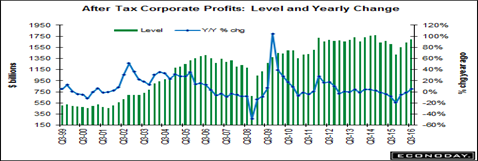
It also means higher growth ahead, as corporate profits also soared 6.6 percent in the third quarter, the main reason corporations were able to increase business investment in plants and equipment, a much better performance than the 0.6 percent decline in the second.

image

Graph: Econoday

And, consumer confidence is soaring because we are so close to full employment, which Friday’s unemployment should confirm. But rising confidence could also be due to the Trump promise of more economic stimulus, as consumer confidence rose sharply following the November 8 election, up 6.3 points to 107.1 for by far the best reading of the cycle, since July 2007. November’s current conditions component is up 7.2 points to 130.3 and is led by strong gains in the assessment of business conditions and those saying jobs are plentiful.

image

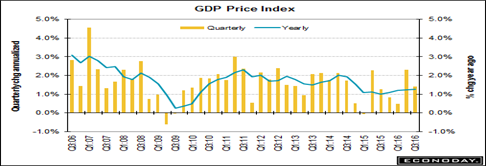
All-in-all, it could mean an even stronger GDP in Q4. But inflation as measured by the GDP Price Index is up just 1.4 percent, still below the Fed’s target inflation goal of 2 percent, as are all of the other inflation indexes, except the CPI.

But the Fed will still probably raise their interest rates in December, if Friday’s unemployment report continues to look strong, which means a 4.9 percent unemployment rate or better and more workers continue to enter the labor force.

Harlan Green © 2016

Follow Harlan Green on Twitter: https://twitter.com/HarlanGreen

Posted in Consumers, Economy, Macro Economics, Weekly Financial News | Tagged , , , | Leave a comment

Conforming Mortgage Limits Rise for 2017

Financial FAQs

The Federal Housing Finance Authority, or FHFA, just announced it is increasing the limit for conforming mortgages from $417,000 to $424,100 in most regions of the United States starting Jan. 1, 2017—the first such increase since 2006.

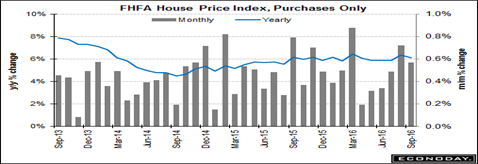
The approximately 1.7 percent bump in the baseline conforming loan limit follows the FHFA’s announcement that  the average U.S. home price has returned to its pre-decline peak, which it hit in the third quarter of 2007. The FHFA bases the loan cap on its quarterly Housing Price Index, which gauges average single-family home prices. The index rose 1.5 percent during the third quarter of 2016 and is up 6.1 percent over the past year, enough to push it above its previous high point.

image

Graph: Econoday

The FHFA is the supervising entity of conforming loans guaranteed by Fannie Mae and Freddie Mac.

FHFA house price index eased slightly in September and was up 0.6 percent after increasing 0.7 percent in August. On the year, the FHFA index surged to plus 6.1 percent, down from August’s gain of 6.4 percent. In the third quarter, house prices were up 1.5 percent and were 6.1 percent higher than the third quarter in 2015. 

Eight of nine census divisions posted monthly gains in September ranging from plus 1.3 percent in the in the Pacific with the Northeast declining 0.2 percent. On the year, the Pacific region was up 8.1 percent with New England in the rear at 2.9 percent.

Conforming loan limits are significant because they apply to home loans that meet the underwriting guidelines of Fannie Mae or Freddie Mac, the government-sponsored entities that acquire mortgages from lenders and ensure a steady flow of money to the mortgage market.

Interest rates for nonconforming, or jumbo mortgages, are generally higher than rates for loans that fall under the cap, and these types of mortgages can be more difficult to obtain.

“Today’s conforming loan limit increase is a much-needed recognition of rising home prices in high-cost markets, and a help to first-time and lower-income borrowers looking to utilize an FHA mortgage,” said NAR President William E. Brown. “Credit remains tight, but this decision will help more qualified buyers address the hurdles and high costs standing between them and the dream of homeownership.”

Conforming loan limits are higher than the baseline cap in parts of the country where home prices are especially high, but cannot be more than 150 percent of the baseline limit—$636,150 for 2017—for the contiguous U.S. Exceptions are established for Alaska, Hawaii, Guam, and the U.S. Virgin Islands, where loan limits in specific locations may exceed that amount.

Harlan Green © 2016

Follow Harlan Green on Twitter: https://twitter.com/HarlanGreen

Posted in Consumers, Housing, Weekly Financial News | Tagged , , , , , | Leave a comment

Conforming Mortgage Limits Rise for 2017

Financial FAQs

The Federal Housing Finance Authority, or FHFA, just announced it is increasing the limit for conforming mortgages from $417,000 to $424,100 in most regions of the United States starting Jan. 1, 2017—the first such increase since 2006.

This has to help home sales, as conforming fixed rates guaranteed by Fannie Mae and Freddie Mac are the lowest fixed rates, so raising the conforming limit for that rate will allow more home buyers to afford a home. 

Total existing-home sales, which are completed transactions that include single-family homes, townhomes, condominiums and co-ops, grew 2.0 percent to a seasonally adjusted annual rate of 5.60 million in October from an upwardly revised 5.49 million in September. October’s sales pace is 5.9 percent above a year ago (5.29 million) and surpasses June’s pace (5.57 million) as the highest since February 2007 (5.79 million).  

The approximately 1.7 percent bump in the baseline conforming loan limit follows the FHFA’s announcement that  the average U.S. home price has returned to its pre-decline peak, which it hit in the third quarter of 2007. The FHFA bases the loan cap on its quarterly Housing Price Index, which gauges average single-family home prices. The index rose 1.5 percent during the third quarter of 2016 and is up 6.1 percent over the past year, enough to push it above its previous high point.

image

Graph: Econoday

The FHFA is the supervising entity of conforming loans guaranteed by Fannie Mae and Freddie Mac.

FHFA house price index eased slightly in September and was up 0.6 percent after increasing 0.7 percent in August. On the year, the FHFA index surged to plus 6.1 percent, down from August’s gain of 6.4 percent. In the third quarter, house prices were up 1.5 percent and were 6.1 percent higher than the third quarter in 2015. 

Eight of nine census divisions posted monthly gains in September ranging from plus 1.3 percent in the in the Pacific with the Northeast declining 0.2 percent. On the year, the Pacific region was up 8.1 percent with New England in the rear at 2.9 percent.

Conforming loan limits are significant because they apply to home loans that meet the underwriting guidelines of Fannie Mae or Freddie Mac, the government-sponsored entities that acquire mortgages from lenders and ensure a steady flow of money to the mortgage market.

Interest rates for nonconforming, or jumbo mortgages, are generally higher than rates for loans that fall under the cap, and these types of mortgages can be more difficult to obtain.

“Today’s conforming loan limit increase is a much-needed recognition of rising home prices in high-cost markets, and a help to first-time and lower-income borrowers looking to utilize an FHA mortgage,” said NAR President William E. Brown. “Credit remains tight, but this decision will help more qualified buyers address the hurdles and high costs standing between them and the dream of homeownership.”

Conforming loan limits are higher than the baseline cap in parts of the country where home prices are especially high, but cannot be more than 150 percent of the baseline limit—$636,150 for 2017—for the contiguous U.S. Exceptions are established for Alaska, Hawaii, Guam, and the U.S. Virgin Islands, where loan limits in specific locations may exceed that amount.

Harlan Green © 2016

Follow Harlan Green on Twitter: https://twitter.com/HarlanGreen

Posted in Consumers, Housing, housing market, Weekly Financial News | Tagged , , , , , , | Leave a comment

The Real Donald Trump—Part II

Popular Economics Weekly

President-elect Donald Trump is about to move into the White House. This is the man who has become a case-study and text book model of Narcissism for Psycho Therapists. Narcissistic personality disorder (NPD) as defined by Wikipedia, ‘is a long-term pattern of abnormal behavior characterized by exaggerated feelings of selfimportance, an excessive need for admiration, and a lack of understanding of others’ feelings.”

whitehouse

Or, a Narcissist can also be defined as one who has to believe he cannot do wrong, cannot admit he has ever been wrong or apologized for any of his failings. So it could be helpful to understand President-elect Trump’s failings, in order to understand and perhaps influence (as President Obama says he wants to attempt), just how he might behave as ‘our’ next President.

In fact, that is why Trump doubles down on any who would question him, accusing the accuser of the same misdeeds. Maria Konnikova implied that Trump was a classic Con Artist in her now famous New Yorker article: “A grifter takes advantage of a person’s confidence for his own specific ends—ends that are often unknowable to the victim and unrelated to the business at hand. He willfully deceives a mark into handing over his trust under false pretenses. He has a plan.”

That has to be why Trump maintained during the campaign that he would convene a special prosecutor to prosecute and jail Hillary Clinton for her “crimes”, when in fact Trump himself has been prosecuted for outright criminal behavior, such as the three Trump University lawsuits that he had to settle. Whereas, Hillary was cleared of all criminal charges for use of a private email server by FBI Director Comey.  We need need not compare their Trusts, as the Trump Family Trust has just admitted to the IRS that it was ‘self-serving”, meaning it it broke IRS regulations that define a trust.

Or, he accused President Obama of not being born in the US for six years, in the face of overwhelming evidence to the contrary. Was Trump being stupid? No, he was currying favor with the birther movement to gain their support; mainly white male, racist Tea Partiers still fighting the Civil War who wanted to cast doubt on Obama’s legitimacy as the first African American President.

“What ultimately sets con artists apart is their intent,” says Konnikova. “To figure out if someone is a con artist, one needs to ask two questions. First, is their deception knowing, malicious, and directed, ultimately, toward their own personal gain? Second, is the con a means to an end unrelated to the substance of the scheme itself?”

It is the classic definition of a con game. Distract from the actual behavior by misdirecting our attention elsewhere—preferably to something even more sensational. Mitt Romney, Senators Marco Rubio, Ted Cruz and many others have called him a classic con-man.

But no one seems to be asking why he has had to perpetuate so many cons, broken so many contracts, filed multiple bankruptcies, and been involved in so many lawsuits—some 4,000 at last count—on his way to become the celebrity billionaire? The toll on supporters—even his family—must be devastating to maintain that image of success with overwhelming evidence to the contrary.

A major reason has to be his very short attention span. Tony Schwartz, ghost writer of Trump’s “The Art of The Deal”, has described him best: “Trump has been written about a thousand ways from Sunday, but this fundamental aspect of who he is doesn’t seem to be fully understood,” Schwartz told Jane Mayer, author of a New Yorker article. “It’s implicit in a lot of what people write, but it’s never explicit—or, at least, I haven’t seen it. And that is that it’s impossible to keep him focussed on any topic, other than his own self-aggrandizement, for more than a few minutes, and even then . . . If he had to be briefed on a crisis in the Situation Room, it’s impossible to imagine him paying attention over a long period of time,” said Schwartz

Trump in fact may only be able to focus on what is in front of him at the moment, hence his need for advisors more capable than he to pay attention, to analyze and make intelligent decisions. It has to be why he has lost so much money in his various ventures (such as the Trump Casinos), stiffed so many investors, walked away from so many debts, so that all the major banks now shun him.

We can now know the reason for his admiration of Vladimir Putin, for instance, who Trump has been trying to cultivate since his 1980 Miss Universe contest held in Moscow. It was really an attempt to buy a Moscow hotel. He has had to turn to Russian oligarchs and Mafia figures in order to fund many of his real estate ventures. How’s that for a classic conflict-of-interest as President?

So the question: if once a con-artist, always a con-artist? He’s 70 years old, and one doesn’t change their behavior at that age. But can he use such talents for the good of US, as he has promised; or once again, for his own self-aggrandizement and wealth?

It doesn’t look good.  He was quoted in a recent New York Times interview that “Presidents cannot have a conflict of interest,” which is blatantly unconstitutional under the emolument clause that prohibits gifts or favors from foreign governments or individuals.

If he is that misinformed about his responsibilities as President, what kind of behavior will result that isn’t ‘self-serving’?

Harlan Green © 2016

Follow Harlan Green on Twitter: https://twitter.com/HarlanGreen

Posted in Economy, Politics, Uncategorized | Tagged , , , , , , | Leave a comment