
Why Home Sales Rising Fast, Construction Lagging?

The Mortgage Corner

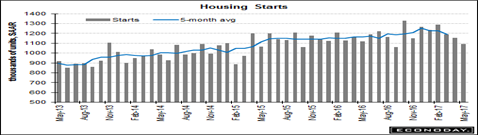
We are once again in a housing conundrum. May Existing-home sales just surged 1.1 percent to 5.62 million units, after falling for several months. And housing starts fell for the third straight month an unexpected 5.5 percent in May to a far lower-than-expected annualized rate of 1.092 million with permits for future construction likewise very weak, down 4.9 percent to a 1.168 million rate.

So where is the housing to come from with soaring prices, historically low unemployment, and interest rates? At the current sales rate, it would take 4.2 months to clear inventory, down from 4.7 months one year ago. That means a severe shortage of available housing.

The median number of days homes were on the market in May was 27, the shortest time frame since NAR began tracking data in 2011. Housing inventory has dropped for 24 straight months on a year-on-year basis, reports the National Association of Realtors.
image

Graph: Econoday

“Home prices keep chugging along at a pace that is not sustainable in the long run,” said NAR chief economist Lawrence Yun. “Current demand levels indicate sales should be stronger, but it’s clear some would-be buyers have to delay or postpone their home search because low supply is leading to worsening affordability conditions.”

There is declining affordability because incomes are not keeping up with rising home prices. The median existing-home price has risen 6 percent April-to-April, says the NAR, while median household income rose just 2.4 percent over that time.

The hottest housing markets with the shortest sales’ times in May were Seattle-Tacoma-Bellevue, Wash., 20 days; San Francisco-Oakland-Hayward, Calif., 24 days; San Jose-Sunnyvale-Santa Clara, Calif., 25 days; and Salt Lake City, Utah and Ogden-Clearfield, Utah, both at 26 days, said the NAR.

“With new and existing supply failing to catch up with demand, several markets this summer will continue to see homes going under contract at this remarkably fast pace of under a month,” said Yun.

Affordability is becoming an acute problem, in other words. The majority of Americans and Canadians say their nations are not doing enough to address and solve affordable housing needs, according to just published Habitat for Humanity’s Affordable Housing Survey. Escalating costs remain a top barrier preventing families from accessing decent homes with affordable mortgages, the survey says.

One major barrier to homeownership cited among survey respondents: the high costs of rent. Eighty-four percent of survey respondents said the high cost of rent was preventing them from buying, followed by 75 percent who said obtaining a mortgage was proving to be a big barrier.

We know why obtaining a mortgage is still a high barrier, even with historically low interest rates. Fannie Mae and Freddie Mac, the major guarantors of residential mortgages are still in government conservatorship, which really means the U.S. Treasury Department is in charge, though the Federal Housing Finance Authority is supposed to be the supervisor. And because Treasury maintains taxpayer monies are still ‘at risk’, it won’t relax credit standards to allow more borrowers to qualify.

The median FICO credit score is still 750 for approved loans, whereas it was closer to 680 during the last decade. It was a much lower bar since most fully-employed Americans have some kind of late charge in their past. And easing the qualification standard could bring 1 million more homebuyers into the housing market, said the Urban Institute in a recent study.

We believe such strict qualification standards are because the U.S. Treasury Department doesn’t want to part with the cash flow from raking in all of their profits—some $5 billion in Q2—so that no capital will be left to cushion any downturn.

Why? Because Treasury Secretary Mnuchin says they are working on a plan to dissolve Fannie and Freddie and come up with something better. But Treasury has been promising the same thing since 2008, and then Obama’s Treasury in 2012 when it decided to put all their profits into the general fund. That amount paid to Treasure has now climbed to more than $271 billion, vs. the $187.5 billion it cost to take over Fannie ane Freddie, making them cash cows at the expense of prospective homebuyers.

We have still not seen an outline of what a future Fannie and Freddie organization might look like. Nor has Congress been able to agree on whether they should be returned to the private sector as stockholding corporations or in a form that more resembles highly regulated VA and FHA loan programs.

So Habitat For Humanity is right in calling for more government action to increase affordability options for home owners and prospective homebuyers.

Harlan Green © 2017

Follow Harlan Green on Twitter: https://twitter.com/HarlanGreen

Posted in Consumers, Housing, housing market, Politics, Weekly Financial News | Tagged , , , , , , , | Leave a comment

Why Did Fed Raise Rates Again?

Popular Economics Weekly

U.S. growth cycles have averaged about 8 years since WWII, yet the Federal Reserve just announced they were raising their overnight rate for the third time—to 1.25 percent. It also forecast that the unemployment rate could fall further, and economic growth continue for another one to two years, before the inevitable downturn.

What is the basis for their very optimistic prognosis with this growth cycle already 8 years old, and as Goldman Sachs economist Jan Hatzius says 8 years has been the average length of recoveries since WWII? We have a 4.3 percent unemployment rate, and one million fewer workers were hired (5 million in May) than the number of job openings (6 million) in the Labor Department’s latest JOLTS report, so what comes next?

image

Graph: Hatzius-Goldman Sachs

Fed Chair Yellen said that because of the tight labor market, price pressures are more likely to intensify. The unemployment rate fell in May to a 16-year low of 4.3 percent amid widespread reports that businesses are running out of qualified workers to hire, as I said.

In some cases, firms have sharply boosted pay to attract or retain workers, and the Fed believes that is always a red flag for incipient inflation. “Conditions are in place for inflation to move up,” Yellen said in a press conference after the Fed action.

But inflation is nowhere in sight, nor are wages on average rising more than 2.5 percent, still to low to boost economic activity. The May Consumer Price Index was basically unchanged, which may be why retail sales fell in May, but are still rising some 5 percent. Retail sales aren’t corrected for inflation, so when prices fall, it can affect retail sales.

The annual CPI core rate without volatile food and energy prices is just 1.7 percent. The Fed just can’t seem to boost inflation, no matter how hard it tries to talk it up, so it has announced it will begin to sell its $4.5 billion cache of Treasury securities that were accumulated during the various Quantitative Easing programs that have driven interest rates to historic lows. The ten-year bond yield had sunk to an unheard of 2.11 percent, which is why mortgage rates are still at historic lows.

Republicans seem to want to improve the chances of another Great Recession with their passage of the Choice Act that rolls back all the Dodd-Frank regulations that are designed to prevent another Great Recession.

The New York Times just reported on its passage in the House last Thursday, “…a sweeping deregulation of the financial sector. It passed 233-186, with no Democratic support. One Republican, Walter Jones of North Carolina, voted no. This bill rolls back or weakens most of the protections put in place since the 2008 financial crisis through President Barack Obama’s Dodd-Frank Act.”

In their attempts to please Wall Street (how quickly they changed their tune once in power), they are doing everything in their power to remove any oversight, even putting the consumers main protection, the Consumer Financial Protection Bureau, back into the hands of those regulators that allowed the Bush era excesses to happen by looking the other way.

In their purview, the Lehman Brothers failure that started the panic and consequent Great Recession was “market cleansing”. Republicans are saying someone should be punished for the excesses, rather than those excesses be prevented with regulation, and it has to stockholders and homeowners (Lehman had funded all those liar loans without adequate collateral), rather than the banks which were bailed out by the Bush administration’s TARP program, and are now bigger than ever. So what happened to Too Big To Fail?

So the Federal Reserve seems to be operating in its own bubble of unreality. It is anticipating higher growth and inflation, whereas there are no signs of either. Or, it could be anticipating another downturn, and wants to be prepared for it by clearing out its portfolio of bonds. But in selling those bonds into the open market it will surely raise long term bond rates, and mortgages.

But in pushing up interest rates, it could in fact create the slowdown it seems to believe is about to happen.

Harlan Green © 2017

Follow Harlan Green on Twitter: https://twitter.com/HarlanGreen

Posted in Consumers, Economy, Politics, Weekly Financial News | Tagged , , , , | Leave a comment

Why Did Fed Raise Rates Again?

Popular Economics Weekly

U.S. growth cycles have averaged about 8 years since WWII, yet the Federal Reserve just announced they were raising their overnight rate for the third time—to 1.25 percent. It also forecast that the unemployment rate could fall further, and economic growth continue for another one to two years, before the inevitable downturn.

What is the basis for their very optimistic prognosis with this growth cycle already 8 years old, and as Goldman Sachs economist Jan Hatzius says 8 years has been the average length of recoveries since WWII? We have a 4.3 percent unemployment rate, and one million fewer workers were hired (5 million in May) than the number of job openings (6 million) in the Labor Department’s latest JOLTS report, so what comes next?


image

Graph: Hatzius-Goldman Sachs

Fed Chair Yellen said that because of the tight labor market, price pressures are more likely to intensify. The unemployment rate fell in May to a 16-year low of 4.3 percent amid widespread reports that businesses are running out of qualified workers to hire, as I said.

In some cases, firms have sharply boosted pay to attract or retain workers, and the Fed believes that is always a red flag for incipient inflation. “Conditions are in place for inflation to move up,” Yellen said in a press conference after the Fed action.

But inflation is nowhere in sight, nor are wages on average rising more than 2.5 percent, still to low to boost economic activity. The May Consumer Price Index was basically unchanged, which may be why retail sales fell in May, but are still rising some 5 percent. Retail sales aren’t corrected for inflation, so when prices fall, it can affect retail sales.

The annual CPI core rate without volatile food and energy prices is just 1.7 percent. The Fed just can’t seem to boost inflation, no matter how hard it tries to talk it up, so it has announced it will begin to sell its $4.5 billion cache of Treasury securities that were accumulated during the various Quantitative Easing programs that have driven interest rates to historic lows. The ten-year bond yield had sunk to an unheard of 2.11 percent, which is why mortgage rates are still at historic lows.

Republicans seem to want to improve the chances of another Great Recession with their passage of the Choice Act that rolls back all the Dodd-Frank regulations that are designed to prevent another Great Recession.

The New York Times just reported on its passage in the House last Thursday, “…a sweeping deregulation of the financial sector. It passed 233-186, with no Democratic support. One Republican, Walter Jones of North Carolina, voted no. This bill rolls back or weakens most of the protections put in place since the 2008 financial crisis through President Barack Obama’s Dodd-Frank Act.”

In their attempts to please Wall Street (how quickly they changed their tune once in power), they are doing everything in their power to remove any oversight, even putting the consumers main protection, the Consumer Financial Protection Bureau, back into the hands of those regulators that allowed the Bush era excesses to happen by looking the other way.

In their purview, the Lehman Brothers failure that started the panic and consequent Great Recession was “market cleansing”. Republicans are saying someone should be punished for the excesses, rather than those excesses be prevented with regulation, and it has to stockholders and homeowners (Lehman had funded all those liar loans without adequate collateral), rather than the banks which were bailed out by the Bush administration’s TARP program, and are now bigger than ever. So what happened to Too Big To Fail?

So the Federal Reserve seems to be operating in its own bubble of unreality. It is anticipating higher growth and inflation, whereas there are no signs of either. Or, it could be anticipating another downturn, and wants to be prepared for it by clearing out its portfolio of bonds. But in selling those bonds into the open market it will surely raise long term bond rates, and mortgages.

But in pushing up interest rates, it could in fact create the slowdown it seems to believe is about to happen.

Harlan Green © 2017

Follow Harlan Green on Twitter: https://twitter.com/HarlanGreen
Posted in Economy, Politics, Weekly Financial News | Tagged , , , , , , , | Leave a comment

What, Too Many Job Openings?

Financial FAQs

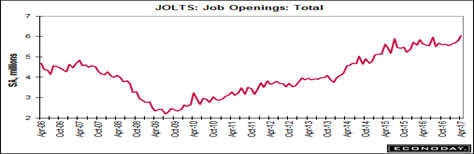
We are now seeing real evidence of the need for more working adults, if the US economy is to continue to grow. The Labor Department’s Job Openings and Labor Turnover Survey, or JOLTS report, said April job openings are nearly 1 million ahead of hirings in a widening spread pointing to skill scarcity in the labor market.

image

Graph: Econoday

“Job openings totaled 6.044 million in April which is well outside Econoday’s high estimate for 5.765 million and up from a revised 5.785 million in the prior month. Hirings totaled 5.051 million which is well down from March’s 5.304 million with the spread between the two nearly 150,000 higher at 993,000,” said Econoday.

What to do about it, since infrastructure upgrades are needed to boost economic growth? Private industry has not increased capital expenditures on anything for more than one year, choosing to either hoard their increased profits, or invest overseas. Both state and federal governments have to increase their public works spending as well, which is not yet happening because states have to run on balanced budgets.

And many chose to cut taxes like Kansas in the belief that trickle-down economics was the conservatives’ answer to adversity; which has instead prolonged the pain.

The ultra-conservative Tea Party is in control of Congress and many states, in other words, and they have focused on tax cuts, such as those incorporated in the so-called repeal and replace Obamacare House bill that was passed without updating its CBO scoring, because up to 24 million could lose health coverage, while coverage costs would skyrocket.

The Center For Budget Policies Priorities (CBPP), a progressive think tank, has been asking states to boost their infrastructure spending for years:

“But rather than identifying and making the infrastructure investments that provide the foundation for a strong economy, many states are cutting taxes and offering corporate subsidies in a misguided approach to boosting economic growth.  Tax cuts will spur little to no economic growth and take money away from schools, universities, and other public investments essential to producing the talented workforce that businesses need.”

image

Graph: CBPP

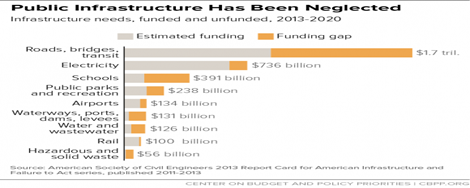
As I’ve reported in past columns, the American Society of Civil Engineers (ASCE) in its 2017 report card on the condition of America’s infrastructure gave U.S. infrastructure a D+ or “poor” rating.  The engineers estimated the cost of bringing America’s infrastructure to a state of good repair (a grade of B) by 2020 at $4.59 trillion, of which only about 55 percent has been committed. 

Improving roads and bridges alone would require almost $850 billion more than states, localities, and the federal government have allocated.  Schools need another $270 billion beyond what’s been invested. 

CBS News reports that the Trump plan specifies only $200 billion in new federal spending even as the administration’s budget includes “enormous cuts to public investment,” according to the liberal Economic Policy Institute. The administration also did not specify just where the remaining $800 billion would come from and how the spending increases would jibe with the huge cuts in infrastructure spending envisioned in its proposed budget. 

The question now is not only how will these projects be financed, but where will we find the workforce?

Harlan Green © 2017

Follow Harlan Green on Twitter: https://twitter.com/HarlanGreen
Posted in Economy, Politics, Uncategorized, Weekly Financial News | Tagged , , , | Leave a comment

Republicans About to Make ‘America Last’

Popular Economics Weekly

President Trump’s withdrawal from the Paris Accord on climate change is symbolic in more ways than one. In his call to make America first again, he could set us back decades in bringing cleaner air and reducing global warming, not to speak of what would happen to economic growth.

In fact, he wants to Make America Last in the developed nations in caring for not only our environment, but economic growth as well. The agenda of Trump and his Tea Party supporters seem to want is to knock out the main pillars that grow the economy—a better social safety net (fewer workers lose work time), restriction of immigration and the importation of new workers needed for higher growth, as well as cutting huge chunks out of the budget for education and R&D, which are needed for a more educated workforce and the development of new products, the seed corn for future productivity and prosperity.

We currently have the second highest carbon emissions per capita after China, but could become the highest emitter if Republicans succeed in rolling back 30 years of environmental protection, becoming the country with the least amount of environmental protections.

Why leave the Paris Accord, when it is a voluntary accord to reduce carbon emissions? It was to help the coal industry, where Commerce Secretary Wilbur Ross is heavily invested in coal and has already made $millions with the 50 percent bumpup in coal stocks since Trump took office.

And the Koch Brothers $millions that were spent to elect Tea Party candidates is paying off as Trump initiated an immediate review of President Obama’s Clean Power Plan, which restricts greenhouse gas emissions at coal-fired power plants.

Surrounded by coal miners, the president described that plan as a “crushing attack” on workers and vowed to nix “job-killing regulations. We’re going to have safety, we’re going to have clean water, we’re going to have clean air, but so many [regulations] are unnecessary, so many are job-killing,” he said.

The withdrawal process takes a total of 4 years, beginning in 2020 after the next congressional elections. It is totally voluntary, with all but 3 countries now on board, except the US, Nicaragua, and Syria.

But it’s symbolic in another way, as well. Trump and his Republican supporters seem to want to be left out of collective agreements of any kind, and this will hurt us economically as well as isolate US from future attempts to lower carbon emissions.

America will also be last in health care if Republicans succeed in repealing Obamacare, because Repubs want to slash spending on Medicaid and social security disability coverage, needed predominately by the poorer states that supported Trump. Why? So they can use the $1.11 billion is savings to pay for the repeal of the Obamacare taxes that benefit the wealthiest.

Need we say more of why the Trump Team wants to make America Last? So their own wealthy supporters gain even more wealth, and Trump’s supporters—most of whom reside in the poorest states—will continue to suffer the most from his sleight of hand.

Harlan Green © 2017

Follow Harlan Green on Twitter: https://twitter.com/HarlanGreen
Posted in Economy, Politics, Uncategorized | Tagged , , , , , | Leave a comment

We Have Reached Full Employment!

Financial fAQs

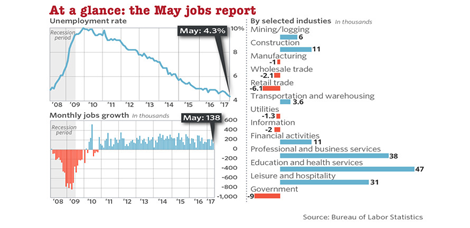
The U.S. added a modest 138,000 new jobs in May and hiring earlier in the spring was weaker than initially reported, adding to evidence that the tightest labor market in years is making it harder for companies to fill open jobs. So is this as good as it gets for employment and jobs?

The unemployment rate dropped to 4.3 percent because 429,000 workers dropped out of the civilian labor force, while the number of employed fell by 233,000 in the Household survey—one of two reports put out today by the Labor Department.

This was the lowest unemployment rate since 2001, while in March the private payroll (or Establishment) jobs total was revised downward to 50,000, and April was revised downward to 174,000 for a total of 66,000 fewer jobs, according to the Bureau of Labor Statistics (BLS).

image

Graph: Marketwatch

But a very good total of 2.23 million jobs were created over the past 12 months, yet there are 5.7 million unfilled jobs in April, according to the BLS JOLTS report. In fact 429,000 fewer looked for work, either because they couldn’t find the job they liked, or more women are leaving the workforce to raise families according to one survey. Jobs are going begging, in other words, which is another sign of full employment.

As recently as 1990, the United States had one of the top employment rates in the world for women, says a 2014 NYTimes Upshot article, but it has now fallen behind many European countries. “After climbing for six decades, the percentage of women in the American work force peaked in 1999, at 74 percent for women between 25 and 54. It has fallen since, to 69 percent today.”

The reason? The lack of maternity leave and other social programs that would support child raising. In a New York Times/CBS News/Kaiser Family Foundation poll of nonworking adults aged 25 to 54 in the United States, conducted last month in the same Upshot article, “61 percent of women said family responsibilities were a reason they weren’t working, compared with 37 percent of men. Of women who identify as homemakers and have not looked for a job in the last year, nearly three-quarters said they would consider going back if a job offered flexible hours or allowed them to work from home.”

So where do we go from here? What will draw those back into the labor force the approximately 6 million working age adults that no longer want to work at the moment? There is plenty of job growth in Health, Leisure and Hospitality, Professional and business services, and construction, since the housing market is still perking along.

image

Graph: Econoday

Maybe we should forget about that magical 3 percent GDP growth goal the Trump administration says we can reach with their proposed tax and regulation cuts. The US population isn’t growing as fast as during the baby boom and labor productivity is stuck in the 1 percent range, in part because businesses aren’t investing in new plants and equipment, as we said yesterday.

Harlan Green © 2017

Follow Harlan Green on Twitter: https://twitter.com/HarlanGreen
Posted in Consumers, Economy, Housing, Politics, Weekly Financial News | Tagged , , , , , | Leave a comment

This is A Goldilocks Economy!

Financial fAQs

Economists have debated just what ideal economic growth should be, but the Federal Reserve does it for us. The Fed defines ideal growth as when we are at full employment with moderate inflation, inflation that says an economy isn’t overheating (Goldilocks’ porridge is too hot), or the economy is below its growth potential (it’s too cold).

Could we already be at that ideal of an economy that’s not growing too fast, or wants for jobs to be filled? We are at a 4.4 percent unemployment rate, the low of this 8-year growth cycle, and there are 5.7 million unfilled jobs in April, according to the Labor Department’s JOLTS report.

Maybe we should forget about that magical 3 percent GDP growth goal the Trump administration says we can reach with their proposed tax and regulation cuts. Our population isn’t growing as fast as during the baby boom and labor productivity is stuck in the 1 percent range, in part because businesses aren’t investing in new plants and equipment.

image

Graph: Econoday

But why should corporations invest more with weak Q1 2017 growth at 1.2 percent? Though second Quarter GDP growth may be picking up, which always seems to happen at this time of year. Consumer confidence is holding steady at an unusually strong level, 117.9 in May for the sixth straight reading over 110 and following a revised 119.4 in April and 124.9 in March which were the two best months of the expansion, reports the Conference Board.

So it’s been consumers that have held up this 8-year growth cycle, rather than corporations, which haven’t invested their record profits in expanded production; though profits are up 12 percent this quarter, after another record 22 percent surge in fourth quarter 2016.

image

And consumer spending is showing signs of more life as well in April, as the consumer benefited from strong wage gains, kept money in the bank, and was an active shopper at least compared to the first quarter. If both confidence and spending continue to increase at these rates, then a 3 percent growth rate could be achievable for Q2. But that can only be short term without either higher productivity or population growth.

The key positive in the May report is jobs-hard-to-get which is a closely watched current assessment of the labor market. This reading pf the PCE index is down a very sizable 1.2 percentage points to a very low 18.2 percent for a new expansion best, reports Econoday. But inflation is still subpar with the core PCE inflation rate (without gas and food) rising just 1.5 percent.

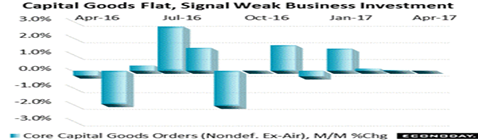
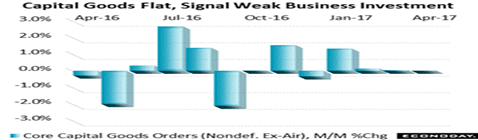
This is not a good sign for future growth, as we need 3 to 4 percent inflation in an economy growing faster—such as maybe 3 percent, which the Trump administration is predicting for GDP growth this year. It’s really what are called core capital goods—investments in plant and equipment—that will determine future growth, and businesses haven’t yet begun to spend that kind of money with their record profits.

We wonder if businesses are waiting for those promised tax and regulation cuts? The Trump administration can’t accomplish much with executive orders, so Congress has to find a way to compromise. The health care deadlock should tell them that they need Democrats to bring that about, since Republican moderates and extremists can’t agree among themselves.

So maybe we should be happy that we are in the eighth year of this growth cycle, even with 2 percent growth.  We have in fact achieved a goldilocks, steady growth economy .

Harlan Green © 2017

Follow Harlan Green on Twitter: https://twitter.com/HarlanGreen
Posted in Consumers, Economy, Politics, Weekly Financial News | Tagged , , , , , , | Leave a comment

Has dismantling of American health care system begun?

Financial fAQs

We now know that the revised Republican repeal of Obamacare is really intended to dismantle and perhaps destroy any federally-funded health care program, which would return health care coverage to either cash-starved states or private industry; to the high cost, broken healthcare system it was before Obamacare. And all this is to give the wealthiest among us a tax break they don’t need?

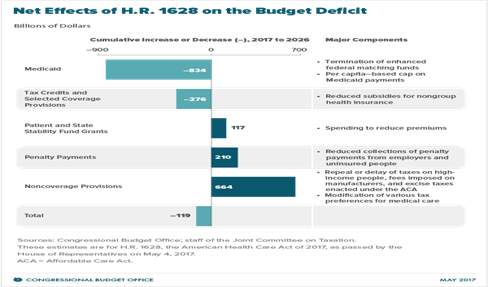
We know because the CBO and JCT estimate just out says that, in 2018, 14 million more people would be uninsured under H.R. 1628 than under current law. The increase in the number of uninsured people relative to the number projected under current law would reach 19 million in 2020 and 23 million in 2026.

We also know this because no public hearings were held on the House plan and none are planned for the still-secret Senate plan, something that Senator Diane Feinstein said has never happened before for major legislation in her 40 years in Congress.

And it is a very major bill. For instance, in 2026, an estimated 51 million people under age 65 would be uninsured, compared with 28 million who would lack insurance that year under current law, according to the CBO. Under the legislation, a few million of those people would use tax credits to purchase policies that would not cover major medical risks, but their costs would rise because no longer protected by the ACA prohibition against raising costs for those with pre-existing conditions, for example.

It in fact dismantles the possibility of affordable health care that covers pre-existing conditions for most Americans. It gives businesses and the wealthiest a juicy $664 billion reduction in taxes, which are the tax revenues needed to pay for the Obamacare state subsidies—mainly to reimburse states that cover their poorest Medicaid citizens. So, it’s to be paid for with a total of $1.111B in spending cuts for Medicaid and social security disability coverage.

image

Graph: CBO

It is what the white racist agenda of Tea Party Republicans and President Trump is leading us towards. It is what they mean by making American great again. Let us hope there are enough intelligent Senators to block what is being done in secrecy, in the hopes that most Americans won’t notice there is nothing great about leaving a total of 53 million in 10 years—mostly the elderly and poor—without any healthcare options except the most expensive, and a budget that wants to continue to redistribute our tax dollars to the wealthiest one percent where it will do the least good.

And in a coda, Senate Republicans face increasing pressure to rescue health insurance markets and protect coverage for millions of Americans amid growing fears that the Trump administration is going to let the markets collapse, said the LA Times.

This is because President Trump has repeatedly threatened to withhold federal aid that helps millions of low-income Americans afford their deductibles and co-pays.  The aid, which reimburses insurers for lowering out-of-pocket costs for low-income consumers, was paid by the Obama administration. But it is now the subject of a lawsuit by congressional Republicans, who argue Congress must approve the payments.

In recent days, leading hospitals, physician groups, health insurers and the U.S. Chamber of Commerce have pleaded with the Senate to step in, effectively going around the White House.

“Congress must take action now,” the groups warned in a letter to Republican and Democratic Senate leaders. “At this point, only congressional action can help consumers.”

Can it be any clearer that health care coverage for many, if not most Americans, is in danger of collapse? 

Harlan Green © 2017

Follow Harlan Green on Twitter: https://twitter.com/HarlanGreen

Posted in Consumers, Economy, Politics, Weekly Financial News | Tagged , , , , , | Leave a comment

What Creates Higher Growth?

Popular Economics Weekly

Amidst all the talk of Republicans promise to cut regulations and taxes to boost growth, there is one problem. Where are the workers that would boost growth? We are already close to full employment, and in fact Red states like Utah have an unemployment rate of 3.1 percent, per Binyamin Applebaum’s New York Times visit to the state.

“After eight years of steady growth, the main economic concern in Utah and a growing number of other states is no longer a lack of jobs, but a lack of workers,” says Applebaum. “The unemployment rate here fell to 3.1 percent in March, among the lowest figures in the nation. Nearly a third of the 388 metropolitan areas tracked by the Bureau of Labor Statistics have an unemployment rate below 4 percent, well below the level that economists consider “full employment,” the normal churn of people quitting to find new jobs. The rate in some cities, like Ames, Iowa, and Boulder, Colo., is even lower, at 2 percent.”

And this is when the Trump administration wants to build a wall and cut immigration quotas in half. There aren’t enough working-age American citizens to pick up growth, in other words. A corporate tax cut may encourage corporations to spend more on business investment. In fact, business equipment, in a positive indication for second-quarter business investment, rose a very sharp 1.2 percent, which should boost productivity from its recent very low 1.2 percent, and is the other component of GDP growth.

And there’s a simple reason for the surge in business investment, as I said last week. Businesses need more automation, because they can’t find enough qualified workers to fill the 5.743 million, job openings reported in the Labor Department’s latest JOLTS report, which is far above total hirings of 5.260 million in April, a gap of 483,000.

image

Then there is the Trump administration budget proposal, which wants to slash healthcare and food assistance programs for the poor as they cut $3.6 trillion in government spending over 10 years, according to the White House’s budget proposal for next year.

So instead of increasing revenues to pay for the Wall, tax cuts for the wealthiest, and more military spending, they are reducing revenues by cutting spending on the programs that pay for our social safety net. And studies have shown this will create an even larger hole in the federal budget.

It’s really elementary mathematics. Without the workers to produce them, and consumers with enough money to buy said products (e.g., those middle and lower income workers who lose their Medicare or Obamacare benefits), there can’t be higher growth. And the Fed has said if the federal government increases spending without the concomitant revenues to pay for that spending, they will continue to raise interest rates to avoid higher inflation.

This is the Faustian bargain that the current Congress is attempting to pass. Tax cuts for those making more than $200,000 per year ($250,00 for married couples) takes away much needed revenues that cover benefits for everyone else. For instance, repeal of the Affordable Care Act’s tax provisions would provide America’s wealthiest taxpayers with an immediate tax cut totaling $346 billion over 10 years.

That will not fly, as word gets out and more Town Halls are flooded with protestors over the proposed $800 billion in Medicaid spending alone, cuts which would hurt the poorer Republican red states. So, unless lawmakers come to their senses, this could cause Republicans to lose their congressional majorities in 2018.

Harlan Green © 2017

Follow Harlan Green on Twitter: https://twitter.com/HarlanGreen
Posted in Consumers, Economy, Politics, Weekly Financial News | Tagged , , , | Leave a comment

Higher Industrial Production Sign Increased Growth?

Popular Economics Weekly

Industrial production in April grew at the fastest monthly rate in more than three years on the back of broad-based gains in the manufacturing sector, reports the Federal Reserve. Industrial production grew 1 percent in April led by a 5 percent increase in motor vehicle production. It was because business investment is up sharply, as is consumer spending.

image

Graph: Econoday

Business equipment, in a positive indication for second-quarter business investment, rose a very sharp 1.2 percent, reports Econoday, which could be a sign of a badly needed business expansion. “Production of consumer goods was even stronger, up 1.5 percent. Two negatives are hi-tech industries with a small decline and also construction supplies which posted a second straight dip that offers a reminder of this morning’s disappointing housing starts report.”

There’s an obvious reason for the surge in business investment. Businesses need more automation, as they can’t find enough qualified workers to fill the 5.743 million, job openings reported in the Labor Department’s latest JOLTS report, much more plentiful than total hirings of 5.260 million in April, a gap of 483,000.

That also means an ultimate surge in badly needed Labor Productivity that has been lagging of late. From the first quarter of 2016 to the first quarter of 2017, productivity increased just 1.1 percent, reflecting increases in output and hours worked of 2.4 percent and 1.3 percent, respectively, said the BLS.

And without higher labor productivity, the US economy can’t grow more than the current 2 percent GDP growth rate. What was the rate during periods of higher growth? Until 2000, economic growth averaged more than 3 percent, while productivity averaged 2.5 percent until 2007.

image

But then something happened. Average productivity plunged to 1.2 percent from 2010 onward. Why? Businesses stopped investing, for starters. This was partly due to the plunge in oil prices (from $100 to $30 per barrel last year), and consequent plunge in industrial production.

But our population also began declining, the other component to GDP growth (besides labor productivity). Until 2000, the U.S. population grew more than 1 percent, but since 2000 average population growth halved to about 0.5 percent.

image

Graph: CBO

The Congressional Budget Office estimates that we would need 2.8 million new workers per year to reach the 3 percent growth rate that Trump and Repubs want. Where will they come from? New immigrants, as the U.S. currently generates just 600,000 new job entrants per year, on average.

The baby boom is gone, in other words, and even the record-breaking millennial generation won’t help growth, unless we have both higher productivity and immigration quotas for working age adults.

Harlan Green © 2017

Follow Harlan Green on Twitter: https://twitter.com/HarlanGreen

Posted in Consumers, Economy, Weekly Financial News | Tagged , , , , , , | Leave a comment