Poverty Level Down, As Household Incomes Surge

Popular Economics Weekly

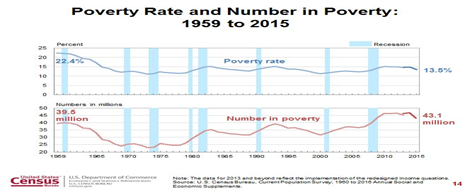
Fewer Americans lived in poverty in 2015 and median incomes charted their first increase since the Great Recession, according to data released Tuesday by the Census Department. The official poverty rate fell 1.2 percentage points between 2014 and 2015 to 13.5 percent, and the number of people in poverty fell by 3.5 million, Census said. The threshold for a family of two adults and two children to be considered living in poverty was $24,036.
image

Graph: Census Bureau

And new data showing middle-class household incomes growing at the fastest rate since the recession seemed to confirm that a recovery that’s remained slow and uneven is finally touching the lives of ordinary, especially middle-class Americans.

image

Graph: Marketwatch

In fact, this could be the income growth needed to bring US back to 3 percent GDP growth; something that hasn’t happened since before the Great Recession. Millions of Americans escaped poverty last year and incomes rose at their biggest gain ever, as the 6-year long economic recovery finally hit home for households. Median middle-class wages surged 5.2 percent between 2014 and 2015, the Census Department said Tuesday, the first annual increase since 2007, just before the economy plunged into recession.

This is in large part due to almost non-existent inflation, which has not returned to even the Fed’s 2 percent target, hence the reluctance of Janet Yellen’s Federal Reserve to raise interest rates at all this year. But that may change, as rising wages also have an effect on inflation, since wages make up some two-thirds of product costs.

An even better way to increase growth is to invest more in what would grow our economy; like infrastructure, education, R&D, the environment, etc. That’s why productivity has ground to a halt, which is the main driver of future growth.

At least 43 companies plan to cut, or leave unchanged, their capital spending levels in 2016, while about 20 are increasing, according to a Reuters review of Standard & Poor’s 500 companies that have given explicit early guidance.

image

Graph; Citibank

However, Citibank seems to disagree. It’s the energy sector that has cut back due to the slump in energy prices. This, however, is boosting growth in capex spending in other sectors, says Tobias Levkovich, Citigroup chief equity strategist. There’s no reason to think stock buybacks, the current straw man for the lack of productive investment, are replacing capital expenditures. Rather, he said, they are complementing them.

“While misperceptions abound when it comes to companies allegedly not investing in their businesses and preferring to buy back stock instead, there is little corroborating evidence,” Levkovich argued. “S&P 500 companies have had capital investment dollars ahead of the amount used for buybacks for more than four and a half years and capex has hit a record every year since 2011.”

And a major reason for this is the low cost of capital is today’s low inflationary environment. So there is good reason to keep interest rate as low as possible, until we see signs of more normal GDP growth.

Harlan Green © 2016

Follow Harlan Green on Twitter: https://twitter.com/HarlanGreen

Posted in Economy, Macro Economics, Politics, Weekly Financial News | Tagged , , , , , | Leave a comment

Why Isn’t It Easier to Qualify For A Mortgage?

The Mortgage Corner

It’s not getting any easier to obtain a mortgage. This is in spite of record low mortgage rates, as low as 3.0 percent for 30-year conforming fixed rates; as well as the appearance of so-called Alt-A, non-QM mortgages with 3 to 7 year, interest only, fixed rates that require 12 months personal bank statements to verify income.

According to a report from the Urban Institute that tracks mortgage availability among other housing issues, the pool of mortgage loans made between 2011 and 2015 have even lower default rates than the more “normal” lending period of 1999 to 2003, when less than 2 percent of the loans defaulted after 10 years.

By comparison, 12 to 13 percent of the mortgage loans made at the height of the housing bubble between 2006 and 2007 defaulted within 10 years of their origination, the Urban Institute said in August, citing Fannie Mae’s data. And that was mostly due to the Great Recession and loss of some 8 million jobs.

image

Graph: Calculated Risk/Black Knight

The Urban Institute noted that of Fannie Mae- and Freddie Mac-backed loans made after 2011 and through the first quarter of 2015, 69 percent of the borrowers had FICO scores better than 750. Between 1999 and 2003, only a third of people with such mortgages had a credit score that high. Less than 1 percent of loans that have been made after 2011 have defaulted, according to Fannie Mae’s data, the Urban Institute said, even for those borrowers with FICO scores under 700

Requiring higher credit scores is just one way lenders have made it more difficult to qualify. Fannie and Freddie also pile on points for scores above 680, which was a normal mid-score before the housing bubble, and in effect boosts the interest rate. For instance, just a 1 pt. cost add on for a score below 700 is the equivalent of a one-quarter percent raise in the rate.

Other problems are due to the reforms mandated by Dodd-Frank designed to protect consumers from predatory lenders, while a good idea, have made it much more difficult for lenders and slowed down the qualification time. This includes additional delays in closings for the slightest change in rates or points enacted due to the new TRID requirements (short for TILA/RESPA Integrated Disclosure) enacted last fall.

This has made lenders much more selective in granting mortgages. We are probably back to 1980s qualification standards when many fewer loans were granted—mostly by S&Ls that disappeared after the late 1980s banking scandals.

We are in a much better position today, 7 years after the Great Recession, in other words. The inventory of loans in negative equity positions dropped by 31 percent (1.5 million) in 2015, according to Black Knight. At a total of 3.2 million, or 6.5 percent of all homeowners with a mortgage, this represents significant improvement from the peak in 2010, but is still well above “normal” levels.

image

Graph: Black Knight

Both the S&P Case-Shiller Home Price Index and Corelogic stats show home prices rising as much as 10 and 11 percent in Portland and Seattle, respectively, in its latest 3-month averaged, same home survey, and 5-6 percent nationally on average. This will continue to bring back housing values and lower negative equity in homes.

So there’s no reason to continue to be as cautious as mortgage lenders are today. There is of course the political brouhaha over whether Fannie and Freddie should become private corporations again, and so separated from US Treasury control. With their future unclear, these entities that guarantee more than 60 percent of all mortgages make lenders doubly cautious about qualifying younger, entry-level borrowers, in particular.

Harlan Green © 2016

Follow Harlan Green on Twitter: https://twitter.com/HarlanGreen

Posted in Consumers, Economy, Housing, housing market, Politics, Weekly Financial News | Tagged , , , , , | 1 Comment

A Record In Job Openings

Financial FAQs

Not only are Nonfarm payrolls averaging some 200,000 jobs per month this year, but the Labor Department’s job openings and labor turnover survey showed 5.87 million openings, an all-time high, while hires increased to 5.23 million from 5.17 million in June. Businesses are creating jobs at a much faster rate than they can be filled, in other words.

The number of job openings are up 1 percent year-over-year. Quits are up 9 percent year-over-year. Quits are voluntary separations, which usually means workers must have found better paying jobs.

image

Graph: Econoday

The number of people quitting jobs voluntarily was flat at 2.98 million, but that’s still up substantially from the depths of the recession, which signals more worker confidence in the ability to find another job, as I said.

Less heartening was yesterday’s ISM’s Non-Manufacturing (i.e., service sector) survey for July, down 4 points to 51.4. This is the lowest rate of composite growth for this sample of the whole cycle since February 2010. But that may be a fluke, as new orders in past months were as high as 60 percent. It could be a catch-up month, in other words, as businesses sell off past months’ inventories.

image

Graph: Econoday

This should also keep the Fed from raising interest rates until at least December, since the jobs report of last week was a letdown, as well. The composite score is no fluke, says Econoday, with new orders for service sector products falling nearly 9 points to 51.4 for their lowest score since December 2013. New export orders are a particular disappointment, also down a steep 9 points and in contraction at 46.5 which is also the lowest score since December 2013. And backlog orders are also in contraction, down 1-1/2 points to 49.5.

Moody’s doesn’t see this lull as more than a blip, at least. The U.S.’s Aaa credit rating is safe no matter who wins the presidential election, according to Moody’s Investors Service in a new report on Wednesday.

“The outcome of the forthcoming presidential election will not impact the Aaa stable credit rating of the United States, regardless whether Donald Trump or Hillary Clinton is elected,” the report says. “This is because the U.S.’s rating reflects the country’s very high degree of economic, institutional and government financial strength and its very low susceptibility to event risk,” says Moody’s, naming the four factors in its sovereign bond rating methodology.

What to make of the current weakness? It could be a summer lull, as businesses wait for the results of Brexit negotiations, the Presidential election, and maybe even China’s growth to resume.

Harlan Green © 2016

Follow Harlan Green on Twitter: https://twitter.com/HarlanGreen

Posted in Economy, Macro Economics, Politics, Weekly Financial News | Tagged , , , | Leave a comment

A Half-Full Jobs Report

Financial FAQs

Nonfarm payrolls rose a lower-than-expected 151,000 in August with revisions to July and June at a net minus 1,000, reported the Bureau of Labor Statistics. I would call this a half-full employment report in an economy that is not too hot, or too cold. The unemployment rate held at 4.9 percent with modest increases on both the employment and unemployment.

Earnings are very soft in this report, up only 0.1 percent in the month for a year-on-year plus 2.4 percent which is down a sizable 3 tenths from July and isn’t pointing to any wage-hike flashpoint. And the workweek is down, at 34.3 hours with July revised 1 tenth lower to 34.4.

image

Graph: Marketwatch

Earnings were at the bottom end of wage growth, because bars and restaurants added 34,000 new employees to lead the way in hiring. And the number of social workers also rose by 22,000, an unusually large increase, both low-paying service sector jobs. Retail also added 15,100 jobs in a sign that consumer spending is holding up.

Consumer spending last month was lifted by a 1.6 percent surge in purchases of long-lasting manufactured goods such as automobiles. Spending on services rose 0.4 percent, but outlays on non-durable goods slipped 0.5 percent (such as food and clothing).

The number of persons employed part time for economic reasons (sometimes referred to as involuntary part-time workers) was little changed at 6.1 million in August. These individuals, who would have preferred full-time employment, were working part time because their hours had been cut back or because they were unable to find a full-time job.

And the manufacturing sector is showing signs of growth in Q3, even though the ISM’s manufacturing index fell below 50 percent in August for its first contractionary sub-50 reading since February, at 49.4 a more than 3 point decline.

image

Graph: Econoday

Manufacturing, which accounts for about 12 percent of the economy, remains constrained by the lingering effects of a strong dollar and weak global demand, which have crimped exports of factory goods. A collapse in oil drilling activity following a plunge in oil prices has also squeezed manufacturing by undermining business spending, leading to weak demand for heavy machinery. In addition, a U.S. inventory correction has resulted in factories receiving fewer orders.

This may be temporary, however, as factory orders surged 1.9 percent in July for the best gain since October last year, after monthly declines of 1.2 and 1.8 percent in May and June. Orders for core capital goods (nondefense ex-aircraft) were especially strong in July, up 1.5 percent following June’s 0.5 percent gain in readings that upgrade what has been a very soft outlook for business investment. Aircraft, which is always volatile in this report, is July’s biggest plus, surging 90 percent in the month. But vehicles are a negative in the report, down 0.5 percent.

We therefore see mixed results for Q3, as businesses seem to be waiting for the various elections in November that will determine Congress, as well as the President. Business shouldn’t wait, however, as the US is in the best position to profit from uncertainty in the EU and elsewhere, regardless of who wins.

And there are still 7.8 million unemployed workers and 6.1 million part timers that would prefer to work fulltime, which means a half-full economy that still has room to grow.

Harlan Green © 2016

Follow Harlan Green on Twitter: https://twitter.com/HarlanGreen
Posted in Consumers, Economy, Politics, Weekly Financial News | Tagged , , , , , , , | Leave a comment

US Consumers Are Happy Again

Popular Economics Weekly

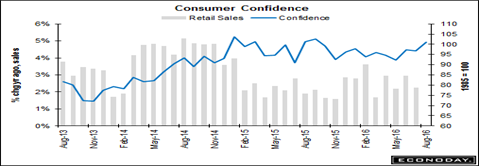
US consumers are feeling good, with higher confidence and rising wages pushing demand for housing and consumer spending. The Conference Board’s Consumer Confidence Index rose a huge 4.4 points to 101.3 in August. It has been hovering in this range for more than one year, reflecting the strong jobs market.

image

Graph: Econoday

“Consumer confidence improved in August to its highest level in nearly a year, after a marginal decline in July,” said Lynn Franco, Director of Economic Indicators at The Conference Board. “Consumers’ assessment of both current business and labor market conditions was considerably more favorable than last month. Short-term expectations regarding business and employment conditions, as well as personal income prospects, also improved, suggesting the possibility of a moderate pick-up in growth in the coming months.”

And consumer spending is reflecting that optimism. Consumer spending last month was lifted by a 1.6 percent surge in purchases of long-lasting manufactured goods such as automobiles. Spending on services rose 0.4 percent, but outlays on non-durable goods slipped 0.5 percent (such as food and clothing).

image

Graph: Econoday

Personal income increased 0.4 percent in July after rising 0.3 percent in June. Wages and salaries advanced 0.5 percent. This is while savings rose to $794.7 billion from $776.2 billion in June, still a 5 percent savings rate, which means consumers are saving for the possibility of another rainy day.

Who can blame consumers for being cautious? But with housing markets taking off, it looks at long last that housing supplies are returning to normal. The Case-Shiller Home Price Index is now rising a more normal 5 percent per year, down from its recent 10 percent rise in 2013-14, as more housing comes on the market.

image

Graph: Marketwatch

In boom cities like Portland and Seattle prices rose 12.6 and 11 percent, respectively, while Denver and Dallas were some 9 percent higher in June. Cities that suffered the most from the bust are also recovering in such areas as California’s Central Valley and San Francisco’s East Bay; cities such as Stockton and Vallejo that filed for bankruptcy because of the housing bust.

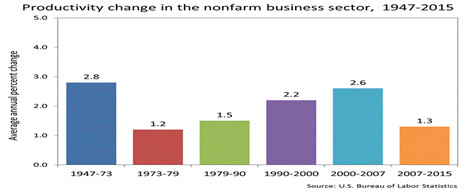
So what has been keeping economic growth in the 1 percent range of late, over the last 3 quarters? Most of it comes from a slowdown in labor productivity due to businesses’ refusal to invest in capital improvements. Labor productivity is at a historic post WWII low, increasing just 1.3 percent since the Great Recession, as I said last week. Normally, so-called cap-ex spending should also surge after such a downturn for production to catch up with depleted inventories, but it hasn’t this time.

Instead, corporations have been using their record profits to buy back stock, enhancing their own and stockholders incomes, a major cause also for the record income inequality. That has to change, needless to say, if voters have anything to say in the upcoming elections.

Harlan Green © 2016

Follow Harlan Green on Twitter: https://twitter.com/HarlanGreen

Posted in Consumers, Economy, Housing, housing market, Politics, Weekly Financial News | Tagged , , , , | Leave a comment

The Fed Can’t Really Grow US Economy

Popular Economics Weekly

Most eyes are watching Janet Yellen and the Fed’s Jackson Hole conference, where she hinted at a possible raise in short term rates this September. Higher rates are really not needed. Nothing she says in Jackson Hole can really affect longer term economic growth, which is the real problem. The record low interest rates engineered by the Fed have barely raised inflation since the Great Recession, and done almost nothing to increase investment and future growth.

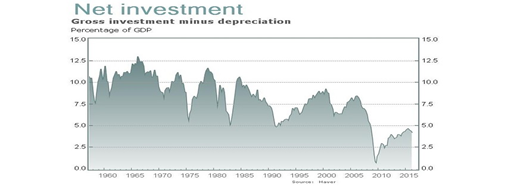
Marketwatch economist Rex Nutting highlighted the low investment climate of today. We are still in an investment recession. The record low amount of investment (capital expenditure) spending by the private sector, local, and national governments as a percentage of GDP since the Great Recession has meant we are using up what we have invested to date in public and private productive capacity without replacing it.

image

Graph: Marketwatch

The result is a record low productivity rate and low-paying jobs in the service sector that mostly cater to domestic demand. “Who’s preparing the United States for the 21st century?” writes Nutting. “Nobody, really. Not the 22 million private businesses, not the 118 million households, and not the 90,000 state, local or federal government agencies. Most troubling, there’s still very little investment in the buildings, equipment and intellectual property that we ought to be putting into place today as the foundation of our prosperity tomorrow.”

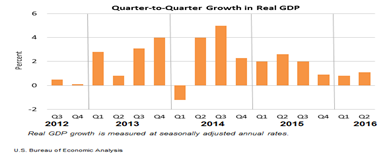
We see as evidence the lackluster growth in this morning’s second revision to Q2 GDP growth at only a plus 1.1 percent annualized rate following even softer rates in the prior two quarters of 0.8 and 0.9 percent. Yet consumer spending increased 4.2 percent in Q2. So what are consumers buying? Mostly imported foreign products produced overseas.

Much of that is due to the flight of manufacturing jobs overseas that Bernie Sanders and Donald Trump have been railing about. But the flood of cheaper imports is also because of our low productivity rate due to the obsolescence of things that increase productivity, which means better transportation, power transmission, education and R&D investments that would enable Americans to produce more efficiently, and so compete with cheaper foreign products.

image

Labor productivity is at a historic post WWII low, increasing just 1.3 percent since the Great Recession. It is calculated at output per hour of work. In Q2 2016, for instance, output increased 1.2 percent while hours needed to produce that amount increased 1.8 percent. Normally, productivity should also surge after such a downturn for production to catch up with depleted inventories, but it hasn’t this time.

image

This is one area in which both Republicans and Democrats seem to be in agreement. Both advocate increased spending on public and other productivity enhancing projects, but not who should pay for them. It has to be taxpayer funded if private industry won’t step up. And Hillary, for one, is proposing to penalize those corporations that spend their profits on stock buybacks that enhance CEO incomes, rather that projects that would enhance their long term growth. Such ‘inducements’ seem to be the only way to keep US competitive in what is now a global economy.

Harlan Green © 2016

Follow Harlan Green on Twitter: https://twitter.com/HarlanGreen

Posted in Consumers, Economy, Keynesian economics, Politics, Weekly Financial News | Tagged , , , , , , | Leave a comment

Home Sales Soar

The Mortgage Corner

It’s finally happened. Housing is now leading this 7-year recovery—finally. It’s taken a long time for those wanting to form new households to leave their parents, or school, or even pay down their education loans sufficiently to be able to buy a home. It is in large part to be due to historic low mortgage rates, since household incomes are still barely rising, as well as rapidly rising rents we have discussed in past columns.

New-home sales, a leading indicator of future growth, have reached a 9-year high, according to the US Census Bureau. New U.S. single-family home sales rose in July, as demand increased broadly, brightening the housing market outlook.

This is while total existing-home sales, which are completed transactions that include single-family homes, townhomes, condominiums and co-ops, fell 3.2 percent to a seasonally adjusted annual rate of 5.39 million in July from 5.57 million in June, said the National Association of Realtors. But that’s only the second time in the last 21 months, sales are now below (1.6 percent) a year ago (5.48 million).

New home sales surged 12.4 percent to a seasonally adjusted annual rate of 654,000 units last month, the highest level since October 2007. June’s sales pace was revised down to 582,000 units from the previously reported 592,000 units.

image

Graph: Wrightson-ICAP

Still, sales were up 31.3 percent from a year ago, said Reuters. Economists polled by Reuters had forecast single-family home sales, which account for about 9.6 percent of overall home sales, slipping to a rate of 580,000 units last month.

“July’s positive report shows there is a need for new single-family homes, buoyed by increased household formation, job gains and attractive mortgage rates,” said NAHB Chief Economist Robert Dietz. “This uptick in demand should translate into increased housing production throughout 2016 and into next year.”

And it will give a boost to housing construction, among other sectors, as there is a mere 4.3-month supply of homes left on the market, something that will boost future construction. The inventory of new homes for sale was 233,000 in July, which is a 4.3-month supply at the current sales pace. The median sales price of new houses sold was $294,600.

This has to be why July housing construction also rose a strong 2.1 percent to a 1.211 million annualized rate which comes on top of June’s 5.6 percent surge. Starts for single-family homes, the most important category in terms of economic growth, rose a very respectable 0.5 percent in July but were dwarfed by a 5.0 percent surge for multi-family homes. These results point to ongoing strength for construction, as well.

And Lawrence Yun, NAR chief economist, says existing sales fell off track only slightly in July after steadily climbing the last four months. “Severely restrained inventory and the tightening grip it’s putting on affordability is the primary culprit for the considerable sales slump throughout much of the country last month,” he said. “Realtors® are reporting diminished buyer traffic because of the scarce number of affordable homes on the market, and the lack of supply is stifling the efforts of many prospective buyers attempting to purchase while mortgage rates hover at historical lows.”

The dearth of supply is mainly in the lower prices ranges with lower profit margins, needless to say.  Dr. Yun adds, “Furthermore, with new condo construction barely budging and currently making up only a small sliver of multi-family construction, sales suffered last month as condo buyers faced even stiffer supply constraints than those looking to purchase a single-family home.”

The result is surging housing prices. The median existing-home price for all housing types in July was $244,100, up 5.3 percent from July 2015 ($231,800). July’s price increase marks the 53rd consecutive month of year-over-year gains. That is why the share of first-time buyers was 32 percent in July, which is below last month (33 percent) but up from 28 percent a year ago. That is sad, as entry level first-timers have made up 40 percent of buyers in better times. First-time buyers represented 30 percent of sales in all of 2015.

But if Janet Yellen and her Fed Governors give in to the cry by inflation hawks for higher interest rates, as we said last week, just because Q3 and Q4 growth may be slightly higher than the horrid current GDP growth (how about 1.2 percent?), the housing rally (if you can call it that) would be nipped in the bud. It’s only because of the record low mortgage rates that housing is becoming more affordable for those that can afford to buy—which is the diminished American middle class.

Harlan Green © 2016

Follow Harlan Green on Twitter: https://twitter.com/HarlanGreen
Posted in Consumers, Housing, housing market, Weekly Financial News | Tagged , , , , | Leave a comment

Much More Housing Needed

The Mortgage Corner

There’s an exception to the current low inflation prognostications echoed in my column by the San Francisco Fed Prez John Williams. It’s in housing, which is struggling to meet the surging demand for both new homes and apartments that our newest millennial generation and immigrants need. The result is housing prices are rising faster than inflation, some 5 to 6 percent.

But if Janet Yellen and her Fed Governors give in to the cry by inflation hawks for higher interest rates just because Q3 and Q4 growth may be slightly higher than the horrid current GDP growth (how about 1.2 percent?), the housing rally (if you can call it that) would be nipped in the bud. It’s only because of the record low mortgage rates that housing is becoming more affordable for those that can afford to buy—which is the diminished American middle class. We will know more when both new and existing-home sales come out this week.

Millennials are the new baby boomers (as well as their offspring) in being the largest population group in history. And they are coming of age, all 80 million of them, of which the oldest now are 36 years of age and forming households.

image

Graph: NAHB.org

This increased demand for housing is reflected in new home construction and higher builder optimism, reflected in the Wells Fargo Housing Market Index that measures home builders sentiment, and has been positive since January 2014.

image

Graph: Econoday

July housing starts rose a strong 2.1 percent to a 1.211 million annualized rate which comes on top of June’s 5.6 percent surge. Starts for single-family homes, the most important category in terms of economic growth, rose a very respectable 0.5 percent in July but were dwarfed by a 5.0 percent surge for multi-family homes. These results point to ongoing strength for construction, as well.

Other signs point to faster growth, such as industrial production, which is finally expanding after contracting for more than one year. July production jumped 0.7 percent to give a big one half point lift to the capacity utilization rate which is at 75.9 percent, according to the Federal Reserve. And the Chicago Fed’s National Economic Activity Index that attempts to measure overall US growth rose to a 12-month high this week.

image

Graph: Econoday

Manufacturing output rose 0.5 percent in the month which follows a downward revised but still very respectable 0.3 percent gain in June. Vehicle production was exceptionally strong in June and was also very solid in July though other manufacturing industries were also strong contributors to the latest month’s gain.

Hi-tech was also strong in the month and a look at market groups shows 0.6 percent monthly gains for both consumer goods and business goods, the latter a plus given the persistent weakness in business investment.

The pundits are saying that Fed Governor Yellen will hint at a boost in the Fed’s short term rates from 0.5 percent, at their annual Jackson Hole summit, but that would be a mistake. There is no really affordable housing being built at present, which means rents and rental housing will have to carry the burden of new household formation.

And the result is that rents are now rising at record rates throughout the country. In fact, RealtyTrac, (www.realtytrac.com) “the nation’s leading source for comprehensive housing data,” released its 2016 Rental Affordability Analysis in January, which shows that buying is still more affordable than renting in 58 percent of U.S. housing markets despite home price appreciation outpacing rent growth in 55 percent of markets. The report also shows that the rise in rents is outpacing weekly wage growth in 57 percent of markets, per Realtytrac.

Harlan Green © 2016

Follow Harlan Green on Twitter: https://twitter.com/HarlanGreen

Posted in Consumers, Housing, housing market, Politics, Weekly Financial News | Tagged , , , , , , , | Leave a comment

No More Inflation?

Popular Economics Weekly

San Francisco Fed President John Williams has said something that most Central Bankers won’t say. He believes the current low inflation, low growth economy could continue indefinitely, if something isn’t done differently.

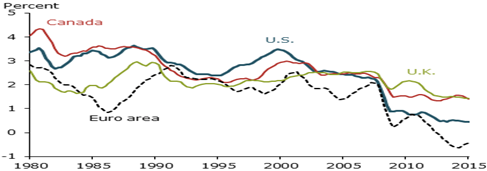
He writes in the FRBSF’s latest Economic Letter, “In the post-financial crisis world, however, new realities pose significant challenges for the conduct of monetary policy. Foremost is the significant decline in the natural rate of interest, or r* (r-star), over the past quarter-century to historically low levels.”

image

Graph: SF Fed

In his words, “battling low inflation and stagnation via unconventional monetary policy actions like quantitative easing and near-zero or even negative interest rates” isn’t working any longer. Because central bank interest rates have already declined to negative rates in many EU countries. It means the savers have to pay to keep their money in central banks, rather than central banks paying the savers.

Worldwide interest rates have been falling since 1980, down to zero inflation during 2015. It means economic stagnation, as savers would rather pay to keep from using their savings, instead of investing said savings. This is surely not a sustainable state of affairs.

What is the answer? The Fed should firstly stop focusing over excessively on inflation targets, something I’ve been advocating in past columns. Their target rate of 2 percent is too low, since any significant economic growth requires higher than 2 percent inflation—more like 3 to 4 percent. The Bill Clinton era had inflation rates of 4 percent plus, that helped to give US 4 years of budget surpluses. Even retro-Reagan Prez GW Bush had to have 3 percent plus inflation to grow enough to pay for his wars and tax cuts.

Why do we need higher inflation? There isn’t enough demand being generated for new products and services that would generate higher growth and job formation. Governments, as well as wealthy individuals are hoarding their cash, rather than taking the risk of making new investments. It’s in part a prolonged reaction to excessive risk-taking that brought on the Great Recession.

“The underlying determinants for these declines are related to the global supply and demand for funds, including shifting demographics, slower trend productivity and economic growth, emerging markets seeking large reserves of safe assets, and a more general global savings glut (Council of Economic Advisers 2015, International Monetary Fund 2014, Rachel and Smith 2015, Caballero, Farhi, and Gourinchas 2016),” says Fed President Williams. “The key takeaway from these global trends is that interest rates are going to stay lower than we’ve come to expect in the past.”

One of his prescriptions for remedying this malaise of low inflation and economic stagnation in order to create longer-run growth and prosperity is what leading macro economists like Paul Krugman and Larry Summers have been pounding the pavement over for years–greater long-term investments in education, public and private capital, and research and development.

“Despite growing skepticism and endless column inches questioning whether college is worth the cost, the return on investment in post-secondary education is as high as ever (Autor 2014, Daly and Cao 2015). Likewise, returns on infrastructure and research and development investment are very high on average (Jones and Williams 1998, 2000, Fernald 1999),” says Williams

It means also a return to a Keynesian mode of thought and policies. Ways have to be found to entice this hoarded wealth back into circulation, as the New Deal policies of FDR did in the 1930s, and that created the modern infrastructure and standard of living we Americans experience today.

Let us hope more Central Bankers and US Fed Governors think as does Dr. Williams.

Harlan Green © 2016

Follow Harlan Green on Twitter: https://twitter.com/HarlanGreen

Posted in Economy, Keynesian economics, Macro Economics, Politics, Weekly Financial News | Tagged , , , , , | Leave a comment

Why A return to Goldilocks Growth?

Financial FAQs

We could be back in the ‘goldilocks’ economy that was talked about several years ago. Growth is not too hot or too cold as we near full employment with very little inflation. It means the U.S. economy isn’t yet close to over-heating. In fact, the reason there is such low inflation is because GDP growth hasn’t been able to break out of the 2 percent range. And what will happen if it does?

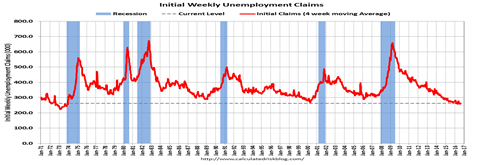
This is even though weekly initial jobless claims keep falling. “In the week ending August 6, the advance figure for seasonally adjusted initial claims was 266,000, a decrease of 1,000 from the previous week’s revised level. The previous week’s level was revised down by 2,000 from 269,000 to 267,000, according to the Labor Department.” There were no special factors impacting this week’s initial claims. This marks 75 consecutive weeks of initial claims below 300,000, the longest streak since 1970, said the Labor Department.

image

Graph: Calculated Risk

And we are seeing almost no inflation. The retail Consumer Price Index is sticking to a 1 percent inflation rate of late and has been close to zero in the past year—which is scary. At any other time, it would be a sign of impending recession, but not in a economy close to full employment with more than 7 million still looking for full time work, and a BLS JOLTS report that says there are 5.6 million job openings.

image

Graph: Trading Economics

Why so little inflation with so many jobs being created? Low commodity prices are one reason, still at post-recession lows, and which are hurting the mining and energy sectors. The latest Producer Price Index for final demand has fallen to -0.2 percent year-over-year, and is up just 0.7 percent over the past year, even excluding food and energy prices.

But most product costs come from labor costs, and the so-called Employment Cost Index has also been barely rising. Compensation costs for civilian workers increased 2.3 percent for the 12-month period ending in June 2016, vs. 2.0 percent in June 2015, reports the Bureau of Labor Statistics. Wages and salaries increased 2.5 percent for the current 12-month period, vs. 2.1 percent for the 12-month period ending in June 2015.

image

Graph: Calculated Risk

Lastly, the so-called JOLTS report shows employment still expanding. The number of job openings was at 5.624 million on the last business day of June, up slightly from 5.514 million in May, the U.S. Bureau of Labor Statistics reported last week.

This is huge, with a total 5.1 million new jobs being created last month. The number of job openings is up 9 percent YoY, and the number of ‘Quits’ (those leaving their job voluntarily) is up 6 percent YoY, usually because they were able to find a better job, or are retiring.

So a goldlilocks-type economy is really a two-edged sword. Such low inflation means we aren’t able to return to the 3.2 percent average growth rate that has prevailed since WWII.

And we know why. Labor costs, which account for two-thirds of product costs, aren’t rising much above the inflation rate as most business profits are either saved or go to stockholders, rather than the employees who would spend it, thus putting the money back into circulation. It also means a large segment of the working population still lives at or below the poverty line.

Harlan Green © 2016

Follow Harlan Green on Twitter: https://twitter.com/HarlanGreen
Posted in Consumers, Economy, Macro Economics, Weekly Financial News | Tagged , , , , , | Leave a comment