Why Record Low Mortgages Rates?

The Mortgage Corner

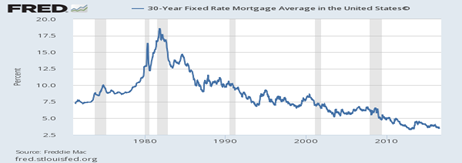
Mortgage applications increased 7.2 percent from one week earlier, according to data from the Mortgage Bankers Association’s (MBA) Weekly Mortgage Applications Survey for the week ending July 8, 2016. It’s a result of mortgage rates dropping to historic lows.

The conforming 30-year fixed rate is now 3.0 percent, with a 1 pt. origination fee, and the Hi-Balance conforming fixed rate (with a maximum loan amount of $625,500 in high cost areas) now as low as 3.25 percent with a 1.25 pt. origination fee in California.
image

Graph: FRED

This is unheard of, with rates now the lowest since WWII, really, before there was even much of a housing market, and just one conventional GSE, the Federal National Mortgage Association, or Fannie Mae, created during the New Deal to offer 30-year fixed rate mortgages. This gave homebuyers longer payback terms, and helped to start the post-WWII housing boom.

Today’s record low rates are mainly due to a flight to quality as some large investment funds such as Black Rock predict England will fall back into recession as a result of the Brexit vote. And this is leading investors to put their money elsewhere, mainly the U.S. where bond and stock returns are still positive.

Britain will fall into recession over the coming year and growth in each of the next five years will be at least 0.5 percentage points lower as a result of Britain leaving the European Union, BlackRock Inc (BLK.N) said on Tuesday.

“Our base case is we will have a recession,” Richard Turnill, chief investment strategist at the world’s largest asset manager, told reporters at the firm’s investment outlook briefing. There’s likely to be a significant reduction of investment in the UK,” he said, adding that Brexit will ensure political and economic uncertainty remains high, according to Reuters.

The Market Composite Index, a measure of mortgage loan application volume, increased 7.2 percent on a seasonally adjusted basis from one week earlier. On an unadjusted basis, the Index decreased 14 percent compared with the previous week. The Refinance Index increased 11 percent from the previous week. The seasonally adjusted Purchase Index was unchanged from one week earlier. The unadjusted Purchase Index decreased 20 percent compared with the previous week and was 5 percent lower than the same week one year ago. Last year, the Fourth of July fell on the prior week.

The refinance share of mortgage activity increased to 64.0 percent of total applications from 61.6 percent the previous week. The adjustable-rate mortgage (ARM) share of activity decreased to 5.2 percent of total applications.

New York-based BlackRock oversaw $4.7 trillion in assets globally as of March 31. Of that, $1.5 trillion was in fixed income assets, said the Reuters report. The Brexit fallout will result in “materially lower” growth in the euro zone as investment plans are deferred, and have a “moderately” negative impact on U.S. and Asian growth, Turnill said.

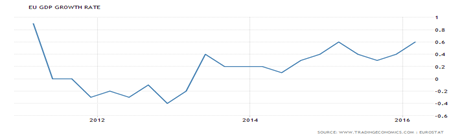
So we are now seeing early results of the possible breakup of not only Great Britain, with Northern Ireland and Scotland wanting to remain in the EU, but right wing parties in other EU members such as the Netherlands and France making noises about leaving the EU.
image

Graph: Trading Economics

It is serious business, folks, with possible repercussions to US growth. At least 20 percent of US exports go to the EU, already teetering on the edge of a recession. Such low rates will give the US housing market another boost in the near term as we near full employment with rising wages reported in the latest US employment report.

Harlan Green © 2016

Follow Harlan Green on Twitter: https://twitter.com/HarlanGreen
Posted in Consumers, Economy, Housing, housing market, Weekly Financial News | Tagged , , , , , , , | Leave a comment

Spring Employment Surges

Popular Economics Weekly

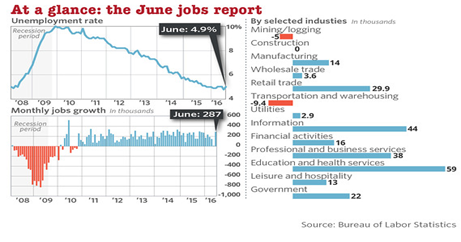
Total nonfarm payroll employment increased by 287,000 in June, and the unemployment rate rose to 4.9 percent, said the U.S. Bureau of Labor Statistics Friday. It means last month’s 11,000 private payrolls was a ‘Yuge’ aberration. How so? Job growth occurred in leisure and hospitality, health care and social assistance, and financial activities. Employment also increased in information, mostly reflecting the return of workers from the Verizon strike.

image

Graph: Marketwatch

May’s aberration was in part because of so-called seasonal adjustments, which means the BLS likes to deduct the average of increases over the past couple of years from the actual total. For instance, actual, non-seasonally (NSA) adjusted June non-farm payrolls increased +682,000 over May, and the NSA increase in May was +669,000 jobs, but that’s too big a number for statisticians. Hence the BLS said just 11,000 more payroll jobs were added in May than was normal for that time of year.

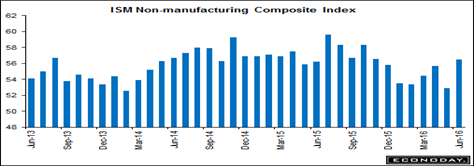
But other indicators showed much larger job increases that I’ve reported on in the past. Such as a jump in the ISM non-manufacturing index and consumer spending, extremely low layoffs and record job openings that suggest the labor market remains the healthiest it’s been in years. The June jobs report also offers confirmation the U.S. economy is expanding moderately. I predict a Q2 GDP growth rate even higher—between 3 to 4 percent after barely rising 1.1 percent in Q1 2016, and keeping a recovery that just turned seven years old intact.

The other less reliable Household Survey that includes self-employed showed that the unemployment rate increased by 0.2 percentage point to 4.9 percent in June, and the number of unemployed persons increased by 347,000 to 7.8 million who were now looking for work. It was the reason why the unemployment rate jumped from 4.7 to 4.9 percent, as more people entered the workforce.

These increases largely offset declines in May and brought both measures back in line with levels that had prevailed from August 2015 to April. Leisure and hospitality added 59,000 jobs in June, following little employment change in the prior month (It’s the beginning of vacation months).

The ISM’s Non-Manufacturing Business Activity Index increased to 59.5 percent, 4.4 percentage points higher than the May reading of 55.1 percent, reflecting growth for the 83rd consecutive month, at a faster rate in June. The New Orders Index registered 59.9 percent, 5.7 percentage points higher than the reading of 54.2 percent in May. The Employment Index grew 3 percentage points in June after one month of contraction to 52.7 percent from the May reading of 49.7 percent.

image

Graph: Econoday

In June, employment increased in performing arts and spectator sports (+14,000), after edging down in May. Employment in food services and drinking places changed little over the month (+22,000). Health care and social assistance added 58,000 jobs in June. Health care employment increased by 39,000 over the month. Job gains occurred in ambulatory health care services (+19,000) and hospitals (+15,000), about in line with average monthly gains over the prior 12 months in each industry. Within social assistance, child day care services added 15,000 jobs in June.

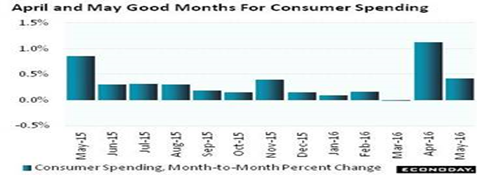
And consumer spending is also rising at 4 percent in the BEA’s latest personal income and expenditure survey. April spending rose 1.1 percent for the best monthly gain since August 2009. And May rose 0.4 percent, the second best in since November last year, says Econoday. April and May together track at 4 percent annualized growth which is why I see at least a 3 percent increase in second-quarter GDP, as I said. 

Harlan Green © 2016

Follow Harlan Green on Twitter: https://twitter.com/HarlanGreen
Posted in Consumers, Economy, Weekly Financial News | Tagged , , , | Leave a comment

The Divided States of America

Financial FAQs

It is now becoming obvious that we are not a United States of America. There are many states that restrict voting rights, abortion rights, immigration, even the collective bargaining rights of workers that are no longer able to negotiate for their own living wages.

This is when the media is lamenting the possible breakup of the European Union with Great Britain’s Brexit vote to depart from the EU. But the US is breaking up in far more serious ways, even without the influx of millions of Muslim refugees that Europe has to deal with and is causing its drift to xenophobia and the fear of foreigners.

The US in many ways is still fighting the Civil War of 150 years ago, with the defacto apartheid of poor vs. wealthy neighborhoods, and the police killing of blacks at traffic stops. A recent study by the New York based Center For Policing Equity showed that African Americans are more than 3 times as likely to be beaten, bitten by police dogs, pepper sprayed, Tasered, or shot, according to the New York Times.

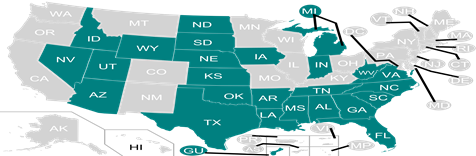
There are now 26 right-to-work states that either don’t allow workers to join unions, or pay dues, or bargain collectively for their wages, even when their workplace may be under a union contract. This has resulted in those states having the greatest income inequality and lowest wage-earners.

image

Graph: Wikipedia

There are a very similar number that restrict abortions—even in the case of rape for women—and restrict voting rights when the Voting Rights Act was gutted by a 5-4 Supreme Court vote in 2015.

And it is many of those same states that don’t allow convicted felons that have served their time from voting—as many as 30 percent of voter-age African Americans in southern states, thanks to the War on Drugs, according to Michael Moore’s movie, Where To Invade Next. GW Bush probably only won Florida because some 80,000 ex-felons were stricken from the voting roles—mostly in Democratic-leaning counties.

This is why African-Americans now comprise 50 percent of our 2.3 million prison population when they are 12 percent of our population. It provides the cheap labor that prison factories have used to generate products for most large corporations plus the military—another form of slave labor.

Florida leads the pack in the number of citizens excluded. According to Desmond Meade of the nonprofit Florida Rights Restoration Coalition, “Over 1 million people in Florida right now are disenfranchised. Nearly 1 in 3 of them are African American men.” If these people were able to vote, Meade continues, “Florida would no longer be a swing state.”

But according to the Brennan Center for Justice, 48 states (exceptions: Maine and Vermont) prohibit current prisoners with felony convictions from voting and 29 of them also bar those on probation or parole. All told, felony disenfranchisement prevents more than from voting. And of the four states that permanently bar voting by former felons—Kentucky, Florida, Iowa, and Virginia—the latter three are battleground states.

Then there are the gun laws. Only 6 states restrict or outright ban the sale of military-style assault weapons, when more than 30,000 gun deaths are recorded every year, and Orlando-style massacres occur because of unlimited magazine sizes of those same assault weapons.

What is behind the defacto civil war still raging?  Many economists says it’s the globalization and export of good jobs to developing countries with cheaper wages that have hurt those blue collar workers in the poorer states.  And too many blame immigrants, or nonwhites, or anyone not belonging to their tribe for their predicament. But we also have to look at the monopoly power of corporations that have pushed such free trade treaties, suppressing their employees’ wages while paying their executives record incomes.

In fact, these states have in many ways already withdrawn from the United States of America in trumpeting state and local rights over inalienable rights. It is just a modern incarnation of our ongoing Civil War.

Harlan Green © 2016

Follow Harlan Green on Twitter: https://twitter.com/HarlanGreen
Posted in Economy, Politics, Uncategorized | Tagged , , , , , , , , | Leave a comment

Q2 3% + GDP Growth Confirmed?

Financial FAQs

The best news of last week was the ‘Yuge’ jump in consumer spending and manufacturing, which should signal a Yuge jump in Q2 GDP; perhaps to as much as 4 percent.

image

Graph: Econoday

That’s because consumers spending is up 4 percent YoY, and since it takes up 70 percent of GDP activity, it usually means at least 3 percent plus GDP for the quarter just ended, plus net exports. And manufacturing is now picking up, which is the main driver of exports.

April’s 1.1 percent consumer spending gain was the best monthly gain of the cycle since August 2009. And May’s gain of 0.4 percent was the second best since November last year. So April and May together track at 4 percent annualized growth which has lifted outside expectations for 3 percent growth in second-quarter GDP, as we said.

image

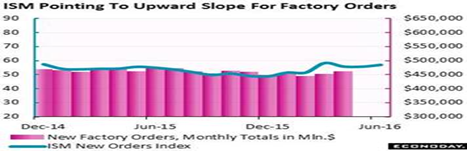
Manufacturing activity also shot up, according to the ISM Manufacturing report. The headline index easily beat expectations at 53.2 for the best reading since February last year. The report’s new orders index is especially strong, up 1.3 points in June to 57.0 with export orders now keeping up, gaining 1.0 point to 53.5 for the 4th straight plus-50 showing, says Econoday.

As if to confirm the role of exports in helping to boost GDP, the Q1 GDP third growth estimate was revised upward to 1.1 percent last week, mainly because of higher exports. Net exports added more than 1 tenth to GDP as exports rose slightly in the quarter and imports fell. An upward revision to software helped shave the negative contribution from nonresidential investment by 2 tenths to 6 tenths.

Another telling indicator of future growth is the ISM’s Chicago Purchasing Managers Index, which shows both manufacturing and non-manufacturing business activity.

Volatility is the name of the game when it comes to the Chicago PMI business activity index, which surged in June to a 56.8 level that is far beyond expectations and follows a sub-50 contractionary reading of 49.3 in the May report. And there was no indication in the May report of the strength to come as both new orders and backlog orders were in outright contraction.

But that was for May! For June, new orders are suddenly at their best level since October 2014 while backlog orders are rising at their fastest pace since May 2011.

This has to mean another sudden spring surge in growth, which in past years has surpassed 4 percent in the second quarter ending in June.

Harlan Green © 2016

Follow Harlan Green on Twitter: https://twitter.com/HarlanGreen
Posted in Consumers, Economy, Weekly Financial News | Tagged , , , , | Leave a comment

Why Did Brexit Happen?

Popular Economics Weekly

The shortest answer is the Great Recession and austerity policies of EU policymakers. The result will be a Lessor, or Little Britain, which was inevitable given the austerity policies greatholding sway in the EU. What austerity policies? In the UK’s case, it was raising taxes in 2010 while cutting government spending in an attempt to pay down debt incurred during and by the Great Recession. In doing so it has kept the UK close to recession level growth ever since 2008.

But standard economic theory tells us the opposite is needed. A recession or economic downturn of any kind is when private business (and consumers) begin to hoard (i.e., save more, and spend less), which the Great Depression and (WWII) taught US means governments have to spend more to preserve jobs and productive capacity, which will ultimately bring a more robust recovery and the means to pay down that public debt.

Nobelist Paul Krugman has been one of austerity’s most vocal critics. “By late 2008 it was already clear in every major economy that conventional monetary policy, which involves pushing down the interest rate on short-term government debt, was going to be insufficient to fight the financial downdraft. Now what? The textbook answer was and is fiscal expansion: increase government spending both to create jobs directly and to put money in consumers’ pockets; cut taxes to put more money in those pockets.”

image

Graph: Trading Economics

But the Brits did just the opposite, with predictable results—near zero GDP growth since 2008. “I don’t know how many Britons realise the extent to which their economic debate has diverged from the rest of the western world – the extent to which the UK seems stuck on obsessions that have been mainly laughed out of the discourse elsewhere,” said Krugman. “George Osborne and David Cameron boast that their policies saved Britain from a Greek-style crisis of soaring interest rates, apparently oblivious to the fact that interest rates are at historic lows all across the western world.”

This led to the scapegoating by demagogues quick to take advantage of diminishing economic prospects of working class whites in (formerly) Great Britain, and that Donald Trump is taking advantage of in the U.S. as well. Hence the Brits came to blame immigrants for taking away lower and mid-level jobs, when it was Cameron’s government that was downsizing itself at the same time of diminished private spending.

The scapegoating of Mexican and Muslim immigrants is really the only way Trump knows how to scare those people that don’t have another way to understand their predicament after his anti-Obama birther movement failed. I once wrote about the reason for the Tea Party supported by many of those same middle-aged US white voters who felt disenfranchised with a fast changing economy.

The Ted Cruz-led rebellion and 2011 government shutdown (while holding the confederate battle flag) brought in those still fighting the Civil War 150 years later. Big Government to them was the Northern Yankees bullying the Southern, more conservative states.

The EUs overall predicament has been the same, as ours—which is a poor growth record due to the austerity policies of political elites—both in Europe and unfortunately, the U.S. as well, where the Obama administration also allowed taxes to rise and government spending cut after the 2011 shutdown and consequent spending sequester that downgraded the U.S. sovereign debt rating.

Such policies have prevented the massive spending and investment programs that occurred during President Roosevelt’s New Deal, a New Deal that employed those many who could not otherwise have had the dignity of work during the Great Depression.

The result of our own austerity policies has been our failing schools, highlighted in Michael More’s latest film, Where To Invade Next, and Detroit’s toxic drinking water, the result of Michigan’s cutback in government services—which in Detroit’s case meant taking over control of Detroit’s government and replacing its elected officials with a state-appointed ‘manager’.

So can anyone blame the Brits wanting to become Little Britain again; or so many Americans that want to close our borders in order to Make America Great Again, because their predicament has been ignored for so long by those same Austerians?

Unfortunately, it is a lesson lost to European elites and even most American politicos, it seems, so a history of wall-building is on the cusp of repeating itself. Only this time, we have to find a better way than another World War to rescue our economies (and break down those walls).

Harlan Green © 2016

Follow Harlan Green on Twitter: https://twitter.com/HarlanGreen
Posted in Consumers, Economy, Keynesian economics, Macro Economics, Politics | Tagged , , , , , , , | 1 Comment

Stricter Gun Controls Now Inevitable

Financial FAQs

You know the tide has turned against gun violence when even the American Medical Association calls it a public health menace at the finish of its annual convention.

“CHICAGO – In the wake of the worst mass shooting in American history and with more than 6,000 deaths already in 2016 from gun violence, the American Medical Association (AMA) today adopted policy calling gun violence in the United States “a public health crisis” requiring a comprehensive public health response and solution,” said its press release.

Additionally, at the Annual Meeting of its House of Delegates, the AMA resolved to actively lobby Congress to overturn legislation that for 20 years has prohibited the Centers for Disease Control and Prevention (CDC) from researching gun violence.

This is after the US Senate could not even agree on banning gun purchases for anyone on the terrorism watch list in the wake of the Pulse nightclub massacre. You know it’s a public health menace when such mass killings are the work of both domestic and foreign terrorists, whether at Aurora, Sandy Hook, San Bernardino, and Orlando.

You know more effective gun control measures are coming, including the banning of military assault weapons like the AR-15, when Nicholas Kristof wrote an op-ed stating that more Americans had died from gunfire since 1968 than in all the wars ever fought by the United States — a claim PolitiFact twice pronounced to be true.

“When 50 people were shot and killed early Sunday morning at a gay nightclub in Orlando,” wrote Kristof, “the toll from gun murders this year rose to somewhere around 6,000 deaths, which means if the trend continues, this year may end up with the highest gun homicide count since Barack Obama took office in 2009. Add to the homicide number the 550 or so victims of police shootings, roughly the same number of accidental gun deaths and the 21,000+ Americans who use a gun to end their own lives, and the total gun mortality number this year may go above 35,000.”

And now the women are getting together, as did those MADD women that enabled stricter drunk driving laws. (You would think the insurance companies would be behind this initiative as well, for all the money in lawsuits they would save.)

Recently, a powerful new gun control group has emerged, called Everytown for Gun Safety, a combining of several smaller gun control groups, including Women Against Gun Violence and Mom’s Demand Action. This is while former New York Mayor Michael Bloomberg was getting ready to launch Everytown for Gun Safety with a pledge of $50 million, but it lacked foot soldiers. So today Bloomberg and the women’s groups have merged together with 3.5 million supporters.

And the nail in the coffin of unregulated gun violence may have been supplied by the now 8-member Supreme Court which allowed a lower court ruling banning assault weapons to stand, which in effect means that the Second Amendment right to own guns does have limits. The U.S. Supreme Court on Monday left in place gun control laws in New York and Connecticut that ban military-style assault weapons like the one used in last week’s massacre at an Orlando nightclub, rejecting a legal challenge by gun rights advocates.

The New York and Connecticut laws, among the strictest in the nation, were enacted after a gunman with a semiautomatic rifle killed 20 young children and six educators in 2012 at Sandy Hook Elementary School in Newtown, Connecticut. In total, seven states and the District of Columbia ban semiautomatic rifles.

“”With approximately 30,000 men, women and children dying each year at the barrel of a gun in elementary schools, movie theaters, workplaces, houses of worship and on live television, the United States faces a public health crisis of gun violence,” said AMA President Steven J. Stack, M.D. “Even as America faces a crisis unrivaled in any other developed country, the Congress prohibits the CDC from conducting the very research that would help us understand the problems associated with gun violence and determine how to reduce the high rate of firearm-related deaths and injuries.”

So we can now have a discussion about the latest public safety menace, the epidemic of gun violence. It requires similar treatment as did the Ebola and Zika epidemics—eradication of the carriers of that violence; which means stricter licensing requirements for starters, and maybe the banning of military-style assault weapons.

Harlan Green © 2016

Follow Harlan Green on Twitter: https://twitter.com/HarlanGreen

Posted in Economy, Politics | Tagged , , , , , , , , | Leave a comment

Housing Leads Continuing Recovery

Popular Economics Weekly

Harvard economist and GW Bush chief economic advisor Greg Mankiw’s recent New York Times Upshot column attempts to explain why US growth is so slow. “Here is the sad fact,” he says: “Over the last decade, the growth rate of real G.D.P. per person has averaged just 0.44 percent per year, compared with the historical norm of 2.0 percent. At a rate of 2.0 percent, incomes double every 35 years. At a rate of 0.44 percent, it takes about 160 years to double.”

Mankiw blames it in part on policy missteps. E.g., when Barack Obama took office in 2009, the economy was in the midst of the Great Recession, and President Obama’s advisers relied on standard Keynesian theory when they proposed a large increase in government spending to energize the economy. But it wasn’t enough.

Instead of waiting for the stimulus spending to take effect, Obama listened to conservative economists (such as G Mankiw) and supported tax increases too soon in an attempt to pay down the debt accumulated during the Bush administration. The economy hadn’t yet recovered from a very Great Recession. President Roosevelt made the same mistake in 1937 when he also raised tax rates with a Republican Congress, which shrank growth so much that it prolonged the Great Depression.

We do have more signs of improved growth led by housing sales, which may offset some of the policy missteps—due in large part to misjudgments about the depth of the Great Recession.  Sales of previously owned homes increased in May to the highest level in nearly a decade, reports the National Association of Realtors, another sign of durable demand in the housing market despite ongoing headwinds. And a recovering housing market has historically been a leading economic indicator of healthier consumers, hence future growth.

image

Graph: Calculated Risk

Existing-home sales rose 1.8 percent to a seasonally adjusted annual rate of 5.53 million, the National Association of Realtors said Wednesday. That was 4.5 percent higher compared to a year ago and the highest pace since February 2007 during the housing bubble.

Lawrence Yun, NAR chief economist, says existing sales continue to hum along, rising in May for the third consecutive month. “This spring’s sustained period of ultra-low mortgage rates has certainly been a worthy incentive to buy a home, but the primary driver in the increase in sales is more homeowners realizing the equity they’ve accumulated in recent years and finally deciding to trade-up or downsize,” he said. “With first-time buyers still struggling to enter the market, repeat buyers using the proceeds from the sale of their previous home as their down payment are making up the bulk of home purchases right now.”

Any recovery depends on boosting aggregate demand—the demand for goods and services from all sectors of the economy, including governments. And to date the Obama administration has been too lax in encouraging both private and public investment that would expand capacity, and so productive jobs.

This is particularly true of government jobs. State and local government employment has been the largest drag on job growth. State and local governments lost 129,000 jobs in 2009, 262,000 in 2010, 247,000 in 2011, and 29,000 in 2012, for a total of 669,000 jobs lost due to the Great Recession. 

Through November 2015, reports Calculated Risk, state and local employment is up a net 70,000.   So, in the aggregate, state and local government layoffs are over.  However state and local government employment is still 561,000 below the pre-recession peak.

So it is public sector jobs that have suffered the largest decline due to the Great Recession. Here is the comparison during presidential terms of government job creation.

image

Graph: Calculated Risk

The public sector grew during Mr. Carter’s term (up 1,304,000), during Mr. Reagan’s terms (up 1,414,000), during Mr. G.H.W. Bush’s term (up 1,127,000), during Mr. Clinton’s terms (up 1,934,000), and during Mr. G.W. Bush’s terms (up 1,744,000 jobs).

However public sector employment declined significantly since Mr. Obama took office (down 638,000 jobs in 2015, including federal jobs). These job losses have mostly been at the state and local level, as I said, but more recently at the Federal level.  This has been a significant drag on overall employment, needless to say.

How does one boost additional growth with a no-compromise Republican Congress that resists any and all Obama initiatives? (And yet he was able to pass Obamacare, but unable to defend it, resulting in the all-Repub Congress of 2014!).

So public employment is as important as private sector jobs. Not only does this put more people to work, but it provides the necessary energy-transportation-communication networks without which private industry cannot operate.

Harlan Green © 2016

Follow Harlan Green on Twitter: https://twitter.com/HarlanGreen

Posted in Uncategorized | Leave a comment

Builder Optimism Returning to Historical Levels

The Mortgage Corner

After holding steady for the past four months, builder confidence in the market for newly constructed single-family homes rose two points in June to a level of 60 on the National Association of Home Builders/Wells Fargo Housing Market Index (HMI). This is the highest reading since January 2016.

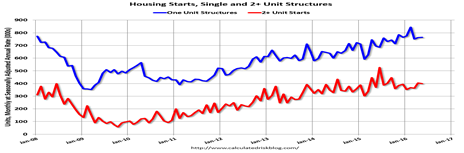
And it’s for an obvious reason, as the just released privately-owned housing starts in May were at a seasonally adjusted annual rate of 1,164,000. This is 0.3 percent below the revised April estimate of 1,167,000, but is 9.5 percent above the May 2015 rate of 1,063,000. But mostly large, expensive homes are being built to date, which is hurting affordability.

image

Graph: Calculated Risk

“Rising home sales, an improving economy and the fact that the HMI gauge measuring future sales expectations is running at an eight-month high are all positive factors indicating that the housing market should continue to move forward in the second half of 2016,” said NAHB Chief Economist Robert Dietz.

In fact, the HMI builder optimism index is returning to a range that prevailed from 1970s to early 2000, in the run up to the housing bubble. It means that 60 percent of the builders surveyed are seeing increased business activity.

image

But what kind of activity? Mostly larger, even very large homes are being built, rather than the more traditional 16-1800 sf single family homes of yore. Of the estimated 648,000 single-family homes completed last year, just 136,000, or 21 percent, were homes with square footage of less than 1,800.

The number of “moderately-sized” single-family homes completed in 2015 was little changed from 2011, when overall single-family home completions hit at a “record” low. In contrast, the number of homes with 3,000 or more square feet of floor area last year was up 76 percent from 2011’s level.

This is obviously a problem for younger, first-time buyers entering the housing market. Sales of new single-family houses in April 2016 were at a seasonally adjusted annual rate of 619,000, according to estimates released jointly today by the U.S. Census Bureau and the Department of Housing and Urban Development. This is 16.6 percent (±15.4%) above the revised March rate of 531,000 and is 23.8 percent (±22.8%) above the April 2015 estimate of 500,000, said the Census Bureau.

The result has been that there is a severe shortage of affordable new housing, driving prices higher. The median sales price of new houses sold in April 2016 was $321,100; the average sales price was $379,800. The seasonally adjusted estimate of new houses for sale at the end of April was 243,000. This represents a supply of 4.7 months at the current sales rate, below the normal 5-6 month supply.

image

Graph: Calculated Risk

So if builders’ optimism holds we can be sure that new-home construction and sales will provide more homes for buyers—maybe even affordable homes if current construction levels hold.

The Fed has to cooperate by holding interest rates low, of course, but St. Louis Fed President James Bullard said on Friday the current economic trend of tepid 2 percent growth, coupled with a low unemployment rate and quiet inflation are likely to persist and, as a result, the U.S. central bank can sit on its hands.

Harlan Green © 2016

Follow Harlan Green on Twitter: https://twitter.com/HarlanGreen

Posted in Consumers, Housing, housing market, Weekly Financial News | Tagged , , , , | Leave a comment

Who Are the Homeowners?

The Mortgage Corner

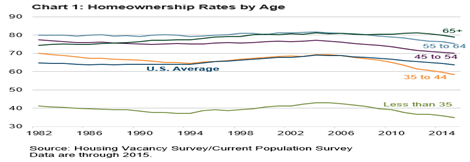
The Atlanta Federal Reserve Bank just published a housing study entitled, “It’s Not Just Millennials Who Aren’t Buying Homes,” that breaks down homeownership by age and household status. And the results show that age and whether one is head of a household makes a difference.

image

Graph: Atlanta Fed

“In recent years, much attention has been focused on the growing tendency of millennials to rent,” says the Atlanta Fed study. “Theories for the decrease in homeownership among young adults abound. They include rising student debt levels that crowd out additional borrowing, a tendency to live in more urban areas where the cost to buy is relatively high, a generally tougher credit environment, and even shifts in the perception of homeownership in the wake of the housing bust.”

But in fact the homeownership rate has declined in all age brackets, except 65 + year-olds. Why is not clear. We know household incomes since 1980 have declined for all age brackets except seniors whose incomes are boosted by social security, Medicare, and other retirement benefits.

The study also shows that homeownership rates have actually returned to pre-housing bubble levels of 64 percent, the homeownership rate since the 1970s.

“The fact that the average U.S. homeownership rate is close to rates seen in the mid-1980s and mid-1990s while homeownership rates within age groups (under 65) are currently lower than their respective averages in the mid-1980s to mid-1990s suggests that factors other than age may be affecting the average person’s decision to buy or rent.”

I believe it has to be declining household incomes that haven’t yet returned to pre-recession levels, even with record low interest rates. According to the Federal Reserve, the median household income was $51,939 in 2013, below the 1999 peak of around $57,000. The Census Bureau estimated real median household income at $53,657 for 2014 and $54,462 in 2015. Household income varies by race, with Asians the highest in 2014 at over $74,000 and African Americans the lowest around $35,000.

image

Graph: FRED

So household incomes have a long way to go to return to historic highs. A major reason has to be the soaring inequality that could take decades to correct; if and only if more progressive economic policies can be enacted—such as a wealth tax on large financial assets, and a higher maximum personal tax rate, which hasn’t yet even returned to 1980, Reagan era levels.

The nation’s aggregate household income has substantially shifted from middle-income to upper-income households, driven by the growing size of the upper-income tier and more rapid gains in income at the top. Fully 49 percent of U.S. aggregate income went to upper-income households in 2014, up from 29 percent in 1970. The share accruing to middle-income households was 43 percent in 2014, down substantially from 62 percent in 1970.

image

The bottom line is that married couple families still have the highest homeownership rate, whereas non-married singles have the lowest rate. What better reason to own a home than raising a family? And millennials are just now entering the age when they are beginning to form their own households, so their homeownership rate may also rise.

Harlan Green © 2016

Follow Harlan Green on Twitter: https://twitter.com/HarlanGreen
Posted in Consumers, Housing, housing market, Politics, Weekly Financial News | Tagged , , , , , | Leave a comment

Consumers are Happier!

Financial FAQs

The consumer is happier, at least, due mostly to higher wages, even if overall economic growth is lagging. Consumer sentiments and retail sales are rebounding after a punk first quarter. Corporations don’t want to invest in new plants and equipment—so-called capex spending—so they have to boost their employees incomes in order to convince them to work longer hours and produce more.

Sales at U.S. retailers rose a solid 0.5 percent in May after an even larger gain in the prior month, suggesting consumers still feel confident enough in the economy to stick to their usual spending patterns despite a slowdown in hiring. The sales gains were widespread. Auto dealers, Internet retailers, clothing outlets, gas stations, sporting-goods stores and restaurants all saw a healthy uptick in sales.

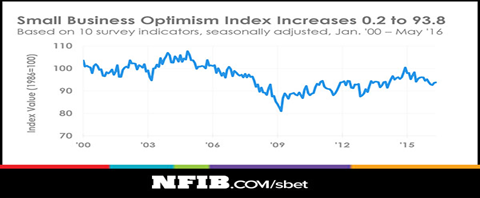
This is in large part because small businesses, which employ most of US, are hiring again. The Index of Small Business Optimism rose two tenths of a point in May to 93.8, according to the National Federation of Small Businesses (NFIB) monthly economic survey released today.

image

Graph: NFIB

Fifty-six percent reported hiring or trying to hire (up 3 points), but 48 percent reported few or no qualified applicants for the positions they were trying to fill. Hiring activity increased substantially, but apparently the “failure rate” also rose as more owners found it hard to identify qualified applicants. … Twenty-seven percent of all owners reported job openings they could not fill in the current period, down 2 points, but historically strong.

It is in line with the Labor Department’s JOLTS report, which showed 5.8 million job openings, and just 5.1 million hires in April. There are plenty of unfilled jobs, in other words. Why aren’t corporations investing more in capital expenditures? It is hurting economic growth in a big way.

image

Graph: Econoday

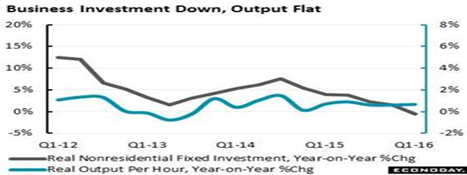
The second revision to first-quarter productivity fell at a quarter-to-quarter annualized pace of 0.6 percent, reports Econoday. It took a 1.5 percent rise in hours in the quarter to produce a 0.9 percent gain in output. With the labor market nearing full employment, this mismatch may very well become increasingly urgent for national policy. Not only did hours exceed output, compensation rose at the same time, up 3.9 percent to lift unit labor costs by an outsized 4.5 percent.

The lack of capex investment is puzzling economists, but one reason has to be they don’t have to, sitting on record profits and $4.5 trillion is cash and cash equivalent assets. Corporations would rather buy back their stock to boost stock prices, and so enrich their stockholders and CEOs than their employees and consumers.

But that will soon change, as they now have to pay their employees more, or begin to invest in expanding their productivity.

Harlan Green © 2016

Follow Harlan Green on Twitter: https://twitter.com/HarlanGreen

Posted in Consumers, Economy, Weekly Financial News | Tagged , , , , | Leave a comment