Middle Class Finally Gets A Raise

Popular Economics Weekly

A new rule announced by the Obama administration will, effective December 1, double the overtime-pay salary threshold and set it to automatically increase every three years. It’s about time. The salary of employees has been diminishing since the 1970s, as a share of the economic pie, believe it or not. While the profits of businesses are at record highs, as a percentage of GDP.

The high point of employee earnings was 50.1 percent of Gross Domestic Income in 1970, a proxy for Gross Domestic Product, and the current low point is 42.5 percent.

image

Why the discrepancy? It’s complicated, but has resulted in the decline of middle class wealth—and so of the middle class itself. The Obama administration, thanks to Labor Secretary Thomas Perez, is set to correct the deficiency.

The Labor Department says about 4.2 million workers will gain overtime benefits as a result of the rule, though the labor think tank Economic Policy Institute, which has argued strongly in favor of the rule, says this is a major undercount. Up to 13.5 million employees could be affected.

Americans’ paychecks have not kept pace with their productivity in part because millions of lower-middle-class and even middle-class workers are working overtime but not getting paid for it. President Obama directed the Labor Department to modernize the rules that require employers to pay workers time-and-a-half if they work overtime. The department issued a proposed rule to raise the overtime threshold from $455 per week, or $23,660 per year, to a “standard salary level equal to the 40th percentile of earnings for full-time salaried workers,” which is $921 per week in 2013 dollars, or $933 per week adjusted to 2014 dollars.

Salaried workers whose earnings are $933 per week or more can be exempted from the right to receive overtime if they fall into one of three categories: professionals, administrators, and executives. Each of these exempt categories is defined by a set of duties showing that the exempt employee is skilled and exercises independent judgment, or is a boss with a department and employees to supervise.

Unfortunately this rule was ignored by the Bush administration when the overtime pay rule was last adjusted. The threshold was kept at $23,660 per year, and even those workers were required to work overtime, even though they had little or no management duties.

The result has been record corporate profits, and very low productivity improvements with little incentive for businesses to raise workers’ wages or make investments that would create more jobs.

Why does private business have so little incentive to put some of their record profits to productive use? Nobelist Joe Stiglitz and other economists have labeled it “Monopoly’s New Era”.

“Capitalists are rewarded for saving rather than consuming – for their abstinence, in the words of Nassau Senior, one of my predecessors in the Drummond Professorship of Political Economy at Oxford (in order to pass their wealth on to succeeding generations)…The second school of thought takes as its starting point “power,” including the ability to exercise monopoly control or, in labor markets, to assert authority over workers.”

In other words, Big Business in particular has since the 1970s focused on maximizing profits, not to create even more wealth for their employees or communities, but to pass it on to future generations. Economist Thomas Piketty has labeled it a return to Europe’s Gilded Age when most of the wealth was inherited.

US President Barack Obama’s Council of Economic Advisers, led by Jason Furman, has attempted to tally the extent of the increase in market concentration and some of its implications, says Stiglitz. In most industries, according to the CEA, standard metrics show large – and in some cases, dramatic – increases in market concentration. The top ten banks’ share of the deposit market, for example, increased from about 20 percent to 50 percent in just 30 years, from 1980 to 2010. Hence the need for Dodd Frank to avoid any more ‘too big to fail’ scenarios.

image

And the result is our middle class is shrinking, the economic class that is the most productive in our society. After more than four decades of serving as the nation’s economic majority, the American middle class is now matched in number by those in the economic tiers above and below it, reports a recent PEW Research study.

In early 2015, 120.8 million adults were in middle-income households, compared with 121.3 million in lower- and upper-income households combined, a demographic shift that could signal a tipping point, according to a new Pew Research Center analysis of government data.

Over the same period, however, the nation’s aggregate household income has substantially shifted from middle-income to upper-income households, driven by the growing size of the upper-income tier and more rapid gains in income at the top. Fully 49 percent of U.S. aggregate income went to upper-income households in 2014, up from 29 percent in 1970. The share accruing to middle-income households was 43 percent in 2014, down substantially from 62 percent in 1970.

So it’s no surprise that economic growth has slowed. There are fewer households that tend to spend their earnings into the economy, which would generate the jobs and future economic growth. This is something the wealthiest do not do—they have other uses for their wealth.

Harlan Green © 2016

Follow Harlan Green on Twitter: https://twitter.com/HarlanGreen
Posted in Consumers, Economy, Keynesian economics, Politics, Weekly Financial News | Tagged , , , , , | 1 Comment

Why Too Little Inflation?

Financial FAQs

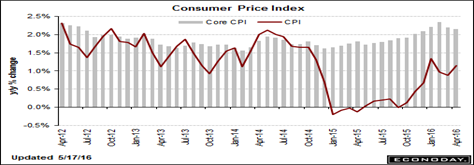
Where’s the inflation? It is barely rising, as consumers still wait for bargains, before they decide to buy. The overall Consumer Price Index in April rose just 1.1 percent, and is up 2.1 percent less food and energy prices, which have been falling this year.

image

Graph: Econoday

This is the major reason we saw just 0.5 percent GDP growth in Q1. It is the surest sign we are still in deflationary times, and the reason Janet Yellen’s Fed doesn’t want to raise short term rates further. We aren’t growing fast enough to put everyone to work—which includes some 8 million that are either working part time, or have stopped looking for work—which is why so many have listened to Bernie or Donald during the primaries.

Consumers sit on their pocket books when they believe prices might go lower, and job prospects aren’t so good. It is also how Japanese consumers continue to behave, as do Europeans during deflationary times, which keeps their economies from growing faster.

The U.S. isn’t as badly affected thanks to a very proactive Federal Reserve and the Obama administration $1.1T budget agreement that is pumping some infrastructure spending into public spending, as is the $305B Surface Transportation Bill that renewed the gasoline tax so that our roads and bridges could be repaired.

The new law, dubbed the Fixing America’s Surface Transportation Act, or the FAST Act, formally reauthorizes the collection of the 18.4 cents per gallon gas tax that is typically used to pay for transportation projects, and also includes $70 billion in “pay-fors” to close a $16 billion deficit in annual transportation funding that has developed as U.S. cars have become more fuel-efficient.

image

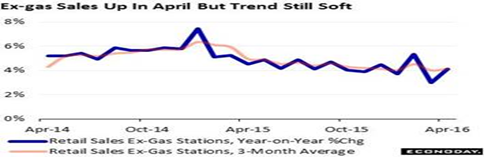
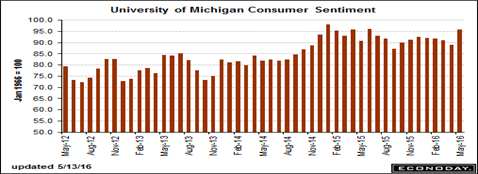
Retail sales also jumped, along with consumer sentiment in April. So we should see better growth this Q2. What is causing the spike in consumer sentiment? The U. of Michigan’s consumer sentiment survey is absolutely soaring so far this month, up nearly 7 points to 95.8 for the mid-month flash, as we said last week. This is the best reading since June last year.

Retail sales surged in April a much higher-than-expected 1.3 percent for the best showing since March last year. The strength is broad based and includes auto sales which finally show some life for the first time this year, with a 3.2 percent monthly jump.

Nobelist Joseph Stiglitz has been pounding the table on what is needed for better economic growth. He says there is a deficiency in aggregate demand, a Keynesian formula that measures the overall demand in goods and service from government as well as consumer spending, and exports.

“Today’s markets are characterized by the persistence of high monopoly profits,” says Stiglitz. “The implications of this are profound. Many of the assumptions about market economies are based on acceptance of the competitive model, with marginal returns commensurate with social contributions. This view has led to hesitancy about official intervention: If markets are fundamentally efficient and fair, there is little that even the best of governments could do to improve matters.

“But if markets are based on exploitation (i.e., monopoly power), the rationale for laissez-faire disappears. Indeed, in that case, the battle against entrenched power is not only a battle for democracy; it is also a battle for efficiency and shared prosperity.”

So when the private sector won’t spend—thanks in large part to the monopoly power of Big Business that has kept most of their record profits in the board rooms or on Wall Street, rather than investing in plants and equipment—government has to tax more of those profits in order that they be put to productive use.

So welcome to the popularity of Sanders and Trump!

Harlan Green © 2016

Follow Harlan Green on Twitter: https://twitter.com/HarlanGreen
Posted in Consumers, Economy, Keynesian economics, Macro Economics, Politics, Weekly Financial News | Tagged , , , , , | Leave a comment

Housing Affordability Improving

The Mortgage Corner

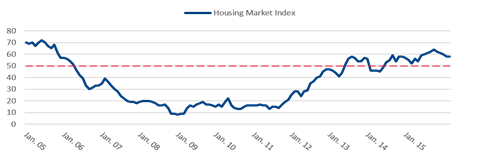
Spurred by a modest reduction in mortgage interest rates and favorable home prices, nationwide housing affordability in the first quarter of 2016 posted a slight increase, according to the National Association of Home Builders/Wells Fargo Housing Opportunity Index (HOI) released today.

image

“This is the second consecutive quarter that we’ve seen a nationwide improvement in affordability due to favorable home prices and mortgage rates,” said NAHB Chief Economist Robert Dietz. “These factors, along with rising employment, a growing economy and pent-up demand will provide a boost for home sales in the second half of 2016.”

Is this causing the spike in consumer sentiment? Consumer sentiment is absolutely soaring so far this month, in the opinion of Econoday, up nearly 7 points to 95.8 for the mid-month flash. This is the best reading since June last year.

image

Graph: Econoday

Expectations, which have been pulling down the headline index most of this year, jumped nearly 10 points to 87.5. The month-to-month turnaround for this reading is the best of the cycle, since 2006. Current conditions are also moving higher, to 108.6 from 106.7.

In all, 65 percent of new and existing homes sold between the beginning of January and end of March were affordable to families earning the U.S. median income of $65,700. This is up from the 63.3 percent of homes sold that were affordable to median-income earners in the fourth quarter.

The national median home price fell from $226,000 in the fourth quarter to $223,000 in the first quarter. Meanwhile, conforming 30-yr fixed mortgage rates are still as low as 3.25 percent in California, and 3.375 percent for a Hi Balance conforming fixed rate with a 1 pt. origination fee.

Harlan Green © 2016

Follow Harlan Green on Twitter: https://twitter.com/HarlanGreen
Posted in Consumers, Economy, Housing, housing market, Weekly Financial News | Tagged , , | Leave a comment

Trump’s RICO Trial Date Set

Popular Economics Weekly

Trump says he will be the first candidate since 1976 not to release tax returns. Analysts said that Trump likely pushed the envelope to turn ordinary income into capital gains, and deferred the payment of tax through like-kind exchanges, said the MarketWatch report. The tax returns could also verify how much income he receives from licensing his name.

In fact, they could show much more—for instance, how much of his fortune was made from defrauding other investors. Trump’s sordid business dealings are known to very few, as I’ve said in past columns. And now Donald Trump will go to trial in a class-action lawsuit against him and his now-defunct Trump University that includes the Racketeer Influenced and Corrupt Organizations Act, or RICO charges, after the presidential election but before the inauguration, setting the stage for a president-elect to take the witness stand if he wins the White House.

One of his 4 Chapter 11 (business) bankruptcies was for Trump Casinos and Hotels. “For 10 years between 1995 and 2005, Donald Trump ran Trump Hotels & Casino Resorts — and he did it so badly and incompetently that it collapsed into Chapter 11 bankruptcy,” said Marketwatch’s Brett Arends, who has been tracking his business failures for years. “His stockholders were almost entirely wiped out, losing a staggering 89 percent of their money. The company actually lost money every single year. In total it racked up more than $600 million in net losses over that period,” something no other major casino chain did over that term.

  image

Graph: MarketWatch

In total, Donald Trump pocketed $32 million in nine years of running Trump Casinos and Hotels, while his public stockholders lost more than $100 million. But much more damaging are the various class action lawsuits filed again Trump and Trump University, which was a university in name only.

Instead of receiving a quality degree, “as good as any from a university”, said Trump, students received a printed certificate and no degree after spending as much as $36,000 on a weekend course that solicited more money, and were given commonly known real estate websites, such as Zillow, and several worthless property referrals.

These are the words of several plaintiffs suing Trump that a San Diego court has elevated to gangster status. Trump is accused of not only fraud, but racketeering, as if he were running a criminal enterprise.

U.S. District Judge Gonzalo Curiel on Friday scheduled trial for Nov. 28 in the suit that alleges people who paid up to $35,000 for real estate seminars got defrauded. The likely Republican nominee planned to attend most, if not all, of the trial and would testify, Trump attorney Daniel Petrocelli said.

“This means that, fairly or unfairly, opponents will be able to say that a large group of everyman voters, many of them elderly, have accused a leading contender for the Oval Office of being a racketeer,” said Time Magazine’s Steven Brill, who has been following the progress of this lawsuit, initiated more than five years ago.

Harlan Green © 2016

Follow Harlan Green on Twitter: https://twitter.com/HarlanGreen
Posted in Economy, Politics, Weekly Financial News | Tagged , , , , , , | Leave a comment

JOLTS Jobs Report Highest In Years

Popular Economics Weekly

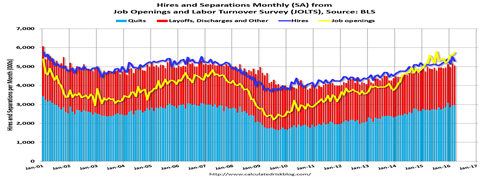
The U.S. Bureau of Labor Statistics reported the number of job openings was little changed at 5.8 million on the last business day of March, but it is actually up 11 percent over March 2015. Methinks the BLS is being overly modest, as it shows many more available jobs than workers, a sign of future job and economic growth.

image

Graph: Calculated Risk

Why do we know this? Jobs openings even increased substantially in March to 5.757 million from 5.608 million in February. And Quits are up 9 percent year-over-year, which is when workers leave voluntarily, usually because they are able to find better jobs. These are voluntary separations. (see light blue columns at bottom of graph for trend for “Quits”).

Note that hires (dark blue line) and total separations (red and light blue columns stacked) are pretty close each month in the Calculated Risk graph. This is a measure of labor market turnover.  When the blue line is higher than the columns, the economy is adding net jobs – when it is below the columns, the economy is losing jobs.

We also see much improvement in home building, another job creator, as construction jobs are up 1.2 million jobs from their lows, but 1.1 million below their 2006 bubble highs.

The U.S. Census Bureau of the Department of Commerce announced construction spending during March 2016 is 8.0 percent (±1.6%) above the March 2015 estimate of $1,052.9 billion. During the first 3 months of this year, construction spending amounted to $240.4 billion, 9.1 percent (±1.5%) above the $220.3 billion for the same period in 2015.

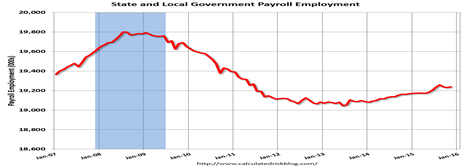
Lastly, state and local government employment has been the largest drag on job growth. This graph shows total state and government payroll employment since January 2007. State and local governments lost 129,000 jobs in 2009, 262,000 in 2010, 247,000 in 2011, and 29,000 in 2012, for a total of 669,000 jobs lost due to the Great Recession.

image

Graph: Calculated Risk

And through November 2015, reports Calculated Risk, state and local employment is up 70,000.   So, in the aggregate, state and local government layoffs are over – and the economic drag on the economy is over.  However state and local government employment is still 561,000 below the pre-recession peak.

So where will all the new jobs come from? There will be a pickup in manufacturing for one, but most jobs will occur in the non-manufacturing service sector, as I’ve said in past columns. That means Professional and Business Services, construction, health care, and Real Estate, now the fastest growing segments.

Harlan Green © 2016

Follow Harlan Green on Twitter: https://twitter.com/HarlanGreen

Posted in Consumers, Economy, Weekly Financial News | Tagged , , , , , , | Leave a comment

Service Sector Economy Booming

Financial FAQs

There was a huge jump in the U.S. service sector economy, our largest sector, some 67 percent of all U.S. economic activity. This is why we keep growing while most other developed and emerging economies aren’t.

The Institute of Supply Management’s non-manufacturing index registered 55.7 percent in April, 1.2 percentage points higher than the March reading of 54.5 percent. This represents continued growth in the non-manufacturing sector at a slightly faster rate. The Non-Manufacturing Business Activity Index decreased to 58.8 percent, 1 percentage point lower than the March reading of 59.8 percent, reflecting growth for the 81st consecutive month, at a slower rate in April.”

Even more importantly, the New Orders Index registered 59.9 percent, 3.2 percentage points higher than the reading of 56.7 percent in March, said the ISM press release. The Employment Index increased 2.7 percentage points to 53 percent from the March reading of 50.3 percent and indicates growth for the second consecutive month.

image

Graph: Calculated Risk

The service sector is booming because it includes most consumer-based services, such as Wholesale Trade; Health Care & Social Assistance; Utilities; Finance & Insurance; Real Estate, Rental & Leasing; Construction; Agriculture, Forestry, Fishing & Hunting; Public Administration; Professional, Scientific & Technical Services; and Retail Trade. The four industries reporting contraction in April are: Other Services; Mining; Transportation & Warehousing; and Educational Services.

So they are all the businesses that cater to consumers. In fact, the index is back to the highs of pre-recession 2005-2006. Much this is due to the rising consumer demand for goods and services as we approach full employment.

Even the Prices Index increased 4.3 percentage points from the March reading of 49.1 percent to 53.4 percent, indicating prices increased in April for the first time in three months and counteracting the recent deflationary trend that comes mostly from falling commodity and energy prices. According to the NMI®, 13 non-manufacturing industries reported growth in April. The majority of the respondents’ comments reflect optimism about the business climate and the direction of the economy.

What other factors favor higher growth this year, in spite of the initial estimate of 0.5 percent GDP growth in Q1? Even the manufacturing sector is showing better growth this spring. April’s 50.8 (i.e., more than 50 percent of manufacturing supply managers surveyed means growth) for the ISM manufacturing index may be moderately below expectations for 51.5 but details in the report are positive, says Econoday. “New orders did slow by 2.5 points but the level at 55.8 still points to a very solid rate of growth. “

New export orders, offering positive evidence on the effects of the lower dollar, are also positive, unchanged at 52.5 which isn’t dramatically above breakeven 50 but is still very solid for this reading and the best since December 2014. Backlog orders are still rising, though just barely at 50.5, but this along with March’s 51.0 are the best two months for this reading also since December 2014.

So, continued growth in both sectors of the economy—with the service sector particularly strong—is reason for optimism that we can yet achieve 3 percent GDP growth this year.

Harlan Green © 2016

Follow Harlan Green on Twitter: https://twitter.com/HarlanGreen
Posted in Consumers, Economy, Uncategorized, Weekly Financial News | Tagged , , , , | Leave a comment

April Private Payrolls Increase 171,000

Popular Economics Weekly

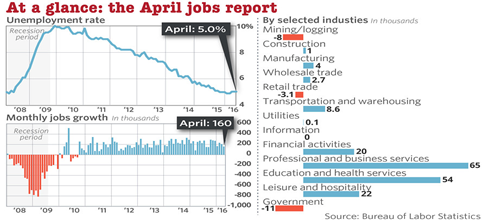
But government payrolls lost 11,000 jobs, so total nonfarm payroll employment increased just 160,000 in April. Over the prior 12 months, employment growth had averaged 232,000 per month.

The April jobs report was well below Wall Street’s expectations. But that is partly because we are nearing full employment, and 14.5 million jobs have been added during President Obama’s term already, third best behind Presidents Clinton and Reagan, and Obama still has 7 month left in his term.

But what is really full employment when the number of persons employed part time for economic reasons (also referred to as involuntary part-time workers) was unchanged in April at 6.0 million and has shown little movement since November? These individuals, who would have preferred full-time employment, were working part time because their hours had been cut back or because they were unable to find a full-time job.

And 1.7 million persons were marginally attached to the labor force, said the BLS, down by 400,000 from a year earlier. (The data are not seasonally adjusted.) These

Individuals were not in the labor force, wanted and were available for work, and had looked for a job sometime in the prior 12 months.

The unemployment rate, meanwhile, was flat at 5 percent. More people dropped out of the labor force and the so-called participation rate fell for the first time in seven months. That could mean people find it a bit harder to get a job. In April, employment gains occurred in professional and business services, health care, and financial activities, while mining continued to lose jobs.

image

Graph: Marketwatch

The increase in hiring last month was the smallest since September. Job creation slowed to an average of 200,000 in the last three months from a five-year high of 282,000 a month in the fourth quarter. Still, the soft employment report could reduce the odds of the Federal Reserve raising interest rates in June, say pundits.

The disappointing April employment report, however, might be a blip. Job openings sit near a record high and a sharp rebound in auto sales in April suggest consumers are still fairly confident, said MarketWatch. Businesses are unlikely to hold the line on hiring if sales continue to rise.

There are also signs of record consumer spending, as consumer credit levels rose to the highest level in 15 years. Outstanding consumer credit, a measure of non-real estate debt, rose by a seasonally adjusted $29.67 billion in March from the prior month, the Federal Reserve said Friday. The 10.0 percent seasonally adjusted annual growth rate was the fastest growth pace since November 2001.

Of particular note was that revolving credit (ie, credit cards) rose 14.2 percent after remaining in the low single digits since at least 2011. So consumers must finally be confident enough to use their plastic money.

That’s why this shows the possibility to higher growth ahead. In both 2014 and 2015, the economy rebounded smartly in the spring after growth sagged in the first quarter. Many economists expect a repeat this year. In April, professional-oriented companies, health care providers and financial firms added the most new workers. White-collar businesses added 65,000 employees, health-care firms created 44,000 jobs, and banks and insurance companies padded payrolls by 20,000.

Yet retailers cut 3,000 jobs to mark the first drop since the end of 2014. The mining sector, hurt by cheap oil prices, eliminated another 8,000 jobs to bring total cuts to nearly 200,000 in the past few years.

Employment gains for March and February, meanwhile, were reduced by a combined 19,000. The government said 208,000 new jobs were created in March instead of 215,000. February’s gain was trimmed to 233,000 from 245,000.

Harlan Green © 2016

Follow Harlan Green on Twitter: https://twitter.com/HarlanGreen
Posted in Consumers, Economy, Weekly Financial News | Tagged , , , , | Leave a comment

Fannie Mae, GSEs, Even More Important

The Mortgage Corner

With news that Fannie Mae, one of the GSEs now managed by the Federal Housing Finance Authority (and US Treasury) just showed a $1.1B profit in Q1, but must pass all of it profits to Treasury since 2012, the question of how to resolve the status of major mortgage guarantors Fannie Mae and Freddie Mac becomes even more critical.

Why? They will have no capital left after 2017, and ““Operating with essentially zero capital is not sustainable,” said Fannie CEO Tim Mayopoulos on the Thursday morning earnings call, just after his company reported a $1.14 billion profit in the first three months of the year, the 17th consecutive quarter of profitability.

Yet banks and other non-GSE lenders aren’t stepping up to the plate to replace Fannie and Freddie. And they still guarantee more the 60 percent of all conventional mortgages. Private capital is “unwilling to step in” to replace the government-sponsored enterprises as mortgage finance leaders in the secondary market, said Mayopoulos to HousingWire’s Jacob Gaffney.

This is hurting the housing market, needless to say, as the GSEs keep tightening qualification standards in an attempt to satisfy Treasury that it is shrinking its loan portfolio. The average Fannie borrower’s FICO score was 746 in the first quarter. By way of comparison, the median credit score across the entire mortgage market in 2001, before the bubble era, was 701.

And that is even high, as scores of 620 to 680 were more prevalent in past decades because it was hard for homeowners to avoid at least one mortgage late payment in a year, what with so many payments made via snail mail. In fact, both FHA and VA, the other two Government Supervised Entities, allow credit scores as low as 520.

image

Graph: Calculated Risk

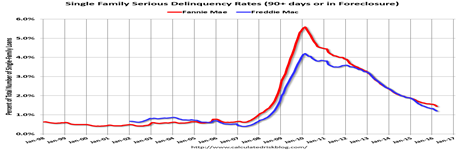
Fannie’s serious delinquency rate also shows cleaner credit quality. It fell for the 24th quarter in a row in the beginning of the year, to 1.44 percent. According to the company’s financial statement, that number would be even lower if foreclosures didn’t take so long in many states.

And Freddie Mac reported the Single-Family serious delinquency rate decreased in March to 1.20 percent from 1.26 percent in February. Freddie’s rate is down from 1.73 percent in March 2015. This is the lowest rate since August 2008.

All this is making it more difficult for younger, first-time homebuyers with generally lower incomes, savings and credit scores. The NAR’s March existing-home sales survey reported the share of first-time buyers was 30 percent in March, unchanged both from February and a year ago. First-time buyers in all of 2015 also represented an average of 30 percent.

“With rents steadily rising and average fixed rates well below 4 percent, qualified first-time buyers should be more active participants than what they are right now,” said the NAR’s chief economist Lawrence Yun. “Unfortunately, the same underlying deterrents impacting their ability to buy haven’t subsided so far in 2016. Affordability and the low availability of starter homes is still a major barrier for them in most markets.”

So there is no reason that credit requirements should be tightening at a time when more first-time homebuyers are entering the housing market. And there is plenty of evidence that the younger generations want and need housing.

Harlan Green © 2016

Follow Harlan Green on Twitter: https://twitter.com/HarlanGreen

Posted in Consumers, Housing, housing market, Politics, Weekly Financial News | Tagged , , , , , | Leave a comment

Bernie’s Economic Platform—Part II

Popular Economics Weekly

Bernie Sanders and Donald Trump won their respective Indiana primaries, and we know why.

In February air-conditioner manufacturer Carrier, a wing of United Technologies, announced that beginning next year it will move its Indianapolis production to Mexico and lay off the company’s U.S. workers. (It will also gut the factory’s suppliers and surrounding businesses.) The announcement was caught on video and went viral just as the presidential campaign was focusing on the disastrous effects of our country’s “trade” policies.

Why is this an issue now when so many jobs have already moved overseas? Because of the presidential primaries, of course, and both Bernie Sanders and Donald Trump have taken notice.

“United Technologies reported $7.6 billion in profits for 2015,” reports The Campaign For America’s Future, a progressive blog. “This was up from $6.2 billion in 2014. The company is spending $12 billion to purchase its own stock, which manipulates an increase in the stock price. That gives an idea of just how much cash the company has at its disposal. They use plenty of it to enrich executives, with their CEO getting almost $10 million in 2014 after getting more than $20 million in 2013.”

The sad fact is this has become an everyday event for many American workers, and the reason it has taken so long for workers’ salaries to begin to rise again, reports New York Times Neil Irwin.

United Technologies’ decision is of course an outrage, any way it’s looked at. How can a major and very profitable corporation dare to only enrich its executives and shareholders, but not benefit its employees? We know why. Big Business has succeeded in reducing tax rates for the highest income tax brackets, and granting major loopholes for corporations to shelter their profits (both domestically and overseas) since the late 1970s, with the deregulation of whole industries and globalization of the workforce.

image

“American workers are reaping fewer of the gains of a growing economy in the form of pay and benefits,” said Irwin. “Shareholders are reaping more in the form of corporate profits. That shift has been one of the most important economic stories of the past several decades, and it’s the key to understanding stagnant wages for middle-class workers and a soaring stock market in the last quarter-century.”

It is why corporate profits’ share of national income soared to a record 14.2 percent in the middle of 2014, the highest in history, and only now is beginning to decline to 12.1 percent by the end of 2015, reports Irwin, as we edge closer to full employment.

image

Graph: Econoday

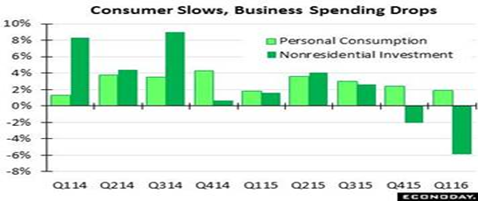
This graph shows what corporations haven’t done with their profits, here called nonresidential investments, as a percentage of GDP growth. The largest negative component of Q1 Gross Domestic Product (up just 0.5 percent in initial estimate) was business spending as nonresidential fixed investment. It fell 5.9 percent for a second drop in a row. Business spending had been a plus for GDP until the last two quarters.

Instead, corporations in particular have been using their record profits to enrich their execs and shareholders, as I’ve said. This is while consumers are still spending, which should boost nonresidential investment, since consumers make up some 70 percent of economics activity these days. Personal consumption expenditures rose at a 1.9 percent annualized rate vs rates of 2.4, 3.0, and 3.6 percent in the prior three quarters (when GDP growth was higher).

The good news is that businesses are still hiring, but mostly in the lower-paying service industries, as higher-paying manufacturing jobs continue to move overseas. So Bernie and The Donald are right in calling out U.S. corporations. How is it benefiting American workers? Stay tuned. Maybe the outcome of this presidential election will help to answer that question.

Harlan Green © 2016

Follow Harlan Green on Twitter: https://twitter.com/HarlanGreen
Posted in Consumers, Economy, Politics, Weekly Financial News | Tagged , , , , , | Leave a comment

Is Bernie’s Economic Platform Impossible?

Financial FAQs

It looks like Hillary Clinton’s nomination as the Democratic candidate is assured, but are Bernie Sander’s economic proposals impossible to achieve, as many mainstream economists maintain? Bernie wants to be able to introduce them into their platform at the Democratic convention.

He has some good ideas—such as tuition-free public universities, universal health care for all, a $15/hour national minimum wage, as well as achieve record economic growth, as happened from 1950’s through the 1970’s.

“As President, I will invest $1 trillion to rebuild our crumbling infrastructure to put 13 million Americans to work in good jobs, says Bernie on his website, “invest $5.5 billion to employ 1 million young Americans and provide job-training to hundreds of thousands of others, and create a Clean-Energy Workforce of 10 million good jobs through a 100 percent clean energy system.”

Not possible, say economists like Nobelist Paul Krugman: “On health care: leave on one side the virtual impossibility of achieving single-payer. Beyond the politics, the Sanders “plan” isn’t just lacking in detail; as Ezra Klein notes, it both promises more comprehensive coverage than Medicare or for that matter single-payer systems in other countries, and assumes huge cost savings that are at best unlikely given that kind of generosity. This lets Sanders claim that he could make it work with much lower middle-class taxes than would probably be needed in practice.”

Actually, yes, Bernie’s goals are attainable, and have been achievable in the past. In fact, they mirror much of what was done in President Roosevelt’s New Deal, when conditions were worse (i.e., 25 percent unemployment), and government the employer of last resort. Bernie based his proposal on University of Massachusetts economist Gerald Friedman, a full-blown Keynesian economist who believes in government intervention to pull the U.S. out of its present economic malaise. Unfortunately Bernie is no FDR, able by himself to sell his program beyond union blue collar workers and our youngest, more educated generation that is looking for another new deal.

“While economists from different perspectives will differ on these fundamental issues,” says Professor Friedman in an initial response to mainstream economists that rejected his new deal plan almost outright (such as Krugman), “we have experience in the United States that demonstrates the lasting effect of government stimulus spending. Emerging from the depths of the Great Depression, New Deal stimulus spending (including monetary easing) nearly doubled the GDP growth rate from pre-1929 levels to 7 percent per year, 1933-40, and nearly 10 percent a year from 1933-44; between the 1929 peak and 1944, output grew to a level 25 percent higher than it would have been at the pre-1929 growth rate.”

Paul Krugman, a student of the New Deal, should know. He was one of the first economists to unmask conservatives’ attempt to unravel New Deal legislation—including their attempts to dismantle social security and Medicare—in his best-selling book, The Great Unraveling, yet he doesn’t seem to believe another New Deal is possible.

“The Republican candidates have been widely and rightly mocked for their escalating claims that they can achieve incredible economic growth,” said Krugman, “starting with Jeb Bush’s promise to double growth to 4 percent and heading up from there. But Mr. Friedman outdoes the G.O.P. by claiming that the Sanders plan would produce 5.3 percent growth a year over the next decade.”

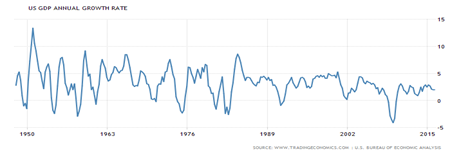
However, Professor Friedman wasn’t talking about the Republican agenda to cut government programs—just the opposite. “Active Keynesian policy maintained faster growth rates for the next quarter century as well. From 1947-73, the unemployment rate averaged 4.7 percent and annual GDP growth averaged 4.0 percent; output in 1973 was 13 percent higher than it would have been at earlier growth rates.

image

Graph: Trading Economics

Much of that growth was due to massive infrastructure spending like our public freeway system, NASA’s moon landing, and other public works programs. It was massive government spending, in a word, that was possible with higher revenues from a maximum tax rate of 92 percent during the Eisenhower era, and an exploding baby boomer generation.  But tax rates gradually began to decline, until the ‘Reagan revolution’ cut the maximum tax rate to 40 percent.

Then we had the 1970s Arab oil embargo and skyrocketing inflation, due to the resultant gasoline shortage. Americans adopted conservative ways and began to believe government was the problem, at a time of greatest prosperity and a very low federal budget deficit.

It had also happened in 1937, when Roosevelt was convinced the Depression was over, and a Republican Congress called for a balanced budget and tax cuts. The result was a second depression that wasn’t over until WWII (hence it became the Great Depression) and government spending resulted in the full employment of women as well.

“Only when we abandoned Keynesian policies after 1973 did growth rates fall, says Friedman. “From 1973-2014, annual growth has averaged only 2.6 percent, almost a full percentage point below the pre-1929 rate, while unemployment has risen to 6.5 percent. Because of the slowing of growth rates after jettisoning Keynesian policies, output in 2007 was almost 30 percent less than it would have been at the growth rates of the 1947-73 period.”

Why the confusion over economic policy? The main disagreement seems to be the duration of government stimulus benefits. Krugman and other establishment economists believe it is short term, only, whereas Friedman and some British Keynesians say history should be the final word. Spending on improving infrastructure, education, Research and Development (such as funded DARPA and the Internet), health care, not only improves lives, but also labor productivity, which stimulates more growth.

So it’s really a matter of history repeating itself, and its lessons being forgotten. Higher growth happened until the 1970s, and we don’t (yet) have another World War to bring US together, which is when we seem to realize the importance of government policies that boost growth.

Harlan Green © 2016

Follow Harlan Green on Twitter: https://twitter.com/HarlanGreen
Posted in Economy, Keynesian economics, Macro Economics, Politics, Weekly Financial News | Tagged , , , , , , | Leave a comment