U.S. Nearing Full Employment?

Popular Economics Weekly

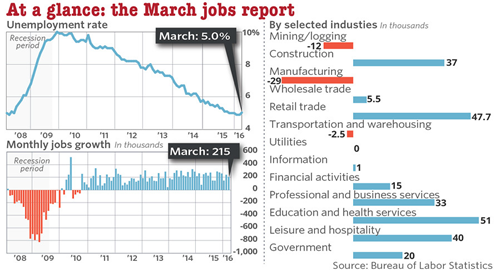
Are we approaching full employment will be the debate raging within the Federal Reserve and beyond this year. That’s because, “Total nonfarm payroll employment rose by 215,000 in March, and the unemployment rate was little changed at 5.0 percent,” the U.S. Bureau of Labor Statistics reported today. “Employment increased in retail trade, construction, and health care. Job losses occurred in manufacturing and mining, only.”

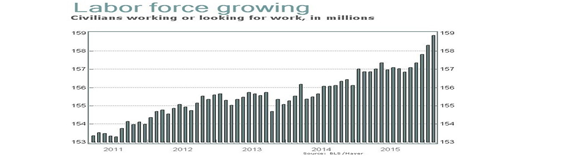
It does look like the U.S. is approaching full employment, the holy grail of most economists and the Fed’s overriding mandate? This is even though the unemployment rate rose a notch to 5 percent from 4.9 percent. But it was because more Americans joined the labor force, said the Labor Department. The size of the labor force has increased by 2 million people in the past five months, a clear sign that jobs are easier to find.

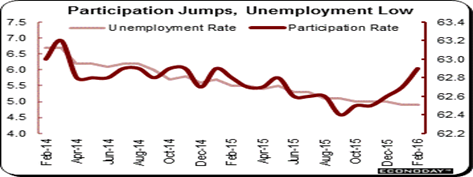
Those new workers and jobseekers, particularly since last fall, pushed the so-called labor force participation rate up to 63 percent. That’s the highest level in two years, reversing at least for now a sharp decline that kicked in after the onset of the Great Recession, said the Bureau of Labor Statistics.
image

Graph: Marketwatch

And this is with the mini job-recession in the energy and manufacturing sectors that lost 12,000 and 29,000 jobs, respectively. The household survey measure of employment shows a very good 246,000 gain in March, it is just that the labor force increased by an even bigger 396,000. That means the labor force has now increased by more than two million in the past five months alone. The participation rate has jumped from a low of 62. percent last September to a two-year high of 63.0 percent this March.

“This is a remarkable turnaround in terms of both its speed and magnitude,” said Marketwatch’s Jeff Bartash.

And the manufacturing drop may be temporary as its component of the industrial production report posted a surprising 2 tenths gain in February last week, which came on top of January’s ‘stunning’ gain of 0.5 percent.

In fact, the March just released ISM Manufacturing Report showed a big surge in ISM new orders, which is certain to shake up what has been a very downbeat outlook for the manufacturing sector, said Bradley J. Holcomb, CPSM, CPSD, chair of the Institute for Supply Management® (ISM®).

“The March PMI® registered 51.8 percent, an increase of 2.3 percentage points from the February reading of 49.5 percent. The New Orders Index registered 58.3 percent, an increase of 6.8 percentage points from the February reading of 51.5 percent. The Production Index registered 55.3 percent, 2.5 percentage points higher than the February reading of 52.8 percent.”

“Manufacturing registered growth in March for the first time since August 2015, as 12 of our 18 industries reported sector growth, and 13 of our 18 industries reported an increase in new orders in March,” said Holcomb.

So what will full employment actually look like? Even In March, 1.7 million persons were marginally attached to the labor force, says the Labor Department, down by 335,000 from a year earlier. (The data are not seasonally adjusted.) These individuals were not in the labor force, wanted and were available for work, and had looked for a job sometime in the prior 12 months. They were not counted as unemployed because they had not searched for work in the 4 weeks preceding the survey.

But, the number of persons employed part time for economic reasons (also referred to as involuntary part-time workers) was about unchanged in March at 6.1 million and has shown little movement since November. These individuals, who would have preferred full-time employment, were working part-time because their hours had been cut back or because they were unable to find a full-time job.

So, eh, we are approaching full employment, but are still not there. Our Fed Chairwoman Janet is right. Let’s allow more of those part timers, and marginally attached folks to find work that can fully support them and their families, before the Fed tightens the credit screws any further.

Harlan Green © 2016

Follow Harlan Green on Twitter: https://twitter.com/HarlanGreen
Posted in Consumers, Economy, Weekly Financial News | Tagged , , , | Leave a comment

Why Such Dismay At Fed Chair Yellen’s Dovish Remarks?

Financial FAQs

Janet Yellen gave another speech yesterday, and stocks and bonds rallied. So you would think the pundits would applaud her speech. But, no, with approximately half of the Fed Governors saying they want higher interest rates now, many thought she was the Fed party pooper.

She in fact said that with so much economic uncertainty both here and abroad, now wasn’t the time to talk about raising interest rates further. And there is plenty of uncertainty, since our last quarter’s GDP growth was just raised to 1.4 percent from 1 percent, and we might be lucky to achieve 2 percent GDP in Q1 2016.

“Global developments have increased the risks” to the outlook, with economic and financial conditions still less favorable than in December when the Fed engineered its first rate hike in a decade, Yellen said in a speech to the Economic Club of New York.

“Given the risks to the outlook, I consider it appropriate for the Committee to proceed cautiously in adjusting policy,” she said. She didn’t mention a month for when the Fed could lift interest rates.

So why on earth are so many calling for higher rates at this time? How would that benefit growth, and employment? It’s the bankers among the Fed Governors who worry most about another recession. They voiced the fear that with rates so low, the Fed wouldn’t be able to stimulate more growth should we enter another recession.

So in an unexpected twist to the speech, Yellen pushed back on the conventional wisdom that the U.S. central bank would be virtually powerless to respond to a recession given that interest rates are so close to zero. “The Fed would still have considerable scope to provide additional accommodation,” Yellen said.

But where are the inflation fears coming from, with more than 200,000 jobs being created every month, and the unemployment rate at 4.9 percent? An economy has to overheat first, such as during the housing or dot-com bubbles, has to be producing at full capacity with inflation soaring before there’s any danger of a recession.

And inflation is dependent mostly on increasing wages, these days, since wages and salaries still make up two-thirds of product costs. Yet wages are only beginning to rise after being stagnant for some 30 years.

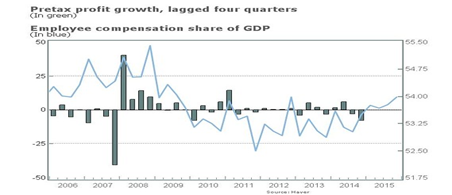
One caveat that may be feeding recession fears is that corporate profits are shrinking, which could mean slowing growth. Pretax profits fell nearly 8 percent in the fourth quarter, and annual profits fell for the first time since the Great Recession, the Commerce Department reported last week.

But Marketwatch reports that David Rosenberg, chief economist and strategist of Gluskin Sheff, in a research note says consumer income leads business income, and not the other way around. Historically, the relationship runs from personal income growth to corporate profit growth by a four-quarter lag.

And the Commerce Department report on corporate profits also showed employment compensation as a percentage of total income on the rise. It’s admittedly rebounding from historic lows, but this growth should ultimately lead households to bolster spending, and that spending will end up in corporate coffers, Rosenberg says.

image

Graph: Marketwatch

Then we have this news. Manufacturing may be on the rebound. The Institute For Supply Management’s just released Chicago Business Barometer, one of the major manufacturing indicators, increased a HUGE 6.0 points to 53.6 in March, led by sharp bounce backs in Production and Employment. In fact, I’ve already reported that manufacturing is returning to pre-Great Recession levels.

“Four of the five Barometer components increased between February and March,” said Chicago-ISM, “with only Supplier Deliveries declining on the month. Movements in the Barometer and its components have been volatile over the past few months, while trend growth has remained weak. March’s positive outturn, though, left the three month trend at the highest for just over a year and the Q1 average at the highest since Q4 2014.”

So where is the recession?

Harlan Green © 2016

Follow Harlan Green on Twitter: https://twitter.com/HarlanGreen

Posted in Consumers, Economy, Politics, Uncategorized, Weekly Financial News | Tagged , , , , | Leave a comment

U.S. Manufacturing’s Near Record Output

Popular Economics Weekly

Gross output of U.S. manufacturing industries — counting products produced for final use as well as those used as intermediate inputs — totaled $6.2 trillion in 2015, about 36 percent of U.S. gross domestic product, and nearly double the output of any of the other big sectors: professional and business services, government and real estate, reports Marketwatch’s Rex Nutting.

This is hardly a failed sector of the economy, as the Republican primary candidates maintain. “China may have become the leading manufacturing economy in the world in 2010,” says Nutting, “but the United States maintains a strong second-place standing. The value added by U.S. factories is more than $2 trillion a year, equal to the next three countries (Japan, Germany and South Korea) combined. U.S. manufacturing is still the envy of the world.”

image

Graph: Marketwatch

Then why so much bad mouthing of U.S. manufacturing? It’s maybe because fewer workers are needed to produce more, which has hurt the Midwest rust-belt states, and is probably why those blue collar workers have supported either Bernie or Donald in the Presidential primaries. Technology and new ways of organizing work have revolutionized the American factory since the Golden Age of the 1980s, says Nutting. Today, U.S. factories produce twice as much stuff as they did in 1984, but with one-third fewer workers.

image

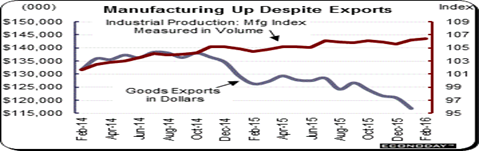
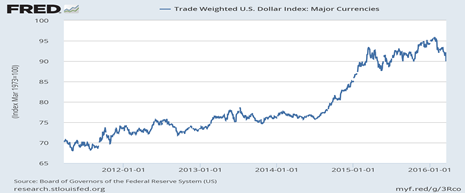
The manufacturing component of the industrial production report posted a surprising 2 tenths gain in February last week, which came on top of January’s stunning gain of 0.5 percent. Exports aren’t specifically tracked in any of these reports but the implication is clear, says Econoday that this year’s steep and early decline in the dollar, down 3.8 percent on the dollar index, is making our exports less expensive to our foreign customers.

image

So the ultra-strong dollar exchange rate with foreign currencies that allows Asian countries to outprice US on the cheaper consumer goods hasn’t hurt our manufacturing base that much. In fact, it’s been a great help to consumers, making imported goods that consumers love even cheaper.

Consumers aren’t necessarily spending their windfall from the cheaper imports and low inflation, however. Wages and salaries fell for the first time since last September in the Commerce Department’s just released Personal Income and Outlays report, and their savings rates has risen to 5.4 percent. Why? We suppose anytime incomes fall, households tend to want to save more for that rainy day those pundits keep talking about.

Harlan Green © 2016

Follow Harlan Green on Twitter: https://twitter.com/HarlanGreen
Posted in Consumers, Economy, Weekly Financial News | Tagged , , , , | 1 Comment

Where Are The New Homes?

The Mortgage Corner

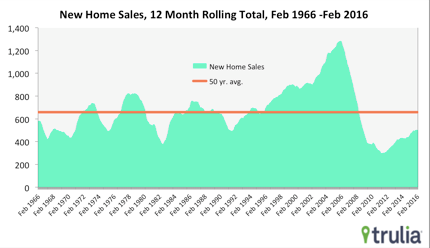
Sales of newly built, single-family homes rose 2 percent in February from an upwardly revised January reading to a seasonally adjusted annual rate of 512,000 units, according to newly released data by the U.S. Department of Housing and Urban Development and the U.S. Census Bureau.

This shows progress in badly needed housing inventory, but new-home sales are still far below the 50-year average, which means there is still a tremendous amount of pent up demand for housing in the 7th year of this economic recovery that is reflected in escalating rents and housing prices. And developers are only now beginning to get it.

“This reflects a slow but steady increase in demand from homebuyers as well as increasing confidence of homebuilders,” said Trulia Chief Economist Ralph McLaughlin. “It is also a positive sign for the U.S. economy headed into 2016, as new home sales leads to new construction and consumer demand for housing-related goods and services. Despite the positive news, new home sales remain still remain about 24 percent below the 50-year average.”

image

Graph: HOUSINGWIRE

Where is the shortage? It is mostly in the lower-priced brackets that most homebuyers can afford.

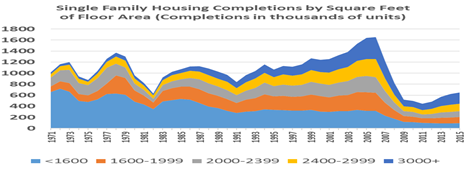
From housing economist Tom Lawler, per Calculated Risk:  “While single-family housing production has continued to recover, the overall level of production – in terms of units – has been well short of consensus forecasts from a few years ago. In looking at the production “shortfall,” the one thing that is striking is that production of moderately sized homes has barely recovered from the cyclical lows, while production of big homes (3000+ square feet) has been running at a higher pace that in all but one year of the 1990’s, as the above graph illustrates.

This makes very little sense if builders are to meet the housing need, as 80 percent of the employed are wage and salary earners and the U.S. median household income is barely above $60,000 per year these days. That is, household incomes are finally returning to early 2000, pre-recession levels. Such a median income can buy a home worth approximately $400,000 with 10 percent down at today’s very low conforming fixed rates (still less than 4 percent).

Yet hardly any homes with 1600 square foot or less areas are being built that can be sold in moderate price ranges. Builders maintain it is because of labor and land shortages, but banks have been very slow to grant development or acquisition financing, which is the credit developers need to even acquire the land for development.

image

Graph: Calculated Risk

However builders remain ever optimistic in this new year. “While builders contend with industry headwinds such as labor shortages, relatively low mortgage interest rates and solid job growth should keep the housing market moving ahead as we enter the spring buying season,” said NAHB Chief Economist Robert Dietz.

The inventory of new homes for sale was 240,000 in February, which is a 5.6-month supply at the current sales pace (still slow). The median sales price of new houses sold in February was $301,400. Regionally, new home sales rose 38.5 percent in the West. (But) Sales dropped 4.1 percent in the South, 17.9 percent in the Midwest and 24.2 percent in the Northeast.

Does this mean builders and banks will realize they have to build for the middle class as well as the wealthiest that can afford those 3,000 sf homes, if they want to grow the housing market?

Harlan Green © 2016

Follow Harlan Green on Twitter: https://twitter.com/HarlanGreen
Posted in Consumers, Housing, housing market, Weekly Financial News | Tagged , , , , , | Leave a comment

Why Is the Fed Waiting For Inflation?

Popular Economics Weekly

The Federal Reserve should stick with a “wait-and-see monetary response” absent more evidence of sustainable inflation gripping the U.S. economy, Chicago Fed President Charles Evans said Tuesday. That seems to be Fed Chairwoman Yellen’s response to current world events, as well.

But what is ‘sustainable inflation’, really? It’s a code word for sustainable growth, as past history tells us we really need an inflation rate that is more than the Fed’s 2 percent target to achieve GDP growth that is sustainable.  And, as I said last week, though several of the Fed’s Open Market Committee are still pushing for higher interest rates, there is little sign of inflation at the wholesale or retail level, which means wages are not rising fast enough (that approx. 2/3rds of product costs) to boost consumer demand, and hence economic growth.

Evans — considered to be one of the policy panel’s doves but perhaps no longer an outlier with that view — said he’s willing to allow the U.S. economy to tip above the Fed’s roughly 2 percent inflation target to gain assurance that flares in inflation signals aren’t transitory, even masking economic trouble-spots that might benefit from a go-slow Fed. Factors dragging on growth potential right now include: weaker corporate spending, low commodities prices, China’s economic slowdown and market volatility, he told the City Club of Chicago.

There’s also the U.S. Dollar’s strength, which is harming our exports (read manufacturing sector) because it is in such demand as the world’s reserve currency and considered a safe haven for foreign investors that are leery of investing otherwise amidst the current geopolitical uncertainty.

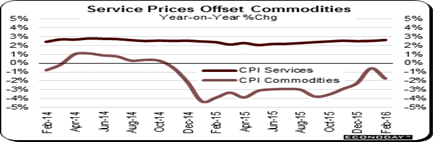
And if the Fed does boost interest rates further than last December’s one quarter percent hike, it will boost the dollar’s value higher, thus making U.S. exports even less competitive in the current hyper-competitive world trade environment. Such a trade environment with low trade barriers means almost anyone anywhere can produce what is needed, resulting in a world awash in goods and services. The current oil glut is just one example that is depressing commodity prices.

image

Graph: Econoday

The good news is that manufacturing seems to be recovering, even with the strong dollar. The Philly Fed and Empire State manufacturing reports are the first positive signals of factory activity during the month. A look at February’s industrial indicators also show definitive evidence of recovery, says Econoday. The manufacturing component of the industrial production report posted a surprising 0.2 percent gain which came on top of January’s stunning gain of 0.5 percent.

Why the manufacturing pickup after 6 months of decline? The dollar is down a surprising 3.8 percent on the dollar index, making our exports less expensive to foreign customers. The above Econoday graph tracks the index value of the manufacturing component against monthly dollar totals for exports.

Exports have been sinking sharply for more than a year in what, by contrast, underscores the formidable strength of domestic demand. Yet the drop in the dollar has been accelerating. It is probably because the Fed’s Open Market Committee has been backing off its promise to raise short term rates as much as 4 times this year.

So we should listen to Fed Governor Evans. Higher inflation is necessary at his time and should be allowed, before the Fed raises rates further. Any sign that inflation could be a danger to growth would be almost instantly reflected by higher yields in the bond markets. And today’s US 10-year Treasury Bond is yielding an absurdly low 1.9 percent.

Harlan Green © 2016

Follow Harlan Green on Twitter: https://twitter.com/HarlanGreen
Posted in Consumers, Economy, Politics, Weekly Financial News | Tagged , , , , , | Leave a comment

Existing-Home Sales Fall, Inflation Too Tame

The Mortgage Corner

After increasing to the highest annual rate in six months, existing-home sales tumbled in February amidst very low supply levels and robust price growth in several sections of the country, according to the National Association of Realtors. Led by the Northeast and Midwest, all four major regions experienced sales declines in February.

And though several of the Fed’s Open Market Committee are still pushing for higher interest rates, there is still little sign of inflation at the wholesale or retail level, which means wages are not rising fast enough (that aprox. 2/3rds of product costs) to boost consumer demand, and hence economic growth.

Total existing-home sales1, which are completed transactions that include single-family homes, townhomes, condominiums and co-ops, dropped 7.1 percent to a seasonally adjusted annual rate of 5.08 million in February from 5.47 million in January. Despite last month’s large decline, sales are still 2.2 percent higher than a year ago.  

image

Graph: Calculated Risk

Lawrence Yun, NAR chief economist, said existing sales disappointed in February and failed to keep pace with what had been a strong start to the year. “Sales took a considerable step back in most of the country last month, and especially in the Northeast and Midwest,” he said. “The lull in contract signings in January from the large East Coast blizzard, along with the slump in the stock market, may have played a role in February’s lack of closings. However, the main issue continues to be a supply and affordability problem. Finding the right property at an affordable price is burdening many potential buyers.”

image   

Graph: Econoday

Year-on-year, the producer price index (for wholesale goods and services), at dead zero, is a full 1 percentage point below the CPI while the producer core rate, at plus 1.2 percent, is 1.1 percentage point behind the CPI core.

So there is really no reason to worry about inflation. The Fed should instead be concerned with boosting growth. As the primary Presidential debates are highlighting, the various trade agreements have sent most of the high-paying blue collar jobs overseas. What is left? The lower-paying service sector jobs, such as in health care.

There is the hope that housing will boost construction jobs, which are higher paying. Indeed, the lower February existing-home sales are mainly due to the lack of inventory, which is down to a 4.4 month total, and the consequent higher prices.

“The overall demand for buying is still solid entering the busy spring season,” said Yun, “but home prices and rents outpacing wages and anxiety about the health of the economy are holding back a segment of would-be buyers.”

The median existing-home price for all housing types in February was $210,800, up 4.4 percent from February 2015 ($201,900). February’s price increase marks the 48thconsecutive month of year-over-year gains.

And total housing inventory at the end of February increased 3.3 percent to 1.88 million existing homes available for sale, but is still 1.1 percent lower than a year ago (1.90 million). That is why unsold inventory is at a 4.4-month supply at the current sales pace, up from 4.0 months in January.

Dr. Yun speculates part of the inventory decline may be due to large funds that are still buying up vacant units. “Investor sales have trended surprisingly higher in recent months after falling to as low as 12 percent of sales in August 2015,” adds Yun. “Now that there are fewer distressed homes available, it appears there’s been a shift towards investors purchasing lower-priced homes and turning them into rentals. Already facing affordability issues, this competition at the entry-level market only adds to the roadblocks slowing first-time buyers.”

Rising housing prices do boost inflation, but rising incomes even more so. So when incomes aren’t rising more than, say, 2.5 percent per year, then housing prices cannot rise much faster. The biggest constraint on housing today, even with still ultra-low interest rates, is in fact static household incomes.

Harlan Green © 2016

Follow Harlan Green on Twitter: https://twitter.com/HarlanGreen
Posted in Consumers, Economy, Housing, housing market, Politics, Weekly Financial News | Tagged , , , , , , | Leave a comment

Job Openings Still At Record Level

Popular Economics Weekly

The number of job openings rose to 5.5 million on the last business day of January, the U.S. Bureau of Labor Statistics reported today. It is just below the record high set in July 2015. Hires declined slightly to 5.0 million while separations edged down to 4.9 million. The JOLTS report highlights the millions of jobs actually lost and created each month. It highlights the rising number of job openings, which means more of the unemployed are finding work. And economic growth generally follows job growth.

The quits rate was 2.0 percent (looked at by the Fed because it tells them how many are voluntarily leaving their old job to find a better new job), and the layoffs and discharges rate was down to 1.2 percent.

The following graph shows job openings (yellow line), hires (dark blue), Layoff, Discharges and Other (red column), and Quits (light blue column), according to Calculated Risk. The number of job openings (yellow) are up 11 percent year-over-year compared to January 2015. Quits are up 1 percent year-over-year. This is a sign of growing job opportunities as quits are voluntary separations. (see light blue columns at bottom of graph for trend for “quits”).

image

Graph: Calculated Risk

This month, more than 4.5 million people who weren’t in the labor force found a job, according to the St. Louis Federal Reserve, even though only about 7.7 million Americans were officially unemployed the previous month. Just since December, the U.S. economy has added more than 1 million jobs and brought more than 1.5 million Americans into the labor force (based on the household survey).

It is huge, folks, and can only mean younger workers are also entering the labor force—i.e., from the millennial generation that now makes up some 53 percent of the workforce and will continue to increase. That’s because those born between 1980 to 2000 and are the offspring of the baby boomers already number some 90 million, a veritable population explosion that will boost economic growth even further, as they enter the job market.

Barron’s Magazine, for one, has been predicting robust, 3 percent plus GDP growth for years to come because of the population explosion that will bring years of prosperity harking back to the 1970s, when the baby boomers entered the jobs market.

“Industries from housing and autos to retailing and financial services could be transformed by their collective demands and desires,” says Barron’s Jacqueline Doherty, “while their growing wealth, coupled with their doubts about the future of government entitlement programs, could usher in a new era of saving and a bull market for stocks.”

The Millennials—sometimes called Generation Y, and defined by many demographers as ranging from ages 18 to 37—make up the largest population cohort the U.S. has ever seen. Eighty-six million strong, it is 7 percent larger than the baby-boom generation, which came of age in the 1970s and ’80s. And the Millennial population could keep growing to 88.5 million people by 2020, owing to immigration, says demographer Peter Francese, an analyst at the MetLife Mature Market Institute.

“When the baby-boom generation drove the economy in the 1990s,” continued Doherty, “growth in gross domestic product averaged 3.4 percent a year. As the Millennials hit their stride, they could help lift GDP growth to 3 percent or more, at least a percentage point higher than current levels.”

While it is not certain exactly when such GDP growth can be sustained, both economic theory and history says that such a large surge in population will eventually create what has been missing until now—a sustained aggregate demand that has to generate much stronger growth.

Harlan Green © 2016

Follow Harlan Green on Twitter: https://twitter.com/HarlanGreen

Posted in Consumers, Economy, Weekly Financial News | Tagged , , , , , , , | Leave a comment

Builder Sentiment Holds, Housing Starts Booming

The Mortgage Corner

Builder confidence in the market for newly-built single-family homes was unchanged in March at a level of 58 on the National Association of Home Builders/Wells Fargo Housing Market Index (HMI).“Confidence levels are hovering above the 50-point mid-range, indicating that the single-family market continues to make slow but steady progress,” said NAHB Chairman Ed Brady.  

And Housing Starts rose 5.2 percent in February to 1,178,000 units and is 30.9 percent above the February 2015 rate of 900,000, confirming builder’s increased confidence. Single family construction was 7.2 percent higher than January.

“While builder sentiment has been relatively flat for the last few months, the March HMI reading correlates with NAHB’s forecast of a steady firming of the single-family sector in 2016,” said NAHB Chief Economist David Crowe. “Solid job growth, low mortgage rates and improving mortgage availability will help keep the housing market on a gradual upward trajectory in the coming months.”

Solid job growth is being helped by those of working age returning to the jobs market. This month, more than 4.5 million people who weren’t in the labor force found a job, according to the St. Louis Federal Reserve, even though only about 7.7 million Americans were officially unemployed the previous month. Just since December, the U.S. economy has added more than 1 million jobs and brought more than 1.5 million Americans into the labor force (based on the household survey).

image

Graph: Marketwatch

The labor force — which includes all adults over 16 who have jobs and as well as those are who actively looking for work — has increased by 2 million in the past year, the biggest 12-month gain since before the recession began in 2007, writes Marketwatch’s Rex Nutting.

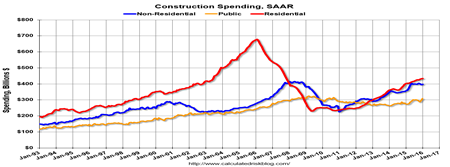
This is giving a tremendous boost to new-home construction, in particular. It is why the U.S. Census Bureau reported that construction spending during January 2016 was estimated at a seasonally adjusted annual rate of $1,140.8 billion, 1.5 percent above the revised December estimate of $1,123.5 billion. And the January figure is 10.4 percent above the January 2015 estimate of $1,033.3 billion.

image

Graph: Calculated Risk

On a year-over-year basis, private residential construction spending is up 8 percent. Non-residential spending is up 11 percent year-over-year. Public spending is up 13 percent year-over-year. Looking forward, all categories of construction spending should increase in 2016. Residential spending is still very low, non-residential is increasing (except oil and gas), and public spending is also increasing after several years of austerity.

In the meantime, the number of people who have jobs has increased by 2.8 million. The strength of those numbers is startling once you consider that the population of working-age people (ages 16 to 65) has grown by only a million in the past year, says Nutting. The number of employed people is growing about three times as fast as the number of working-age adults. This means that the slack in the economy is disappearing quickly (but it’s not gone yet).

The point is that with so many workers returning to the jobs market, a strong housing recovery is assured. For it is working age Americans that want most to own a home, according to a recent National Association of Realtors survey.

Harlan Green © 2016

Follow Harlan Green on Twitter: https://twitter.com/HarlanGreen

Posted in Consumers, Economy, Housing, housing market, Weekly Financial News | Tagged , , , , | Leave a comment

We Need More Productive Investment

Financial FAQs

Consumers’ financial health has substantially improved in 2015, according to the Fed’s 2015 Q4 Flow of Funds report, plus, their real wages are rising because of lower inflation. And since consumer income drives aggregate demand—the overall demand for goods and services, and so Gross Domestic Product —it directly impacts economic growth.

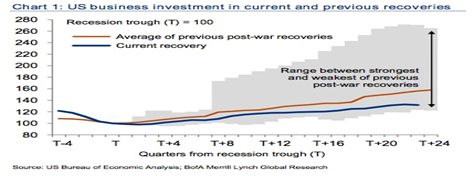
This dearth of aggregate demand has happened at the same time as diminished corporate investment in more productive capacity, according to a recent Bank of America report. “Since the Great Recession, US business investment has grown at an average annual rate of 4.9 percent, compared with the 8.1 percent average for the corresponding period of all post-war recoveries. This shortfall is a much larger than the 1.8pp shortfall for household consumption, and the 2.0 pp for residential investment.”

image

Graph: zerohedge.com

Why? The Great Recession occurred in 2008, and businesses and financial markets have been slow to recover. But a recent Economic Policy Institute report highlights a more serious reason for slower growth—wage inequality.

“The rise in wage inequality over the last three-and-a-half decades largely stems from intentional policy choices that have eroded ordinary workers’ leverage to secure higher pay (Bivens et al. 2014), said the EPI author Elise Gould. “These policy choices—made on behalf of those with the most economic power—include allowing the minimum wage to stagnate, eroding workers’ rights to bargain collectively, and (the Fed) prioritizing low inflation over low unemployment. Policies such as these have resulted in hourly pay for the vast majority of American workers stagnating despite growing economy-wide productivity, with economic gains highly concentrated at the top.”

And because wages and salaries of most Americans haven’t increased more than 2.2 percent since 2000, economic growth has also been stuck in the 2 percent range. This creates ever larger budget deficits, needless to say, and so endangers social security, Medicare, crimps investments that would increase productivity and boost our standard of living, and is the reason for our crumbling infrastructure of roads, bridges, resulting in even more productivity losses, for starters.

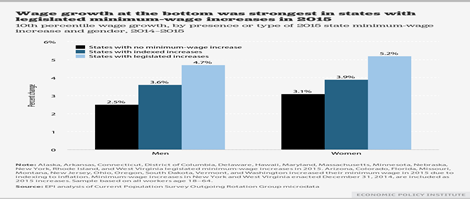
So raising the minimum wage floor is a start. In fact, states that have already raised the minimum wage have boosted wages of the bottom 10th percentile—as much as 5.2 percent for women in states where it was legislated, vs. states with no minimum wage increase.

image

Graph: EPI

That makes it even more important for companies and governments to invest more in capital expenditures, i.e., the best way to spend the profits made from higher productivity. But it is hardly surprising that businesses lack confidence in any sustained upswing in demand that would justify taking the risks associated with large increases in investment, concludes the BofA report. For many listed companies, returning surplus cash to shareholders through dividends or share buybacks has seemed a safer strategy.

It is the old chicken and the egg puzzle. Which comes first, investing to expand business, or removing the barriers that depress household incomes in order to encourage businesses to use their cash for productive growth rather than stock buybacks that benefit the few?

We really do know how to boost aggregate demand. We have to create more jobs to fix our public infrastructure that hasn’t been upgraded in 75 years, build and upgrade our schools to educate a growing population, and spend more for the research and development of new, productivity-enhancing inventions.

These are really the functions of governments, when businesses lack confidence to do anything but buy back their own shares.

Harlan Green © 2016

Follow Harlan Green on Twitter: https://twitter.com/HarlanGreen
Posted in Consumers, Economy, housing market, Keynesian economics, Macro Economics, Weekly Financial News | Tagged , , , , , | Leave a comment

Consumer Finances Much Healthier

Financial FAQs

Consumers’ financial health has substantially improved in 2015, and their net worth has now surpassed that of pre-recession 2006, according to the Fed’s 2015 Q4 Flow of Funds report. That is the main reason economic growth prospects have picked up in 2016.

The net worth of households and nonprofits as a percentage of Gross Domestic Product rose to $86.8 trillion during the fourth quarter of 2015, said the Fed. The value of directly and indirectly held corporate equities increased $758 billion and the value of real estate rose $458 billion. Consumers’ net worth is now the highest in history in this graph that dates back to 1952. This includes real estate and financial assets (stocks, bonds, pension reserves, deposits, etc.) net of liabilities (mostly mortgages).

image

Graph: Calculated Risk

We are in a goldlilocks economic moment, in other words. Gas and energy prices are extremely low, there is almost no inflation, and we are nearing full employment. Interest rates are also still at record lows, with fixed 30-year conforming mortgage rates still at 3.375 percent for a 1 point origination fee in California, which means housing will continue to contribute to growth.

We know consumers are buying more because consumer debt is increasing. January’s increase in total outstanding consumer credit is an initial $10.5 billion (subject to later revisions, as more data comes in). But revolving credit, the component that tracks credit cards, fell $1.1 billion in January following December’s nearly unrevised $5.5 billion increase (due to holiday spending). Even with January’s dip, revolving credit has been showing strength and has been positive for consumer spending, hinting at greater willingness of the consumer to take on credit-card debt.

And sure enough, ex-gas retail sales month-to-month expanded for seven months in a row which matches the longest streak in five years. And year-on-year, ex-gas sales are at a very respectable plus 4.5 percent and reflect special strength in vehicle sales, up 6.9 percent on the year, as I’ve reported.

image

Graph: Econoday

This is while overall construction spending rose a strong 1.5 percent in January. A one-month surge in highway & street spending skewed the headline higher as did gains for manufacturing and on Federal construction projects. Year-on-year rates include an impressive 33.9 percent gain for highways & streets which is a big category. Federal spending, a far smaller category to date, is up 9.9 percent.   But that will pick up as well, with more public works projects on the books for this year on federal highways and bridges, in particular.

Turning to the private nonresidential components, offices lead at a 24.8 percent year-on-year gain. Demand on the multi-family side, reflecting strength in rental prices, also has been very strong with year-on-year spending up 30.4 percent vs. 6.6 percent for single-family homes. Together, residential spending is up a year-on-year 7.7 percent.

We mention construct spending because construction projects will continue to add higher paying jobs, so important to income growth, in particular.

Harlan Green © 2016

Follow Harlan Green on Twitter: https://twitter.com/HarlanGreen

Posted in Consumers, Economy, Housing, housing market, Weekly Financial News | Tagged , , , , , , | Leave a comment