Pending Sales, Housing Construction Are Healthy

The Mortgage Corner

Most of the Federal Reserve Governors have announced they don’t support raising interest rates until sometime next, year, and only if worldwide economic growth picks up. Why? The US Dollar is so strong that it’s hurting exports, and China and emerging markets aren’t importing much these days anyway, which hurts our growth.

So housing is leading our ongoing recovery at the moment. For instance, the NAR’s Pending Home Sales Index continues to grow. Though pending home sales retreated in August, they remained at a healthy level of activity and have now risen year–over–year for 12 consecutive months, according to the National Association of Realtors. A modest increase in the West was offset by declines in all other regions.

Lawrence Yun, NAR chief economist, says even with the modest decline in contract signings, demand continues to outpace housing supply and elevate price growth in numerous markets. “Pending sales have leveled off since mid–summer, with buyers being bounded by rising prices and few available and affordable properties within their budget,” he said. “Even with existing–housing supply barely budging all summer and no relief coming from new construction, contract activity is still higher than earlier this year and a year ago.”

The national median existing–home price is expected to increase 5.8 percent in 2015 to $220,300. Yun forecasts total existing–home sales this year to increase 7.0 percent to around 5.28 million, about 25 percent below the prior peak set in 2005 (7.08 million). Actually, that has already happened with August sales already at a 5.31m rate, which has to continue to achieve his annual total.

I wrote last week that Janet Yellen’s Fed delayed their announced rate raise in September because their growth projections for the rest of 2015 and beyond have been downgraded, since inflation is still too low for sustained growth. And now both the Fed and IMF are projecting a worldwide economic slowdown.

The Fed staff’s view was already gloomy. A mistaken leak this summer by the U.S. central bank revealed, before the Fed’s June policy committee meeting, potential growth averaging just 1.74 percent over 2015-2020, according to the document now on the Fed’s website. That’s down from an average growth rate of 3.1 percent over the past 50 years. Ordinarily, those predictions would not be released for 5 years, says the Fed.
image

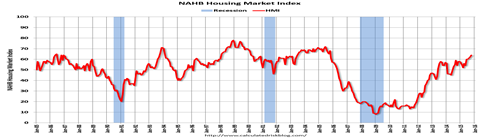
Graph: Calculated Risk

Even better housing news was that builder confidence in the market for newly constructed single-family homes rose three points in October to a level of 64 on the National Association of Home Builders/Wells Fargo Housing Market Index (HMI), according to the HAHB. This month’s reading is a return to HMI levels seen at the end of the housing boom in late 2005.

“With October’s three-point uptick, builder confidence has been holding steady or increasing for five straight months. This upward momentum shows that our industry is strengthening at a gradual but consistent pace,” said NAHB Chief Economist David Crowe. “With firm job creation, economic growth and the release of pent-up demand, we expect housing to keep moving forward as we start to close out 2015.”

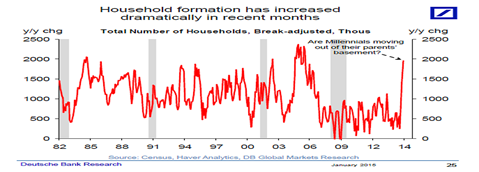
Housing construction has to catch up to more normal levels of approximately 1.2 million historical units per year from the current 1.09 million units. So there is still room for housing sales to grow, as household formation picks up (which is already happening, according to Deutsch Bank).
image

Graph: Deutsch Bank

This is even better news, needless to say.  Deutsche Bank predicts 1 million new households are being formed in 2015.  Millennials need dwellings as they continue to leave home and graduate from college. But much of new construction has to be in the moderate price ranges that we see in outlying areas. Even California has these regions in the southland and desert regions, mainly.

Harlan Green © 2015

Follow Harlan Green on Twitter: https://twitter.com/HarlanGreen
Posted in Consumers, Economy, Housing, housing market, Weekly Financial News | Tagged , , , , , , , , , | Leave a comment

Why the Q3 Slowdown Predictions?

Financial FAQs

The International Monetary Fund and the Federal Reserve have downgraded their estimates of growth in upcoming quarters. The IMF takes the worldwide view, with particular weakness in the emerging markets of Brazil, Nigeria, South Africa and Russia., and reduced demand in China for the commodities supplied by emerging market countries.

For the U.S., the IMF slightly raised its growth estimate by 0.1 percentage points to 2.6 percent this year amid a strong second-quarter rebound from an anemic first quarter marked by harsh winter weather and a West Coast ports slowdown. But IMF cut its U.S. projection to 2.8 percent from 3 percent for next year in light of deeper long-term headwinds for advanced economies generally, such as weak productivity growth, lower investment and aging populations.

The US Federal Reserve is also becoming less optimistic, due as well to the worldwide slowdown, but also to a hiring slowdown over the past couple of months. And retail sales seem to be slowing as well. Consumers seem to paying down debt, while eating out more, rather than buying things.

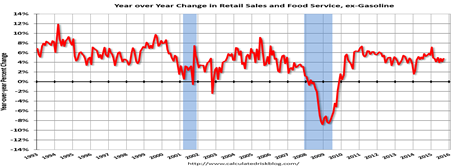
That’s probably why the U.S. Census Bureau announced today that advance estimates of U.S. retail and food services sales for September, adjusted for seasonal variation and holiday and trading-day differences, but not for price changes, increased just 0.1 percent from the previous month, and 2.4 percent above September 2014. The July 2015 to August 2015 percent change was revised from +0.2 percent to virtually unchanged.

image

Graph: Calculated Risk

But wait a minute. Gas prices have plunged, so if always unpredictable gas prices are eliminated, the rest of sales including booming auto sales, plus Retail and Food service sales ex-gasoline increased by 4.8 percent on a YoY basis (2.4 percent for all retail sales including gasoline). That’s not such a bad figure with the holidays creeping in when sales always pick up.
Then why the doom and gloom about third quarter growth? Some economists are predicting below 1 percent GDP growth for Q3. For instance, the GDPNow model for real GDP growth (seasonally adjusted annual rate) in the third quarter of 2015 is 0.9 percent on October 14, down from 1.0 percent on October 9, says the Atlanta Federal Reserve. This is even though the model’s nowcast for real consumer spending growth in the third quarter fell from 3.6 percent to 3.2 percent after this morning’s retail sales report from the U.S. Census Bureau.

With consumer spending still good, such slow growth doesn’t make a lot of sense. Firstly, because the Atlanta Fed’s Lockhart has been the most consistently hawkish on inflation if the Fed doesn’t raise interest rates soon, and the lone dissenter of the latest Fed’s easy credit policies. So why suddenly does Lockhart now see essentially no growth in Q3, which means little or no inflation?

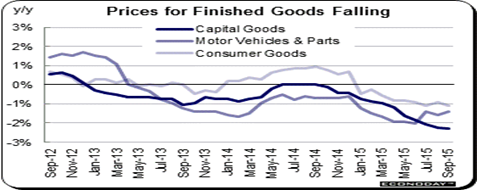
Another reason for reduced domestic expectations may be the huge drop in producer, or wholesale prices. The latest Producer Price Index plunged 0.5 percent, and has fallen 1.1 percent in a year. Exports remain very weak at minus 0.8 percent in the month following August’s 0.4 percent decline. September energy prices fell 5.9 percent and are down 23.7 percent year-on-year. Gasoline fell a monthly 16.6 percent for an almost incredible 42.8 percent year-on-year decline.

image

But that still doesn’t explain the prediction for a decline in aggregate, or overall demand. Non-manufacturing service sector growth is still strong at 55 percent, according to the Purchasing Managers indexes.

And Marketwatch’s Rex Nutting believes service industry prices are actually rising above the 2 percent inflation target, since they measure domestic demand, which is largely shielded from outside influences such as the Dollar’s value.

“For instance, the CPI excluding energy has risen 1.9 percent in the past year, right in the narrow range it’s been in for three years. And the prices of services excluding energy (which account for three-fifths of the consumer price index’s market basket) have risen 2.7 percent in the past year, matching the largest gain since 2008.”

Lael Brainard, one of the youngest Fed Governors, believes foreign trouble will weigh down future growth, and so has joined the chorus to hold down any rate increases until inflation is more obvious in a recent speech.

“There is a risk that the intensification of international cross currents could weigh more heavily on U.S. demand directly,” she said, “or that the anticipation of a sharper divergence in U.S. policy could impose restraint through additional tightening of financial conditions. For these reasons, I view the risks to the economic outlook as tilted to the downside. The downside risks make a strong case for continuing to carefully nurture the U.S. recovery–and argue against prematurely taking away the support that has been so critical to its vitality.”

Remarks such as Brainard’s with current low inflation is helping to keep interest rates at record lows. The 30-year fixed conforming rate has dropped to as low as 3.375 percent of late in California, which should help sustain economic growth. Much of the doom and gloom is due to predictions that Wall Street’s ‘salad’ days are over. I.e., stocks can’t go much higher, or interest rates much low—the 10-year T Bond yield today dropped to 1.90 percent—almost a historic low. So any reversal in these trends (higher rates, falling stock prices) could mean slower growth ahead.

But we don’t believe it with the holiday spending season coming up, and consumer confidence at post-recession highs, because consumers are in fact earning more money.

Harlan Green © 2015

Follow Harlan Green on Twitter: https://twitter.com/HarlanGreen
Posted in Consumers, Economy, Macro Economics, Politics, Weekly Financial News | Tagged , , , , | Leave a comment

When Will Fed Raise Interest Rates?

The Mortgage Corner

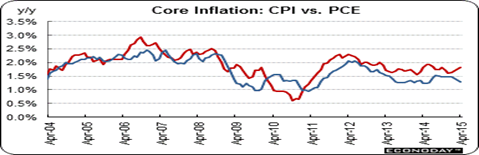
It has been puzzling many major economists, including Nobelist Paul Krugman, Obama advisor Larry Summers, and Minneapolis Fed Chair Narayan Kacherlakota, why Janet Yellen’s Fed is still talking about raising interest rates when current inflation numbers are so poor, as well as future growth projections.

image

Janet Yellen’s Fed delayed their announced rate raise in September because their growth projections for the rest of 2015 and beyond have been downgraded, since inflation is still too low for sustained growth. And now both the Fed and IMF are projecting a worldwide economic slowdown.

The Fed staff’s view was already gloomy. A mistaken leak this summer by the U.S. central bank revealed, before the Fed’s June policy committee meeting, potential growth averaging just 1.74 percent over 2015-2020, according to the document now on the Fed’s website. That’s down from an average growth rate of 3.1 percent over the past 50 years. Ordinarily, those predictions would not be released for 5 years, says the Fed.

In fact, the numbers are poor enough that the only beneficiaries of a rate rise at present would be Republican Presidential candidates, since past history shows economic growth would slow even more if interest rates were raised at this time of low inflation, and so favor the Republican Presidential candidate, whoever it may be.

And maybe that’s the reason Republicans continue to criticize anything the US Federal Reserve does, even though most economic growth since the Great Recession has been due to the Fed’s ultra-low low interest rates that has kept the cost of borrowing anything low. It could enhance their chances next November.

Even former Fed Chair Ben Bernanke has been irked by right wing conservatives for doing just the thing that most conservative economists, such as Martin Feldstein, and even arch-free market theorist Milton Friedman, said was the right thing to do during recessions—inject more money into the economy.

“[T]he increasing hostility of the Republicans to the Fed and to me personally troubled me, particularly since I had been appointed by a Republican president who had supported our actions during the crisis,” he said in his new book, The Courage To Act. “I tried to listen carefully and accept thoughtful criticisms. But it seemed to me that the crisis had helped to radicalize large parts of the Republican Party.”

“An aggressive Fed policy was the conservative alternative to the Keynesian idea that government spending and deficits were needed to counteract a severe economic recession,” says former George HW Bush Treasury official Bruce Bartlett. “But what happened is that the conservatives rejected both monetary and fiscal stimulus, in effect endorsing the “Austrian” view propounded by Friedrich Hayek and others that the government should do nothing and just let economic imbalances right themselves.”

But what is the Republican Party these days? In fact, there seem to be very few true conservatives left in the Republican Party. The definition of a conservative, after all, is to preserve the status quo, not to attempt to return to a distant past that never existed. And so what is left for the Republican Party to do if they can no longer agree on a viable policy to govern? Oppose governing itself.

In fact, Minnesota Fed President Kacherlakota believes interest rates could be dropped further to stimulate more growth in a recent speech. “I don’t see raising the target range for the fed funds rate above its current low level in 2015 or 2016 as being consistent with the pursuit of the kind of labor market outcomes that we are charged with delivering,” Kocherlakota said Thursday in remarks prepared for a speech in Mankato, Minnesota. “Indeed, I would be open to the possibility of reducing the fed funds target funds range even further, as a way of producing better labor market outcomes.”

Does future growth look very bad? We don’t think so, since cheaper goods and energy prices should help households and most businesses. Signs of slower growth would please Republicans, of course, who continue to maintain Democrats have done a lousy job of governing (in spite of a 5.1 percent US unemployment rate). How so, when the Republican alternative is not to govern at all?

Harlan Green © 2015

Follow Harlan Green on Twitter: https://twitter.com/HarlanGreen
Posted in Consumers, Economy, Macro Economics, Politics, Weekly Financial News | Tagged , , , , , , , , , , | Leave a comment

“Australia Is Not Like US”

Popular Economics Weekly

“Australia is not like the U.S.” said commentator Michael Pascoe in the Sydney Morning Herald in response to President Obama’s remarks on the Umpqua Community College killings by a deranged killer, whose mother kept at least 7 guns at home, in addition to the 8 guns plus ammunition carried by the shooter in the slaughter of college students and a teacher.

“We know that other countries in response to one mass shooting have managed to craft laws that almost eliminate mass shootings,” said President Obama. “Friends of ours, allies of ours, Great Britain, Australia, countries like ours.”

We happened to be in Australia while this happened, where the minimum wage for full-time, working adults is more than $16Aus per hour and Australian’s have created a health care system that pays for all normal health care costs (as opposed to catastrophic events), though hospital care is free for every Australian citizen.

In fact, the US now has a gun homicide rate 370 times that of Australia’s. “Unlike the US,” said Pascoe, “we collectively decided to have a decent social safety net, the concept of a living wage and make good education freely available. Most of us are wary of those with extreme views of any kind.”

Our gun problem of course extends beyond mass violence, says the LA Times. In 2014 alone, for example, the Centers for Disease Control and Prevention recorded 11,208 people shot to death, 33,636 injured by gunfire and 21,175 who killed themselves with a gun. That’s a total of 66,019 people who were killed or injured by a gun, which comes out to 1,269 per week, 180 a day or 7.5 per hour.

Current Australian gun laws were passed after 35 were killed and 23 wounded in 1996. There hasn’t been a mass shooting in Australia since. At the heart of the new laws was a massive buyback of more than 600,000 semi-automatic shotguns and rifles, or about one-fifth of all firearms in circulation in Australia. The country’s new gun laws prohibited private sales, required that all weapons be individually registered to their owners, and required that gun buyers present a “genuine reason” for needing each weapon at the time of the purchase, as well as a 28-day waiting period while backgrounds were checked. (Self-defense did not count.) In the wake of the tragedy, polls showed public support for these measures at upwards of 90 percent.

“The US is too immature a society to be allowed to play with guns,” said Pasco. “It has never shed its Wild West mythology. Americans still use their courts to kill people, which sends a message in its own way.”

What would cause the mother of the Umpqua college killer to have what can only be called a fanatical devotion to guns? “I keep all my mags full. I keep two full mags in my Glock case. And the ARs & AKs all have loaded mags. No one will be ‘dropping’ by my house uninvited without (acknowledgment),” the mother, wrote in her Tweety Bird tweet several years earlier, according to a CNN account.

It has been known for years by those who research gun violence that more gun killings occur in households owning guns. A new survey in the Annals of Internal Medicine narrows down some of the causal relationship between guns and death by finding conclusively that having a gun in your home makes you more likely to successfully attempt suicide. The authors of the survey also found with a lesser degree of certainty that people with guns in their home are more likely to be the victims of a homicide.

According to data gleaned from State and Justice departments for the period between 2001-2011, there have, in fact, been many, many more Americans killed by gun violence than by terrorism. During that 10-year period, some 130,347 have lost their lives to gun violence, compared to the approximately 3,000 Americans killed in acts of terrorism.

“It’s all fodder for the deranged fanatics of the American gun lobby, with a bible in one hand and an assault rifle in the other. It’s fuel for the paranoid interpretation of a line in the constitution that is a blatant anachronism.”

We have to be a very sick society to have allowed this to happen. We are so good at preventing foreign terrorists from attacking us, but not protecting Americans from domestic terrorists. Then we should understand that gun violence itself is an act of terror. And those that support unrestricted use and purchase of guns are the sponsors of domestic terrorism.

Harlan Green © 2015

Follow Harlan Green on Twitter: https://twitter.com/HarlanGreen

Posted in Economy, Politics, Uncategorized | Tagged , , , , , , , | Leave a comment

Single Payer “Universal” Health Plans, versus What?

Financial FAQs

We are in Australia, and my wife just paid for a General Practitioner’s visit to examine possibly dangerous sun damage to her skin. The Doctor’s examination cost her $37 Australian, and the topical medication just $10Au. So what is wrong with a health care system that functions so well, yet is mostly paid for by Australia’s taxpayers?

Perhaps it’s time to bust the myth that universal, or government-run, or ‘socialized’ medicine is somehow less desirable than the present U.S. system of private health insurance. We know the U.S. has the highest per capita health care costs in the developed world. So how does that make private health care that is owned and run by privately-owned health care providers (except for Medicare) more desirable?

It just isn’t true that total health expenditures – government plus private spending – is unsustainable. Australia spends about 9.5 percent of GDP on health services, for instance; the United States spends 17.7 percent. And even US spending, whether or not a good value for money, hasn’t undermined its economy or sapped the vitality of the country.

image

Graph: Washington Post

Australia has a government-run and insured health care system that covers every citizen cost free. And there was absolutely no waiting period in Australia’s fisth largest city, Adelaide, with the appointment scheduled just one day in advance.

The Physician my wife consulted said that the only drawback to the Australian system, in her opinion, was the difficulty of keeping the same General Practitioner, as there were some 44,000 GPs in Australia, and a patient had to see whoever was available at the time needed. Then what about our own Obamacare?

The Commonwealth Fund, a noted health care foundation, provides some of the best research on comparing national health plans and policies. And it maintains the U.S. Affordable Care Act will enable the U.S. to only begin to catch up with the rest of the developed world in not only health care benefits but global competitiveness, even though it still relies on private physicians and doesn’t regulate drug costs,.

“First, working-age Americans are sicker and die younger than citizens in many other developed countries,” say two researchers of the Commonwealth Fund. “This health disadvantage translates into a competitive disadvantage, as there is a well-documented relationship between workers’ health status and their productivity. The annual economic losses from diabetes and depressionalone are estimated to exceed $100 billion.

“The ACA could significantly improve the U.S. workforce’s overall health. Insurance expansions have been shown to improve beneficiaries’ health and raise their future earnings. Since the main coverage provisions of the law took effect, 12 million to 17 million working-age adults have gained health insurance. In addition, the ACA has stimulated a wave of innovations in health care, many focused on the things that keep us well, like prevention, telehealth, and promoting healthy lifestyles and living environments. To the extent that these succeed, the benefits will be felt in workforce productivity and business competitiveness.

“Second, taming our nation’s astronomical health care bill would further improve our ability to compete in foreign markets. We spend more on health care than any other wealthy country, as I said—health spending represents nearly one-fifth of the U.S. economy, compared with one-tenth in the average industrialized nation. This leaves fewer resources available for research, infrastructure, education, and other investments that are foundational to economic competitiveness. Warren Buffett went so far as to call our health system “the tapeworm, essentially, of the American economy.”

Another study by the Commonwealth Fund reported:

· The United States stands out for having the highest rates of chronic health conditions, such as diabetes and heart disease: 87 percent of older adults in the U.S. reported at least one chronic illness, and 68 percent reported two or more.

· Despite having Medicare coverage, U.S. adults age 65 or older were the most likely to report that cost posed a barrier to care. One-fifth (19 percent) said cost was the reason they did not visit a doctor, skipped a medical test or treatment recommended by a doctor, did not fill a prescription, or skipped doses.

· U.S. survey respondents were also the most likely to report trouble paying their medical bills (11 percent). Only 1 percent in Norway and Sweden reported the same.

So the U.S. Affordable Care Act is just a beginning in offering equivalent health care benefits of other developed countries. Yet many of our poorest red and southern states are refusing to expand their own health care coverage, though much of it will be paid for by the federal government. Hence they will remain our poorest states, with the greatest income inequality. Need we say more?

Harlan Green © 2015

Follow Harlan Green on Twitter: https://twitter.com/HarlanGreen
Posted in Consumers, Economy, Politics, Weekly Financial News | Tagged , , , , , | Leave a comment

Q2 Economic Growth Gangbusters, But Q3?

Popular Economics Weekly

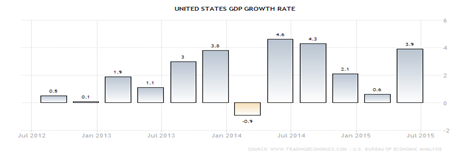
In spite of all those predictions that GDP growth would exceed 3 percent for the rest of the year and into 2016, the latest factory orders and inflation indicators show a slowdown in Q3 from Q2’s gangbusters growth, probably thanks to China’s abrupt downturn in manufacturing.

image

Graph: Trading Economics

Q2 GDP was revised higher from its earlier 3.7 percent estimate. Personal spending was stronger than thought in the second quarter, helping to drive real GDP to a very solid 3.9 percent annualized rate. Boosted by the consumer, final sales also rose 3.9 percent for a 4 tenths upward revision.

Personal consumption expenditures were the main reason, revised 5 tenths higher to 3.6 percent as the service spending component, reflecting strength in travel, was revised 7 tenths higher to 2.7 percent. So consumers are spending more, thanks to the good jobs numbers.

Revisions to goods spending were mixed with durable goods that last more than 3 years down 2 tenths to a vehicle-led surge of 8.0 percent with nondurables up 2 tenths to 4.3 percent. Consumer strength is also evident in a 1.5 percentage point upward revision to residential fixed investment, now at 9.3 percent.

image

Graph: Econoday

But what else is driving growth, finally? Nonresidential fixed investment, driven by structures, is revised 9 tenths higher to 4.1 percent. But new-home sales are also surging, as builders try to catch up with the now severe shortage in new housing due to the housing bust. Another plus in the report is a downward revision to inventory growth.

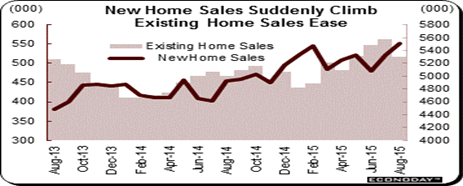
New home sales can be very volatile month-to-month as they are in the August report where, at 552,000, the annual rate came in far above the high-end estimate. This is the highest rate since February 2008. Adding to the momentum is a 15,000 upward revision to July.

In especially welcome news for builders, the sales strength pulled supply relative to sales even lower, to 4.7 months from 4.9 months. Still, low supply is a constraint on sales in contrast to pricing which remains favorable, at a median $292,700 for a 0.5 percent gain on the month but at a paltry year-on-year gain of only 0.3 percent. By comparison, the year-on-year sales gain is 22 percent.

Existing home sales came in at a lower-than-expected 5.31 million annual rate in August which is the lowest since April. Though July was revised down just slightly but is still an 8-year high at 5.58 million. With the in dip sales, supply relative to sales is less tight, at 5.2 months from 4.9 months in the prior two months. But there’s still a lack of homes on the market, evidenced by a comparison with the year-ago supply at 5.6 months.

Now we have to begin to guess at Q3 growth. China’s slowdown and the strong Dollar (U.S. now the fastest growing western economy, by the way) have hurt exports. That and the current oil oversupply have brought down inflation, which might keep Yellen’s Fed from raising interest rates this year at all, as we have been saying. But it also means lower growth in the factory sector, and manufacturing over all.

So it will be up to consumers and the service sector of domestic consumption to keep us above 3 percent growth in Q3. Consumer sentiment is one indicator of how consumers feel, and they are remaining optimistic, in spite of the plunge in stock prices, of late.

Consumer sentiment popped up as expected from stock-market depression at mid-month, to 87.2 for final September from 85.7 for the flash. Still, September’s final reading is the weakest since October last year. The expectations component, which tracks the jobs outlook, improved 1.2 points from mid-month to end September at 78.2 which is the lowest reading since September last year, says Econoday. The current conditions component, which tracks ongoing strength in the jobs market, rose 9 tenths to 101.2 for the lowest reading since October.

So stay tuned to the Fed’s next 2 FOMC meetings this year, and we will know if Yellen and Company dare to raise interest rates at all.

Harlan Green © 2015

Follow Harlan Green on Twitter: https://twitter.com/HarlanGreen
Posted in Consumers, Economy, Housing, housing market, Politics, Weekly Financial News | Tagged , , , , , | Leave a comment

The Results of Being the Dumb Down Party

Financial FAQs

We saw in the latest CNN Republican candidate debate the results of what seems to be a prolonged campaign to discount almost all scientific facts, as well as intelligent discussion of the most important issues of the day.

Especially scary was Donald Trump saying if we build up our military enough, we won’t have to negotiate with anybody. Or Marco Rubio, a seemingly moderate Republican, endorsing a 1,900 mile fence along our entire border with Mexico (or double fence, says Dr. Ben Carson) over mountains and rivers, or Carli Fiorina saying that Planned Parenthood was aborting live babies to harvest their organs.

Global warming is one of the most important issues today, since there is almost unanimous agreement among scientists that it is manmade and rising alarmingly. Hence the record heat waves, cold spells and catastrophic storms the world has been experiencing recently. Yet thanks to the funding of multibillionaires like the Koch Brothers, none of the Republican Presidential candidates said they believe global warming is manmade, or even real.

What is the reason Republicans have become the party of anti-intellectuals—some even want to abolish the Department of Education, and otherwise defund public education? Journalist Chris Hedges said in a PBS interview President Clinton in coopting moderate Republican positions, such as deregulation of the financial industry, putting 100,000 more cops on the street, and ‘reforming’ welfare, had driven the Republican Party to “insanity”.

But the anti-intellectual, anti-science bias goes much further and deeper. It is in fact an almost totally American phenomenon that Republicans have taken advantage of, in an attempt to dumb down the electorate to levels that would even deny evolution. Why would anyone not want to support public education, when it educates more than 80 percent of our students? The result is that higher education is also falling behind.

According to the National Research Council, only 28 percent of high school science teachers consistently follow the National Research Council guidelines on teaching evolution, and 13 percent of those teachers explicitly advocate creationism or "intelligent design," said Psychology Today in a very damning 2014 article entitled, Anti-Intellectualism and the Dumbing Down of America:

“After leading the world for decades in 25-34 year olds with university degrees, the U.S. is now in 12th place,” said

Psychology Today. “The World Economic Forum ranked the U.S. at 52nd among 139 nations in the quality of its university math and science instruction in 2010. Nearly 50 percent of all graduate students in the sciences in the U.S. are foreigners, most of whom are returning to their home countries”

Republican candidates were echoing the Republican platform that advocated the deportation of all illegal aliens, would abolish or cripple whole government agencies (including the Environmental Protection Agency), shut down the federal government over Planned Parenthood funding, and maintain that a fertilized egg is a viable human being that can’t be aborted.

Pundits give other reasons for such a dumbing down of a segment of the electorate—such as social media and television replacing literacy, or education that no longer teaches math and science or even history. Maybe that has enabled the Donald Trumps of the world to shout louder. The danger is that it may drown out any intelligent discourse about the most important issues of our day. It’s driving at least one of our political parties into insanely ridiculous positions, at the moment.

Harlan Green © 2015

Follow Harlan Green on Twitter: https://twitter.com/HarlanGreen
Posted in Consumers, Economy, Politics, Weekly Financial News | Tagged , , , , , , , , , | Leave a comment

Don’t Count On Inflation Moving Federal Reserve

Popular Economics Weekly

The Federal Reserve didn’t raise interest rates today at the close of their FOMC meeting. In fact the 9-1 vote against raising rates wasn’t even close. So don’t count on inflation to save the day for the deficit hawks demanding that the Fed must raise interest rates.

Inflation is not imminent or even possible in today’s low demand, slow growth, and world-wide economies. It ain’t going to happen. Inflation won’t happen, not only because the Asian tigers are overproducing and under pricing everything—hence China’s problem—or that many economists now believe in the so-called ‘new normal’ of slower economic growth model, due to slowing population and labor productivity growth.

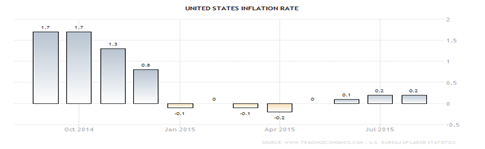
Here is the U.S. CPI, or retail inflation rate. It’s basically zero or negative, and has been since January 2015.

image

Graph: Trading Economics

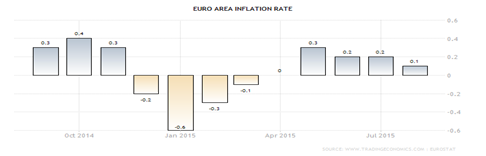
The eurozone’s inflation rate is no higher, in spite of their Austerians’ (read German) insistence that it’s right around the corner (if only growth would increase). It experienced its second recession in 2011, and growth hasn’t really recovered with an 11 percent plus average unemployment rate throughout the eurozone, except in Germany.

image

Graph: Trading Economics

Because it’s as much due to misguided government policies by the modern Austerians that have stopped eurozone growth by demanding draconian cuts in government spending and budget deficits that would create growth. But U.S. austerity advocates have damaged our growth, as well, with measures such as our current sequester agreement that caps government spending.

The result is very little investment in the areas that increase future growth, such as modernizing public infrastructure, increasing educational opportunities, and Research & Development that got us to the moon and created the Internet.

Yes, it is those politicians and the economists supporting them that are destroying our seed corn that nurtures future growth. There is no incipient inflation, nor will there be for years to come. The disinflationary spiral world economies are currently experiencing are due as much to misplaced policies and ideologies that don’t create growth as to slower population growth in the developed economies.

How then will those that want to continue the trickle down economic policies that say only the wealthiest are able to create more growth with their $Trillions, to justify transferring so much of the nation’s wealth to those overpaid CEOs and hedge fund managers?

Harlan Green © 2015

Follow Harlan Green on Twitter: https://twitter.com/HarlanGreen
Posted in Consumers, Economy, Politics, Weekly Financial News | Tagged , , , , , | Leave a comment

Construction, Retail Sales Higher

The Mortgage Corner

The strength of the economy right now is in the housing and construction sectors, again areas insulated from global factors, such as China’s slowdown. Construction spending, next to vehicle sales, is perhaps the week’s best surprise, rising 0.7 percent for a second straight month, and 13.7 percent annually. Why? Rents are rising fast, which means many householders will start thinking about whether buying with today’s ultra-low mortgage rates as the better alternative.

image

Graph: Econoday

The Econoday graph shows the slope has steepened nicely in the spring and summer. The latest gain is centered in the most important component of all, single-family homes where construction spending rose 2.1 percent in the month for a year-on-year gain of 15.8 percent. Multi-family homes slowed in the month but the year-on-year rate, reflecting demand tied to high rents, is still outstanding at 21.2 percent.

image

Graph: Econoday

And auto sales are up a surprising 1.5 percent to a 17.8 million annual rate, with 14.1 million sales of domestic-made vehicles. The gain points to another strong month for retail sales in what would underscore the insulated strength of the domestic economy. It was outsized strength in the auto sector that supported the factory sector in June and July, though August’s sales gain was centered in foreign-made vehicles. Still, sales of domestic-made cars and light trucks, which make up 80 percent of all sales, are at very strong levels.

In fact, retail sales just in this morning show a 2.2 percent annual gain, with strong sales in auto and food service. It could ave been above 3 percent if gas prices hadn’t fallen, but then would consumers be buying as much if gas prices were higher? This should mean Q3 GDP growth will again exceed 3 percent, following a revised Q2 reading of 3.7 percent by the BEA.

image

Graph: Calculated Risk

Will more renters be buying homes this year? The best way to compare rents to housing prices is the price-to-rent ratio. It is leveling off, which means rents are rising as fast as housing prices—some 5 percent of late.  (Whereas during the housing bubble prices were rising twice as fast as rents.) Combine that with conforming 30-year fixed mortgage rates of 3.75 percent in California, and we will have more renters looking to buy a home this and next year if interest rates hold. And the tax advantages of owning vs. renting really mean it’s more advantageous to buy over the longer term, rather than give those tax advantages to a landlord.

Harlan Green © 2015

Follow Harlan Green on Twitter: https://twitter.com/HarlanGreen

Posted in Consumers, Economy, Housing, housing market, Weekly Financial News | Tagged , , , , , , , | Leave a comment

What Should Yellen’s Fed Do?

Popular Economics Weekly

The big question hovering over the markets (both stocks and bonds), is whether the Federal Reserve will finally begin to raise short term interest rates at next week’s FOMC meeting. Markets are uncertain, and only a few economists are saying anything. Why? Because of a tremendous (and artificial) fear of higher inflation, which shouldn’t be fearsome at all.

Nobelists Joseph Stiglitz and Paul Krugman say there is absolutely no reason to begin to raise the rock bottom interest rates yet. There’s still too many out of work—so much so, that wages and salaries are barely rising.

“If the Fed focuses excessively on inflation, it worsens inequality,” says Professor Stiglitz, “which, in turn, worsens overall economic performance. Wages falter during recessions; if the Fed then raises interest rates every time there is a sign of wage growth (a major effect on inflation), workers’ share will be ratcheted down, never recovering what was lost in the downturn.”

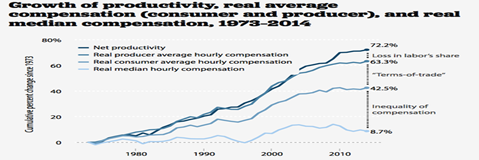
And much income has been lost, as Professor Krugman and the EPI have pointed out for years.

image

Graph: EPI

“Since 1973, hourly compensation of the vast majority of American workers has not risen in line with economy-wide productivity,” say the EPI authors. “In fact, hourly compensation has almost stopped rising at all. Net productivity grew 72.2 percent between 1973 and 2014. Yet inflation-adjusted hourly compensation of the median worker rose just 8.7 percent, or 0.20 percent annually, over this same period, with essentially all of the growth occurring between 1995 and 2002.”

The question is why the Fed is even discussing the possibility of higher rates with so many still out of work. There has to be some kind of mismatch in this picture, as a record 5.8 million job openings (yellow line in graph) were just reported in Labor Department’s Job Openings and Labor Turnover Survey.

The number of hires and separations edged down to 5.0 million and 4.7 million, respectively. Within separations, the quits rate was 1.9 percent for the fourth month in a row, and the layoffs and discharges rate declined to 1.1 percent. This means that

There were 2.7 million quits in July, little changed from June. Although the number of quits has been increasing overall since the end of the recession, the number has held between 2.7 million and 2.8 million for the past 11 months. Quits are generally voluntary separations initiated by the employee. Therefore, the quits rate can serve as a measure of workers’ willingness or ability to leave jobs.

So what is Chairperson Yellen and the Fed Governors to do? Their goal is to maximize the purchasing power of consumers that power most economic growth. If consumers can’t or won’t spend more, then economic growth is stuck.

image

Year-on-year wage growth is 2.2 percent, slightly higher, but inflation is falling, which means there are still too many out of work. The only way to increase wage growth is to allow a tighter labor market, which means keeping rates low as long as possible, without causing excessive inflation.

In fact, even 4 percent inflation would be preferable as a way to boost both jobs and economic growth. But will policy makers even allow such a thing? That’s the real (political) problem—the misconceptions about inflation.

Harlan Green © 2015

Follow Harlan Green on Twitter: https://twitter.com/HarlanGreen

Posted in Consumers, Economy, Macro Economics, Politics, Weekly Financial News | Tagged , , , , , , , , , , , | Leave a comment