Why Does Bernie Love Denmark?

Popular Economics Weekly

Presidential candidate Bernie Sanders is breathing fire on the campaign trail these days, including his most recent campaign speech that advocated the breakup of too-big-to fail banks. “We will no longer tolerate an economy and a political system that has been rigged by Wall Street to benefit the wealthiest Americans in this country at the expense of everyone else,” said Sanders.

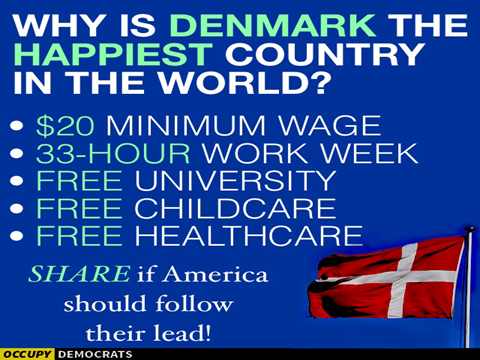
Then why does Senator Bernie Sanders love Denmark, and has been mentioning it and the other Scandinavian countries as ideal models for a developed country, one he would like the U.S. to emulate?

“In Denmark, social policy in areas like health care, child care, education and protecting the unemployed are part of a “solidarity system” that makes sure that almost no one falls into economic despair,” he said in a 2015 Huffington Post article. “Danes pay very high taxes, but in return enjoy a quality of life that many Americans would find hard to believe.”
image

A recent Center For Economic Policy and Research report highlighted the differences between Nordic countries and the United States. The differences are mainly because of their superior social safety nets.

For instance, the U.S. has the lowest average longevity at 78.8 years, vs. Denmark’s 80 years, while citizens of Iceland and Sweden live 82 years. Do their colder climates have something to do with it? No, more likely is the fact that they have to work fewer hours for almost the same income, with better health, educational and retirement outcomes.

image

It’s well-known that U.S. health care costs are double that of all other developed countries, as are infant mortality rates, while homicide rates are more than double of any other developed country. We know, for instance, there are more than 32,000 gun deaths per year in the U.S., with the majority due to suicides—which also tells us the mental toll that comes with an inadequate social safety net that doesn’t support its citizens.

So it should be no surprise the U.S. has the highest income developed world, before and after taxes and transfers. The higher the Gini Coefficient number portrayed in the graph, the higher the inequality. With the exception of the United States, there is a perfect correlation between market inequality and the role of fiscal policy in reducing inequality.

That is to say, western capitalist-oriented economies generate profits that go to the major wealth holders, so fiscal policies need to rebalance this effect. And that is what the Nordic countries in particular, do so well. “Countries with greater levels of market income inequality are more proactive at reducing inequality through their tax and spending systems,” says the CEPR.

image

Graph: CEPR

Then why is there opposition in our Congress, particularly, to U.S. citizens having the same benefits as other developed countries, when we are supposed to be the richest country in the world? It’s the successful opposition to higher taxes by the wealthiest among US. The wealthiest have succeeded in reducing their taxes and tax rates since President Reagan, the first ultra-conservative Republican president.

The result is ugly—and shows the U.S. is not the land of opportunity for many Americans. Instead, we have the result of a largely unregulated financial system–higher death rates, violent crime and incarceration rates, as well as inadequately funded health care, retirement, and educational systems.

Harlan Green © 2016

Follow Harlan Green on Twitter: https://twitter.com/HarlanGreen
Posted in Consumers, Economy, Keynesian economics, Macro Economics, Politics, Weekly Financial News | Tagged , , , , , , , , , | Leave a comment

Our Too Deflationary Times!

Popular Economics Weekly

The answer to the inflation conundrum may be at hand, the conundrum that has kept the Fed pushing down interest rates since the Great Recession and recovery. Why aren’t prices rising with all the QE stimulus programs that have injected literally $billions into the economy?

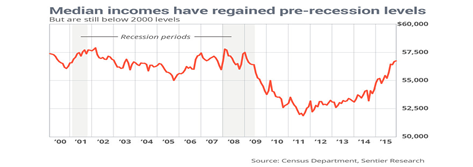
Maybe the answer is that consumers have held back on spending more because it has taken 8 years for Americans’ median incomes to recover the ground lost since the beginning of the Great Recession—8 years. There is no other plausible explanation for why consumers haven’t spent enough to push up prices during the now six year recovery. They are still in a deflationary mentality, brought on by the worst downturn since the Great Depression—which lasted some 10 years, let us not forget.

A report released Tuesday by Sentier Research drew on Census Department data shows what a long, hard climb out of this recession it’s been. And we know what depressed incomes—and job prospects—will do to so-called animal spirits—the term coined by JM Keynes to describe deflationary times as happened during the Great Depression.

image

Graph: Marketwatch

The medium income is just 1.9 percent higher than where it was in June 2009, the beginning of the economic expansion. Perhaps even more discouraging, the median income is 1.1 percent lower than in January 2000, when record-keeping began. Average weekly earnings adjusted for inflation are just 5 percent higher in November 2015 than they were when the recession began, whereas the inflation rate has risen more than 10 percent over that time.

And, such a small increase may be a reason consumers are saving more than they are spending these days. There is almost no inflation with oil and commodity prices in general falling these days. And research shows that consumers tend to spend more when prices rise over the longer term, and conversely wait longer to buy when prices are level or even discounted. This may fly in the face of so-called conventional wisdom. Otherwise, why all the discounts and specials offered these days?

image

Graph: Econoday

The Fed has been most concerned with little or no inflation, rather than higher inflation, because it means less demand for products and services. And demand is a two-edged sword. Consumers may have the means to buy, but not the will when they see prices falling, as they are for many goods and services today.

In other words, if prices go down, conventional wisdom says the situation would likely encourage more buying (Remember Say’s Law, anyone?). But it can actually have the opposite effect. If consumers and corporations expect prices to continue to go down, they will often delay purchases, waiting for a better price—dramatically slowing demand and causing prices to drop further. It leads to a downward spiral that reduces the circulation of money through the economy, which may limit growth—which is the situation today. 

This is well-known to economists such as Paul Krugman and former Fed Chair Ben Bernanke who studied the Japanese 1990’s period of prolonged deflation, and its belated attempt to boost prices. Recent noteworthy efforts to curtail deflation include Japan’s current monetary stimulus program, the European Central Bank’s recent lowering of its interest rate and quantitative easing (QE) programs in the United States.

In the 20th century, there were two main examples of deflation’s effect on economies: The Great Depression of the 1930s, which began in the United States and spread globally, and Japan’s “lost decades,” which began in the early 1990s

So the median annual household income was $56,746 in November. That’s barely above October’s median of $56,688, but it was enough to top the $56,688 reached in December 2007, when the recession began.

Does this mean consumers (and the businesses that serve them) might finally be ready to spend enough to boost the inflation rate high enough to grow the economy again, and shake off the deflationary mentality? We need at least 3 percent GDP growth to pay all the bills, and reduce the federal budget deficit to a manageable level.

The Conference Board’s Consumer confidence index rebounded in December to a reading of 96.5, up from 92.6 in November. The present situation index increased from 110.9 last month to 115.3 in December, while the expectations index improved to 83.9 from 80.4 in November. And the U. of Michigan Sentiment Survey is up 8/10s from the December flash to a higher-than-expected final December reading of 92.6. It may just be higher holiday spirits, of course.

We know from the Great Depression just how long it took for animal spirits to rise, and shake off those deflationary expectations that keep consumers saving more than they are spending. So the return of median incomes to pre-recession levels should be good news for next year growth, since consumers power approximately 70 percent of GDP growth. If only our business interests would understand this, and why consumers hold back, even when they are feeling better! Corporations might then begin to invest more of their record profits in productive enterprises that would create those oh so necessary jobs.

Harlan Green © 2015

Follow Harlan Green on Twitter: https://twitter.com/HarlanGreen

Posted in Consumers, Economy, Keynesian economics, Politics, Weekly Financial News | Tagged , , , , , , | Leave a comment

What Happens in 2016?

Popular Economics Weekly

Even with interest rates rising, we see 2.5 percent plus GDP growth in 2016, because of strong employment and consumer spending. An early sign of this this trend is the Conference Board’s Index of Leading Economic Indicators (LEI) for November, with 8 of the 10 leading indicators that help to predict jobs, housing trends (via permits), interest rates, and stock market movements staying positive.

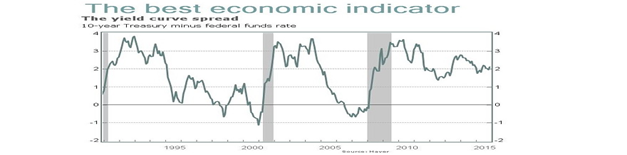
One LEI indicator, the so-called yield curve spread, focuses on the interest rate spread between short and the 10-year Treasury yield. The spread is narrowest (even negative, when short term rates are higher than long term interest rates) during recessions, per the Marketwatch graph, as in 2001 and 2008. The yield curve spread is currently a healthy 2 percent, with the 10-year yield currently at 2.25 percent, indicating good growth.

image

Graph: Marketwatch

Wages and salaries that make up some 80 percent of personal income are rising, but much of it is being saved or used to pay down debt. Still, however, the year-on-year gain for this component, as seen in the Econoday graph, has been slowing to plus 4.5 percent for the lowest reading since March. Nevertheless, growth is still respectable and is being combined with strong savings, which is the light line in the graph. This rate came in at 5.5 percent in November which outside of October’s 5.6 percent is the strongest rate in three years.

image

Graph: Econoday

That means jobs are available, gas prices are low, and consumers are building up their bank accounts. The spending side of the report isn’t so strong, however, up a respectable looking 0.3 percent for the month that includes Black Friday — but compared with no change in October. November’s year-on-year rate was only plus 2.9 percent, which along with October’s 2.9 percent are the weakest showings for spending since January last year.

But consumer sentiment is on the rise going into the final shopping days of Christmas, according to the U. of Michigan Sentiment Survey, up 8/10s from the December flash to a higher-than-expected final December reading of 92.6. The implied level in the final half of the report is in the mid-93 area which would be the strongest pace since way back in June. And in a sign of specific strength for December, the current conditions component is up 1.1 points from mid-month to 108.1 which is nearly 4 points over November.

image

Graph: Econoday

So most signs point to a very robust holiday spending season, which should help early 2016 growth. First quarter growth in the past 2 years was slowed by the severe winters, but the west coast El Nino phenomena has already kicked in, with signs of a much warmer eastern and southern U.S.

In fact, year-on-year retail sales show non-store, online retailers out in front, at plus 7.3 percent. Restaurants are right behind at plus 6.5 percent year-on-year followed by furniture and by sporting goods, both at plus 5.4 percent. Altogether, core retail sales are up a moderate 3.6 percent year-on-year, but the plunge of 19.9 percent in gas prices is making everything cheaper, with Regular gas prices as low as $2 per gallon in many parts of the country.

Harlan Green © 2015

Follow Harlan Green on Twitter: https://twitter.com/HarlanGreen
Posted in Consumers, Economy, Weekly Financial News | Tagged , , , , , , , , | Leave a comment

Can Economy Grow With Higher Interest Rates?

Financial FAQs

The Federal Reserve’s Open Market Committee announced it is raising short term interest rates by ¼ percent. But can this economy continue to grow with higher interest rates, as Fed Chairwoman Yellen has promised?

That depends on several mundane factors, such as cheap gas and energy prices that have been helping to hold down consumer and producer costs. And since most consumer and many producer products are imported, the more expensive dollar exchange rate has made them cheaper. Hence the very low inflation rate these days.

image

Graph: Econoday

An early sign of continued growth is the Conference Board’s Index of Leading Economic Indicators (LEI). The 12 leading indicators it tracks predict “moderate” future growth. And Congress’s new era of cooperation has resulted in the passing of two very important spending bills—the $305 billion Surface Transportation bill, and $1.14 Trillion federal budget.

Boosted by yesterday’s strong showing for housing permits (housing will be another area of strong growth next year), the LEI rose a solid 0.4 percent in November on top of October’s very strong 0.6 percent rise. Other positives include the interest-rate spread, specifically low short-term rates, and also gains for the stock market.

“The U.S. LEI registered another increase in November, with building permits, the interest rate spread, and stock prices driving the improvement,” said Ataman Ozyildirim, Director of Business Cycles and Growth Research at The Conference Board. “Although the six-month growth rate of the LEI has moderated, the economic outlook for the final quarter of the year and into the new year remains positive.”

Congress on Friday passed far-reaching legislation funding the government through next September plus passing tax breaks for business and low-income families. It was a compromise that helped the GOP, also, as the bill lifts a 40-year-old ban on oil exports.

The legislation pairs two enormous bills: a $1.14 trillion government-wide spending measure to fund every Cabinet agency through next September, and a $680 billion tax package extending dozens of breaks touching all sectors of the economy, making several of them permanent and tossing the entire cost onto the deficit.

President Barack Obama is expected to sign the legislation today. The bill cleared both chambers easily, first in the House, which passed it 316-113, followed by the Senate in a 65-33 vote.

The biggest reason this benefits economic growth is that another spending sequester was avoided, a sequester that limited spending across the board, hurting all segments of the economy. There was not even a spending cap, which means governments can function again without the interference of the Austerians, those conservatives that have been trying to restrict government spending on everything, including research and development. The $1.14 trillion spending bill avoids a shutdown next week, when the government’s current funding was scheduled to expire at 12:01 a.m. on Dec. 23.

Refunding the Highway Trust Fund that has run out of funds will be the biggest beneficiary of the $305 billion surface transportation bill. Called Fixing America’s Surface Transportation Act, or the FAST Act, it fixes and replaces badly degraded railroads, highways and bridges, hence it benefits those industries that depend on surface transportation.

One big benefit of the bill is the creation of programs to focus federal aid on eliminating bottlenecks and increasing the capacity of highways designated as major freight corridors. The Transportation Department estimates the volume of freight traffic will increase 45 percent over the next 30 years, which gives a tremendous boost to productivity.

The five-year FAST infrastructure bill is the longest reauthorization of federal transportation programs that Congress has approved in more than a decade, ending an era of stopgap bills and half-measures that left the Highway Trust Fund nearly broke and frustrated local governments and business groups. President Obama will sign the bill into law, as it fulfills his long-running push for lawmakers to pass an infrastructure bill even though it is significantly less than the $478 billion he sought in his own plan earlier this year.

image

Graph: Econoday

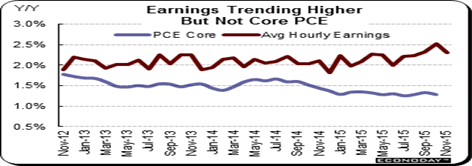
Lastly, and perhaps the best reason interest rates won’t have much effect on future growth—at least through next year—is hourly earnings are finally rising above the very low inflation rate, which means we are reaching full employment. That’s why consumers have become more upbeat, hence are spending more. Average hourly earnings in the last unemployment report rose 2.3 percent annually, whereas the core PCE inflation index favored by the Fed has risen just 1.3 percent.

In fact, that is a major reason the Fed raised short term rates at this time, in the teeth of holiday spending. Wages and salaries are finally showing signs of life—of rising faster than inflation. Fed Chair Yellen has said many times it is a precondition for raising short term rates, which mainly influence consumer spending via credit card and auto loan rates.

So as long as inflation stays low and wages continue to increase the U.S. economy will continue to grow. And with Iran about to join the oil markets, energy prices should remain at the low end, with some analysts predicting oil prices could drop as low as $20 per barrel next year. So what’s to worry about? The Fed really can now sit on the sidelines, until and if inflation again catches up with wage and salary growth.

Harlan Green © 2015

Follow Harlan Green on Twitter: https://twitter.com/HarlanGreen

Posted in Consumers, Economy, Housing, housing market, Politics, Weekly Financial News | Tagged , , , , , , | Leave a comment

Housing Starts Surge, Millennials Are Buying

The Mortgage Corner

The Federal Reserve’s Open Market Committee has just announced it is raising short term interest rates by ¼ percent. Its press release said: “Given the economic outlook, and recognizing the time it takes for policy actions to affect future economic outcomes, the Committee decided to raise the target range for the federal funds rate to ¼ percent to ½ percent. The stance of monetary policy remains accommodative after this increase, thereby supporting further improvement in labor market conditions and a return to 2% inflation.”

This is at the same time that privately-owned housing starts in November rose to a seasonally adjusted annual rate of 1,173,000, reports the U.S. Census Bureau. This is 10.5 percent above the revised October estimate of 1,062,000 and is 16.5 percent above the November 2014 rate of 1,007,000. It’s a huge number, and has to be a sign that household formation is picking up from the lows of the Great Recession.

Much of the construction surge is fueled by the millennial generation in particular leaving home and beginning to form new households. The interest rate boost may not affect construction, as longer term rates are set by bonds, such as the 10-year Treasury Bond which remains at historical lows.

image

Graph: Calculated Risk

Single-family housing starts in November were at a rate of 768,000; this is 7.6 percent above the revised October figure of 714,000. The November rate for units in buildings with five units or more was 398,000.

“Single-family production this month has reached levels last seen before the Great Recession, an indicator that we are making gradual headway back to a normal housing market,” said NAHB Chief Economist David Crowe. “As we close out the year, we can see that the housing sector has made headway in 2015, and we expect the recovery to continue at a modest pace.”

Higher household formation among 20-year olds is an early sign that millennials are coming into the housing market in force. Demographic Intelligence, according to the Wall Street Journal, has analyzed the marriage data on millennials. Demographic Intelligence predicts that ultimately about 60 percent of the children of millennials will be born to married parents, up from about 45 percent today.

“The narrative about millennials has been they’re putting parenthood before marriage, never going to get married,” said Sam Sturgeon, president of Demographic Intelligence, based in Charlottesville, Va. “Now that the cohort is in the middle of their 20s, from here on out you’re going to see a lot of millennial marriages and a lot of millennial married births.”

Millennials, those that most demographers say are born between 1980 and 2000, are the largest and most diverse generation in U.S. history. Earlier this year, they became the largest generation in the U.S. labor force, surpassing Generation X, those ages 35 to 50, according to the Pew Research Center.

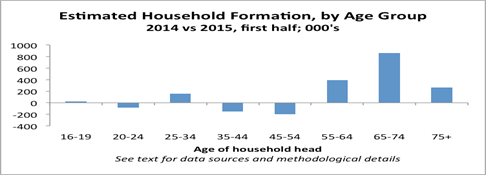
Household formation has picked up at the same time, though UC Berkeley’s Terner Center For Housing Innovation says most of the new households are being formed by seniors. Despite expectations that millennials are the force behind household formation, older adults are driving household formation. Strikingly, age groups younger than 55 collectively had negative household formation between 2014 and 2015, while 65-74 year-olds accounted for more than two thirds (860 thousand) of overall household formation.

image

Graph: UC Terner Center

And privately-owned housing units authorized by building permits in November were also much higher, at a seasonally adjusted annual rate of 1,289,000, signaling higher new-home construction for next year as well,. This is 11.0 percent above the revised October rate of 1,161,000 and is 19.5 percent above the November 2014 estimate of 1,079,000.

Combined single- and multifamily starts rose in the South and West, with respective gains of 21.3 and 6.3 percent. The Midwest was unchanged and the Northeast fell 8.5 percent.

So who is right? The Berkeley study said the seniors are forming more households because 65-74 year-olds are the fastest growing population group at present. But that can’t last as mid-20 year-olds will soon be the largest population segment. And their sample is just through mid-2015, so millennials could begin to show more numbers for the rest of 2015.

Regardless, this will continue to boost housing construction, and Demographic Intelligence maintains that 4 million ancillary jobs are created with every 1 million new homes that are built and sold.

Harlan Green © 2015

Follow Harlan Green on Twitter: https://twitter.com/HarlanGreen

Posted in Consumers, Economy, Housing, housing market, Weekly Financial News | Tagged , , , , , | Leave a comment

What Are Benefits of Paris Accord?

Popular Economics Weekly

PARIS — More than 190 nations have agreed on a plan to limit climate change, said the conference press release, ending a decades long search for an accord requiring the world’s economies to regulate the emission of gases that scientists say are causing the earth to warm.

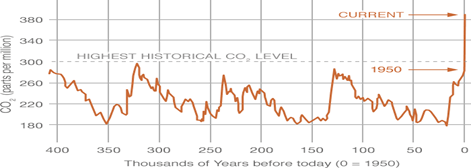
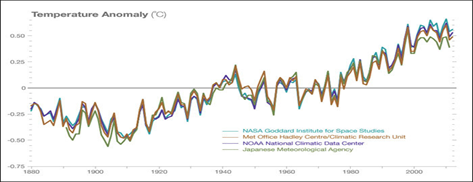
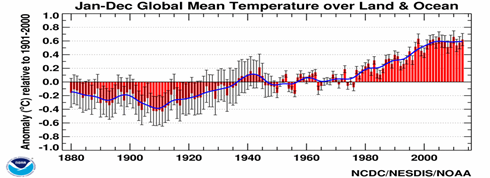
And to reach the goals set by the history-making accord that limit world temperature rises to 1.5 to 2 percent Centigrade, will require massive investments that could spur economic growth worldwide for decades to come. The main beneficiaries will be the new technologies that mitigate fossil fuels and other non-renewable energy sources that have been heating up our atmosphere.

image

Graph: NOAA

Bill Gates has announced his own accord with other billionaires to fund startups that mitigate global warming. The New York Times reported Gates’ role in sealing the deal. It underscores how a handful of the world’s wealthiest people can stand with heads of state to spotlight a social, economic and policy issue on the global stage, said the Times.

Last week, on the opening day of the Paris meeting, Mr. Gates joined Mr. Obama and Mr. Hollande to introduce the coalition. It will commit 20 governments to doubling their renewable energy research budgets to a total of $20 billion over the next five years.

In addition, Mr. Gates and a group of other wealthy businesspeople agreed to invest at least $2 billion in clean-energy start-ups — with half the money coming from Mr. Gates himself. The group plans to finance companies that turn promising clean-energy concepts, some of which will originate in government labs, into viable products. Some of the companies will fail, Mr. Gates warned.

And Wall Street is taking notice. There are “9 entry points for investors wishing to play the climate change and low carbon solutions theme,” said Bank of America-Merrill Lynch equity strategists Sarbjit Nahal, Beijia Ma and Felix Tran in a note released last Tuesday. They say the nine places to get involved are: “1) Energy Efficiency; 2) Wind; 3) Solar; 4) YieldCos; 5) Nextgen Vehicles, Batteries & Storage; 6) Nuclear; 7) Hydro; 8) Diversified Cleantech; and 9) Other Cleantech.”

There are already many new energy efficiency startups, which have had their ups and downs with or without federal subsidies, such as solar power. Bloomberg has listed 25 companies that are either researching or already producing clean-energy alternatives to fossil fuels. They range from boring miles into earth’s crust to produce thermal energy, to cleaner-burning diesel engines that raise gas mileage to 100 miles per gallon, to LED lighting that is already saving electricity, to converting coal efficiently to cleaner-burning natural gas.

The Paris accord requires any country that ratifies it to act to stem its greenhouse gas emissions in the coming century, with the goal of peaking greenhouse gas emissions “as soon as possible” and continuing the reductions as the century progresses. Countries will aim to keep global temperatures from rising more than 2°C (3.6°F) by 2100 with an ideal target of keeping temperature rise below 1.5°C (2.7°F).

The Paris accord will also encourage billions, if not trillions of dollars of capital to be spent adapting to the effects of climate change, as I’ve said—including infrastructure like sea walls and programs to deal with poor soil—and developing renewable energy sources like solar and wind power. The text of the agreement also includes a provision requiring developed countries to send $100 billion annually to their developing counterparts beginning in 2020. That figure will be a “floor” that is expected to increase with time.

The stakes could scarcely be higher. Without urgent action, warming was predicted to reach unprecedented levels, of as much as 5C above current temperatures – a level that would see large swathes of the globe rendered virtually uninhabitable. What is more, infrastructure built today – coal-fired power plants, transport networks, buildings – that entail high carbon emissions will still be operating decades into the future, giving the world a narrow window in which to change the direction of our economies.

This all spells out a massive retooling of national economies, as the new technologies are implemented, which can well be called a post-industrial revolution, one started with the digital and Internet revolution, which makes possible the next revolution; one of a planet that won’t overheat, as have other planets in our solar system.

image

Graph: NASA

Which planets have the most CO2 in their atmosphere? Venus and Mars have about 95 percent carbon dioxide, which has made them uninhabitable, though the atmosphere of Venus is also much thicker (90 times earth’s at present). Earth has only a small amount of carbon dioxide, but it’s enough to have a “greenhouse effect”, reports NASA.

In fact, there is a precedent for such massive investment: the Marshall Plan that rebuilt Europe after WWII. So there is the best of incentives to sign on to the agreement. It should be in the interest of every country that wants to continue to grow their future economies—rich and poor—to implement the Paris accord on Global Warming.

Harlan Green © 2015

Follow Harlan Green on Twitter: https://twitter.com/HarlanGreen

Posted in Economy, Politics, Uncategorized, Weekly Financial News | Tagged , , , , | Leave a comment

Let’s Recognize The Enormous Economic Benefits of Global Warming

Financial FAQs

It should now be time to look at the future benefits that will come from the necessity to mitigate global warming, while the Paris climate change conference is in session. We already know the environmental havoc it has wreaked, with the greater frequency of flooding from rising oceans (e.g., via Hurricane Sandy), tornadoes, increased carbon emissions, and the like resulting in $billions in economic losses.

image

Graph: NASA

But no one is looking yet at the benefits to economic growth increased investments will bring to prevent our Earth from overheating, investments that will be needed to mitigate the ongoing damage of rising seas, as well as fund future investments in new technologies that can reduce the increase warming science predicts.

Bill Gates has been one harbinger of these benefits, with his calls to spend more on future technologies. For instance, Gates has invested $1 billion of his own money into startups working on new kinds of batteries and nuclear reactors.

“Honestly, I’ve been a bit surprised that the climate talks historically haven’t had R.&D on the agenda in any way, shape or form,” Mr. Gates, 60, said in an interview last week on the sidelines of the summit meeting, which ends on Friday.

And Gates has just announced a multi-billion dollar, multi-national initiative “intended to forge a global accord to cut planet-warming emissions,” at the Paris conference, according to the New York Times.

“The fund, which one of the people described as the largest such effort in history, is meant to pay for research and development of new clean-energy technologies, says the Times article. “It will include contributions from other billionaires and philanthropies, as well as a commitment by the United States and other participating nations to double their budget for clean energy research and development, according to the people with knowledge of the plans, who asked not to be identified because they were not authorized to discuss the fund.”

China will be one of the major contributors to this fund, for good reason. Air pollution in Beijing on Tuesday reached “hazardous” levels, as rated by international municipal air quality standards, so that the government announced an almost complete shutdown of factories, schools, and auto traffic. This is the result of being the world’s largest user if coal-generated power.

And of immediate benefit to the U.S. economy was final Senate approval of a five-year, $305 billion highway bill Thursday that will refund the Highway Trust Fund. Its passing was spurred in part by the disastrous weather that has damaged our infrastructure, such as some 60,000 bridges badly in need of repair and replacement.

The bill calls for spending approximately $205 billion on highways and $48 billion on transit projects over the next five years. It also reauthorizes the charter of the controversial Export-Import Bank until 2019, which will boost U.S. exports for companies such as Boeing that require loan guarantees to sell its products overseas.

It was sent to President Obama with just one day to spare before the scheduled expiration of the nation’s road and transit spending. The measure passed by a 83-16 tally, hours after sailing through the House on a lopsided 359-65 vote. This bill will be a huge boost to many business sectors. For instance, it will create $13 billion in economic activity related to construction equipment and generate 4,000 jobs at equipment dealerships, according to a new study released by the Associated Equipment distributors.

The Washington, D.C.-based group said Wednesday the new $305 billion highway bill will stimulate approximately 6.4 cents in growth in the equipment industry for every dollar that is spending on infrastructure.

“The new analysis clearly illustrates what AED told lawmakers for almost a decade: restoring certainty to the federal highway program will yield positive economic benefits for equipment distributors, manufacturers and their employees,” AED President Brian McGuire said in a statement.

“After so many near misses and close calls, so many cans kicked down the road and so many cliffs narrowly averted, we finally have long-term, fully funded highway legislation,” Associated Equipment Distributors President Brian McGuire said in a statement about the measure, which is known as the Fixing America’s Surface Transportation (FAST) Act

The Pentagon has been one of the most vocal on the damage from climate change in a well-known report.

“Global climate change will have wide-ranging implications for U.S. national security interests over the foreseeable future because it will aggravate existing problems — such as poverty, social tensions, environmental degradation, ineffectual leadership, and weak political institutions — that threaten domestic stability in a number of countries,” said the Pentagon report.

This is only the tip of the iceberg on benefits of investments to mitigate global warming, needless to say. The $5 billion Tesla battery factory in Carson City, Nevada is just one example of the drive for sustainable energy sources that will power the Tesla electric car.

“This is great news for Nevada,” said Nevada Governor Brian Sandoval in the joint press release with Tesla Motors. Tesla will build the world’s largest and most advanced battery factory in Nevada which means nearly one hundred billion dollars in economic impact to the Silver State over the next twenty years. I am grateful that Elon Musk and Tesla saw the promise in Nevada.”

We can already see the benefits to growth when a $5billion investment is expected to produce nearly $100 billion in future benefits within just one state.

Harlan Green © 2015

Follow Harlan Green on Twitter: https://twitter.com/HarlanGreen

Posted in Economy, Politics, Weekly Financial News | Tagged , , , , , , , | Leave a comment

No Recession Is In the Cards

Financial FAQs

There is a growing consensus among economists that recovery from the Great Recession will continue for several more years. This is in part because there are really no signs of a looming recession. Inflation is still too low, job openings are still plentiful, and housing, the usual predictor of a slowdown, is still in an early stage of recovery.

Jonathan Golub of RBC Capital Markets is one such optimist. ”No two recessions are the same, but they tend to follow a similar pattern. Typically, an accelerating economy burns through existing spare capacity. This leads to inflationary pressure, which forces the Fed to act. As markets anticipate rate hikes, the yield curve inverts. Growth slows and, more often than not, the economy rolls over, taking the market with it.”

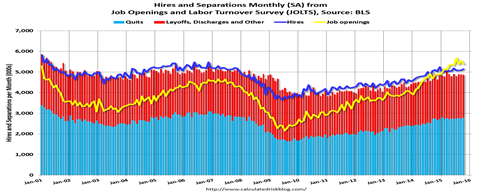
But the Labor Department’s JOLTS report just out signals there are plenty of jobs–in part because hiring picked up: there were 5.14 million hires in October, up from 5.08 million in September.

image

Graph: Calculated Risk

And though there were 5.38 million job openings in October (yellow line in graph), down from 5.53 million in September, some 2.78 million workers left work voluntarily, up from 2.77 million in September (blue bars in graph). This is a sign that workers are gaining confidence in the job market and their ability to find other jobs.

So we are hardly approaching full employment. And Friday’s unemployment report said the number of persons employed part time for economic reasons (sometimes referred to as involuntary part-time workers) increased by 319,000 to 6.1 million in November, following declines in September and October. Their hours had been cut back because they were unable to find a full-time job, said the BLS. (Though over the past 12 months, the number of persons employed part time for economic reasons is down by 765,000, a good sign.)

Another telltale sign of continued growth are the low inflation numbers, combined with barely rising incomes. Year-on-year, as seen in the dark line of the graph, average hourly earnings dipped 2 tenths to 2.3 percent, says Econoday. Whereas the Fed’s central inflation gauge, core PCE prices, are up just 1.3 percent. It’s the light blue line in the graph, and has been trending lower for the past year. When energy and food are included, the PCE drops to a year-on-year rate of only plus 0.2 percent.

image

Graph: Econoday

And low inflation (ie, cheap gas, commodities), plus rising incomes are reasons for optimism among consumers. As much as 1 million barrels per day of Iranian oil is about to come back into world markets, per the nuclear arms agreement, which will only bring down energy prices further. And demand in China for all commodities has weakened, as it works through its oversupply problems.

What about housing? The Mortgage Bankers Association just reported that purchase mortgage applications have risen a huge 1.2 percent from the previous week, while its unadjusted Purchase Index increased 36 percent compared with the previous week and was 29 percent higher than the same week one year ago. This means more housing sales, folks.

Its Market Composite Index, a measure of mortgage application volume, increased 1.2 percent on a seasonally adjusted basis from one week earlier.  On an unadjusted basis, the Index increased 43 percent compared with the previous week.  Even the Refinance Index increased 4 percent from the previous week.

This is when both existing-home sales and housing construction are still expanding. A strong housing market depends on mortgage rates staying near current lows, of course, but we believe that Yellen’s Fed dares not raise short term rates more than 0.25 percent in the near term.

In fact, Treasury Bond yields are also at record lows, with slowing worldwide growth. Foreign investors prefer to buy U.S.Treasury securities when other countries aren’t doing well; in comparison to our own better growth prospects.

So any rise in energy prices is just not in the cards, interest rates should stay low, which keeps down so many other costs—including lower household expenses, as well as production costs. These conditions spell future growth, rather than a near term recession.

Harlan Green © 2015

Follow Harlan Green on Twitter: https://twitter.com/HarlanGreen

Posted in Consumers, Economy, Housing, housing market, Weekly Financial News | Tagged , , , , , | Leave a comment

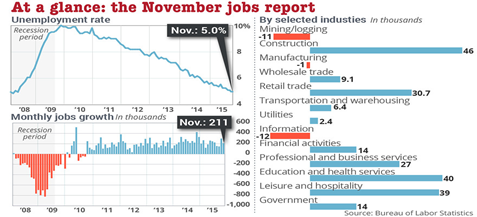
211,000 Payroll Jobs Not Enough

Popular Economics Weekly

Friday’s unemployment report was disappointing for a number of reasons, mainly because we are not yet close to full employment, and there is no sign of inflation. The number of persons employed part time for economic reasons (sometimes referred to as involuntary part-time workers) increased by 319,000 to 6.1 million in November, following declines in September and October.

This is hardly approaching full employment. The report said these individuals, who would have preferred full-time employment, were working part time because their hours had been cut back or because they were unable to find a full-time job. Over the past 12 months, the number of persons employed part time for economic reasons is down by 765,000.

Yet because 211,000 payroll jobs were added to payrolls, the calls are now for the Fed to begin to raise their interest rates.

image

Graph: Marketwatch

Most companies added jobs in November. Construction firms hired 46,000 people; restaurants added 32,000 employees and retailers beefed up staff by 31,000. The lone exceptions were the energy industry and Hollywood. Cheap oil has stunted business for energy producers, which have cut 124,000 jobs in 2015. The motion-picture industry also shed 13,000 jobs, though there’s been little change in employment over the past year.

But employment among manufacturers was basically flat, because of a strong dollar and weak global economy that’s reduced demand for their exports. In a separate report Friday, the government said U.S. exports fell to the lowest level in three years.

Raising interest rates now will cut back our exports even further (and so manufacturing), which are the bastion of higher income earners. This is while the EU is lowering their interest rates, making their exports more competitive.

ECB Chairman Mario Draghi promised he “would do whatever it takes” to boost economic growth in the Eurozone, and has just lowered their interest rates to a negative -0.3 percent. Mr. Draghi said there was “no particular limit to how we can deploy any of our tools” in terms of what the central bank could do to foster demand and, crucially, fulfill its stated goal of lifting inflation to 2 percent.

The report said the change in total nonfarm payroll employment for September was revised from +137,000 to +145,000, and the change from October was revised from +271,000 to +298,000. Over the past 3 months, job gains have averaged 218,000 per month.

This is hardly robust job growth, when November’s total dropped 87,000, and September’s total was still weak. And the inflation rate isn’t back to their 2 percent target. Nor is the labor market at full employment. We therefore believe such a rate increase would be premature and dampen consumer demand, at a time when consumers are already saving much more than they are spending.

Harlan Green © 2015

Follow Harlan Green on Twitter: https://twitter.com/HarlanGreen
Posted in Consumers, Economy, Macro Economics, Politics, Weekly Financial News | Tagged , , , , , , , , | Leave a comment

Lower Payroll Employment Tomorrow?

Popular Economics Weekly

Will tomorrow’s unemployment report be disappointing, and so cause the Fed to hesitate in raising their overnight interest rate above 0.25 percent, as they’ve been saying they will do this month? The most current economic indicators show that Fed Chair Yellen may be overoptimistic in her predictions for future growth, and so the need for higher rates.

The ADP private payroll report out yesterday is showing strength in Friday’s employment report, at a higher-than-expected gain of 217,000 for payrolls in November. But month-to-month, this report is not always an accurate indicator for the government’s data, forecasting a much lower reading than what turned out for October and a much higher reading than what turned out for September.

image

Graph: Econoday

Another sign that tomorrow’s report may be weaker is the ISM’s non-manufacturing survey index just out that dropped to 55.9 in November from 59.1, which is the lowest rate of monthly growth since May. And service sector activity now accounts for some 70 percent of economic activity.

image

Graph: Calculated Risk

Readings across the report have also edged down to growth levels last seen in the second quarter including new orders (57.5), backlog orders (51.5), and employment (55.5). New export orders, at 49.5, had their first contraction since April, showing a weaker manufacturing sector that is more dependent on exports.

The Employment Index decreased 4.2 percentage points to 55 percent from the October reading of 59.2 percent and indicates albeit slower growth for the 21st consecutive month. This is though the breadth of strength across industries, with 12 showing growth and six in contraction, is positive.

So what might tomorrow’s unemployment report be? The consensus is 200,000 payroll jobs, with a slightly higher unemployment rate of 51 percent. And Calculated Risk reports that Goldman Sachs maintains wages are still too low for longer term growth. “Our wage tracker—which also now includes the Atlanta Fed wage measure—stands at 2.6 percent. Apart from a technical blip in late 2012, this is the highest reading of the recovery, although it is still somewhat below our 3-3.5 percent estimate of the full-employment equilibrium rate,” reports Goldman economist David Mericle.

I therefore believe Fed Chair Yellen is being overly optimistic about future economic growth, when she said recently, “I anticipate continued economic growth at a moderate pace that will be sufficient to generate additional increases in employment, further reductions in the remaining margins of labor market slack, and a rise in inflation to our 2 percent objective.”

These indicators tell us that Fed Chair Yellen is still premature in predicting what may never happen, if they begin to raise interest rates at this time.

Harlan Green © 2015

Follow Harlan Green on Twitter: https://twitter.com/HarlanGreen
Posted in Consumers, Economy, Politics, Weekly Financial News | Tagged , , , , , , , , | Leave a comment