
Financial FAQs
“The Conference Board Leading Economic Index® (LEI) for the US was unchanged in September 2026 at 99.6 (2016=100), after a decline of 0.1% in August. The LEI grew by 0.6% between March and September 2026, a reversal from its decline of 1.1% over the previous six months (September 2025 to March 2026).”
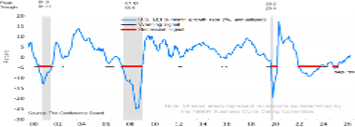
The Conference Board’s Index of Leading Economic Indicators (LEI) does a decent job of predicting future economic growth and recessions. So, we can use it to learn just how much recent economic events, such as President Trump’s illegal tariffs and gulf wars, are affecting future growth in President Trump’s second term.
The above LEI graph is an overlay of its growth rate predictions (blue line) 6-months ahead overlaying the length of actual recessions (gray bars). That means its various dips portrayed in the graph seem to have predicted a downturn looming in the upcoming 12 months.
The red line below which a recession was called had one exception—there was no recession in the 2022 to 2024 dip before the latest positive upturn.
Why then is the positive upturn predicting higher growth ahead? The A.I. data center construction is generating so much investment (approx. $800B) by the ‘Big 7’ tech companies and banks—such as Apple, Meta, Alpha (Google)—that it has boosted the stock market to record levels.
It’s also boosted interest rates and shaken the bond markets, who are worried that it is crowding out other more mundane investment that keep our government running. And several IPOs are in line, such as Anthropic which believes it can raise up to $1Trillion in its upcoming IPO.
So, economic growth has been a mixed bag until now. The growth slump in 2024 happened when Trump enacted his first tariffs and another One Big Beautiful Bill tax cut bill that added more $Trillions to the national debt.
“Five out of ten components made positive contributions to the LEI in September, led by the interest rate spread and average weekly hours in manufacturing. Nevertheless, these gains were offset by a large decline in consumer expectations and much smaller negative contributions from stock prices, new orders for capital goods and building permits.”
The huge surge in A.I. investment is giving a boost to economic growth this year. But what happens when all the data centers have been built out sometime next year? When will use of the new ChatGPTs, Claude software generate enough profits to pay for the record debt that underpins its construction and the huge amount of power required to run it?
The good news is that it’s a huge plus for upgrading our energy infrastructure that requires new electrical networks to run it as well.
But we do have examples of past over-investment bubbles that burst and caused recessions, such as the dot-com bubble of 2000 when there was a huge buildout in fiber optic cables that opened the Internet to everyone.
Then GDP growth stalled in 2001, a recession followed and growth didn’t turn positive until 2003, which lasted until the 2008-09 Great Recession.
So the LEI red line may not reflect recessions as accurately as we would like. But we are dealing with an administration that glories in its ignorance of the most basic economic verities in its quest to prolong the latest Gilded Age of robber barons as long as possible.
A recession might not occur in the next 12 months, of course. What if the Strait of Hormuz is opened and Trump makes a deal with Iran? Or he settles the tariff trade war? Or, the Federal Reserve succeeds in taming inflation?
Harlan Green © 2026
Follow Harlan Green on Twitter: https://twitter.com/HarlanGreen


