Celebrating Our Great Society

Popular Economics Weekly

We are in the midst of celebrating the 50th anniversary of President Johnson’s Great Society, enacted for the most part from 1964-66, perhaps the greatest legislative achievement of any president since FDR and the New Deal.

We know how FDR’s New Deal improved the lives of millions, literally preventing tens of thousands from starving to death during the Great Depression, and giving millions more a useful and productive public service job when there were none to be had in the private sector.

But the results of the Great Society are perhaps more mixed. That’s only if we wonder what might have happened if the U.S. economy was an ideological utopia, which didn’t go through its cycles of boom and bust, or the Vietnam War, or an Arab Oil Embargo, or 5 recession since 1980—the housing bubble and Great Recession being the latest examples.

Many of the programs were stymied by those events that took money away from social programs; in particular the Office of Economic Opportunity that funded many public programs similar to the Depression’s WPA. Conservatives’ ire is particularly directed at the spending for anti-poverty programs that were supposed to eliminate poverty, but were in fact meant to give the poorest a ‘leg up’ in their race to escape poverty.

Spending to help the poor doubled from 1965-68, and within 10 years the percentage of Americans living below the poverty line declined to 12 percent from 20 percent. Those were also the years of highest economic growth of the middle class. The rate has fluctuated greatly in the past 50 years. According to the census, 15.9 percent of Americans lived in poverty in 2012, which is just a couple of points lower than where the Census estimates it stood in 1965.

We really don’t know, for instance, how many jobs were created by the Office of Economic Opportunity. Those were also boom years when President Johnson dropped the top marginal tax rate from 91 to 71 percent. More than 4 years of 6 and 7 percent Gross National Product growth followed, employing anyone that wanted a job. The U.S. Gross National Product (Since 1991 the U.S. has used Gross Domestic Product as a more accurate measure of US output.) rose 10 percent in the first year of the tax cut, and economic growth averaged a rate of 4.5 percent from 1961 to 1968, says Wikipedia.

Johnson’s tax cut measure triggered what one historian described as "the greatest prosperity of the postwar years," according to the Washington Post. GNP increased by 7, 8 and 9 percent in 1964 to 1966, respectively. The unemployment rate fell below 5 percent. But the OEO did much more, as did most of the Great Society programs.

Do we really have to be reminded of the Clear Air and Water Acts that have kept our water and air cleaner than they would have been otherwise?  Or the Civil and Voting Rights Acts that banned discrimination and abolished the blatant ban on African Americans voting in the South?  Or the enactment of Medicare and Medicaid that has reduced the poverty rate of seniors from 1 in 7 living below the poverty line in 1965 to 1 out of 3 in 2013? 

We also now have consumer protection laws such as the Cigarette Labeling and Advertising Act requiring labeling of dangerous chemicals in cigarettes, and the National Highway Safety Administration setting safety standards for our highways.  Almost all of the Great Society programs have saved or improved the lives of millions of Americans.

That is something that can only be measured in non-economic ways. Head Start, for instance, has served more than 31 million children from birth to age 5 since 1965. In 2012-13, 1.13 million children and pregnant women were served by Head Start, according to the program. The vast majority – 82 percent – were children ages 3 and 4.

And how do we measure the value of its cultural contributions, such as PBS, the Public Broadcasting System that has 987 stations nationwide – most locally owned and operated – that broadcast NPR programming?

The Great Society also led to the fruition of the John F. Kennedy Center for the Performing Arts in Washington and created the National Endowment for the Humanities, which is one of the largest arts and culture funders in the United States.

These institutions and programs of the Great Society have in fact given a national voice to our hopes and dreams, because a nation that doesn’t care for its citizens’ hopes and dreams is a nation that has no future.

Harlan Green © 2015

Follow Harlan Green on Twitter: https://twitter.com/HarlanGreen
Posted in Economy, Keynesian economics, Macro Economics, Politics, Weekly Financial News | Tagged , , , , , , , , , , , | 1 Comment

Labor Force Participation Improving

Popular Economics Weekly

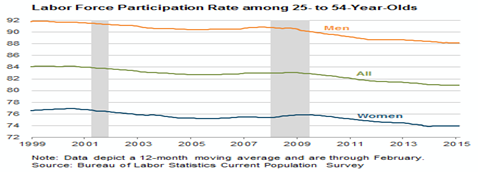
One lament by Fed Chairperson Janet Yellen and others has been the low labor participation rate of the prime-age workers—those 25 to 54 year-olds that have dropped out of the labor force, or are working part time.  But that may be changing, as we get closer to full employment.

The Atlanta Fed has just published an optimistic study that says they might be coming back to work. Atlanta Fed President Dennis Lockhart commented on it in a recent speech:

“Over the last few years, there has been a worrisome outflow of prime-age workers—especially men—from the labor force. I believe some of these people will be enticed back into formal work arrangements if the economy improves further.”

image

Graph: Atlanta Fed

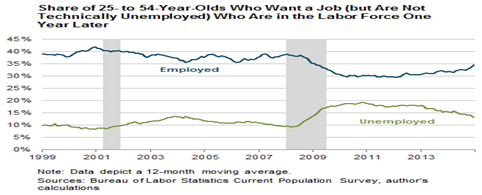
The decline in the “shadow labor force”—the share of the prime-age population who say they want a job but haven’t been looking (i.e., are not technically counted as unemployed)—demonstrates the cyclical nature of the labor market, says Lockhart. For the last year and half, the share of these individuals in the labor force had been generally declining (see the chart).

image

But now the ability of the prime-age shadow labor force to find work is improving at the same time that the Labor Force Participation rate of the prime-age population is stabilizing. Taken together, this trend is consistent with improving job market opportunities and further absorption of the nation’s slack labor resources, says the Atlanta Fed.

What might be enticing them back into the labor force? Rising wages and salaries, of course. About 70 percent of U.S. companies indicate that wages are starting to outpace inflation, according to a recent Duke University study of 500 CFOs. Wage growth should be at least 3 percent in tech, services and consulting, manufacturing and health care.

“The U.S. is finally entering a new phase in the economic recovery,” said John Graham, a finance professor at Duke’s Fuqua School of Business and director of the survey. “The first few years of recovery were ‘jobless’ and, even as job growth picked up over the past year, wages remained stagnant. Finally, we are starting to see wage growth for employees that outstrips inflation. Given that CFOs expect continued strong employment growth, it is surprising that wage pressures are not even greater.”

But wage growth will remain subdued at about one-third of companies that indicated employee pay will not outpace inflation in the survey. In particular, employees in retail/wholesale, transportation/energy and communications/media should expect pay hikes of less than 2 percent. The primary reasons are weak company financial performance, intense product market competition that keeps a lid on wages (because of need to keep production costs lean?), and minimal labor market pressure in these industries.

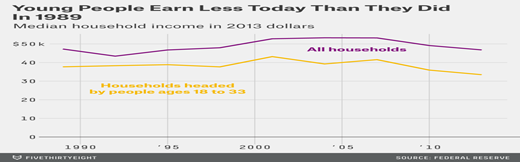
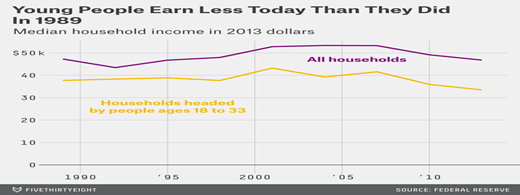
And we said last week that analyzing about three decades of census data—from 1980 to 2012—the  Federal Reserve’s 2013 Survey of Consumer Finances found that on average, young workers are now 30 years old when they first earn a median-wage income of about $42,000, a marker of financial independence, up from 26 years old in 1980.

image

Graph: fivethirtyeight.com

But with increasing employment and wage pressures, the financial well-being of younger workers should improve. It isn’t just the millennial generation of 18 to 36 year-olds that has suffered from the Great Recession, in other words.

Harlan Green © 2015

Follow Harlan Green on Twitter: https://twitter.com/HarlanGreen
Posted in Consumers, Economy, Weekly Financial News | Tagged , , , , , , , | 1 Comment

2014 Household Formation Rebounds

Financial FAQs

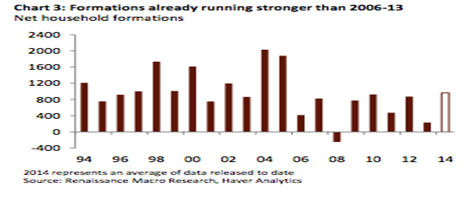
Breaking news. The latest Homeownership & Vacancy Survey, released by the Census Bureau, estimated household formation surged to 1.7 million in 2014 from 400,000 the previous year. That is really big news. Household formation, which is the bottom line demand factor for RE sales, mortgage financing, as well as the insurance and construction industries—in fact, anything related to the housing market–may finally begin to show growth from the horrible post-Great Recession years.

image

Graph: Trading Economics

This graph tells the story. Projections were for a recovery to 800,000 new households in 2014, but it looks like Millennials are beginning to leave home, or even college, and form new households in greater numbers—especially the oldest ages from 30 to 36 years. And most demographers agree millennials were born between 1980 to 1996, which means the oldest are reaching the age when they want to start a family, and that usually means buying a home.

Many of those have been renting, and we actually saw a 2.1 million surge in rental units in 2014, which has to account for many of those new households, according to the Census Bureau survey.

In fact, over the past year all the growth in net household formations has been among renters, according to the U.S. Census. For those 35 years old and younger, their home ownership rate has fallen from 44 percent to 36 percent over the past decade, which is why construction of multi-family apartments is at the highest level in a quarter-century this year.

And we know why. They can’t afford to buy until they reach an older age—in fact 30 years of age is when they achieve the median income wage of $42,000, according to a new Georgetown University study.

Through analyzing about three decades of census data—from 1980 to 2012—the study found that on average, young workers are now 30 years old when they first earn a median-wage income of about $42,000, a marker of financial independence, up from 26 years old in 1980.

image

Graph: fivethirtyeight.com

Economists now estimate millennials will spend some $1.6 trillion on home purchases and $600 billion on rent over the next five years, more per person than any other generation with more of them opting for more affordable rents versus paying the big price tags to buy homes, according to a new report from The Demand Institute, a non-profit think tank operated by The Conference Board and Nielsen. Millennials will form just over eight million new households, albeit most of them rental households, as we said.

But there is some good income news. The 2014 numbers aren’t in for a breakdown in median incomes, but the Q4 2014 Federal Reserve Flow of Funds report says the net worth of households and nonprofits rose to $82.9 trillion during the fourth quarter of 2014. The value of directly and indirectly held corporate equities increased $742 billion and the value of real estate rose $356 billion.

This can only boost the millennial generation’s financial well-being, as well, and so the housing market and its ancillary industries.

Harlan Green © 2015

Follow Harlan Green on Twitter: https://twitter.com/HarlanGreen
Posted in Consumers, Economy, Housing, housing market, Weekly Financial News | Tagged , , , , , , , , | Leave a comment

Will 2015 Interest Rates Remain This Low?

The Mortgage Corner

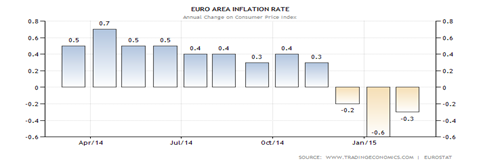
Record low interest rates are holding, in spite of the latest stock market selloffs, and may remain low throughout 2015. Why? Oil prices are still below $50/barrel, and overall prices are falling throughout the developed world. The Eurozone in particular has fallen into such deflationary times that some euro bonds have negative interest rates. That means holders of those bonds have to literally pay interest to hold them (i.e., government issued bonds), believe it or not.

image

Graph: Trading Economics

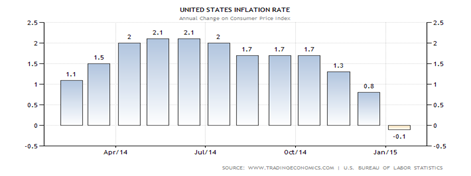
This is while the U.S. inflation rate has fallen to 1.3 percent, below the Fed’s 2 percent target that would mean prices are rising enough to sustain economic growth—in part because of those plunging oil prices. And because low oil prices will probably be sustained for at least 2 years, according to energy analysts, Janet Yellen’s Fed shouldn’t be tempted to raise their rates until later this year, if at all.

Oil prices are likely to stay at $60 a barrel or lower for the next two years as US shale extraction continues to suppress prices, according to the International Energy Agency’s latest report. After plunging from $115 a barrel in June to little more than $45 in January, the price of Brent crude has rallied recently, but the IEA said price pressures could have further to go.

“Despite expectations of tightening balances by end-2015, downward market pressures may not have run their course just yet,” the IEA, which advises mainly developed economies on the oil market, said in a monthly report.

There’s another reason for the Fed not to raise rates anytime soon, even though the so-called “confidence fairies” (P Krugman’s term) demand it; which are mainly deficit hawks that see inflation right around the corner, even when there’s none.

image

Graph: P Krugman

Because we are still not close to full employment, in spite of February’s 5.5 percent unemployment rate. Annual household median incomes after inflation have plunged 7.42 percent since the Great Recession, from $68,931 to $63,815. And history both here and in Europe has shown that tightening credit when household incomes haven’t recovered (either by raising interest rates, or otherwise restricting credit) can stop an economic recovery in its tracks.

That also means today’s long term mortgage rates, such as for the conforming 30-year fixed rate—should remain at or below 4 percent for the rest of 2015. Today, the 30-year conforming rate is 3.75 percent, still a very affordable mortgage.

Harlan Green © 2015

Follow Harlan Green on Twitter: https://twitter.com/HarlanGreen
Posted in Consumers, Economy, Housing, housing market, Weekly Financial News | Tagged , , , , , , , , , , , | Leave a comment

Good Employment Report for Most

Financial FAQs

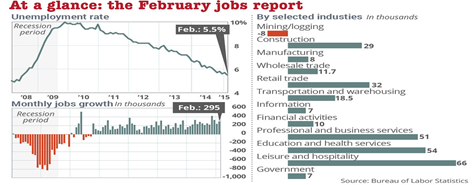
The stock market plunged on news total nonfarm payroll employment increased by 295,000 in February, and the unemployment rate edged down to 5.5 percent, the U.S. Bureau of Labor Statistics reported today. The DOW fell 279 points, and Gold, oil, and bond prices also plunged.

image

Graph: Marketwatch

Why so, when it was an extremely strong report with all sectors adding jobs that showed strong economic growth? Because the financial markets mistakenly believe it will push up the Fed’s schedule for raising interest rates, and higher rates mean less excess liquidity to invest in the financial markets.

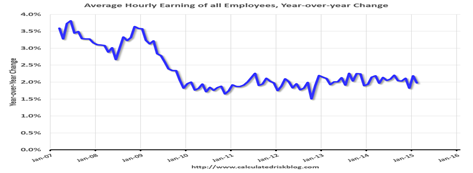
But Janet Yellen’s Fed isn’t focused solely on the rate of job formation or jobless rate, as she has said countless times, if the U.S. isn’t closer to full employment. And there wasn’t good news on wage growth; though January’s report had showed a slight improvement. The BLS report said: “In February, average hourly earnings for all employees on private nonfarm payrolls rose by 3 cents to $24.78. Over the year, average hourly earnings have risen by 2.0 percent.”

image

Graph: Calculated Risk

This is the real reason the U.S. economy has taken so long to recover. There are still more workers out of work, or looking for work than available jobs that pay a living wage. And the unemployment rate shrank from 5.7 to 5.5 percent only because 178,000 left the workforce, because they stopped looking for work.

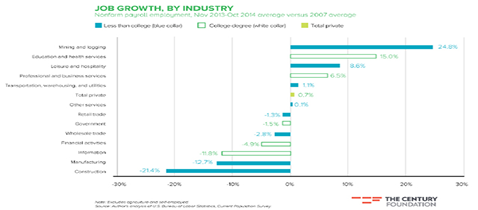
Why no wage growth after adjustment for inflation (now slightly under 2 percent)? A Federal Reserve study reported that the greatest demand for workers since the Great Recession has been in the poverty-level, minimum wage-paying service industries, and the lowest demand is for midlevel workers who once comprised the vast majority of the middle class.

A April 2014 report by the National Employment Law Project provided details supporting the Federal Reserve study. During the recession, low-wage jobs, those paying less than $27,700 per year, had both the lowest percentage of losses and the highest percentage of gains. Twenty-two percent of the total job losses were in the low-wage category, but 44 percent of new jobs were in that category.

image

Graph: Truthout

Mid-wage jobs, those paying between $27,700 and $41,600 (i.e., middle class jobs), had the lowest percentage of new jobs created, 26 percent, but the second highest rate of job losses, 37 percent. High-wage jobs, those paying more than $41,600, had the highest rate of losses, 41 percent, but a higher rate of new jobs created, 30 percent, than the mid-wage category.

So Janet Yellen may not even be ready to raise interest rates in June, or sooner, as the financial markets fear. There can be no sustainable recovery, the Fed’s stated goal, until there is enough income growth to prevent another fallback into recession as happened to the Japanese and Eurozone economies because of premature credit tightening.

Harlan Green © 2015

Follow Harlan Green on Twitter: https://twitter.com/HarlanGreen
Posted in Consumers, Economy, Politics, Weekly Financial News | Tagged , , , , , , , , , , | Leave a comment

Governor Scott Walker vs. Education

Financial FAQs

It is hard to believe, but prospective presidential candidate Wisconsin Governor Scott Walker’s main platform seems to be his antipathy towards education, and higher education, in particular. He has obfuscated his near hatred of higher education to date by getting his Republican-Controlled Legislature to first ban public union collective bargaining, especially unions for teachers and public health nurses.

But the veil that has obscured his anti-education agenda is lifting. His latest salvo is directed at the University of Wisconsin. He proposes not only to cut its budget, but proposed downsizing its mission from that of higher education to supply workers, whoever they might be. Walker’s new budget proposal would slash $300 million from the University of Wisconsin system over the next two years. That’s a 13 percent reduction in state funding.

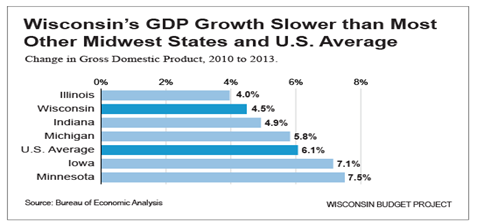
That might be explained by the poor performance of the Wisconsin economy since he took office—an economy now ranked below all other comparable Midwestern states.

A harbinger of what Walker might face came in an immediate uproar on social media this month after his staff proposed changing the university’s focus on the pursuit of truth, known as the “Wisconsin Idea,” to a grittier focus on “workforce needs.”

“Inherent in this broad mission are methods of instruction, research, extended training and public service designed to educate people and improve the human condition,” is part of the University of Wisconsin’s mission statement.

What is wrong with that mission, you ask? It speaks to a well-educated mind, is Walker’s problem, apparently. If Walker gets his way, that sentence, along with “Basic to every purpose of the system is the search for truth,” would be entirely cut from the charter. Walker also seeks to cut statements reinforcing the university’s commitment to working with out-of-state institutions and its prioritization of “programs with emphasis on state and national needs.”

In its place, Walker proposes language stating Wisconsin only provides a state education because it is constitutionally required and among its top priorities are meeting “workforce needs.” So the U. of Wisconsin should be down-sized to a trade school?

On reflection, Walker’s anti-education agenda fits right in with the current Republican Party’s prejudice against modern education in general, scientific knowledge and empirical facts in particular, such as the denial of global warming. Republicans have even proposed abolishing the Department of Education, a cabinet position, which helps to keep their supporters in the poorer red states literally ignorant of those facts that would better their lives.

It was in 2011 that Walker pushed through a law, Act 10, that slashed the power of public employee unions to bargain, and cut pay for most public sector workers.  As a special slap to teachers, Walker exempted the unions of police, firefighters and state troopers from the changes in collective bargaining rights but not educators. 

Teachers protested for a long time, closing schools for days, but the law passed, and the impact on teachers unions in Wisconsin has been dramatic: according to this piece by Washington Past columnist Robert Samuels. The state branch of the National Education Association, once 100,000 strong, has seen its membership drop by a third, and the American Federation of Teachers, which organized in the college system, has seen a 50 percent decline.

image

Graph: Wisconsin Budget Project

The effect on Wisconsin’s economy has been even more dramatic. The latest comprehensive state employment data from the U.S. Bureau of Labor Statistics and the Quarterly Census of Employment and Wages (QCEW) reveals that Wisconsin continues to lag both the national rate of job growth as well as the rates of employment gain in most other states. Between December 2012 and 2013, Wisconsin gained 26,816 jobs, posting an annual employment growth rate of 0.98 percent, significantly trailing the national job growth rate of 1.75 percent during the same period.

Thus, Wisconsin’s year-over-year job growth in fourth quarter of 2013 was just slightly over half the national rate – a level of underperformance that has been consistent since 2011. Overall, Wisconsin ranked 37th among the 50 states in the rate of total employment growth between December 2012-13. Wisconsin trailed every single neighboring Midwestern state (Illinois, Indiana, Iowa, Michigan, Minnesota, and Ohio) in year-over-year employment growth between December 2012-13.

Walker is destroying Wisconsin’s economy, in other words. Right now he is pushing to demolish union organizing once and for all with his proposal to make Wisconsin a Right to Work state, which will further depress its economy. And this man wants to run for President of all 50 states?

Harlan Green © 2015

Follow Harlan Green on Twitter: https://twitter.com/HarlanGreen
Posted in Consumers, Economy, Keynesian economics, Macro Economics, Politics, Weekly Financial News | Tagged , , , , , | Leave a comment

Pending Home Sales, Consumer Confidence Looking Better

The Mortgage Corner

Oh, the winter is freezing consumers, as I’ve said! It affected January existing-home sales, but the NAR’s January Pending Home Sales index rose sharply 1.7 percent. So pending sales of contracts signed may give a boost to existing-home sales in coming months that fell slightly in January.

Part of the reason for slightly lower home sales, according to the NAR, is that homeowners aren’t changing homes every 7 years on average as they used to. It’s now 10 years, probably due to the busted housing bubble, loss of so much housing equity, and the Great Recession, of course.

image

Graph: Econoday

But this marks the fifth consecutive month of year-over-year gains for pending sales with each month accelerating the previous month’s gain, said the NAR.

Lawrence Yun, NAR chief economist, says for the most part buyers in January were able to overcome tight supply which highlights the underlying demand that exists in today’s market. “Contract activity is convincingly up compared to a year ago despite comparable inventory levels,” he said. “The difference this year is the positive factors supporting stronger sales, such as slightly improving credit conditions, more jobs and slower price growth.”

“All indications point to modest sales gains as we head into the spring buying season,” says Yun. “However, the pace will greatly depend on how much upward pressure the impact of low inventory will have on home prices. Appreciation anywhere near double-digits isn’t healthy or sustainable in the current economic environment.”

He is right, of course. Consumer confidence is at an all-time, post-recession high, which also bodes well for housing demand—though February’s consumer confidence index fell 7.4 points to 96.4 from a revised 103.8 in January which was a 7-1/2 year high.

The dip was centered in the expectations component which fell a very steep 9.8 points to 87.2. Could it just be the winter blahs, when jobs are harder to find in part because winter weather keeps consumers from spending more?

image

The second main component of the confidence index, consumers’ present situation, also dipped but less severely, down 2.7 points to 110.2. Here, a closely watched sub-component, jobs currently hard to get, rose 1.6 percentage points to 26.2 percent which is mild indication of weakness for the monthly employment report that comes out this Friday, let us not forget.

The employment consensus is for 230,000 (Wrightson ICAP) to 235,000 (Bloomberg) jobs, a decline in the unemployment rate to 5.6 percent (reversing last month’s surprise uptick), a 0.2 percent increase in average hourly earnings and an unchanged 34.6-hour workweek.

February unemployment reports tend to start out slow and be revised in coming months, as it has in past years—by as much as 50,000 additional jobs, which would boost consumers’ attitudes.

Reuter’s Wrightson ICAP Research says February nonfarm payrolls have been revised over the subsequent two reports in each of the past five years by an average of more than 50K. Their forecast assumes that February nonfarm payroll growth this year will end up somewhere around 280K, so the preliminary estimate probably won’t be quite as strong as the final value. (Their forecast also assumes that the net revision to December and January this month will be positive but probably 25K or less).

Harlan Green © 2015

Follow Harlan Green on Twitter: https://twitter.com/HarlanGreen

Posted in Consumers, Economy, Housing, housing market, Weekly Financial News | Tagged , , , , , | Leave a comment

Fed Chair Yellen Still Dovish, Economy Still “Sluggish”

Popular Economics Weekly

Federal Reserve Chairperson Yellen wants to keep interest rates as low as possible for at least the “next couple of FOMC meetings”, even as there are signs that economic growth is accelerating. This is in the face of the newly Republican-dominated Congress threatening to curb its powers, because their deficit hawks want to raise rates sooner, and we know what happened in Europe and Japan when this happened—their 2nd and 3rd recessions since 2008.

Why? Because raising rates too soon could stop many consumers from spending, because income growth is poor and consumers are only beginning to feel confident enough to spend. Whereas the deficit hawks see inflation where there is none at the moment, since they are mainly creditors that see any deficit as endangering the value of the debt they hold.

Yellen said inflation measures still show inflation too low to sustain growth, and wage pressures are still not enough to sustain higher household incomes, which is the main driver of inflation. Or, in her words, the Fed doesn’t want to raise rates “until the economy is fully healed”

However, “If economic conditions continue to improve,” said Dr. Yellen, “as the Committee anticipates, the Committee will at some point begin considering an increase in the target range for the federal funds rate on a meeting-by-meeting basis. …However, it is important to emphasize that a modification of the forward guidance should not be read as indicating that the Committee will necessarily increase the target range in a couple of meetings.”

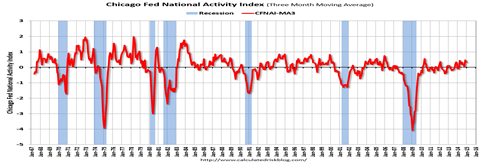
The most recent measures do show accelerating growth. For instance, the Chicago Fed National Activity Index (CFNAI), a proxy for nationwide growth, edged up to +0.13 in January from –0.07 in December. It is one of the broadest measures of economic activity, outside of the Gross Domestic Product quarterly report. Three of its four broad categories of indicators that make up the index increased from December, and only one of the four categories made a negative contribution to the index in January.

image

Graph: Calculated Risk

Too low inflation still remains a problem, you say? Yes, and is the main reason Yellen wants to keep interest rates at their lowest level. It’s now negative for the first time in the year, and even since 2009. There was another huge drop in energy prices. Overall consumer price inflation fell sharp 0.7 after declining 0.3 percent in December. Energy plunged 9.7 percent after dropping 4.7 percent in December.

Gasoline plummeted 18.7 percent, following a 9.2 percent fall in December. Food prices were unchanged, following a rise of 0.2 percent in the previous month. Core inflation excluding food and energy was just 0.2 percent after a modest 0.1 percent rise December, and is up 1.6 percent in a year.

image

Graph: Trading Economics

That is the main reason the Fed wants to keep rates low as long as possible. Low interest rates boost both housing prices and sales, lower debt levels, and higher valuations enable more homeowners to sell, refinance, and move, if necessary. So Yellen’s last two days of testimony should encourage those fence sitters, as well as give all consumers more confidence in their future economic well-being.

Harlan Green © 2015

Follow Harlan Green on Twitter: https://twitter.com/HarlanGreen
Posted in Consumers, Economy, Housing, housing market, Politics, Weekly Financial News | Tagged , , , , , , , | Leave a comment

January Existing Home Sales, Mortgage Applications Dip

The Mortgage Corner

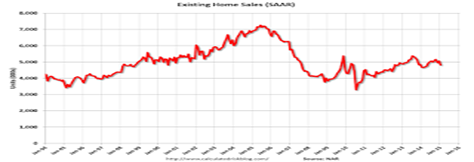
Oh, the winter freeze! It seems to put the housing market into a deep freeze, as well. Total existing-home sales, completed transactions that include single-family homes, townhomes, condominiums and co-ops, fell 4.9 percent to a seasonally adjusted annual rate of 4.82 million in January (lowest since last April at 4.75 million) from an upwardly-revised 5.07 million in December, said the NAR. Despite January’s decline, sales are higher by 3.2 percent than a year ago.

Lawrence Yun, NAR chief economist, says the housing market got off to a somewhat disappointing start to begin the year with January closings down throughout the country. “January housing data can be volatile because of seasonal influences, but low housing supply and the ongoing rise in home prices above the pace of inflation appeared to slow sales despite interest rates remaining near historic lows,” he said. “Realtors® are reporting that low rates are attracting potential buyers, but the lack of new and affordable listings is leading some to delay decisions.”

image

Graph: Calculated Risk

Better news was that the Chicago Fed National Activity Index (CFNAI) edged up to +0.13 in January from –0.07 in December, with industrial production up. Three of the four broad categories of indicators that make up the index increased from December, and only one of the four categories made a negative contribution to the index in January.

The index is a weighted average of 85 indicators of national economic activity drawn from four broad categories of data: 1) production and income; 2) employment, unemployment, and hours; 3) personal consumption and housing; and 4) sales, orders, and inventories.

Total existing-home inventory at the end of January increased 0.5 percent to 1.87 million existing homes available for sale, but is 0.5 percent lower than a year ago (1.88 million). Unsold inventory is at a 4.7-month supply at the current sales pace – up from 4.4 months in December. The median existing-home price for all housing types in January was $199,600, which is 6.2 percent above January 2014. This marks the 35th consecutive month of year-over-year price gains.

image

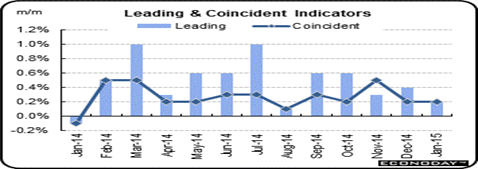
This follows the Conference Board’s LEI, which slowed to a not-so-strong plus 0.2 percent versus a slightly downward revised plus 0.4 percent in December. Once again the yield spread is the biggest positive for the index reflecting the Fed’s near zero rate policy. Consumer expectations are the 2nd largest positive in the month, though one that may reverse in the next report given last week’s plunge in the consumer sentiment index. Credit indications, which continue to be very positive in this report, are the 3rd largest positive.

Both indexes show increased employment in 2015, which should mean home sales will pick up with the selling season and better weather in the spring. “Although sales cooled in January, home prices continued solid year-over-year growth,” adds Yun. “The labor market and economy are markedly improved compared to a year ago, which supports stronger buyer demand. The big test for housing will be the impact on affordability once rates rise.”

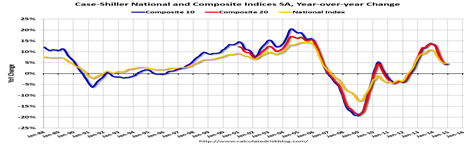
Real estate is showing more signs of life, with the Case-Shiller Home Price Index rising again. Data released for December 2014 shows a slight uptick in home prices across the country. The S&P/Case-Shiller U.S. National Home Price Index, which covers all nine U.S. census divisions, recorded a 4.6 percent annual gain in December 2014 versus 4.7 percent in November.

image

Graph: Calculated Risk

Nine cities reported monthly increases in prices … Both the 10-City and 20-City Composites saw year-over-year increases in December compared to November. The 10-City Composite gained 4.3 percent year-over-year, up from 4.2 percent in November. The 20-City Composite gained 4.5 percent year-over-year, compared to a 4.3 percent increase in November.

image

Graph: US Census Bureau

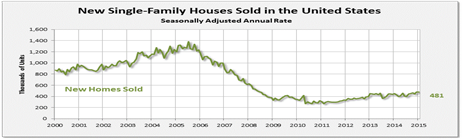
And lastly, January new-home sales were unchanged, but prices rose. Sales of new single-family houses in January 2015 were at a seasonally adjusted annual rate of 481,000, which is not enough product to keep prices in the affordable range. This is 0.2 percent below the revised December rate of 482,000, but is 5.3 percent above the January 2014 estimate of 457,000.

“In a promising sign, new home sales have been trending at post-recession highs for the past two months,” said NAHB Chief Economist David Crowe. “As the economy strengthens and mortgage rates remain low, we can expect continued upward movement in the housing market this year.”

So still record low interest rates (i.e., 3.50 percent conforming fixed rates) are keeping homebuyer and refinancers interested, but not enthusiastic.   And we believe mortgage rates will remain low, as evidenced by Fed Chairwoman Janet Yellen’s latest congressional testimony, which hinted that said rates could remain low for much of this year.

Harlan Green © 2015

Follow Harlan Green on Twitter: https://twitter.com/HarlanGreen
Posted in Consumers, Economy, Housing, housing market, Weekly Financial News | Tagged , , , , , , | Leave a comment

Enslavement of the Middle Class

Financial FAQs

It is becoming obvious that the American middle class (topic dujour among presidential candidates these days) has been enslaved by an ideology that only benefits the wealthiest among US. It is an ideology of austerity that has prevailed in the U.S. at least since the 1980s, and Paul Krugman says is putting Europe into its Second Great Depression.

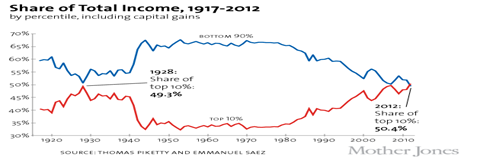
It is really an economic ideology of the 18th century first formulated by Adam Smith—of fewer government services and lower taxes that has made corporations all powerful with the greatest profits in their history, left American workers with little or no control over their livelihoods, and resulted in the greatest income inequality since the 1920s.

image

Such an insidious ideology has kept the poorest states poorer, caused declining investment in education (our seed corn for future entrepreneurs), is quickly degrading our public infrastructure, and even the ability to protect ourselves. President Obama’s State of the Economy report and latest speeches have made it obvious. The greatest income inequality since the 1920s is here to stay, unless there are major changes in economic policies.

That is why most Americans (at least the 90 percent) have become harried, 24/7 workers with little vacation time, poor health care options (in spite of Obamacare), too expensive educational opportunities, too few well-paying jobs, and little protection from the globalization that stronger labor laws would bring.

Those policies have been called supply-side economics, under the theory that giving more tax breaks to the wealthiest by reducing capital gains and maximum tax rates, while shrinking government investment and oversight, would induce the wealthiest to put their money into productive investments, thus creating more jobs.

But that never happened. When President Reagan cut the maximum income tax rate from 70 percent that prevailed in the 1970s to 50 percent, it and 2 recessions created the largest budget deficit of that era, which is why he instituted 11 tax hikes to bring the budget back into a semblance of balance. This was all catalogued by his budget director, David Stockmen in The Triumph of Politics.

Then we have GW Bush’s further tax cuts on both maximum income tax rates to 35 percent and capital gains to their lowest in modern history that so depleted tax revenues it created the largest budget deficits in history, and ultimately the Great Recession.

It’s no use sugar coating the truth any longer. Since the end of the Great Recession, the top 1 percent of income earners have garnered 96 percent of total income since 2009, after a brief dip. And Americans still have the greatest income inequality of the developed western world.

Why could such inequality be here to stay? In part because so much wealth has flowed to so few, and it is easy to buy influence in this country. The most obvious receivers of such largesse are the conservative members of Congress, mostly Republicans, who continue to block the economic reforms that would better the lives of those that live on Main Street.

Nobelist Paul Krugman said as much in his latest NYTimes Oped: “So what does it say about the current state of the G.O.P. that discussion of economic policy is now monopolized by people who have been wrong about everything, have learned nothing from the experience, and can’t even get their numbers straight?… Clearly, failure has only made them stronger, and now they are political kingmakers. Be very, very afraid.”

image

Graph: CEA Report

The White House just released their Council of Economic Advisors 2015 Report, chaired by Jason Furman. It said, “The second important factor influencing the dynamics of middle-class incomes is inequality. This, too, is a global issue. In the US, the top 1 percent has garnered a larger share of income than in any other G-7 country in each year since 1987 for which data are available, as shown in the above graph.”

It should be clear what must be done to remove the obstacles that hold back most Americans from a better life. Let us start by jettisoning the 18th century myth which enslaves all economic classes, a myth that only holds us back in the 21st century. Indiscriminately lowering taxes while minimizing government services and oversight hasn’t improved the lives of anyone except the wealthiest among us.

Harlan Green © 2015

Follow Harlan Green on Twitter: https://twitter.com/HarlanGreen
Posted in Consumers, Economy, Macro Economics, Politics, Weekly Financial News | Tagged , , , , , , , , , | Leave a comment