Who Needs a Tax Cut?

Popular Economics Weekly

“A bill that cuts federal income taxes for middle-class families makes absolutely no sense, except as a sad way of camouflaging the real intent of the bill: Giving millions of dollars to the very wealthy, who happen to be the only people who are really benefiting from our uneven economic growth,” Rex Nutting

Huffington Post

I wrote this Huffington Post piece in 2017 during President Trump’s first term when he passed the Tax Cuts and Jobs Act (TCJA) that is set to expire but is being renewed if Republicans succeed in passing their new fiscal budget.

But in seeking to repeat Trump’s first term, Trump and his Republicans are regressing to an economic model that existed more than 100 years ago, and that is completely out of touch with the modern world.

His tax cut helped very few income earners, i.e., ordinary working folk. MarketWatch economist Rex Nutting calculated that those in the 60 percent middle-income brackets—from $32,000 to $140,000 per year—pay just an average 2.5 percent in income taxes. It’s only the richest 0.1 to 1 percent income earners that pay more and therefore want the huge tax cuts Congress and the Trump administration are proposing.

The TCJA renewal in 2025 will add at least $3 trillion to our federal debt in the next 10 years, according to the Congressional Budget Office, and raise our federal debt from 120 percent to as much as 130 to 150 percent of GDP because Republicans have no mechanism to pay for it, except higher import taxes from the tariffs and cuts to health care services such as Medicaid.

Hence the just announced sovereign debt downgrade of Moody’s AAA to Aaa, the last debt rating agency that held a AAA rating on U.S. Treasury debt, which will raise the cost of U.S, Treasury securities.

The tariff war that Trump illegally initiated with the dubious rationale that it will bring back a bygone era of manufacturing (Congress has the power to regulate tariffs during wartime emergencies but they have since allowed presidents to enact them during peacetime), will cause another period of stagflation as happened in the 1970s that took 10 years and double-digit interest rates to cure.

How soon voters and investors have forgotten what stagflation was like! The Federal Reserve under Chairman Paul Volcker raised its Fed Funds rate to 20 percent in the 1980s because inflation had risen to 14 percent rate and resulted in two back-to-back recessions under President Reagan.

“Top this off with another record for corporate profits, up 7.4 percent in a year, and there is no reason to be cutting their taxes,” I said in 2017. “They haven’t been using their profits for productive purposes, so what’s needed is for them to pay higher taxes so government can use that money to invest productively in the $2 trillion plus in outmoded infrastructure that badly needs replacement,”

And that’s precisely what the Biden administration did, pass bipartisan legislation that invested $2 trillion in the Infrastructure, CHIPs and Science, and Inflation Acts to modernize the U.S. economy.

Yet voters re-elected a man in Trump 2.0 that is returning the budget and tax cut debate to an earlier historical period. President Trump is now touting the need for another Gilded Age that prevailed in 1900 when tariffs protected fledgling industries.

Tariffs became less important with the introduction of income taxes in 1913 to support government services, and the trend since then has been downward to the very low rates that prevailed until now.

Then why have so many Americans re-elected someone who is only interested in reducing taxes to enrich himself and his Oligarchs; who has shown an almost total ignorance of basic economics (in maintaining a tariff isn’t an import tax) with a history of countless business failures, and that is causing investors to flee the US economy and impoverish the rest of us?

Will it take another recession to convince voters once again that One-man rule doesn’t work if Americans still want to live and prosper in a democracy?

Harlan Green © 2025

Follow Harlan Green on Twitter: https://twitter.com/HarlanGreen
Posted in Consumers, COVID-19, Economy, Politics, Weekly Financial News | Tagged , , , , , , , , | Leave a comment

Consumers Are Unhappy

Financial FAQs

“Consumer confidence declined for a fifth consecutive month in April, falling to levels not seen since the onset of the COVID pandemic,” said Stephanie Guichard, Senior Economist, Global Indicators at The Conference Board. “The decline was largely driven by consumers’ expectations. The three expectation components—business conditions, employment prospects, and future income—all deteriorated sharply, reflecting pervasive pessimism about the future.”

The University of Michigan’s Sentiment Survey Index has also declined for five consecutive months, from 74 to 50.8. It’s mainly about the growing inflation fears.

Year-ahead inflation expectations surged from 6.5% last month to 7.3% this month. This month’s rise was seen among Democrats and Republicans alike. Long-run inflation expectations lifted from 4.4% in April to 4.6% in May, reflecting a particularly large monthly jump among Republicans.” Survey Director Joanne Hsu.

Why so much doom and gloom in surveys while consumers are still fully employed? Consumers don’t like uncertainty any more than businesses. and their lack of confidence could have an even larger impact on economic growth than uncertainty in the financial markets.

Consumer activity drives two-thirds of economic growth, and a recession begins when a majority begin to save more than they spend for a prolonged period. There are many ways to measure this, such as a growing cutback in retail sales.

Retail sales rose just 0.1% in April. That’s a big comedown from a 1.7% spike in March that marked the biggest increase in more than two years because consumers bought ahead of the April 2 tariff announcements that imports from all 180 countries in the world would be taxed at least 10 percent.

FREDretailsales

Retail sales account for one-third of consumer spending and and shoppers have been hunting for more bargains. Sales have declined in three of the past 13 months as portrayed in the FRED graph and were flat another three months, but are still 4.7 percent higher in a year.

Motor vehicle and parts dealers were up 9.4 percent (±1.8 percent) from last year because consumers knew that motor vehicle import taxes (i.e., tariffs) of at least 25 percent had already been announced, while food service and drinking places were up 7.8 percent (±1.8 percent) from April 2024.

The Conference Board’s Index of Leading Economic Indicators (LEI), another growth indicator that attempts to predict future growth, showed more weakness.

“The US LEI for March pointed to slowing economic activity ahead,” said Justyna Zabinska-La Monica, Senior Manager, Business Cycle Indicators, at The Conference Board. “March’s decline was concentrated among three components that weakened amid soaring economic uncertainty ahead of pending tariff announcements: 1) consumer expectations dropped further, 2) stock prices recorded their largest monthly decline since September 2022, and 3) new orders in manufacturing softened.

Manufacturing will be hardest hit, because Trump’s tariffs will bring higher inflation and interest rates, which especially hurts manufacturers because they need to borrow lots of money to build their factories. The LEI survey reported new manufacturing orders were already softening.

This will defeat what he says is the main reason for tariffs—bringing manufacturers home—as will the immigration crackdown, which reduces the working age population at a time of worker shortage. The Manufacturing Institute and Deloitte accounting firm have projected that manufacturing will need an additional 3.8 million workers by 2033. Where will they come from?

In fact, this tells us it’s not the real reason for his tariffs, since he is more concerned about cutting taxes and federal spending that would also disincentivize more domestic manufacturing investment.

No, it looks like Trump’s chaotic tariff war will create bottlenecks last seen during the COVID-19 pandemic and worse, unless he relents.

We know what those supply interruptions did to economic growth during the pandemic and why it took the succeeding Biden administration four years to fix with its bipartisan New, New Deal legislation.

Harlan Green © 2025

Follow Harlan Green on Twitter: https://twitter.com/HarlanGreen
Posted in Consumers, COVID-19, Economy, Politics, Weekly Financial News | Tagged , , , , , , , | Leave a comment

Trump’s Manufacturing Scam

Financial FAQs

Why? It’s not like we’re a small country or full of stupid people. No, it’s the takeover of the economists and bankers. Simply put, modern American law is oriented towards ensuring very high returns on capital to benefit Wall Street and hinder the ability to make things.” Matt Stoller, American Economic Liberties Project

CBPP.org

Matt Stoller’s cry is a sign that even Libertarians are alarmed at Donald Trump and the Republicans’ scheme to grow the manufacturing sector. It’s another scam that enables them to turn the economic clock back to the 19th century, the Gilded Age of Robber Barons and rampant corruption and downsize government while ignoring modern laws and even the constitution.

Trump is doing it by raising tariff rates to a level not seen since 1930 at the onset of the Great Depression. But it won’t bring back a manufacturing industry that was lost to a globalized economy over the past 30 years.

The Manufacturing Institute and Deloitte accounting firm have projected that manufacturing will need an additional 3.8 million workers by 2033, in part due to the Biden administration’s $2 trillion worth of projects already invested by the Infrastructure, CHIPs and Science, and Inflation Reduction Acts, according to a recent NPR report.

And the Trump administration’s goal of deporting millions of undocumented workers as well as eliminating DEI programs that develop more skilled minorities will defeat his purpose by hollowing out the required workforce.

Early 19th century was a time of few laws to protect working folk, and there was no income tax until 1913 when Teddy Roosevelt’s Progressive era began to level the income playing field for workers. Oligarchs had to pay income taxes for the first time.

It was Ronald Reagan and the Business Roundtable of corporate CEOs that began the “takeover of the economists and bankers” that moved whole industries overseas while reducing their income taxes—from a maximum personal tax rate as high as 92 percent in President Eisenhower’s time—transferring $trillions that once went to the 80 percent of Americans earning salaries to the oligarchs that owned the capital and became “rentiers”; i.e., living off the capital created by their workers.

Trump wants a return to the era because it’s how he made his money. Who better than a convicted felon, a “liar and cheat” his whole life in the words of his erstwhile attorney Michael Cohen, to con Americans into believing that a tariff war against the whole world is the best way to bring back our manufacturing industry that has already migrated to Southeast Asia and China?

He has rationalized the economic chaos his tax war is creating with the promised goal of returning to an earlier era when we were a manufacturing superpower. But workers had fewer rights and benefits until Roosevelt’s New Deal.

Are we to believe it justifies more tax cuts for himself and his oligarchs that will grow our record federal debt ever higher, endangering the “full faith and credit” of the U.S. Government, as well as creating another era of stagflation with possible double-digit inflation and interest rates as happened in the 1970s?

Trump is attempting to recreate a time (1900) when we invaded and occupied Cuba and the Philippines. The reason for his nonsensical pronouncements that Canada should become our 51st state and Greenland a U.S. territory now begin to make sense.

Democrats do have an answer to the huge wealth gap between blue states and red states that might bring American workers back to present times. Start with small steps such as lobbying to raise the national minimum wage, currently $7.25 per hour to what it is today when inflation adjusted—$10.50/hour. That is already the case in 30 of the mostly blue states, where the minimum wage has risen above $15 per hour.

It will be a terrific struggle that will take time. President Trump and Republicans have erected such a wall of ignorance to protect his administration—officials of such incompetence that they lack the ability to even think for themselves so they will obey his commands without question and even anticipate them beforehand (Pete Hegseth, et. al.).

We aren’t a country of stupid people that can’t see the erosion of rights and civil liberties the Trump administration is justifying to return to an earlier century. The mass protests and demonstrations against Trump and Musk’s chainsaw tactics are proving it.

It’s a great time to return the Democratic Party to the party that has always supported greater equality for wage-earners and farmers. Democrats have the means to block Trump’s impossible time travel back to an earlier century that no longer exists.

Harlan Green © 2025

Follow Harlan on Twitter: https://twitter.com/HarlanGreen

Posted in Consumers, COVID-19, Economy | Tagged , , , , , , , , | Leave a comment

Stopping the Steal

Popular Economics Weekly

“We were losing hundreds of billions of dollars with China. Now we’re essentially not doing business with China. Therefore, we’re saving hundreds of billions of dollars. Very simple.” Donald Trump

NYTimes

Why would Trump mouth such an obviously stupid statement, other than to maintain the lie to his MAGA base that tariffs are not import taxes?

The above Donald Trump quote during his Sunday “Meet the Press” interview with NBC’s Kristin Welker is alarming for too many reasons. It indicates Trump is living in a surreal world, ignoring the warnings from small businesses, and even the U.S. Chamber of Commerce, that are literally terrified over the damage that his tariff war is already causing.

“Stopping the Steal” was an HBO documentary that described the January 6 uprising and Donald Trump’s attempt to overturn Joe Biden’s election. But the title is also a good description of Donald Trump’s attempt to justify his poorly though out tariff war on all 180 countries in the world that he maintains have been stealing from Americans and deserve the chaos it is causing.

It must be exhausting, having to maintain such falsehoods every time he makes public statements, especially economic untruths that are threatening to wreck the U.S. economy.

Bloomberg reports that because there are no agreements with anyone in the first 100 days, trade flows are shifting away from America. Canadian exports to the US tumbled while shipments to other countries soared. The Trump administration’s duties on Canadian steel, aluminum, autos and other products, as well as Canada’s retaliatory levies on a range of American goods, led to a large pullback in activity between Canada and its largest trading partner in March.

Canadian exports to the US plunged 6.6%, the biggest drop since the pandemic, while imports fell 2.9%. Canada’s exports to countries other than the US jumped 24.8%, however, almost entirely offsetting the decline in shipments to the U.S.

Most worrisome of all, Trump is becoming more incoherent in his speeches and interviews. He also claimed on Sunday, he did not know that as President he swore to defend the U.S. Constitution “from all enemies, foreign and domestic.”

Some of his pronouncements could be an act but it is an act that will cause sky-high inflation and the empty shelves that we have not seen since the COVID-19 supply shortages.

Why the lies? Mental health experts have warned many of Trump’s actions are designed to create the chaos he needs to control his surroundings. He created a cabinet in his second term as dysfunctional and subservient as that of his family and real estate business.

Mary Trump, his niece and a Clinical Psychologist, wrote a book about her uncle. There is no understanding Donald Trump without understanding his “malignantly dysfunctional family”, according to Mary, in a 2020 Guardian interview with David Smith about her best-seller,  Too Much and Never Enough: How My Family Created the World’s Most Dangerous Man.

It was a family patterned after Trump’s father, Fred, Sr., that was “a nightmare of traumas, destructive relationships and a tragic combination of neglect and abuse” that Donald Trump grew up in, said Mary Trump.

She also told The Current guest host Mark Kelley it has resulted along with being “fairly unstable and easily manipulated,” the president’s ability to “destroy alliances, rip up treaties and be in control of an enormous nuclear arsenal” has made him a “very dangerous” leader. 

Paul Krugman, who won his Nobel Prize for original research on foreign trade, has said, “The best bet, then, is that the trade war will proceed, even intensify. There will be some winners, at least in terms of global influence, including China, which gains from America’s loss of credibility, and the European Union, which unlike Trump’s America can be trusted to honor its agreements. The United States will be a big loser, both politically and economically.”

So the question Americans must answer if we are to save our economy, is how much longer are we willing to live in such chaos?

Harlan Green © 2025

Follow Harlan Green on Twitter: https://twitter.com/HarlanGreen
Posted in Consumers, COVID-19, Economy, Politics, Weekly Financial News | Tagged , , , , , , , , , , | Leave a comment

What’s Next?

Financial FAQs

The GDPNow model estimate for real GDP growth (seasonally adjusted annual rate) in the second quarter of 2025 is 1.1 percent on May 1, down from 2.4 percent on April 30.”

AtFedGDPNow

What’s next for economic growth? Predictions for Q2 are all over the map since the first quarter GDP went negative with -0.3% GDP growth because businesses boosted their imports ahead of future price hikes caused by the tariffs, and imports are subtracted from exports in the Gross Domestic Product calculation.

The Atlanta Fed’s GDPNow Q2 growth estimate of +1.1 percent gives us an idea of what’s to come. It has already fallen sharply from +2.4 percent because of the negative Q1 surprise, as well as the drop in consumer spending (PCE) and real private fixed investment (e.g., factories), all signs of further slowing.

I see stagflation on the economic horizon, rather than an actual recession since wherever the import taxes being negotiated end up to be, it will raise prices. And the service sector of our economy is still expanding, that includes the leisure, healthcare and transportation sectors.

The Institute for Supply Management said that its service-sector PMI rose to 51.6% in April from 50.8% in the prior month in the largest sector of our economy. The measure of new orders rose to 52.3% in April from 50.4 in the prior month. And the measure of prices paid for services for inputs jumped to 65.1 from 60.9 in the prior month, which is the inflation component of stagflation.

However, Q2 growth is uncertain because no one knows what the tariffs will be (i.e., import taxes). If Q2 GDP should also contract it could indicate we are in a recession, since two consecutive quarters of negative GDP growth have been one tell of a recession.

Torsten Slok, Apollo Global’s chief economist interviewed on CNBC’s Squawk Box predicts if the high tariffs that were. put in place earlier this month remain in effect, odds of a two-quarter contraction in economic output stand at 90 percent, with gross domestic product dropping by 4 percentage points.

But Trump knows this so he will probably bring the tariffs down to the 10 percent minimum already being levied on all 180 countries in the world (that include penguin only islands).

Trump has probably calculated this will ultimately bring in enough tax revenues to enable the tax cuts he wants enacted for his Oligarchs. The rest of Americans will suffer, however, as the budget negotiations will demand spending cuts to everything else except the military and immigration services

So we shouldn’t ignore a recession possibility, since China is the elephant in the room, and could derail everything, since it accounts for most of the holiday season imports, for starters. And any manufacturing renaissance will be years in the offing.

Declining Gross Domestic Product growth isn’t the only measure of recession. The National Bureau of Economic Research (NBER), the official caller of recessions, adds several other indicators, such as when nonfarm payrolls, personal incomes, and industrial production have peaked in a business cycle.

The NBER, a board of top economists, makes the recession call by looking at peaks and troughs of business activity. The last recession was caused by the COVID-19 pandemic shutdown and came after the longest post WWII expansion in history, said the NBER.

The committee has determined that a peak in monthly economic activity occurred in the U.S. economy in February 2020. The peak marks the end of the expansion that began in June 2009 and the beginning of a recession. The expansion lasted 128 months, the longest in the history of U.S. business cycles dating back to 1854.”

And small businesses, who thought Trump would bring some relief from regulations as well as lower prices, do not like what they are seeing, I said last week. The National Federation of Independent Business on Tuesday said its Small Business Optimism Index dropped 3.3 points in March to 97.4, falling just below its 51-year average of 98.

Marketplace, a public radio show, said the U.S. Chamber of Commerce sent a letter to the Trump administration this week saying that tariffs pose “significant risks to U.S. employment” and may soon do “irreparable harm” to many small businesses.  

The Chamber, which represents businesses of all sizes, is asking the administration to lift tariffs on any goods that “cannot be made in the U.S.,” establish a tariff exclusion process and automatically exempt small business importers from tariffs.

The problem is that President Trump believes he can use tariffs to wall us off from our allies and trading partners. But wanna be autocrats, such as Trump, are terrible at running economies. The best examples are Turkey’s President Erdogan or Putin, whose economies still suffer from double-digit inflation.

They make decisions for the wrong reasons, because they don’t have to please everyone, just their Oligarchs. But an era of stagflation as happened in the 1970s could cause as much suffering, so stay tuned. Whether recession or prolonged stagflation, it won’t be pretty. 

Harlan Green © 2025

Follow Harlan Green on Twitter: https://twitter.com/HarlanGreen
Posted in Consumers, COVID-19, Politics, Weekly Financial News | Tagged , , , , , , , , , | Leave a comment

Whose Economy Is It Now?

Popular Economics Weekly

“Total nonfarm payroll employment increased by 177,000 in April, and the unemployment rate was unchanged at 4.2 percent, the U.S. Bureau of Labor Statistics reported today. Employment continued to trend up in health care, transportation and warehousing, financial activities, and social assistance. Federal government employment declined.”

MarketWatch

Even though the U.S. economy contracted in the first quarter of 2025 for the first time in three years, nonfarm payroll jobs increased 177,000 in April, as employers aren’t ready to cut their workforce at the start of the second quarter, even though many businesses have stopped ordering foreign goods for the holidays because no tariff agreements have been made or are even in negotiation, especially with China.

The universal April 2 tariff announcements on all 180 countries in the world have already begun to hurt manufacturing, as the manufacturing sector lost 1,000 jobs. Reuters reports the Institute for Supply Management’s manufacturing PMI dropped to a five-month low of 48.7 last month, as tariffs are already raising prices on strained supply chains, keeping prices at the factory gate elevated and encouraging some firms to lay off workers.

Gene Seroka, executive director of the Port of Los Angeles, said Tuesday on CNBC’s “Squawk Box” that he expects incoming cargo volume to slide by more than a third next week compared with the same period in 2024, especially with China that makes of 45 percent of Los Angeles Port imports.

According to our own port optimizer, which measures the loadings in Asia, we’ll be down just a little bit over 35% next week compared to last year. And it’s a precipitous drop in volume with a number of major American retailers stopping all shipments from China based on the tariffs,” Seroka said.

But the Education/Health sector added 70,000 jobs, Transporting/warehouse added 29,000 jobs, so the service sector is still healthy. There seems to hope that Trump will have some kind of tariff agreements in 90 days, but with whom and when means domestic production will be affected, since so many US businesses import parts as well as iPhones.

So looking ahead, the employment picture won’t look so good. Reuters also reported that the Labor Department report showed initial claims for state unemployment benefits jumped 18,000 to a seasonally adjusted 241,000 for the week ended April 26. The number of people receiving benefits after an initial week of aid soared 83,000 to a seasonally adjusted 1.916 million during the week ending April 19. Global outplacement firm Challenger, Gray & Christmas said that planned job cuts fell 62 percent to 105,441 last month. Layoffs were, however, 63 percent higher.

It looks like the April unemployment report is a picture of what was, not what is to come. Consumers are also eating out less. The NYTimes reports McDonald’s among other large food vendors have reported weaker sales in the first three months of the year.

PepsiCo cut its full-year guidance outlook assuming that demand for its beverages and snacks will soften. Chipotle, the burrito giant, reported that its same-store sales fell for the first time since 2020 in the most recent quarter. Both companies attributed the results to customers’ feeling apprehensive about the economy.”

It will become more difficult to hide the wholesale destruction the Trump administration is about to wreak on the U.S. economy, not only due to the tariffs, but because Trump and Republicans have weakened most of the laws and congressional mandates that affect economic growth, such as cutting much of the funding for President Biden’s New, New Deal, so that all now depends on the gut instincts of one man who believes he can run the country and the world.

Harlan Green © 2025

Follow Harlan Green on Twitter: https://twitter.com/HarlanGreen

Posted in Consumers, COVID-19, Economy, Politics, Weekly Financial News | Tagged , , , , , , , , , | Leave a comment

It’s Trump’s Economy Now

Popular Economics Weekly

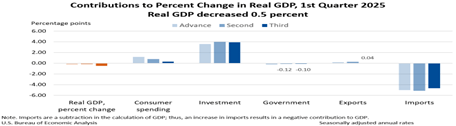
“Real gross domestic product (GDP) decreased at an annual rate of -0.3 percent in the first quarter of 2025 (January, February, and March), according to the advance estimate released by the U.S. Bureau of Economic Analysis. In the fourth quarter of 2024, real GDP increased 2.4 percent.”

BEA.gov

It’s President Trump’s economy now after the first 100 days of his second term.

The U.S. economy contracted in the first quarter of 2025 for the first time in three years, reflecting a surge in imports ahead of President Donald Trump’s tariffs and a slowdown in consumer spending.

The BEA graph of economic growth from Q4 2023 tells us all we need to know to compare President Biden’s economic record and Trump’s misrepresentations and lies of his economic record as president. Biden had an average growth rate of +3.2 percent over his term vs. Trump’s -0.3 percent contraction in the first quarter 2025. And it can’t get much better, because worldwide tariff wars take a long time to settle.

Is this what Americans wanted in re-electing Donald Trump, who has proven once again after failed casinos, Trump University, and countless lawsuits, he has never been a successful businessman?

The real question is how could so many Americans been fooled into thinking Trump knew what he was doing?

Some supporters believed that because economic growth was positive in Trump’s first term he could repeat his performance. But in fact, it followed President Obama’s eight years of investments that boosted the recovery from the 2008 Great Recession, the worst recession since the Great Depression.

How could it have been different, since Trump based his whole economic policy on his most blatant lie, that tariffs were not a tax on imports that would be paid by American importers and consumers, hence were not inflationary when he promised to bring down the price of groceries on ‘Day 1’.

Americans can now look behind Trump’s curtain of lies with the first actual reading on Trump’s economic record. Joe Biden’s economy was one of the strongest since World War Two, aided by the passing of bipartisan legislation that renewed our infrastructure, mitigated climate change and strengthened our social safety net, legislation that was equivalent to Roosevelt’s New Deal.

We can also see clearly that Elon Musk’s DOGE is attempting to tear all of this down by illegally firing the government employees and cutting the funds that congress appropriated to implement Biden’s New, New Deal

The American public can also see Republicans’ real goal in the current budget negotiations—continuing to grow the wealth of its Oligarchs by cutting taxes, while taking away the services that benefit all Americans.

Economic growth will continue to shrink, in other words. The ADP National Employment Report of private job creation just out for April shrank to 62,000 from 147,000 jobs in March, presaging what will happen with the upcoming official U.S. unemployment report for April.

Consumers have also pulled back their spending, a sure indicator of a possible recession. And the Conference Board just reported another record drop in consumer confidence.

“Consumer confidence declined for a fifth consecutive month in April, falling to levels not seen since the onset of the COVID pandemic,” said Stephanie Guichard, Senior Economist, Global Indicators at The Conference Board. “The decline was largely driven by consumers’ expectations. The three expectation components—business conditions, employment prospects, and future income—all deteriorated sharply, reflecting pervasive pessimism about the future.”

We must now face the fact that President Trump has already damaged the most powerful economy and country in the world with his lies and incompetence.

What’s next? He answered in an interview with The Atlantic,“The first time, I had two things to do — run the country and survive; I had all these crooked guys,” Trump said. “And the second time, I run the country and the world.”

Really? The American public is already answering President Reagan’s famous dictum, “Are you better off today than you were four years ago.” with a resounding NO!

Harlan Green © 2025

Follow Harlan Green on Twitter: https://twitter.com/HarlanGreen

Posted in Consumers, COVID-19, Economy, Politics, Weekly Financial News | Tagged , , , , , , , , , , | Leave a comment

A Place of Tolerance and Understanding

Answering Kennedy’s Call

“I believe our political divide can be repaired. But our leaders must act with moral clarity and take their cues from the good people of this nation, who in times of tragedy always seem to find our better angels.” Pennsylvania Governor Josh Shapiro

Pennsylvania Governor Shapiro wrote the above appeal just days after an arsonist invaded and attempted to burn down the Governor’s residence. Governor Shapiro attributed the attack to “the political division and violence in America today.”

He also gave thanks for the good people, whose “…prayers, blessings and messages of support we’ve received have lifted us up and shown us the way forward in the wake of a traumatic event.”

How do we find the “better angels” of our nature; was there a time when Americans were less partisan, more united in purpose?

There are many explanations and explainers of the political divide that led to red states vs. blue states and Donald Trump’s re-election. A major economic reason was the migration of many manufacturing jobs overseas, and politics shifting to the right after the stagflation of the 1970s while Fed Chair Paul Volcker’s Federal Reserve raised the Fed Funds rate to 20 percent, causing several recessions .

The loss of manufacturing jobs resulted in a very angry rust-belt populace and a huge surge in drug use and suicides among white males living there that was first documented in the best-selling Deaths of Despair and the Future of Capitalism by Nobel Laureate Angus Deaton and his wife, Ann Case.

The result is the share of Americans still living middle class lives in 2023 has shrunk to 51 percent from 61 percent in 1971 due to the loss of those jobs as well as Republican legislatures and the Supreme Court limiting labor unions’ collective bargaining power to replace them.

PEW

The loss of jobs led to the current economic divide, GW Bush’s war on drugs and the highest incarceration rate in the world. The hollowed out American middle class became a predominantly consumer society living on cheaper imports mostly employed in lower paying service sector jobs, whether as professionals in high tech or recreation and leisure activities.

Best-selling author Robert Putnam in Bowling Alone: The Collapse and Revival of American Community attributed the growing political divide to the consequent breakup of communities as they moved away from their birthplace or original communities in search of better jobs.

Whereas our neighbor Canada with a similar population mix had greater income equality by maintaining a predominately middle-class society, in part because it had strong labor unions. A 2023 Pollara survey of 3,000 Canadians 18 and older found that a much larger 78 per cent of Canadians consider themselves middle class, including 39 per cent of those earning less than $20,000, and 92 per cent of those earning more than $150,000.

Australia with a similar population mix is also considered a much more egalitarian society. Approximately 56 percent of the population self-identify as middle class, while 43 percent identify as working class and 1.4 percent as upper class. Other surveys suggest that around 58 percent of the population is in the middle-income class. The HILDA survey indicates that a significant portion, roughly 80 percent, of Australians are classified as middle class based on one measure.

Just the fact that most of their inhabitants considered themselves in the middle-class contributed to their sense of wellbeing.

We can also begin to restore our sense of wellbeing by growing our middle class once again with a simple but profound change—heeding Governor Shapiro’s appeal to find political leaders who will work to raise the national minimum wage above $7.25 per hour that was last raised in 2009.

Many of the poorest red states in the south and Midwest rust belt don’t even have a minimum wage, so they must adhere to our national minimum wage. Yet we know blue states such as California and New York have raised their minimum wage above $15 per hour, attracting a more creative and productive work force.

Working towards greater income equality that other developed countries have maintained with a strong middle class would help to bring Americans together again.

“William Penn founded our commonwealth as a place where all would be welcome — a place of tolerance and understanding where people of different faiths could live together in peace,” said Shapiro.

Where better to find such a leader who will take his cues from the good people and listen to our better angels than the Governor of Pennsylvania, in the state that was the original home of the Declaration of Independence and U.S. Constitution.

Harlan Green © 2025

Follow Harlan Green on Twitter: https://twitter.com/HarlanGreen

Posted in Consumers, COVID-19, Economy, Politics, Weekly Financial News | Tagged , , , , , , , , | 1 Comment

Trump’s 2.0 100 Days

Popular Economics Weekly

With President Donald Trump’s second term approaching its 100-day mark, 40% of Americans approve of how he’s handling the job – a decline of 7 percentage points from February,” PEW Research.

PEW

The big mystery is why Donald Trump is repeating the same mistakes he made in his first 100 days in office—chaotic tariff wars, illegal downsizing of congress-mandated agencies, threats of cuts to social security, Medicare and Medicaid services— that have hurt his ratings, as happened in Trump 1.0.

The answer is the continued support of his base; MAGA Republicans vs. that of all Americans, says PEW Research.

Seven-in-ten or more Republicans and Republican-leaning independents approve of:

  • · Trump’s job performance (75%)
  • · The administration’s cuts to government (78%)
  • · Increased tariffs (70%)
  • · Ending diversity, equity and inclusion (DEI) policies in the federal government (78%)

Among Trump’s predecessors dating back to Ronald Reagan, the only other leader who did not enjoy majority approval at his 100-day mark was Bill Clinton (49% approval in April 1993), according to PEW.

Why? For starters, Trump’s supporters seem to believe that executive orders can replace laws and tariff negotiations, though such tactics don’t work well in a democracy based on laws enforced by an independent judiciary.

Whose tariff policies that are based on mostly false premises has Trump followed —e.g., calculating trade imbalances solely on goods but not service sector trades? Some blame Peter Navarro, his chief tariff advisor, while Trump has admired President William Mckinley’s use of tariffs in 1890 that enriched Robber Barons in the first Gilded Age.

But Hitler also raised import tariffs in the 1930s to shield and build Germany’s domestic manufacturing base that fueled his war machine, all in the quest for more ‘Lebensraum.’ Trump scares me when he maintains his lie that tariffs don’t cause inflation, while he talks about creating more Lebensraum by wanting to acquire Greenland, the Panama Canal, and even Canada.

There is a darker vein as well, the racial purity efforts (e.g., white supremacy) that was a mainstay of Hitler’s Nazi Party that is reflected in Trump’s attempts to purge all mention of DEI programs in both government and private (e.g., educational) institutions.

I like a Fortune Magazine report from 2017 on candidate Trump’s past negotiating tactics: “The legal actions provide clues to the leadership style the billionaire businessman would bring to bear as commander in chief. He sometimes responds to even small disputes with overwhelming legal force. He doesn’t hesitate to deploy his wealth and legal firepower against adversaries with limited resources, such as homeowners. He sometimes refuses to pay real estate brokers, lawyers and other vendors.”

Trump’s attempts to act like a strong man aren’t panning out, in other words, mainly because autocratic regimes are antithetical to strong economies, which require a citizenry that has the freedom to innovate. It’s the same reason Americans don’t like Putin, China’s Xi, or dictators in general.

Polls show there are still Americans that would rather have an autocrat such as Trump to make decisions for them. But the price they pay is living in mostly Republican-controlled red states where living standards are much lower.

It’s a lesson Americans have had to learn more than once—that knowing truth from fiction, making one’s own decisions rather than following opinions of the herd, or cult figures, is the world most Americans prefer to live and prosper in.

Harlan Green © 2025

Follow Harlan Green on Twitter: https://twitter.com/HarlanGreen
Posted in Consumers, COVID-19, Economy, Macro Economics, Politics, Weekly Financial News | Tagged , , , , , , , , , , | Leave a comment

Immigrants the Lifeblood of U.S. Economy

The Mortgage Corner

“For most of the past half-century, adults in the U.S. Baby Boom generation – those born after World War II and before 1965 – have been the main driver of the nation’s expanding workforce. But as this large generation heads into retirement, the increase in the potential labor force will slow markedly, and immigrants will play the primary role in the future growth of the working-age population (though they will remain a minority of it).” PEW RESEARCH

PEW

I wrote in 2017 during Donald Trump’s first term as president that the stakes are enormous if Republicans succeed in removing most of the estimated 11 million undocumented worker (only half of which are from Mexico and the Latin countries), and cut legal immigration in half, as they have promised to do, economic growth will plummet, since it is mainly based on growth of the working age population, as well as labor productivity, which has also fallen since 2000.

America has always had a labor shortage. It’s the reason we have needed immigrants and led in technology to keep our production levels high. And as the 2017 PEW study above highlights, immigrants have been at the core of our national workforce.

This is while the Trump administration continues to trip over itself in every economic sector, repeating the same mistakes it made during Trump’s first term. This is not only with its tariff policy—negotiating with China to lower their tariffs, though China says they are not currently in talks—but is especially true with its immigration policy that is designed to please its MAGA base.

It’s pleasing no one else. Former Labor Secretary Robert Reich reports on Substack that one American was detained by ICE in Arizona for 10 days until his relatives produced papers proving his citizenship, because ICE didn’t believe he was American. Meanwhile, ICE handcuffed and deported a group of German teenagers vacationing in Hawaii because they turned up without a hotel pre-booked, which ICE found “suspicious.”

The number of adults in the prime working ages of 25 to 64 – 173.2 million in 2015 – will rise to 183.2 million in 2035, according to Pew Research Center projections. That total growth of 10 million over two decades will be lower than the total in any single decade since the Baby Boomers began pouring into the workforce in the 1960s. The growth rate of working-age adults will also be markedly reduced, says the study.

The Biden administration’s record growth was based in large part because of the immigration surge that Trump is attempting to reverse, that Trump characterized as criminals to stir up his MAGA base. There was no crime wave; records show immigrants commit fewer crimes than American citizens.

So Trump is creating a worker shortage when he wants to bring back manufacturing. Who will replace the immigrants? We need to develop more labor-saving technologies, which means developing better computer chips that Biden has is already funding with Research and Development grants and the CHIPs Act, but will take time to develop.

Trump has no plan of his own, other than slash the government programs that would create newer technologies, nor is anything being done at the congressional level, except pushing for more tax cuts. This was his only accomplishment during the first Trump administration.

It’s a sad day when Trump, Republicans and his MAGA supporters see immigrants as threats when they are the only readily available resource that will grow our economy.

Harlan Green © 2025

Follow Harlan Green on Twitter: https://twitter.com/HarlanGreen

Posted in Consumers, COVID-19, Economy, Politics, Weekly Financial News | Tagged , , , , , , , , | Leave a comment