
What Happened to Animal Spirits?

Financial FAQs

“We’re seeing a strong divergence between animal spirits of the stock market and what we’re actually seeing unfold from businesses and business leaders,” a White House official told reporters Monday, CNBC reported, adding, “The latter is obviously more meaningful than the former on what’s in store for the economy in the medium to long term.”

FREDconsumersentiment

The White House is now admitting that the rise in “animal spirits” over Trump’s reelection had waned and business leaders were now guiding the financial markets lower “in the medium to long term” because of Trump’s on again, off again tariff announcements. They are saying in effect that the Republican campaign promises of lower taxes and fewer regulations won’t matter.

Such market enthusiasm couldn’t last when it became obvious that Trump’s contradictory messaging and his lack of knowledge about foreign trade could lead to tariff wars, which in the words of a growing number of business leaders, showed “he does’t know what he is doing”.

Consumers are beginning to catch on as well, which is resulting in the decline of their own “animal spirits”. The above chart of declining consumer confidence as measured by the University of Michigan last peaked in January 2024 with Donald Trump’s re-election, when consumers believed in Trump’s promises to bring down inflation on “Day 1” of his second term.

But that hasn’t yet happened, and consumers are not happy about it. In the words of the U. of Michigan’s survey director Joanne Hsu:

“Consumer sentiment fell for the second straight month, dropping about 5% to reach its lowest reading since July 2024. This decrease was pervasive, with Republicans, Independents, and Democrats all posting sentiment declines from January, along with consumers across age and wealth groups.”

The term, “Animal Spirits”, was first coined during the Great Depression to explain why consumer behaved the way they did. Roosevelt’s New Deal that gave workers more benefits, such as the 8-hour work day, workers compensation, and social security, was created to boost their animal spirits and led to the recovery from the Great Depression.

Nobel Laureates George Akerlof and Robert Shiller even wrote a book about it that was entitled, Animal Spirits; How Human Psychology Drives the Economy and Why It Matters for Global Capitalism.

It was an important book because it refuted the long-held theory that so-called free market, or Laissez Faire, economic theories created more growth with less regulations.

But Republicans’ touting of the benefits of free markets and less regulations was a giant lie that led to President Reagan’s trickle-down economic theories, because with little or no oversight of their trades, the wealthiest always prospered the most because they had the time and money to research the markets.

Therefore conservatives that favored less regulation had to create a myth that some of that wealth was bound to “trickle down” to Main Street and benefit ordinary wage-earners to placate voters.

Professors Akerlof and Shiller showed it was a lie. Most consumers in fact do not have the resources or knowledge to adequately research what they buy or invest in. They discovered in their research that most consumers act on hearsay, or word of mouth, in making purchase decisions, including when to buy real estate.

And because consumers didn’t or wouldn’t do the necessary historical research in early 2000 when buying homes, but believed that housing prices could never decline, they pushed up housing prices so much that builders built too many homes, which was a major reason for the busted housing bubble and resultant Great Recession.

History has shown that the tax cuts and market regulations the Trump campaign promised will make the wealthy even wealthier, and 80 percent of Americans that are wage earners, less wealthy.

It’s the real reason Trump has unleashed “Chainsaw Musk”—to terrorize federal workers into quitting their jobs and destroy as much as possible of Roosevelt’s New Deal, as well as the laws and regulations that have benefited most Americans since then.

Harlan Green © 2025

Follow Harlan Green on Twitter: https://twitter.com/HarlanGreen
Posted in Consumers, COVID-19, Economy, Politics, Weekly Financial News | Tagged , , , , , , , , , , | Leave a comment

What Happens Next?

Financial FAQs

In an interview with Fox News on Sunday, Trump refused to rule out a recession for the U.S. this year, implying his tariff strategy and attempts to cut government spending were part of a necessary transition that in the short term could cause problems for the world’s biggest economy.” MarketWatch

AtlantaFedGDPNow

I find it laughable that President Trump is now saying the ‘R’ word on a Sunday talk show, when one of his most famous campaign promises was that “Starting on day one, we will end inflation and make America affordable again, to bring down the prices of all goods.”

So the question to ask is, what happens next when and if he succeeds in enacting his agenda? We should know by now it isn’t words but his administration’s actions that will determine (or hinder) how much the economy and prices will grow (or shrink) this year.

In fact, Trump has inherited a fully employed and still growing economy. Prices and inflation can’t come down in such a situation because there is more demand (i.e., money in circulation) than goods available. It’s good old Economics 101 that is taught in business classes.

But economists do agree on what would bring prices down, a recession. Many economists and pundits have been looking at the Atlanta Fed’s estimates of first quarter GDP growth, and been seeing the possibility of the ‘R’ word.

Why? It’s mainly because consumers have been spending less since the holidays, in part because they are losing confidence that they may even have a job, or the ability to change jobs in the future. Why wouldn’t they lose confidence when “chainsaw Musk” cuts federal jobs with abandon and the newly jobless federal workers start competing in the private sector?

That’s why first quarter growth estimates, such as the Atlanta Fed’s GDPNow estimate have fallen.

“The GDPNow model estimate for real GDP growth (seasonally adjusted annual rate) in the first quarter of 2025 is -2.4 percent on March 6, up from -2.8 percent on March 3,” is their latest

That’s also why the stubbornly high inflation and interest rates are making creation of a new fiscal budget so difficult. Republicans want the tax cuts they promised to spark more spending, which is inflationary, but need Democrats to agree. Yet Democrats don’t want the cuts to social security, Medicare, and Medicaid that Trump said would never happen, but must happen for any preservation of the tax cuts enacted during Trump’s first term.

Hence there will probably be a so-called continuing resolution to keep the existing budget until end of the fiscal year in September. This will avoid a possible government shutdown, but what then?

This week’s news will be mostly about inflation, since February’s Consumer Price Index and wholesale Producer Price Index will come out that may paint a clearer inflation picture, and whether the Fed might resume cutting interest rates.

And we need not only to be talking about the prospects for higher prices from tariffs, but also the trade disruptions that tariff wars cause, because President Trump will antagonize both friend and foe in his flailing (and counterproductive) attempts to decree rather than negotiate a new foreign trade policy.

There is something seductive to many voters about a new foreign trade policy that promises to bring more jobs home. But firstly, it’s more expensive to make things in the U.S., which is why we import more than we export. And with Trump making enemies of our friends and closest allies, they will be sure to reciprocate with higher tariffs.

Trump has to know that is no way to do business from his history of bankruptcies and lawsuits. He has always chosen confrontation over cooperation to get what he wants, and the financial markets as well as consumers will soon figure this out. The only question is when, and what happens next?

Harlan Green © 2025

Follow Harlan Green on Twitter: https://twitter.com/HarlanGreen
Posted in Consumers, COVID-19, Economy, Politics, Weekly Financial News | Tagged , , , , , , , | Leave a comment

Job Growth vs. Job Cuts

Popular Economics Weekly

Total nonfarm payroll employment rose by 151,000 in February, and the unemployment rate changed little at 4.1 percent, the U.S. Bureau of Labor Statistics reported today. Employment trended up in health care, financial activities, transportation and warehousing, and social assistance. Federal government employment declined.” BLS

FREDpayrolls

The February payroll numbers were somehow comforting because of the looming ‘R’ (recession) fears. There was not the sudden halt in hiring that many economists feared because of Trump’s on and off tariff announcements and ‘chainsaw Musk’s” indiscriminate (and mostly illegal) firings of government workers.

Fewer new jobs have been added to payrolls even before Musk’s machinations, as can be seen from the decline in FRED’s payroll formation graph through February before his firings took effect. It’s partly because companies don’t know what to expect. But I will make a prediction that things won’t get better unless Republicans better understand the budget making process.

We know this because the five recessions and record budget deficits since 1980 have all occurred during Republican administrations. That is why most of the Republican-controlled red states are the poorest states, many with no minimum wage of their own.

And there are also real signs that consumers that make up 60 percent of economic growth have exhausted their savings and become more pessimistic.

The real tragedy is that Republicans don’t have to act so callously. The Trump/Musk induced chaos is intentional, since they aren’t bothering to negotiate with anyone—such as congress that created most of the agencies being affected, the employee unions, or even checking with the courts beforehand to see if it is legal.

The Clinton administration did it the right way by negotiating with the parties affected and stringing out the job cuts over years, as I’ve said before, thereby handing off four years of budget surpluses to GW Bush, who promptly wasted them with unpaid tax cuts and the wars on terror.

We also know that Americans have been very lucky with the unemployment rate at or below 4 percent for more than two years. What is confusing consumers and small businesses in particular is why Trump and Musk are so acting so unnecessarily unpredictable with the growing public blowback, confusing everyone as to their motives.

One clue is that both Trump and Musk are autocrats who don’t like to consult with anyone but themselves, hence the yes-men and women they surround themselves with.

But why do Republicans follow so docilely when Musk is cutting spending or eliminating programs in their districts and states? Part of it is an almost complete ignorance of economic principles. For instance, tax cuts only boost the wealthiest incomes if they aren’t paid for—or paid by cutting the social safety net of Medicare and Medicaid that service the poorest.

The unemployment rate crept up to 4.1% in February from 4.0% in the prior month, largely because some 588,000 fewer people said they were employed in February, the U.S. Bureau of Labor Statistics said. That’s the biggest one-month decline in 14 months, per MarketWatch’s Jeffry Bartash.

We are nearing the end of this post-pandemic business cycle as well. Morningstar, the rating agency, attributed the hiring slowdown to lower economic growth in general.

At the industry level, the slowdown in hiring in the past three months has been driven by government (payrolls slowing from 3.4% to 1.6% growth) as well as construction and real estate (payrolls slowing from 3.5% to 1.4%).”

We are now in fact seeing a drop in job formation that is sure to continue—January added just 146,000 jobs, and there is a federal government hiring freeze that will affect state hiring as well.

It’s also not surprising that construction job growth is slowing, as high interest rates are causing a renewed slowdown in housing and as well as nonresidential construction, which shows up in the GDP.

Interest rates are falling again with the growing signs of economic weakness, such as the big drop in first quarter 2025 growth expectations—now down to -2.8 percent, when earlier estimates were as high as + 4 percent GDP growth in Q1.

What’s more, data released Wednesday from the Mortgage Bankers Association showed that mortgage rates hit their lowest levels since early December 2024 when the FHA rate dipped to 6.42%, which in turn led to a 20.4% increase in mortgage applications.

Lower interest rates are really the only event that would continue economic growth this year, and encourage more Federal Reserve rate cutting, but only if Trump’s tariffs don’t give a big bump to import prices and inflation.

Fed Chair Powell wouldn’t hint at the Fed’s future actions in a speech for the U.S. Monetary Policy Forum. “The White House is in the process of implementing significant policy changes in four distinct areas; trade, immigrations, fiscal policy, and regulations…It is the net effect of these policy changes that will matter for the economy and for the path of monetary policy.”

However, the Trump administration is showing woeful ignorance in the four areas Powell spoke about, as well not knowing how to balance or pay down the federal budget.

So, it looks like we could probably muddle through the next four years, as we did during President Trump’s first term; without a discernable economic plan other than more tax cuts. And, whether Musk’s chain saw doesn’t wreak too much havoc on the government bureaucracy that makes everything work.

Harlan Green © 2025

Follow Harlan Green on Twitter: https://twitter.com/HarlanGreen

Posted in Consumers, COVID-19, Economy, Politics, Weekly Financial News | Tagged , , , , , , , , , | Leave a comment

What Happened to the Budget?

Popular Economics Weekly

The House Republican budget passed today calls for massive cuts in health coverage, food assistance, and help paying for college, among some other areas, to pay for huge tax giveaways for wealthy households and businesses.” CBPP.org

CBPP.org

President Trump had to know that devoting a large part of his State of the Union speech insulting Democrats would make it much more difficult to forge a budget for the fiscal year that ends September 30, when they will need Democrats’ support because of their thin majorities.

It will make it all but impossible to ratify an annual budget that significantly reduces the budget deficit. It’s not a great way to negotiate, in other words, unless Republicans don’t believe they need Democrats to fund their tax cuts.

House Republicans have passed a purely Republican budget resolution that relies on massive cuts to federal programs that the Center For Budget and Policy Priorities (CBPP), a nonpartisan research and policy organization, recently analyzed.

“The House budget would require the Energy and Commerce Committee to cut at least $880 billion; the Agriculture Committee to cut at least $230 billion; the Education and Workforce Committee to cut at least $330 billion; and other committees to also cut programs to reach a cumulative target of at least $1.5 trillion in cuts through 2034. The magnitude of these reductions would force congressional committees to make enormous cuts in Medicaid, SNAP, student loan assistance and other vital sources of support when they develop the “reconciliation” spending and tax bill that follows the budget resolution.” CBPP

Yet Republicans must compromise with Democrats to pass the annual budget that keeps the federal government open for business because of their paper-thin majorities in both the House and Senate, as I said. And the Democrats’ cooperation will require that some of their own budget priorities be included.

Trump must know by insulting Democrats he won’t get much of what he wants. He must believe there is a better way to narrow the budget deficit. Of course, he and Elon Musk have said so out loud—find some $2 billion in savings in the current budget that totals more than $4.2 trillion at last count.

Instead, Trump/Musk are firing federal employees and closing whole agencies with abandon to make their case that it will eliminate enough fraud and waste to bring down the deficit to justify their tax cuts. But it can’t happen without cuts to the sacred third rails as well—social security, Medicare and Medicaid.

But they will be slowed down in their haste to downsize government because most of the DOGE work to date seems to be illegal, according to the many lawsuits that have been filed to stop the DOGE efficiency drive.

It will end up being a failed “Shock and Awe” campaign, according to Thomas Friedman, since their real intent is to cut government “down to the size where one could drag it into the bathroom and drown it in the bathtub,” to quote Grover Norquist, a Republican  strategist.

AtlantaFed

And we might already be seeing evidence of the damage; such as predictions of negative first quarter economic growth for the first time since the COVID-19 pandemic. The Atlanta Fed’s GDPNow model of real GDP growth (seasonally adjusted annual rate) in the first quarter of 2025 is -2.4 percent on March 6, up from -2.8 percent on March 3.

Tariff fears are part of the problem, as importers are ordering as much as possible before tariffs kick in that will raise prices, and subtracts from GDP growth. But consumer spending in the new year that powers 60 percent of economic growth has declined because of consumers’ exhausted savings.

Consumer spending could shrink even further as the federal job firings and layoffs accelerate. MarketWatch reports some 172,017 job cuts were unveiled in February by U.S.-based employers, according to the monthly report by the outplacement firm Challenger Gray & Christmas. That’s the highest total since July 2020.

“It was chiefly because of a large reduction in government employees from actions by Elon Musk and his so-called Department of Government Efficiency, or ”DOGE,” purportedly to reduce bureaucracy,” said MarketWatch’s Jeffry Bartash.

Challenger put the federal job cuts at 62,242 last month, up from just 151 in January and February combined in 2024. Historically, very few federal employees lose their jobs annually. Retail and tech companies also announced sizable layoffs in February.

Economist Claudia Sahm said in a CNBC interview that such a massive number of workers losing their jobs at once has never happened before and will be flooding the job market.

I can’t imagine what such a large loss of jobs will do to our economy this year, even though federal jobs are a small part of the US workforce.

Harlan Green © 2025

Follow Harlan Green on Twitter: https://twitter.com/HarlanGreen
Posted in Consumers, COVID-19, Economy, Politics, Weekly Financial News | Tagged , , , , | Leave a comment

What Is Burning?

Answering Kennedy’s Call

“Yet another tragic story of people being trapped inside a burning Tesla, this time in Toronto. Four dead; one rescued when a bystander smashed a window. Phil Koopman, cited by Paul Krugman in Substack

Carscoops.com

Paul Krugman in a recent Substack column made a horrific analogy with the damage that Trump/Musk is doing to the American economy that I agree with.

Trump/Musk are blindly rushing ahead with Musk’s so-called DOGE efficiency drive and Trump’s tariff wars raising the risks of a downturn to our economy, when there are much better ways to accomplish their stated goals of decreasing the budget deficit and national debt.

Such haste is causing irreparable damage to lives and livelihoods; just as Musk’s failure to correct Tesla’s design flaws have killed people. There are better ways, and maybe the SCOTUS 5-4 ruling that the Trump administration can’t withhold $2 billion in USAID funds owed to its contractors will cause him to slow down enough to prevent a very large economic conflagration, such as stagflation,that happened in the 1970s, or even a recession.

There is a lesson to be learned. Tesla’s sometimes fatal design flaws seem to happen because of his lack of attention to details in his single-minded drive to invent new and better technologies. At least half of the automated-driver deaths (46 cars without a driver at last count) are Tesla’s, and now there is news that a defect in its electric door opening mechanism won’t unlock the door in the event of a power failure, as ahappened in some of Tesla’s car fires.

“This has been going on for years,” said Koopman. “At least some of the victims were definitely alive and trying to escape a burning Tesla when door lock power was lost. Some escaped. Some did not. Below is a writeup I posted on a blog in 2022. Nothing has really changed. The Tesla door release situation is a fatality-via-burning-alive waiting to happen. As it has multiple times at this point.”

And why is Trump rushing to start a trade war with our closest allies in the name of national security? He is promoting a blatant lie, that our closest neighbors pose a national security threat. Yet Mexico and Canada as border neighbors are in the best position to protect Americans, hence pose the least danger to our national security. But this is if we would pass an immigration bill, such as the bipartisan border bill Biden negotiated that Trump nixed because it would make Democrats look better.

Instead, we are now making an enemy of those nations that are in a position of protecting our borders.

What has become clear is Trump/Musk are good at wrecking everyone else’s economies but their own; at a time when more government oversight is needed because of the greater frequency of natural disasters (NOAA, US Geological Survey), increasing cyber-attacks, new and deadly (African) viruses, bird flu, on top of a potential measles epidemic in Texas.

And, even more sadly, there are signs that Trump will want to make some of Biden’s new, New Deal legislation his own, by canceling contracts and reopening them under his own administration, just as Musk is doing with the FAA.

Musk as already starting to replace Verizon’s contract to upgrade and modernize the FAA’s telecommunication networks ‘that oversee 29 million square miles of US airspace and ensure the orderly and safe movement of 45,000 flights daily’ with his own Starlink Satellite network.

They are selling more snake oil, instead of working with congress on a bipartisan agreement. Trump is rushing to downsize government and instigate tariff wars because he wants Americans to believe there is danger from all sides that only he can prevent, before something horrendous happens and we discover we might need our allies.

It doesn’t have to be this way, but if Trump won’t change his ways, there will be larger fires that will be much more difficult to put out.

Harlan Green © 2025

Follow Harlan Green on Twitter: https://twitter.com/HarlanGreen
Posted in Consumers, COVID-19, Economy, Politics, Weekly Financial News | Tagged , , , , , , , , , , , , , | Leave a comment

Why Weaken U.S. Economy?

Answering Kennedy’s Call

“On February 28, the same day that President Donald Trump and Vice President J.D. Vance took the side of Russian president Vladimir Putin against Ukraine president Volodymyr Zelensky in the Oval Office, Martin Matishak of The Record, a cybersecurity news publication, broke the story that Defense Secretary Pete Hegseth has ordered U.S. Cyber Command to stop all planning against Russia, including offensive digital actions.”@heathercoxrichardson, Historian, Letters from An American

Reuters

What became clear in last week’s disastrous Oval Office meet with Vladimir Zelenskyy, and Trump’s abrupt switch to Putin’s side of the peace negotiations, is that Trump and Putin are engaging in a very consequential protection racket that could bring down the U.S. economy as well.

They have come to rely on each other to stay in power. Russia’s huge cyber-attack machine helped Trump eke out his two election victories, and Putin wants Trump to hand him Ukraine to justify to the Russian people their horrific losses, and his hold on power.

Outrageous as that may seem, there is no other explanation for Trump’s actions in weakening the major federal agencies that protect our national security and growing isolation from our econmic alliances, and persisting in a tariff war that is alienating our closest allies.

Trump has jumped into their extortion racket with both feet. It’s a quid pro quo between two thugs, as happens between mafia bosses. Trump can hand Ukraine to Putin by withdrawing America’s support, and Putin will continue his unrelenting attacks on our national security infrastructure, weakening U.S. power and influence.

We can now see how they are doing it. Musk’s DOGE cuts are gutting the watchdogs that would uncover their protection racket, whether it’s by downsizing the FBI, CIA, NEC, CISA and other watchdogs (e.g., illegally firing 11 agency Inspector Generals), or reorganizing agencies in such a way that they function much more poorly.

The CISA, Cybersecurity & Infrastructure Security Agency, is especially important for our national defense. Former FBI Director Christopher Hays warned in pre-election congressional testimony to be especially concerned with the penetration of our cyber networks.

Wray noted that hostile nation-states, such as China, Russia, Iran, and the Democratic People’s Republic of Korea, are increasingly using “cyber operations” to meet their strategic goals and undermine the United States. These adversaries are “growing stealthier,” he said, and are always devising fresh methods to make their cyber operations more far-reaching and impactful.

“We’re seeing hostile nation states become more aggressive in their efforts to steal our secrets and our innovation, target our critical infrastructure, export their aggression to our shores and front and center is China,” Wray said at last year’s Boston Cyber Security Conference.

And why would Trump and his loyal followers want to take away our protections from such attacks? The answer is even more frightening. So that we align our priorities with Putin’s Russia, of all countries.

Professor Richardson reports, “Shortly after the election, a newspaper reporter asked Nikolai Patrushev, who is close to Putin, if Trump’s election would mean “positive changes from Russia’s point of view.” Patrushev answered: “To achieve success in the elections, Donald Trump relied on certain forces to which he has corresponding obligations. And as a responsible person, he will be obliged to fulfill them.”

It’s becoming obvious that President Trump wants the USA to be run under the same one-man rules as Putin’s Russia, where the only laws are Putin’s laws, enforced by terror. He can murder his dissenters, whereas Trump will attempt to silence his opposition by weakening our election laws as well.

Professor Richardson reported that “On February 20, Steven Lee Myers, Julian E. Barnes, and Sheera Frenkel of the New York Times reported that the Trump administration is firing or reassigning officials at the FBI and CISA who had worked on protecting elections. That includes those trying to stop foreign propaganda and disinformation and those combating cyberattacks and attempts to disrupt voting systems.’

In fact, Putin may not need to hack Democratic Party emails, as he did in past elections. Musk’s DOGE hackers can do it for him in the upcoming 2026 midterm elections as they continue to penetrate the federal government’s closely guarded personnel networks.

We could see a WikiLeaks scandal all over again, if state elections officials aren’t careful. Trump/Musk have already attempted to remove Ellen Weintraub, the Democrat head of the Federal Election Commission that rules on election finance laws, without nominating a successor who must be confirmed by the Senate before she can step down.

But there is an even more immediate worry, the direction of our economy. Trump’s announcements of tariffs on Mexico, Canada, and Mexico caused the DOW to drop 800 points once again, and their immediate retaliation. He is also threatening the EU. It is an almost kneejerk reaction as happened one week ago. Markets don’t like tariffs levied with no other reason than to collect import taxes to fill the gaping hole of our budget deficit and ballooning national debt.

Reuters just reported that a private survey showed American factory activity last month edged closer to stagnation—slowing growth combined with higher inflation—as new orders and employment contracted. A gauge of prices paid for materials jumped to the highest since June 2022. So how should investors react to all this smoke on the horizon?

It looks like Trump wants to ally with a country and economy that is one-ninth the size of the European Union when economic growth is more dependent on allies we can trust than ever before.

Harlan Green © 2025

Follow Harlan Green on Twitter: https://twitter.com/HarlanGreen

Posted in Consumers, COVID-19, Economy, Politics, Weekly Financial News | Tagged , , , , , , , , , , , , | Leave a comment

Economic Growth Slowing…Because?

Popular Economics Weekly

“The U.S. government is currently under the control of a deeply ignorant, vengeful megalomaniac with zero impulse control. And it’s not just Elon Musk: Trump shares the same characteristics.” Nobel Laureate Paul Krugman

AtlantaFed

“The GDPNow model estimate for real GDP growth (seasonally adjusted annual rate) in the first quarter of 2025 is -1.5 percent on February 28, down from +2.3 percent on February 19.” Atlanta Federal Reserve 

Watch out below, as economic growth looks to contract (-1.5 percent) in the first quarter of 2025! Trump’s abrupt announcement of tariffs on Mexico, Canada, and China, as well as Elon Musk’s indiscriminate slashing of payrolls and elimination of whole government agencies created a shock to economic growth that we have not seen in a long time.

How do we know? For starters, Trump’s tariff announcement caused a sudden plunge in predictions by Fed officials and economists of first quarter 2025 economic growth. The Atlanta Fed’s GDPNow estimate (graph above) dropped almost 4 percentage points from earlier predictions in part because of Trump’s just announced tariffs; that is a record plunge, I might add. They will be levied on Mexico, Canada, and China, which will mean higher import prices ahead for consumers when Trump had promised to lower inflation from ‘Day 1’.

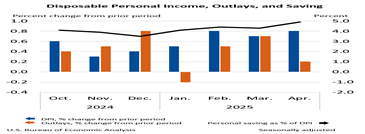
And the just released U.S. Personal Consumption Expenditure (PCE) read on inflation for January (see below graph) is another reason first quarter economic growth is worsening. Consumer spending declined for the first time in two years, and consumer expenditures make up the largest component of Gross Domestic Product growth.

BEA.gov

I said consumer spending should weaken after the holiday shopping splurge in an earlier report, Are Consumers In Danger?, and it’s happened. U.S. first-quarter consumer spending growth was just 1.6% annualized—the weakest since the second quarter of 2023. Much of the spending slowdown was due to the horrendous Los Angeles wildfires, unseasonably cold winter temperatures, and consumers having to replenish their depleted savings. The personal savings rate jumped from 3.8 percent to 4.6 percent (black line in above graph).

Some good may come out of the PCE report because its inflation index declined from 2.6 to 2.5 percent, which increases the likelihood that the Fed may cut interest rates further, especially if the labor market continues to soften.

Elon Musk’s mass layoffs and complete elimination of whole federal agencies without plan or regard for the consequences will have a disastrous effect on the job market as well.

Well-regarded Chief Economist Torsten Slok of Apollo Global Management estimates there could be 300,000 federal job cuts, but when private-sector contractors that work for them are included, a total of one million jobs could be at risk, in a Barron’s article by Randall Forsythe.

And this is just the beginning. The uncertainty and craziness of Trump and Musk’s actions are already showing up in the alarming drop in consumer confidence surveys as well.

There is a better way to trim government excesses. Even Musk has acknowledged that “What @DOGE is doing is similar to Clinton/Gore Dem policies of the 1990s.”

Not really. President Clinton’s “Reinventing Government” initiative headed by VP Gore was only initiated after an initial year of planning and cooperation with congress that resulted in four years of budget surpluses. 

This is a far different approach than Trump/Musk’s  blatantly illegal attempts to usurp the power of congress and the constitution, which can only lead to more court fights and budget deficits.

Harlan Green © 2025

Follow Harlan Green on Twitter: https://twitter.com/HarlanGreen
Posted in Consumers, COVID-19, Economy, Politics, Weekly Financial News | Tagged , , , , , , , , , , , , | Leave a comment

What Happened to the Minimum Wage?

Popular Economics Weekly

As of January 2025, Alabama, Louisiana, Mississippi, South Carolina, and Tennessee have not adopted a state minimum wage. This means that workers in these states earn the federal minimum wage of $7.25 per hour.

PBS.org

Currently, just 34 states, territories and districts have minimum wages above the federal minimum wage of $7.25 per hour, according to the National Association of State Legislatures.

“Five states have not adopted a state minimum wage: Alabama, Louisiana, Mississippi, South Carolina and Tennessee. Three states, Georgia, Oklahoma and Wyoming, have a minimum wage below $7.25 per hour. In all eight of these states, the federal minimum wage of $7.25 per hour generally applies.” NASL

How is that possible in today’s inflationary economy when the price of everything is too high? Republicans call it States Rights, the mantra that conservative Republicans use to justify the high poverty rate prevailing in these red states, which is the reason a Donald Trump could become the president.

The federal government is so evil (too many gays, immigrants, taxes), say the red staters, that they must oppose as many of its policies as possible (other than social security, Medicare and Medicaid, of course).

It’s also a total con that Republicans have succeeded in convincing the majority of their electorate in those states to listen to them rather than the blue states whose excess (higher) tax monies pay their benefits and help to balance the budgets of the red states.

Kentucky is a prime example, where prosperous blue states such as California and New York have large surplus taxes that flow to poor red states like Kentucky—more than $60 billion annually in their case for pensions and healthcare owed its citizens—to support its citizens and its own budget deficit (due to a low tax rate).

The above PBS map highlights where the poorest (gray colored) states are located, mainly the south and Midwest where right-to-work laws that obstruct union organizing still prevail. These are laws that say one can work for a company that has unionized its workers in these states, but the Supreme Court has ruled they don’t have to pay the union dues that support the benefits being unionized (higher wages and benefits, generally) such membership gives them.

It’s difficult to believe such ignorance still prevails with the modern mass media, but culture wars still exist in America with its many ethnic and racial divisions. Such a variety of immigrants has been the reason the United States of America has been the most prosperous country in the world, but also the most divided in these red states.

It’s the overweening bigotry, a relic of the civil war, that has kept red states poor; and a propaganda network of Fox News and conservative talk shows that has kept the likes of autocrats and dictators in power.

High inflation since COVID-19 is a good example of fear and paranoia topping common sense. Most people understand that inflation is caused by a shortage of things; in this case because of the COVID-19 pandemic that caused a brief recession and shut down the world economy.

But fear does funny things to people, and only such a well-oiled, conservative propaganda network could convince red staters that it was because Democrats had given them too much money to spend. Yet it is Biden’s New, New Deal legislation that is modernizing the American economy and keeping them at full employment!

But when has common sense prevailed in politics? We need to bring back the middle class that prevailed after World War Two, but was decimated by so many recessions since then, as politics gradually moved to the right and budget deficits grew.

Common sense could prevail if congress can avoid renewing Trump’s first term tax cut in the budget negotiations, which will increase the federal debt by another $4 trillion, while cutting Medicaid benefits in the red states that need them the most.

But since when has common sense prevailed?

Harlan Green © 2025

Follow Harlan Green on Twitter: https://twitter.com/HarlanGreen
Posted in Consumers, COVID-19, Economy, Politics, Weekly Financial News | Tagged , , , , , , , , , , , , | Leave a comment

Who Is Going to Mars?

Answering Kennedy’s Call

“There is nobody in this country who got rich on their own. Nobody. You built a factory out there – good for you. But I want to be clear. You moved your goods to market on roads the rest of us paid for. You hired workers the rest of us paid to educate. You were safe in your factory because of police forces and fire forces that the rest of us paid for. You didn’t have to worry that marauding bands would come and seize everything at your factory…

Now look. You built a factory and it turned into something terrific or a great idea – God bless! Keep a hunk of it. But part of the underlying social contract is you take a hunk of that and pay forward for the next kid who comes along.” Senator Elizabeth Warren

Blue Origins

Both Elon Musk and Jeff Bezos are in a race to land on the moon, and maybe beyond. Their enthusiasm is infectious, but also dangerous. It doesn’t prepare America for future generations. They are also propagating a giant lie that Oligarchs have used to hoard their wealth—that they are exceptionally beings who deserve special treatment (such as tax cuts paid with borrowed money).

It appears in Bezos stated rationale for taking the Washington Post’s editorial page to the right and not allowing opposing viewpoints.

“I am of America and for America, and proud to be so,” Mr. Bezos said. “Our country did not get here by being typical. And a big part of America’s success has been freedom in the economic realm and everywhere else. Freedom is ethical — it minimizes coercion — and practical; it drives creativity, invention and prosperity.”

The problem with conservatives’ ethos of personal freedom and free markets is that it doesn’t build forward or think of future generations. It doesn’t provide seed money for future growth as the Biden administration provided in its infrastructure, Inflation Reduction, and CHIPs Act bills that the Trump administration is trying to dismantle—further enlarging the budget deficit.

Musk’s and Republicans’ short-sightedness also applies to the dismantling of USAID. By working to improve the lives of the poorest in the world—mainly Africans today—it lifts up the ability of future generations to provide for themselves. It also prevents future worldwide pandemics, such as Bird Flu, and even the deadly Eboli-like virus now ravaging in war-torn Congo.

The result of Republicans’ belief in free markets has been five recessions since 1980 that were mainly caused by Republicans’ insistence of tax cuts without paying for them. It has led to record budget deficits and a record federal debt of $32 trillion.

The lie they continually foment, in other words, is based on pure greed. The future be damned, let’s go to the moon and beyond! Senator Elizabeth Warren, a former Harvard Law Professor, knows something about this. She has studied the poor, and written a book with her daughter on their dilemma, The Two-Income Trap: Why Middle-Class Parents Are (Still) Going Broke.

“In this exposé, says the Amazon summation, Elizabeth Warren and Amelia Warren Tyagi show that modern middle-class families are increasingly trapped by the grinding reality of flat wages and rising costs. Warren and Tyagi reveal how a ferocious bidding war for housing and education has silently engulfed America’s suburbs, driving up the cost of keeping families in the middle class, and placing unprecedented pressure on hard-working families.”

And just as big a lie is that creativity, invention, and prosperity isn’t already happening with the AI revolution that has fueled the Big Seven U.S. companies, such as Microsoft, Facebook, to new market highs.

But much of it is being fueled by the Biden administration’s New, New Deal that has already created tens of thousands of manufacturing jobs, and kept US fully employed.

The Donald Trump, Elon Musk and Jeff Bezos Oligarchs of the world are not particularly exceptional people, just greedier in wanting to add to their wealth by making ordinary Americans less healthy, wealthy, and safe.

If Musk and Bezos want to end up on Mars, they can use their own massive wealth, not ours!

Harlan Green © 2025

Follow Harlan Green on Twitter: https://twitter.com/HarlanGreen
Posted in Consumers, COVID-19, Economy, Politics, Weekly Financial News | Tagged , , , , , , , , , , , , , | Leave a comment

Are Consumers In Danger?–Part II

The Mortgage Corner

“In February, consumer confidence registered the largest monthly decline since August 2021, This is the third consecutive month on month decline, bringing the Index to the bottom of the range that has prevailed since 2022.” Stephanie Guichard, Conference Board Senior Economist

Conference Board

The last Mortgage Corner column asked what 2025 economic growth will depend on, and whether consumers will keep spending in the New Year. If they can’t continue their spending ways, growth will stall in this year. And as has been widely reported, the latest consumer confidence surveys show a weakening in their resolve.

It’s beginning to worry the financial markets and that affects our overall wealth and health, which is why I cover consumer spending.

The Conference Board’s consumer confidence survey caused some of the worry. Bloomberg News headlined that fact with the title, “Recession fear is back” recently:

“Perceptions of present and future financial situations worsened and the share of respondents expecting a recession in the next year rose to a nine-month high.

That pessimism has Americans cutting back their spending: According to a new study from Wells Fargo, more than half of consumers are delaying major life plans due to uncertainty over the economy and the consequences of Trump’s tariff threats. Of those, about a third said they were putting off buying a home while one in six have postponed education plans—and one in eight have pushed back retirement.” Jordan Parker Erb

Such fear was the reason the DOW fell almost 800 points last Friday, although the markets might have a very tentative recovery this week. But there’s another elephant in the room besides their declining confidence that is causing more worries—the ongoing budget debate.

Republicans want badly to extend Trump’s tax cuts from his first term, which could add another $4 trillion to the federal debt, per the latest estimates, which is threatening the U.S. Treasury’s bond rating and causing investors to become leery about investing in US Treasury securities. They will demand higher rates to compensate for the added risk.

There is also another elephant—inflation fears. No one can agree on where public expectations are. Republicans want to believe Trump can conquer inflation, as he promised, but Democrats don’t, to no one’s surprise. Inflation has been rising, which will keep interest rates higher than they should be at this time in the business cycle. It is in its late stage because of a weakening job market. Just 143,000 jobs were created in January, though the unemployment rate dropped to 4.0 percent from 4.1 percent.

The housing market is also a good indicator of future economic health, and it is mired in a mini-recession because 30-year fixed mortgage rates are still close to 7 percent (6.8% at present). Existing home sales are down to a 4.08 million annual rate. New-home sales are doing better because builders are offering to buy down their mortgage rates, although tend to be more expensive, hence shutting out most first-time homebuyers.

“Mortgage rates have refused to budge for several months despite multiple rounds of short-term interest rate cuts by the Federal Reserve,” said NAR Chief Economist Lawrence Yun. “When combined with elevated home prices, housing affordability remains a major challenge.”

Affordability in all things will remain the question this year for consumers, unless prices show some sign of easing, but that will depend on lower interest rates, which will depend on lower inflation.

Am I sounding too pessimistic? It’s because we don’t know what the Trump administration will do. Markets don’t like confusion or chaos, and it won’t help to reduce the budget deficit, or inflation.

Harlan Green © 2025

Follow Harlan Green on Twitter: https://twitter.com/HarlanGreen
Posted in Consumers, COVID-19, Economy, Housing, housing market, Politics, Weekly Financial News | Tagged , , , , , , | Leave a comment