December Unemployment Report Sets Record

Financial FAQs

Friday’s Labor Dept. nonfarm payrolls report has just set a record for annual job creation. The U.S. added 252,000 new jobs in December to extend the strongest streak of hiring since the mid-1990s, but wages fell and more people dropped out of the labor force to slightly tarnish an otherwise excellent employment report.

image

Graph: WSJ

The economy has added at least 200,000 jobs for 11 straight months, the longest streak in almost 20 years. In 2014, the U.S. created 2.95 million new jobs to mark the largest gain since a 3.18 million increase in 1999.

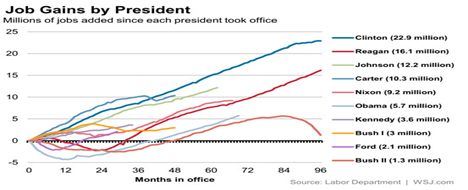
In December, President Obama noted that the economy had created 10.9 million jobs over the past 57 months. The number is now 11.2 million with December added in plus an additional 50,000 jobs added to the past 2 months. This streak of growth is improving the net job creation over which Mr. Obama has presided, which now puts him in fourth place among the last 10 presidents in terms of job creation.
image

Graph: WSJ

The economy has 6.1 million more jobs today than when Mr. Obama took office in January of 2009. That puts his total job creation ahead of presidents John Kennedy, Gerald Ford, and George H.W. Bush, who each served one term or less. It also puts him well ahead of President George W. Bush, whose final year in office also comprised the beginning to the longest and deepest recession since the Great Depression.

The nation’s unemployment rate also continued to tumble, falling to 5.6 percent from 5.8 percent and hitting the lowest level since June 2008, the Labor Department said Friday. The fall in the jobless rate stemmed partly from the increase in the number of people working, but more Americans also dropped out of the labor force. As a result, the percentage of working-age Americans 16 or older fell again to match a postrecession low of 62.7 percent — a level last seen in 1978.

That may be why wages aren’t rising above 2 percent annually, when 3 to 4 percent annual wage increases are the norm during economic recoveries. Wage gains have ranged from 1.7 percent to 2.1 percent since 2010, just two-third as fast as they normally grow. Economists predict a tightening labor market will spur higher wages but so far earnings haven’t budged much.

image

Graph: WSJ

And Chicago Fed President Charles Evans has speculated that the Fed won’t have to raise interest rates until 2016, if inflation doesn’t pick up to the 2 percent target of stated Fed policy.

Private payrolls increased 240,000 after rising 345,000 in November. Goods-producing jobs jumped in December, led by construction which advanced 67,000 in December after a 20,000 increase the month before. Manufacturing employment increased 17,000, following a jump of 29,000 in November. Mining rose 3,000 in December, following a 1,000 boost the prior month.

Private service-providing jobs gained 173,000 after a 294,000 jump in October. The latest increase was led by professional & business services. Government jobs increased 12,000 after rising 8,000 in November.

Harlan Green © 2014

Follow Harlan Green on Twitter: https://twitter.com/HarlanGreen
Posted in Economy, Keynesian economics, Macro Economics, Politics, Weekly Financial News | Tagged , , , , , , , , | Leave a comment

Good Pending Sales, Home Prices in 2015

The Mortgage Corner

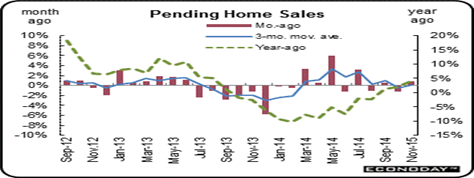
Pending home sales are rising again. Sales picked up steam in November, to 104.8 from a revised 104.0 in October for a better-than-expected gain of 0.8 percent. It is a sign, along with the Case-Shiller Home Price Index, that the housing market will pick up in 2015.

image

Graph: Econoday

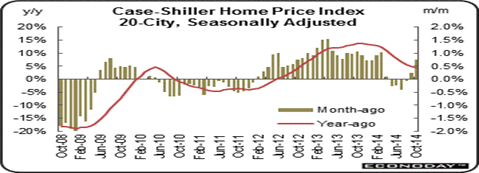
Pending sales had been declining since last September, and only began to rise again this January. But they are still below post-recession highs. Rising prices may be the culprit, as the Case-Shiller Home Price Index rose 13.5 percent in 2014, but has now settled back to moderate 4.5 percent annual increases in recent months.

“The consistent economic growth and steady hiring we’ve seen the second half of this year is giving buyers enough assurance to consider purchasing a home before year’s end,” said NAR chief economist Lawrence Yun. “With rents now rising at a seven-year high, historically low rates and moderating price growth are likely to entice more buyers to enter the market in upcoming months.”

image

Graph: Econoday

Where are those new buyers coming from? The main reason could be fresh data that show those 18 to 25 year-olds are finally leaving home, or school, when the lack of first-time homebuyers has kept existing-home sales from breaking out of a narrow range since 2009 and the end of the Great Recession. This is while housing prices have moderated their double-digit climb in 2014, making housing more affordable to those now able to find jobs.

Case-Shiller’s 20 city year-on-year index for October (both adjusted and unadjusted) came in soft, at plus 4.5 percent, says Econoday, down 3 tenths from September. This is the lowest rate since October 2012 and follows a full year of low double digit gains through much of 2013 and into April this year.

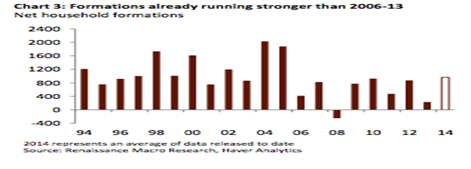
So ‘the times they are a changin’. Household formation is increasing again, and history says at least 50 percent of those new householders will purchase a home. Fortune Magazine has just cited Neil Dutta, head of economics at Renaissance Macro Research, who pointed out in a note to clients that household formation in 2014 through September is already at its highest rate since 2005.

image

Graph: Fortune.com

The employment rate for folks aged 25 to 34 has grown 2.8 percent over the past year, about 29 percent faster than the overall employment rate, and they make up the largest generation ready to enter the housing market, larger than their baby boomer parents.

And don’t forget those record low interest rates, now back to last year’s pre-April rates, before Fed Chair Bernanke announcement that QE3 would end. The 30-year fixed conforming rate is now down to 3.50 percent with 0 origination points in California, for those with the best credit scores.

Harlan Green © 2014

Follow Harlan Green on Twitter: https://twitter.com/HarlanGreen
Posted in Consumers, Housing, housing market, Weekly Financial News | Tagged , , , , , , , | Leave a comment

The Political Consequences of Inequality

Financial FAQs

Paul Krugman recently highlighted the dangers of Europe’s austerity policies and the growing inequality of the developed world, the worst since the Great Depression. The result then, as now, has been the growing strength of right wing parties in Europe, such as Marine Le Pen’s National Front in France, and Hungary’s Jobbik Party; all rascist, anti-immigration parties calling for some form of independence from the European Union.

“Look at France, where Marine Le Pen, the leader of the anti-immigrant National Front, outpolls mainstream candidates of both right and left. Look at Italy, where about half of voters support radical parties like the Northern League and the Five-Star Movement. Look at Britain, where both anti-immigrant politicians and Scottish separatists are threatening the political order.”

And now we have upcoming Greek elections that threaten to derail the euro as the EU’s currency, or if the favored Syriza party wins, Greece will demand at the very least to renegotiate its austerity agreement with the EU.

“And the devastation in Greece is awesome to behold,” says Krugman. “Some press reports I’ve seen seem to suggest that the country has been a malingerer, balking at the harsh measures its situation demands. In reality, it has made huge adjustments — slashing public employment and compensation, cutting back social programs, raising taxes. If you want a sense of the scale of austerity, it would be as if the United States had introduced spending cuts and tax increases amounting to more than $1 trillion a year. Meanwhile, wages in the private sector have plunged. Yet a quarter of the Greek labor force, and half its young, remain unemployed.”

These austerity policies are keeping Eurozone unemployment still in the double digits, with France’s rate still above 10 percent, (whereas Germany’s is 5 percent), and that is unacceptable to growing nationalist movements in particular that want to break away from the European Union.

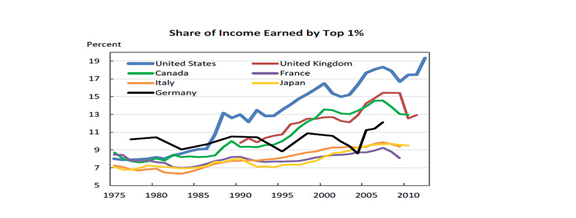
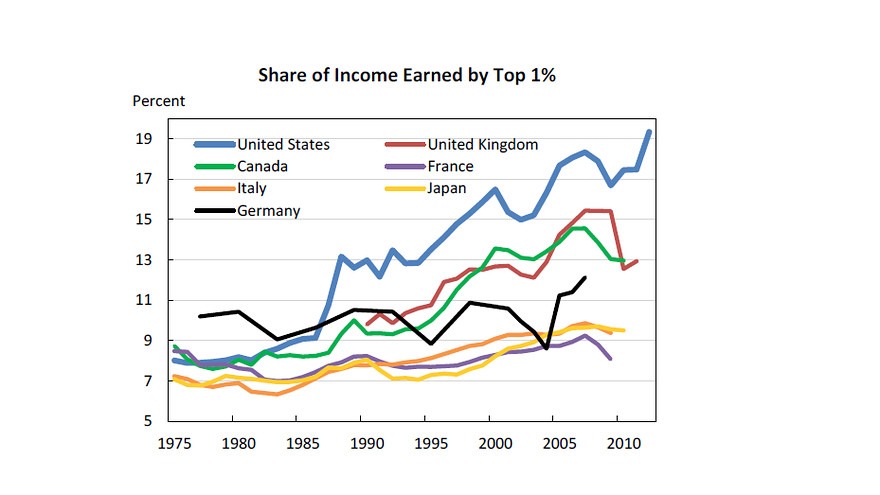
The results are a growing income inequality that the World Economic Forum’s Global Agenda Councils name the top threat to global stability in 2015.

“While wealth is rapidly increasing in developing nations, and advanced economies struggle with stagnation, there is great concern about rising economic inequality in all parts of the world, particularly in Asia, according to the Global Agenda survey. The Outlook 2015 report suggests renewed focus on improved education, tax policy and job creation as ways to alleviate the problem.”

It turns out that much of the nationalists’ support is coming from Vladimir Putin’s push to destabilize Europe for its opposition to his annexation of Crimea and parts of Southern Ukraine. But don’t blame it on Putin, who is just taking advantage of European policymakers protecting their own economies, instead of the overall EU economy. Rather than spend more money to stimulate growth, as the U.S. Federal Reserve has done with its QE purchases, they want to balance their budgets and thus favor the creditors, when it is Europe’s debtor nations that need relief, if they want to break out what could become a deflationary spiral.

It’s the old story that Thomas Piketty has retold in his Capital in the Twenty-First Century—the tendency of profits from capital in western, free market economies to rise to the top of the wealth ladder when government policy making is weakened and financial regulations ignored, as happened during the Great Recession.

one percent

Europe is now suffering the same fate, with conservative governments in control and the debtor nations such as Greece still being punished, while Germany flourishes as it protects its own interests rather than that of the EU as a whole.

Harlan Green © 2014

Follow Harlan Green on Twitter: https://twitter.com/HarlanGreen

Posted in Consumers, Economy, Macro Economics, Politics, Weekly Financial News | Tagged , , , , , , , , , , , , , | Leave a comment

What Will 2015 Bring?

Popular Economics Weekly

We already have an idea of what will happen in 2015. Firstly, job creation should continue to exceed 300,000 payroll jobs per month. Nobelist Paul Krugman is especially optimistic about economic growth, given that we have escaped much of the austerity budget cuts taken by the Eurozone and Japan.

“What about the prospects looking forward? As I’ve pointed out before, business investment has been relatively strong throughout. Residential investment, however, has been very low since 2006, suggesting that there’s a backlog of pent-up demand, which should come into play in an improving job market. So that’s one source of strength. Also, low oil prices are going to be mostly positive, although with some adverse regional effects; more on that in a later post.”

image

Graph: Trading Economics

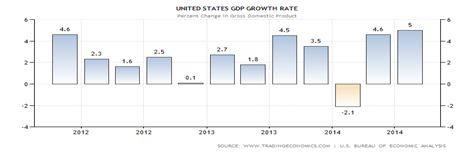
We would also posit that current economic growth will remain high in 2015, following consecutive 4.6 and 5 percent growth rates in Q2 and Q3. This is because government hiring will continue to pick up as effects of the Great Recession wear off.  It has been the main drag on growth, as Professor Krugman says.

“Since Obama took office, we’ve gained 6.7 million private-sector jobs, compared with just 3.1 million at the same point under Bush. But under Bush we’d added 1.2 million public sector jobs, while under Obama we’ve cut 600,000. The point is that relatively good private sector performance has been masked by public-sector cutbacks; this is the opposite of what you usually hear, but that’s no surprise.”

And Fed Chair Janet Yellen is determined to keep interest rates low until wage and salaries climb above the 2 percent inflation rate, which might happen in 2015 with continuing strong job growth.

The weak growth link remains the housing market, and any improvement will be closely watched by economists. The key will be adequate population growth (with more new household formation), especially from the millennials, children of the baby boomers as we have been saying.

Several housing specialists, including the NAR’s Realtor.com, Jed Kolko of Trulia.com, and even Robert Shiller of the Case-Shiller Housing Price Index see a better housing market in 2015. But increased household formation of those millennials that have been living with their parents, or renting, are the key. And 2015 looks to be the year when they begin to buy homes, according to Fortune Magazine’s Fortune.com. Historical household formation has been some 1 million new households per year, but has been less than half the historical average since the end of the housing bubble.

image

Graph: Fortune

Why? Millennials job growth, for one: “In 2014, it’s been a banner year for employment but parsed by age groups those under 35 have been gaining jobs at a 60 percent faster rate than rest – one of the best years for employment was even better for millennials,” said Realtor.com economist Jonathan Smoke in his recent release of the 2015 housing forecast.

And the oldest cohort of 25-34 puts the majority of millennials out of school and getting married. That’s combined with birth rates putting 2014 in the running for highest volume of births in years, as millennials outnumber their baby boomer parents by as much as 10 percent (as much as 88 million vs. 77 million baby boomers).

We will see what else 2015 brings, of course. More new, entry-level homes will have to be built, of course, so builders have to get the message that millennials won’t be able to afford the homes and higher prices tolerated by their parents.

There are indications that home builders are already doing this. For example, CNBC’s Diana Olick reports homebuilder D.R. Horton has a new brand, Express Homes that offers properties at $120,000 to $150,000 in lower priced states such as Texas and Georgia, well below the national median price of a new home, which in March came in at a record $290,000, according to the U.S. Census.

In other words, if and when housing returns to normal growth levels, we should see more sustained overall economic growth for 2015 and beyond.

Harlan Green © 2014

Follow Harlan Green on Twitter: https://twitter.com/HarlanGreen
Posted in Consumers, Economy, Housing, housing market, Weekly Financial News | Tagged , , , , , , , , , | Leave a comment

Why Lower Home Sales?

The Mortgage Corner

November existing home sales in November tumbled 6.1 percent, the biggest drop since July 2010, down to a seasonally adjusted annual rate of 4.93 million. New-home sales also fell slightly—probably for the same reason. Why? There were plenty of conjectures.

“While the headlines often point to first-time buyers’ reluctance to enter the market as a catalyst to the sluggish housing recovery, today’s report shows inventory needs to climb before it can support more interested buyers,” Quicken Loans Vice President Bill Banfield said. “As homeowners gain trust in the economy, they will be more comfortable leaving their current mortgage and entering the market, thus driving up inventory to support further demand.”

image

Graph: Calculated Risk

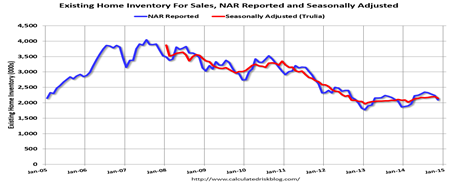
Existing-home inventories increased 2 percent, but are still at post-recession lows. So this makes sense, as refinancing levels have to pick up as well, for homeowners to be able to move up, or downsize their dwellings as they approach retirement. New-home inventories rose slightly from 5.7 to 5.8 months’ supply at the current sales rate.

image

Graph: Calculated Risk

But it’s also the winter season, with all the obstacles that winter weather brings. And sales dropped to their lowest annual pace since May (4.91 million) but are above year-over-year levels (up 2.1 percent from last November) for the second straight month, says Calculated Risk.

The NAR’s chief economist Lawrence Yun thought it might have something to do with the stock market, also. “Fewer people bought homes last month despite interest rates being at their lowest levels of the year,” he said. “The stock market swings in October may have impacted some consumers’ psyches and therefore led to fewer November closings. Furthermore, rising home values are causing more investors to retreat from the market.”

So why are for sale inventories still so low? The main reason may be credit tightness, in spite of record low mortgage rates. Both mortgage refinancing and purchase applications are still too low for this stage of the housing recovery. This is while the 30-year fixed conforming rate is down to 3.50 percent for a 1 point origination fee.

When will prospective homebuyers become more trusting of the housing market? It may already be happening. Economist Robert Shiller of the Case-Shiller Home Price Index recently reported that homeowners are becoming more optimistic again, with their latest survey now done by Dodge Data & Analytics reporting that homeowners now see housing values appreciating at +5 percent in future years.

“On average over the next 10 years,” asked Professor Shiller of a home owning sample survey, “how much do you expect the value of your property to change each year?” In 2004, a boom year, the average answer was a gain of 12.6 percent, but in succeeding years the figure began to decline, bottoming at 4 percent in 2012. The expected gain rose to 4.2 percent in 2013 and 5.5 percent in mid-2014.”

Are we returning to bubble territory with such low interest rates, as back in 2005? No, according to Dr. Shiller. “…both our data and that of the Chicago Mercantile Exchange show higher expectations than they did a couple years ago. But these new expectations are hardly wild: If inflation ran at 2 percent a year, the Federal Reserve’s target, the expected appreciation in housing would be an inflation-corrected 2 percent to 3.5 percent a year. So at the moment, there is no evidence of extravagant bubble thinking.”

Still, there are many homes either with little or no equity, or in outright foreclosure, especially in the older Judicial Foreclosure states of the Midwest and East—some 5 million at last count. And such a ‘shadow’ inventory of distressed housing can only be reduced with further price appreciation, and more job creation. It does look like that might happen in 2015, so stay tuned!

Harlan Green © 2014

Follow Harlan Green on Twitter: https://twitter.com/HarlanGreen
Posted in Consumers, Housing, housing market, Weekly Financial News | Tagged , , , , , , | Leave a comment

Fed’s Yellen—No Inflation In 2015?

Popular Economics Weekly

Fed Chair Janet Yellen has given us a very good holiday gift. that boosted stock and bond prices.  She announced at her post-FOMC meeting press conference that Fed Governor’s see little or no inflation next year. In fact, if falling prices continue in the rest of the world, the Fed may be tempted to not raise interest rates at all next year.

That is a startling conclusion, but she made particular mention of the effects of falling oil prices. They will of course help consumer spending in the developed countries, but the oil exporting countries will be hurt. And lower oil prices also mean less oil is being used, so there is less worldwide demand for energy-based products and services, which means less business activity in general.

“At this point we think it unlikely that it will be appropriate that we will see conditions for at least the next couple of meetings that will make it appropriate for us to decide to begin normalization,” Yellen said at the press conference. The bank’s policymakers meet next in late January again in mid-March, and at the end of April. Most pundits and forecasters say the Fed isn’t likely to change policies until their April meeting, at the earliest.

image

Graph: Econoday

Consumer price inflation turned down in November on sharply lower gasoline prices plus dips in some core subcomponents. Overall consumer price inflation fell 0.3 percent after no change in October. Energy dropped 3.8 percent, following a 1.9 percent decline the month before. Gasoline plunged 6.6 percent in November after a 3.0 drop in October.

Excluding food and energy, consumer price inflation posted at 0.1 percent in November easing from 0.2 percent in October. The Fed’s own target inflation rates were lowered to 1.0 to 1.6 percent in 2015. Within the core, the shelter index rose 0.3 percent, and the indexes for medical care, airline fares, and alcoholic beverages also rose. In contrast, the indexes for apparel, used cars and trucks, recreation, household furnishings and operations, personal care, and new vehicles all declined in November.

There are others of the same opinion that rates may not rise at all next year. Nobelist Paul Krugman, for instance, has said, “Basically, while (U.S) growth and job creation have finally been pretty good lately, there is so far no sign whatever that the economy is overheating. Core inflation remains below the Fed’s target (the Fed focuses on a different measure that usually runs lower than the CPI, so this report is actually fairly far below target.)

“Add to this troubles abroad — the direct spillover from Russia or even Europe is fairly small, but the rising dollar means that good news on manufacturing may not last — and there is a real risk that any rate hike will turn out to have been a mistake. And it’s a mistake that would be very costly, because it could all too easily set the stage for a Japan/Europe style long-term low-inflation trap (yes, at this point I think we can put the euro area in the same category).”

We also have record high consumer sentiment, which is boosting retail sales, for one.  The expectations component that offers an indication on confidence in the outlook for jobs and income, is up 3 tenths from mid-month and up a very strong 6.5 points from final November. Inflation expectations are very soft reflecting the downdraft underway in oil prices with both the 1-year and 5-year outlooks at 2.8 percent. Today’s report will be especially pleasant reading for the nation’s retailers.

[Chart]

That should also mean longer term mortgage rates could remain low next year, bringing even more buyers into the housing market (read younger millennial buyers currently renters) and so contributing to the housing recovery.

Harlan Green © 2014

Follow Harlan Green on Twitter: https://twitter.com/HarlanGreen
Posted in Consumers, Economy, Macro Economics, Weekly Financial News | Tagged , , , , , | Leave a comment

Conference Board’s Leading Economic Indicators Near Highs

Financial FAQs

The Conference Board Leading Economic Index® (LEI) for the U.S. increased 0.6 percent in November to 105.5 (2004 = 100), following a 0.6 percent increase in October, and a 0.8 percent increase in September.

It is a further sign of strong U.S. growth in the months ahead, maybe as high as 4 percent over the next 2 quarters. GDP growth has already averaged 4.25 percent over the last 2 quarters.

image

Graph: Trading Economics

“The increase in the LEI signals continued moderate growth through the winter season,” said Ken Goldstein, Economist at The Conference Board. “The biggest challenge has been, and remains, more income growth. However, with labor market conditions tightening, we are seeing the first signs of wage growth starting to pick up.”

image

Graph: Econoday

“Widespread and persistent gains in the LEI point to strong underlying conditions in the U.S. economic expansion,” said Ataman Ozyildirim, Economist at The Conference Board. “The current situation, measured by the coincident economic index, has been improving steadily, with employment and industrial production making the largest contributions in November.”

image

Graph: Calculated Risk

Much of the better job numbers come from industrial production that increased 1.3 percent in November after edging up in October. Manufacturing output increased 1.1 percent, with widespread gains among industries. Factory output was well above its average monthly pace of 0.3 percent over the previous five months and was its largest gain since February. It is up 13.2 percent from its low point in 2009, according to Calculated Risk.

Janet Yellen’s Federal Reserve also helped to boost growth prospects with her post-FOMC press conference in which she said that the Fed’s rates would not increase until long term job and wage growth showed a sustained pickup.

Nobelist Paul Krugman believes the Fed might wait even longer to raise their rates. “Basically, while growth and job creation have finally been pretty good lately, there is so far no sign whatever that the economy is overheating. Core inflation remains below the Fed’s target (the Fed focuses on a different measure that usually runs lower than the CPI, so this report is actually fairly far below target.)

“In fact, the opposite is happening. Domestic and worldwide inflation continues to fall, largely because of falling oil prices, which signals less use of petroleum products, ergo slowing business activity in other parts of the world. The U.S. seems to be the exception, in what we have come to call a ‘goldilocks economy’—growth without overheating.”

So we seem to have returned to a goldilocks economy much like that the 1990s that sustained high job and economic growth with little or no inflation, thanks to plentiful oil supplies that are projected to last for several years, at least.

Harlan Green © 2014

Follow Harlan Green on Twitter: https://twitter.com/HarlanGreen
Posted in Consumers, Economy, Macro Economics, Weekly Financial News | Tagged , , , , , , , , | Leave a comment

New-Home Construction, Builders’ Optimism Still Rising

The Mortgage Corner

Home builders’ optimism is still high, though builder confidence in the market for newly built single-family homes fell one point in December to a level of 57 on the National Association of Home Builders/Wells Fargo Housing Market Index (HMI), following a four-point uptick last month.

image

Graph: Calculated Risk

“After a sluggish start to 2014, the HMI has stabilized in the mid-to-high 50s index level trend for the past six months, which is consistent with our assessment that we are in a slow march back to normal,” said NAHB Chief Economist David Crowe. “As we head into 2015, the housing market should continue to recover at a steady, gradual pace.”

What is helping new-home demand is the lack of existing-home inventory. Total housing inventory at the end of October fell 2.6 percent to 2.22 million existing homes available for sale, which represents a 5.1-month supply at the current sales pace – the lowest since March (also 5.1 months).

Meanwhile, new-home construction that would replenish housing inventories is advancing in fits and starts, largely due to uncertain weather conditions and still tough mortgage qualification standards that lenders have only recently begun to ease. Privately-owned housing starts in November were at a seasonally adjusted annual rate of 1,028,000. This is 1.6 percent below the revised October estimate of 1,045,000 and is 7.0 percent below the November 2013 rate of 1,105,000.

Single-family housing starts in November were at a rate of 677,000; this is 5.4 percent below the revised October figure of 716,000, but double the number of multiple units being started. The November rate for units in buildings with five units or more was 340,000.

image

Graph: Calculated Risk

Another reason for builders’ optimism and healthy new-home construction is the pickup in U.S. employment. Private non-farm payrolls increased 321,000 in November and the jobless rate held at 5.8 percent. The competition for jobs is also dropping, with just 1.9 unemployed workers looking for work per job opening, when it was as much as 4 workers per job opening just after the Great Recession.

Also, prospective borrowers may find it easier to get a loan in 2015 as some lenders, encouraged by federal regulators, ease standards. In addition, mortgage rates are still low, enabling qualified borrowers to get relatively cheap loans. For example, 30-year fixed rate conforming mortgage rates with as little as 5 percent down have dropped to 3.50 percent in California.

Another reason for the better job numbers is industrial production increased 1.3 percent in November after edging up in October. In November, manufacturing output increased 1.1 percent, with widespread gains among industries. The rise in factory output was well above its average monthly pace of 0.3 percent over the previous five months and was its largest gain since February. It is up 13.2 percent from its low point in 2009, according to Calculated Risk.

NAR also recently released its economic and housing forecast for 2015 and 2016. NAR chief economist Lawrence Yun is forecasting existing-home sales this year to fall slightly below 2013 (5.1 million) to 4.9 million, and then increase to 5.3 million next year and 5.4 million in 2016. Yun expects the national median existing-home price to rise 4 percent both next year and in 2016.

Harlan Green © 2014

Follow Harlan Green on Twitter: https://twitter.com/HarlanGreen

Posted in Consumers, Housing, housing market, Weekly Financial News | Tagged , , , , | 1 Comment

Retail Sales Portend +4 Percent GDP in 2015

Popular Economics Weekly

We have said that the prospect of higher interest rates next year may spur some extraordinary growth over the next few quarters, and just out holiday retail sales seem to be fulfilling that prophecy.  Consumer spending is returning to pre-recession levels, and this is without the boost from housing refinance that drove the housing bubble.

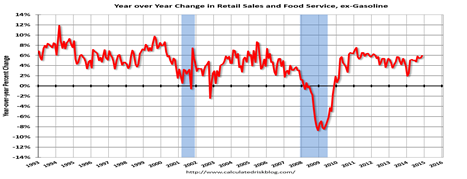
Retail sales are soaring even with lower gasoline prices (since retail prices not adjusted for inflation), up 5.1 percent YoY. This put sales back to pre-recession levels. Sales in November posted a 0.7 percent boost after rebounding 0.5 percent in October. Autos in particular jumped a huge 1.7 percent after gaining 0.8 percent in October. And retail sales ex-plunging gasoline prices increased by 6.0 percent on a YoY basis.

image

Graph: Calculated Risk

Couple that with the highest U. of Michigan consumer sentiment since before the Great Recession, and we can see why consumers are spending more. It can’t be only falling gasoline prices creating more optimism. Payroll jobs are now increasing some 300,000 per month, which heartens householders’ future financial prospects.

image

Graph: Calculated Risk

Sentiment surged to 93.8 for the mid-month December reading vs an already strong 88.8 in final November and 89.4 in mid-month November. This is the strongest reading since January 2007. The current conditions component is up 3.0 points from final November to 105.7 in a gain that signals month-to-month strength in consumer activity this month. The expectations component, though lagging at 86.1, is up a very sharp 6.2 points to signal rising confidence in the outlook for income and jobs, as we said.

image

Graph: Econoday

The prospects for faster growth over the next 2 quarters at least may also have to be due to the possibility of higher interest rates next year, as we have been saying. But we still have severe price-cutting in many retail areas, and wholesale prices have been flat for several months.

And the Fed is worried about falling prices at both the wholesale and retail levels, rather than inflation at the moment, so don’t look for Janet Yellen’s Fed to begin to raise their short term rates, until prices have firmed and begin to climb again.

Harlan Green © 2014

Follow Harlan Green on Twitter: https://twitter.com/HarlanGreen

Posted in Consumers, Economy, Housing, housing market, Macro Economics, Weekly Financial News | Tagged , , , , | Leave a comment

The Economic Consequences of Too Much Inequality

Financial FAQs

A new report released by the World Economic Forum, ranks rising inequality as the top trend facing the globe in 2015, according to a survey of 1,767 global leaders from business, academia, government and non-profits, many of whom convened recently in Dubai.

image

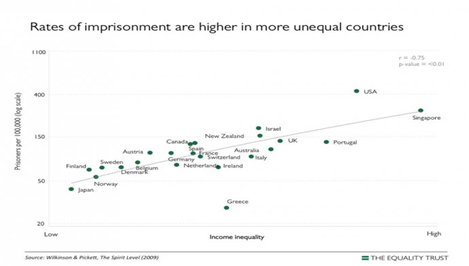
Its effects are barely known to economists, much less politicians. The U.S. has far and above the greatest income inequality in the developed world, as well as the highest crime and prison incarceration rates. Yet even economists such as Nobelist Paul Krugman can’t agree that this has had a measurable effect on economic growth!

image

Graph: The Spirit Level

Then what economic growth are we discussing when so many working age men (and women) are in prison, 2,300,000 at last count, the minimum wage is still $7.25 in most states, and we have had 5 recessions since 1980? Economists can’t be looking at the 90 percent of Americans that haven’t experienced any economic growth since 2009, and the recovery from the Great Recession.

The soaring inequality today matches that of 1928 before the Great Depression, and it is causing irreparable damage to our economy. Yet very little has been done about it, other than the American Recovery and Reinvestment Act’s $835 billion stimulus package of 2009 that saved or created some 3 million jobs according to the Congressional Budget Office, but whose effect petered out quickly in 2010 and reduced GDP growth to 2 percent until recently.

Economic growth has resumed with 321,000 nonfarm payroll jobs created in November, but 8 million jobs and at least $6 trillion in economic output were lost during the Great Recession, and . And with a Republican congress taking over in January, economic forecasters such as Macroeconomic Advisors are not optimistic about more job creating programs in the works due to a resumption of the budget battles soon to come, in spite of Republican protestations from new Senate Majority Leader Mitch McConnell that there will be no more government shutdowns.

Joel Prakken, a Macroeconomic Advisors co-founder, cited the effect further budget battles could have on growth in the New York Times. Past fights and the ensuing downgrade of U.S. government debt has cost approximately 1 percent in economic growth, which means instead of the 2.15 GDP growth average since Republicans took over the House in 2011, we could have had 3 percent plus growth and many more jobs.

How does inequality most affect growth? The classic answer is that since consumers power some 70 percent of economic activity, their spending power must be the driver of growth, and they cannot spend or save more with declining incomes, as the graph should make abundantly clear.

But it must be a quality of life issue, as well. How can we continue to live well in the most violent society in the developed world, with outmoded public infrastructure and educational facilities?

Richard Wilkinson and Kate Pickett’s The Spirit Level, a 30-year study of the effects of inequality, has said it best.

“Research has shown that greater inequality leads to shorter spells of economic expansion and more frequent and severe boom-and-bust cycles that make economies more vulnerable to crisis,” say Wilkinson and Pickett. “The International Monetary Fund suggests that reducing inequality and bolstering longer-term economic growth may be “two sides of the same coin”. And development experts point out how inequality compromises poverty reduction.”

The consequences of growing inequality are too great to ignore.  We now know from history what they are—two great economic downturns that can only be corrected with a return to the values that have made the U.S. great—economic justice for all.

Harlan Green © 2014

Follow Harlan Green on Twitter: https://twitter.com/HarlanGreen

Posted in Consumers, Economy, Keynesian economics, Politics, Weekly Financial News | Tagged , , , , , , , , , , | Leave a comment