Government Spending Boosts Q3 GDP

Popular Economics Weekly

WASHINGTON (MarketWatch) — The U.S. economy grew by a 3.5 percent annual rate in the third quarter, fueled by a surge in exports and the biggest jump in federal spending in five years, screamed one headline this morning.

That is all we need to know to understand why US economic growth is finally returning to the long term average that has prevailed since the Great Depression. This is in spite of the Great Recession and a busted housing bubble that is taking years to recover, record wealth inequality that has kept consumers from spending, and ultra-conservative House Republicans that have refused to allow even the most basic public works spending; such as to repair and replace the roads and bridges that have so fallen into disrepair, not to speak of keeping up with the educational needs of a growing population.

image

Graph: Calculated Risk

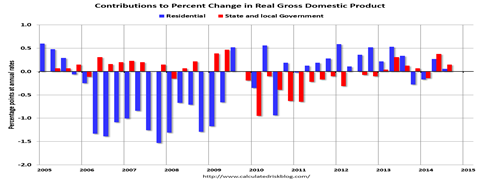
This first graph from Calculated Risk shows the increasing contribution to GDP for residential investment (RI) and state and local governments since 2005. It’s the beginning of recovery from the huge slump in RI during the housing bust (blue), followed by the unprecedented period of state and local austerity (red) not seen since the Depression.

It doesn’t tell the whole story, of course, as continuing austerity policies that cut government spending and some taxes in Japan and Europe have kept them in recession, whereas the pro-growth actions of the Fed (and boosting of some taxes) have reduced the budget deficit and kept the US government solvent.

It is a phenomenal recovery, even a miracle that this could even happen with a Congress locked in a battle over ideologies, and race. So it is thanks mainly to Ben Bernanke and Janet Yellen’s Federal Reserve QE actions, in particular, part of their pro-growth policies that pushed interest rates (especially long term rates) to record lows, just because the Fed could act outside of politics as usual.

“What’s more, the U.S. is adding jobs at the fastest rate since the recession ended in 2009 and consumers are feeling the most confidence in seven years, buoyed by a rising stock market and falling gasoline prices. As a result, most analysts believe the U.S. is likely to expand at a 3 percent pace or so in the fourth quarter to string together the best stretch of economic growth since before the Great Recession,” said the MarketWatch announcement.

So government spending was the largest contributor, up 10 percent mostly for defense, and exports up 7.8 percent annually. State and local governments’ spending rose 1.3 percent, and consumer spending slowed to a 1.8 percent annual pace from 2.5 percent in the prior quarter.

Business investment on equipment decelerated from the second quarter’s 11.2 percent gain to 7.2 percent, but is still strong. Residential housing investment grew at a low 1.8 percent rate after an 8.8 percent increase in the spring.

What does all this data mean? That there are ways around Congressional gridlock, if the executive branch and Federal Reserve concentrate on pro-growth policies that keep interest rates low, raise taxes sufficiently to lower the budget deficit, lower health care costs, support collective bargaining of employees, as well as lobby for higher household incomes to boost consumer spending (and the housing market).

And best of all, this happened with very low inflation, in spite of warnings that more government spending and the Fed’s QE policies would cause soaring inflation. Instead inflation as measured by the PCE index rose just 1.2 percent annually, down from 2.3 percent in Q2, as cheaper energy prices has kept inflation ultra-low. Even the core PCE that excludes food and energy rose just 1.4 percent.

We can now say officially that we have that goldilocks economy that prevailed through the 1990s; not too hot or too cold that will boost economic growth for years to come, if Congress can be ignored.

Harlan Green © 2014

Follow Harlan Green on Twitter: https://twitter.com/HarlanGreen

Posted in Consumers, Economy, Housing, housing market, Politics, Weekly Financial News | Tagged , , , , , , , | Leave a comment

Consumer Confidence Soaring, Case-Shiller Home Prices Unchanged

Popular Economics Weekly

Why are stock prices rallying?  Maybe it’s because though housing price increases have slowed, consumer confidence is soaring for the holidays.  The prospect for future job and income growth looks good, in other words

Home prices contracted for a 4th straight month in August in Case-Shiller 20-city data, down 0.1 percent vs expectations for a gain of 0.1 percent. This is while consumer confidence rose to a post-recession high, a good sign for increased holiday spending.

Month-to-month prices declined in just 3 of the 20 cities, monthly—Charlotte, NC, San Diego, and San Francisco—with San Francisco, Las Vegas and Miami prices up the most year-over-year.

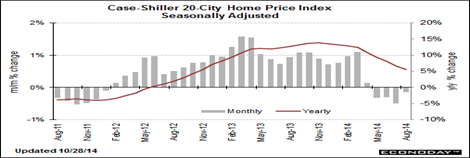
So though the 20-city monthly average fell sharply, annual year-on-year overall prices are still a plus 5.6 percent from plus 6.7 and 8.0 percent in the two prior months for the 20-city index. The 5.6 percent rate is the lowest since November, says Econoday.

image

Graph: Econoday

This is while the Conference Board’s Consumer Confidence Index for October is at a new recovery high of 94.5, up from an upwardly revised 89.0 in September and surpassing the previous recovery high of 93.4 in August. The last time the index reached this level was in October 2007, right at the beginning of the Great Recession.

image

Graph: Econoday

October’s gain is concentrated almost entirely in the expectations component, which jumped 8.6 points to 95.0 in a reading that is close to February 2011’s 97.5. The strength in expectations reflects optimism in the outlook for both jobs and income, both of which show convincing gains in this month’s report.

Despite improved housing conditions and low interest rates (as low as 3.625 percent for the conforming 30-yr fixed rate today), tight credit conditions continue to be a barrier for some buyers, as we have said in past columns. Of the reasons for not closing a sale, about 15 percent of Realtors in September reported having clients who could not obtain financing, reports the NAR.

image

Graph: Calculated Risk

Lastly, the so-called price-to-rent ratio tells us that prices are again rising faster than rents, and are above the long term ratio of 1:1. This means that housing prices are growing faster than rents again. Ergo, prices cannot continue this trend for long, since rent increases mirror actual income increases, whereas prices rise or fall for a number of reasons. This includes the perception that housing prices will continue to rise (due to irrational exuberance, which is an early sign of housing inflation) and perhaps ultra-low interest rates, which must eventually rise to more normal levels.

On a price-to-rent basis, the Case-Shiller National index is back to February 2003 levels, the Composite 20 index is back to September 2002 levels, and the CoreLogic index is back to July 2003, reports Calculated Risk.

So are we at the beginning of another housing bubble? Probably not, because the main cause of the current price increases is inadequate new home construction to meet the demand for housing (which is rental housing, at the moment), rather than oversupply of new homes that caused the housing bubble to burst.

Harlan Green © 2014

Follow Harlan Green on Twitter: https://twitter.com/HarlanGreen

Posted in Consumers, Economy, Housing, housing market, Weekly Financial News | Tagged , , , , , | Leave a comment

NRA Uses Gun Violence to Maximize Profits

Financial FAQs

How can we believe the National Rifle Association opposes gun violence when every mass murder committed with guns is answered by the NRA’s call to buy more weapons? There have been 3 mass killings by crazed gunmen just over the past week, and the gun industry’s reponse via the NRA is that guns don’t kill people, people kill people.

The latest attempt by the gun industry to boost sales is to compete with a Washington State ballot initiative that limits gun sales. Initiative 594 would require universal background checks, whereas their Initiative 591 bars universal background checks. Guess which one is backed by the gun industry? So restricting gun sales via universal background checks won’t stop the killers? Really?

It means those gun makers who fund the NRA are directly responsible for the bizarre mass shootings that have discriminately killed so many children and adults. Their only answer has been to blame the victims who hadn’t purchased guns (with high capacity magazines) for not being ‘cocked and ready’ when a crazed gunman commits mayhem.

Yet large capacity ammunition magazines are the common thread uniting all of the high-profile mass shootings in America, according to the Washington DC Violence Policy Center that listed the mind-numbing results—42 mass killings from 1984 to June 2013, with 380 killed and 365 wounded by the gunmen. Two of the shooters used assault rifles with 75-round high capacity drum magazines enabling the huge body count.

The shooter who killed 20 children and 7 adults at Sandy Hook Elementary School in Newtown, Connecticut in 2012 equipped his assault weapon with 30-round magazines, which enabled him to fire 154 rounds in less than five minutes.

The gunman in Tucson, Arizona who killed six people and injured 13 others, including U.S. Representative Gabrielle Giffords, in a supermarket parking lot in 2011, used a handgun equipped with a 33-round magazine.  His shooting spree was only interrupted when he was tackled by a bystander as he finally stopped to reload his weapon.

We have to look at when gun manufacturers began to manufacture large magazine weapons in order to increase their profits for the origins of the mass killings. In fact, prior to the 1980s, the most popular type of handgun was the revolver, which typically holds six rounds of ammunition in a rotating cylinder. During the 1980s, however, the firearms industry began mass producing and marketing semiautomatic pistols, which can accept ammunition magazines.

In 1980, semiautomatic pistols accounted for only 32 percent of the 2.3 million handguns produced in America.9 By 2008, however, such pistols accounted for 76 percent of the 1.8 million handguns produced that year.

How has the gun industry been able to fool so many people for so long on the facts of gun violence? Factcheck.org points out how the NRA’s reflex response to any gun violence is to mount truly bizarre campaigns that deny any culpability for the mayhem.

The NRA’s response to the Sandy Hook Elementary School killing of 20 children and 7 adults is but one example. "We need to have every single school in America immediately deploy a protection program proven to work — and by that I mean armed security," said the NRA’s Wayne LaPierre just one week after the massacre.

Why would the NRA so blatantly ignore the revulsion felt by so many over the massacre? New Jersey Governor Chris Christy highlighted the callous absurdity of Wayne Lapierre’s response. “In general I don’t think that the solution to safety in schools is putting an armed guard because for it to be really effective in my view, from a law enforcement perspective, you have to have an armed guard at every classroom,” he said. “Because if you just have an armed guard at the front door then what if this guy had gone around to the side door? There’s many doors in and out of schools.”

So the gun industry would be much happier it they could sell every teacher a firearm that would have to be kept in every classroom to be an effective deterrent. That would really boost their profits!

The Sandy Hook massacre even caused the U.S. Senate to attempt to take action to tighten gun regulations with universal background checks, including for gun show and online sales. Yet it was still voted down because of a multi-million dollar lobbying campaign by the gun industry.

“I agree wholeheartedly with the goal of the NRA,” Joe Manchin, one of the bill’s sponsors. “I was surprised when the latest alert from the NRA was full of misinformation. … They are telling members that our legislation would criminalize the private transfer of firearms by honest, law-abiding citizens. … That is a lie.”

The Brady Campaign To Prevent Gun Violence spells out the loopholes that allow gun sales to grow and gun companies to make even more profits. Online and gun show sales require no background checks, even though the Bureau of Tobacco and Firearms documents U.S. gun shows as a major source of bulk weapons’ sales to Mexican Drug Cartels.

The NRA’s excuses for Elliot Rogers Isla Vista, California, mass murder was that it was the result of California’s stringent gun regulation that prevents lawful citizens from owning guns. But that is an outright lie, as the California law only bans assault rifles with large magazine clips. California has banned the sale of Semi-automatic firearms that the state has classified as assault weapons, .50 BMG caliber rifles, and magazines that can hold more than ten rounds of

Since 2005, the gun industry and its corporate allies have given between $20 million and $52.6 million to the NRA through the NRA Ring of Freedom sponsor program. Donors include firearm companies like Midway USA, Springfield Armory Inc, Pierce Bullet Seal Target Systems, and Beretta USA Corporation. Other supporters from the gun industry include Cabala’s, Sturm Rugar & Co, and Smith & Wesson.

And industry profits have soared. According to the Christian Science Monitor, $6 billion in estimated revenue was earned by the US gun and ammunition manufacturing industry in 2012, according to a financial report by the research firm D&B First Research based in Austin, Texas. The major manufacturers include Browning Arms, Freedom Group, Olin, Aliant Tech Systems, Sturm, Ruger & Company, and Smith & Wesson.  The biggest companies are Ruger and Smith & Wesson, which represent about 30 percent of the industry.

The estimated number of guns in circulation in the United States as of 2009 was 310 million, according to a survey from the National Institute of Justice. That number includes 114 million handguns, 110 million rifles, and 82 million shotguns. The number of available guns has increased 62 percent since 1994, when there were about 192 million firearms in circulation. "Per capita, the civilian gun stock has roughly doubled since 1968, from one gun per every two persons to one gun per person," according to a report from the Congressional Research Service.

Need we say more to uncover the tactics used by gun manufactures to increase their profits, regardless of public safety concerns? The Brady Campaign’s numbers tell it all:

  • One in three people in the U.S. know someone who has been shot.
  • On average, 32 Americans are murdered with guns every day and 140 are treated for a gun assault in an emergency room.
  • Every day on average, 51 people kill themselves with a firearm, and 45 people are shot or killed in an accident with a gun.
  • The U.S. firearm homicide rate is 20 times higher than the combined rates of 22 countries that are our peers in wealth and population.
  • A gun in the home is 22 times more likely to be used to kill or injure in a domestic homicide, suicide, or unintentional shooting than to be used in self-defense.

Gun manufacturers and the NRA are maximizing profits at the expense of public safety. They have become in fact a danger to civil society, rather than protector of public safety.

Harlan Green © 2014

Follow Harlan Green on Twitter: https://twitter.com/HarlanGreen

Posted in Consumers, Economy, Politics | Tagged , , , , , , , | Leave a comment

Pending and New-Home Sales Looking Up

The Mortgage Corner

Sales of new single-family houses are barely budging from their recession lows. But pending home sales for September nudged up to the highest this year, which is a sign that record low interest rates are bringing buyers back into the market.

Pending sales rose slightly in September and are now above year-over-year levels for the first time in 11 months, according to the National Association of Realtors.

The Pending Home Sales Index inched 0.3 percent to 105.0 in September from 104.7 in August, and is now 1.0 percent higher than September 2013 (104.0). The index is above 100 for the fifth consecutive month and is at the second-highest level since last September, reports the National Association of Realtors.

Lawrence Yun, NAR chief economist, says moderating price growth and sustained inventory levels are keeping conditions favorable for buyers. “Housing supply for existing homes was up in September 6 percent from a year ago, which is preventing prices from rising at the accelerated clip seen earlier this year,” he said. “Additionally, the current spectacularly low mortgage rates should help more buyers reach the market.”

Despite improved housing conditions and low interest rates (as low as 3.625 percent for the conforming 30-yr fixed rate today), tight credit conditions continue to be a barrier for some buyers. Of the reasons for not closing a sale, about 15 percent of Realtors in September reported having clients who could not obtain financing as the reason for not closing.

Yun says the final rule on Qualified Residential Mortgages should improve access to credit once it goes into effect next year. “The rule provides clarity for lenders and is a win for creditworthy consumers by ensuring they continue to have access to safe and affordable loan products without overly burdensome down payment requirements,” he said.

And Mel Watt, the newly appointed Director of FHFA that oversees Fannie Mae and Freddie Mac just announced he would be easing credit standards for the largest guarantors of residential mortgages.

But it is a two-edged sword, according to pundits. Watt said that Fannie and Freddie are working to develop “sensible and responsible” guidelines that will allow them to buy mortgages with down payments as low as 3 percent, instead of the 5 percent minimum that both institutions currently require. But lenders will not have to retain earnings to cover any losses, which means they could again begin to offer subprime mortgages (but that are not sold to Fannie or Freddie).

This change would apply to a “targeted segment of creditworthy borrowers” and take into account “compensating factors,” Watt said. (Housing experts speculate that maybe the lower down payments would only be offered to first-time buyers.) More details to come in the weeks ahead, Watt added.

But these provisions should boost sales to first time homebuyers, in particular who might not be able to afford larger down payments.

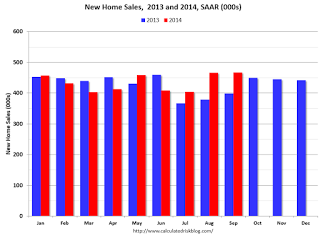
new sales

Graph:Calculated Risk

Sales of newly built, single-family homes inched up 0.2 percent in September to a seasonally adjusted annual rate of 467,000 units, the highest level in six years. Sales numbers for August were revised down from 504,000 to 466,000.

“Three consecutive months of sales upticks demonstrate steady growth in the housing market,” said Kevin Kelly, chairman of the National Association of Home Builders (NAHB). “Consistent job creation and low mortgage interest rates are spurring the release of pent-up consumer demand.”

So new-home sales have to improve, as well, to enlarge the housing inventory. Right now, most housing construction is now multi-family dwellings to absorb the increasing demand for rental housing.

Harlan Green © 2014

Follow Harlan Green on Twitter: https://twitter.com/HarlanGreen

Posted in Consumers, Housing, housing market, Weekly Financial News | Tagged , , , , , | Leave a comment

The Mystery of Money: Understanding the Modern Financial World

Harlan Green “Unpacks” the Money Metaphor–Book Review by Mark Whitehurst / CASA MAGAZINE

Yelling “Show me the money!” usually only works in the movies, but Harlan Green’s down to earth book, The Mystery of Money: Understanding the Modern Financial World, recently published by Publishing by the Seas, Inc., opens new doors into how the realm of money really works.

Creating perspectives on how money functions and doesn’t function is what local author and columnist Green accomplishes with this book, which is a quick and easy read at 85 pages.

“Demystifying financial information for readers has always been my goal over the past thirteen years amid the breathtaking real estate and credit bubbles that have transformed both domestic and world financial markets,” writes Green in The Mystery of Money’s introduction.

Over the years, Green has been a financial columnist for The Huffington Post; Popular Economics Weekly; CASA Magazine; and the Santa Barbara News Press.

Using common knowledge and experiences that were the result of the Great Recession and the Subprime Debacle as a starting point, Green provides readers with a social connection to money. It’s a connection that continues to be disconcerting, and Green tells it like it is.

“The shocking truth was that much of the so-called ‘complexity’ was caused by willful obfuscation — the disguising of financial information via many exotic derivatives and insurance vehicles that were off the glance sheets of financial institutions,” Green explains.

Green’s explanations lead to key points of reference and how to negotiate and mediate definitions and ideas about money.

He literally opens up a discussion on the art of negotiation, using some of his personal experiences as a mortgage broker.

“The one Golden Rule of any negotiation is never to feel rushed into making a decision,” he comments.

Green moves through the classic view of Herd behavior; Imperfect Financial Markets; Decision-Making; Irrational Exuberance; Managing Big Data; Personality Cults and Charismatic CEOs; and the Mystery of Real Wealth in nine chapters and an introduction.

The book, The Mystery of Money: Understanding the Modern Financial World, will soon be available at local book stores and is available from Amazon.

Posted in Consumers, Keynesian economics, Macro Economics | Tagged , , , , | Leave a comment

California’s Fracking Controversy

Financial FAQs

Santa Barbara voters have an upcoming ballot measure that bans all forms of enhanced drilling techniques, including steam injection and fracking, and it is getting national attention. Fracking supporters tout the huge boost in national oil and gas production that franking, or hydraulic fracturing of shale oil deposits to make extraction possible, that is making the U.S. more independent of foreign oil and gas..

But it is the well-documented loss of property values for those properties close to fracking sites, due to lax environmental regulations that govern fracking operations, that may be the biggest concern for Santa Barbara County voters in November.  Nearly 7,000 new wells are proposed locally.

The loss of property values comes from the 24/7 operation of fracking sites that generates so much pollution. Twenty-four hour, day-for-night lighting is required on the rigs, as well as noise and truck traffic from the transportation of the chemicals used—some toxic—in the drilling operation. But there are also fears of ground water contamination from toxic chemicals being injected into the wells.

And fracking operations are non-stop, thanks to the “Halliburton Loophole”, a 2005 amendment to the Clean Air and Water Acts that former VP Dick Cheney, former Halliburton CEO, pushed through Congress exempting fracking operations from almost all Environmental Protection Agency regulations.

“Coupled with existing exemptions to a variety of pollution laws like the Clean Air Act, the Resource Conservation and Recovery Act, the Superfund Act, and the Emergency Planning and Community Right to Know Act, the 2005 carve-outs gave the fracking industry seven total exemptions from important environmental regulations,” reported a recent truthout.org article.

And Congress has not as yet been able to close any of those exemptions. Even former congressional allies of Cheney, such as House Majority Leader Dick Armey, are regretting the Halliburton Loophole they supported at the time. Mr. Armey is one of the plaintiffs now suing the drilling companies that are causing loss of property values in his own Texas backyard from fracking operations.

California already has a thriving fracking industry. The majority of the state’s new and active wells are concentrated in Kern and Los Angeles counties, said a National Resource Defense Council report entitled Drilling in California: Who’s at Risk? However, expanded fracking in the large Monterey Formation could bring the oil and gas industry into more communities, especially in Ventura, Monterey, Fresno and Santa Barbara counties.

The NRDC report reveals that 14 percent of the state’s population—5.4 million Californians—already lives within a mile of at least one oil or gas well. Of that group, 69 percent—3.7 million residents—are people of color (45 percent Latino/Hispanic, 13 percent Asian, 8 percent African American and 3 percent other).

No less than business friendly Forbes Magazine published a study documenting the loss of property values from hydraulic fracturing for those property-owners near fracking sites, with the headline Pollution Fears Crush Home Prices Near Fracking Wells.

“Researchers from the University of Calgary and Duke University studied property sales from 1994 to 2012 in 36 Pennsylvania counties and seven counties in New York,” said Forbes in describing the study. “They mapped sales against the locations of shale-gas wells, and they compared homes connected to public drinking-water systems to homes with private wells.


“Properties with private wells suffered a loss in value compared to properties connected to a municipal water system, they found, offsetting gains in value from mineral-rights royalties. The loss varied with distance from the nearest shale-gas well. At 1.5 kilometers, properties with private wells sold for about 10 percent less.”

Properties suffered greater losses when closer to shale-gas wells where hydraulic fracturing had been employed. Within 1 km of shale gas wells, properties with private drinking water wells dropped 22 percent in value. Properties connected to public water suffered no losses, but also showed no net gains.

There are a host of factors that cause this, said the study, from the noise and toxic smells of fracking machinery (methane and sometimes Hydrogen Sulfide gases are released), to growing evidence of pollution of ground water from the toxic chemicals used. Sulfuric acid is one of the chemicals used to dissolve the oil-bearing shale.

And then there’s the real danger of earthquakes from injecting waste water back into the ground, which have been occurring with increasing frequency in some Oklahoma fracking fields, reports NPR Radio in a July 2014 broadcast by Linda Wertheimer.

Denver, Colorado had the same problems with so-called natural gas injection wells back in the 1960s, and played a critical role in discovering the link between forced injection wells and induced earthquakes.

“In the mid-1960s, Denver experienced a series of quakes believed to have been caused by a 12,000-foot deep wastewater disposal well at Rocky Mountain Arsenal, according to a June 2014 report by Denver’s NBC Channel 9. It culminated in a 5.3 magnitude quake on August 9, 1967 that remains the strongest recorded earthquake in Denver’s history, after which the well was decommissioned and the Army began to remove the wastewater it had pumped below the surface.

There are currently more than 1.1 million active oil and gas wells in the United States, and more than 15 million Americans now live within a mile of the hundreds of thousands that have been drilled since 2000, according to an analysis by the Wall Street Journal. Made possible by the advent of fracking, drilling is taking place in shale formations from California to New York and from Wyoming to Texas.

And there’s no indication that this “unprecedented industrialization” shows any signs of slowing. Almost 47,000 new oil and natural gas wells were drilled in 2012, and industry analysts project that pace will only continue.

Even Exxon CEO and board chairman Rex Tillerson, is suing to stop construction of a water tower that would supply nearby drilling operations because of the nuisance of, among other things, heavy truck traffic, noise and traffic hazards from the fracking operations the tower would support.

So the CEO of the single largest drilling company in the world acknowledges the “constant and unbearable nuisance” that would come from having “lights on at all hours of the night …traffic at unreasonable hours … noise from mechanical and electrical equipment.” And Tillerson’s lawsuit – filed in 2013 with other plaintiffs, including former House Majority Leader Dick Armey – claims the project would do “irreparable harm” to his property values, in papers filed for the Denton County, Texas lawsuit.

One little noticed side effect is that the secondary mortgage market hasn’t caught up with the risk of loaning on properties affecting by fracking, which means such properties could be harder to finance. Housing Wire has reported on a webinar entitled, “Oil and Gas Exploration for Mortgage Bankers,” in which Daniel McKenna, with the Ballard Spahr’s Mortgage Banking Group said, “The loans are actually low risk. But Fannie, Freddie, the FHA and the VA prohibit gas leases on their loans. There are a ton of different regulations that impact selling these loans on the secondary market.”

The Calgary and Duke University study of property values near shale gas wells has caused a 10 percent drop in values, but with fracking operations, values dropped some 22 percent in value. So it does look like the “Halliburton Loophole” that exempts the fracking industry from almost all environmental regulations will make Californians, a notoriously environmentally-friendly state, wary of allowing it to operate closer to population centers, at the very least.

Harlan Green © 2014

Follow Harlan Green on Twitter: https://twitter.com/HarlanGreen

Posted in Consumers, Economy, Politics, Weekly Financial News | Tagged , , , , , , | Leave a comment

Existing-Home Sales Highest in Year

The Mortgage Corner

The National Association of Realtors reports total existing-home sales, which are completed transactions that include single-family homes, townhomes, condominiums and co-ops, increased 2.4 percent to a seasonally adjusted annual rate of 5.17 million in September from 5.05 million in August. Sales are now at their highest pace of 2014, but still remain 1.7 percent below the 5.26 million-unit level from last September.

image

Graph: Calculated Risk

That has to be partly due to falling interest rates, with conforming 30-year fixed rates dropping as low as 3.625 percent for a 1 point origination fee in California. But also rents are soaring, up more than 10 percent year-over-year in five large rental markets — San Francisco, Sacramento, Oakland, Denver, and Miami.

Lawrence Yun, NAR chief economist, says the improved demand for buying seen since the spring has carried into the fall. “Low interest rates and price gains holding steady led to September’s healthy increase, even with investor activity remaining on par with last month’s marked decline,” he said. “Traditional buyers are entering a less competitive market with fewer investors searching for available homes, but may also face a slight decline in choices due to the fact that inventory generally falls heading into the winter.”

image

Graph: Calculated Risk

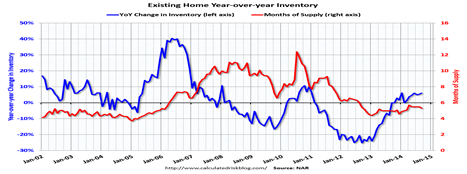
Total housing inventory at the end of September (blue line in graph) fell 1.3 percent to 2.30 million existing homes available for sale, which represents a 5.3-month supply (red line) at the current sales pace. This is far too few homes available for sale, which means a greater demand for new home construction. Despite fewer homes for sale in September, unsold inventory is still 6.0 percent higher than a year ago, when there were 2.17 million existing homes available for sale.

And housing prices continue to rise, though more slowly than last year. The median existing-home price for all housing types in September was $209,700, which is 5.6 percent above September 2013. This marks the 31st consecutive month of year-over-year price gains.

Why the falling interest rates? Worries of slower worldwide growth are worrying stock prices. The 10-year Treasury note yield dropped below 2 percent for the first time in 16 months. This has even caused Federal Reserve Vice Chairman Stanley Fischer to voice fears that the slowdown in the Eurozone in particular could slow U.S. growth. Why? Because it lowers the demand for U.S. goods and services.

Fischer said in a speech recently that, “if foreign growth is weaker than anticipated, the consequences for the U.S. economy could lead the Fed to remove accommodation more slowly than otherwise.”

Lawrence Yun added, “Economic instability overseas is leading to volatility in the stock market and is causing investors to seek safer bets, which will likely keep interest rates in upcoming weeks hovering near or below where they are now,” said  Yun. “This is welcoming news for consumers looking to buy, although they could temporarily become more cautious by less certain economic conditions.”

Of interest are all-cash sales, which tell us whether the mortgage markets are functioning better, or worse. Fewer all-cash sales generally mean banks are easing their credit standards. All-cash sales were 24 percent of transactions in September, said the NAR, up slightly from August (23 percent) but down from 33 percent in September of last year. Individual investors, who account for many cash sales, purchased 14 percent of homes in September, up from 12 percent last month but below September 2013 (19 percent). Sixty-three percent of investors paid cash in September. 

Distressed homes – foreclosures and short sales – increased slightly in September to 10 percent from 8 percent in August, but are down from 14 percent a year ago, another reason there are fewer all-cash purchases. Seven percent of September sales were foreclosures and 3 percent were short sales. Foreclosures sold for an average discount of 14 percent below market value in September (same as in August), while short sales were discounted 14 percent (10 percent in August). 

Harlan Green © 2014

Follow Harlan Green on Twitter: https://twitter.com/HarlanGreen
Posted in Consumers, Economy, Housing, housing market, Weekly Financial News | Tagged , , , , , , , | Leave a comment

Deflation Is Now Major Concern

Popular Economics Weekly

We wrote recently about the Eurozone in danger of becoming Japan, which has suffered through some 2 decades of a deflationary spiral, before Prime Minister Abe opened the stimulus spigots. Why is deflation (or disinflation, which is lower inflation but not falling prices) such a bad thing?

Because it deflates everything, including profits, incomes and so job creation.   This starts a vicious circle of more job cuts and shrinking household incomes, which is what causes a recession, or depression. That danger is now slowly creeping into the U.S. economy, though the U.S.  is growing faster than almost all other developed countries at the moment.

Pundits, and even Fed Vice Chair Stanley Fischer are beginning to voice fears that the slowdown in the Eurozone in particular could slow U.S. growth. Why? Because it lowers the demand for U.S. goods and services.

Fischer said in a speech on Saturday that, “if foreign growth is weaker than anticipated, the consequences for the U.S. economy could lead the Fed to remove accommodation more slowly than otherwise.”

This means the Fed would have to keep interest rates at the so-called zero bound longer than it wants to. That’s because too much cheap money feeds asset bubbles, as happened with the housing bubble. So the European data added to a slew of fears that growth could be slowing across the world.

U.S. growth at present is doing very well with 4.6 percent growth in Q2 after the 2.1 percent shrinkage in Q1, and third quarter growth could exceed 3 percent based on recent inventory rebuilding numbers.

image

Graph: Trading Economics

But there are headwinds, as interest rates continue to plunge, which signals worries of slower worldwide growth that is hurting stock prices. The 10-year Treasury note yield dropped below 2 percent for the first time in 16 months. But the good news is it will stimulate more housing sales, as 30-yr conforming fixed mortgage rates have plunged to 3.75 percent with 0 origination points, and the Hi-Balance conforming fixe rate is just 3.875 percent with 0 points. So the worries of slower U.S. growth, at least, have no basis.

image

Graph: Econoday

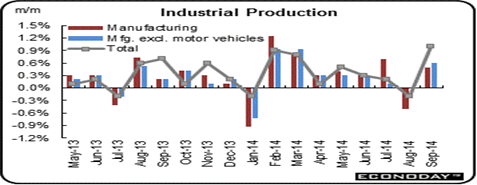
In fact,U.S. industrial production is approaching its historical average. Industrial production jumped an outsized 1.0 percent in September after a decline of 0.2 percent in August. Forecasts were for 0.4 percent. Overall capacity utilization jumped to 79.3 percent from 78.7 percent in August, close to its 80.1 percent long term average.

Manufacturing was solid, rebounding 0.5 percent in September after a 0.5 percent decline the month before. Within manufacturing, the production of durable goods increased 0.4 percent in September, led by the aerospace and miscellaneous transportation equipment. The production of nondurable goods also moved up 0.5 percent in September. With the exception of petroleum and coal products, each of the major components of nondurables posted gains in September.

So the warnings are real, but somewhat exaggerated. Europeans cannot allow prolonged slow growth policies that emphasize deficit reduction over job creation programs for long. And Fed Vice Chairman Fischer just emphasized that job creation is more important for Fed policy makers, and why the Fed will keep interest rates low for as long as possible, given almost no inflation, to spur more job creation.

Harlan Green © 2014

Follow Harlan Green on Twitter: https://twitter.com/HarlanGreen
Posted in Consumers, Economy, Keynesian economics, Macro Economics, Weekly Financial News | Tagged , , , , , , , , , , , , , , | Leave a comment

Why Do We Need Wars for Great Recoveries?

Financial FAQs

Nobelist Paul Krugman has said history tells us it could take another world war, or similar mobilization effort to put everyone back to work and economic growth to return to historical levels from the Great Recession—even an Alien Invasion would do it, he once quipped

In fact, the Great Recession was the equivalent of the Great Depression, which took more than 10 years of massive infrastructure building, retooling of whole industries, and a World War to recover. But aren’t the wars are we are now fighting—against ISIS, Ebola, and global climate change—such equivalents?

What do we mean by that? Even the New Deal wasn’t enough to get us out of the Great Depression. It took the mobilization of everyone in the effort of producing and building things to defeat a worldwide danger. Government as well as the private sector was involved, as all governments are during wartime. Governments created the jobs and paid the bills that produced the millions of tanks, planes, and war equipment needed to defeat our enemies.

Well, it looks like we already have more world wars on our hands. ISIS has declared war on infidels and apostates, the Ebola Virus could infect and maybe kill tens of not hundreds of thousands, and climate change is scheduled to flood major coastal cities by 2050.

The Pentagon has even said that global climate warming could provoke more wars and cost $trillions in lost property and foodstuffs if not dealt with soon. “Climate change will affect the Department of Defense ability to defend the nation and poses immediate risks to U.S. national security,” it has reported.

And the Ebola virus? The most authoritative model, at the moment, suggests a potential economic drain of as much as $32.6 billion by the end of 2015 if “the epidemic spreads into neighboring countries” beyond Liberia, Guinea and Sierra Leone, according to a recent study by the World Bank. This includes the possibility of the quarantine of whole countries, and the consequent reduction in world travel and trade.

The war against ISIS is also predicted to not only be very long, but very expensive. In a critically important article Harvard Professor Linda Bilmes wrote for the Boston Globe this week, the author of The Three Trillion Dollar War (with Nobel Prize winning economist Joseph Stiglitz) points out that although the US has already spent approximately one billion dollars thus far on President Obama’s plan to “degrade and destroy” ISIS, the price tag is going to climb steeply — and quickly — from there. Direct costs of the president’s plan will likely be on the order of $22 billion per year, but that is only the start.

Shouldn’t this call for mobilization of a nationwide campaign to defeat these enemies that threaten not just US, but the rest of the world? The 2014 Climate Change Adaptation Roadmap anticipates that rising temperatures, changing precipitation patterns, climbing sea levels and more extreme weather events will collectively have a profound effect on U.S. security:

‘In our defense strategy, we refer to climate change as a “threat multiplier” because it has the potential to exacerbate many of the challenges we are dealing with today – from infectious disease to terrorism. We are already beginning to see some of these impacts,” said the report.

A 127-page UN study on global warming “leaked” to Bloomberg News includes a 32-page summary and is filled with language highlighting the dangers from rising temperatures. Those include damage to crop production, rising sea levels, melting glaciers and more pervasive heatwaves. The report mentions the word “risk” more than 350 times; “vulnerable” or “vulnerability” are written 61 times; and “irreversible” comes up 48 times.

Possible permanent changes include the melting of the ice sheet covering Greenland. That would boost sea levels by as much as 7 meters (23 feet) and threaten coastal cities from Miami to Bangkok along with island nations such as the Maldives, Kiribati and Tuvalu.

This means putting everyone to work that wants to. It can be mass employment to rebuild the $2.2 Trillion in deferred infrastructure and climbing that the U.S. Society of Civil Engineers has been warning about, or putting the 11 million unemployed back to work building more schools, or cleaning up our environment, or replanting forests, or even rebuilding some of those homes that need to replace those lost during the housing bust.

There is currently a shortage of available homes with rental costs rising sharply. Government could subsidize the refinancing of home loans, as was done during the New Deal by the Home Owners Loan Corporation (HOLC). By the HOLC’s final year in 1936, it had provided just over a million new mortgages, had lent out approximately $350 billion ($750 billion today), and by 1934 about one in five mortgages in America were owned by the corporation. This is in contrast to just $1.8 billion spent by the Obama administration to date in subsidizing today’s distressed housing market.

Why not find a way to mobilize all our resources to fight those wars? GW Bush understood that government spending was required to fight his Wars on Terror, yet left us with the massive federal deficit because he wouldn’t mobilize and unite all Americans to participate. Instead he cut taxes sharply, rather than use the Clinton budget surplus to pay for it.

President Obama could cite the urgency to combat the spread of Ebola as well as ISIS in order to spend what is necessary to boost U.S. economic strength now. We have known since the Korean War that governments had to spend to create prosperity in peacetime as well as wartime. And what happens when we have another Hurricane Sandy or more Katrinas? Does anyone believe that we can’t afford to build what is necessary to prevent more natural disasters?

It’s only when those lessons of Great Depressions and wars are forgotten that we listen to the wrong people, forget we are a United States, and have the power to defeat such enemies.

Harlan Green © 2014

Follow Harlan Green on Twitter: https://twitter.com/HarlanGreen

Posted in Uncategorized | Tagged , , , , , , , , , , , , , , , | Leave a comment

Fannie/Freddie, Home Prices in Good Shape

The Mortgage Corner

Government-sponsored enterprises Fannie Mae and Freddie Mac brought in a combined second-quarter net income of $5 billion, nearly half of the $9.3 billion the two made in the first quarter of 2014, the Federal Housing Finance Agency’s Quarterly Performance Report of the Housing GSEs stated.   But the decline is attributed mainly to lower income from private-label mortgage-related securities settlements.

image

Graph: Housing Wire

On the other hand, both enterprises reported that continued improvement in national home prices contributed to releases of loan loss reserves at both enterprises, with combined loan loss reserves decreased $4.5 billion during the quarter. Since Dec. 31, 2013, combined loan loss reserves at the GSEs declined 10%, or $7.1 billion to $64.9 billion.

To put it in perspective, for the first half 2014, the Fannie and Freddie reported combined net income of $14.3 billion, driven by proceeds from legal settlements in the first quarter, as GSE and FHFA continued to reach agreements with a number of financial institutions to cover claims in connection with the purchases of Private Label Securities. Bank of America is the latest to settle a record $16.5 billion lawsuit on its mortgage malpractices, much of it due to the purchase of Countrywide Financial with its subprime mortgages.

The Case-Shiller Price Index of 3-month same-home prices continues to slow, but is still up 6.7 percent year-over-year. Fourteen for the 20-city sample show declines in the month with Chicago and Minneapolis showing the most severe declines, at minus 1.6 percent in the month. Three cities show no change leaving three with gains led by Las Vegas at only plus 0.3 percent.

image

Graph: Econoday

Lawrence Yun, NAR chief economist, says price increases are balancing out to the benefit for both buyers and sellers. “National median home prices began their most recent rise during the first quarter of 2012 but had climbed to unsustainable levels given the current pace of inflation and wage growth,” he said. “At this slower but healthier rate, homeowners can continue steadily building equity. Meanwhile, for buyers, increased supply with moderate price gains is giving them better opportunities to choose.”

image

Graph: Black Knight

So the real problem is how to preserve the home owning advantages that Fannie Mae and Freddie Mac guaranteed mortgages have enabled since World War II. The Obama administration wants to abolish and replace the GSEs with some kind of secondary market clearing house that will guarantee and package these conforming and Hi-Balance conforming mortgages for investors that provide the same security to investors with their strict underwriting criteria that has kept default rates low, historically.

There really is no reason to attempt to reinvent these very successful ‘wheels’ that only failed because of the Great Recession. They have already made the US Treasury a profit on what was lent to them, and with adequate capitalization would continue to service homeowners in ways that the so-called Private Label mortgages have never been able to do.

Harlan Green © 2014

Follow Harlan Green on Twitter: https://twitter.com/HarlanGreen

Posted in Consumers, Housing, housing market, Politics, Weekly Financial News | Tagged , , , , , , , , | Leave a comment