Higher Economic Growth In 2014

Financial FAQs

We should be seeing a huge jump in economic growth this year. Why? Most economists are saying businesses are more optimistic with the federal budget agreement for 2 years, and no more tax increases hanging over consumers (and businesses). Republicans even finally agreed to spend $1.1 trillion this fiscal year—that is, until September when another fiscal year begins.

I maintain the increase in government spending, healthier state tax coffers, and a reviving housing sector with housing prices up 13.6 percent annually according the S&P Case-Shiller Home Price Index, will be the main reasons for faster growth and more job creation this year.

We know this because the Census Bureau’s JOLTS report now shows 4 million job openings, and a rising ‘quit’ rate, which means job seekers are feeling optimistic enough about their prospects to voluntarily leave their current job.

clip_image002

Graph: Wrightson-ICAP

“After having risen by an average of 0.5 percent per month from the beginning of 2011 to the middle of 2013,” says Wrightson-ICAP, “the number of voluntary quits since July has climbed by 2.0% per month. The quit rate is important on two levels: it is both a general measure of worker confidence that tells us something about developments in the labor market, and it is a direct contributor to worker mobility, which is a key driver of productivity growth. (Matching workers to better jobs contributes to overall economic efficiency.)”

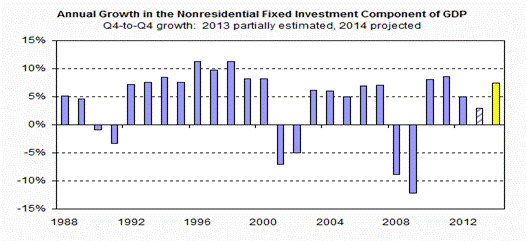
The best sign of an improvement in business optimism is the boost in capital expenditures. That expectation is based on a variety of factors, including the recent strength in the ISM factory orders index, a pick-up in capital spending plans by small businesses, and strong balance sheets and ample financing for larger companies. The capacity utilization data in Friday’s industrial production report reinforced that expectation. Total capacity utilization climbed to 79.2%, which is only one percentage point below the long-run (1972-2012) average that the Fed publishes as a reference point.

Wrightson-ICAP agrees with me on this, also. “As the aggregate level of capacity utilization rises, says Wrightson, many individual sectors are approaching or surpassing their previous cyclical highs. In the December data published last week, industries accounting for 33 percent of the Fed’s industrial production index had operating rates that were equal to or greater than their peaks in the previous cycle.
clip_image004

Graph: Wrightson-ICAP

There are other factors, as well, such as the pickup in consumer spending with higher December retail sales, and consumer confidence. This could lead to a GDP growth rate in the mid-3 percent range for 2014, up from the average 2 percent growth rate of late. It is a huge jump and just reflects the pent up demand for everything, as household balance sheets are turning positive and businesses begin to spend the cash they have been hoarding.

So the Federal Reserve will probably continue with its tapering of QE3 purchases that will cause long term interest rates to continue to rise. But it’s still the beginning of this business cycle, believe it or not. And there is almost no inflation, which will keep interest rates from rising too fast.

Harlan Green © 2014

Follow Harlan Green on Twitter: https://twitter.com/HarlanGreen

Posted in Consumers, Economy, Housing, housing market, Weekly Financial News | Tagged , , , , , , , | Leave a comment

Housing Construction Continues Increase

The Mortgage Corner

Residential investment and housing starts are usually the best leading indicator for economy, and they show continued growth.  This isn’t the only leading indicator, but it suggests the economy will continue to grow over the next couple of years, says Calculated Risk. Housing starts increased 18.3 percent in 2013 (initial estimate). This was another solid year-over-year increase.

After increasing 28 percent in 2012 and 18 percent in 2013, the 923 thousand housing starts in 2013 were the sixth lowest on an annual basis since the Census Bureau started tracking starts in 1959 (the three lowest years were 2008 through 2012).   But Single Family starts have increased by one-third since the end of the Great Recession, as the supply of foreclosed homes and existing-home inventories have sharply declined.

starts

Graph: Calculated Risk

Starts averaged 1.5 million per year from 1959 through 2000.  Demographics and household formation suggests starts will return to close to that level over the next few years. That means starts will probably increase another 50 percent + from the 2013 level, says Calculated Risk.

But there is a caveat to this scenario. Most economists are banking on new Fed Chairwoman Yellen to maintain QE3 at least through this year, while the ‘Taperians’ such as Governors Lacker and Fisher want to end it sooner, which would continue to boost mortgage rates, needless to say.

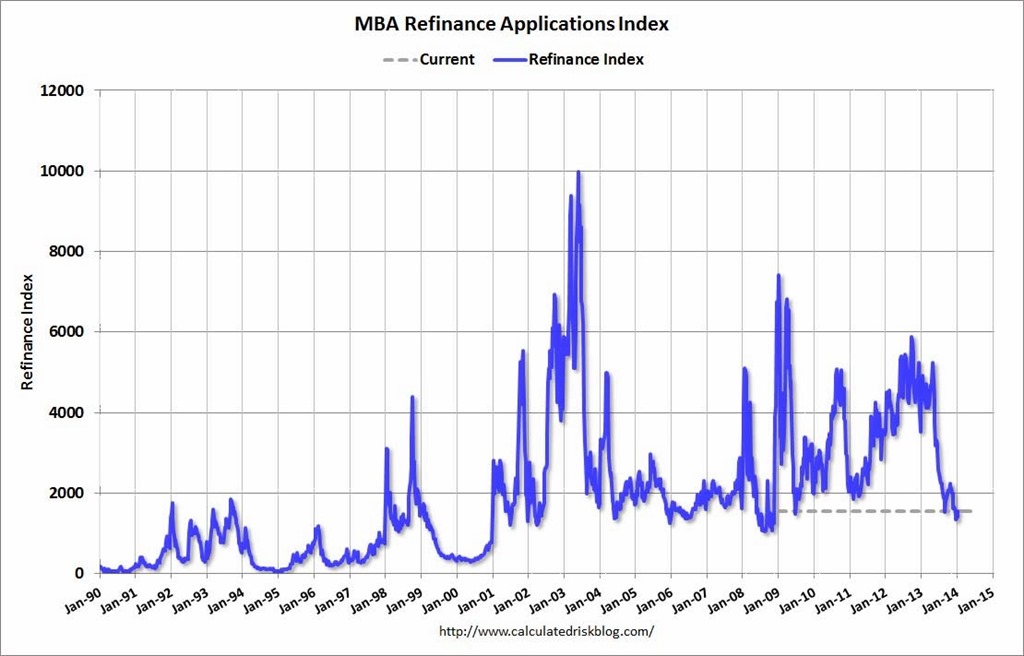
The latest mortgage origination figures support the slowdown in applications since rates have risen, according to the MBA’s weekly survey. Though there is a growing demand for new homes with inventories of existing homes on the market down to a 5.1 months’ supply, whereas inventories were as high as 8 months post-housing bubble.

Mortgage applications increased 11.9 percent from one week earlier, according to data from the Mortgage Bankers Association’s (MBA) Weekly Mortgage Applications Survey for the week ending January 10, 2014.

But it is down to its lowest level during the Great Recession. The MBA’s purchase applications index is also down for the year. This is mainly due to rise in mortgage rates of some 1 percent since April and former Fed Chairman Bernanke’s announcement that QE3 would begin to end sometime this year.

refinance

Graph: Calculated Risk

So it is not a given that real estate sales and prices will rise in 2014 as they have in 2013, when the S&P Case-Shiller Home Price Index rose some 13.6 percent. The key will be construction spending, which has been robust in 2013.

construction

Graph: Calculated Risk

The U.S. Census Bureau just announced that privately-owned housing starts in December were at a seasonally adjusted annual rate of 999,000. This is 9.8 percent below

the revised November estimate of 1,107,000, but is 1.6 percent above the December 2012 rate of 983,000. Single-family housing starts in December were at a rate of 667,000; this is 7.0 percent below the revised November figure of 717,000. An estimated 923,400 housing units were started in 2013. This is 18.3 percent above the 2012 figure of 780,600.

Harlan Green © 2013

Follow Harlan Green on Twitter: https://twitter.com/HarlanGreen
Posted in Uncategorized | Tagged , , , , , | Leave a comment

Post-WWII Lessons—How to Reduce Debt?

Financial FAQs

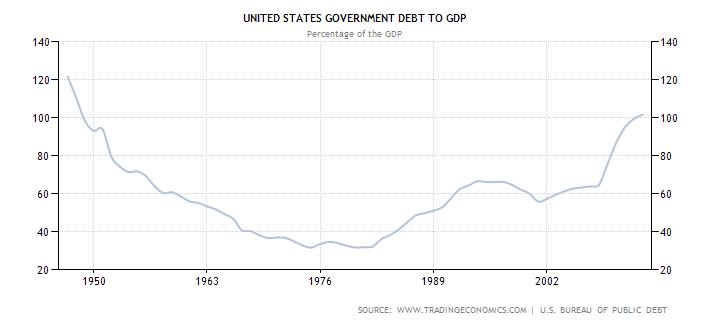
There is a productive way to pay down the federal and consumer debt loads instead of the austerity policies currently in vogue both here and in Europe (i.e., that cut taxes and government spending). It’s means implementing policies that will increase average household incomes; and tax revenues in the case of governments. We know this works because it happened after World War II with its record 120 percent of GDP debt load that was reduced to as low as 31.7 percent in the 1974.

But the debt has climbed back to 100 percent of GDP today (including $5 trillion owed to the social security trust fund) for a variety of reasons; including spending for the 2 Wars on Terror + an extensive domestic security apparatus that wasn’t paid for, regressive tax policies, the decline in household incomes, and the Great Recession itself.

govdebt

Graph: Trading Economics

The last 4 years of Clinton’s presidency also gave us 4 federal budget surpluses. This was because of a slightly higher maximum federal income tax rate while capping government spending, mainly because of the post-cold war drop in military spending during the longest growth cycle (10 years) in U.S. history.

The fallacy is to believe that it can’t happen today. Because, the story goes, only the immediate post-WWII society had lots of savings so that Eisenhower’s sky-high maximum income tax rate of 92 percent didn’t harm private spending and investment. That was why consumers could afford all those new consumer goods, fund a new freeway system and travel to the moon.

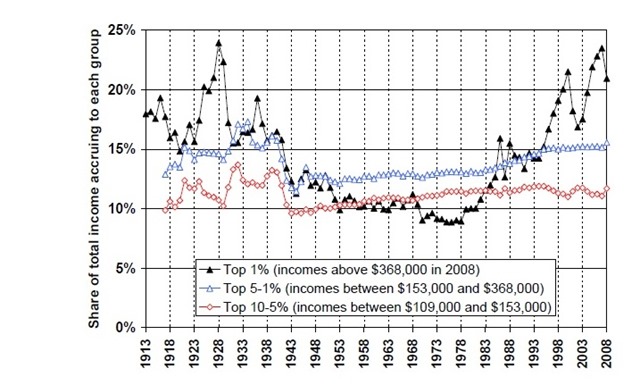
But there is as much wealth saved today. Only it has become very concentrated. Those with the wealth today—such as the top 1 percent that hold some 23 percent of our total wealth—also have very high savings rates. According to research from American Express Publishing and Harrison Group, the savings rate of the wealthiest 1 percent soared to 37 percent in the second quarter 2013. That’s up from 34 percent in the second quarter of 2012—and more than three times their savings rate in 2007. And it contrasts with the current 4.2 percent personal savings rate for all consumers.

Studies in fact show that increasing the maximum tax rate to as high as the 80 percentage wouldn’t harm consumption, the main driver of domestic economic growth. Today, the richest 1 percent of Americans pay a top federal rate of 29 percent, according to Emmanuel Saez, an economist at the University of California, Berkeley. That’s because almost a third of their income derives from capital gains and dividends — which are now taxed at around 20 percent rate — while the rest is ordinary income taxed at a top marginal rate of 39.6 percent.

Today, people earning over $200,000 a year capture more than a third of national income. In fact, three decades of tax cuts may have gilded the pockets of the rich, but they didn’t provide much economic juice, says one study. Among developed nations, incomes per person grew no faster in countries like the United States and Britain that slashed their top tax rates than in countries like Spain, Germany or Denmark, which did not.

There is even evidence that higher tax rates encourage growth. For instance, reducing inequality through higher tax rates on the wealthy may promote wealth creation. What’s the mechanism? Bowles and Jayadev claim to have identified one element of it: inequality leads to conflict and tensions, and society has to waste resources dealing with those conflicts and tensions.

The people at the top have to spend a lot of time and energy keeping the lower classes obedient and productive. So-called “guard labor” is one such waste, says the study. Some estimates say that 1 in 4 Americans are employed to keep fellow citizens in line and protect private wealth. This waste includes corporate IT monitoring, CCTV at work, and mobilizing police forces to protect property.

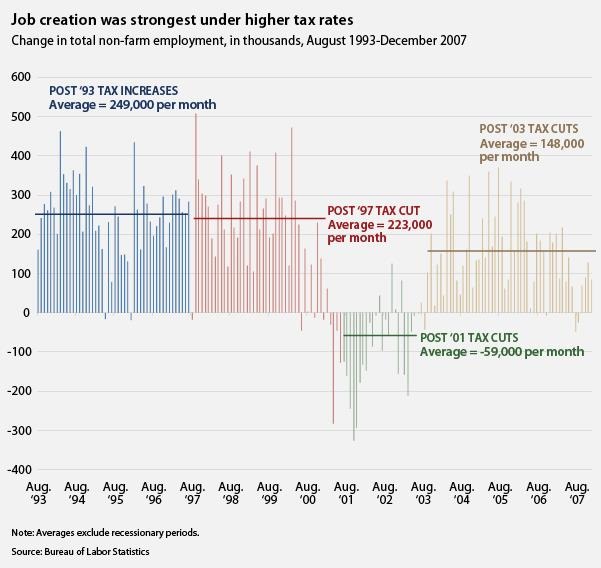
jobcreate

Graph: Center For American Progress

And the above figure shows that there is no correlation between cuts in U.S. top tax rates and average annual real GDP-per-capita growth since the 1970s. Countries that made large cuts in top tax rates such as the United Kingdom or the United States have not grown significantly faster than countries that did not, such as Germany or Denmark.

How to increase household incomes is more difficult, as many right-to-work states have limited both collective bargaining and union membership for middle class workers that have prevented their incomes from even keeping up with inflation. But there are movements to increase the minimum wage, as well as strengthen collective bargaining laws for better wages and benefits. The ongoing economic recovery and increasing employment will also boost both incomes and tax revenues.

So there are many good reasons to support policies that increase tax revenues and household incomes, and no longer valid reasons for austerity policies that actually increase deficits, as well as depress household incomes.

Harlan Green © 2013

Follow Harlan Green on Twitter: https://twitter.com/HarlanGreen

Posted in Consumers, Economy, Keynesian economics, Macro Economics, Weekly Financial News | Tagged , , , , , , | Leave a comment

Will 2014 Be a Janet Yellen Rally?

Popular Economics Weekly

Consumer spending and future economic growth will depend on just how hard New Fed Governor Janet Yellen pushes the Federal Reserve Governors to maintain QE3 in 2014. She is a UC Berkeley economist interested more in creating jobs, and most of the Governors are bankers that would rather fight the fear of inflation than focus on keeping interest rates low enough to create those jobs. The December unemployment report was terrible, needless to say, with just 74,000 net nonfarm payroll jobs added.

It’s a contest between the Austerians (or Taperians), such as Fed Governors Lacker and Fisher that would end QE3 sooner vs. the Accomodators, such as Minneapolis Fed Governor Kacherlakota, which would like credit to remain easy until the unemployment rate drops below 6 percent—perhaps to 5.5 percent and closer to full employment. So how much will Dr. Yellen resist further tapering of QE3 is a big question to be answered at her first January FOMC meeting.

Taking out autos and gasoline, November consumer spending wasn’t that bad, but it could be all the holiday shopping, which is seasonal and could drop in January. So this is one indicator that will help decide what the Fed Governors do next with new Fed Governor Janet Yellen.

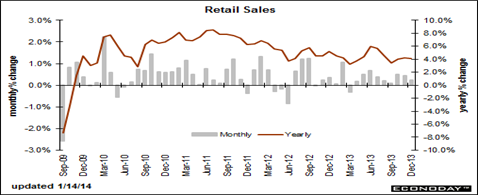
The latest retail sales report suggests a moderately healthy consumer sector-somewhat in contrast to the December employment report. Overall retail sales in December rose 0.2 percent, following an upwardly revised gain of 0.7 percent the month before (originally up 0.4 percent). Analysts forecast no change for the overall December figure.

image

Graph: Econoday

As expected, autos tugged down sharply on sales. Motor vehicle & parts dropped 1.8 percent after a 1.9 percent increase in November. Excluding both autos and gasoline, sales advanced a healthy 0.6 percent in December, following a 0.3 percent gain in November. In the core, strength was seen in food & beverage stores, health & personal care, clothing, nonstore retailers, and food services & drinking places.

image

Graph: Econoday

Consumers are also modestly optimistic about the economy, based on the expansion of consumer credit.  (This could have a lot to do with those low interest rates, which include mortgage rates, and it is such low mortgage rates that have boosted housing prices.) Consumer credit rose $12.3 billion in November—a solid gain. Details showed a rare back-to-back gain for revolving credit, up a modest $0.5 billion but following a $4.0 billion gain in October which was the third largest gain of the whole recovery. The last time revolving credit rose 2 months in a row was back in January and February of last year.

So maybe we will have a Yellen rally, based on her well-publicized views on the importance of the labor side (vs. the owners, including corporations) in a strong economy—especially the 80 percent of wage and salary workers whose incomes haven’t risen at all with inflation since 2000.

Harlan Green © 2013

Follow Harlan Green on Twitter: https://twitter.com/HarlanGreen
Posted in Uncategorized | Tagged , , , , , , | Leave a comment

Unemployment Still the Problem

Financial FAQs

Friday’s U.S. unemployment report might have been an aberration due to the severe winter with just 74,000 nonfarm payroll jobs created, according to the Bureau of Labor Statistics, but how many of those workers who left the labor force might never return? The civilian participation rate fell to 62.8 percent, which is a 35-year low.

We are now in the 71st month of the recovery without employment having returned to its prior peak (red line in graph). It was the GW Bush recovery that held the record of 47 months until then (brown line on graph), which highlights just why tried and true New Deal era measures, such as expanding social welfare programs and reviving public sector jobs, are needed to revive economic growth for Main Street workers.

image

Graph: Calculated Risk

The lack of jobs is the real problem. Discouraged workers no longer looking for work (down 347,000) dropped the December unemployment rate to 6.7 percent from 7 percent, rather than more workers entering the workforce. And this highlights the 700,000 government jobs lost from the Great Recession, instead of public sector jobs being added or retained to help the recovery, as was done during Roosevelt’s New Deal. It also highlights the growing popularity for extending unemployment and food stamps benefits to middle class workers that have lost jobs and income, as well as the poorest reported in Paul Krugman’s latest NY Times column.

So this hardly shows the need for more Fed tapering at the moment. It is the low interest rates and cheap money that have enabled soaring auto sales, and yes, housing construction to rebound with private construction adding the most jobs since 2006, according to ADP and Moody’s Analytic’s Mark Zandi.

image

Graph: WSJ Marketwatch

As much as Fed Chairman Bernanke tried to sound optimistic during his most recent speech, government and both political parties are only now beginning to think about how to create more jobs. The problem won’t be economic growth, as productivity is soaring thanks to technology, but political policies that shed the public sector of jobs and public projects that pay forward for future growth.

Growth can’t become sustainable unless highways and bridges are improved, more teachers are hired, and spending on the research and development of future products is boosted. And that can only happen if governments are solvent again, which means increasing tax revenues, either with higher minimum wage rates and/or a more equitable tax rate structure.

Right now, wage and salary earners pay a rising portion of their incomes in taxes, whereas investors’ share of capital gains and income tax has shrunk, which allows wealthy investors to have effective tax rates in the teens. And workers can’t buy more products, unless wages are rising again.

image

Graph: EPI

It’s the Henry Ford story all over again. His workers couldn’t buy enough of his cars until he raised their wages to $5 per day. So it will take the middle class rising up again to claim their benefits from the forces that took them away, claiming the profits from increased labor productivity for themselves.

Harlan Green © 2013

Follow Harlan Green on Twitter: https://twitter.com/HarlanGreen
Posted in Consumers, Economy, Keynesian economics, Politics, Weekly Financial News | Tagged , , , , , , , , | Leave a comment

Housing Inventories, Price Rises Slowing

The Mortgage Corner

The most important housing statistic in 2014 will be whether inventories continue to increase. Low inventories are hurting sales, and Goleta, California is helping local supplies with several new housing projects in the works.

This is because interest rates and housing prices are rising and the most affordable housing sold off quickly, which has slowed existing-home sales, in particular. New-home construction and sales are doing well, however, because of what is becoming a housing shortage as the economy and jobs continue to recover.

Existing-home inventories have declined in 2013 as most of the 2 million plus foreclosed and abandoned housing lost during the Great Recession have been gobbled up by investors and are being rented back. For sale inventories increase if housing prices continue to rise, of course, and the various housing price indexes show just that going into 2014.

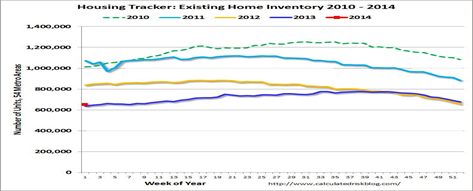
Calculated Risk reports that Ben at Housing Tracker (Department of Numbers) has provided some weekly inventory data for the last several years. This graph shows the Housing Tracker reported weekly inventory for the 54 metro areas for 2010, 2011, 2012, 2013 and 2014.

image

Graph: Calculated Risk

“In 2011 and 2012, inventory only increased slightly early in the year,” says Calculated Risk, “and then declined significantly through the end of each year. Inventory in 2014 is now 2.0 percent above the same week in 2013 (red dot is 2014, blue is 2013). Inventory is still very low – and barely up year-over-year – but this increase in inventory should slow house price increases.”

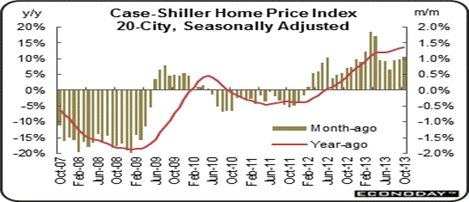
The S&P Case Shiller Home Price Index, a 3-month average of same-home prices, continued to climb. So in part due to limited supply, home price momentum was “solid and steady” going into year-end.  The Case-Shiller adjusted home price index for October showed a gain of 1.0 percent for the 20-city index.  This matched September’s gain and compares with gains of 0.9 and 0.6 percent in the two prior months. The year-on-year gain of 13.6 percent was up 3 tenths for the best rate of the recovery.

image

Graph: Econoday

Gains were in all 20 cities for a 3rd month in a row, said the report, led in October by Miami at plus 1.9 percent and followed by Atlanta and Detroit, both at 1.8 percent. Year-on-year rates were strongest out West with several above 20 percent, including Las Vegas and San Francisco.

Lastly, new-home construction is booming, which should increase the housing supply somewhat. Private residential construction in particular posted a 1.9 percent rebound in November after a 0.4 percent dip the month before. Both the new single-family and new multifamily subcomponents rose notably.

New single-family home outlays increased 1.8 percent, following a decline of 0.4 percent in October. New multifamily spending advanced 0.9 percent after a 3.4 percent jump the month before. Residential outlays excluding new home outlays rebounded 2.2 percent, following a dip of 1.3 percent the month before.

We are seeing a surge in the Santa Barbara South Coast with several new housing developments in the City of Goleta. A total of 177 units are now under construction or completed, including Haskell’s Landing (102 units), The Bluffs (62 units), and Willow Springs (100 condo units).

Harlan Green © 2013

Follow Harlan Green on Twitter: https://twitter.com/HarlanGreen
Posted in Consumers, Housing, housing market, Weekly Financial News | Tagged , , , , , , | Leave a comment

Beware of the Taperians!

Popular Economics Weekly

Now that the Fed has begun to reduce its QE3 securities’ purchases $10B per month in January, what will that do for growth? My answer is it’s too soon to say. Firstly, beware of the ‘Taperians’, those who would end QE3 too soon. As outgoing Fed Chairman Bernanke explained in his most recent speech, without QE3 we might have regressed back into a recession.

“”Skeptics have pointed out that the pace of recovery has been disappointingly slow, with inflation-adjusted GDP growth averaging only slightly higher than a 2 percent annual rate over the past few years and inflation below the Committee’s 2 percent longer-term target,” Bernanke said at the American Economic Association annual meeting in Philadelphia. “However, as I will discuss, the recovery has faced powerful headwinds, suggesting that economic growth might well have been considerably weaker, or even negative, without substantial monetary policy support. For the most part, research supports the conclusion that the combination of forward guidance and large-scale asset purchases has helped promote the recovery.”

Then there are the political ‘headwinds’. Will the next 2 years’ budget agreement mean no more budget fights for a while, or will opponents to Obamacare continue to throw up roadblocks to its implementation in the 35 states that wouldn’t set up their own health care exchanges? This would make it more expensive and wasteful of government resources, needless to say.

Yet it seems at least one Fed Governors has been sounding the need to end QE3 before its time—Richmond Fed Governor Jeff Lacker. Lacker has been most vocal in wanting to rein in QE3 almost from its start last fall, and one who most consistently voted against continuing it at subsequent FOMC meetings. The reason? He’s an inflation hawk, or ‘inflationista’ (P Krugman’s term), as well as deficit hawk that fears all those bonds bought by the Fed will create runaway inflation (and deficits), once they are sold back into the economy.

In other words, he belongs to the ‘confidence fairy’ camp (another Krugman term) that believes business confidence is the key to growth, instead of consumer demand for their products, and businesses will lose confidence when interest rates and debt servicing costs rise, increasing budget deficits. But what about consumer confidence, when consumers are currently spending at a 4 percent annual rate, which is the largest component of overall demand?

“Businesses also appear to be quite reticent to hire and invest,” said Lacker in his most recent report. “A widely followed index of small business optimism fell sharply during the recession and has only partially recovered since then. Interestingly, when small business owners were asked about the single most important problem they face, the most frequent answer in the latest survey was “government regulations and red tape.” This observation accords with reports we’ve been hearing from many business contacts for several years now. They’ve seen a substantial increase in the pace of regulatory change and a substantial increase in uncertainty about the shape of new regulations. Both are said to discourage new hiring and investment commitments.”

image

Graph: DShort

However that is not all survey results show in the December 10 NFIB report. “The net percent of all owners (seasonally adjusted) reporting higher nominal sales in the past 3 months compared to the prior 3 months was unchanged at a negative 8 percent. Fifteen percent still cite weak sales as their top business problem, but it is the lowest reading since June 2008. The net percent of owners expecting higher real sales volumes rose 1 point to 3 percent of all owners after falling 6 points in October (seasonally adjusted), a weak showing.”

In fact, the lack of consumer demand for their products is still the chief problem, not federal regulations or high taxes, as shown by their lack of need for more credit. “…only 2 percent of NFIB members cite credit and interest rates as their top business problem,” says the NFIB report,  “and a record 66 percent expressed no interest in a loan, obviously due to their dismal view of the future of the economy. It’s not a problem of credit supply; it’s a lack of credit demand due primarily to poor economic prospects.”

What does Lacker say about consumer demand, the largest driver of economic growth, as we said? That consumer sentiment is still depressed because of economic ‘uncertainty’. “Although consumption grew rapidly at the end of last year, we have seen similar surges since the last recession, only to see spending return to a more moderate trend. Consumer spending trends are likely to depend on whether the dramatic events of the last few years are only a temporary disturbance to household sentiment or if they instead represent a more persistent shift in attitudes about borrowing and saving. At this point, I am inclined toward the latter view (i.e., that household sentiment remains depressed).

Once again he talks about sentiments, rather than real income and wealth, which are the main determinants of consumer spending. It is their actual wealth that determines consumers’ spending habits, much more than what they feel about future prospects, research has shown.

So it’s true consumers are still being cautious, but several factors are improving consumer confidence. For example, said Bernanke, “notwithstanding the effects of somewhat higher mortgage rates, house prices have rebounded, with one consequence being that the number of homeowners with “underwater” mortgages has dropped significantly, as have foreclosures and mortgage delinquencies. Household balance sheets have strengthened considerably, with wealth and income rising and the household debt-service burden at its lowest level in decades.

If in fact Fed Governor Lackey believes consumer and business uncertainty is still too high, he should not be supporting an early end to the QE3 taper. Consumers and businesses are still facing an uncertain future. Is this the time to be taking away the credit ‘punch bowl’, with the private sector holding back?

So beware of those Taperians which cite the shortcomings of governments, rather than their own policies that hamper future prosperity.

Harlan Green © 2013

Follow Harlan Green on Twitter: https://twitter.com/HarlanGreen

Posted in Consumers, Economy, Housing, Keynesian economics, Macro Economics, Politics, Weekly Financial News | Tagged , , , , , | Leave a comment

The Great Income Divergence—II

Financial FAQs

Ben Bernanke is now defending his record as Fed Chairman. He shouldn’t have to, as without the Fed’s easy money policies—such as QE3—the economy would surely have plunged back into recession, as the European Union has done with its ongoing austerity policies. This is but the outcome of the Great Divergence in wealth that has occurred over the past 30 years, and why the Fed had to maintain its massive injection of money into the economy over such a long period of time.

tp11

Graph: Economix

“Skeptics have pointed out that the pace of recovery has been disappointingly slow, with inflation-adjusted GDP growth averaging only slightly higher than a 2 percent annual rate over the past few years and inflation below the Committee’s 2 percent longer-term target,” Bernanke said at the American Economic Association annual meeting in Philadelphia. “However, as I will discuss, the recovery has faced powerful headwinds, suggesting that economic growth might well have been considerably weaker, or even negative, without substantial monetary policy support. For the most part, research supports the conclusion that the combination of forward guidance and large-scale asset purchases has helped promote the recovery.”

History will surely ask what the Great Divergence has done for America and Americans, when its results are assessed. As of now, we seem to have achieved very little for the long term, if anything—at least since 1980. Its rationale was that by transferring more wealth to investors and corporations, the suppliers of goods and services rather than the buyers of those products, would increase employment and household wealth.

But, alas, that didn’t happen. Employment was actually much higher when tax rates were raised under President Clinton, and growth was higher when governments spent more to stimulate growth, hallmarks of Keynesian policies, rather than the austerity policies that were the hallmark of the so-called supply-siders.

Perhaps its end result was the Great Recession, just as the Great Depression ended the Roaring Twenties period of excesses. We know that this Great Divergence resulted in reduced household incomes for all but the top 1 percent, record corporate profits as a percentage of GDP, and a personal savings rate that dropped to 0 during the runup to the Great Recession.

Nothing was done for the future, in other words. Two wars were fought that drained necessary resources from domestic priorities, reduced retirement pensions, environmental safeguards, and drove some large cities into bankruptcy.

Another result of the Great Divergence in wealth are the austerity policies that have gripped America and Europe since 2009, resulting in sky-high unemployment rates in some European countries, and increasing, rather than decreasing budget deficits. These policies, including opposing U.S. debt ceiling increases and across the board sequester spending cuts, are the direct result of those calling for ever smaller government, lower taxes and less social welfare spending—at a time when just the opposite is needed.

What is to be done, with so much wealth concentrated in so few hands? Will governments continue to be too weak to regulate those beneficiaries of the Great Divergence that continue to deprive minority and poor voters of their right to vote, women of their right to contraception, and employees of their right to collective bargaining in the many right to work states?

This is but a short list of damages done by the Great Divergence in wealth that cries for a resurgence of New Deal legislation and regulation.

Harlan Green © 2013

Follow Harlan Green on Twitter: www.twitter.com/HarlanGreen
Posted in Economy, Macro Economics, Politics, Weekly Financial News | Tagged , , , , , , | Leave a comment

Mortgage Defaults Continue to Fall

The Mortgage Corner

Fannie Mae reported last week that the Single-Family Serious Delinquency rate declined in November to 2.44 percent from 2.48 percent in October. The serious delinquency rate is down from 3.30 percent in November 2012, and this is the lowest level since December 2008. This is when Fannie Mae serious delinquency rate peaked in February 2010 at 5.59 percent.

And Freddie Mac, the other GSE now administrated by the Federal Housing Finance Authority (FHFA), reported the Single-Family serious delinquency rate declined in November to 2.43 percent from 2.48 percent in October. Freddie’s rate is down from 3.25 percent in November 2012, and is at the lowest level since March 2009. Freddie’s serious delinquency rate peaked in February 2010 at 4.20 percent.

image

Graph: Calculated Risk

This tells us several things. Firstly, housing price continue to increase, with the Case-Shiller Home Price index now up 13.6 percent in 2013, so that homeowners now have more equity. Las Vegas and San Francisco had the largest prices increases in the 20 city index. And jobs are becoming more plentiful so that home owners are now able to sell or refinance their homes, rather than default on their mortgages. But the Fed will begin in January to cut back $10B per month in so-called Quantitative Easing securities’ purchases that has kept long term rates low since last September.

image

Graph: Calculated Risk

But the cutback in QE3 has S&P and banks worried about the future of housing in 2014. “Home prices increased again in October,” says David M. Blitzer, Chairman of the Index Committee at S&P Dow Jones Indices. “Both Composites’ annual returns have been in double-digit territory since March 2013. However, monthly numbers show we are living on borrowed time and the boom is fading.

“The key economic question facing housing is the Fed’s future course to scale back quantitative easing and how this will affect mortgage rates. Other housing data paint a mixed picture suggesting that we may be close to the peak gains in prices. However, other economic data point to somewhat faster growth in the new year. Most forecasts for home prices point to single digit growth in 2014.”

So relatively low interest rates will be a key to housing’s health in 2014, as well as whether the unemployment rate continues to decline. The prognostications so far are favorable, with unemployment projected to drop to 6.5 percent. And I believe interest rates will remain in the 4 percent range in 2014, since household incomes and therefore inflation, which reflects how much buying power consumers can maintain, will remain low.

Harlan Green © 2013

Follow Harlan Green on Twitter: www.twitter.com/HarlanGreen
Posted in Consumers, Economy, Housing, housing market, Politics, Weekly Financial News | Tagged , , , , , , | Leave a comment

What Happens in 2014??

Popular Economics Weekly

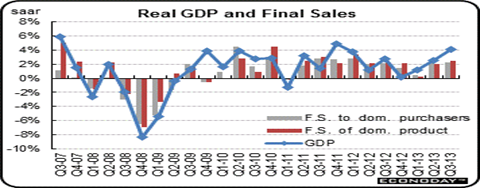
Next year could start with a bang. U.S. third quarter Gross Domestic Product expanded at 4.1 percent, revised up from 3.6 percent, with consumer spending a main driver of growth. This has to mean consumers are feeling prosperous again, and if employment continues to rise as predicted by the Fed, and others, so will consumers’ incomes and spending.

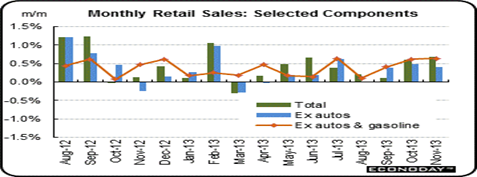
Retail sales are also strong with the holidays looking good.  Overall retail sales in November jumped 0.7 percent, following a rise of 0.6 percent the month before (originally up 0.4 percent).  Autos were a big part of the November boost, gaining 1.8 percent after a 1.1 percent increase in October, so that annual sales are approaching 5 percent, and 6 percent is closer to a normal sales rate, and full employment.

image

Graph: Econoday

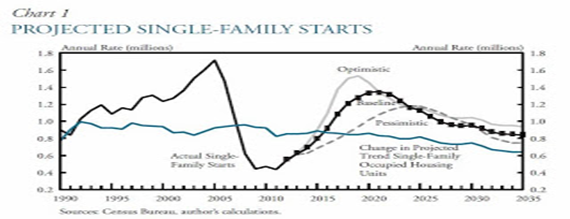
The Kansas Federal Reserve Bank just released a study that says single family starts could increase by 150 percent from 2012 to their peak in 2021 (Chart 1). The annual level of starts at this peak is about the same as in 2002, one year into the single-family construction boom. Single-family construction is then projected to fall over the subsequent decade.

image

Graph: Calculated Risk

Demand in particular was raised in the GDP report, and increasing demand for goods and services is what induces businesses and economies to grow. Final sales of domestic product were revised up to 2.5 percent, compared to the second estimate of 1.9 percent and 2.1 percent in the second quarter. Final sales to domestic purchasers (which exclude net exports) were bumped up to 2.3 percent versus the second estimate of 1.8 percent and 2.1 percent in the second quarter.

image

Graph: Econoday

The best news of all was the bipartisan budget agreement that put off any talk of indiscriminate sequester cuts for the next 2 years. It will add back a total of $85 billion to government spending and will give an additional boost to growth in 2014. It has been the decline in government investments and employment in particular that have been the largest roadblock to increased growth.

Under the terms of the deal, spending for the Pentagon and other federal agencies would be set at $1.012 trillion for fiscal 2014, said the Washington Post, midway between the $1.058 trillion sought by Democrats and the $967 billion championed by Republicans. The Pentagon would get a $2 billion increase over last year, while domestic agencies would get a $22 billion bump, clearing space for administration priorities such as fresh investments in education and infrastructure.

Harlan Green © 2013

Follow Harlan Green on Twitter: www.twitter.com/HarlanGreen
Posted in Consumers, Economy, Weekly Financial News | Tagged , , , , , , | Leave a comment