Is Builder Optimism, New Home Construction Faltering?

The Mortgage Corner

Will new-home construction falter, now that interest rates are rising and consumers remain unsettled over Washington’s political gridlock that prevents any legislation being passed that would aid economic growth?

Builder confidence in the market for newly built, single-family homes was unchanged in November from a downwardly revised level of 54, reported the National Association of Home Builders/Wells Fargo Housing Market Index (HMI). This means that for the sixth consecutive month, more builders have viewed market conditions as good than poor, since any index value above 50 percent, means a majority of builders report growing activity. But that hasn’t spurred more new-home construction, which is stuck at early spring levels.

image

Graph: Calculated Risk

“Given the current interest rate and pricing environment, consumers continue to show interest in purchasing new homes, but are holding back because Congress keeps pushing critical decisions on budget, tax and government spending issues down the road,” said NAHB Chairman Rick Judson. “Meanwhile, builders continue to face challenges related to rising construction costs and low appraisals.”

“Policy and economic uncertainty is undermining consumer confidence,” said NAHB Chief Economist David Crowe. “The fact that builder confidence remains above 50 is an encouraging sign, considering the unresolved debt and federal budget issues cause builders and consumers to remain on the sideline.”

New-home construction has basically stalled since April and the beginning of interest rates increases due to the Fed’s hints that QE3 could end. This will hurt economic growth and employment, since new-home construction makes up a large part of economic growth these days, with other growth components are being constrained by lower government and consumer spending.

image

Graph: Calculated Risk

There has been a significant increase in new home sales this year.  Sales of new single-family houses in August 2013 were at a seasonally adjusted annual rate of 421,000, according to estimates by the U.S. Census Bureau and the Department of Housing and Urban Development. This is 7.9 percent above the revised July rate of 390,000 and is 12.6 percent above the August 2012 estimate of 374,000
Read more at

Though year-over-year increases have slowed – August only saw a year-over-year increase of 12.6 percent, but Calculated Risk’s Bill McBride still expects new home sales to be up 15 percent to 20 percent for the year.  That follows an annual increase of 21 percent in 2012.

The seasonally adjusted estimate of new houses for sale at the end of August was 175,000. This represents a supply of 5.0 months at the current sales rate. It means that new home construction has not taken up the slack in supply, and might slow new-home sales.

The initial third Quarter GDP growth was 2.8 percent, up from 2.5 percent in Q2. And residential real estate activity was a large part of that increase. So we will need more new-home construction to keep growth at that level.

Harlan Green © 2013

Follow Harlan Green on Twitter: www.twitter.com/HarlanGreen
Posted in Consumers, Economy, Housing, housing market, Politics, Weekly Financial News | Tagged , , , , | Leave a comment

Why Do We Have Two Countries?”

Popular Economics Weekly


Former CIA assistant director Mike Morell lamented on a recent CBS 60 Minutes that he didn’t understand why congressional Democrats and Republicans couldn’t work together to boost economic growth for “the good of the country” when our weak economy was the greatest problem facing US, above even terrorist threats.

“I don’t understand the inability of our government to make decisions that push our economy and society forward,” he said. “Our national security is more dependent on the strength of the economy and society than anything else.”

The real answer is that we are living in two countries at the moment, mainly divided into anti-government Republican Red states and pro-government Democratic Blue states. And the Red states are suffering, with the lowest per capita incomes, education levels, and everything else that modern economies need to thrive.

To be sure it’s about politics and Republican ideological intransigence. But in the Old South it’s also about fighting the last Civil War—which means preserving racism. They are getting their wish to secede from the union, but it’s economically rather than politically.

This is while those states depend on government most for their social safety needs, whether it is farm subsidies or food stamps and Medicare for their poorest populations. More government monies flow into their states than flow back to the federal government, in other words.

This is a little-known fact that puzzles economists. Why are the states most dependent on government aid most opposed to it, particularly to Obamacare and the expansion of Medicare?

“A South Carolina legislator put it bluntly earlier this year,” in a recent Huffington Post column. “State Rep. Kris Crawford told a business journal that he supports expansion, but said electoral math is the trump card. “It is good politics to oppose the black guy in the White House right now, especially for the Republican Party,” he said.”

Most of the Red states also adamantly oppose the expansion of voters’ rights, union collective bargaining, better healthcare, immigrants’ rights, environmental regulation, abortion and women’s rights, as if they want to turn the clock back to the last century.

Government gridlock not only endangers our security, but the resultant inequality—greatest in the Red states—endangers our democratic system itself, needless to say. The CIA should know, as it has kept track of the economic well-being of nations in its World Factbook, with the U.S. now ranked below other developed countries in income equality, birth-death rates, longevity, and health outcomes.

The problem today is the huge amount of damage gridlock is doing to economic growth, from downgrades of government debt by Standard & Poor’s rating agency to reluctant consumer spending. Even Moody’s has put U.S. debt on credit watch. The Red and Blue states seem to still be fighting the Civil War all over again after 150 years, as I’ve said in past columns.

So the question is, government and the Congress should work for the good of whose country? Tea Partiers and southern politicians in particular want to take back “their” country. If that is their sentiment, we will have two countries living one century apart.

Harlan Green © 2013

Follow Harlan Green on Twitter: www.twitter.com/HarlanGreen

Posted in Consumers, Economy, Macro Economics, Politics, Weekly Financial News | Leave a comment

Thanks For Nothing, Washington!

Financial FAQs

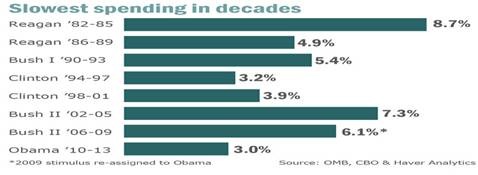
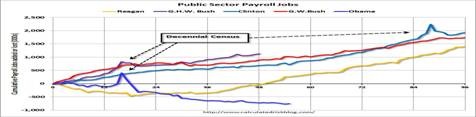
Democrats have bought the Republican lie that Democrats were the big spenders, it seems, with the draconian federal budget cuts enacted over the past 2 years. But recent statistics show it’s been the Republicans since 1980 that created the most state and federal government jobs—4,289,000 under the Reagan and 2 Bush administrations, whereas Clinton created 1,934,000 jobs, while 752,000 government jobs have been lost to date during the Obama Administration.

The result of the huge cutbacks in government spending and hiring since the Great Recession has been an economy still stalled—especially in overall jobs and lost output.

WSJ Marketwatch’s economist Rex Nutting highlighted this recently. Though we are out of the Great Recession, and the just announced Q3 2013 GDP growth is 2.8 percent, above Q2’s 2.5 percent, our economy lost some $5 trillion in income and output since the end of the Great Recession. Our unemployment rate is stuck at 7.2 percent with millions of jobs lost, median household incomes have been falling steadily, and our infrastructure continues to crumble with some $2.2 trillion in deferred maintenance and upkeep, according to the American Society of Civil Engineers.

“And we’re falling behind the Chinese in investing in the future,” said Nutting. “Last week, the Treasury Department announced that federal spending fell 2.3 percent to $3.45 trillion in fiscal 2013 after dropping 1.8 percent in 2012,” he wrote. “It was the largest annual decline in federal spending since 1955, and the first time spending had fallen two years in a row since 1954-55, at the end of the Korean War.”

clip_image002

Graph: WSJMarketwatch

“We can’t blame Obama alone,” said Nutting. “Congressional Republicans must take the bulk of the responsibility because they insisted that supposed out-of-control federal spending was our paramount economic problem, despite stagnant wages, the glaring scarcity of jobs and the glaring lack of out-of-control spending. Obama and congressional Democrats fought back, but only half-heartedly.”

Gross Domestic Growth picked up in Q3. However there was underlying weaknesses. Personal consumption expenditures (PCE) that power most consumer spending increased at a 1.5 percent annualized rate – the slowest rate since Q2 2011.
It looks like state and local governments are spending more, but the Federal government isn’t.  Federal government actually subtracted 0.13 percentage points in Q3, whereas state and local governments added 0.17 percentage points.

clip_image004

Graph: Calculated Risk

That means the U.S. economy isn’t operating anywhere near its full potential, not to speak of an unemployment rate that was predicted to drop to 6.5 percent by the end of this year. Now it looks like we will be lucky to reach 7 percent.

clip_image006

Graph: Calculated Risk

Government has actually lost jobs during Obama’s tenure to date, as we said. Calculated Risk reports that 752,000 jobs have been lost, mostly due to the Great Recession, but also because Republicans have succeeded in their message that government spending is out of control.

“Even Herbert Hoover, the president who has gone down in history as the man who did nothing to stop the Great Depression, wasn’t this bad,” said Nutting. “Under Hoover, real federal spending rose at an 18 percent annual rate. And Hoover built stuff we still use. Our fiscal policy has been awful. We needed government to step up and fill some of the gap left by the private sector, and instead we got literally nothing. Thanks for nothing, Washington!”

Harlan Green © 2013

Follow Harlan Green on Twitter: www.twitter.com/HarlanGreen
Posted in Consumers, Economy, Macro Economics, Politics, Weekly Financial News | Tagged , , , , , , , , , , , , | Leave a comment

Are Consumers Losing Confidence in Housing??

The Mortgage Corner

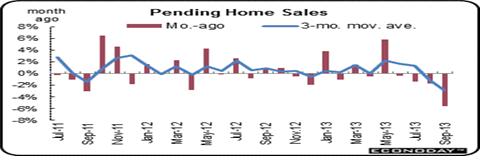
The unanswered question to date is how the debt ceiling impasse and government shutdown has affected economic activity.  Both the industrial and service sectors have shown stronger growth, according to the Institute of Supply Management (ISM).  But real estate is another story.  Pending home sales in the NAR’s Pending Home Sale Index doesn’t look good. The index that measures home sales under contract, but not closed, has been declining for 4 months, a sure sign that housing sales, at least, are faltering.

This is in part because consumer confidence is faltering, as consumers lose confidence in government’s ability to function.  The shutdown endangered much more than 800,000 furloughed defense workers.  Combined with huge cuts in food stamps, no farm aid bill, and a not yet functioning Affordable Care Act, the shutdown and debt ceiling impasse has spooked consumers big time.

image

Graph: Econoday

Year-on-year, the index is down 1.2 percent for the first negative reading in nearly 2-1/2 years. The National Association of Realtors (NAR), which compiles the report, cites as a major factor the government shutdown which it says pushed government workers and contractors to the sidelines of the housing market.

NAR chief economist Lawrence Yun wasn’t optimistic about the near future, either. “Declining housing affordability conditions are likely responsible for the bulk of reduced contract activity’” he said. (But) “In addition, government and contract workers were on the sidelines with growing insecurity over lawmakers’ inability to agree on a budget. A broader hit on consumer confidence from general uncertainty also curbs major expenditures such as home purchases.”

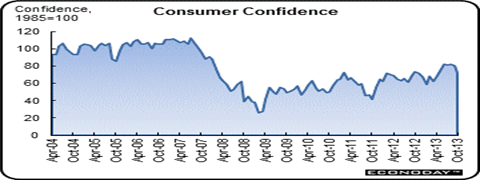
The government shutdown really weighed on confidence indexes.  The Conference Board’s confidence index fell to 71.2 from a revised 80.2. With an 11 point drop, the dip is the largest since 12 points in January, a month that was also hit by a fiscal standoff in Washington.

image

Graph: Econoday

But the drop was mainly in expectations, which could reverse if some agreement is reached on a new federal budget by the December 15 deadline.  The component for present situations continued to show much less volatility, at 70.7 versus 73.5 for what is a 4th straight reading over 70—“a trend that is consistent with steady and soft month-on-month growth for the economy,” said Econoday

A negative on the present situation side was a sharp 2.2 percentage point rise to 35.8 percent for those that said jobs fewer jobs were available. This suggests another month of weakness for monthly payroll growth.

Consumer confidence powers much more than home sales, of course.  Retail sales are also growing just 4 percent per annum with the holiday season approaching, when 6 to 8 percent is the normal sales’ rate if consumers feel more confident.  Retail sales don’t adjust for inflation, so ‘real’ retail sales after inflation are rising just over 2 percent. This has to mean government dysfunction is definitely affecting consumer spending overall that powers some 70 percent of economic activity.

Harlan Green © 2013

Follow Harlan Green on Twitter: www.twitter.com/HarlanGreen
Posted in Consumers, Economy, housing market, Politics | Tagged , , , | Leave a comment

Mortgage Delinquencies Continue to Decline

The Mortgage Corner

The good news is that foreclosure rates continue to fall, though delinquencies more than 90 days late are fluctuating with the season, according to Lender Processing Services (LPS) in their Mortgage Monitor report for September. According to LPS, 6.46 percent of mortgages were delinquent in September, up from 6.20 percent in August. But LPS reported that 2.63 percent of mortgages were in the foreclosure process, down from 3.86 percent in September 2012, in this graph that begins in June 1995.

This is great news, and due mainly to the increase in housing values that has allowed many homeowners to either refinance or sell their homes.

image

Graph: Calculated Risk

This gives a total of 9.03 percent delinquent or in foreclosure. It breaks down as, according to Calculated Risk:
• 1,935,000 properties that are 30 or more days, and less than 90 days past due, but not in foreclosure.
• 1,331,000 properties that are 90 or more days delinquent, but not in foreclosure.
• 1,328,000 loans in foreclosure process.

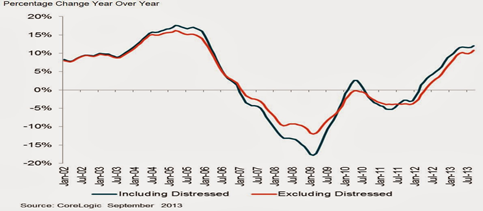
Meanwhile, CoreLogic reports that home prices nationwide, including distressed sales, increased 12 percent on a year-over-year basis in September 2013 year over year. This change represents the 19th consecutive monthly year-over-year increase in home prices nationally. On a month-over-month basis, including distressed sales, home prices increased by 0.2 percent in September 2013 compared to August 2013.

image

Graph: Calculated Risk

Excluding distressed sales, home prices increased on a year-over-year basis by 10.8 percent in September 2013 compared to September 2012. On a month-over-month basis, excluding distressed sales, home prices increased 0.3 percent in September 2013 compared to August 2013. Distressed sales include short sales and real estate owned (REO) transactions.

The bottom line is that housing values should continue to increase, in spite of the shutdown, because overall business activity continues to improve in both the manufacturing and non-manufacturing (service industries) sectors. The October Purchasing Managers’ Non-Manufacturing Business Activity Index increased to 59.7 percent, which is 4.6 percentage points higher than the 55.1 percent reported in September, reflecting growth for the 51st consecutive month. Though the New Orders Index decreased by 2.8 percentage points to 56.8 percent (maybe because of the government shutdown), the Employment Index increased 3.5 percentage points to 56.2 percent, indicating growth in employment for the 15th consecutive month.

Harlan Green © 2013

Follow Harlan Green on Twitter: www.twitter.com/HarlanGreen
Posted in Consumers, Economy, Housing, housing market, Macro Economics, Weekly Financial News | Tagged , , , , , , , | Leave a comment

Consumer Debt At Record Lows

Financial FAQs

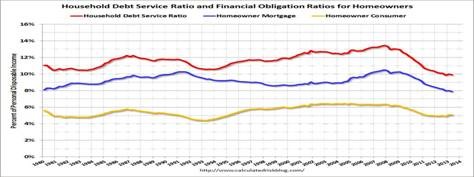
The Federal Reserve just released the Q2 2013 Household Debt Service and Financial Obligations Ratios. The overall Debt Service Ratio decreased in Q2 2013, and is just above the record low set in Q4 2012 thanks to very low interest rates. The homeowner’s financial obligation ratio for consumer debt increased slightly in Q2 (omitting mortgage debt), and is back to levels last seen in early 1995.

These ratios show the percent of disposable personal income (DPI) dedicated to debt service (DSR) and financial obligations (FOR) for households, says Calculated Risk.

The household debt service ratio (DSR) is an estimate of the ratio of debt payments to disposable personal income. Debt payments consist of the estimated required payments on outstanding mortgage and consumer debt.

Also, the financial obligations ratio (FOR) adds automobile lease payments, rental payments on tenant-occupied property, homeowners’ insurance, and property tax payments to the debt service ratio.

This is a very good sign for higher employment and economic growth in 2014, which shows the Fed’s QE3 quantitative easing program that is keeping interest rates at record lows is bearing results.

clip_image002

Graph: Calculated Risk

Also the homeowner’s financial obligation ratio for mortgages (blue line in graph) is at a new record low.  This ratio increased rapidly during the housing bubble, and continued to increase until 2008. With falling interest rates, and less mortgage debt (mostly due to foreclosures), the mortgage ratio has declined to an all time low, said the Federal Reserve report.

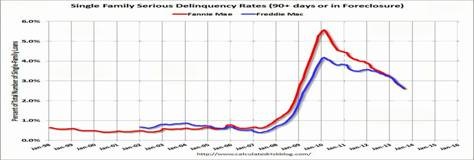
This is while Fannie Mae also just reported that the Single-Family Serious Delinquency rate declined in September to 2.55 percent from 2.61 percent in August, while Freddie Mac’s serious delinquency rate declined in September to 2.58 percent from 2.64 percent in August.

Fannie Mae’s serious delinquency rate is down from 3.41 percent in September 2012, and this is the lowest level since December 2008. Its serious delinquency rate peaked in February 2010 at 5.59 percent, believe it or not.

clip_image004

Graph: Calculated Risk

So can we say that real estate is out of danger of falling back into recession? Probably, but Congress and Obama haven’t resolved the fate of Fannie and Freddie that guarantee some 90 percent of mortgages originated today. The U.S. Treasury is still holding them in conservatorship when they are making record profits, and putting those profits into general coffers, rather than paying off the $180 billion in debt incurred by them during the Great Recession and busted housing bubble.

That is not a good sign, what with the Consumer Finance Protection Bureau now policing mortgages with ever more stringent regulations, such as Qualified Mortgages, that is restricting mortgage lending. So indications are good for more growth in consumer spending this year, but prospects for housing in 2014 are still questionable.

Harlan Green © 2013

Follow Harlan Green on Twitter: www.twitter.com/HarlanGreen

Posted in Consumers, Economy, Housing, housing market, Politics, Weekly Financial News | Tagged , , , , , , , | Leave a comment

Why Isn’t Washington Working “For the good of the Country?”

Popular Economics Weekly

If we really want to know what is depressing consumers, look at how Congress is tied up in knots over the debt ceiling and spending losses from sequestration cuts–$109 billion per year, according to labor economist Jared Bernstein.

Former CIA assistant director Mike Morell on CBS’s 60 Minutes said he didn’t understand why congressional Democrats and Republicans couldn’t work together to boost economic growth for “the good of the country” when our weak economy was the greatest problem facing US, above even terrorist threats.

“I don’t understand the inability of our government to make decisions that push our economy and society forward,” he said. “Our national security is more dependent on the strength of the economy and society than anything else.”

But for “the good of whose country” are we talking about? We seem to be living in two countries at the moment, mainly divided into anti-government Republican Red states and pro-government Democratic Blue states. Most of the Red states adamantly oppose the expansion of voters’ rights, union collective bargaining, better healthcare, immigrants’ rights, environmental regulation, abortion and women’s rights, for starters.

Government gridlock not only endangers our security, but the resultant inequality endangers our democratic system itself. The CIA should know, as it has kept track of the economic well-being of nations in its World Factbook. The U.S. now ranks below other developed countries in income equality, birth-death rates, longevity, and health outcomes.

The problem today is the huge amount of damage gridlock is doing to economic growth, from downgrades of government debt by Standard & Poor’s rating agency, to higher borrowing rates. Even Moody’s has put U.S. debt on credit watch. The Red and Blue states seem to be fighting the Civil War all over again, after 150 years, as I’ve said.

clip_image002

Graph: Reuters

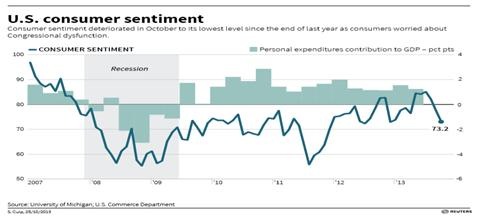
The latest evidence of the damage being done is orders for a wide range of U.S.-made capital goods plummeted in September and consumer sentiment weakened sharply in October, signs that the budget battle in Washington has held back the economy, said Thomson-Reuters. The Thomson Reuters/University of Michigan’s final reading on the overall index on consumer sentiment fell to 73.2in October from 77.5 in September and was the lowest final reading since December 2012.

Then we have the latest unemployment report that showed more workers dropping out of the labor force, while the Labor Department’s JOLTS report of labor layoffs and hires remained stagnant over the past year.

clip_image004

Graph: Econoday

There were 3.883 million job openings on the last business day of August, up from July at a revised 3.808 million. The job openings rate improved slightly to 2.8 percent from 2.7 percent in July. But it has leveled off after increasing steadily since the end of the Great Recession.

So the question is, government should work for the “good of whose country”? Tea Partiers want to take back “their” country, a country that no longer exists. If that is their sentiment, how do we push our country and society forward?

Harlan Green © 2013

Follow Harlan Green on Twitter: www.twitter.com/HarlanGreen
Posted in Consumers, Economy, Macro Economics, Politics, Weekly Financial News | Tagged , , , , , , , , | Leave a comment

Conforming Mortgage Limit Reductions Postponed

The Mortgage Corner

Federal officials will delay any reduction in the maximum size of home-mortgage loans eligible for backing by Fannie Mae and Freddie Mac until next spring at the earliest, said FHFA Administrator Ed DeMarco in a Wall Street Journal article–DeMarco: No Mortgage Limit Declines Before Spring 2014. It is reputably from heavy resistance from the real-estate industry and many lawmakers in Congress.

This is in the face of the recent government shutdown and debt ceiling debate that has slowed economic growth this year, and even next year, if a budget agreement isn’t reached by January 2014.

Couple this with a recent slowdown in real estate sales, including for new homes.  There appears to be little doubt that rising mortgage rates, combined with higher home prices, resulted in a material slowdown in net new-home orders last quarter, says Calculated Risk. Mortgage rates, of course, have fallen considerably since early September, though they remain well above levels since during the first five months of the year.

Currently, Fannie and Freddie can guarantee mortgages that have balances as high as $417,000 in most of the country and up to $625,500 in expensive housing markets, including parts of California and New York. Loans within the limits are called “conforming” or “High-Balance conforming loans.

Potential loan-limit changes will be announced six months ahead of their implementation date, said Demarco, and such changes wouldn’t be announced until November at the earliest. “Anything we do would have a long lead time and would be gradual and measured,” said Mr. DeMarco.

When the agency does move ahead with loan limit declines, the declines will apply to both the national limit and the high-cost limits, which were enacted on an emergency and temporary basis by Congress in 2008.

It will be politically difficult to lower these limits, and the limits probably wouldn’t be adjusted down very much.  The conforming loan limit was $252,700 in 2000. Using the FHFA Purchase Only index, the national conforming loan limit might be lowered to around $360,000.

Using the CoreLogic or Case-Shiller Comp 20 indexes, the conforming loan limit might be lowered to $380,000 to $395,000. Not a large downward adjustment for the national limit.

Harlan Green © 2013

Follow Harlan Green on Twitter: www.twitter.com/HarlanGreen
Posted in Economy, Housing, housing market, Politics, Weekly Financial News | Tagged , , , , , | Leave a comment

Why Is Government So Important?

Popular Economics Weekly

So it turned out to be true, contrary to those who believed less government is better. The government shutdown proved just how important government is to our daily lives. Not only its cost—upwards of $24 billion in lost output, for starters. Standard & Poor’s said the shutdown “to date has taken $24 billion out of the economy,” equaling $1.5 billion dollars a day and “shaved at least 0.6 percent off annualized fourth-quarter 2013 GDP growth.” And probably the future loss of jobs, as well, because employers have cut back on future hires over the uncertainty of another shutdown.

“As a consequence (of the shutdown), you may expect fourth-quarter growth in gross domestic product to be shaved by a half-point or more – bringing the rate of growth down to 2 percent or less”’ said Marketwatch economist Irwin Kellner. “Some of this might also carry over into the first quarter – especially since this brouhaha could well see a return engagement come early 2014.”

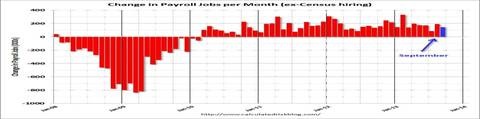
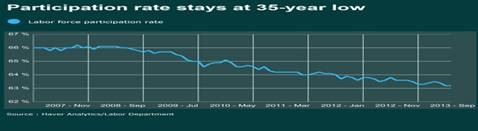
Economists are already speculating on why just 148,000 payroll jobs were created last month, in a report delayed some 2 weeks because of the shutdown. The 7.2 percent unemployment rate was lower because more were dropping out of the workforce, not because more were employed in the household study.

clip_image002

Graph: Calculated Risk

According to the Bureau of Labor Stat’s household survey, the labor force rebounded 73,000 after dropping 312,000 in August. However, the pool of available workers fell another 183,000 after a plunge of 532,000 in August-resulting in the fourth decline in a row. Again, a low labor force participation rate is at least partly behind the lower unemployment rate.

clip_image004

Graph: WSJ Marketwatch

The bottom line is that government provides too many services, and employs too many people in the private and public sectors, to be shut down for any length of time. That is the overriding lesson learned from this shutdown.

And the public knows it. In the aftermath if this shutdown, 8 in 10 Americans say they disapprove of the shutdown, according to a new Washington Post-ABC News poll. Two of three Republicans, or independents who lean Republican, share a negative view of the stalemate. And even a majority of those who support the tea party movement disapprove.

Does that mean it can’t happen again, or will history continue to repeat itself?

Harlan Green © 2013

Follow Harlan Green on Twitter: www.twitter.com/HarlanGreen
Posted in Economy, Macro Economics, Politics, Weekly Financial News | Tagged , , , , , | Leave a comment

Government Shutdown Dims Builder Optimism

Financial FAQs

New-home construction is already a casualty of the government shutdown, and even sequestration agreement that has cut government hiring and spending more than $1.6 trillion to date. But its effect would be mitigated if interest rates remain low, and lenders continue to ease qualification criteria, such as lowering their super-high credit score requirement.

The National Association of Home Builders/Wells Fargo housing-market index fell to 55 in October from 57 in September. A prior September estimate pegged the level at 58, which matched the highest reading since 2005. Results above 50 signal that builders, generally, are optimistic about sales trends.

clip_image002[6]

“Interest rates remain near historic lows and we don’t expect the level of rates to have a major impact on sales and starts going forward,” said David Crowe, NAHB’s chief economist. “Once this government impasse is resolved, we expect builder and consumer optimism will bounce back.”

Despite the recent decline, pent-up demand is supporting builder sentiment, which has increased 34 percent over the past year, outpacing home-construction growth.

“A spike in mortgage interest rates along with the paralysis in Washington that led to the government shutdown and uncertainty regarding the nation’s debt limit have caused builders and consumers to take pause,” said Crowe. “However, interest rates remain near historic lows and we don’t expect the level of rates to have a major impact on sales and starts going forward. Once this government impasse is resolved, we expect builder and consumer optimism will bounce back.”

Interest have declined slightly from their recent highs, so that the 30-year conforming fixed rate today is approximately 4.25 percent with 0 origination points in California.

There is some good news. The average credit score among borrowers who received a mortgage in September was 732, down from a peak of 750 a year prior, according to new data released today by Ellie Mae, which provides mortgage lenders with loan origination systems.  And this is a sign both that lenders loosening their heretofore strict qualification standards, and that more eligible homebuyers will be allowed in the market.

“The share of purchase loans continued to grow in September 2013, climbing 1 percent to 58 percent of all loans even in the face of higher interest rates and seasonality,” said Jonathan Corr, president and chief operating officer of Ellie Mae. “This was the eighth consecutive month that the purchase loan percentage has increased or stayed steady. In January 2013, purchases represented only 27 percent of closed loans.

“The credit standards also continued to ease in September with average FICO scores for closed loans dropping to 732 compared to 734 in August. September’s averages were 15 points below where they were at the beginning of the year (January 2013) and the lowest level since we began our tracking in August 2011,” noted Corr. “When you drill down farther, the change is even more apparent. For example, 31 percent of the closed loans in September 2013 had FICO scores under 700 compared to 17.4 percent of closed loans in September 2012.“

That’s also the lowest average credit score since the company started tracking this data in August 2011.

This is important because even a 680 FICO score is a sign of good credit record, though credit balances may be high. But the overall debt-to-income ratio is more important in determining borrowers’ ability-to-pay in this case.

Lenders pulled back on giving mortgages to borrowers with less-than-perfect credit in 2008 as the number of borrowers who foreclosed on their homes spiked. That’s left millions of would-be home buyers shut out of the housing market. The findings suggest that some borrowers who were unable to gain financing as recently as a year ago could get mortgage approval now.

To be sure, the bar to getting a mortgage remains high. Applicants who were denied a mortgage in September had an average FICO score of 696, according to Ellie Mae—a score that’s relatively stellar by most counts. FICO scores range from 300 to 850. Before the recession it was common for borrowers with credit scores in the 600 range and below to get mortgages.

Harlan Green © 2013

Follow Harlan Green on Twitter: www.twitter.com/HarlanGreen
Posted in Consumers, Housing, housing market, Politics, Weekly Financial News | Tagged , , , , | Leave a comment