Household Formation Key To Housing Recovery

Financial FAQs

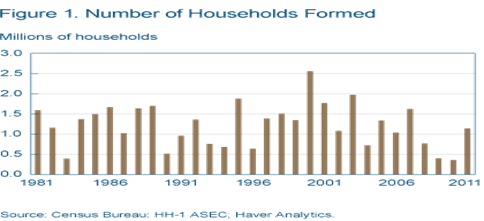
The formation of new households—young adults leaving the homestead—has always been an important ingredient of home sales. We are talking about 18 to 34 year-olds who have been staying at home during the Great Recession for understandable reasons—whether lack of jobs, or college. And 2011 was the first year that household formation returned to more normal levels, which is why we are seeing housing beginning to recover.

One impact of the Great Recession is that it markedly reduced the rate at which Americans set up households, said a recent Cleveland Federal Reserve report on household formation. But pent up demand from young adults finding jobs will certainly reverse that trend and lead to a stronger sales and price increases.

Compared to the previous 10 years, the growth rate in the number of households was cut by two-thirds between 2007 and 2010. This slowing in household formation reflects the overall weak economy, but it has also negatively impacted the housing market, as lower household formation rates reduce housing demand.
image

Graph: Cleveland Fed

While younger adults between the ages of 18 and 34 make up a relatively small proportion of heads of households, they account for almost three-quarters of the overall shortfall in household formation. The growth in the number of younger households was lower in metropolitan areas that experienced weaker labor and housing markets, though, to be sure, household formation slowed across the United States, consistent with the widespread nature of the shocks to output, labor, and housing markets that occurred during the Great Recession.

From 1997 to 2007, about 1.5 million households were formed on average each year in the United States. Then the Great Recession hit, and in the ensuing three years, the rate fell to 500,000 per year. This decline in household formation occurred even as the U.S. population was expanding at a rate of 2.7 million per year, only slightly below the rate of 2.9 million a year observed between 1997 and 2007. A “modest” rebound has since followed during the economic recovery, with 1.1 million new households being created in 2011.

That is why we predict much better years ahead for housing. The Harvard Joint Center for Housing Studies (JCHS) in a recent blog said, “Given the trends of the last five years, the spurt in household growth to an annual rate of 900,000 through the first three quarters of this year is notable.  If the upward trend in household growth continues, housing should see a sustained recovery in 2013.”

image

Graph: JCHS

In fact, we are already seeing the rebound in 2012, with both housing construction and new home sales increasing significantly. The Census Bureau reports New Home Sales in October were at a seasonally adjusted annual rate (SAAR) of 368 thousand. This was down from a revised 369 thousand SAAR in September, but up 17 percent from October 2011. Supply, at 4.8 months for the lowest reading since 2005, is very tight and actually is limiting sales, according to Calculated Risk.

image

Graph: Calculated Risk

And sales of existing homes increased in October, even with some regional impact from Hurricane Sandy, while home prices continued to rise due to lower levels of inventory supply. Total housing inventory at the end of October fell 1.4 percent to 2.14 million existing homes available for sale, according to the National Association of Realtors, which represents a 5.4-month supply at the current sales pace, down from 5.6 months in September, and is the lowest housing supply since February of 2006. It is 21.9 percent below a year ago when there was a 7.6-month supply, a sure sign that housing is already in recovery.

Harlan Green © 2012

Posted in Consumers, Economy, Housing, housing market, Weekly Financial News | Tagged , , , , | Leave a comment

National Home Prices (Finally) Recovering

The Mortgage Corner

Is the end of the housing bust in sight?  The Case-Shiller Home Price Index reported the fourth consecutive year-over-year (YoY) gain in their house price indexes since 2010 – and the increase back in 2010 was related to the housing tax credit. Excluding the tax credit, the previous YoY increase was back in 2006. The YoY increase in September suggests that house prices probably bottomed earlier this year.

And this is the slow time of year when families that have already moved to put their children in new school districts. It really means that those at the bottom of the housing bubble—Las Vegas (up 1.4 percent, 3.8 percent YoY), Phoenix (up 1.1 percent, 20.4 percent YoY), San Diego (up 1.4 percent, 4.1 percent YoY)—are finally seeing some relief from the worst economic slump since the Great Depression.

clip_image002

Graph: Calculated Risk

“Home prices rose in the third quarter, marking the sixth consecutive month of increasing prices,” says David M. Blitzer, Chairman of the Index Committee at S&P Dow Jones Indices. “In September’s report all three headline composites and 17 of the 20 cities gained over their levels of a year ago. Month-over-month, 13 cities and both Composites posted positive monthly gains.”

The Federal Housing Finance Authority (FHFA) house price index posted also another monthly increase in September. This measure is up 4.4 percent YOY, a bigger YOY gain than the 3 percent rise in the Case-Shiller index. Also, the FHFA index is down just 16 percent from its peak, about half the cumulative decline in the Case-Shiller gauge. Most of the discrepancy reflects the fact that the FHFA index is much less affected by distress sales, since it covers only properties financed with conventional GSE mortgages (Fannie Mae and Freddie Mac), which have more stringent qualification guidelines.

This may be because of the continuing rise in consumer confidence. The Conference Board’s Consumer Confidence survey rose again with buying plans for homes a special positive, said the report. The consumer confidence index rose to a new recovery high of 73.7 in November from an upwardly revised 73.1 in October. Strength is centered in the expectations component which is up 1.1 points to 85.1. The present situation component is down one tenth to 56.6.

clip_image004

Graph: Econoday

A major reason for the increased confidence is a jump in those who expect to buy a house in the next six months. This is the latest indication of building momentum for the housing sector. Inflation expectations are another plus in the report, down two tenths for the 12-month outlook to 5.6 percent in what is a reflection of falling gas prices.

California is also doing well. I reported last week that Southern California home sales also rose sharply in October as move-up buyers joined investors, according to San Diego-based DataQuick, shifting the mix of homes selling upward as foreclosure resales hit a five-year low. Southern California’s real estate market bucked the typical fall slowdown last month, with buyers snapping up pricier homes and sales roaring up 18 percent over the prior month.

Sales hit a three-year high for an October, rising 25 percent from the same month last year. The median sale price for a Southland house last month was $315,000, equal to September and up 17 percent from October 2011.

Harlan Green © 2012

Posted in Consumers, Economy, Housing, housing market, Weekly Financial News | Tagged , , , | Leave a comment

Falling Households Incomes—The Real ‘Fiscal Cliff’

Popular Economics Weekly

It is household income that is falling off a cliff. This is partly due to the busted housing bubble and subsequent Great Recession that shaved 40 percent from household wealth. But household incomes haven’t been rising as fast as inflation since the 1970s, either. So we should be worrying about the drastic decline in buying power, rather than Congress’s inability to agree on a federal budget, if we want to cure the looming ‘fiscal cliff’.

If we don’t find a way to improve average household finances, Americans could plunge into decades of slow growth and the continued deterioration in their standard of living. Why? We are a consumer society, so that 70 percent of U.S. economic growth is powered by consumer spending. That is why government has to be part of the solution.

Three-fifths of all jobs lost during the Great Recession paid middle-income wages, while those created during the economic recovery pay low wages, according to a new study by the National Employment Law Project. Both economic forces and government budget cuts are causing this deficit of good jobs, according to the study.

For instance, many of the losses in well-paying jobs came from state and local governments, which have cut 485,000 jobs since February 2010, NELP found. Many mid-wage government workers that have been laid off during the economic recovery include teachers and police officers.

There is an easy way to reverse the downward spiral in wages—begin to upgrade our aging public services. In what New York Times Nicholas Kristof has labeled A Failed Experiment, the World Economic Forum ranks American infrastructure 25th in the world, down from 8th in 2003-4.

One would think with the ongoing drought, Tsumanis, and Hurricane Sandy that we would know how important government is to the solution of our many problems. New Jersey Governor Chris Christy certainly thought so in lauding President Obama for his help during Sandy. So the most obvious place to start is a national program to repair our crumbling infrastructure that the American Society of Civil Engineers estimates needs at least $2.2 Trillion in repairs and upgrades over the next 5 years just to keep it safe.

The wealthy have always had an answer to the ongoing decrepitude of public services, said Kristof. “Public playgrounds and tennis courts decrepit? Never mind—just join a private tennis club. I’m used to seeing this mind-set in developing countries like Chad or Pakistan, where the feudal rich make do behind high walls topped with shards of glass; increasingly, I see it in our country.”

The ASCE has launched a new series of reports that take a closer look at the economic impacts of America’s deteriorating infrastructure. These economic studies look forward to 2020 and 2040 to predict impacts on GDP, personal income, and jobs if current infrastructure investment trends continue. 

The first report was released in July 2011 and focused on surface transportation. The landmark study, Failure to Act: The Economic Impact of Current Investment Trends in Surface Transportation Infrastructure, found the nation’s deteriorating surface transportation infrastructure will cost the American economy more than 870,000 jobs, and suppress the growth of the country’s Gross Domestic Product by $897 billion by 2020. Commissioned by ASCE and conducted by the Economic Development Research Group of Boston, the report shows that the nation is facing a funding gap of about $94 billion a year compared with our current spending levels.

In fact Nobel Economist Joseph Stiglitz asserts in a recent Project Syndicate blog that “Spending, especially on investments in education, technology, and infrastructure, can actually lead to lower long-term deficits.”

Most of the federal ‘fiscal cliff’ was created by borrowing to finance serial tax cuts and increased military spending that benefited the few at the expense of the many, instead of shoring up social security and Medicare reserves, as Bush Treasury Secretary Paul O’Neill advocated.

In fact, those tax revenues were diverted to the real ‘takers’, the wealthiest Wall Street financiers and corporate CEOs who have managed to capture most of the created wealth over the last decades. Just in 2009, it’s well documented that 93 percent of the income increase went to the top 1 percent of income earners through lower dividend and capital gains taxes, as well as record corporate profits.

But that means taking political power back from the elites who would rather starve government programs that could boost middle class incomes and consumers, asserts Chrystia Freeland in Plutocrats, The Rise of the New Global Super-Rich and the Fall of Everyone Else. Plutocrats are putting the wealth accumulated from deregulation of the U.S. economy into developing the middle classes of developing countries such as India, China, and Brazil, rather than the U.S.

Need we say more? Should we continue to allow the private good to trump public good? Not unless we enjoy reverting back to conditions like those in the developing world.

Harlan Green © 2012

Posted in Consumers, Economy, Macro Economics, Politics, Weekly Financial News | Tagged , , , , , | Leave a comment

Southland Home Sales Up, Foreclosures Down

The Mortgage Corner

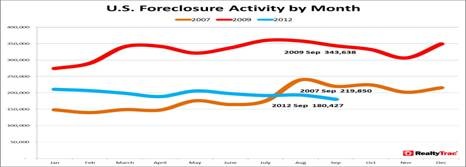
Southern California home sales rose sharply in October as move-up buyers joined investors, according to San Diego-based DataQuick, shifting the mix of homes selling upward as foreclosure resales hit a five-year low. Southern California’s real estate market bucked the typical fall slowdown last month, with buyers snapping up pricier homes and sales roaring up 18 percent over the prior month.

Sales hit a three-year high for an October, rising 25 percent from the same month last year. The median sale price for a Southland house last month was $315,000, equal to September and up 17 percent from October 2011, according to DataQuick.

Sales rose sharply in most mid- to-higher-cost markets. Sales between $300,000 and $800,000 – a range that would include many move-up buyers – jumped 41.5 percent year-over-year. October sales over $500,000 rose 55.2 percent year-over-year, while sales over $800,000 rose 52.4 percent compared with October 2011.

Gary Wood’s analysis of Santa Barbara County’s MLS sales including Carpinteria/Summerland, Montecito, Hope Ranch, downtown Santa Barbara and Goleta through October 2012 were similar. Sales rose to 100 from 83 in September. The median sales price also came up from $750,000 in September to about $815,000 in October with escrows rising from 94 to about 120 for the month. The median list price on those escrows showed the biggest upswing—going from $762,540 to almost $900,000.

Year over year, the numbers of sales are still way up with about 1,050 transactions completed compared to 780 last year. The median sales price is basically unchanged but down just a little from $800,050 in 2011 to about $795,000 now. The escrows are also still way up from 841 last year to about 1,150 this year while the median list price on those escrows has risen a little from about $825,000 last year to approximately $830,000 now.

clip_image002

Graph: RealtyTrac

Foreclosure resales – properties foreclosed on in the prior 12 months – accounted for 16.3 percent of the Southland resale market last month. That was down from 16.6 percent the month before and 32.8 percent a year earlier. Last month’s level was the lowest since it was 16.0 percent in October 2007. The foreclosure resales had hit a high of 56.7 percent in February 2009 during the Great Recession.

The delinquency rate for mortgage loans on one-to-four-unit residential properties fell to a seasonally adjusted rate of 7.40 percent of all loans outstanding as of the end of the third quarter of 2012, a decrease from the second quarter of 2012, and a decrease of 59 basis points from one year ago, according to the Mortgage Bankers Association’s (MBA) National Delinquency Survey.

“Mortgage delinquencies decreased compared to last quarter overall, driven mainly by a decline in loans that are 90 days or more delinquent,” said Mike Fratantoni, MBA’s Vice President of Research and Economics. “The 90 day delinquency rate is at its lowest level since 2008, and together with the decline in the percentage of loans in foreclosure, this indicates a significant drop in the shadow inventory of distressed loans-a real positive for the housing market. The 30 day delinquency rate increased slightly, but remains close to the long-term average for this metric.  Given the weak economic and job growth in third quarter, it is not surprising that this metric has not improved. ”

And foreclosures nationwide are declining as well, mostly in the 26 so-called non-judicial states that enable Trust Deed auctions, such as California and Texas. This was the largest decline in foreclosure inventory ever recorded. Judicial states’ foreclosure inventory was at 6.61 percent, and the non-judicial states’ inventory was at 2.42 percent, reports the MBA.

Harlan Green © 2012

Posted in Consumers, Economy, Housing, housing market, Weekly Financial News | Tagged , , , , | Leave a comment

Next 4 Years—Back to the Future

Financial FAQs

President Obama’s victory means it’s Back to the Future for economic as well as social policies. It means he now has the mandate to implement what the electorate chose him for—a functioning government to not only fix disasters such as Hurricane Sandy, but the economy; to lead the United States of America into the future rather than backward with Republican economic policies of the 1920s, as Obama said in the third debate.

Yes, that does mean government creates jobs, contrary to the Bain Capital ethos—whether in Detroit, or with clean energy investments, infrastructure building, better regulations that prevent economic disasters, and lower cost student loans that enable a better educated workforce.

That is, if he doesn’t give in to Boehner’s House Republicans who aren’t budging on returning tax rates to the Clinton era, when 23 million jobs were created and there was greater prosperity for all.

Paul Krugman has called it economic blackmail. “Because Republicans are trying, for the third time since he took office, to use economic blackmail to achieve a goal they lack the votes to achieve through the normal legislative process. In particular, they want to extend the Bush tax cuts for the wealthy… So they are, in effect, threatening to tank the economy unless their demands are met.”

The fiscal cliff is not the real problem, or large budget deficits at a time when the economy still needs a boost. It is not really a cliff, according to most analysts. The Center for Budget and Policy Priorities is one of many that say it is more of a slope, in that the effects of letting the Bush tax cuts lapse and the sequester agreement to cut government spending only begin to take effect in 2013.

“In fact, the slope would likely be relatively modest at first (and then much steeper if 2013 unfolds without a fiscal resolution). This means that if there is no agreement by January 1, policymakers will still have some (although limited) time to take steps to avoid the serious adverse economic consequences that the Congressional Budget Office (CBO) outlines in its recent analysis of what will happen if the expiring tax cuts and new spending cuts take effect on a permanent basis.”

Exit polls showed voters tended to blame Bush for the Great Recession, rather than Obama, and so have given President Obama the opportunity to lead us back to fiscal sanity. It turns out Republicans tried to label Democrats as the tax and spend party, but voters decided Republicans have been the real tax-cut and spend party; which is true. Presidents Reagan and GW Bush were responsible for both the largest tax cuts and largest budget deficits since WWII, in their decision not to follow the pay-as-you-go budget rules that said tax cuts had to be matched by spending cuts.

It really boils down to how much to tax which U.S. taxpayers. Conservatives have called for lower taxes in the name of greater freedom from government controls. But Obama’s victory is a victory for the right to choose—the freedom to choose union representation and negotiate wages via collective bargaining, or women’s control of their health, family planning, or even a cooler climate.

The future belongs to those who have recognized that the richest have been helping themselves, rather than the country. It belongs to those who see that government is for the common good, rather than the few. This is the direction, however halting, that government has been marching ever since the New Deal began to cure the flaws and real damage that unrestrained capitalism can cause—back to the future.

Harlan Green © 2012

Posted in Consumers, Economy, Macro Economics, Weekly Financial News | Tagged , , , , , , , , , , , | Leave a comment

It’s the Consumers Turn

Popular Economics Weekly

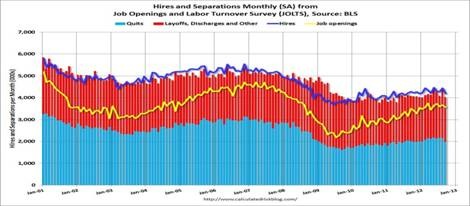
We know that consumers will continue to push economic growth this fall and winter for several reasons. Firstly, the Bureau of Labor Statistics monthly JOLTS report showed 3.6 million job openings (yellow line), and more than 4 million hires (blue line), which is slightly more than the red and blue blocks that show total layoffs and quits. That is why payrolls are increasing some 157,000 per month in 2012, according to the BLS.

clip_image002

Graph: Calculated Risk

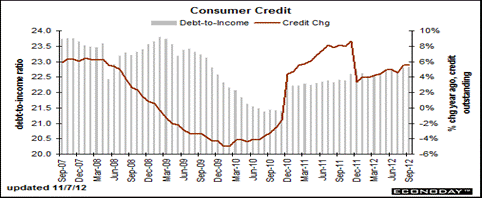
And consumers know this, which is why they are spending more. Another big increase in student loans drove consumer credit higher, up $11.4 billion vs. August’s very large revised gain of $18.4 billion. The non-revolving component, home to the student loan category, rose $14.3 billion in the month on top of August’s $14.1 billion gain. Revolving credit card debt actually fell $2.9 billion for the third decrease in four months.

clip_image004

Graph: Calculated Risk

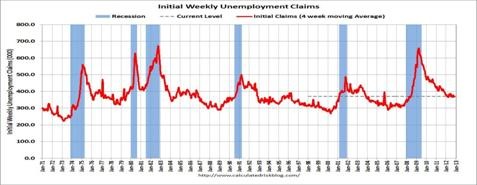
And in spite of Hurricane Sandy, the advance figure for seasonally adjusted initial jobless claims was down to 355,000 for the week ending November 3, a decrease of 8,000 from the previous week’s unrevised figure of 363,000. The 4-week moving average was 370,500, an increase of 3,250 from the previous week’s unrevised average of 367,250, according to Calculated Risk. Claims may spike up, though, if Sandy causes many jobs to be lost in coming weeks. But the recovery—reconstruction efforts should more than make up for the losses.

clip_image006

Graph: Calculated Risk

If we look at the long term in this graph that goes back to the 1970s, with gray shaded areas showing recessions, we see that claims are following normal trends. The lows seem to be 300,000 claims per week in each business cycle. So as long as the trend is downward, employment is increasing and consumers will feel more secure about their finances.

Harlan Green © 2012

Posted in Consumers, Economy, Macro Economics, Weekly Financial News | Tagged , , , , , | Leave a comment

More Jobs Equals Happier Consumers

Popular Economics Weekly

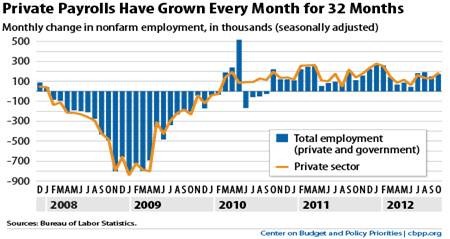
It is not secret by now that whoever convinces the majority they are the best jobs creator will win the Presidential election. Today’s 171,000 payroll increase with upward revisions for the past 2 months may tilt things slightly in President Obama’s direction. The change in total nonfarm payroll employment for August was revised from +142,000 to +192,000, and the change for September was revised from +114,000 to +148,000, which hugely increases the monthly average in the fall after a spring lull.

clip_image002

Graph: CBPP

In other words, employers are finally realizing this recovery is for real, regardless of the ‘fiscal cliff’ outcome. What are the nay sayers worst fears? That restoring Clinton-era tax rates will reduce the deficit! Monthly job growth has averaged 173,000 over the past four months compared to a 67,000 average in the April-to-June period, says WSJ Marketwatch.

The civilian labor force rose by 578,000 to 155.6 million in October, and the labor force participation rate edged up to 63.8 percent. Total employment rose by 410,000 over the month. The employment-population ratio was essentially unchanged at 58.8 percent, following an increase of 0.4 percentage point in September.

clip_image004

Graph: Econoday

That may be why consumers are cheering up. The Conference Board’s October consumer confidence index improved to a reading of 72.2, up from 68.4 in September. The present situation index increased to 56.2 from 48.7, a huge jump, while expectations climbed to 82.9 from 81.5 last month. Consumer confidence is now at its highest level this year.

Or, it could be housing prices have been rising this year. The Case-Shiller Home Price Index showed prices rising in 19 of the 20 cities surveyed. On a year-ago basis, the 20-city index is up 2.0 percent, following 1.2 percent in August, Not Seasonally Adjusted.

clip_image006

Graph: Econoday

Either way, the economy is expanding fast enough to warrant hiring more workers, and consumers know that. Add in the jump in personal incomes, which are now increasing more than 2 percent per year (though 3 percent plus needed to bring back full employment), and we may have a very good 2013.

Harlan Green © 2012

Posted in Consumers, Economy, Housing, housing market, Weekly Financial News | Tagged , , , , , , | Leave a comment

Two Percent Growth Isn’t ‘New’ Normal

Popular Economics Weekly

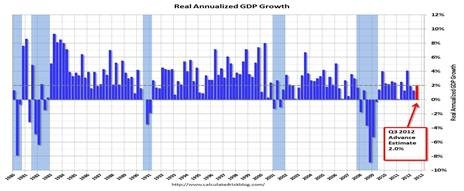
There are many ways to look at the “weak” 2 percent growth numbers for Q3, though just the ‘Advance Estimate’ and so subject to at least 2 more revisions. But such weak growth isn’t due to excessive government regulations (since deregulation has not created greater overall growth, only more recessions). The record low interest rates mean that banks and corporations have too much money to spend, but no place to invest it, since consumers aren’t spending as they used to.

Weak growth over the past decade in particular can mainly be traced to the fall in household incomes, and what consumers can really afford. If their incomes were growing as in 2000 before the Bush tax cuts and wars, for instance, then we would already be back to 1990s levels of economic growth—when 4 to 6 percent annual growth rates were more normal—before the last 2 recessions (gray bars) as the graph shows.

clip_image002

Graph: Calculated Risk

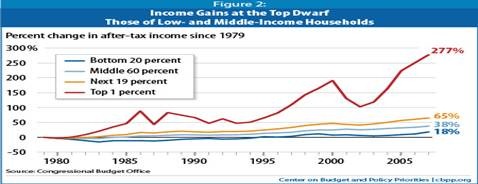
And where has the lost household income flowed, since corporations have the highest profits in history as a percentage of GDP? It has been paid to the investor class and corporate CEOs, in the form of increased dividends, capital gains and stock options, or is part of the $2 trillion cash hoard held by corporations.

clip_image004

Graph: CBPP

For it is the tremendous shift of wealth that has stunted growth since 2000 and caused the Great Recession. Incomes of the wealthiest have soared, mainly because of 2001 and 2003 tax cuts that lowered investment tax rates for the wealthiest and drastically cut tax revenues, while incomes of 99 percent barely grew. This diminished purchasing power of consumers has accounted for most of the $6 trillion in lost output that resulted from the 18-month Great Recession (12/2007 – 6/2009).

It is an example of the failure of small government policies that instead of creating more prosperity for all, diverted it to the wealthiest. And the resulting record income inequality has damaged economic growth say more and more studies, such as a recent IMF study by Andrew Berg and Jonathan D. Ostry that suggests income inequality might shorten our economic expansion by one-third in jobs lost and goods products.

“…a careful look at the varying levels of inequality in different countries demonstrates just how much societal divides in wealth really matter. Countries with high inequality are far more likely to fall into financial crisis and far less likely to sustain economic growth,” said the authors in a Foreign Affairs article.

The U.S. has fallen to the lowest ranking on income inequality. The CIA World Fact Book ranks the U.S. 94th in income equality below all developed countries, Iran, and Russia. In fact, the U.S. is just above Jamaica and the poorest African countries. Wealth—both income and assets—has become concentrated among fewer and fewer Americans, in other words.

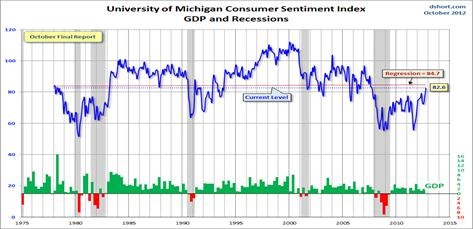
In spite of consumers’ massive loss of income, the University of Michigan reports confidence is being restored—though nothing like the 1990s readings of 100 plus. Hence the belief that consumers are becoming resigned to a ‘new’ lower growth normal. The 88.1 reading for current conditions is up a noticeable 2.4 points from September to hint at general growth for October’s slate of economic data. The expectations index is up a sizable 5.5 points from September which hints at confidence in income prospects and is a positive for the holiday shopping outlook.

clip_image006

Graph: DShort

But this new normal for lower growth is nothing like the 1990s, as we’ve said, and as the graph makes clear. Contrary to Mitt Romney’s assertion that governments don’t create jobs, we can now see the effects of FEMA’s disaster relief efforts after Tropical Storm Sandy. Governments spend most revenues in the private sector—whether for defense, education, environmental protection, infrastructure or research.

So we do not have to accept slower growth, if we recognize and right the record inequality that has caused our market economy to repeatedly crash. As Nobel Economist Joseph Stiglitz was quoted in a recent review of his latest book, The Price of Inequality, “Inequality leads to lower growth and less efficiency. Lack of opportunity means that its most valuable asset — its people — is not being fully used. Many at the bottom, or even in the middle, are not living up to their potential, because the rich, needing few public services and worried that a strong government might redistribute income, use their political influence to cut taxes and curtail government spending. This leads to underinvestment in infrastructure, education and technology, impeding the engines of growth… “

Harlan Green © 2012

Posted in Consumers, Economy, Macro Economics, Politics, Weekly Financial News | Tagged , , , , , , , , | Leave a comment

U.S. Economy Is In Recovery

Popular Economics Weekly

I mentioned last week that the U.S. economy is now growing faster than the rest of the developed world. How can that be, you say, with all the election propaganda saying the recovery has been a failure?  Here’s why.  The IMF has now chimed in to the chorus of voices that says the U.S. is the first to repair the destruction wrought by the Great Recession. 

The International Monetary Fund’s latest World Economic Outlook projects that the United States will be the strongest of the world’s rich economies. U.S. growth is forecast to average 3 percent, much stronger than that of Germany or France (1.2 percent) or even Canada (2.3 percent).

“Increasingly, the evidence suggests that the United States has come out of the financial crisis of 2008 in better shape than its peers — because of the actions of its government,” says Fareed Zakaria in a Washington Post Oped. “In addition to providing general liquidity, the Fed and the Treasury rescued the financial system but also forced it, through stress tests and new rules, to reform. The result is that U.S. banks are in much better shape than their European counterparts.”

And the Fed announced it will discuss a possible expansion of the size of its third round of bond buying and “better ways to guide markets about future policy actions” at its last FOMC meeting.  This includes setting actual employment targets to reduce the unemployment rate to 6 percent or below.  This is huge, and markets rallied on the announcement because there is no other stimulus spending in the works with austerity in Europe and even China slowing. 

One major issue that hasn’t been discussed is debt deleveraging, and the U.S. is outperforming other developed—and underdeveloped—countries in reducing its debt, contrary to the contentions of politicians who have been repeating their charge that Obama is making the deficit worse, though most of it came from the Great Recession.

clip_image002

Graph: McKinsey and Company

Also, a McKinsey and Company study noted that “Debt in the financial sector relative to GDP has fallen back to levels last seen in 2000, before the credit bubble. U.S. households have reduced their debt relative to disposable income by 15 percentage points, more than in any other country; at this rate, they could reach sustainable debt levels in two years or so.”

Then U.S. corporations have bounced back. Corporate profits are at an all-time high as a percentage of Gross Domestic Product, and companies have $1.7 trillion in cash on their balance sheets. The key to long-term recoveries from recessions is reform and restructuring, and U.S. businesses have responded with government help.

And there is America’s energy revolution, which is also bringing back manufacturing. U.S. exports, which have climbed 45 percent in the past four years, are at their highest level ever as a percentage of GDP.

The facts speak for themselves, in spite of the ‘fiscal cliff’ scares, and most of the euro zone in recession.  The best way to weather any future downturn is to have paid down their debts.  So it looks like the U.S. will once again be the world’s engine of growth that prevents another recession, as I’ve said.

Harlan Green © 2012

Posted in Consumers, Economy, Macro Economics, Politics, Weekly Financial News | Tagged , , , , , , , | Leave a comment

New-Home Sales, Mortgages Boosting Growth

The Mortgage Corner

Following the 15 percent housing construction bump in September, new-home sales rose 11.7 percent and are up 27 percent over September 2011, as inventories have shrunk to a meager 4.5 months, especially at the affordable level. The Census Bureau reports New Home Sales in September were at a seasonally adjusted annual rate (SAAR) of 389 thousand. This was up from a revised 368 thousand SAAR in August. This is the highest level since April 2010 and the tax credit related bounce, says Calculated Risk.

clip_image002

Graph: Calculated Risk

The Mortgage Bankers Association (MBA) also expects to see $1.3 trillion in mortgage originations during 2013, largely driven by a spillover of refinances into the first half of the year. This is thanks in large part to the Fed’s QE3 that has pushed 30-year fixed conforming rates to 3.125 percent with 0 points in California at this writing.

The MBA also upwardly revised its estimate of originations for 2012 to $1.7 trillion, approaching levels at the height of the housing boom. MBA expects to see purchase originations climb to $585 billion in 2013, up from a revised estimate of $503 billion for 2012. In contrast, refinances are expected to fall to $785 billion in 2013, down from a revised estimate of $1.2 trillion in 2012, as more new homes are built.

clip_image004

Graph: Calculated Risk

“We expected 2012 originations to be front-loaded in the first half of the year, with refis falling off with rate increases, said Jay Brinkmann, MBA’s Chief Economist. “Instead we saw the refinance market grow during the year due to a combination of low rates, thanks to QE3 and slowing global growth because of continuing problems in Europe, and adjustments in the HARP and FHA refinance programs. We expect 2013 refinance originations to play out like our original expectations for 2012, with a long tail of refis extending through the first half of the year followed by a rapid drop-off in the second half.”

The bottom line is that with banks still holding some 2 million plus of the so-called ‘shadow inventory’ of existing homes, as they work through their homes in default, the demand for new homes should continue to grow. Serious delinquencies, which are the main driver of the shadow inventory, declined the most from April 2012 to July 2012 in Arizona (3.2 percent), Pennsylvania (2.8 percent), New Jersey (2.3 percent), Delaware (2.2 percent) and Maine (2.2 percent).

In the end, an improving jobs picture will be most effective in bringing down serious delinquencies, and so the shadow inventories further—thus increasing the supply of houses available for sale. And employment is improving with 150,000 private sector jobs per month created just over the past year, enough to absorb new entrants.

Harlan Green © 2012

Posted in Economy, Housing, housing market, Weekly Financial News | Tagged , , , , | Leave a comment