Real Estate Leading Recovery—Part II

The Mortgage Corner

Further evidence that real estate is recovering is the drop in both vacancy rates and so-called Real Estate Owned (REO) properties—i.e., that banks have taken back in foreclosure. Several analysts, including Calculated Risk, believe this is absorbing much of the excess housing inventory that has been depressing prices.

image

Graph: Calculated Risk

Existing-home sales represent more than 90 percent of the market so they are the best measure of housing inventory. Inventory decreased 23 percent year-over-year in July from July 2011. It is the seventeenth consecutive month with a YoY decrease in inventory, and near the largest year-over-year decline reported. Months of supply decreased to 6.4 months in July from 6.6 percent in June. Listed inventory is 24.4 percent below a year ago when there was a 9.1-month supply.
image

Graph: Calculated Risk

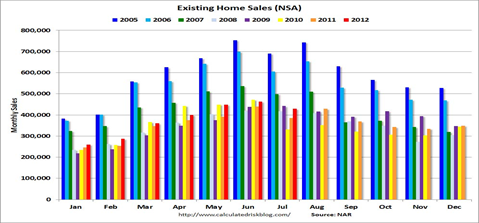
Existing-home sales increased 2.3 percent in July from a month earlier to a seasonally adjusted annual rate of 4.47 million, the National Association of Realtors said Wednesday. The month’s sales were 10.4 percent above the same month a year earlier.

Lawrence Yun, NAR chief economist, said housing affordability conditions are very good.  “Mortgage interest rates have been at record lows this year while rents have been rising at faster rates.  Combined, these factors are helping to unleash a pent-up demand,” he said.  “However, the market is constrained by unnecessarily tight lending standards and shrinking inventory supplies, so housing could easily be much stronger without these abnormal frictions.”

While not yet overwhelming, the real estate recovery will continue to spur growth, with construction spending also up some 7 percent in the year. But lower inventories are the key, and Realtors are reporting rising prices and multiple offers in most of the metropolitan areas.

Lawrence Yun said inventory shortages are a factor.  “Buyer interest remains strong but fewer home listings mean fewer contract signing opportunities,” Yun said.  “We’ve been seeing a steady decline in the level of housing inventory, which is most pronounced in the lower price ranges popular with first-time buyers and investors.”

image

Graph: FHFA

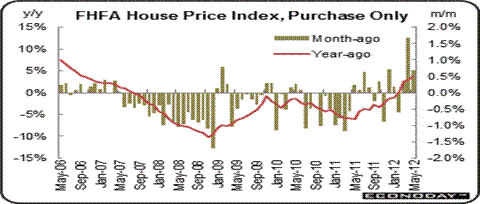
Hence the higher prices. Lastly, home prices climbed 0.7 percent on a seasonally adjusted basis in June, following a revised 0.6 percent increase in May, the Federal Housing Finance Agency said Thursday. In the 12 months through June, prices rose 3.6 percent, the agency said. The FHFA purchase-only index is based on transactions bought or guaranteed by Fannie Mae or Freddie Mac for so-called conforming mortgages.

Harlan Green © 2012

Posted in Consumers, Economy, Housing, housing market, Weekly Financial News | Tagged , , , , , , , | Leave a comment

Increased Consumer Spending a Good Sign

Financial FAQs

The most recent retail sales show consumers are able to spend more, even as they borrow more. Add to that credit card delinquencies are at an 18-year low, according to credit reporting company Transunion Corp., and we have a picture of an improving economy. This is, the fact that consumers can continue to cure their debt problems, while spending more, is a good sign.

“The national credit card delinquency rate continues to remain at the lowest levels we’ve observed in 18 years,” said Ezra Becker, vice president of research and consulting in TransUnion’s financial services business unit. “It’s a positive situation because average borrower balances have increased over the past year as new card originations have grown.”

image

Graph: Econoday

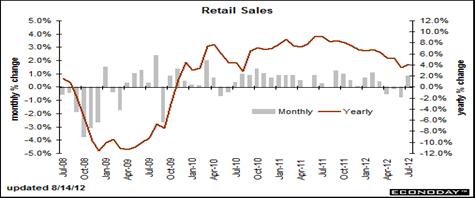
Retail sales soared in July. Total sales rose 0.8 percent for the strongest rise since February with ex-auto sales also up 0.8 percent for, again, the best showing since February. All components show gains including motor vehicles, general merchandise, health & personal care, furniture, and restaurants. Clothing also shows a significant gain, one that points to strength for the back-to-school season. Ex-auto ex-gas the gain is 0.9 percent for the best showing since January, said Econoday.

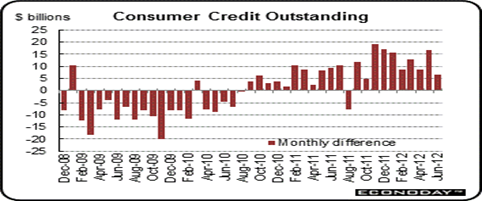
This was predicted by the surge in consumer borrowing. Total credit outstanding rose $6.5 billion in June, following a $16.7 billion jump the month before, reported the Federal Reserve. The latest gain was led by non-revolving credit, gaining $10.2 billion in June after a $9.2 billion rise in May. Non-revolving credit is mostly for motor vehicle purchases and student loans.

 image

Graph: Econoday

What is behind greater consumer spending is the consumer feels better about the economy despite the recent run up in gasoline prices. Apparently it is due to a somewhat improved jobs picture with 163,000 net payroll jobs created in July. Strength was in the consumer’s assessment of current conditions which was up solidly at 87.6 versus July’s 82.7. This gain also underscores the improvement seen in weekly jobless claims, which are now down in the 350,000 range from more than 400,000 last year.

image

Graph: Econoday

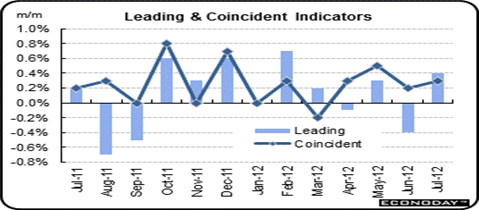
So there are signs that the recovery may be gaining a little more strength—emphasis on little, however.  The Conference Board’s July index of leading economic indicators rebounded 0.4 percent, offsetting the June decline of 0.4 percent. It is at its highest level since February 2007, which should boost consumer confidence even higher.

image

Graph: Econoday

The improvement in jobless claims, which points to improvement in underlying job growth, together with improvement in building permits led the increase in the overall index with each component having a contribution of 0.18 percentage points.

Also with positive contributions were the report’s credit reading, the stock market, and the report’s imputed readings for new orders on both consumer and capital goods which are government data that have yet to be released, said Econoday.

So July was a good month for consumers, and points to further economic improvement for holiday retail sales, which should drive economic growth for the rest of the year. So consumers seem to be focusing more on improving their own financial condition, rather than the discouraging news about China, Europe, and a deadlocked Congress.

Harlan Green © 2012

Posted in Consumers, Economy, Macro Economics, Weekly Financial News | Tagged , , , , , , , , , | Leave a comment

Consumer Spending Continues to Improve

FINANCIAL FAQs

The most recent retail sales show consumers continue to spend, as consumer borrowing is increasing. Add to that credit card delinquencies are at an 18-year low, according to credit reporting company Transunion Corp., and we have a picture of an improving economy.

“The national credit card delinquency rate continues to remain at the lowest levels we’ve observed in 18 years,” said Ezra Becker, vice president of research and consulting in TransUnion’s financial services business unit. “It’s a positive situation because average borrower balances have increased over the past year as new card originations have grown.”

Retail sales soared in July. Total sales rose 0.8 percent for the strongest rise since February with ex-auto sales also up 0.8 percent for, again, the best showing since February. All components show gains including motor vehicles, general merchandise, health & personal care, furniture, and restaurants. Clothing also shows a significant gain, one that points to strength for the back-to-school season. Ex-auto ex-gas the gain is 0.9 percent for the best showing since January, said Econoday.

image

Graph: Econoday

This was predicted by the surge in consumer borrowing. Total credit outstanding rose $6.5 billion in June, following a $16.7 billion jump the month before, reported the Federal Reserve. The latest gain was led by non-revolving credit, gaining $10.2 billion in June after a $9.2 billion rise in May. Non-revolving credit is mostly for motor vehicle purchases and student loans. 

image

Graph: Econoday

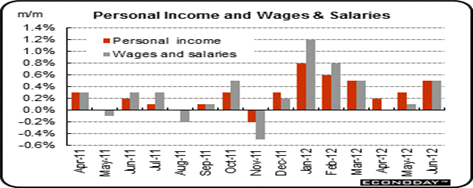
What is behind greater consumer spending is they continue to improve their financial position. Personal income in June gained 0.5 percent, following an advance of 0.3 percent the prior month.  The wages & salaries component also showed strength, rising 0.5 percent after a 0.1 percent rise in May.

image

Graph: Econoday

And with 163,000 net payrolls jobs added in July, their condition should continue to improve. Both the goods-producing and service-providing sectors added jobs. Goods-producing jobs indicate that manufacturing is doing better than monthly surveys suggest.  Total goods-producing jobs rose 24,000 in July after a 13,000 gain the prior month.  Manufacturing rose 25,000 after a 10,000 boost in June.

So even the drag from Europe’s austerity-induced recession hasn’t kept American consumers down. Even housing is showing signs of life, with the NAHB’s builder confidence survey at its highest level since February 2007, which should boost consumer confidence even higher.

Harlan Green © 2012

Posted in Economy, Housing, housing market, Macro Economics, Weekly Financial News | Tagged , , , , , | Leave a comment

It’s Ryancare vs. Obamacare

POPULAR ECONOMICS WEEKLY

Will Ryancare replace Obamacare? Ryancare could become the campaign buzzword with Mitt Romney’s choice of Wisconsin Republican Paul Ryan as his Vice Presidential candidate. Ryancare is bringing budget-cutting austerity that Paul Ryan once called his “Path to Prosperity” budget proposals now endorsed by two Republican-led House majorities, vs. President Obama’s program of stimulus spending via health care, infrastructure repair, and job creation.

Yet history says Ryancare won’t work. It is a battle between almost polar opposites—government austerity vs. government stimulus—when the two must work together to bring back prosperity to the 80 percent of us who are wage earners that have lost out on this recovery.

Romney has come off the fence, in other words, since being Massachusetts’s governor that supported abortion and universal health care. Mitt has said during the campaign that he supported Ryancare, which “will greatly shrink the government, largely undoing the social safety net by shifting more costs onto individuals and essentially converting Medicare into a capped voucher program. It would also alter the progressive income tax system, which, like the safety net, was built through the 20th century under Republican as well as Democratic presidents,” said the New York Times.

So Ryancare is really about more austerity when we know the track record of austerity programs. The latest is England’s Conservative Party program that has returned it into recession with their program to slash government spending while lowering taxes for the wealthy, thus starving the government of revenues during the euro crisis. Only President Clinton was able to slow government spending while balancing the federal budget. He did it by raising taxes back to pre-Reagan rates for the highest income brackets, while slashing defense spending.

In fact, though few economists will admit it, Republican economic policies since 1980 based on slashing tax rates have been disastrous for economic growth and budget deficits, which is why President Reagan had to raise taxes 11 times during his tenure.

While GW Bush helped to create the largest federal deficit since World War II with his tax cuts of 2001 and 2003 that starved the government of revenues at a time when spending soared. The historical fact remains: the recessions, President Bush’s tax cuts and the wars in Afghanistan and Iraq explain virtually the entire deficit over the next ten years.

image

Graph: CBPP. Org

“In fact, the deficit for fiscal year 2009 — which began more than three months before President Obama’s inauguration — was $1.4 trillion and, at 10 percent of Gross Domestic Product (GDP), the largest deficit relative to the economy since the end of World War II,” said the Center for Budget and Policy Priorities, a progressive think tank.

So is it just coincidence that the historical record also shows all recessions since 1980 have occurred during Republican administrations? The recession score (gray shadings)—Presidents’ Reagan and GW Bush two recessions, GHW Bush, Sr. one, and Democrats zero.

image

Graph: Calculated Risk Blog

If austerity in the guise of slashing taxes to shrink government isn’t the answer, then what is? That, also, is no secret to most economic historians, at least. Promote economic growth in both the private and public sectors. It turns out that growth has been greatest when tax revenues were higher, because those revenues also boosted private sector growth. How so? Through almost too many ways to be counted—via boosting spending on education, environmental protection, infrastructure, and Research and Development.

President Clinton proved it with his 23 million jobs created and 4 years of actual budget surpluses. In other words, all those public tax dollars boost growth, while the historical record shows that the Bush and Reagan tax cuts benefited the wealthiest; including those corporate CEO’s whose salaries and benefits have gone through the roof, leaving their own employees with little to spend.

And so does social welfare spending, which should be a no-brainer. Medicare and social security have almost no overhead, so that more than 95 percent of revenues flow to the elderly and health care providers, which boosts job growth in the health care professions, as well as consumer spending.

“Nonpartisan analyses of Mr. Ryan’s proposed income tax cuts reached conclusions much like those of Mr. Romney’s tax proposals in recent weeks’” said the same New York Times column. “The tax cuts in Paul Ryan’s 2013 budget plan would result in huge benefits for high-income people and very modest — or no — benefits for low-income working households,” Howard Gleckman, a senior fellow at the Urban Institute, a policy research organization, wrote in summarizing the findings of the Tax Policy Center.

Thus we have the consequences of Ryancare, or shall we now call it Romneycare, which will provide very little care for most Americans.

Harlan Green © 2012

Posted in Economy, Keynesian economics, Politics, Weekly Financial News | Tagged , , , , , , , , | Leave a comment

Real Estate Now Leading Recovery

The Mortgage Corner

Can it be that real estate will give a boost to the next stage of the U.S. recovery? Exports, and so manufacturing has stalled due to the China and European slowdown. Multiple indexes show rising real estate prices, as inventories of both market and delinquent properties continue to decline. And consumer incomes have risen of late, so real estate may be a better investment than the 0 percent interest banks are willing to pay these days.

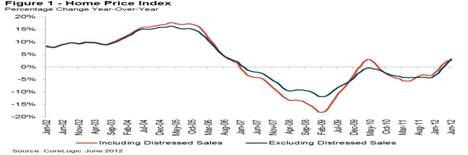
Home prices nationwide, including distressed sales, increased on a year-over-year basis by 2.5 percent in June 2012 compared to June 2011, says Corelogic’s June Home Price Index, which closely follows the S&P Case-Shiller Home Price Index, without seasonal adjustments. On a month-over-month basis, including distressed sales, home prices increased by 1.3 percent in June 2012 compared to May 2012, a huge jump. “The June 2012 figures mark the fourth consecutive increase in home prices nationally on both a year-over-year and month-over-month basis,” said Corelogic.

clip_image002

Graph: Calculated Risk Blog

Excluding distressed sales, home prices nationwide increased on a year-over-year basis by 3.2 percent in June 2012 compared to June 2011. On a month-over-month basis excluding distressed sales, home prices increased 2.0 percent in June 2012 compared to May 2012, the fifth consecutive month-over-month increase. Distressed sales include short sales and real estate owned (REO) transactions.

And Calculated Risk reports that housing inventories have dropped as much as 22.7 percent in one year, according to the National Association of Realtors. “On a seasonal basis, housing inventory usually bottoms in December and January and then starts to increase again through the summer. Inventory only increased a little this spring and has been declining for the last three months by this measure. It looks like inventory has peaked for this year,” said Calculated Risk.

clip_image004

Graph: Calculated Risk

This decline in active inventory is a huge story. The lower level of inventory has to be a major reason housing prices are rising, needless to say. But the rise in personal incomes of late also has to be a factor. Personal income in June gained 0.5 percent, following an advance of 0.3 percent the prior month.  Wages & salaries also showed strength, rising 0.5 percent after a 0.1 percent rise in May.

clip_image006

Graph: Econoday

Lastly, the Labor Department’s June Job Openings and Labor Turnover Report (JOLTS) may be boosting consumers’ confidence. It showed 3.76 million job openings in June, which the Labor Dept. characterizes as “little changed” from 3.66 million in May, but is up from 2.4 million job openings at the low point in June 2009.

Harlan Green © 2012

Posted in Economy, Housing, housing market, Weekly Financial News | Tagged , , , , | Leave a comment

Taxes Shouldn’t Be the Main Worry

Financial FAQs

Economist and British Lord John Maynard Keynes opined in the 1930s that in the end we are all dead, so why worry too much about anything else? Well, this particular election year there is something else worrying both parties—taxes.

Taxes shouldn’t be our main worry.  Creating more jobs should take precedence in the debate over growth.  In fact, recent surveys have found it’s the lack of sufficient demand for goods and surveys that is holding up faster growth, not taxes, or regulations, or too big government.

“Data from the U.S. Department of Labor indicate the employers infrequently cite government regulations and intervention as the reason for layoffs. According to the most recent quarterly data on layoffs lasting more than 30 days, employers said business-demand problems were behind more than 40 percent of separations, followed by seasonal factors, financial issues and organizational changes, among other factors. Employers cited governmental regulations/intervention for less than 1 percent of layoffs.”

Republicans worry about inheritance (i.e., death) and capital gains taxes in particular, since so much of their wealth is either invested or inherited. It is reputed by Senate Speaker Harry Reid and others that Mitt Romney pays very little in taxes, and would like even to pay less in his 5-Year Economic Plan to Grow the Economy.

Democrats worry about overtaxing the middle consumer class, but not the upper class. But cutting taxes to anyone means lower tax revenues, which shrinks government at a time when the private sector isn’t expanding enough on its own.

The real problem with both approaches is that neither will pay down our humongous federal budget deficit, unless economic growth picks up and no one as yet is providing a realistic plan to do it. It’s no secret what that is. Someone has to start spending money to make money that creates jobs and so stimulates greater demand for goods and services.

Even our ‘Government is the Problem” President Reagan knew this when he raised taxes 11 times to bring us out of the 1980 and 1983 recessions, mainly spending those revenues on defense. He knew that government had to provide the funds for growth when record interest rates had choked off private credit in the early 1980s.

image

Graph: CBPP

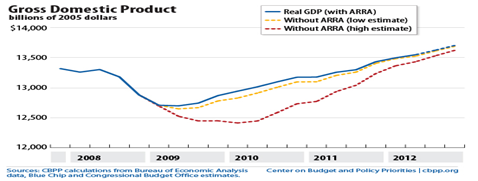
And President Obama’s $830B American Recovery and Reinvestment Act spending pulled us out of the Great Recession. The Recovery Act was designed to boost the demand for goods and services above what it otherwise would be in order to preserve jobs in the recession and create them in the recovery, says the CBPP.

The Congressional Budget Office finds that GDP has been higher each year since 2009 than it would have been without the Recovery Act (with the largest impact in 2010 when GDP was between 0.7 and 4.1 percent higher than it otherwise would have been). The economy is still benefiting from the Recovery Act, although as expected that effect is diminishing as the economy grows; CBO estimates that GDP in the third quarter of 2012 will be between 0.1 and 0.7 percent larger than it would have been without the Recovery Act.

So how to create more government revenues with which to simulate growth? A starter would be to allow all the Bush tax cuts to expire, bringing us back to Clinton-era taxes that created budget surpluses and 23 million jobs. This would save US about $3.6 Trillion in debt over the next 10 years, according to CBPP. And when estimating the revenue gained by just raising taxes on high-income groups, the Joint Center on Taxation and Treasury find that modest increases in the top marginal tax rates would also raise significant revenue. For example:

  • Treasury estimates that allowing the cuts in income taxes for high-income households (those with adjusted gross incomes above $250,000 for married filers and $200,000 for single filers) and estate taxes that were enacted in 2001 and 2003 to expire at the end of 2012 would save a $968 billion over the next ten years.

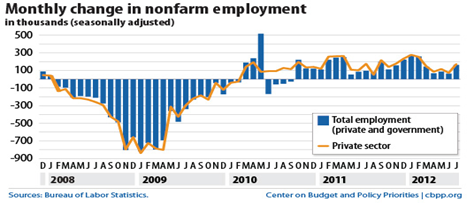
The ‘real’ jobs numbers I spoke about in June are beginning to show up in July, as jobs added, and 9,000 government jobs lost. The change in total nonfarm payroll employment for May was revised from +77,000 to +87,000, and the change for June was revised from +80,000 to +64,000.

image

Graph: CBPP.Org

This points to further employment growth ahead. Why? Incomes are increasing, as are hours worked, which means increased demand for products and services in the fall; ergo, increased hiring. Although employers began to add jobs in 2010, the economy has recovered only about 4 million of the 8.7 million jobs lost between the start of the recession in December 2007 and early 2010, says the Center For Budget and Policies Priorities. As a result nonfarm payroll employment was 3.4 percent (4.7 million jobs) lower in July 2012 than it was at the start of the recession.

So the economy still faces a long and difficult climb out of the jobs hole created by the recent recession. The private sector created, on average, about 157,000 jobs a month in the past 29 months — a pace somewhat faster than population growth. That has contributed to a decline in the unemployment rate, but much faster job growth will be needed to restore normal labor force participation.

Harlan Green © 2012

Posted in Economy, Keynesian economics, Politics, Weekly Financial News | Tagged , , , , , | Leave a comment

Housing Values Jump in Q2 2012

The Mortgage Corner

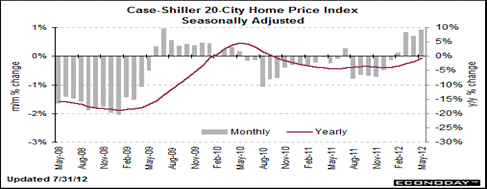
Consumers, perk up, as I said last week. Housing values are finally rising nationally. In fact, housing prices in all 20 city-metro areas in the Case-Shiller Home Price Index rose for the first time in years, before seasonal adjustment.

Home prices rose an adjusted 0.9 in May. This is the third strong gain in a row following 0.7 and 0.8 percent readings in April and March. Prices are coming off the bottom reflected in the year-on-year rate which is still in the negative column at minus 0.7 percent. Yet the direction is going the right way with 18 of 20 cities showing monthly growth led by Chicago and Atlanta, when prices are adjusted for the usual seasonal fluctuations.

clip_image002

Graph: Econoday

And Fannie Mae/Freddie Mac financed home prices are doing even better. The FHFA home price index in May increased 0.8 percent, following a 0.7 percent boost in April.  June’s figure was the fourth increase in a row.  The year-on-year rate is up 3.7 percent, compared to up 3.0 percent in April, according to the FHFA.

clip_image004

Graph: Econoday

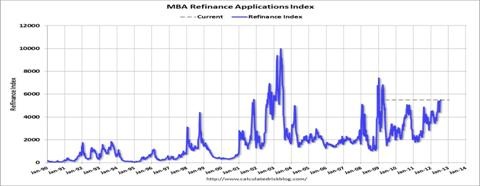
One reason housing prices are firming is soaring refinance activity, due in part to the new HARP 2.0 Fannie Mae/Freddie Mac loan modification program that allows unlimited loan to values, but without forgiving principal. It’s hard to quantify just how much this is helping home prices, but it is certainly helping fix the pocketbooks of homeowners, since conforming 30-year fixed rates have dipped to as low as 3.25 percent in California with zero origination points. And increased refinance activity has always preceded higher home sales.

The Refinance Index increased 0.8 percent from the previous week to its highest level since the week ending April 17, 2009, said the Mortgage Bankers Association.  The slight increase in refinance activity was muted by a 6 percent drop in government refinance applications, while conventional refinance activity increased about 2 percent over the week.  The seasonally adjusted Purchase Index decreased about 2 percent from one week earlier.

clip_image006

Graph: Calculated Risk

Another indicator Pending Home Sales dipped slightly in June, but that may be due to fewer homes available for sale. The inventory of homes on the market has been dropping steadily. In fact, there are only 4.9 months of new homes on the market, something we haven’t seen since the 1980s.

clip_image008

Graph: Econoday

So lack of supply appears to be an increasing negative in the housing sector. The National Association of Realtors, which compiles the pending sales report, blamed inventory shortages for June’s weakness. But shortage of inventory may also be boosting home prices, which should pull more existing homes into the market and will encourage builders in the new home market. Also, by region, weakness was most pronounced in the Northeast which was hit by bad weather.

Harlan Green © 2012
Posted in Economy, Housing, housing market, Weekly Financial News | Tagged , , , , , , , | Leave a comment

Romney’s 5-Point Plan—Very Primitive Economics

Financial FAQs

Romney’s “Five Point Plan to Grow the Economy” that he touts on his website, is primitive economics almost beyond belief. It returns us to 19th century government of the few by the few with few regulations or insurance against the kinds of events that brought on the Great Depression and Great Recession, for starters.

Conservatives in general and Mitt Romney don’t seem to understand the most basic concept of modern economics–insuring against major disruptions—that is indispensable to run a modern economy. Insurance isn’t only about insuring the many to protect the most vulnerable—whether against physical disasters such as the Midwest drought, or financial disasters such as the Great Depression, or catastrophic illness. It is really about all of our citizens being for one, and one for all. It is why we tax ourselves to pay for a government, because government is really the protector of last resort against the most basic risks in a world grown increasingly complex and uncertain.

Modern economies can’t do without it, yet Romney says he opposes most modern forms of protection in his 5-point plan by continuing to reduce taxes that would starve government of revenues, as well as cap spending on regulation enforcement. He would also repeal the Affordable Care Act that insures 30 million more Americans. Instead he proposes more of GW Bush’s ‘Ownership Society’ which seeks to return us to the era of laissez faire, free, unregulated markets that existed 100 years ago. And we know the damage those institutions which evaded or ignored modern financial regulation did to financial markets.

Then was a much smaller, less complex world where most Americans were still living on farms. But the farming world collapsed in the 1920s when mechanization caused farming prices to plunge, ultimately bringing on the Great Depression. That is when the modern, industrial world came into being, requiring New Deal insurance; including social security, unemployment insurance, and even workman’s compensation to cushion the effects of modern business cycles on the urban unemployed who could no longer return to the farm during tough times. And unions came into being to organize workers so they could bargain for better than minimum wages and benefits.

The centerpiece of Romney’s plan is to continue to cut taxes for both individuals and corporations. This is when corporations have the highest profits as a percentage of GDP in history, while most individual tax cuts have benefited the wealthiest, thus creating the worst income inequality since the 1920s.

clip_image002

Graph: CBPP

And in starving the government of revenues he would  impose a regulatory budget cap, “reform” regulations so that coal-fired power plants would no longer have to control their pollution (thank you, Koch Brothers, for your $millions in contributions), open ANWAR, the Arctic National Wildlife Preserve to oil drilling, and in general continue to support our most polluting, non-renewable energy resources.

Returning the U.S. to an almost primitive society is already happening, of course, with continuing Republican attempts to block Dodd-Frank regulation, privatize Medicare and social security. The Great Recession was a product of Adam Smith’s primitive economic theory that said an ‘invisible hand’ controls markets for the benefit of all.

Really? That hasn’t been the case during the past two GW Bush recessions, including the Great Recession. $Trillions were lost during those recessions that were the result of inflated asset bubbles bursting, as regulations were ignored or evaded which controlled financial risk-taking. The Bush record is not pretty, and that is the most recent record to look at that is the result of primitive economic thinking.

clip_image004

Graph: Calculated Risk

The historical graph of economic growth shows most clearly which policies work to grow the economy—primitive economic policies, or using government as an active participant in growth? In fact, all recent recessions since 1980 have occurred during Republican administrations; from President Reagan’s in 1980, 1983, Bush I in 1991, and GW Bush in 2001 and 2007-09. Policies that starve government of what is needed to govern effectively starves all of U.S. Need we say more?

Harlan Green © 2012

Posted in Economy, Keynesian economics, Macro Economics, Politics, Weekly Financial News | Tagged , , , , , | Leave a comment

Why the Summer Growth Slowdown?

Financial FAQs

The summer growth numbers seem weak, and pundits are saying it’s due to the European recession (so lower exports), the ‘fiscal cliff’(employers uncertain about future growth), and consumers with too much debt. But the numbers really show a repeat of last summer, when hiring slowed due to basically the same worries but picked up again in the fall (due to the Japanese Tsunami instead of euro, and debt cap stalemate that downgraded U.S. debt).

However, overall growth is still weak because so much income has been transferred to the wealthiest; particularly since 2000 and the Bush tax breaks, leaving middle class earners with even less income than in 2000. In fact, middle incomes have not even kept up with inflation since 2000. And middle income earners—i.e., most consumers—have been the main engine of U.S. growth since World War II.

clip_image002

Graph: CBPP

The good news is the Conference Board’s Index of Leading Economic Indicators which seems to alternate in up and down months, still shows moderate growth prospects for the rest of the year.

clip_image004

Graph: Econoday

For instance, since July 2011 growth in the Coincident Indicators that tracks GDP growth has been positive 8 of the past 12 months, with huge spikes in October and December 2011 and only 1 negative month in March 2012. The Leading Indicator that attempts to predict growth over the next 6 months was more negative with 4 contractions in 12 months. But in fact, the Leading Indicator has grown 1 percent in the past 6 months, up from 0.5 percent over the prior 6 months, signaling better prospects for growth.

So why all the fears of a dismal rest of the year? Could it be the 24/7 news cycle that exaggerates both the good and bad news? That is what causes most ‘bubbles’, according to Robert Shiller of Irrational Exuberance fame. We are literally being showered with too much economic data that even economists are hard put to understand.

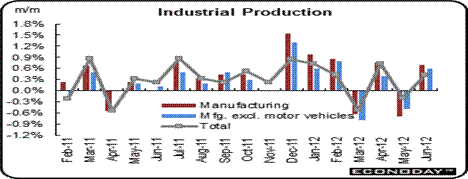
For instance, other indicators also point to better growth in the fall. By major components, June industrial production gained 0.7 percent after falling 0.7 percent in May, according to the Fed. Motor vehicles output added significantly to manufacturing, rebounding 1.9 percent in June after a 2.2 percent decline in May. Manufacturing excluding motor vehicles was quite strong also gaining 0.6 percent in June, following a 0.5 percent drop in May.

clip_image006

Graph: Econoday

So once again growth far outnumbers contraction in the manufacturing sector, with just 4 contractions in the past 17 months. So it seems rumor drives much of business and consumer confidence, as Europe’s problems seem to be affecting U.S. growth, but know one knows how much. So it is all about ‘momentum”, the magic word that spurred so much inflated stock values in the last decade, but now seems to deflate expectations for future growth!

What to do about this? Firstly, we need to counter the pessimists with greater stimulus spending, which more than pays for itself in increased activity. It can even be revenue neutral. For the real reason growth has been so tardy is most of the profits from the past 10 years of growth have gone to the wealthiest, thanks both to record corporate profits, and record tax cuts for the investor class, as I said—the lowest tax rates since the 1920s—that have drastically lowered tax revenues and increased the federal deficit.

So right now, it is the intransigence of many of the richest among us (such as Mitt Romney with his tax havens) who refuse to divert some of their wealth to provide more stimulus during a time of record income inequality. It is their refusal to return to the pre-Bush, Clinton-era taxation levels of 1992-2000 when most growth occurred and most jobs were created, in other words, that is holding back a real recovery.

Harlan Green © 2012

Posted in Consumers, Economy, Weekly Financial News | Tagged , , , , , , , | Leave a comment

Gun Violence Has Too Many Causes

Popular Economics Weekly

The shooting in Aurora’s Central Theatres is not something “impossible to understand” as was said by Denver’s Mayor just after the massacre, if we look at the culture of violence that has made U.S. the most violent nation on earth. In fact, gun violence, as violence in general, has too many causes. Studies bear out that record income inequality, a poor social safety net and lax, almost nonexistent gun control laws all contribute to the U.S. record as the most gun violent culture in the world.

The Trayvon Martin killing illustrated this culture with the Stand Your Ground Laws being enacted in several states. And thereby we are beginning to see where the National Rifle Association, backed by some elements of Big Business, is leading this country—into a greater lawlessness, at the very least. For the Stand Your Ground Law enshrines the gangster code—shoot first and ask questions later.

As Paul Krugman said in a March New York Times Op-ed after the Trayvon Martin killing:

“Specifically, language virtually identical to Florida’s law is featured in a template supplied to legislators in other states by the American Legislative Exchange Council, a corporate-backed organization that has managed to keep a low profile even as it exerts vast influence (only recently, thanks to yeoman work by the Center for Media and Democracy, has a clear picture of ALEC’s activities emerged). And if there is any silver lining to Trayvon Martin’s killing, it is that it might finally place a spotlight on what ALEC is doing to our society — and our democracy.”

Krugman was exposing the links between corporations and the NRA that continues to push for guns to be worn by everyone everywhere, with or without background checks or even licenses.

Why the push by the NRA, and Big Business for more guns, as I said back in April? The reason most gun advocates and the NRA give, is that it is for the purpose of self-defense in an increasingly violent world. The NRA even asserts it decreases violence. But studies cited in an excellent book, Gun Violence: The Real Costs by Philip J. Cook and Jens Ludwig show that gun use tends to increase gun violence—i.e., there are almost 4 times more fatalities in gun-related robberies than other robberies with knives, clubs, etc.

And a study cited in the Justice Department’s National Crime Victimization Survey (NCVS) on home invasions found that just 3 percent were able to use guns against someone who broke in (or attempted to do so) while they were at home, when 40 percent of households have guns.

So it turns out guns are not very helpful in self-defense. Also overlooked is the fact that criminals are predators, and predators prey on the weakest and most vulnerable, not those who look like they can defend themselves. So really, does the agenda of the NRA to abolish all gun controls do more than reinforce the fear factor, the fear that your neighbor may be your assailant?

“But where does the encouragement of vigilante (in)justice fit into this picture?” asks Krugman. “In part it’s the same old story — the long-standing exploitation of public fears, especially those associated with racial tension, to promote a pro-corporate, pro-wealthy agenda. It’s neither an accident nor a surprise that the National Rifle Association and ALEC have been close allies all along.”

The culture of violence is not a pretty picture in our crowded cities in particular. Philadelphia averaged more than 30 gun-related deaths per month in 2011, when Europe as a whole had less than 300 per year. The last time U.S. gun violence was this high was during the Great Depression, when we had gangsters like Al Capone, John Dillinger, and Bonnie and Clyde.

English Sociologist Richard Wilkinson has brought this out in books and lectures, especially his TEDx lecture on the roots of violence and crime, in which he charts that countries with the most inequality in wealth are also the most violent countries. And surprise, the U.S. is now one of the most unequal countries—in terms of wealth and opportunities for wealth—in the world, as has been brought out by the CIA World Factbook. It is ranked 94th of the 136 countries ranked by the for income inequality, close to Camaroon, Zimbabwe, some of Africa’s poorest countries.

There are many who will say that the deeds of a psychopath cannot be prevented. But is that the point when it is so ridiculously easy for an individual to purchase an arsenal without an alarm being set off? Why would anyone need 6,000 rounds, for instance, said the New York Times?

“With a few keystrokes, the suspect, James E. Holmes, ordered 3,000 rounds of handgun ammunition, 3,000 rounds for an assault rifle and 350 shells for a 12-gauge shotgun — an amount of firepower that costs roughly $3,000 at the online sites — in the four months before the shooting, according to the police. It was pretty much as easy as ordering a book from Amazon.”

Do we need another reason to demand laws that require the reporting of such weapon sales?

Harlan Green © 2012

Posted in Politics, Uncategorized | Tagged , , , , , , , | Leave a comment