Coup Attempt by Donald Trump-Elon Musk

A couple dozen young men go from government office to government office, dressed in civilian clothes and armed only with zip drives. Using technical jargon and vague references to orders from on high, they gain access to the basic computer systems of the federal government. Having done so, they proceed to grant their Supreme Leader access to information and the power to start and stop all government payments.

That coup is, in fact, happening. And if we do not recognize it for what it is, it could succeed.

In the third decade of the twenty first century, power is more digital than physical. The buildings and the human beings are there to protect the workings of the computers, and thus the workings of the government as a whole, in our case an (in principle) democratic government which is organized and bounded by a notion of individual rights.

The ongoing actions by Musk and his followers are a coup because the individuals seizing power have no right to it. Elon Musk was elected to no office and there is no office that would give him the authority to do what he is doing. It is all illegal. It is also a coup in its intended effects: to undo democratic practice and violate human rights.

Timothy Snyder, Author of On Tyranny

do

Posted in Politics, Uncategorized | Tagged , , , , , , , | Leave a comment

Fewer Jobs Available

Financial FAQs

“It’s gotten harder for the unemployed to find work: Job openings in the U.S. fell at the end of 2024 to the second lowest level since the end of the pandemic.” MarketWatch

FREDjobopenings

Job vacancies reported by the Bureau of Labor Statistics have dropped from 8.2 million to 7.6 million openings in just one month. And this is becoming worrisome with the financial markets’ uncertainty over the effects of the federal government efficiency drive that President Trump is promising.

It’s also taking people who lose a job a lot longer to find one. The number of people collecting unemployment benefits has risen to the highest level since 2018 if the pandemic years are omitted,” said Marketwatch.

This is having an impact on consumer confidence, needless to say, since consumers tend to become more cautious in their spending ways at such times. The Conference Board’s Confidence survey wasn’t upbeat.

“All five components of the Index deteriorated but consumers’ assessments of the present situation experienced the largest decline. Notably, views of current labor market conditions fell for the first time since September, while assessments of business conditions weakened for the second month in a row,” said its Chief Economist, Dana Peterson.

Why the doubts when the just elected Republicans are touting they can cure the budget deficit with a tariff war, which the Wall Street Journal just headlined was “The Dumbest Trade War in History.”

None of this is supposed to happen under the U.S.-Mexico-Canada trade agreement that Mr. Trump negotiated and signed in his first term, according to WSJ’s Editorial Board.

“The U.S. willingness to ignore its treaty obligations, even with friends, won’t make other countries eager to do deals. Maybe Mr. Trump will claim victory and pull back if he wins some token concessions. But if a North American trade war persists, it will qualify as one of the dumbest in history,” says the WSJ.

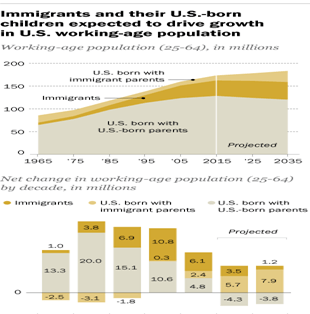
Then there are the ongoing deportations which will hurt service industries like leisure, transportation, healthcare, and construction which employ a majority of immigrants, especially in the smaller businesses.

The number of job vacancies reported by companies was lowest after the 2008 Great Recession and began the steady climb to 7 million just before the COVID-19 pandemic 7.6 million job openings has stabilized over the past several months, indicating that the job market and so the unemployment report hasn’t changed. There were 5.5 million hires and 5.3 million separations (i.e., left their jobs), indicating that some 200,000 new jobs were created, which will be confirmed in Friday’s official unemployment report.

All three major stock market indexes have been seesawing since Trump enacted, then suspended the Mexican and Canadian tariffs, but not the Chinese 10% tariff. So, it is really up to the new administration to calm the markets, if they don’t want more investors to head for the exits.

And how will the threatened firing of FBI agents calm the waters? Who will then protect us from domestic and foreign terrorists?

Harlan Green © 2025

Follow Harlan Green on Twitter: https://twitter.com/HarlanGreen

Posted in Consumers, COVID-19, Economy, Politics, Weekly Financial News | Tagged , , , , | Leave a comment

The Tariff Wars–Part II

Financial FAQs

“Trump has called “tariff” the fourth most beautiful word in the dictionary behind “God”, “love” and “religion.” CNN

FREDdebt/GDP

On Saturday, President Trump, just 11 days into his second term, said he will impose a 25 percent tariff on Canadian and Mexican imports, and 10 percent on Chinese imports.

He has said it will raise revenue to correct the large trade imbalances with those countries, as well as induce Mexico and Canada to halt the flow of fentanyl into the U.S., as well as illegal immigration.

But immigration flows are already down to levels before even the Obama administration, while Mexico and Canada have already said they will work with Trump to stem the flow of illegal drugs.

So why is he doing what will badly harm the U.S. economy and that of our two best neighbors and trading partners? His real motivation is pure greed. He and his oligarch friends must decrease the massive budget deficit that has mushroomed to 121 percent of Gross Domestic Product (see graph), so that he can prolong the tax cuts that have transferred so much wealth from working adults to his wealthiest supporters and added $5 trillion to the national debt.

He must cut the huge budget deficit that has resulted because it is alarming bond investors and budget hawks.

Hedge fund manager Ray Dalio, founder of Bridgewater Associates, once the world’s largest hedge fund, has been sounding the alarm mostly recently in a Barron’s Magazine interview, in which he said our current budget deficit could give the world a “financial heart attack.”

“Think of the credit flow like the blood flow that carries nutrients through the system to the body. Credit creates debt that builds up like plaque in those arteries, and like plaque, it grows and crowds out the nutrients because debt service crowds out other spending,” , said Dalio

“When does the heart attack come? When the constriction is enough that it squeezes out other spending, which in increasingly happening, or when investors see that happening, which leads them to sell bonds,” said Dalio.

Tariffs had become Trump’s way of paying down the deficit by taxing imports. He has said collecting what he believes will be “billions” in taxes from the tariffs on imports will help pay down the huge budget deficit that he helped to generate from the 2017 tax cut bill (Tax Cuts and Jobs Act) in his first term.

But that tax cut was just the latest by Republican administrations that have caused the massive national debt, which is expressed as a ratio of debt-to-gdp in the above FRED graph dating from 1980, when Republicans first began increasing the budget deficit.

It has been Republicans’ huge tax cuts since President Reagan in 1980 that have created the largest national debt since World War Two, and the trickle-down economy ever since. And renewing Trump’s 2007 Tax Cuts and Jobs Act when it expires this year could add another $5 trillion to the budget deficit, according to non-partisan analysts.

So who will be hurt most by the tariffs? Workers in all countries at a time when inflation is still too high, and preventing the Fed from making fewer rate cuts this year due to higher inflation.

The NAFTA trade agree between Mexico and Canada has made North America the largest trade-free zone outside of the Eurozone, enabling each country to produce what it does best, such as autos where many auto parts are manufactured more cheaply and shipped into the U.S. where they are assembled.

Trump has repeatedly (and incorrectly) said that “the tariff sheriff” former President William McKinley, ushered in an era of American prosperity at the end of the 19th century by going all-in in tariffs, as cited by CNN.

No, it was the result of the industries created in the first Gilded Age by the Robber Barons of that era—the oil, railroad, and banking magnates of that era. And Trump, a convicted felon, believes he can become another Robber Baron in this Gilded Age.

Harlan Green © 2025

Follow Harlan Green on Twitter: https://twitter.com/HarlanGreen
Posted in Consumers, COVID-19, Economy, Politics, Weekly Financial News | Tagged , , , , , , , | Leave a comment

Why Inflation Still a Problem?

Financial FAQs

The Fed’s preferred inflation gauge, Personal Consumption Expenditures Index (PCE) isn’t declining because consumers continue to spend more than they earn. Why?

BEA.gov

Such spending gave a boost to retail sales and so made holiday shoppers happier. But it also highlighted the underlying problem, inflation is still too high.

The June to December BEA graph shows the difference between income (blue bar) and spending, or outlays (orange bar). It has been this way for at least one year. The declining black line in the graph measures consumers’ personal savings rate, which is back down to 3.8 percent from almost 5 percent in June 2024 because of it.

Why do consumers keep spending more than they make? One clue is that most of the spending is for housing, utilities, transportation and gasoline—necessities. It must be that consumers are not earning enough to keep up with rising prices for their basic needs.

But it also shows a bit if irrational exuberance—a form of excessive optimism that former Fed Chair Greenspan warned about in the ‘90s—and is happening in the financial markets today, which are at record highs.

“The numbers look good. Maybe even surprisingly good—and that’s not a word I throw around willy nilly,” said Barron’s Magazine’s Jack Hough recently about the financial markets.

Stubborn inflation tells us why it became the backbreaker for Democrats in this election cycle. It confirms the most basic of economic laws—the Law of Supply and Demand. The American economy as well as imports are not supplying enough goods and services to satisfy the demand for them.

Most of the inflation surge was in the service sector, as I said, and consumers want more and better services most of all. Hence personal expenditures (blue line in second graph) is hovering around 2.8 percent—too high for the Fed that wants 2 percent inflation.

Inflation in the Fed’s PCE price index for December increased 2.6 percent in one year. Excluding food and energy, the PCE price index increased 2.8 percent from one year ago.

This picture tells us the real problem—the slow recovery from the COVID-19 pandemic isn’t producing enough. World supply has not caught up with the world demand for goods and services. It is also due to so much geopolitical unrest, including the Mideast and Ukraine conflicts.

And the Trump administration wants to deport those undocumented immigrants that mostly work in the services industries, which means more worker shortages; as well as raise tariffs on many countries, which could cut GDP growth by some 1 percent, according to the Peterson Institute, a non-partisan research organization.

It will make everything that American consumers want even more expensive. And that might keep the Federal Reserve from dropping interest rates further, as they hinted in their just concluded January FOMC meeting. How about that?

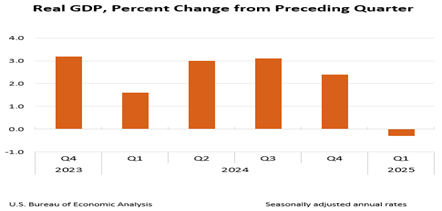
There was also some good news. The U.S. economy grew at a mild 2.3% annual pace in the final three months of 2024, and the details of the report showed an economy on strong footing that was being handed over to the Trump administration. GDP grew at 3% and 3.1% in the two prior quarters.

It’s still not a good time for excessive optimism, in my opinion.

Harlan Green © 2025

Follow Harlan Green on Twitter: https://twitter.com/HarlanGreen
Posted in Consumers, COVID-19, Economy, Politics, Weekly Financial News | Tagged , , , , , , , | Leave a comment

The Housing Recovery–Part II

The Mortgage Corner

Existing-home sales rose 2.2% in December to a seasonally adjusted annual rate of 4.24 million, the strongest pace since February 2024 (4.38 million).

FREDexistinghomesales

The huge jump in existing-home sales on still very high mortgage rates illustrates the enormous pent-up demand for rental or owner-occupied housing, I said last month. Demand is now exceeding the existing home inventory with just a 3.8 months’ supply vs. the 8-month supply of new homes for sale that is only partially filling the housing supply shortage. Realtors believe the strong demand will continue.

“Home sales momentum is building,” said NAR Chief Economist Lawrence Yun. “More buyers have entered the market as the economy continues to add jobs, housing inventory grows compared to a year ago, and consumers get used to a new normal of mortgage rates between 6% and 7%.”

It remains to be seen how long consumers will tolerate such high mortgage rates. The 2001 Dot-com recession was the last time conforming 30-year fixed rate mortgages were above 7 percent, before the long decline in interest rates. It all led to the 2007 housing bubble and Great Recession.

If such demand continues, could we see another era of irrational exuberance as happened then? That’s grist for another column!

Existing-home inventory registered at the end of November was 1.33 million units, down 2.9% from October but up 17.7% from one year ago (1.13 million). Unsold inventory sits at a 3.8-month supply at the current sales pace, down from 4.2 months in October but up from 3.5 months in November 2023.

This is why building more new homes is so important. It is why builders have built up an 8-month inventory. And it is why sales of newly single-family houses in December 2024 were also so high, at a seasonally adjusted annual rate of 698,000, according to estimates released jointly today by the U.S. Census Bureau and the Department of Housing and Urban Development, above the December 2023 estimate of 654,000.

Even pending home sales jumped, another sign of an incipient housing recovery, Pending sales help to predict closings 30 to 60 days out. Pending home sales gained 2.2% in November – the fourth consecutive month of increases and the highest level since February 2023 – according to the National Association of REALTORS®.

“Consumers appeared to have recalibrated expectations regarding mortgage rates and are taking advantage of more available inventory,” said NAR Chief Economist Lawrence Yun. “Mortgage rates have averaged above 6% for the past 24 months. Buyers are no longer waiting for or expecting mortgage rates to fall substantially. Furthermore, buyers are in a better position to negotiate as the market shifts away from a seller’s market.”

Builders blame “unnecessary regulations” for much of the housing shortage. However, most of the ‘unnecessary regulations’ are at the state and local levels, such as restrictive zoning, state environmental laws, and even banking regulations.

It’s difficult to see how the outcome of national elections can affect such local changes. California is one such state that has taken on the NIMBYs (Not in my backyard) crowd as well as putting aside loan subsidies for affordable housing. That’s where the changes need to be to make up for the current housing shortage.

It’s hard for me to see that we will have another 7-million-unit sales year as happened during the housing bubble, however, no matter the mortgage rates. It was a different era, for those that can remember, since we have an ongoing labor shortage and higher construction costs (tariffs?) today.

Harlan Green © 2025

Follow Harlan Green on Twitter: https://twitter.com/HarlanGreen

Posted in Consumers, COVID-19, Economy, Housing, housing market, Weekly Financial News | Tagged , , , , , , , , , | Leave a comment

Trump, the Lucky Loser

Answering Kennedy’s Call

“Born to a rich father who made him the beneficiary of his own highly lucrative investments, Trump received the equivalent of more than $500 million today via means that required no business expertise whatsoever.”

Random House

In just Donald Trump’s first week in office, it’s becoming obvious that the illusions he lives under will be no different than during his first term as president. He is counting on the American electorate to not believe what they are seeing.

For instance:

Climate change—”drill baby drill” for more fossil fuels when we are experiencing the worst climate disasters in history due to global warming—e.g., horrific wildfires, tornadoes and hurricanes.

Healthcare—Leaving WHOrg responsible that monitors worldwide pandemics, and censoring the CDC and other government healthcare watchdogs’ research while releasing their results only after they have been vetted by his political appointees.

Military preparedness—now allowing military service members not to be vaccinated for COVID-19 and reinstating service members with full pay who were discharged for refusing vaccines.

Immigration—Saying he will deport millions of undocumented immigrants, when it will reduce badly needed workers in low-paying jobs that American citizens aren’t taking.

Tariffs—Asserting he would raise tariffs as high as 50 percent on nations with huge trade imbalances viz the U.S., when economists are saying it will be inflationary, and in Nobel Laureate Paul Krugman’s words, “make us poorer.”

Public education—Wants to abolish Department of Education that supports the 80 percent of students in public schools.

Tax cuts—Just extending his first term tax cut beyond 2025 when it is scheduled to expire and could add as much as $5trillion to the already bloated federal budget deficit, which could cause investors to lose faith in the US Dollar.

President Trump’s real intentions are already becoming clear in his second presidential term in office. He and his Oligarchs want to steal the US Government blind, as I said last week, by keeping Americans and the media as blind as possible to what he intends.

Why does Trump continue policies that will only harm more Americans while enriching himself and his oligarch supporters?

This was highlighted in Pulitzer Prize-winners Russ Buettner and Susanne Craig’s just released book, Lucky Loser that raises a bigger question in a Washington Post review by Bethany McLean about the ‘fake it ‘til you make it’ ethos of modern America. In a world that conflates the ‘trappings of wealth with expertise and ability,’ where ‘fame, detached from any other marketable talent or skill,’ is ‘a highly compensated vocation,’ does it even matter if you never actually make it?”

The outright distrust of truth is a propaganda tool used by autocrats that public media has normalized. This probably tells us best why he was able to take over the Republican Party that has drifted so far from conservative values and was once the environmental party when Republican President Nixon signed the U.S. Environmental Protection Agency into law in 1970.

So will he be more successful in passing his promises in his second term? We should ignore some of his most nonsensical executive orders, such as attempting to amend the 14th Amendment by decree that guarantees citizenship for anyone born in the U.S. 50 states and territories, which he knows can’t be done by decree or executive order.

But the furor that it and the immediate release of 1500 January 6 Capital attackers from prison, mostly convicted felons, will generate enough attention that it will cloak his real intention; reduce or eliminate as many government programs as possible that make life better for ordinary Americans, such as Medicaid, in order to fund more tax cuts.

He has already rescinded the Biden executive order to cap Medicaid spending on drugs that would save Medicaid $billions in costs.

“In reversing the executive order Biden signed in 2022, Trump halted an effort to cap the copayment for generic medications at $2 for Medicare beneficiaries, along with another program that would see Medicare pay less for drugs that receive accelerated approval from the Food and Drug Administration,” according to MarketWatch’s Jessica Hall.

And there is also the question of what Trump will do with regard to the prescription-drug provisions in the Inflation Reduction Act, which would be substantially more consequential. Under the Inflation Reduction Act, Medicare can negotiate the prices of certain prescription drugs with the aim of making drugs more affordable for older adults and people with disabilities.

He continues to throw bombs at the public media by announcing he will seek retribution from those prosecutors that sought his indictment for the various crimes he committed during his first term, such as January 6, withholding Top Secret documents at Mar-a-Lago and elsewhere, while hoping to erase some of the Grand Jury indictments.

And he will eventually have to settle the $500 million in awards won by women he defamed. So it’s no wonder he will use his immense power that is meant to protect U.S. citizens to protect himself instead, at their expense.

Harlan Green © 2025

Follow Harlan Green on Twitter: https://twitter.com/HarlanGreen
Posted in Macro Economics, Politics, Weekly Financial News | Tagged , , , , , , , , , , | Leave a comment

No Art of the Deal – Part II

Answering Kennedy’s Call

“It’s 100 days into the Trump Presidency and looking more and more like President Trump is no more effective at running the country than his business interests. His book, The Art of the Deal was meant to tout his negotiating skills, but the results were never very successful.”

Huffington Post

I wrote this piece for Huffington Post in 2017, after President Trump’s first 100 days as president.

And neither are his legislative efforts; with no repeal of Obamacare, or tax reform, an immigration ban, new trade policy, and sanctuary city victories in the offing anytime soon because of poorly thought out strategies. Instead, he threatens judges, sanctuary cities, Congress, and even other countries when they don’t support his various executive orders,” I said then.

President Trump’s real intentions are becoming clear on just his second day of his second term in office. He and his Oligarchs want to steal the US Government blind, as the saying goes, by keeping Americans and the media as blind as possible to what he intends.

Will he be more successful in passing his promises in his second term? We should ignore some of his most nonsensical executive orders, such as attempting to amend the 14th Amendment by decree that guarantees citizenship for anyone born in the U.S. 50 states and territories, which he knows can’t be done by decree or executive order.

But the furor that it and the immediate release of 1500 January 6 Capital attackers from prison, mostly convicted felons, will generate enough attention that it will cloak his real intention; reduce or eliminate as many government programs as possible that make life better for ordinary Americans, such as Medicaid, in order to fund more tax cuts.

He has already rescinded the Biden executive order to cap Medicaid spending on drugs that would save Medicaid $billions in costs.

“In reversing the executive order Biden signed in 2022, Trump halted an effort to cap the copayment for generic medications at $2 for Medicare beneficiaries, along with another program that would see Medicare pay less for drugs that receive accelerated approval from the Food and Drug Administration,” according to MarketWatch’s Jessica Hall.

And there is also the question of what Trump will do with regard to the prescription-drug provisions in the Inflation Reduction Act, which would be substantially more consequential. Under the Inflation Reduction Act, Medicare can negotiate the prices of certain prescription drugs with the aim of making drugs more affordable for older adults and people with disabilities.

We can’t blame it just on Trump. Republicans have been trying to deprive Americans of affordable healthcare managed by the government for years. The efforts became serious in the more than 30 unsuccessful attempts to repeal Obamacare since it was passed during President Obama’s first two years in office. It became an obsession in Trump’s first term that I wrote about in Huffington Post at the time.

What if conservatives succeeded in repealing Obamacare (ACA)? “Republicans’ Obamacare repeal bill would leave 17 million more people uninsured next year, and 32 million more in 2026, the Congressional Budget Office said in an estimate Wednesday. It also said premiums would double by 2026. …By 2026, three quarters of the population would live in areas with no insurers participating in the non-group market, due to upward pressure on premiums and downward pressure on enrollment, the report found.”

The accrued savings in health care spending relative to their projected growth prior to the ACA are substantial: Medicare alone is now projected to spend $1 trillion less between 2010 and 2020.

The lobbies behind the Obamacare repeal effort have not succeeded in making more Americans ill. I don’t even want to imagine what the results would be if he and Republicas succeed in downsizing Medicaid benefits as well.

Harlan Green © 2025

Follow Harlan Green on Twitter: https://twitter.com/HarlanGreen

Posted in Consumers, COVID-19, Politics, Weekly Financial News | Tagged , , , , , , , | Leave a comment

Retail Sales Boost Q4 Growth

Financial FAQs

“Advance estimates of U.S. retail and food services sales for December 2024, adjusted for seasonal variation and holiday and trading-day differences, but not for price changes, were $729.2 billion, an increase of 0.4 percent (±0.5 percent)* from the previous month, and up 3.9 percent (±0.5 percent) from December 2023,”according to the US Census Bureau.

FREDretailsales

Retail sales make up one-third of spending, and during good times such as after the last two recessions, soared above 8 percent annually. But the current 3.9 percent annual spending rise is not adjusted for inflation, so is mostly due to inflation that is stuck in the 2 to 3 percent range.

But stocks and some bonds are rallying as consumers keep spending because they are fully employed and continue to have savings left over from the government’s post-pandemic aid programs.

It’s also the reason Federal Reserve Banks, such as the Atlanta Fed’s GDPNow estimate, are predicting 3 percent GDP growth again in the fourth quarter as seen in their graph. This will be the third consecutive quarter of 3 percent GDP growth.

AtlantaFed

And if consumers continue to shop as they have been, inflation won’t get any better in 2025. In fact, if Trump follows through on his tariff promises, inflation may get worse and maybe even cause the US Fed to raise interest rates again. It’s going to be an interesting battle between the Trump administration wanting to push rates lower and the Fed wanting to push inflation lower. They aren’t compatible, needless to say.

We should probably call this another era of irrational exuberance, as former Fed Chair Alan Greenspan foresaw in 1996 preceding the 2000 Dot-com bubble burst. It really means investors tend to follow the herd, because most of their information isn’t based on research, but “hearsay and word-of-mouth”, in the words of Nobel Laureate Robert Shiller.

Irrational exuberance can be a terrible thing and has been studied by more than one Nobel Laureate. We are still recovering from the Great Recession and consequent housing shortage because of it.

So the moral should be: “Don’t believe in all the misinformation you hear,” and will be hearing this year!

Harlan Green © 2025

Follow Harlan Green on Twitter: https://twitter.com/HarlanGreen

Posted in Consumers, COVID-19, Economy, Weekly Financial News | Tagged , , , , , , , , | Leave a comment

Why the Tariffs Debate?

Popular Economics Weekly

“For far too long, we have relied on taxing our Great People using the Internal Revenue Service (IRS). Through soft and pathetically weak Trade agreements, the American Economy has delivered growth and prosperity to the World, while taxing ourselves. It is time for that to change. I am today announcing that I will create the EXTERNAL REVENUE SERVICE to collect our Tariffs, Duties, and all Revenue that come from Foreign sources.” @realDonaldTrump (cited by Paul Krugman)

This is just another insane fantasy Trump seems to believe—or is practicing his politics of diversion—to mask the fact that tariffs are a tax that we pay on what is imported, just as foreign citizens pay taxes on what enters their countries, which boosts the prices of those products.

Trump collected more than $400 billion in tariffs during his first term, some of which he had to pay out to subsidize American farmers who had lost their soybean and wheat exports when China retaliated in kind.

But such a fantasy can reassure his loyal supporters that there is a way to escape their overriding fear of inflation. And the latest inflation news was good news for the financial markets as well.

FREDcpi

The Consumer Price Index for All Urban Consumers (CPI-U) increased 0.4 percent on a seasonally adjusted basis in December, after rising 0.3 percent in November, the U.S. Bureau of Labor Statistics reported today. Over the last 12 months, the all items index increased 2.9 percent before seasonal adjustment.

Stock and bond investors were so hungry for good inflation news when the Consumer Price Index surprised on the downside that financial markets rallied. Core inflation without food and energy prices factored in rose just 0.2 percent, which was below expectations.

The DOW immediately rallied +744 points, the S&P Index +140 pts., in the first 10 minutes of trading. They are now betting that the Fed will continue to ease credit by lowering interest rates further this year.

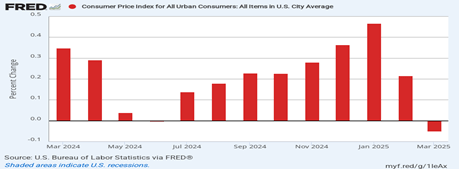
It’s a relief rally because Consumer Price Index (CPI) inflation of retail goods and services has been increasing since it went slightly negative in June of last year (see graph). This raised fears that the Fed might not cut interest rates further this year at all.

The next day’s wholesale Producer Price Index report was also good news. U.S. producer prices (PPI) that are the major part of retail costs rose less than expected in December, as the higher costs for goods were partially offset by stable services prices, suggesting inflation remained on a downward course.

Trump, of course, would like to abolish income taxes as do most Oligarchs. Wouldn’t it be nice to return America to the pre-income tax, Gilded Age of President William McKinley and the Robber Barons! Americans didn’t tolerate the Robber Barons taking so much of their wealth for long, however, which was the reason for creating the personal income tax with the 16th Amendment.

Trump’s misinformation is just one propaganda diversion that Trump will use to hide the fact that tariffs on imports, like all taxes, will be inflationary. As every successful investor knows, it’s better to focus on facts instead of the fiction that we can avoid paying taxes on what we buy, if we want a government that works for the many rather than the few.

Harlan Green © 2025

Follow Harlan Green on Twitter: https://twitter.com/HarlanGreen

Posted in Consumers, COVID-19, Economy, Politics, Weekly Financial News | Tagged , , , , , , , , , | Leave a comment

No Art of the Deal

Answering Kennedy’s Call

‘Insanity is doing the same thing over and over again and expecting different results,’ Einstein?

Huffington Post

Insane behavior could describe the actions that President-elect Trump is promising to implement after January 20. He has said he wants to repeat what he attempted during his first term: deport millions of immigrants, impose higher tariffs on many countries (especially China), cut taxes, reduce wind powered energy, and “Drill baby Drill” for more fossil fuels.

These policies would have damaged economic growth at the least, if successful, maybe even caused a recession, but it didn’t happen. That was in part because of the COVID-19 pandemic that required emergency government relief. And many of his first term cabinet were picked for extreme loyalty rather than ability. Trumps own limited intelligence was also a factor keeping him from implementing his agenda.

So why do he and his his loyal supporters keep expecting different results this time? Because it would enhance his wealth and that of his main financial supporters led by Elon Musk, the world’s wealthiest Oligarch.

And, even partially implemented would keep red states from receiving the benefits blue states receive, such as higher minimum wages, better healthcare, laws protecting labor unions and collective bargaining by reducing regulations and cutting taxes that benefit their ruling elites.

His biggest supporters are wealthy Oligarchs who still believe in a win-lose world that ceased to exist when the industrial revolution and new technologies began to produce more than could be consumed. It took the progressive movement that culminated in Roosevelt’s New Deal to confirm that there were enough resources to benefit working Americans as well as the holders of the wealth created by American workers.

His most loyal followers have been willing to give up such benefits in return for cultural values they still believe in such as banning new immigrants and most abortions, as well as censoring libraries in red states so that their followers only have access to propaganda instead of facts.

President-Elect Trump and Republicans’ singular success in his first term has been another tax cut that has continued the transfer of wealth from working Americans to the wealthiest since the Reagan administration.

He may fail in implementing most of his agenda, but we can be sure he will be as vindictive in seeking revenge in Trump 2.0 for his perceived slights as in his first term, now that he is a convicted felon.

Fortune Magazine reported in 2016 on candidate Trump’s negotiating tactics: “The legal actions provide clues to the leadership style the billionaire businessman would bring to bear as commander in chief. He sometimes responds to even small disputes with overwhelming legal force. He doesn’t hesitate to deploy his wealth and legal firepower against adversaries with limited resources, such as homeowners. He sometimes refuses to pay real estate brokers, lawyers and other vendors.”

And what about reducing the size of government that Republicans promise will reduce graft and waste? Who does it really help?

“Pretty much the whole Republican Party–and, if we’re going to be honest, too many Democrats–talked about the evils of ‘big government’ and called for deregulation,” Senator Elizabeth Warren said in 2016 at a AFL-CIO National Summit on Raising Wages. “It sounded good, but it was really about tying the hands of regulators and turning loose big banks and giant international corporations to do whatever they wanted to do.”

“These families are working harder than ever, but they can’t get ahead. Opportunity is slipping away. Many feel like the game is rigged against them–and they are right,” Warren said. “The game is rigged against them…. The world has changed beneath the feet of America’s working families.”

Many did listen to this warning and elected President Biden because of it. But the message was lost because many Americans thought Democrats were no longer up to the task of protecting them.

Yet we already know who Republicans intend to protect.

Harlan Green © 2025

Follow Harlan Green on Twitter: https://twitter.com/HarlanGreen
Posted in Economy, Keynesian economics, Politics | Tagged , , , , , , , | Leave a comment