Americans Still Fully Employed!

Popular Economics Weekly

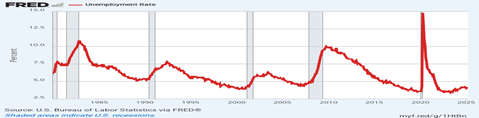
Total nonfarm payroll employment increased by 256,000 in December, and the unemployment rate changed little at 4.1 percent, the U.S. Bureau of Labor Statistics reported today. Employment trended up in health care, government, and social assistance. Retail trade added jobs in December, following a job loss in November.

FREDunemployment

It was a tremendous employment report. Then why did stock and bond values tank on Friday? December’s unemployment report was certainly good for workers. Employment is maxed out, with employers unable to hire new workers other than replacements for those retiring or changing jobs. The Labor Department’s JOLTS report showed that employers reported 8.1 million open job positions in December.

The strong employment report has reignited fears that the Fed will halt their rates reductions because of inflation fears. Almost everyone is currently predicting strong fourth quarter economic growth and continued full employment that has prevailed since January 2022.

The inflation ‘culprit’ (f you want to call it that) is strong government spending for all the construction and climate change projects being funded from the various Bidenomics’ bills.

In fact, it is Bidonomics, the $5 trillion plus investments in the US economy over this decade, that is keeping Americans fully employed. And it is boosting employee wages, as well, which is why inflation is proving so difficult to tame.

We are joined in the age-old battle of workers vs. owners, employees vs. employers, over how to divide our national wealth. Wall Street investors want lower inflation because it doesn’t dilute their wealth, while workers want full employment because it increases their wages.

So who is really complaining about our fully employed economy? Elon Musk, the world’s wealthiest Oligarch, for one. It is those that don’t like any inflation because it dilutes the value of their assets. Therefore the so-called efficiency experts led by Elon Musk want to shrink government spending without admitting it is the only thing keeping Americans fully employed.

Renown economist Mohamed El-Erian recently stated on CNBC’s After the Bell that the U.S. economy’s spectacular growth is the only thing keeping the world’s economies afloat, so why should we worry too much about higher inflation at this stage?

Well, it is triggering consumer worries about rising prices and has provided the propaganda tools that re-elected the party of oligarchs wanting to slash government programs that benefit wage earners most.

Expectations in the University of Michigan sentiment survey for inflation over the next year jumped to 3.3% in January from 2.8% in the prior month. It is the highest rate since May. Expectations for inflation over the next five years surged to 3.3% this month from 3% in December. That’s the highest since June 2008.

But consumers know how to adapt, especially with wages that are keeping ahead of inflation. They tend to look for more bargains when they see rising prices. So, shouldn’t our government’s main goal be to keep workers fully employed and healthy rather than benefiting Elon Musk’s efficiency experts and Wall Street financiers?

Harlan Green © 2025

Follow Harlan Green on Twitter: https://twitter.com/HarlanGreen
Posted in Consumers, COVID-19, Economy, Politics, Weekly Financial News | Tagged , , , , , , , | Leave a comment

Greater Threats = Slower Growth

Answering Kennedy’s Call

“Fostering a culture of fear and ignorance is not the way to run a political party, or country, if it would ever come to that.” Popular Economics

Reuters/January 6

I said in 2014 when writing in Huffington Post “Not all Republicans are bullies, and not all Democrats enlightened progressives, of course. But the bully mentality of House Speaker John Boehner’s “no compromise” tactics, or Senator Mitch McConnell’s filibustering of even the most innocuous Obama administration appointments have been the reason recovery from the Great Recession hasn’t been stronger.”

Fear and intimidation seem to be the main negotiating tools in the second Trump administration to achieve their goals, as well. President-elect Trump seems to believe that by threatening tariffs, he can force Denmark to give up Greenland and Panama the Panama Canal to strengthen our national security.

It didn’t work in his first term when shutting down government and mismanaging the COVID-19 pandemic created such a backlash that Nancy Pelosi and Democrats took back the House in 2018.

Why are tariffs an inflationary tax on imports? In the words of Nobel Laureate Paul Krugman: “What the tariffs would do is shrink our economy. They would cause us to sell less of the goods we currently export — that is, stuff we’re relatively good at producing — and more stuff we aren’t that good at producing. The effect would be to make the economy less efficient and poorer.”

FREDpce

And the level of inflation will determine what kind of growth we will see this year. Several Fed Governors have spoken about what inflation might do to the prospect of further rate cuts. Fed Governor Michelle Bowman and Kansas City Fed President Jeff Schmid both said the 100 basis points in rate cuts since September has brought the Fed’s benchmark rate down to “neutral,” where it neither dampens or boosts demand, according to MarketWatch’s Greg Robb.

Whereas Federal Reserve governor Christopher Waller said Wednesday that he supported more interest-rate cuts this year and didn’t think that proposed import tariffs from the incoming Trump administration will lead to upward pressure on inflation, also per MarketWatch.

We won’t know until higher tariffs are enacted, and which countries will be affected. But we know that the tactics of fear and intimidation haven’t worked in the past without damaging our economy as well as those countries targeted.

Harlan Green © 2024

Follow Harlan Green on Twitter: https://twitter.com/HarlanGreen
Posted in Consumers, COVID-19, Economy, Politics, Weekly Financial News | Tagged , , , , , , , , , | Leave a comment

Bidenomics Works–Part II

Financial FAQs

A large fraction of voters do suffer from economic illiteracy. Indeed, it is fair to say that an ample majority do not understand the basics of how markets work. They are especially confused about labor and international markets. Voters also have severe misconceptions about how government spends their tax dollars, and are extraordinarily pessimistic about long-run economic conditions.” Professor Bryan Caplan of George Mason University, citing a recent Washington Post/ Henry J. Kaiser Family Foundation/ Harvard University Survey Project.

CalculatedRisk

“Job openings in the U.S. rose to a six-month high of 8.1 million in November from 7.8 million in the prior month, helped in part by a rebound in employment after two major hurricanes and the start of the holiday shopping season,” Jeffry Bartash, MarketWatch

Surveys such as the US Labor Department’s Job Openings and Labor Turnover Survey (JOLTS) report as portrayed in the above graph are saying that consumers’ jobs are still safe. Then why so much angst that things might get worse? Polls seem to be buffeted by the latest political winds, especially with Trump’s repeated assertions that our economy is in terrible shape.

“Our Country is a disaster, a laughing stock all over the World!” he declared on social media last week, per NYTimes Peter Baker.

Yet we know that President Biden’s Bidenomics legislation has made us the fastest growing developed country in the world after the COVID-19 pandemic. We have been fully employed for more than two years, and inflation is back down to the 2 percent range.

Peter Baker added, “New data reported in the past few days indicate that murders are way downillegal immigration at the southern border has fallen even below where it was when Mr. Trump left office and roaring stock markets finished their best two years in a quarter-century.

Polls have shown that this is because it’s easier to blame than understand what is happening to ordinary people’s financial circumstances. PEW Research has shown that although voters like their own situation, many believe the overall US economy is in the dumps; some even believing we are in a recession.

There are plenty of horror stories to encourage such a view, such as our national debt has ballooned to 121 percent of GDP, and we may soon lose our last Aaa bond rating.

But the latest economic facts are that both the service sector and manufacturing sectors of our economy are doing very well. Consumers are still powering travel, leisure activities, healthcare, and construction industries per the most recent Institute for Supply Management Service Sector survey. It’s headlines touted:

  • Sharpest growth of output and new orders since March 2022
  • Employment increases for first time in five months
  • Business confidence at 18-month high

The ISM manufacturing survey showed similar but slower growth. “The overall economy continued in expansion for the 56th month after one month of contraction in April 2020. (A Manufacturing PMI® above 42.5 percent, over a period of time, generally indicates an expansion of the overall economy.)

Because Americans get most of their news from public media that doesn’t make much of an effort to differentiate facts from fiction, truth from lies, it requires an effort to ferret out the difference. Propagandists know this as well, hence their nonstop efforts to repeat such fiction.

Harlan Green © 2024

Follow Harlan Green on Twitter: https://twitter.com/HarlanGreen

Posted in Consumers, COVID-19, Economy, Macro Economics, Politics, Weekly Financial News | Tagged , , , , , , , , , , , , , | Leave a comment

Record Inequality = Record Debt

Answering Kennedy’s Call

“Never spend money before you have earned it.” Thomas Jefferson

Thomas Jefferson may not be the best person to quote on the dangers of debt—His slaves weren’t freed upon his death because his estate owed too many debts. And my Italian economics history professor lectured on the cause of the fall of the Roman Empire. Its empire collapsed when it was bankrupted because its armies had run out of territories to invade and loot.

Our American empire might end up in a similar situation. We have transferred as much of our national wealth as possible to the top 10 percent of American households by lowering their taxes. The other 90 percent of American households are tapped out, having accumulated massive debts as household incomes have stagnated since the 1970s.

FREDdebt/gdp

The FRED graph dating from 1980 shows when our debt-to-gdp ratio began to bulge—in 1980 from 31% to 51% of GDP creating the first $400 billion national debt total.

Our national debt has now ballooned to 121 percent of GDP since because we can’t agree on how to pay for it. We may soon lose our last Aaa rating from Moody’s Investors Services who has already warned it is in danger because “Continued political polarization within U.S. Congress raises the risk that successive governments will not be able to reach consensus on a fiscal plan to slow the decline in debt affordability,” as quoted by Barron’s Randall Forsyth.

Graph: Last Tech Age

But the real debt culprit is what the political polarization has led to—our record income inequality, worst in the developed world and many of the developing countries. It is mainly because majority Republican congresses have managed to push through successive tax cuts without the means to pay for them.

The U.S. was in 106th place of the 149 countries in income inequality as ranked by the CIA’s World Factbook with a Gini inequality index of developing countries like Peru and Cameroon when I first wrote about it. Whereas Finland and the Scandinavian countries are at the top of equality rankings, Germany and France are 12th and 20th, respectively. The higher the index, the greater the gap between wealthy and poorer citizens of a country’s population.

Is our bankruptcy immanent? It is becoming increasingly difficult to pay our bills with increasing deficits, since much of the deficit is funded by other countries investing in U.S. Treasuries because the US Dollar is a world currency. But it will become increasingly expensive as foreign investors in US Treasuries will demand higher bond yields for the increased risk of default, as Moody’s Investor Services has warned.

Defaults happened in 1932, when national markets collapsed causing the Great Depression. Americans had borrowed too much and in the words of Roosevelt’s Federal Reserve Chairman Marriner Eccles, “The United States economy is like a poker game where the chips have become concentrated in fewer and fewer hands, and where the other fellows can stay in the game only by borrowing. When their credit runs out the game will stop.”

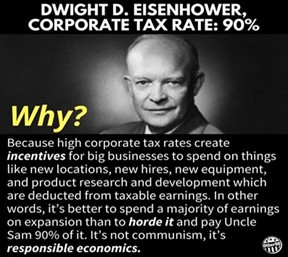
Part of the solution would be to restore the tax rates for the highest income earners that prevailed before President Reagan cut them to downsize government and enrich his Big Business supporters. The first tax cut (Economic Recovery Tax Act of 1981), cut the highest personal income tax rate from 70% to 50% and in the second tax cut (Tax Reform Act of 1986) to 38.5% among other things, per Wikipedia.

But most of the taxes would have to be paid by those he enriched, maybe even a tax on the wealth they had accumulated, i.e., the wealthiest 10 percent that benefited from all those tax cuts since 1980. Is that possible when the incoming administration wants even more tax cuts?

Harlan Green © 2024

Follow Harlan Green on Twitter: https://twitter.com/HarlanGreen
Posted in Consumers, Economy, Macro Economics, Politics, Weekly Financial News | Tagged , , , , , , , , | Leave a comment

Who Wants to Know?

Financial FAQs

“Fewer than a quarter of Americans (23%) currently rate the country’s economic conditions as excellent or good, while 36% say they are poor and about four-in-ten (41%) view conditions as “only fair,” PEW Research

PEWResearch

Why do so many Americans doubt the strength of the American economy that is the fastest growing in the developed world since the COVID-19 pandemic? It depends on their politial leanings, according to the latest PEW Research poll.

PEW Research has been measuring political attitudess for decades. As many as 81 percent of Republicans had positive views of the nation’s economy during Trump’s first presidency, whereas a higher percentage of Democrats were positive during President Biden’s term, per the PEW graph.

It is a condemnation of the lack of economic literacy among American voters, and I maintain largely a reflection of its lack in our educational system.

This is also a reflection of the fact that economic science is still in its infancy. In fact, Adam Smith, who wrote the first treatise on economic theory, The Wealth of Nations, was a Scottish Professor of Moral Philosophy who was the first to show that a successful economy was based on its citizenry guided by an invisible hand to make the right moral choices (honesty, good character).

And economies went awry when those in charge didn’t follow the rules of good character, which have always been autocratic rulers out to serve themselves rather than their citizens, such as in China and Russia. And why is that possible?

A large fraction of voters do suffer from economic illiteracy. Indeed, it is fair to say that an ample majority do not understand the basics of how markets work. They are especially confused about labor and international markets. Voters also have severe misconceptions about how government spends their tax dollars, and are extraordinarily pessimistic about long-run economic conditions,” says Professor Bryan Caplan of George Mason University, citing a recent Washington Post/ Henry J. Kaiser Family Foundation/ Harvard University Survey Project.

Most voters lack even an elementary understanding of economics. When prices change, vague conspiracy theories – not supply-and-demand – are their default explanation, says Professor Caplan.

One survey item that captured the public’s anti-market bias is the question asking why the price of gasoline rose back in 1996. Is the reason the “normal law of supply and demand,” or is it instead “oil companies trying to increase profits”? An overwhelming majority of economists – 89% – point to supply and demand. An almost equally lopsided fraction of the public – 74% – say the opposite.

Why so much ignorance of financial markets and basic economic conditions that everyone should know to make accurate decisions about their financial future? An economic education was not a high priority for Americans during more prosperous times, a time of a growing middle class after the Great Depression and World War Two.

According to the Council for Economic Education’s latest biennial Survey of the States, a nonpartisan education , just 28 states required K-12 students to take an economics course to graduate, until the COVID-19 pandemic and world-side economic shutdown.

But since the pandemic more than two-thirds of all states are now requiring personal finance classes for high school graduation.

The 2024 Survey found that 35 states now require students to take a course in personal finance to graduate. The new regulations in those dozen states will lead to over 10 million additional K–12 students – 21 percent of current students – gaining guaranteed access to this knowledge, the Survey notes.

The picture isn’t much better in higher education. Only 3.3 percent of colleges required students to take a basic economics course, according to a 2014 study by the American Council of Trustees and Alumni, titled “What Will They Learn?”

ACTA looked at 1,098 colleges and universities. The organization found 3.3 percent require an economics class, 18.3 percent require a U.S. government or history class, and 37 percent make students take a literature course.

There is one additional reason for Americans’ economic illiteracy. It is the well-studied phenomena of herd behavior that was called irrational exuberance by former Fed Chairman Alan Greenspan in an earlier decade.

Nobel Laureate Robert Shiller attributed it to a mental laziness that caused the housing bubble. People tend to listen to hearsay and word of mouth rather than rely on their own judgements to make financial decisions.

“It was, and is, about how errors of human judgment can infect even the smartest people, thanks to overconfidence, lack of attention to details, and excessive trust in the judgments of others, stemming from a failure to understand that others are not making independent judgments but are themselves following still others—the blind leading the blind,” said Dr. Shiller.

It is a sorry picture of our economic illiteracy, and the reason so many citizens are easily fooled by leaders without the requisite character traits, such as good morals and character, that Adam Smith said were required to run a successful economy and government that is for all the people.

Harlan Green © 2024

Follow Harlan Green on Twitter: https://twitter.com/HarlanGreen
Posted in Consumers, COVID-19, Economy, Politics, Weekly Financial News | Tagged , , , , , , , , | Leave a comment

Will Housing Recover?

The Mortgage Corner

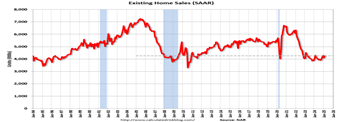
Total existing-home sales[1] – completed transactions that include single-family homes, townhomes, condominiums and co-ops – improved 4.8% from October to a seasonally adjusted annual rate of 4.15 million in November. Year-over-year, sales bounced 6.1% (up from 3.91 million in November 2023).

FREDexistinghomesales

The huge jump in existing-home sales in November on just a brief drop in mortgage rates illustrates the enormous pent-up demand for rental or owner-occupied housing. And Realtors believe it will continue.

“Home sales momentum is building,” said NAR Chief Economist Lawrence Yun. “More buyers have entered the market as the economy continues to add jobs, housing inventory grows compared to a year ago, and consumers get used to a new normal of mortgage rates between 6% and 7%.”

New home sales have surged as well. It may mean that builders also see an uptick in demand. Builder sentiment held steady to end the year as high home prices and mortgage rates battled renewed hope about a better regulatory business climate in 2025, reports the National Association of Home Builders (NAHB).

Builders expressed increased optimism for higher sales expectations in the next months. Sales of new single-family houses in November 2024 were at a seasonally adjusted annual rate of 664,000, up 5.9 percent above the revised October rate of 627,000 and is 8.7 percent (±19.3 percent)* above the November 2023 estimate of 611,000.

“While builders are expressing concerns that high interest rates, elevated construction costs and a lack of buildable lots continue to act as headwinds, they are also anticipating future regulatory relief in the aftermath of the election,” said NAHB Chairman Carl Harris, a custom home builder from Wichita, Kan. “This is reflected in the fact that future sales expectations have increased to a nearly three-year high.”

There is at least one elephant in the room, however. What will inflation do with Trump’s tariff and deportation threats? Consumers are already beginning to worry, per the Conference Board’s latest confidence survey.

“The recent rebound in consumer confidence was not sustained in December as the Index dropped back to the middle of the range that has prevailed over the past two years,” said Dana M. Peterson, Chief Economist at The Conference Board. “While weaker consumer assessments of the present situation and expectations contributed to the decline, the expectations component saw the sharpest drop. … Compared to last month, consumers in December were substantially less optimistic about future business conditions and incomes. Moreover, pessimism about future employment prospects returned after cautious optimism prevailed in October and November.”

So who or what will win this battle of expectations? The builders want less regulations in the hope that it can speed up the pace of construction, while tariffs have boosted construction material prices as much as 50 percent during Trump’s last term from his Canadian tariffs.

The Fed’s Jerome Powell has signaled that Trump’s threat to tax almost all imports will raise prices, while countries so taxed will retaliate with their own tariffs as happened during Trump’s last administration.

So builders should be careful of what they ask for. This won’t help interest rates, mortgage rates in particular, which are extremely sensitive to inflation.

Harlan Green © 2024

Follow Harlan Green on Twitter: https://twitter.com/HarlanGreen
Posted in Consumers, Economy, Housing, housing market, Politics, Weekly Financial News | Tagged , , , , , , , , , | Leave a comment

Bidenomics Cause of Recovery

Financial FAQs

“Real gross domestic product (GDP) increased at an annual rate of 3.1 percent in the third quarter of 2024, according to the “third” estimate. In the second quarter, real GDP increased 3.0 percent. The increase in the third quarter primarily reflected increases in consumer spending, exports, business investment, and federal government spending.”

BEA.gov

It might not seem fair to compare the Biden and Trump administrations, economically. The Biden administration will have created almost 16 million payroll jobs in four years, whereas Trump had created 6.7 million jobs until the 2000 pandemic, but lost -2.7 million jobs overall during his term because of its severity.

Though COVID-19 was made worse by Trump’s misinformation campaign that cast doubt on many of the actions needed to limit its damage, such as wearing masks in crowds and advocating chlorine injections.

But the increase in the 3rd (and final) revision to third quarter economic growth when many thought a recession was immanent this year gives testament to the strength of the economic recovery under President Biden. The U.S. economy has now expanded by at least 3% in each of the past two quarters. What’s more, the most recent estimates suggest GDP will top 3% in the fourth quarter, as well.

The result has been surging growth and full employment with declining inflation, refuting the misinformation barrage that elected Trump for a second term. The Fed’s preferred Personal Consumption Expenditure (PCE) inflation measure even came in below expectations, up just 0.1 percent in November, 2.4% annually.

FREDpce

But it still hasn’t answered the question of many voters:Why haven’t prices come down for the things that consumers use daily?

The simplest answer is that most consumers are flush with rising wages and leftover savings that have boosted retail sales and leisure activities. The big driver of economic growth has been consumer spending. Household spending increased to a 3.7% annual pace in the third quarter, from 3.5%. Prices would come down if consumers wanted to spend less—maybe because they had lost confidence in future growth and feared for their jobs October

But that hasn’t been the case. Consumer confidence surveys, such as by the Conference Board, are showing they aren’t that worried or unhappy about their jobs.

“Consumer confidence continued to improve in November and reached the top of the range that has prevailed over the past two years,” said Dana M. Peterson, Chief Economist at The Conference Board. “November’s increase was mainly driven by more positive consumer assessments of the present situation, particularly regarding the labor market.”

Another index by the Conference Board, it’s Index of leading Economic Indicator (LEI) that attempts to predict future growth has also turned positive. It rose for the first time since February 2022.

“A rebound in building permits, continued support from equities, improvement in average hours worked in manufacturing, and fewer initial unemployment claims boosted the LEI in November,” said Senior Manager Justyna Zabinska-La Monica.

Even Fed Chairman Powell is now saying they might have fewer rate cuts next year if such strong growth continues.

And that will hurt the anemic housing market, which just last Thursday announced the largest rise in existing-home sales in a year, all because of a slight (and temporary?) drop in mortgage rates.

The National Association of Realtors announced that total existing-home sales – completed transactions that include single-family homes, townhomes, condominiums and co-ops – improved 4.8% from October to a seasonally adjusted annual rate of 4.15 million in November. Year-over-year, sales bounced 6.1% (up from 3.91 million in November 2023).

“Home sales momentum is building,” said NAR Chief Economist Lawrence Yun. “More buyers have entered the market as the economy continues to add jobs, housing inventory grows compared to a year ago, and consumers get used to a new normal of mortgage rates between 6% and 7%.”

So even the housing market is telling us that Bidenomics has been a success. And Republicans will now be taking credit for it over the next four years, so I think they won’t dare cut those programs in the name of greater efficiency that have made President Biden’s investments in future growth so successful.

Harlan Green © 2024

Follow Harlan Green on Twitter: https://twitter.com/HarlanGreen
Posted in Consumers, COVID-19, Economy, Housing, housing market, Politics, Weekly Financial News | Tagged , , , , , , , , | Leave a comment

Even More Debt

ANSWERING KENNEDY’S CALL

 “In the recent (2020) GOP primary presidential debate, former United Nations Ambassador Nikki Haley claimed that President Trump added $8 trillion to the national debt while Florida Governor Ron DeSantis said that President Trump added $7.8 trillion to the debt. These statements are true, depending on how you measure additions to the debt. We estimate the ten-year cost of the legislation and executive actions President Trump signed into law was about $8.4 trillion, with interest.” January 2024, Committee for a Responsible Federal Debt.

FactCheck.org

Donald Trump and the Republicans’ most significant legacy will be the huge budget deficits they are projected to leave behind. It will mainly be due to present and upcoming tax cuts they promise to enact without any way to pay for them, except shrinking the social safety net.

And adding higher tariffs to the mix will raise the cost of everything and perhaps cause the Federal Reserve to pause outright in further rate cuts.

Takashito Ito, a former Japanese Deputy Prime Minister of Finance has predicted what will be the result.

“Beyond alienating friends and partners, Trump’s tariffs will probably fail to advance his apparent goal of reducing the U.S. trade deficit. If other countries adopt retaliatory tariffs, total exports from the U.S. — and global trade overall — may well decline. Moreover, high U.S. tariffs would fuel domestic inflation, forcing the U.S. Federal Reserve to raise interest rates, which would probably cause the U.S. dollar to appreciate, causing exports to fall and imports to rise.”

In fact, Nikki Haley was right in their 2020 primary debate: Of the $8.4 trillion President Trump added to the debt, $3.6 trillion came from COVID relief laws and executive orders, $2.5 trillion from tax cut laws, and $2.3 trillion from spending increases, with the remaining executive orders having costs and savings that largely offset each other, said the Committee for a Responsible Federal Debt.

Republicans inflated the budget deficit once before during the GW Bush presidency when they had the chance to almost eliminate it. President Clinton and VP Gore had engineered budget surpluses—yes surpluses—as high as +$236 billion, from 1996-2000 in their last four years that was mainly designed to strengthen social security and Medicare.

Bush’s first Treasury Secretary had also recommended it, but VP Cheney fired him after his first year in office for being such a spending scrooge. Bush had campaigned on returning some of the surplus to taxpayers via tax cuts, because 60 percent of the public in surveys favored tax cuts. But just 12 percent of the tax savings went to the middle class while the wealthiest garnered 79 percent of the tax cut benefits, according to PEW Research.

The Bush administration ended with the first $1 trillion federal budget deficit because of the $trillion spent on the invasion and occupation of Iraq and Afghanistan. Rising budget deficits have been the case ever since with Republican administrations.

It is why we will probably see even more federal debt in Trump’s next four years. It looks like a repeat performance as he is again nominating those most loyal and most incompetent for some of his cabinet picks, such as Pete Hegseth for Defense Secretary, Tulsi Gabbard for the Department of National Intelligence, and Robert Kennedy, Jr. for Health and Human Services.

He has again been using the same bullying tactics to attempt to get his cabinet picks through the Senate without background checks or security clearances. How easily Americans have forgotten that he has used such tactics his whole life to intimidate, once again highlighting his own incompetence to be POTUS.

Harlan Green © 2024

Follow Harlan Green on Twitter: https://twitter.com/HarlanGreen

Posted in Consumers, COVID-19, Economy, Politics, Weekly Financial News | Tagged , , , , , , , , | Leave a comment

Higher Economic Growth Ahead?

Popular Economics Weekly

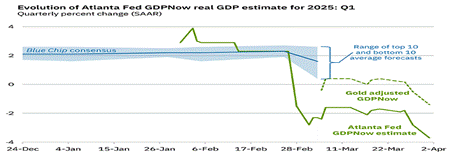
The GDPNow model estimate for real GDP growth (seasonally adjusted annual rate) in the fourth quarter of 2024 is 3.3 percent on December 9, unchanged from December 5 after rounding. After recent releases from the US Census Bureau and the US Bureau of Labor Statistics, a decrease in the nowcast of fourth-quarter real personal consumption expenditures growth was offset by increases in the nowcasts of fourth-quarter real gross private domestic investment growth and fourth-quarter real government spending growth.

BEA.gov

Almost everyone is currently predicting good fourth quarter (GDP) growth. Bank of America and Goldman Sachs are predicting it stays in the 2 percent range of past quarters. The Atlanta Fed GDPNow estimate for Q4 is an outlier, predicting 3.3 percent growth.

Why the seeming growth pickup? Consumer confidence has improved, for starters, as consumers earned enough and have enough savings to keep buying for the holidays. Next week’s retail sales figures will tell us more. Dow Jones is predicting sales could increase as much as +0.6 percent in November, up from +0.4 percent in October.

The Conference Board reported “Consumer confidence continued to improve in November and reached the top of the range that has prevailed over the past two years,” said Dana M. Peterson, Chief Economist at The Conference Board. “November’s increase was mainly driven by more positive consumer assessments of the present situation, particularly regarding the labor market. Compared to October, consumers were also substantially more optimistic about future job availability, which reached its highest level in almost three years.

This is confirmed by the recent JOLTS survey from the Labor Department that reported there were still more than 7 million job openings, and 5.3 million hires in October.

AtlantaFedGDPNow

The Atlanta Fed based its higher GDP growth estimate on increased government spending, such as the $2 billion investment for Intel’s new chip factory in Arizona (part of the CHIPS Act), and higher private capital expenditures. Much of the capex spending is in the expansion of AI production, like NVIDIA’s, the leading AI chip manufacturer that has become the darling of Wall Street.

Donald Trump’s re-election might also be an ingredient, as he has been named Time Magazine’s Person of the Year for a second time. There is no question that he is dominating our national psyche.

Since he began running for President in 2015, perhaps no single individual has played a larger role in changing the course of politics and history than Trump,” said Time Magazine’s announcement.

The question is will it mean better times for most Americans?

Harlan Green © 2024

Follow Harlan Green on Twitter: https://twitter.com/HarlanGreen
Posted in Consumers, COVID-19, Economy, Weekly Financial News | Tagged , , , , , , , , , | Leave a comment

Was Inflation the Problem?

Popular Economics Weekly

“The West Wing may believe Bidenomics is working because the macroeconomic gurus at the Federal Reserve are telling the White House it’s working. But Bidenomics has failed to create sufficient tangible improvement in the lives of most voters in a world in which groceries still cost more than they did a year ago, average rent and mortgage rates have spiked and health and child care grow ever more unaffordable. Mr. Biden cannot win in 2024 unless he speaks to the economy as it is, not as he wishes it was,”Karen Petrou,NYTimes.

FREDcpi

The Consumer Price Index for All Urban Consumers (CPI-U) increased 0.3 percent on a seasonally adjusted basis in November, after rising 0.2 percent in each of the previous 4 months, the U.S. Bureau of Labor Statistics reported today. Over the last 12 months, the all items index increased 2.7 percent before seasonal adjustment.

As shown in the FRED cpi graph dating from 2000, the last inflation surge began in 2020 during the Biden administration and the COVID-19 pandemic. A majority of voters in the presidential election decided prices and inflation had been too high for too long, therefore President Biden was blamed for it.

But no, it was the pandemic’s sudden supply shortages that caused the surge, not Biden’s Bidenomics’ legislation that enabled the quickest recovery in the developed world. Yet it took 3.5 years for inflation to return to today’s 2.7 percent annual rate, still above the Fed’s 2 percent target goal.

But there was another reason for the anger over such high and prolonged inflation. The incomes of half of U.S. households could not keep up with the inflation surge. Most of the increase in household income was achieved in the period from 1970 to 2000. In these three decades, the median income increased by 41%, to $70,800, at an annual average rate of 1.2%, says PEW Research.

The warning shot about the discontent of American workers was written in 2023 by Karen Petrou, a NYTimes guest columnist, in which she said that “ 64 percent of households live paycheck to paycheck from time to time, according to a March consumer survey. These families are barely making it through the week, let alone accumulating the wealth essential for financial resilience and, over time, financial security.’ 

Why such an increase in income inequality? A series of recessions (gray bars in the FRED graph) occurred during tempestuous times—the Gulf War, the various wars on terror in Iraq and Afghanistan, the Great Recession, and busted housing bubble.

The median household income in 2015 – $70,200 – was no higher than its level in 2000, marking a 15-year period of stagnation, an episode of unprecedented duration in the past five decades.

The unemployment rate rose from 4.2 percent to 5.7 percent during the shorter-lived 2001 recession (and 9/11 Twin-towers attack). It rose from 5 percent to 10 percent during the Great Recession that ended in 2009. And those in the lower ‘income brackets suffered the most financial damage, as is always the case.

And the reason for those recessions was in large part because “it is like a poker game where the chips have become concentrated in fewer and fewer hands,” again quoting Roosevelt’s Federal Reserve Chairman at the time.

Ms. Petrou concluded, “Listening to advisers — not voters — is a fatal campaign error, one that Hillary Clinton made in 2016. Mr. Biden only narrowly pulled out a win in 2020 because Mr. Trump wasn’t listening to voters when it came to Covid. Now they’re tuned in to Mr. Trump’s perspective on the economy because he is, in his way, listening to them.”

The irony is that it is just those Bidenomics’ programs that are funding factories in many of the red states that can help to ease the inequality that has affected so many working folk, and that is the source of most of the discontent.

Harlan Green © 2024

Follow Harlan Green on Twitter: https://twitter.com/HarlanGreen

Posted in Consumers, COVID-19, Economy, Politics, Weekly Financial News | Tagged , , , , , , , , , , , , | Leave a comment