Why are Some States Poorer Than Others?

Financial FAQs

We have austerity in our own country as a result of the Great Recession, but it doesn’t fall equally on all states. In fact, states suffering the most are mainly those in the South, Midwest and manufacturing rust belts.

We also know most of them are red states, and so the most conservative. Yet those states—the poorest, who have lost the most wealth—also receive the most government benefits.

How can that be so when they have spawned the most conservative politicians who decry government benefits of any kind? Dean P. Lacy, a professor of political science at Dartmouth College, is one of several researchers who have identified this anachronism. Support for Republican candidates, who generally promise to cut government spending, has increased since 1980 in states where the federal government spends more than it collects. The greater the dependence, the greater the support for Republican candidates, says his research.

Conversely, states that pay more in taxes than they receive in benefits tend to support Democratic candidates. And Professor Lacy found that the pattern could not be explained by demographics or social issues.

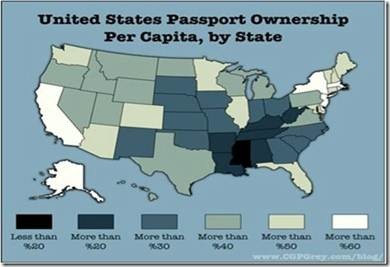
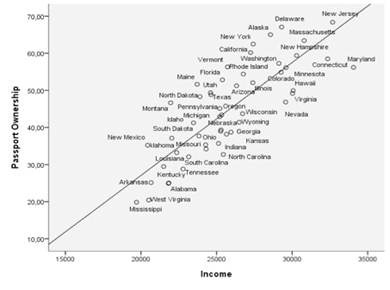
But it can be explained by other factors. One of my earlier columns, entitled “The Have and Have-Not States”, identified several of the factors that differentiate the poorest from the wealthiest states in the U.S., as measured by those states with the highest percentage of passport holders. It comes from a study reported on Grey’s Blog, which shows New Jersey with the highest percentage of passports-68.36 percent-to Mississippi with 19.86 percent of its population having passports.
clip_image002

Grey’s Blog

That factor is openness to outside experience, which is a psychological trait that comes from either having overseas’ relations, or a better education, or a geographical proximity to other cultures. Those states with the highest percentage of passport holders had also the most diverse population, were most educated, most politically liberal, and the wealthiest. Of course, wealth seems to go in hand with education, which shouldn’t be surprising.
clip_image004

Graph: Grey’s Blog

But those same states also had the best public services, most creative workforce and best health care outcomes, as well. Conversely, those states with the fewest passport holders were the least educated, least wealthy, even though they garnered the most governmental services.

Paul Krugman has listed 3 reasons in his own blog why the poorest states tend to elect conservative politicians, who certainly have not enhanced the economic opportunities of their own constituents.

“And what these severe conservatives hate, above all, is reliance on government programs,” says Krugman. “Rick Santorum declares that President Obama is getting America hooked on “the narcotic of dependency.” Mr. Romney warns that government programs “foster passivity and sloth.” Representative Paul Ryan, the chairman of the House Budget Committee, requires that staffers read Ayn Rand’s “Atlas Shrugged,” in which heroic capitalists struggle against the “moochers” trying to steal their totally deserved wealth, a struggle the heroes win by withdrawing their productive effort and giving interminable speeches.”

But he doesn’t mentioning scape-goating, a common tactic used by the most conservative politicians to explain why their own constituents tend to be worse off than those in the blue, more liberal states.

Though Christ’s teaching, “Let he among you who is without sin cast the first stone” should be foremost in the minds of conservative church-goers, particularly, conservative pundits have blamed government and high taxes for their ills, when in fact it has been their own Social Darwinist views that has held back development in the red states.

In fact history has shown that it is during periods of regulatory breakdown, when so-called ‘free market’ ideologies prevailed as during the Hoover and GW Bush eras—i.e. when government oversight was at its weakest—that the greatest economic downturns happened. So it should be no surprise that “Political scientists who use Congressional votes to measure such things find that the current G.O.P. majority is the most conservative since 1879,” says Krugman, “which is as far back as their estimates go.”

That was the era of social Darwinism—when the struggle for survival of the fittest prevailed and made sense to Americans, as we were still struggling to settle and civilize our wildernesses.

But the American landscape is far different today. Modern technology has conquered the means of production, so that we suffer from too much being produced rather than too little. What we cannot or will not domestically produce is easily imported. That is the reason for the succession of burst asset bubbles—from the dot-com market crash, to too- big-to-fail financial institutions, to housing—that Americans have suffered through.

So there is no reason for a regression to 19th century thought and philosophy that the Republican Presidential candidates seem to be yearning for. There is also no reason for the wide divergence of wealth between states. Research has shown the most prosperous states are the most pro-government, most forward-looking, most open to other cultures and new ideas. What economy (or state) can grow otherwise?

Harlan Green © 2012

Posted in Economy, Macro Economics | Tagged , , , , , , | Leave a comment

Builder Confidence Soars in 2012

The Mortgage Corner

WASHINGTON (MarketWatch) — Home builder confidence in the market for new single-family homes climbed in February for the fifth straight month to reach the highest level in more than four years, said a Marketwatch headline. And there are good reasons for builders’ growing confidence as housing starts, affordability, and even employment continue to increase.

The National Association of Home Builders/Wells Fargo housing market index rose to 29 in February from 25 in January, meaning the gauge has more than doubled since September. Economists polled by MarketWatch had expected a reading of 26.

“This is the longest period of sustained improvement we have seen in the HMI since 2007, which is encouraging,” said NAHB Chief Economist David Crowe. “However, it is important to remember that the HMI is still very low, and several factors continue to constrain the market. Foreclosures are still competing with new home sales, and many builders are seeing appraisals come in at less than the cost of construction. Additionally, prospective home buyers are finding it difficult to qualify for a mortgage.”

image 

Graph: Calculated Risk

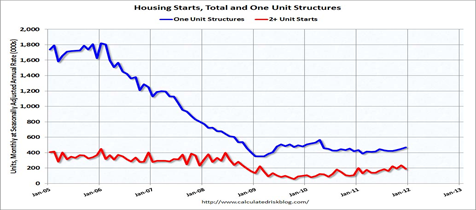
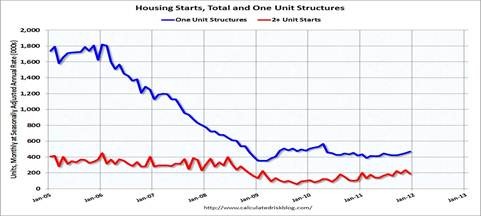
The main reason for increasing optimism is total housing starts were at 699 thousand (SAAR) in January, up 1.5 percent from the revised December rate of 689 thousand (SAAR). Note that December was revised up from 657 thousand. Single-family starts declined 1.0 percent to 508 thousand in January, however December was revised up by 43 thousand from 470 thousand. There were the first two months above 500 thousand since the expiration of the tax credit.

image

Graph: Calculated Risk

And the delinquency rate for mortgage loans on one-to-four-unit residential properties also decreased to a seasonally adjusted rate of 7.58 percent of all loans outstanding as of the end of the fourth quarter of 2011, a decrease of 41 basis points from the third quarter of 2011, and a decrease of 67 basis points from one year ago, according to the Mortgage Bankers Association’s (MBA) National Delinquency Survey. The non-seasonally adjusted delinquency rate decreased five basis points to 8.15 percent this quarter from 8.20 percent last quarter.

The delinquency rate includes loans that are at least one payment past due but does not include loans in the process of foreclosure. The percentage of loans in the foreclosure process at the end of the fourth quarter was 4.38 percent, down five basis points from the third quarter and 26 basis points lower than one year ago.

And, housing affordability is at its highest level in 20 years. Nationwide housing affordability, as measured by the National Association of Home Builders/Wells Fargo Housing Opportunity Index (HOI), rose to a record level during the fourth quarter of 2011, while prospective home buyers continued to feel the constraints of tighter credit standards and a soft economy.

The just released HOI data indicated that 75.9 percent of all new and existing homes sold in the fourth quarter were affordable to families earning the national median income of $64,200, the highest percentage recorded in the 20-year history of the index.

“While today’s report indicates that homeownership is within reach of more households than it has been for more than two decades, overly restrictive lending conditions confronting home buyers and builders remain significant obstacles to many potential homes sales, even with interest rates at historically low levels,” said Barry Rutenberg, chairman of the National Association of Home Builders (NAHB).

Despite restrictive credit conditions, low jobs creation is still the main roadblock to a housing recovery. But 2012 may show continued signs of improvement on that front also, as initial unemployment claims continue downward.

image

Graph: Calculated Risk

In the week ending February 11, the advance figure for seasonally adjusted initial claims was 348,000, a decrease of 13,000 from the previous week’s revised figure of 361,000. The 4-week moving average was 365,250, a decrease of 1,750 from the previous week’s revised average of 367,000. In fact, the 4-week moving average is at the lowest level since early 2008.

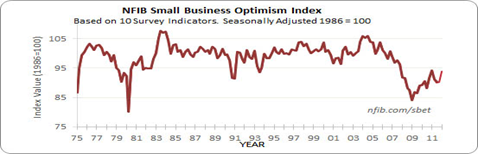
In fact, small businesses provide 70 percent of new hires, so that is where we should look for jobs’ improvement. A good measure of small business is the National Federation of Business Optimism Index, which hasn’t yet risen above recession levels. But the jobs market is tightening, in line with U.S. overall improved employment.

 image

“Reports of workforce reductions are at their lowest level since October 2007,” said the latest NFIB report. “Forty-one percent of owners hired or tried to hire in the past three months, but 31 percent reported few or no qualified applicants for the position(s). The increase in the percent of owners with hard to fill job openings indicates that job markets are tightening somewhere, and correctly anticipated a decline in the unemployment rate.”

So we will see if builders’ optimism is warranted. It has been a long time coming.  But a new generation of home owners and renters are becoming adults—the echo boomers born between 1986 to 2000. I believe the builders’ optimism is warranted, because echo boomers, or Gen Y’ers, are the children of baby boomers and number some 80 million, more than baby boomers—in fact, the largest generation in our history.

Harlan Green © 2012

Posted in Uncategorized | Tagged , , , , , , , | Leave a comment

Where is the Housing Bottom?

The Mortgage Corner

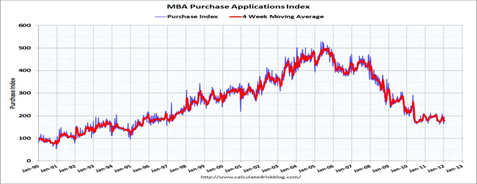
The housing bottom is really a function of incomes, jobs, and inventory of houses for sale. All three indicators are favorable for housing sales to pick up this year. But prices have to bottom first. The main price indicators are the monthly S&P Case-Shiller and FHFA price indexes that supervise Fannie and Freddie telling their direction. Another indicator that tells us when housing markets are improving is weekly mortgage application totals put out by the Mortgage Bankers Association.

image

Graph: Calculated Risk

Mortgage applications increased 23.1 percent from one week earlier (last week’s results included an adjustment for New Years Day), according to data from the Mortgage Bankers Association’s (MBA) Weekly Mortgage Applications Survey for the week ending January 13, 2012.

“Interest rates dropped last week due to continuing anxieties regarding the fragile economic situation in Europe,” said Michael Fratantoni, MBA’s Vice President of Research and Economics.  “With mortgage rates reaching new lows, refinance volume jumped and MBA’s refinance index reached its highest level in the last six months.  Purchase activity also increased as buyers returned to the market after the holiday season.”

image

Graph: Calculated Risk

The Refinance Index increased 26.4 percent from the previous week to its highest level since August 8, 2011. The seasonally adjusted Purchase Index increased 10.3 percent from one week earlier to its highest level since December 12, 2011.

And builder confidence in the market for newly built, single-family homes continued to climb for a fourth consecutive month in January, rising four points to 25 on the latest NAHB/Wells Fargo Housing Market Index (HMI). This is the highest level the index has attained since June of 2007.

“Builder confidence has now risen four months in a row, with the latest uptick being universally represented across every index component and region,” noted Bob Nielsen, chairman of the National Association of Home Builders (NAHB). “This good news comes on the heels of several months of gains in single-family housing starts and sales, and is yet another indication of the gradual but steady improvement that is beginning to take hold in an increasing number of housing markets nationwide — and that has been shown by our Improving Markets Index. Policymakers must now take every precaution to avoid derailing this nascent recovery.”

Privately-owned housing starts in December were at a seasonally adjusted annual rate of 657,000. This is 4.1 percent below the revised November estimate of 685,000, but is 24.9 percent (±18.3%) above the December 2010 rate of 526,000.

image

Graph: Calculated Risk

But Single-family starts increased 4.4 percent to 470,000 in December – the highest level in 2011, and the highest since the expiration of the tax credit. This should give a boost to 2012 growth.

Another upside surprise was signs of increased employment. Momentum is building in the labor market. Payroll jobs in January advanced 243,000 after jumping 203,000 in December (originally 200,000) and rising 157,000 in November (prior estimate up 100,000). The net revisions for November and December were up 60,000.

image

Graph: Econoday

As for some time, says Econoday, private payrolls outstripped the total, increasing 257,000 in January, following a gain of 220,000 in December. So we are seeing a reason for the jump in builder confidence.

Existing-home sales might also pick up, because of the fire-sale prices. Total housing inventory at the end of November fell 5.8 percent to 2.58 million existing homes available for sale, which represents a 7.0-month supply at the current sales pace, down from a 7.7-month supply in October.

image

Graph: Calculated Risk

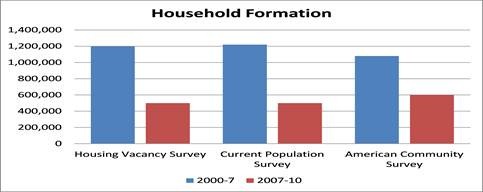
We know that it’s the combination of a better jobs market and even increased household formation that increases the demand for housing. Demand is increasing in spite of some 4 million homes somewhere in the foreclosure process. Maybe a key is that the younger, echo boomer generation is creating more households. Household formation has fallen drastically since 2007, so maybe this is the year when it will return to historical levels.

Harlan Green © 2012

Posted in Economy, Housing, housing market, Weekly Financial News | Tagged , , , , , , , | Leave a comment

Why the Surprising Jobs Report?

Financial FAQs

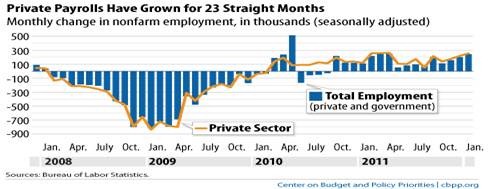
Why so much surprise in January’s employment report that added 243,000 payroll jobs and dropped the unemployment rate to 8.3 percent? The U.S. has now added an average of 183,000 jobs a month in the past five months, while both the manufacturing and service sectors have been expanding for 30 months, since August 2009. You would think that would be grounds for some optimism this year, but it hasn’t cheered up many, including the Federal Reserve.

Economists and pundits, in particular, seem to have been blinded by everything from the euro’s demise, to slower growth in emerging countries, to an overheating of the Chinese economy had been used to tone down predictions for 2012 growth. Even the Fed’s forecasts have been downgraded, though Fed Chairman Bernanke did say the jobs market “had improved modestly” in his latest congressional testimony.

clip_image002

Graph: CBPP

Some of the surprise was due to a pickup in both residential and non-residential construction, as real estate seems to slowly recovering, in part because of extremely affordable housing prices. Construction employment has added 52,000 jobs over just the past 2 months.

A total of 257,000 jobs were added in the private sector minus 14,000 public sector job losses. And Marketwatch reported that employment rose by an incredible 631,000 in January in the Household survey (that includes the self-employed) after adjusting for the effects of updating the population count. That’s the biggest increase since late 2007. Over the past six months, employment as measured by the household survey has increased by 1.98 million, the biggest increase in more than six years.

But there’s more to the story. The steady stream of irrationally pessimistic stories has until now reinforced the belief that our institutions had failed—from government to financial markets, and the private sector business in general that laid off more than 8 million workers from 2008-10.

The bad news had been drowning out the good news, in other words, had reinforced the stories we all hear in the media and elsewhere that tended to emphasize the negative in any report, in spite of the now 2 years of steady job and overall expansion of economic growth since the June 2009 end of the Great Recession .

clip_image004

Graph: Calculated Risk

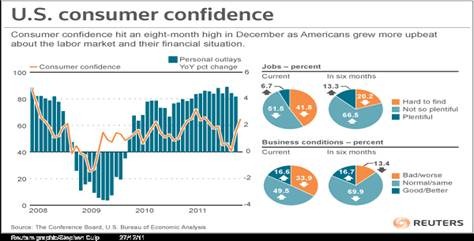
This is what Robert Shiller and George Akerlof discussed in Animal Spirits, How Human Psychology Drives the Economy and Why it Matters for Global Capitalism, which further develops famous economist John Maynard Keynes’ thesis that animal spirits, or emotions, drive most financial decisions. It was as much the negative news that permeated the air waves as anything that drove down consumer confidence to it record lows, in other words, and caused consumers and businesses to stop spending.

And we can measure the degree of confidence at any time in the economy, mainly via the two major confidence surveys of the Conference Board and University of Michigan. Confidence plunged to record lows in June, 2009 at the actual end of the recession, but are now returning to more normal levels.

clip_image006

Graph: Inside Debt

This was reinforced by faulty government statistics that said, for instance, there were no payroll jobs created last August—zip, zero—when in fact later revisions added 103,000 jobs in August, and additional jobs in later months.

Small business hiring has been part of the reason for increased employment, in part because of the Obama Administration’s freeing of $32 billion in SBA financing last year. And small business accounts for 70 percent of new jobs. Bank lending has increased 5 percent in the last half of 2011, according to NPR radio’s All Things Considered news program. In fact, stimulus spending over the past year may have contributed at least 1 percent to current growth, says the Center for Budget Priorities and Policies.

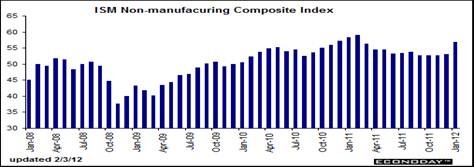
Also pushing growth has been large jumps in both manufacturing and service sector activity, via the ISM Purchasing Management surveys. A gigantic surge in employment and almost an equally dramatic surge in new orders headline a very strong ISM non-manufacturing report where the headline composite index jumped to 56.8, well beyond Econoday’s consensus for 53.3 and a strong 3.6 points above December’s upwardly revised 53.0.

clip_image008

Graph: Econoday

New orders jumped nearly 5 points to a 59.4 level that indicates strong monthly growth and points to acceleration in general activity in the months ahead. But the employment index is the eye catcher, up 8 points to 57.4 for by far the strongest reading of the recovery. This index has been lagging improvement in employment data from the government — but not any more.

clip_image010

Graph: Econoday

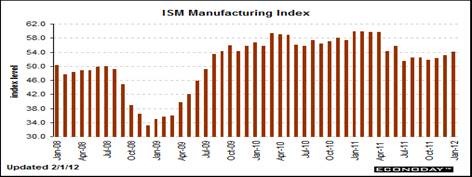
Moderate and steady growth is the indication from the ISM manufacturing report where readings pretty much match those of December, said Econoday. The January composite index rose to 54.1, safely over 50 to indicate monthly expansion and 1 point over December to indicate a slightly faster rate of expansion (prior revised). A key highlight of the report is the new orders index which rose nearly 3 points to 57.6 to indicate a little bit more than just a moderate rate of monthly expansion. In another positive, backlog orders increased 4.5 points to show a build at 52.5.

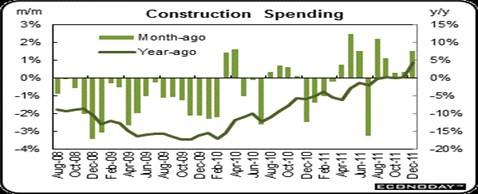
Even builder confidence in the market for newly built, single-family homes continued to climb for a fourth consecutive month in January, rising four points to 25 on the latest NAHB/Wells Fargo Housing Market Index (HMI). This is the highest level the index has attained since June of 2007, and is why construction spending jumped 1.5 percent in December and has increased some 7 percent in one year.

clip_image012

“Builder confidence has now risen four months in a row, with the latest uptick being universally represented across every index component and region,” noted Bob Nielsen, chairman of the National Association of Home Builders (NAHB). “This good news comes on the heels of several months of gains in single-family housing starts and sales, and is yet another indication of the gradual but steady improvement that is beginning to take hold in an increasing number of housing markets nationwide — and that has been shown by our Improving Markets Index. Policymakers must now take every precaution to avoid derailing this nascent recovery.”

So we don’t have to be pessimistic anymore. Rising confidence levels lifts all boats, as the saying goes.

Harlan Green © 2012

Posted in Economy, Housing, Keynesian economics, Weekly Financial News | Tagged , , , , , , , , | Leave a comment

Corporate Austerity Not the Answer in 2012

Popular Economics Weekly

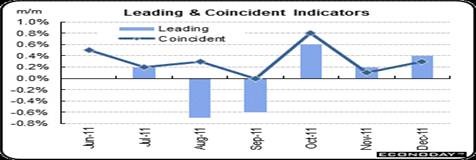
Why so much gloom and tentativeness about U.S. economic growth when all the indicators are looking up for 2012? For instance, the Conference Board’s Index of Leading Economic Indicators again showed positive growth ahead. It rose 0.4 percent with 7 of its 10 indicators positive.

clip_image002

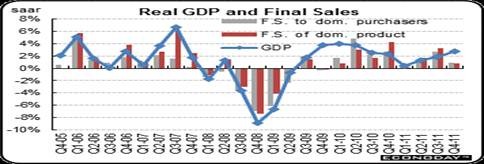
And the Q4 ‘advance’ estimate of GDP growth was 2.8 percent, almost double Q3. Equipment and software, which includes autos and exports, was the largest component. It would be even higher if corporation would use more of their cash hoard for job creation, rather than speculative investments and excessive executive compensation.

clip_image004

Graph: Econoday

Could it be because of the euro’s problems? “This somewhat positive outlook for a strengthening domestic economy would seem to be at odds with a global economy that is losing some steam,” said Ken Goldstein, a Conference Board economist. “Looking ahead, the big question remains whether cooling conditions elsewhere will limit domestic growth or, conversely, growth in the U.S. will lend some economic support to the rest of the globe.”

But JP Morgan’s President Jamie Dimon said even the damage from a default of Greek debt would be “negligible”, in a CNBC interview at the Davos, Switzerland economic summit. So what’s the problem? The austerity (meaning deficit) hawks have their hands around the throats of European commerce. Why? In the mistaken belief that more stimulus spending will increase debt without actually causing more growth.

But Professor Robert Shiller, co-author of Animal Spirits with Nobelist George Akerlof, calls it debt delusion. When the private sector, including households, becomes over indebted, they begin to save more and spend less. But if governments do it at the same time, it causes a downward spiral towards deflation and recession or depression. This comes from the belief of fiscal conservatives that public borrowing takes money away from private users.

That, however, isn’t the case, because the private sector has plenty of funds, but is hoarding them (some $2 trillion in cash to date), rather than creating more jobs. So if governments are also hoarding their monies—in the form of trade or currency surpluses, as is happening in most of Europe today, then the bottom falls out of the economy. I.e., if no one is buying and everyone is saving, then no business gets done. This should be self-evident, because such a truth has been known since the Great Depression and New Deal that established our modern safety net, and ultimately put so many people back to work.

What underlies that truth is that Great Depressions and Great Recessions only happen when there is a wrenching transformation of whole economies. It was transformation of a mostly rural economy to manufacturing in the 1920s that brought on the Great Depression, and now it is wholesale migration of manufacturing jobs overseas and transformation to the Information Age, when little needs to be manufactured in the U.S.

Rutgers Econ Professor James Livingston has explained this transformation best in recent papers and articles. The great wealth shift away from wage earners-consumers to corporate profits began during the Great Depression, according to Livingston: “The underlying cause of that economic disaster (the Great Depression of 1929-33, 1937-38) was a fundamental shift of income shares away from wages/consumption to corporate profits that produced a tidal wave of surplus capital that could not be profitably invested in goods production—and, in fact, was not invested in good production…and that, on the other hand, produced the tidal wave of surplus capital which produced the stock market bubble of the late-1920s.”

And in a recent New York Times Op-ed, It’s Consumer Spending, Stupid, Livingston expands on the reasons for our current prolonged malaise:

“As an economic historian who has been studying American capitalism for 35 years, I’m going to let you in on the best-kept secret of the last century: private investment — that is, using business profits to increase productivity and output — doesn’t actually drive economic growth. Consumer debt and government spending do. Private investment isn’t even necessary to promote growth.”

This, to put it mildly, explodes that rationale used by Wall Street and corporations to justify not passing on more of their profits to consumers—80 percent of which are wage and salary earners. The reasoning being that it is their profits that drive growth.

Professor Livingston says, “Economists will tell you that private business investment causes growth because it pays for the new plant or equipment that creates jobs, improves labor productivity and increases workers’ incomes. As a result, you’ll hear politicians insisting that more incentives for private investors — lower taxes on corporate profits — will lead to faster and better-balanced growth.”

Not so, says Livingston, “But history shows that this is wrong. Between 1900 and 2000, real gross domestic product per capita (the output of goods and services per person) grew more than 600 percent. Meanwhile, net business investment declined 70 percent as a share of G.D.P. What’s more, in 1900 almost all investment came from the private sector — from companies, not from government — whereas in 2000, most investment was either from government spending (out of tax revenues) or “residential investment,” which means consumer spending on housing, rather than business expenditure on plants, equipment and labor.

“In other words, over the course of the last century, net business investment atrophied while G.D.P. per capita increased spectacularly. And the source of that growth? Increased consumer spending, coupled with and amplified by government outlays.”

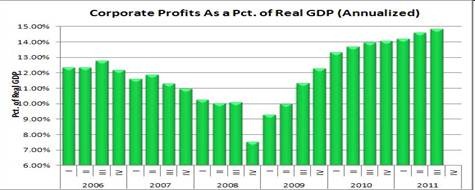
Much has been written already about the record profits of both financial and non-financial corporations that have drained consumption, and that is the main reason why average real household incomes have actually declined over the past 30 years. In fact, corporate profits today are highest in history as a percentage of GDP.

clip_image006

Graph: Trading Economics

And this could be actually endangering economic growth by causing rampant market speculation, rather than productive investments, say many pundits, including Professor Livingston: “So corporate profits do not drive economic growth — they’re just restless sums of surplus capital, ready to flood speculative markets at home and abroad. In the 1920s, they inflated the stock market bubble, and then caused the Great Crash. Since the Reagan revolution, these superfluous profits have fed corporate mergers and takeovers, driven the dot-com craze, financed the “shadow banking” system of hedge funds and securitized investment vehicles, fueled monetary meltdowns in every hemisphere and inflated the housing bubble.”

How to cure the record income inequality that has resulted from so much power going to Wall Street and the corporations? Let us return to the income tax brackets that brought on so much prosperity to the middle class during the 1960s and 1970s. What were they?

The maximum bracket has fluctuated from 91 percent for those earning more than $400,000 in 1960, to the current low of 35 percent for those earning more than $379,150 today. And this has coincided with the astronomical increase in both household and government debt.

So it should be a no-brainer, if we want to see American growth restored to historical levels. Higher taxes have meant more growth, because public revenues are invested in growth-inducing infrastructure, better public safety, and upward mobility inducing education, for starters. Whereas lower taxes mean higher debts, with less growth and more speculative risk-taking to show for it. Why history is so easily forgotten may be a question only psychologists can answer.

Harlan Green © 2012

Posted in Economy, Keynesian economics, Macro Economics, Weekly Financial News | Tagged , , , , , , , | Leave a comment

Fair Play Benefits All of Us

The Popular Economics Weekly

The idea of fair play may be the key issue in 2012—both with the Presidential campaign and economic growth. How so? Both political parties are jockeying to portray their message as fair—Democrats want to restore the middle class, and Republicans still believe the wealthiest are already paying their fair share of taxes. So they maintain any tax increases at all will harm growth prospects.

And President Obama’s message in his 2012 State of the Union speech was even more encompassing. He said “A return to the American values of fair play and shared responsibility will help us protect our people and our economy. But it should also guide us as we look to pay down our debt and invest in our future.”

How will it protect our economy and pay down our debt? Obama wasn’t clear on this, but past history and economic research tells us why. Simply put, the more equal distribution of wealth even up through the 1990s when the maximum tax brackets for income, capital gains, and even dividends’ taxes were higher, produced a thriving middle class so that overall economic growth was higher that it is today with a vastly reduced middle class.

And fair play is in the news. Andrew Kohut’s most recent New York Times Op-ed highlighted a recent poll which “found that 66 percent of Americans believed there were “very strong” or “strong” conflicts between the rich and the poor — an increase of 19 percentage points since 2009”. And, “they care about policies that give everyone a fair shot — a distinction that candidates in both parties should understand as they head into the 2012 campaigns’.

“An awareness of economic inequality is not new,” said Kohut. “Pew surveys going back to 1987 have found an average of 75 percent of the American public thinking that the “rich are getting richer and the poor are getting poorer.” As far back as 1941, 60 percent of respondents told the Gallup poll that there was too much power in the hands of a few rich people and large corporations in the United States.”

In fact, fair play is a very important part of consumer and business confidence, say economists Robert Shiller and Nobelist George Akerlof in Animal Spirits, How Human Psychology Drives the Economy and Why it Matters for Global Capitalism, which further develops famous economist John Maynard Keynes’ thesis that animal spirits, or emotions, drive most financial decisions. And we can measure the degree of confidence at any time in the economy, mainly via the two major confidence surveys of the Conference Board and University of Michigan.

clip_image002

Graph: Inside Debt

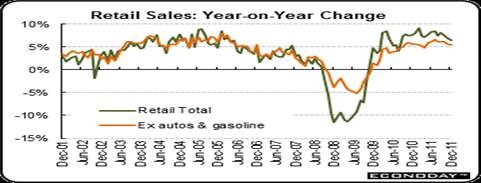
What is most obvious from the survey data is that consumer and investment spending rises and falls with confidence levels. For instance, retail sales sank to negative levels from 2008-2010, at the same time as both confidence surveys. And we know that consumer spending makes up almost 70 percent of economic activity, with 50 percent of it coming from retail sales.

clip_image004

Graph: Econoday

What is their confidence based on? Akerlof and Shiller list 5 elements, of which fair play may be the most important:

  • The cornerstone of our theory is confidence and the feedback mechanism between it and the economy that amplify disturbances.
  • The setting of wages and prices depends largely on concerns about fairness.
  • We acknowledge the temptation toward corrupt and antisocial behavior and their role in the economy.
  • Money illusion is another cornerstone of our theory. The public is confused by inflation or deflation and does not reason through its effects.
  • Finally, our sense of reality, of who we are and what we are doing, is intertwined with the story of our lives and of the lives of others. The aggregate of such stories is a national or international story, which itself plays an important role in the economy.

Akerlof and Shiller’s Animal Spirits therefore develops Keynes’ thesis further. A major part of any business decision is whether the public has confidence in and trusts the economic conditions that determine whether they should spend or save, invest in expansion or lay off workers.

In other words, when the playing field is not perceived as fair, then the public retreats to inaction. “If this is what we mean by confidence, then we immediately see why, if it varies over time, that it plays a major role in the business cycle,” say Akerlof and Shiller.

President Obama was talking not only about the huge decline in income inequality over the past 30 years, and un-progressive tax code that allowed countless tax loopholes and benefits for those individuals and industries that needed them the least, but the loss of opportunity and social mobility that has put the U.S. near the bottom of all developed countries in quality of life factors, according to Richard Wilkinson, a leading authority on the effects of inequality.

And we know a more progressive tax structure means more economic growth and increased tax revenues. President Clinton proved this with his combination of reduced government spending and higher maximum tax brackets that caused 4 consecutive years of budget surpluses.

Whereas the Republican’s sense of fair play doesn’t play well with most Americans, according to the Pew survey. “Just 11 percent of Americans say they are bothered by the amount they pay, while 57 percent of respondents say they are bothered by what they believe are unfairly low amounts paid by the wealthy.”

Then why is it Republicans in particular continue to oppose any government help to boost economic growth? It could be what Robert Frank calls cognitive illusion, in a recent Sunday New York Times Economic View article. Their wealthy supporters believe higher taxation means they will lose out on the things they value most, and which go to the highest bidders—waterfront properties, precious jewels or art, etc.

“But a tax increase is different,” says Frank. “It affects all participants in the bidding for positional (i.e., luxury) goods. And because it leaves everyone with less to spend, it has essentially no effect on the outcomes of those contests. The same paintings and the same marina slips end up in the same hands as before.”

So there is no reason for the 1 percent not to enjoy the benefits of fair play, as well. “…higher spending on many forms of public consumption would produce clear gains in satisfaction for the wealthy,” says Frank. “It’s reasonable to assume, for example. That driving on well-maintained roads is safer and less stressful than driving on pothole-ridden ones.”

Harlan Green © 2012

Posted in Consumers, Economy, Keynesian economics, Macro Economics, Weekly Financial News | Tagged , , , , , , , , , | 5 Comments

Such Pessimism is Unwarranted—Who Should Rescue Housing?

The Popular Economics Weekly

Why is it so many pundits—and some economists—continue to be pessimistic about 2012 growth? Business and Wall Street economists in particular are predicting just 2 percent GDP growth for all of 2012, according to a recent CNBC report.

Why such pessimism? The reason cited is that “the improving data masks unsustainable fundamentals — an unusual drop in the savings rate, a jump in auto purchases due mainly to a recovery from Japan’s natural disasters last spring, and a surge in inventories”.

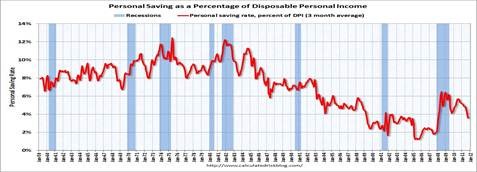
Firstly, there is not an “unusual” drop in the savings rate (which is really dependent on household incomes, let us not forget). It is slightly under 4 percent, and had dropped to 1 percent during the bubble years of early 2000, before rising to 6 percent during the Great Recession. Consumers are just beginning to spend again after paying down their debts for the past 3 years (2009-11), in other words. And consumer spending makes up 70 percent of economic activity.

clip_image002

Graph: Calculated Risk

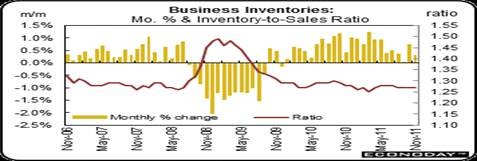
This is while the “jump’ in auto purchases just brings it back to more historical levels of 13-14 million sold, but not to the bubble years of 16 million. And there is no surge in inventories. They are still at historically low levels, as businesses are still overly cautious because aggregate demand for their products and services is still weak.

clip_image004

Graph: Econoday

So business inventories are anything but surging. Inventories rose 0.3 percent in November as did business sales, keeping the stock-to-sales ratio unchanged for a fifth straight month at a lean 1.27, said Econoday.

It is understandable that businesses have just been through the greatest recession since the Great Depression—which lasted 10 years, and took a world war to cure. But there are many more tools to stimulate growth since then. And we know what stimulates growth—government spending; including for the safety nets (social security, unemployment benefits, Medicare), and investments in infrastructure and research—in order that consumers can continue to spend and businesses invest.

Most economists have to know this, so there has to be another reason for their pessimism. Banks in particular are lobbying for more Federal Reserve, as in QE3, to boost the housing market. “Obama Administration officials have come to realize that the ongoing dysfunction in the mortgage market is a key impediment to sustained expansion,” Vincent Reinhart, chief U.S. economist at Morgan Stanley, said in the CNBC article.

“Their problem is that there is no chance of coming to terms with the Congress to fix the mess,” Reinhart added. “The result is that the administration is moving toward mortgage modification, but not decisively. Purchasing MBS is a way that the Fed can support that movement and signal the seriousness of the enterprise.”

But Congress isn’t the only reason for housing’s problem. The Obama Administration is still not serious about either their HAMP or HARP II loan modification programs. They had set aside some $11 trillion from the ARRA legislation back in 2009 that hasn’t been spent! Why? We are not sure, but know Treasury Secretary Tim Geithner is a great friend of banks. Neither he, nor the Office of Thrift Management (OTC) that overseas banks are requiring the banks and loan servicers modify eligible mortgages on their books, when the Executive Branch, has the power to do so.

So the banks and Wall Street have come begging to the Federal Reserve once again to provide stimulus by buying up to as much as $1trillion more of mortgage-backed securities. But why not first get rid of the excess inventory of bad mortgages and foreclosed properties banks are holding on their books? There have been several suggestions on how to do this, including by the Fed in a recently published White Paper to Congress: “The U.S. Housing Market Current Conditions and Policy Considerations”. That is, there are other solutions. But even with the huge TARP bailout and growing profits, banks and Wall Street still want government to continue to pick up their tab.

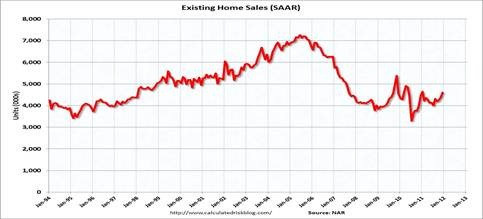
Existing-home sales have just jumped, by the way, which bodes well for housing in 2012. The latest monthly data shows total existing-home sales rose 5.0 percent to a seasonally adjusted annual rate of 4.61 million in December from a downwardly revised 4.39 million in November, and are 3.6 percent higher than the 4.45 million-unit level in December 2010.

clip_image006

Graph: Econoday

Total housing inventory at the end of December dropped 9.2 percent to 2.38 million existing homes available for sale, which represents a 6.2-month supply at the current sales pace, down from a 7.2-month supply in November. Home sales are now back to a 1998 sales’ level, before the housing bubble took off. Maybe that is where it will be for some time to come. Therefore shouldn’t Banks and Wall Street  get over their hangover from the housing binge they profited so well from?

Harlan Green © 2012

Posted in Economy, Housing, housing market, Weekly Financial News | Tagged , , , , , , , , | Leave a comment

Mortgage Applications-Builder Optimism Rising

The Mortgage Corner

Are homebuyers and borrowers finally realizing that mortgage rates might not fall much further? We are seeing a huge jump in both mortgage and builder activity, and much of the most recent interest rate drop has been because of Europe’s solvency problems, which could reverse once the uncertainty is resolved. This is in spite of still restrictive underwriting standards by the likes of Fannie Mae and Freddie.

Mortgage applications increased 23.1 percent from one week earlier (last week’s results included an adjustment for New Years Day), according to data from the Mortgage Bankers Association’s (MBA) Weekly Mortgage Applications Survey for the week ending January 13, 2012.

“Interest rates dropped last week due to continuing anxieties regarding the fragile economic situation in Europe,” said Michael Fratantoni, MBA’s Vice President of Research and Economics.  “With mortgage rates reaching new lows, refinance volume jumped and MBA’s refinance index reached its highest level in the last six months.  Purchase activity also increased as buyers returned to the market after the holiday season.”

clip_image002

The Refinance Index increased 26.4 percent from the previous week to its highest level since August 8, 2011. The seasonally adjusted Purchase Index increased 10.3 percent from one week earlier to its highest level since December 12, 2011.

And builder confidence in the market for newly built, single-family homes continued to climb for a fourth consecutive month in January, rising four points to 25 on the latest NAHB/Wells Fargo Housing Market Index (HMI). This is the highest level the index has attained since June of 2007.

“Builder confidence has now risen four months in a row, with the latest uptick being universally represented across every index component and region,” noted Bob Nielsen, chairman of the National Association of Home Builders (NAHB). “This good news comes on the heels of several months of gains in single-family housing starts and sales, and is yet another indication of the gradual but steady improvement that is beginning to take hold in an increasing number of housing markets nationwide — and that has been shown by our Improving Markets Index. Policymakers must now take every precaution to avoid derailing this nascent recovery.”

Privately-owned housing starts in December were at a seasonally adjusted annual rate of 657,000. This is 4.1 percent below the revised November estimate of 685,000, but is 24.9 percent (±18.3%) above the December 2010 rate of 526,000.

clip_image004

Graph: Calculated Risk

But Single-family starts increased 4.4 percent to 470,000 in December – the highest level in 2011, and the highest since the expiration of the tax credit. This should give a boost to 2012 growth.

Another upside surprise was signs of increased employment. For the week ending January 14, the advance figure for seasonally adjusted initial claims was 352,000, a decrease of 50,000 from the previous week’s revised figure of 402,000. This was the largest plunge in jobless claims in 3 years. The 4-week moving average was 379,000, a decrease of 3,500 from the previous week’s revised average of 382,500.

clip_image006

So we are seeing a reason for the jump in builder confidence rising four points to 25 on the NAHB/Wells Fargo Housing Market Index (HMI), as we have said.

Existing-home sales might also pick up, because of the fire-sale prices. Total housing inventory at the end of November fell 5.8 percent to 2.58 million existing homes available for sale, which represents a 7.0-month supply at the current sales pace, down from a 7.7-month supply in October.

clip_image008

Graph: Calculated Risk

We know that it’s the combination of a better jobs market and even increased household formation that increases the demand for housing. Demand is increasing in spite of some 4 million homes somewhere in the foreclosure process. Maybe a key is that the younger, echo boomer generation is creating more households. Household formation has fallen drastically since 2007, so maybe this is the year when it will return to historical levels.

Harlan Green © 2012
Posted in Housing, housing market, Weekly Financial News | Tagged , , , , , | Leave a comment

Smart Government Creates Better Growth

Financial FAQs

It is smart government that creates better economic growth, not smaller government, per se.  Smart government means effective government that finances and regulates what the private sector can’t or won’t.  So that doesn’t mean downsizing government for its own sake, since the private sector can’t regulate itself, and won’t finance what it doesn’t believe will be profitable.

A recent New York Times’ Op-ed by Paul Krugman talks about what it doesn’t take to run a government—specifically whether owning a private equity firm or being a corporate CEO qualifies one to be President of US. Well, Herbert Hoover and perhaps GW Bush were the last 2 Presidents who were business executives, and the policies of both caused the largest economic downturns in our history.

Why? Because they subscribed to ideologies rather than the reality they were facing. Hoover reacted to the 1929 Black Friday market crash by tightening credit to protect the creditors, thus causing record deflation, when he should have loosened credit to counteract the plunging prices. JM Keynes hadn’t published his theories until 1936 that said a Great Depression was like wartime—emergency spending measures were the only way to lift production during such tough times.

Whereas GW Bush believed in Trickle-down economics. He reacted to 4 years of budget surpluses under President Clinton by believing (as did Fed Chairman Greenspan) all those tax monies should be returned to the private sector—mostly by giving tax breaks to the richest—since “Deficits don’t matter”. Instead everyone’s income fell except that of the top 10 percent, causing the huge borrowing binge that burst the housing bubble.

Both business Presidents came from the private sector, which meant they had little idea of how to make government work. The fallacy was in believing it was up to the private sector alone to bring back growth. But growth doesn’t happen by itself. Not when the private sector becomes overextended and over indebted, which is the cause of all recessions and depressions, really.

Economists know it is oversupply that drives down prices and so profits, causing debt defaults on the most highly leveraged. This is why we have business cycles and is no fault of government, which doesn’t produce anything. In fact, economic downturns occur fairly regularly, as anyone can check on the National Bureau of Economic Research website, www.nber.org. It is how to climb out of those holes that is hardest for business types to know.

Modern history since the Great Depression tells us in fact government is not the problem. It doesn’t rob from anyone, but instead finances the most important segments of our economy. Besides defense it finances education, future research and development, public services, and environmental and financial regulation—that private sector business won’t. It’s too risky for private businesses, and doesn’t give them immediate returns. How does one calculate the profit from use of our public highways and bridges, for instance? Yet without those services the private sector cannot function.

So what about the huge government debt amassed since 2000? In fact, it isn’t the dollar amount that matters, but what it is as a percentage of GDP. We had no problem with running the deficit up to 121.7 percent of GDP in World War II, even though most of the ‘goods’ went up in smoke, rather than back into the economy. Firstly, it generated jobs for everyone, including women. And secondly, it modernized our industrial base that enabled U.S. to grow out of such debt until it fell to 40 percent of GDP in 1980, while giving the post-WWII U.S. economic superiority over those economies devastated by war.

The deficit only began to grow again under President Reagan, who coined the term, “Government is the problem”. Why? Because as his Budget Secretary David Stockman explained, cutting taxes didn’t reduce deficits, because it reduced the revenue needed to pay for the tax cuts. It was only when President Clinton restored the pre-Reagan tax rates and reduced government spending that we had 4 consecutive years of budget surpluses. In fact, what was left of the WWII debt—some $1.2trillion—would have been paid off if GW Bush had elected to continue his policies rather than borrow more money.

clip_image002

Graph: Wikipedia

Christina Romer, former White House Chief Economist, explained the effects of government stimulus spending in a recent New York Times Sunday Op-ed . A historian of the Great Depression, her thesis is that without the various stimulus programs, such as Obama’s 2009 ARRA $800 billion stimulus spending, we would still be in a deflationary recession.

Furthermore, “In place of the tepid budget agreement now in place,” said Dr. Romer, “we could pass a bold plan with more short-run spending increases and tax cuts, coupled with much more serious, phased-in deficit reduction. By necessity, the plan would tackle entitlement reform and gradually raise tax revenue. This would be the World War II approach to our problems.”

Then what is smart government? It’s been proven time and again that just returning it to the private sector during deep recessions doesn’t spur growth. Two examples are the current cash hoarding by corporations of more than $2 trillion, while paying outsize incomes to their executives, and banks keeping almost all of their reserves with the Fed rather than lending their excess cash out to spur growth.

Why do they continue to hoard? The private sector really doesn’t like much risk, contrary to assertions by free marketers who trumpet that entrepreneurs must lead the way for any recovery, if only there was less regulation! In fact, there are very few successful entrepreneurs, because the failure rate of entrepreneurs is very high. The track record of venture capital tells us so. Even the track record of Presidential candidate Mitt Romney’s Bain Capital is mixed at best. Private Equity Firm Bain Capital may have actually eliminated more jobs than it created, when the record is looked at closely.

Harlan Green © 2012
Posted in Economy, Keynesian economics, Macro Economics | Tagged , , , , , , , , , , , , | Leave a comment

More Jobs Key to 2012 Growth

Popular Economics Weekly

How do we know what to look for in 2012? We should not be looking at the headlines, which tend to trumpet totally conflicting news. But more accurate information is available—usually several months later.

For instance, jobs’ formation was much better than initially reported from August onward by the Bureau of Labor Statistics. And some of the regional activity indicators like that of the Philadelphia Federal Reserve that panicked markets have since been revised upward.

The problem? In an attempt to make seasonal adjustments—i.e., tweak the numbers so that they reflect any changes above or below what is normal for that season—the data sometimes subtracts too much from the seasonal variations, making the initial numbers look much worse than they are. The result is, “If the market had known then what it knows now, the drop in the markets in August would have been much milder”, said a recent WSJ Marketwatch article.

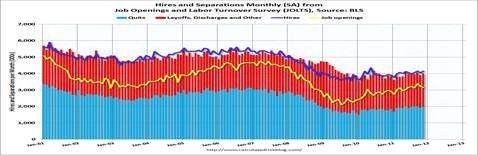
So savvy investors should not be reacting to the initial headlines. For instance, the most accurate unemployment picture is given by the Bureau of Labor Statistics JOLTS report, which lags the unemployment report by 2 months. It is a survey of actual job openings/layoffs. It’s latest report is for November, which showed 3.2 million openings, unchanged from October. Although the number of job openings remained below the 4.4 million openings when the recession began in December 2007, the level in November was 1.0 million higher than in July 2009 (the most recent trough for the series). The number of job openings has increased 30 percent since the end of the recession in June 2009.

clip_image002

Graph: Calculated Risk

Jobs openings declined slightly in November, but the number of job openings (yellow) has generally been trending up, and are up about 7 percent year-over-year compared to November 2010. Quits increased in November, and have mostly been trending up – and quits are now up about 12 percent year-over-year. These are voluntary separations and more quits might indicate some improvement in the labor market. (see light blue columns at bottom of graph for trend for “quits”).

clip_image004

Graph: Econoday

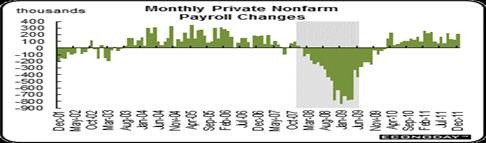
The monthly employment report shows significant broad-based improvement. And the unemployment rate dipped to 8.5 percent, as we know.  Payroll jobs in December jumped a relatively healthy 200,000 after rising a revised 100,000 in November and increased a revised 112,000 in October.  Private payrolls again outstripped the total, gaining 212,000 in December, following increases of 120,000 in November and 134,000 in October.

The Institute for Supply Management (ISM) manufacturing and non-manufacturing (service sector) indexes are the best measure of overall economic activity, and both continue to increase.

clip_image006

Graph: Econoday

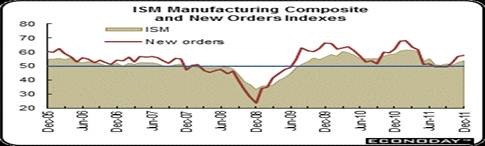
The latest gain in the Manufacturing Composite was led by increases in the production and employment indexes.  Production jumped to 59.9 from 56.6 in November.  Employment rose to 55.1 from 51.8.  The boost in employment is likely a vote of confidence by manufacturing management for stronger demand in coming months.

clip_image008

Graph: Econoday

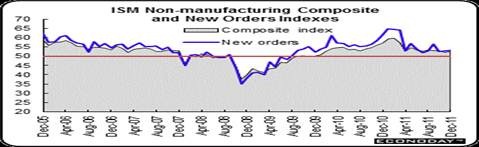
The ISM non-manufacturing Composite Index is not so robust, but still holding above 50 percent, with its overall activity index at 56.2 percent, still a very good number.

And as I said in a recent Mortgage Corner column, construction activity is picking up, which is the part of real estate that influences actual economic growth, since it powers insurance, mortgage, and real estate sales, among other businesses. Only public construction spending hasn’t picked up in 2011, but all other areas of commercial and residential construction have.

clip_image010

Graph: Econoday

So this data tells us there is still a lot of fear to overcome, with many pundits and forecasters expecting the worst—the worst being more of what happened last year—whether it is supply disruptions, Tsunamis, the Middle East, or a euro crisis. We need another year of solid growth, in other words, before the economy becomes strong enough to endure such ‘shocks’.

Harlan Green © 2012
Posted in Economy, housing market, Macro Economics, Weekly Financial News | Tagged , , , , , , , | Leave a comment