Can the Fed Rescue Real Estate?

The Mortgage Corner

How can we thank Fed Chairman Ben Bernanke for keeping our economy afloat? Not only has the Fed kept interest rates low enough to prevent actual deflation, as happened to Japan over the past 20 years and shrunk their economy. But the Fed is now proposing commercial banks under its purview take a more proactive position not only by modifying more ‘underwater’ loans on their books, but actually renting out those it has taken back in foreclosure to tenants; including their former owners.

It is currently circulating a White Paper entitled “The U.S. Housing Market Current Conditions and Policy Considerations” that asks both government supervisors—specifically those of GSEs like Fannie Mae, Freddie Mac, FHA and VA—and private mortgage holders to both loosen their overly restrictive underwriting standards, allow more loan modifications, as well rent out the REO properties they hold, until they are able to be sold!

This is medicine that was applied once before—during the Great Depression—by the Roosevelt Administration, under the Home Owner’s Loan Corporation. It sold bonds to bring down interest rates for something like 1 million homeowners, or rented them back to those who had lost their homes, until they could again be sold.

The data currently show that less than half of all lenders are currently offering mortgages to borrowers with FICO scores of 620 with a 10 percent down payment. Yet these loans are within the GSEs purchase parameters, according to the White Paper, which means little risk to the loan originators.

Particularly first-time homebuyers aged 29 to 34-year-olds are affected, with only 9 percent taking out a mortgage from 2009 to 2011, while 17 percent took out mortgages from mid-1999 to mid-2001.

Why the urgency now? “Perhaps one-fourth of the 2 million vacant homes for sale in the second of 2011 were REO properties…and the continued flow of new REO properties—perhaps as high as 1 million properties per year in 2012 and 2013—will continue to weigh on house prices for some time,” said the Fed.

And we know housing prices continue their decline in most areas, according to the S&P Case-Shiller Home Price Index and other indicators. The Case-Shiller 20-city composite is down a seasonally adjusted 0.6 percent in October following a revised 0.7 percent decline in September and a 0.4 percent decline in August.

clip_image002

Graph: Econoday

Individual cities show a decline in Atlanta where monthly rates of adjusted decline have been 4.1 percent, 4.8 percent and 2.9 percent the last three reports. Other weak spots include Minneapolis, Los Angeles, and Chicago as well as Las Vegas and Miami.

So this is a good time for lenders to rent their REO properties, as rents have been rising while national multifamily vacancy rates have plunged. Depending on whether you use U.S. Census Bureau or REIS, Inc. data, the vacancy rate is hovering around 9.8 percent or 5.2 percent, when rates were as high as 11.8 percent during the recession.

clip_image004

Graph: Calculated Risk

“…the challenge for policymakers is to find ways to help reconcile the existing size and mix of the housing stock and the current environment for housing finance,” said the White Paper. “Fundamentally, such measures involve adapting the existing housing stock to the prevailing tight mortgage lending conditions—for example, devising policies that could help facilitate the conversion of foreclosed properties to rental properties—or supporting a housing finance regime that is less restrictive than today’s, while steering clear of the lax standards that emerged during the last decade.”

So there is hope for real estate when the Fed decides it is time to assist housing, after Chairman Bernanke and others in various speeches have highlighted the drag that a devastated real estate market has on overall economic growth. That is to say, it is time for the banks holding all those vacant homes to get them off their books and back into the real economy.

Harlan Green © 2012

Posted in Consumers, Economy, Housing, housing market, Weekly Financial News | Tagged , , , , , , , , , | Leave a comment

Government Has to Work—or Else

Financial FAQs

We can no longer afford to listen to those conservatives who believe government is the problem, since there is no viable recovery from the worst recession since the Great Depression without government investment in sectors that will grow our future economy—particularly in education, infrastructure and the Research and Development of new technologies such as jump-started the Internet.

So say more economists, such as Nobelist and former chief World Bank economist Joseph Stiglitz in his most recent Vanity Fair article, “The Book of Jobs” that details how we recover from the Great Recession, and which sectors will prosper and expand. This means a “wrenching transition” of our whole economy, as happened in the 1930s, which means government has to be part of the solution.

“The problem today is the so-called real economy,” says Dr. Stiglitz. “It’s a problem rooted in the kinds of jobs we have, the kind we need, and the kind we’re losing, and rooted as well in the kind of workers we want and the kind we don’t know what to do with. The real economy has been in a state of wrenching transition for decades, and its dislocations have never been squarely faced. A crisis of the real economy lies behind the Long Slump, just as it lay behind the Great Depression.”

And so just as with the Great Depression, government has to be part of the transition. Those who advocate little or no government—such as Libertarian candidate Ron Paul who would abolish just about all government—do not seem to realize it would be a return to the beginning of the Industrial Revolution so well documented by Charles Dickens—when there were no child labor laws, for instance.

Or a return to the Great Depression (really two, back-to-back) that lasted almost 10 years when there was no social security, unemployment insurance, or government investments that modernized the industrial sector for World War II.

“It is important to grasp this simple truth: it was government spending—a Keynesian stimulus, not any correction of monetary policy or any revival of the banking system—that brought about recovery,” said Stiglitz. “The long-run prospects for the economy would, of course, have been even better if more of the money had been spent on investments in education, technology, and infrastructure rather than munitions, but even so, the strong public spending more than offset the weaknesses in private spending.”

So, surprise-surprise, the Great Recession wasn’t really the fault of anyone in particular but a cascade of events that are driving us hell-bent out of the industrial, blue-collar era of factory jobs into the White Collar Service and Information Age. And we cannot do this without public-sector investments that must ease the transition; otherwise we are doomed for a “much longer long slump than necessary,” in Stiglitz’s words.

It was small government conservatives like Presidents Reagan and GW Bush that had been wasting taxpayers’ monies to pay for foreign wars and tax cuts since 1980, rather than paying down the deficit or even shoring up social security and Medicare. GW Bush wasted 4 consecutive budget surpluses of the Clinton era. And the low interest rates engineered by Fed Chairman Alan Greenspan for that purpose in turn inflated the housing bubble, lending a sense of false prosperity.

The result of such small government policies was the Fed then took away the punch bowl in 2006 and raised interest rates 17 consecutive times that in effect burst the bubble by raising all those teaser and liar loan interest rates too high for borrowers who shouldn’t have qualified for them in the first place. But that only hastened the inevitable rush away from Industrial to the Information Age. Factory jobs and salaries had already begun to decline in the 1970s along with household incomes for most Americans.

“Today we are moving from manufacturing to a service economy,” says Stiglitz. “The decline in manufacturing jobs has been dramatic—from about a third of the workforce 60 years ago to less than a tenth of it today. The pace has quickened markedly during the past decade. There are two reasons for the decline. One is greater productivity—the same dynamic that revolutionized agriculture and forced a majority of American farmers to look for work elsewhere. The other is globalization, which has sent millions of jobs overseas, to low-wage countries or those that have been investing more in infrastructure or technology.”

“What we need to do instead is embark on a massive investment program—as we did, virtually by accident, 80 years ago—that will increase our productivity for years to come, and will also increase employment now. This public investment, and the resultant restoration in G.D.P., increases the returns to private investment. Public investments could be directed at improving the quality of life and real productivity—unlike the private-sector investments in financial innovations, which turned out to be more akin to financial weapons of mass destruction.”

In other words, we need to put public monies where it will do the most good. Corporate profits today are the highest in history as a percentage of GDP—more than 14 percent—yet their CEOs haven’t been investing it wisely. Most of their profits have been either hoarded, invested overseas, or used to buy back stock to increase the stock options held by corporate executives. It has lined their own pockets, rather than that of their employees and therefore the economy as a whole.

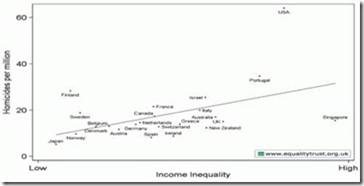
And that is where today’s right and far right wing conservatives want even public monies to flow—into their supporters’ already full pockets—when they won’t allow the Bush tax cuts to expire that have bloated the federal deficit. This will only hasten the decline of America already suffering from record high income inequality, low rates of social mobility, record high violent crime rates, and a government they don’t want to work for the future of all Americans.

Government has to work—or else.

Harlan Green © 2012
Posted in Economy, Keynesian economics, Macro Economics, Uncategorized | Tagged , , , , , , | Leave a comment

Will Real Estate Recover in 2012?

The Mortgage Corner

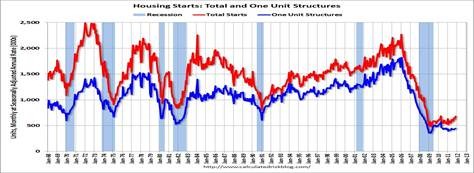
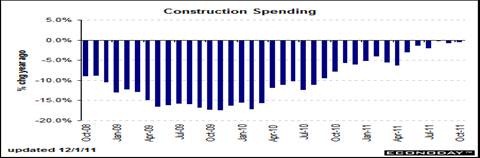
The recovery road may remain bumpy for real estate in 2012 but construction spending continues to increase from low levels of activity, and so housing starts. Much of it is multi-family apartments going to both new households and those who have lost their homes. This should mean replacement of sadly depleted housing inventories, as new construction is not replacing the units taken out of circulation through deterioration or outright destruction.

The total residential stock in the United States is approximately 127 million units – around 75 million owner occupied, some 32 million rentals and 10 million “other” (second / holiday homes etc) – so that conservatively – at least 0.5 percent – or 635,000 units of this stock (depending on age within specific markets) should be replaced annually, said a recent housing study.

Despite the low baseline, activity is stronger than expected as construction spending in November jumped 1.2 percent after slipping 0.2 percent in October (originally up 0.8 percent). The market consensus called for a 0.5 percent increase in November.

clip_image002

Graph: Calculated Risk

The November increase was led by a 2.0 percent gain in private residential outlays, following a 2.3 percent boost in October. Both the single-family and multifamily subcomponents showed strength. Public outlays rebounded 1.7 percent, following a 1.8 percent decline in October. On a year-ago basis, overall construction outlays improved to up 0.5 percent in November from down 0.6 percent in October.

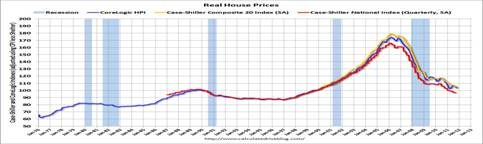
That may be because housing prices are still falling overall. In real terms, the S&P Case-Shiller Home Price Index is back to Q1 1999 levels, the Composite 20 index is back to April 2000, and the CoreLogic index back to March 2000. In real, inflation-discounted terms, all appreciation in the ’00s is gone, says Calculated Risk.

clip_image004

Graph: Calculated Risk

Another sign that housing is coming off a second bottom is that pending existing home sales rose a very strong 7.3 percent in November on top of October’s 10.4 percent gain.

clip_image006

Graph: Econoday

November’s gains were led by the West and include the Northeast and Midwest with the South showing no change. November and October taken together show solid gains for all regions.  The index is at its highest level since April 2010, during the federal homebuyer tax holiday.

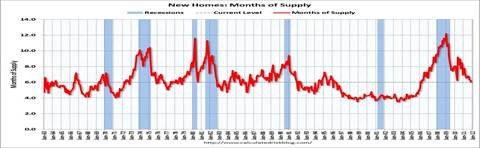
This is while the seasonally adjusted estimate of new houses for sale at the end of November was 158,000. This represents a supply of 6.0 months at the current sales rate, which is the long term supply average. But 158,000 for sale is far below the replacement rate needed for population growth, hence the increase in new construction.

clip_image008

Graph: Calculated Risk

Most of the increase this year has been for multi-family starts, but single family starts are increasing too. Single-family housing starts in November were at a rate of 447,000; this is 2.3 percent above the revised October figure of 437,000. The November rate for units in buildings with five units or more was 230,000.

clip_image010

Graph: Calculated Risk

Builder confidence in the market for newly built, single-family homes has edged up two points from a downwardly revised number to 21 on the National Association of Home Builders/Wells Fargo Housing Market Index (HMI) for December. This marks a third consecutive month in which builder confidence has improved, and brings the index to its highest point since May of 2010, said Calculated Risk.

“This is the first time that builder confidence has improved for three consecutive months since mid-2009, which signifies a legitimate though slowly emerging upward trend,” said NAHB Chief Economist David Crowe. “While large inventories of foreclosed properties continue to plague the most distressed markets and consumer worries about job security and the challenges of selling an existing home remain significant factors, builders are reporting more inquiries and more interest among potential buyers than they have seen in previous months.”

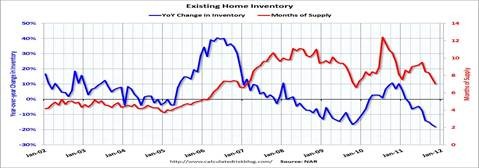
Existing-home sales might also pick up, because of the fire-sale prices. Total housing inventory at the end of November fell 5.8 percent to 2.58 million existing homes available for sale, which represents a 7.0-month supply at the current sales pace, down from a 7.7-month supply in October.

clip_image012

Graph: Calculated Risk

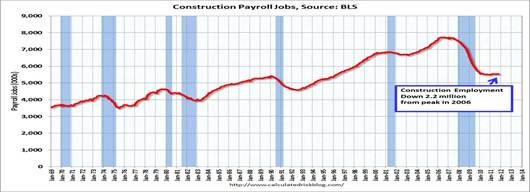
So it does look like additional housing stock will be needed in 2012 just to fill the rising demand for rental properties. And the construction industry will benefit, which has lost more than 2 million jobs during the Great Recession.

clip_image014

Graph: Calculated Risk

Construction employment declined by 20 thousand jobs in October, and is now down 2.2 million jobs from the peak in April 2006. However construction employment is up 27 thousand this year through the October BLS report. After five consecutive years of job losses for residential construction (and four years for total construction), says Calculated Risk, it looks like construction employment will increase this year. However there will not be a strong increase in residential construction until the excess supply of housing is absorbed.

Harlan Green © 2011

Posted in Economy, Housing, housing market, Weekly Financial News | Tagged , , , , , , , , | Leave a comment

2012 Will Be Better

Popular Economics Weekly

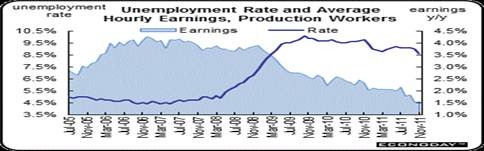
The elements seem to be in place for a better 2012 economy, despite the euro worries, budget deficits, and 8.6 percent jobless rate. Why?  Banks are lending again, and it was the tight bank credit after bursting of the housing bubble that basically stopped businesses from growing.  Banks stopped lending because of their losses from the Great Recession, which finally ended in June 2009.

After three years of Scrooge-like underwriting following 2008’s financial crisis, banks have turned on the spigot, boosting lending at annual rates as high as 8.2 percent since July, according to Federal Reserve statistics.

Lending had fallen from mid-2008 through this year’s second quarter, deepening what became the worst recession since the Great Depression. The data seem to allay fears that making banks keep more capital on their books as a cushion against future downturns and loan losses will take away the cash flow businesses need to keep the recovery moving.

Even small businesses have seen a difference, says Bill Dunkelberg, chief economist of the National Federation of Independent Business. In a monthly NFIB survey, only 3 percent of small-business owners say lack of credit is their most important problem, trailing taxes, regulation and still-sluggish demand.

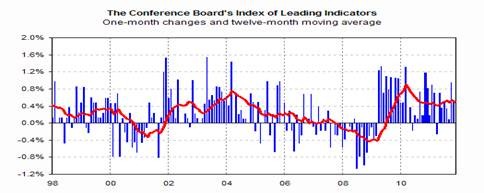
Then the Conference Board’s Index of Leading Economic Indicators continues to show 3 percent plus GDP growth for the next 6 months.

clip_image002

Graph: Wrightson ICAP

The LEI is a weighted gauge of 10 indicators designed to signal business cycle peaks and troughs. Among the 10 indicators that make up the LEI, seven made positive contributions in November. The index rose a very solid 0.5 percent following October’s 0.9 percent surge. The leading positive is the rate spread which reflects the Federal Reserve’s zero interest rate policy, said its press release. The second positive is building permits which appear to be building steam in what is very good news for the construction sector.

Consumer expectations are also a big positive in the month and judging from this month’s consumer sentiment report look to be a big positive for December. Another positive that’s likely to extend through this month is the November improvement in jobless claims which gave the fifth strongest contribution to the month’s 0.5 percent gain.

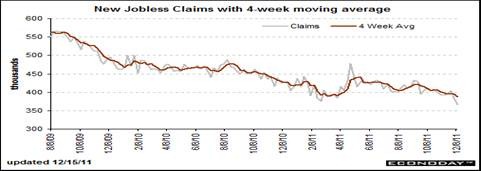
The sharp decline in weekly initial unemployment insurance jobless claims means fewer workers are being fired. Layoffs are on a steady decline in what is good news for the jobs market and for the December employment report. Initial claims fell for a third week in a row, down 4,000 to a much lower-than-expected level of 364,000 (prior week revised to 368,000 for a 17,000 decline). The four-week average is also down for a third week in a row and down for six of the last seven, declining 8,000 to 380,250 which is the lowest level of the recovery.

clip_image004

Graph: Econoday

Both the University of Michigan and Conference Board sentiment surveys continue to improve. The U. of Michigan reading implies a very strong 72.1 over the last two weeks which points to momentum for January. The bulk of the gain is centered in expectations, at 63.6 in December for a more than eight point monthly gain that points further to momentum in the New Year. The assessment of current conditions, likely held down by bad news out of Europe, rose only two points in the month to 79.6.

clip_image006

Graph: Inside Debt

The New York-based Conference Board said that its December Consumer Confidence Index rose almost 10 points to 64.5, up from 55.2 in November. The surge builds on another big increase in November, when the index rose almost 15 points from the month before.

One likely positive for sentiment is improvement in the jobs market as well as the stock market which has been on the recovery, said Econoday. Another positive may be gasoline prices which, despite $100 oil, are on the decline. One-year inflation expectations eased one tenth in the month to 3.1 percent with five-year expectations unchanged at 2.7 percent.

Small businesses are important because they account for 70 percent of new jobs. Though slack demand is still making entrepreneurs wary of borrowing, says NFIB chief economist William Dunkelberg: Only 12 percent think business will be better in 12 months than it is now. “Two-thirds of business owners say, “Who wants a loan?” says Dunkelberg, who is chairman of a small Pennsylvania bank. “In thirty years, I’ve never seen anything like it. The banks all have money to lend, but there’s a shortage of eligible customers coming in.”

Small businesses are the key, so we know the recovery will become sustainable if they can continue to borrow. Increased bank lending is a sign of increased demand for products and services in 2012, a good sign for all businesses.

Harlan Green © 2011

Posted in Consumers, Economy, Macro Economics, Weekly Financial News | Tagged , , , , | Leave a comment

Greater Equality = Greater Democracy

Financial FAQs

A recent Gallup poll said 82 percent of respondents thought economic growth “extremely”, or “very” important, while just 46 percent said reducing the income and wealth gap between rich and poor was extremely or very important.

Yet there is growing evidence that the two are inextricably linked, because new research shows that inequality breeds all the evils that we see in societies—from high crime rates, poor health and educational institutions, to declining environmental quality. An even worse outcome may be a drop in democratic freedoms and rise of authoritarian institutions.

Paul Krugman has worried about this—specifically, the European austerity programs leading to so much economic suffering in Europe are also leading to a rise in intolerance and extremist organizations, even governments. “Nobody familiar with Europe’s history can look at this resurgence of hostility without feeling a shiver. Yet there may be worse things happening.

“Right-wing populists are on the rise from Austria, where the Freedom Party (whose leader used to have neo-Nazi connections) runs neck-and-neck in the polls with established parties, to Finland, where the anti-immigrant True Finns party had a strong electoral showing last April,” said Krugman. “And these are rich countries whose economies have held up fairly well. Matters look even more ominous in the poorer nations of Central and Eastern Europe.”

“Last month the European Bank for Reconstruction and Development documented a sharp drop in public support for democracy in the “new E.U.” countries, the nations that joined the European Union after the fall of the Berlin Wall. Not surprisingly, the loss of faith in democracy has been greatest in the countries that suffered the deepest economic slumps.”

“Taken together, all this amounts to the re-establishment of authoritarian rule, under a paper-thin veneer of democracy, in the heart of Europe. And it’s a sample of what may happen much more widely if this depression continues,” worries Professor Krugman.

We can also see it in the U.S. with the rise of right wing activism, such as the Tea Party with its anti-immigrant, anti-government credo. This is not anti-democratic on its surface, but it’s credo contains much that is undemocratic, such as government invasion of private choice in wanting to control abortion and gay marriages.

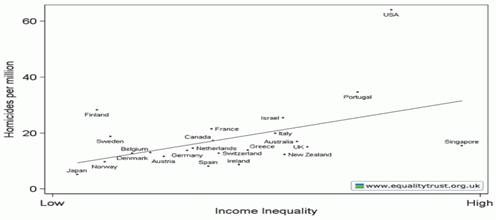
Richard Wilkinson’s TEDx lecture and book with Kate Pickett, “The Spirit Level” show the best exposure of the dire effects of income inequality on the quality of life. The most important factor, and a sign of dire consequences when inequality has approached the level of the Great Depression, is our violent crime and incarceration rates, which Wilkinson discusses at length. The U.S. is by far the most violent country in the world—worse than any other developed country.

clip_image002

Graph: The Spirit Level

So why aren’t such quality of life indicators discussed with economic growth? Part of it is misconceptions—that economic growth and equality aren’t compatible. The conservative position espoused by 1970s Economist Arthur Okun was that greater equality meant less market efficiencies to produce, and so fewer incentives for greater wealth since leveling the playing field meant leveling out the opportunity for large profits. But he also advocated more progressive taxation, and various other social safety net programs to alleviate the effects of income disparities on the quality of their lives.

That was before the decline of centralized planning in socialist and communist countries, of course, when the superior economics of democracies was still in doubt. The abilities of capitalist, market-driven economies to produce more and better products is no longer disputed. In fact, the various asset bubbles of recent years show a propensity for markets to overproduce. It also produces more pronounced income inequality, which leads more than ever to unequal opportunity for those at the bottom of the wealth ladder.

Studies have shown that the greatest periods of economic growth occurred during Democratic administrations, when equality was greatest, and government was not the problem. The evidence now shows the necessity for greater income equality if we want greater peace and prosperity within our own country, as well as a shared peace and prosperity with other countries.

Harlan Green © 2011

Posted in Consumers, Economy, Uncategorized | Tagged , , , , , | Leave a comment

Will Younger Generation Rescue Real Estate?

The Mortgage Corner

Privately-owned housing starts in November rose to a seasonally adjusted annual rate of 685,000, which combined with increasing builder sentiment is a sign that children of the baby boomers—the so-called Boomerang or echo boomer generation—may finally be venturing from their parents’ homestead. This is 9.3 percent above the revised October estimate of 627,000 and is 24.3 percent above the November 2010 rate of 551,000.

Household formation is the big uncertainty. It hit record lows during the Great Recession, as the offspring of baby boomers stayed at home longer, rather than buy or rent their own living space. But population pressures are building as the echo boomers outnumber their parents—some 86 million who will eventually live separately.

U.S. home prices won’t recover until the economy improves enough to boost the number of households and clear an oversupply of properties, said economist Karl Case, co-founder of the S&P/Case-Shiller home price index.

“Normally, the way we’ve cleared the market is we’ve had more household formation,” Case, a retired Wellesley College professor, said in an interview today with Tom Keene and Ken Prewitt on Bloomberg Radio’s “Surveillance.” Lackluster economic growth has encouraged people to move in with friends or family, meaning “demand is not going anywhere,” he said.

The number of U.S. households, a key determinant in home sales, grew by 600,000 this year, less than half the 1.5 million pace of 2006, when prices reached a record, according to IHS Global Insight Inc. This year’s pace isn’t enough to absorb the so-called shadow inventory of distressed properties poised to come on the market, said Patrick Newport, an economist with the Lexington, Massachusetts-based research firm.

Whereas something like 750,000 and 1 million new households were predicted in 2011, predicts UBS Securities LLC’s Maury Harris and IHS Global Insight’s Patrick Newport, according to a recent Bloomberg article. That compares with just 357,000 added in the year ended March 2010, the lowest on record, according to the Census Bureau. As employment picks up, new households are likely to rise above the past decade’s average of 1.3 million a year, according to Newport.

Most of the increase this year has been for multi-family starts, but single family starts are increasing too. Single-family housing starts in November were at a rate of 447,000; this is 2.3 percent above the revised October figure of 437,000. The November rate for units in buildings with five units or more was 230,000.

clip_image002

Graph: Calculated Risk

Builder confidence in the market for newly built, single-family homes also edged up two points from a downwardly revised number to 21 on the National Association of Home Builders/Wells Fargo Housing Market Index (HMI) for December, just released. This marks a third consecutive month in which builder confidence has improved, and brings the index to its highest point since May of 2010, said Calculated Risk.

“This is the first time that builder confidence has improved for three consecutive months since mid-2009, which signifies a legitimate though slowly emerging upward trend,” said NAHB Chief Economist David Crowe. “While large inventories of foreclosed properties continue to plague the most distressed markets and consumer worries about job security and the challenges of selling an existing home remain significant factors, builders are reporting more inquiries and more interest among potential buyers than they have seen in previous months.”

Existing-home sales might also pick up, because of the fire-sale prices. Foreclosures and short-sales now make up some 30 percent of existing-home sales, according to CNBC’s Diana Olick (http://www.cnbc.com/id/45751842). But that number might change with the new revisions of existing-home sales since 2007 by NAR. As it is, existing sales jumped 4 percent in November. Total housing inventory at the end of November fell 5.8 percent to 2.58 million existing homes available for sale, which represents a 7.0-month supply at the current sales pace, down from a 7.7-month supply in October.

clip_image004

Graph: Calculated Risk

So who is right, Karl Case or Patrick Newport? Even 600,000 new households is a doubling of last year’s household growth. And that is why we are seeing more housing construction. Much of it has to be rentals, but the pressure to build will continue as more of the echo boomers find jobs and leave their parents’ homes.

Harlan Green © 2011

Posted in Consumers, Housing, housing market, Weekly Financial News | Tagged , , , , , , , , , , | Leave a comment

Consumers Regaining Financial Health

Popular Economics Weekly

Consumers are spending for the holidays. Retail sales in particular have rebounded to almost pre-recession levels. Overall retail sales in November grew 0.2 percent, following a 0.6 percent boost in October (originally up 0.5 percent) and a 1.3 percent spike in September (previously up 1.1 percent). Retail sales in November rose 6.7 percent annually, compared to 7.5 percent in October. Excluding motor vehicles, sales were up 6.6 percent on a year-on-year basis, compared to 7.5 percent the month before.

clip_image002

Graph: Inside Debt

So once again, as with jobs, the numbers were higher than initially reported. Overall components were largely favorable. The strongest component was for electronics & appliance stores which jumped 2.1 percent in November, followed by nonstore retailers (up 1.5 percent) and auto dealers (up 0.5 percent). Also seeing gains were furniture & home furnishing, clothing & accessory stores, sporting goods & hobby, and general merchandise.

The Labor Department’s Job Openings, Layoffs, and Turnover Survey (JOLTS) report also looked good, with 3.27 million job openings. Although the number of job openings remained below the 4.4 million openings when the recession began in December 2007, the level in October was 1.2million higher than in July 2009 (the most recent trough for the series). The number of job openings has increased 35 percent since the end of the recession in June 2009.

clip_image004

Graph: Wrightson ICAP

But will consumer spending hold up in 2012? Since consumer confidence is rising from the mid-year pessimism of congressional gridlock, Japanese Tsunami, and S&P credit downgrade, it looks like that will happen—in part because real incomes are rising again with declining inflation. Consumer spending has in fact been increasing 7 percent annually since March 2010.

It is particularly hard to understand why we are still in a disinflationary environment, when energy and food prices fluctuate so much. The largest factor is almost no increase in labor costs. This is because wages and salaries—which make up 80 percent of personal incomes and two-thirds of product costs—are barely rising, while housing prices are still falling. And corporations are hoarding some $2 trillion in cash, banks have $1.8 trillion in excess reserves they are not spending or lending. With so little money in circulation—whether from wage earners or corporate spenders—then prices cannot rise appreciably.

clip_image006

Payroll jobs in November advanced a relatively strong 120,000 after gaining a revised 100,000 in October (originally 80,000) and increased a revised 210,000 in September (previously 158,000).  So look for upward revisions once again.  Private payrolls (less government layoffs) gained more than overall, up140,000, following a 117,000 increase in October and 220,000 rise in September.

The stronger employment numbers are corroborated by weekly initial claims for unemployment insurance. Back to back declines of 19,000 in initial jobless claims are signaling sudden strength in the labor market. Claims in the December 10 week came in at 366,000, far below expectations for 390,000 and compared to 385,000 in the prior week (revised 4,000 higher). The 366,000 level is the lowest since May 2008. The four-week average is down 6,500 to 387,750 for the lowest level since July 2008. The average, in a convincing sign of strength, has been down in 10 of the last 12 weeks, said Econoday.

clip_image008

That is the main reason economists are revising growth estimates upward to 3 percent plus in 2012. Consumers are spending—and borrowing again.

Harlan Green © 2011

Posted in Consumers, Economy, Weekly Financial News | Tagged , , , , , , | Leave a comment

2011—The Year That Wasn’t

Popular Economics Weekly

What do we make of this year’s economy, with its ups and downs that have confused even the ‘experts’; and what to make of 2012? Believe it or not, the congressional gridlock that caused the S&P Treasury debt downgrade may actually boost growth. Because the Bush-era tax cuts are scheduled to expire end of 2012, which would put them back to the Clinton-era tax brackets. And we know what happened during Clinton’s Presidency—22.7 million jobs created, and 4 consecutive years of budget surpluses were paid for with the combination of higher income tax brackets and reduced government spending.

Firstly, we should understand that the experts overestimated economic growth at the beginning of 2011, then underestimated it by midyear—which means that we were never in danger of a second recession. The best example is our unemployment numbers. From June onward, both private payrolls and the self-employed have been increasing at more than 200,000 per month, which is close to pre-recession levels.

The household survey component of the jobs report including the self-employed – an actual headcount of working Americans – has shown a gain of 1.28 million over the past four months alone, whereas initial payroll formation showed zero or almost zero job growth in August-September before it was upgraded. And that—with the S&P credit downgrade and euro worries—is what set off new recession talk.

clip_image002

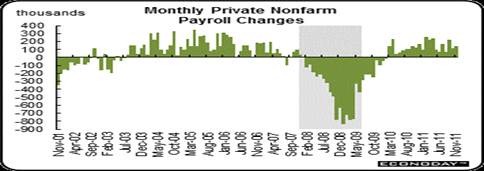
Payroll jobs in November advanced a relatively strong 120,000 after gaining a revised 100,000 in October (originally 80,000) and increased a revised 210,000 in September (previously 158,000).  So look for upward revisions once again.  Revisions for September and October were up net 72,000. Once again, private payrolls (less government layoffs) gained more than overall.  Private nonfarm payrolls gained 140,000, following a 117,000 increase in October and 220,000 rise in September.

clip_image004

Then we had the so-called congressional Supercommittee not being super at all. They couldn’t agree on what budgets to cut, or revenues to raise. But as Paul Krugman has said, that may be a good thing—

“The supercommittee was a superdud — and we should be glad. Nonetheless, at some point we’ll have to rein in budget deficits. And when we do, here’s a thought: How about making increased revenue an important part of the deal?”

In fact, such a budget deficit during the worst recession since the Great Depression is necessary to fund vital public services and keep the economy running, until private business begins to invest again. And that won’t happen until consumer spending picks up, as we have said in past columns. The deficit will improve as the economy continues to grow, in other words, but won’t pick up if more jobs are cut—whether from the private or public sectors.

Consumer spending has barely held up during the various crises. It is best measured by consumer credit. Strength in consumer spending is confirmed by a build in outstanding consumer credit, up $7.6 billion in October following a revised $6.9 billion increase in September. The increase is once again centered in non-revolving credit, which reflects strength in vehicle sales. But a steady increase is now appearing for non-revolving credit, up $0.4 billion for a second consecutive month and offering evidence that consumers are once again, at least to a limited extent, using their credit cards.

clip_image006

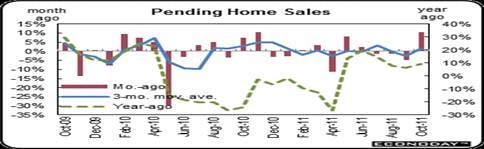
That means it is real estate that is still holding up a stronger recovery. Despite headwinds, the latest pending home sales report indicates that housing may be back on a modest uptrend—at least for sales, according to Econoday. Low prices and low interest rates appear to be creating traction as the pending home index, which is a measure of contract signings for sales of existing homes, jumped 10.4 percent in October, following a 4.6 percent decline the prior month.

clip_image008

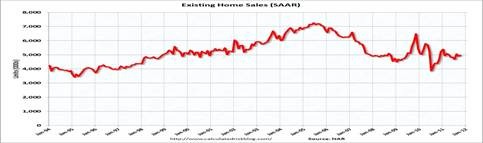
But the real measure of housing health is existing-home sales, which have been stuck in the 5million range since 2008, due to the large number of foreclosures and distressed sales.

clip_image010

Housing prices are just now beginning to recover from a more than 30 percent plunge, as measured by the Case-Shiller Home Price Index. Housing construction is also showing some strength for the first time since 2009, which will add to GDP growth. Why? Household formation is picking up, as the so-called echo boomers—children of baby boomers—finally begin to leave their parents’ home. Household formation should double this year to 1 million from last year’s 500,000.

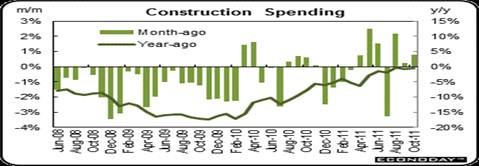
That is probably why construction spending in October advanced 0.8 percent after rising an unrevised 0.2 percent in September. The October increase was led by a 3.4 percent boost in private residential outlays, following a 0.6 percent rise in September.  Construction outlays have risen three months in a row and in six of the last seven months.  The level of activity is still subdued but it now appears to be growing and adding to overall economic growth, as we have said.  It is not an “engine” like manufacturing but it is in better shape than even less than a year ago.

clip_image012

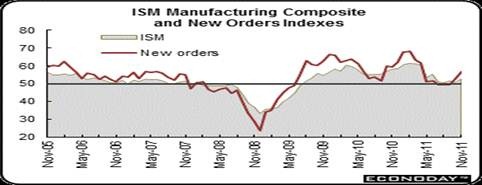
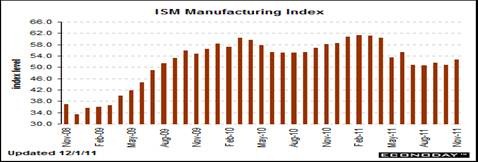
The latest report from the Institute for Supply Management also added to growth estimates as the manufacturing sector is regaining momentum.  The ISM manufacturing index moved further into positive territory, rising 1.2 points in November to a reading of 52.7. The gain in the index was led by a 6.5 point jump in the production index to 56.6.  Importantly, the new orders index was up a very strong 4.3 points to 56.7, above 50 to indicate monthly growth and pointing to continuing momentum.

clip_image014

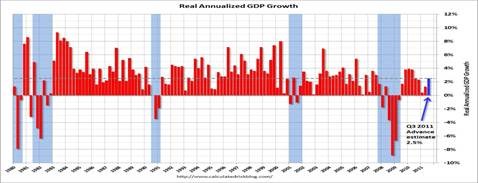
Lastly, Gross Domestic Product estimates, the best measure of overall growth, are being revised upward to 3 percent plus next year by economists, after the mid-year scare. So this also means more job creation if those forecasts are fulfilled.

clip_image016

Graph: Calculated Risk

The bottom line is that many difficulties lie ahead, but it doesn’t look like congressional gridlock can do much more to limit growth. In fact, if the Bush tax cuts of 2001, 2003, and 2006 were extended past 2012, it would increase the deficit by $3.7 trillion over the next decade, according to CNN. Whereas letting the cuts expire on December 31, 2012 would reduce the federal deficit by 40 percent over just the next five years.

So, if both progressives and conservatives would step out of their idelogical strait jackets, they would see that government doing nothing at the moment might be the best road to a recovery. One caveat—Wall Street can’t be allowed to again do business as usual. They are still lobbying ferociously to weaken regulation of derivatives’ trading under Dodd-Frank, which will also reveal just how much risk they are still taking with Other People’s Money—i.e., their investors. Until such reporting requirements are made law, over-the-counter derivatives’ trading, which totals some $600 trillion, according to the New York Times, will continue to endanger our overall economy.

Harlan Green © 2011

Posted in Economy, Macro Economics, Weekly Financial News | Tagged , , , , , , | Leave a comment

Austerity (That) Doesn’t Work

Financial FAQs

It turns out that austerity doesn’t work, when it means tax cuts for the wealthy but spending (and so income) cuts for the rest of US. But austerity does work when applied to the wealthiest who have used their wealth to create more instability, rather than creating jobs.

Great Britain is the best current example. The austerity budget cuts of its ruling Conservative Party have brought economic growth to a halt, whereas U.S. growth is returning to a more normal 3 percent rate because of U.S. government stimulus programs. Britain is much more socialized, yet if it had taxed the wealthiest to support their programs instead of giving them even more tax breaks, it would have paid down debt without taking the earning and spending power away from government workers and unions (a lesson that we have only partially learned). Then such a slowdown would have been averted.

Paul Krugman brings this out in a recent blog, stating that “…what’s happening in Britain now is that depressed estimates of long-run potential are being used to justify more austerity, which will depress the economy even further in the short run, leading to further depression of long-run potential, leading to …It really is just like a medieval doctor bleeding his patient, observing that the patient is getting sicker, not better, and deciding that this calls for even more bleeding.”

Their economic thinking is not quite medieval but certainly from the 18th century, when Adam Smith’s invisible hand theory was first used to rationalize conservatives’ ideology that government is evil. We now know that cutting spending doesn’t lead us out of recessions, or worse. It takes budget deficits during bad times to prime the pumps of private employers, until they loosen their own purse strings and begin to invest the $trillions from record profits that they have instead used to buy back their stock in order to boost CEO incomes.

Most of the economic damage is being done in the government sector, as our own Labor Department’s November employment report shows. The increase in hiring took place entirely in the private sector, with employment rising by 140,000. Governments cut 20,000 jobs last month to put the total loss over the past two years at around 600,000. States and municipalities have been forced to reduce staff to balance their budgets as required by local law.

clip_image002

Graph: Wrightson ICAP

And hiring in October was revised up to 100,000 from 80,000 and the job gains in September were revised up to 210,00 from 158,000, which shows private employers are having to hire more payrolls to keep up with consumers demand during the holidays. So the damage to employment is being done to precisely the workforce targeted by conservatives in England and America—government workers.

The expansion in the Institute for Supply Management’s manufacturing survey also buttressed our stronger growth prospects, which increased in almost all areas. The new orders index for November is up a very strong 4.3 points to 56.7, above 50 to indicate monthly growth and well above October. This index had been stuck at slightly sub-50 levels in prior months which now are forgotten. Helped by new orders, the ISM composite index is up 1.2 points to a 52.7 level that compares with the Econoday consensus for 51.5. November’s level is the best since June.

clip_image004

And it may not be a lot (coming from a low base) but it is starting to look like the construction sector is incrementally adding to overall economic growth. Construction spending in October advanced 0.8 percent after rising an unrevised 0.2 percent in September. Analysts had forecast a 0.3 percent boost for October.

clip_image006

The October increase was led by a 3.4 percent boost in private residential outlays, following a 0.6 percent rise in September. Private nonresidential construction spending also posted a gain, rising 1.3 percent, following a 0.1 percent dip the month before. Once again public outlays declined 1.8 percent after a 0.3 percent increase the prior month, illustrating the damage those pushing for more austerity is doing to economic growth. On a year-ago basis, overall construction outlays improved to down 0.4 percent in October from down 0.6 percent in September.

Construction outlays have risen three months in a row and in six of the last seven months. The level of activity is still subdued but it now appears to be growing and adding to overall economic growth, said Econoday. It is not an “engine” like manufacturing but it is in better shape than even less than a year ago.

So we see the result of austerity policies during recessions. They do not bring on recoveries, period. And that’s why the situation in Europe is so much worse. Krugman’s warnings have been realized: “How did things go so wrong? The answer you hear all the time is that the euro crisis was caused by fiscal irresponsibility. Turn on your TV and you’re very likely to find some pundit declaring that if America doesn’t slash spending we’ll end up like Greece. Greeeeeece!

“But the truth is nearly the opposite. Although Europe’s leaders continue to insist that the problem is too much spending in debtor nations, the real problem is too little spending in Europe as a whole. And their efforts to fix matters by demanding ever harsher austerity have played a major role in making the situation worse.”

The real result of austerity during hard times is really that it falls on necessary public services such as education, police and fire departments, and even environmental regulation. These are the essential services needed by all, rich and poor. Cutting back on those services not only prolongs the slowdown, but deepens it.

Harlan Green © 2011

Posted in Consumers, Economy, Macro Economics, Weekly Financial News | Tagged , , , , , , | Leave a comment

Elizabeth Warren’s Teach-in

Popular Economics Weekly

What better way to understand Elizabeth Warren’s bid for Massachusetts Senator to replace Scott Brown that conduct a Teach-in, much as the OccupyWallStreeters are doing. She stands for what we all need, after all, more knowledge on how to combat the huge levels of social and economic inequality that have arisen over the past 30 years from a corporate and Wall Street culture that glorified profits over social responsibility, or even honesty.

Professor Warren’s specialty at Harvard is contract and bankruptcy law, after all, so she has seen firsthand the damage that fine print in mortgage contracts and wholesale deregulation of financial oversight can do. A New York Times profile spelled out some of her agenda. “Ms. Warren talks about the nation’s growing income inequality in a way that channels the force of the Occupy Wall Street movement but makes it palatable and understandable to a far wider swath of voters,” said the Times. “She is provocative and assertive in her critique of corporate power and the well-paid lobbyists who protect it in Washington, and eloquent in her defense of an eroding middle class.”

But it’s more than that. She is a teacher, and so teaching the public why the middle and lower classes have lost so much of their wealth is a priority. In fact, their loss of wealth is why economic growth has been slowing historically. Part of it has to do with the massive deregulation of industries begun by President Reagan in his war against government; waged on the promise it would raise everyone’s prosperity level. But the result instead was it took away the income and wealth of ‘everyone’ and gave it to the wealthiest on the thinnest of rationalizations—that they were the real job creators, not the consumers who bought their products.

Does that mean we are helpless victims who have to be protected by Big Government, unable to take care of ourselves? No, in “All Your Worth: The Ultimate Lifetime Money Plan” written with daughter Amelia Tyagi, she spells out her beliefs on individual responsibility. “You can’t count on good old-fashioned hard work the way your parents did. Go to school, get a good job, do your work, don’t go crazy with spending, and everything will work out, right? Not anymore. That advice may have worked in your parents’ day, but today you have to be smart with your money. Not just a little smart, but super smart. You have to learn the new rules — the rules nobody told you and nobody talks about. And you have to learn them fast.”

And that in fact is what her teach-ins are about—learning the new rules, as well as working to change them to be more consumer friendly. What are they? Firstly, a major rule change was abolishing usury laws that have enabled national banks to charge as much as 30 percent on credit card debt. In another bestseller with her daughter, “The Two-Income Trap”, they spell out why the middle class has lost ground. Deregulation has allowed banks to write their own rules, with no concern for their own customers’ welfare.

For instance, the 2005 bankruptcy laws have means testing—only those with below median incomes for their states can file for Chapter 7 Bankruptcy, which abolishes all unsecured debt. So struggling households saddled with catastrophic health care costs (because health care costs aren’t controlled), have to sell everything they own to even file for bankruptcy.

“That puts women trying to collect domestic support obligations and credit card companies in direct competition for the ex-husband’s resources,” said Ms. Tyagi in a 2004 Mother Jones interview. “Credit card companies can hire lawyers and develop extensive debt collect departments, something that is really tough for women. When the credit industry controls the bankruptcy rules, women lose.”

That is the real reason the standard of living of all but the top 1 percent has fallen. And it hurts all of us. Richard Wilkinson has spelled it out in a recent TEDS conference, and his book with Kate Pickett, “The Spirit Level”. Countries and states with the highest income inequality have the highest crime rates, illness outcomes, and most environmental degradation—you name it—as well as least social mobility that would allow greater opportunities to improve themselves.

clip_image002

Graph: TED Conference

Why such a shift from equal opportunity back to an era of Social Darwinism in just 30 years that was capitalism in its earliest form? It is in part due to the huge amount of wealth we have amassed. Former Fed Chairman Alan Greenspan has said: “It is not that humans have become any more greedy than in generations past. It is that the avenues to express greed had grown so enormously.”

Wealth generates its own temptations, in other words, and so removing the barriers to its acquisition can overwhelm even common sense when dealing with severe financial crises.

Harlan Green © 2011

Posted in Consumers, Economy, Macro Economics, Weekly Financial News | Tagged , , , , , | Leave a comment