Housing Affordability Still at Highs

The Mortgage Corner

Bolstered by favorable interest rates and low house prices, housing affordability remained near its highest level nationwide for the sixth consecutive month since the series was first compiled nearly two decades ago, according to the National Association of Home Builders/Wells Fargo Housing Opportunity Index (HOI) released today. And both housing construction and new-home sales are beginning to rise again after a lull.

The HOI indicated that 72.3 percent of all new and existing homes sold in the second quarter of 2010 were affordable to families earning the national median income of $64,400. The index for the second quarter was slightly more affordable than the previous quarter and almost equaled the record-high 72.5 percent set during the first quarter of 2009. Until 2009, the HOI rarely topped 67 percent and never reached 70 percent.

“Homeownership is within reach of more households than it has been for almost a generation,” said NAHB Chairman Bob Jones. “Interest rates continue to hover at historic low levels, the economy is beginning to rebound and with house prices starting to stabilize, conditions are beginning to draw home buyers back into the market, which is a positive step on the path to recovery.”

Syracuse, N.Y., was the most affordable major housing market in the country, edging out Indianapolis-Carmel, Ind., which had held the top ranking for nearly five years. In Syracuse, 97.2 percent of all homes sold were affordable to households earning the area’s median family income of $64,300.

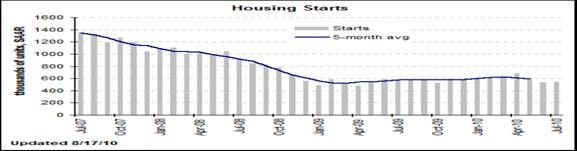
Housing starts also posted a modest comeback in July, rising 1.7 percent after an 8.7 percent decrease in June. The July annualized pace of 0.546 million units came in below the median forecast for 0.565 million units and is down 7.0 percent on a year-ago basis.
clip_image002

The July improvement was led by a 32.6 percent bounce back in multifamily starts, following a 33.3 percent drop in June, as more households become renters. The single-family component is still weighed down by inventories-declining 4.2 percent after dipping 1.7 percent in June.

By region, the gain in starts was led by a 3.9 percent rebound in the South. Other regions declined-the Northeast, down 25.9 percent; the West, down 4.9 percent; and the Midwest, down 1.1 percent.

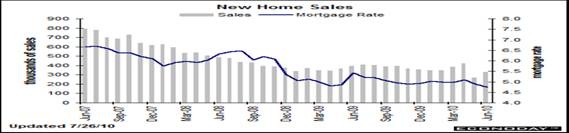
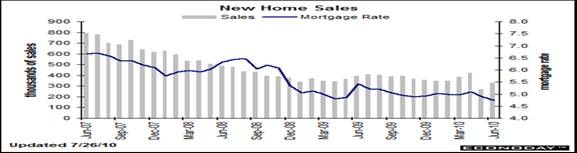
New-home sales also recovered form recent lows. The June pace recovered to an annualized 330,000 from a revised 267,000 for May and revised 422,000 for April. While the comeback is welcome, the bad news is that May’s record drop was revised down notably from the initial estimate of a 33.0 percent decline. The latest figure is down 16.7 percent on a year-ago basis.
clip_image004

Monthly supply has seen sharp movement in recent months as that ratio is moved more by sales than by the number of homes on the market. Supply on the market eased somewhat to 7.6 months after surging to 9.6 in May. April had been pushed down to 6.1 months’ supply as sales bumped up to meet the signing deadline for tax credits. The median home price slipped 1.4 percent to $213,400. Year-on-year, the median price in June is down 0.6 percent. The bottom line is that the elevated inventory levels of new homes is helping keep prices low.

Another interesting statistic put out by Calculated Risk is the distribution of mortgage interest among homeowners.

A just released Census Bureau housing survey showed:

· 76.4 million owner occupied housing units in 2009.

· 24.2 million were owned free and clear (no mortgage). That is 31.7 percent.

· 26.8 million primary mortgages were originated in 2004 or earlier.

· 12.7 million primary mortgages were originated prior to 2000.

· 24.1 million primary mortgage had interest rates above 6 percent.
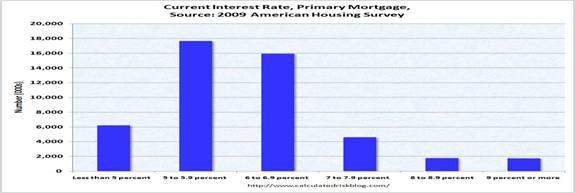
clip_image006

This is while the 30-year conforming fixed-rate mortgage averaged 4.42 percent for the week ending Aug. 19, a record low since Freddie started tracking the rate in 1971. And, there are at least 10.9 million homeowners with 2nd mortgages and another 800 thousand the 3 or more mortgages.

This all means that the new affordability is not available to everyone. Only 6.2 million of primary mortgages were under 5 percent (as of 2009). This will increase in 2010, but quite a few homeowners had primary mortgage interest rates above 6 percent. And the U.S Bureau of Economic Analysis recently reported that the effective rate on all mortgages was still above 6 percent in Q2.

Harlan Green © 2010

Posted in Weekly Financial News | Tagged , , , | Leave a comment

What is the ‘New Normal’—Part II?

Popular Economics Weekly

Fed Chairman Ben Bernanke is sounding more optimistic these days. What is behind his optimism that seems to counteract the “New Normal” predictions of bond traders such as PIMCO and other fiscal conservatives who fear massive debts will hurt growth and fuel increasing inflation?  Bernanke feels that domestic economic activity is bound to pick up with a worldwide pickup, as Asia and Europe slowly recover from their malaise.

Chairman Ben gave his most recent speech to southern legislators in South Carolina. “After a precipitous decline in late 2008 and early 2009, the U.S. economy stabilized in the middle of last year and is now expanding at a moderate pace. While the support to economic activity from stimulative fiscal policies and firms’ restocking of their inventories will diminish over time, rising demand from households and businesses should help sustain growth.”

Third quarter Gross Domestic Growth was 2.4 percent—good but not great enough to bring down the unemployment rate, which is stuck at 9.5 percent.

clip_image002[8]

Domestic demand is the basic driver of growth — consumer spending, business fixed investment, housing investment, and government purchases. Real final sales to domestic purchasers rose a very positive 4.1 percent, compared to a 1.3 percent gain in the first quarter. Basically, demand by said U.S. consumers, businesses, and the government was up significantly in the second quarter.

Bernanke highlights growing strength in the consumer sector, which powers almost 70 percent of economic growth. This showed up in an 18 percent rise in imports, mostly from consumer purchases. “In particular, in the household sector, growth in real consumer spending seems likely to pick up in coming quarters from its recent modest pace, supported by gains in income and improving credit conditions. In the business sector, investment in equipment and software has been increasing rapidly, in part as a result of the deferral of capital outlays during the downturn and the need of many businesses to replace aging equipment. At the same time, rising U.S. exports, reflecting the expansion of the global economy and the recovery of world trade, have helped foster growth in the U.S. manufacturing sector.”

The biggest surprise was the growth in commercial and residential investments. Real nonresidential (i.e., commercial) fixed investment increased 17.0 percent in the second quarter, compared with an increase of 7.8 percent in the first. Nonresidential structures increased 5.2 percent, in contrast to a decrease of 17.8 percent. Equipment and software increased 21.9 percent, compared with an increase of 20.4 percent. Real residential fixed investment increased 27.9 percent, in contrast to a decrease of 12.3 percent.

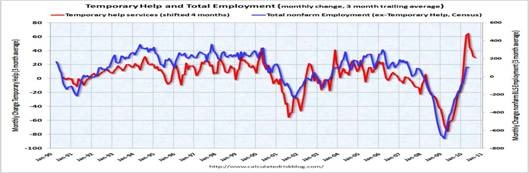
July total nonfarm payroll employment did not so well, declining by 131,000 and the unemployment rate was unchanged at 9.5 percent, said U.S. Bureau of Labor Statistics. This was mainly because federal government employment fell, as 143,000 temporary workers hired for the decennial census completed their work. The good news was that private-sector payroll employment edged up 71,000, seasonally adjusted. e

clip_image004[8]

What is now happening is that consumers are saving much more, as the Q2 preliminary savings rate shot up to 6.4 percent. This is in part due to the drop in spending, but also because consumers continue to pay down their debts.

clip_image006[8]

Consumer credit contracted again in June, this time by $1.3 billion. If there is good news it’s that the level of contraction is less severe than prior months. Also good news is an upward revision to May which now shows a $5.3 billion contraction vs. the initial contraction of $9.1 billion. Nonrevolving credit offers some good news, up $3.2 billion on top of May’s increase of $1.8 (revised from a $6.5 billion contraction). Solid unit vehicle sales in July point to possible gains for this component in the next report.

All the talk about the ‘new normal’ may have a useful purpose. It is making policy makers aware of a possible need for a more comprehensive social safety net to provide for the millions who have been out work for the longest stretch since the Great Depression.

Even stalwart Republicans, like Bush economic advisor Glenn Hubbard, believes government should boost educational opportunities for workers whose jobs are never coming back, said the New York Times. “If there is a new normal, it’s more about the labor market than G.D.P,” said Hubbard.

And PIMCO’s Bill Gross, also a fiscal conservative, is now advocating an expanded role for government to spend tens of billions on new infrastructure projects to put people to work and stimulate demand. He said, “We think the coma will last for years unless government policy changes to restimulate the private sector and bring unemployment down”.

Harlan Green © 2010

Posted in Consumers, Weekly Financial News | Tagged , , , | Leave a comment

What is the ‘New Normal’?

Popular Economics Weekly

There has been much talk of late about the “new normal” of slower economic growth that we may see in coming decades. It is defined by bond trader PIMCO’s Bill Gross as what he calls declining global aggregate demand—the declining demand of consumers, businesses, and government for additional good and services. We have lived through an excess of consumption and debt, and must now pay for it, in other words.

“Developed nation consumers are maxed out because of too much debt, and developing nations don’t trust themselves to stretch their necks for the delicious leaves of domestic consumption just above,” he said in his current economic outlook.

How true is this? He might be correct for the short term—ten million jobs have to be created to replace those lost in just the past 2 years—but not about future growth. What is true is that we will have to live with less indebtedness. But substantial growth is continuing in new industries and developing nations—Brazil, India and China are the 3 fastest growing major nations in the world.

Consumers have been the first to pay down their debts, while businesses haven’t had to borrow much because of huge cash flows during the last decade that enabled them to finance their own operations without borrowing—and what little expansion there has been. So huge amounts of cash are sitting on the sidelines, which positions those with good ideas to expand rapidly.

clip_image002

Government will have to begin to size down as well, once this recovery picks up and the wars on terror have been resolved. This means consumers will be more selective in what they buy, and businesses more selective in who they hire. A recent New York Times article documented the ways industries have been able to achieve record profits (up 40 percent from late 2008 to Q1 2010), without much hiring.

This has resulted in profits rising much faster than revenues. Among the 175 companies in the S&P 500 that have already reported earnings last quarter, reported the NY Times, revenues averaged a 6.9 percent increase, while profits rose 42.3 percent.

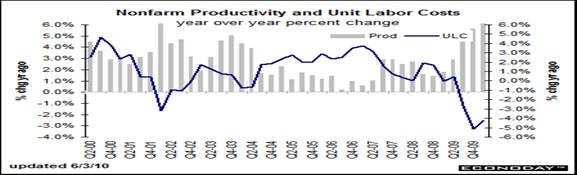
How so? Firstly, productivity is rising faster than wages and salaries. Companies are investing more in technologies than workers, in other words. Year-on-year, productivity advanced 6.1 percent in the first quarter-up from 5.6 percent in the prior quarter. And unit labor costs—both wages and benefits—declined another 4.2 percent, compared to minus 5.1 percent the previous quarter. Output growth was a whopping 4.0 percent annualized, in other words, while hours worked barely budged up to 1.1 percent.

clip_image004
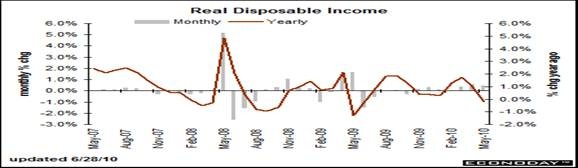
This is while personal income growth is barely rising. It grew just 1.6 percent in May, easing from 2.6 percent in April. Inflation was mixed in May. The headline PCE price index was flat as was also the case the prior month. The core rate, however, firmed to 0.2 percent from 0.1 percent in April.

clip_image006
The result is a basic disparity between income brackets, with the top 10 percent of incomes rising, and the majority of wager and salary earners with no income growth at all.  This is probably the main reason for the ‘new normal’.  Something that New York Times’ columnist Bob Herbert highlighted recently. 

A Yale study showed that more than 20 percent of Americans experienced a 25 percent or more loss in household income without any financial cushion from 1985-95, the highest in 25 years.  This is with our unemployment rate hovering around 9.7 percent. So many more than just the unemployed are suffering from the effects of the Great Recession.  But an income shift is occurring that should aid consumers, and shorten the era of falling incomes of the new normal—expiration of some of the most inequitable Bush II era tax breaks, and restoration of the taxable rates that helped to create a budget surplus during the Clinton era. 

Harlan Green © 2010

Posted in Consumers, Macro Economics, Weekly Financial News | Tagged , , , , | Leave a comment

Is Pent-up Demand Growing?

Financial FAQs

We are now hearing that pent up demand is growing as the economic recovery takes its time. What is it, and what would it mean for an earlier recovery? Fed Chairman Bernanke mentioned that ‘demand’ could grow in a recent speech to South Carolina’s legislators.

“While the support to economic activity from stimulative fiscal policies and firms’ restocking of their inventories will diminish over time, rising demand from households and businesses should help sustain growth…In particular, in the household sector, growth in real consumer spending seems likely to pick up in coming quarters from its recent modest pace, supported by gains in income and improving credit conditions. In the business sector, investment in equipment and software has been increasing rapidly, in part as a result of the deferral of capital outlays during the downturn and the need of many businesses to replace aging equipment.”

Demand usually refers to aggregate demand, a key concept of Keynesian economic theory. The theory being that if consumers, businesses and governments have growing incomes/revenues, then their ‘demand’ for more goods and services will increase. Pent-up demand is comprised of the elements that must grow to stimulate aggregate demand.  This might seem obvious to anyone who has taken Economics 101, but how to measure aggregate demand is not so obvious.

We know several factors that can stimulate demand. For instance, the 2010 Harvard Joint Housing Taskforce Study estimates that 15 million new households will be formed over the next decade, including immigrants. Yet new home growth has slowed drastically. And there are maybe 1 million surplus existing homes, due to the housing collapse. Yet even with the overhang, the demand for housing is bound to grow exponentially over the next decade.

clip_image002

New home sales in June actually rebounded 23.6 percent after plunging a revised 36.7 percent in May. The June pace recovered to an annualized 330,000 from a revised 267,000 for May and revised 422,000 for April. While the comeback is welcome, the bad news is that May’s record drop was revised down notably from the initial estimate of a 33.0 percent decline. The latest figure is down 16.7 percent on a year-ago basis.

Another factor that suppresses demand is deflation. We are now in a deflationary environment, and studies show that consumers hold back from purchases if they believe prices can fall further—which creates a self-fulfilling prophecy. So rising prices will signal increasing demand.

clip_image004

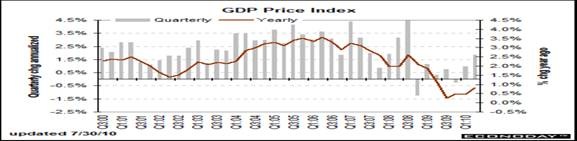
For instance, the just released second quarter Gross Domestic Product report showed falling prices. Though economy-wide inflation accelerated in the second quarter as the GDP price index rose an annualized 1.8 percent, following a 1.0 percent in the first quarter.

The acceleration in prices was due to the impact from higher imports—which signals greater domestic demand. But the price index for gross domestic purchases, which measures prices paid by U.S. residents, increased a bare 0.1 percent annualized in the second quarter, following a 2.1 percent boost in the first quarter. The core rate excluding food and energy prices increased just 0.9 percent in the second quarter, compared with a rise of 1.6 percent in the previous quarter.

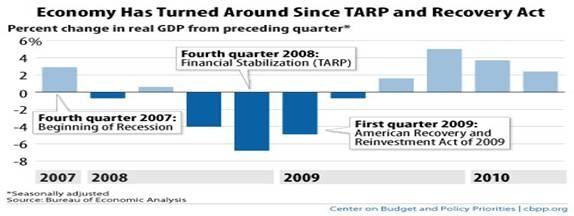
So despite all of the doomsayers, the recovery continued in the second quarter but at a moderate pace. Yes, growth is still below par but not into a double dip, thanks mainly to the TARP and ARRA programs’ stimulus spending. Second quarter GDP came in at an annualized 2.4 percent growth, following a revised first quarter gain of 3.7 percent.

clip_image006

The latest quarter was led by a rebound in residential investment, a jump in investment in equipment & software, and by inventories. Personal Consumption Expenditures also posted a moderate gain along with government purchases.

clip_image008

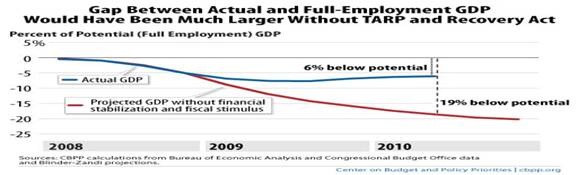
In fact, the best measure of pent-up demand, is what is called the “output gap”.  The San Francisco Federal Reserve puts out that calculation. It was minus 6.1 percent in Q1 2009, but would have been as high as 19 percent without the TARP and ARRA stimulus spending, says the Center for Budget and Policy Priorities (CBPP), a non-partisan think tank.

The output gap measures how far the economy is from its full employment or “potential” level that depends on supply-side factors of the economy: the supply of workers and their productivity. During a boom, economic activity may for a time rise above this potential level and the output gap is positive. During a recession, the economy drops below its potential level and the output gap is negative. In theory, the output gap can play a central role in monetary policy deliberations and strategy.

In fact, one of the goals of the Federal Reserve is to maintain full employment, which corresponds to an output gap of zero. And it is the employment rate that best determines output, so we know that the Fed isn’t going to begin to raise interest rates, until the unemployment rate declines substantially, which means that pent-up demand will begin to kick in.

Was Bernanke being too optimistic? We don’t think so.  Nor does the stock market, which continues to rally.

Harlan Green © 2010

Posted in Consumers, Keynesian economics, Macro Economics, Weekly Financial News | Tagged , , , , , , | Leave a comment

Why Does The Fed Hesitate?

Popular Economics Weekly

Fed Chairman Ben Bernanke just gave his semi-annual report to Congress, and it looks like Bernanke and his Federal Reserve Governors continue to be cautious in advocating more stimulus.  He said that the Fed had more ways to add stimulus but at present no plans to implement them. That is too bad, when a consensus is building that more monetary stimulus is needed to put monies into consumers’ pockets with jobs still hard to find.

Why have the Fed governors been so timid? It has more to do with ideology, than economic fundamentals. Since many of the Fed Governors are former bankers, they dislike debt, and the Fed has had to buy more than $2 trillion in mortgage-backed and Treasury securities to add liquidity to the system. This has kept interest rates at historic lows, but has only begun to bring real estate and job creation out of their doldrums.

Job formation has really been increasing since January, and real estate prices have inched up, but sales remain stagnant. This is while corporations have reported record profits over the last 2 quarters with the highest profit margins since WWII, yet have not been investing in either new plants or employees. Bernanke in his latest Humphrey-Hawkins congressional testimony said that it was because corporations had too much excess capacity, (which means they see insufficient demand for their products and services).

And so government has had to step in to counteract the cash hoarding of some $1.8 trillion being held by the S&P 500 corporations alone, to help stimulate that demand. But why such a fear of debt, when the Great Depression has provided us with a lesson of what needs to be done to counteract such fears?

Nobel economist Paul Krugman has pulled up some of the Great Depression’s history, which shows that the Hoover Administration’s emphasis on reducing deficit spending increased debt as a percentage of GDP, while shrinking actual GDP growth (and revenues). But increased government spending (and debt) during Roosevelt’s New Deal increased economic growth; so though debt loads were high, it brought the U.S. out of the 1929-1933 depression and produced 3 years of growth. The double-dip only returned in 1937, when Roosevelt listened to the bankers and tried to reduce the deficit prematurely.

clip_image002

“The experience of the 30s,” writes Krugman, “offers no support to those who worry about the debt consequences of deficit spending in a depressed economy — FDR didn’t do enough stimulus, but the spending he did do was not reflected in a spiraling, or even rising, debt burden. And the evidence is consistent with the view that austerity, Hoover-style, may well be self-defeating even in a narrow fiscal sense.”

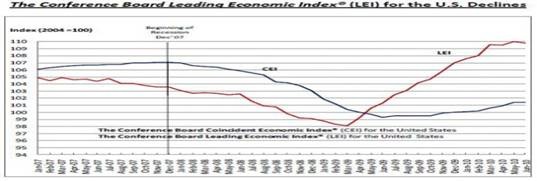
Supporting the present picture is weak growth of the Conference Board’s Index of Leading Economic Indicators, a monthly snapshot of 12 important indicators that affect future growth, such as interest rates, and hours worked.

“The LEI decreased in two of the last three months, but its level is still about 4.5 percent above its previous peak before the recession began,” said Ataman Ozyildirim, economist at the Conference Board. “Moreover, the gains among the LEI components have been widespread, with the exception of housing permits and stock prices, pointing to an expanding economy, but at a slower pace in the second half of the year.”

clip_image004

A major reason for continued sluggish growth is that real estate has still to work off more than 1 million units in excess inventory built up over the bubble years. Total units of housing inventory peaked in 2006, but months of supply didn’t peak until 2008, as the sales’ rate declined drastically during the credit crisis and failure of lending institutions such as Lehman Brothers and Bear Stearns.

clip_image006

This increase in inventory is especially bad news because the reported 8.9 months of supply in June is well above normal.  So there is good reason for the Fed to continue to hold interest rates at record lows, and Chairman Bernanke has continued his promise to do so for “an extended period” in his testimony. “We are ready and we will act if the economy does not continue to improve — if we don’t see the kind of improvements in the labor market that we are hoping for and expecting,” he said.

Harlan Green © 2010

Posted in Macro Economics, Weekly Financial News | Tagged , , , | Leave a comment

Jobs, Jobs, and more Jobs Needed

Financial FAQs

Three new Federal Reserve Governors are up for confirmation that would fill out the Federal Reserve Board of Governors for the first time in years. And what are they saying? Surprise, surprise: “Fed Nominees Stress Job Creation,” was one of the headlines announcing their nomination by President Obama.

That is surprising because the Federal Reserve has since 1980 been fighting the specter (i.e, a ghost or phantom image, per Webster) of inflation. This is even though it has a twin mandate—promote growth (and jobs) while maintaining a stable currency (read low inflation rate). The two have come in conflict in the past, as when 1980 Fed Governor Paul Volcker raised the Fed Funds rate to 18.9 percent to dry out the double-digit inflation of the 1970s, causing two successive recessions (1981 and 1982).

And fighting inflation has had the upper hand ever since, which has resulted in the Fed raising interest rates at the drop of a hat, such as happened in 1994 that caused the Orange County bankruptcy, and job formation to suffer. The results are that job creation after the 1991 and 2001 recessions is the lowest on record.

Stanford economist Robert Hall, Chairman of the NBER business cycle dating committee, has attempted to explain why those two so-called modern recessions differed from the past, but comes up with no conclusive answer. “The facts are perplexing,” writes Hall in a recent Stanford paper, “employment falls at least as far as in past recessions, without identifiable driving forces.”

But Nobelist Paul Krugman has an answer in his blog. It is called demand-side (vs. supply-side) economic policies that have not been adequately utilized.

“One vision, which is the one I subscribe to, is basically an updated Keynesian view: sticky prices revised gradually based on unemployment and excess capacity, the possibility of persistent economic malfunction because people are trying to hoard cash rather than buying real goods. And this view also said that we were and are in a liquidity trap, in which things that might have been inflationary under other conditions — like a large expansion of the monetary base — weren’t at all inflationary under current conditions. In fact, the likely outlook was for falling inflation, and possibly deflation.

“The other vision was basically a crude quantity theory of money view: hey, the Fed is printing money, the government is running deficits, so high inflation, maybe even hyperinflation, is staring us in the face.”

“Sticky prices” refers to the theory that prices are slow to adjust downward during recessions. But that doesn’t mean that disinflationary, or even deflationary forces are not at work. And once they do begin to adjust downward in a sustained way, watch out. Profits and then wages are sure follow, resulting in a downward spiral of incomes and jobs.

“The past year has, in effect, been a fairly clean test of these two views,” says Krugman. “And what has happened has been very much what people like me said would happen: in the face of persistent high unemployment, inflation has fallen despite all that money creation, and interest rates have stayed low despite those budget deficits. If you bet on inflation and rising rates — which, by the way, Eric Cantor, the Republican House whip, did — you lost a lot of money.”

Yet in spite of this history, the Fed is still reluctant to add more stimulus to monetary policy. It has stopped buying mortgage backed securities (though interest rates are still at record lows) in a bid to boost real estate, and stated it is basically standing pat on monetary policy in its latest FOMC meeting.

Krugman thinks this is wrong-headed thinking. The latest Federal Reserve growth projections see core PCE inflation rising 1.2 to 1.6 percent through 2010, well within its stated target range of 1-2 percent. “I have no idea why Fed presidents expect core inflation to rise over the next two years,” he said. “Historically, high unemployment has been associated with falling, not rising inflation. In fact, my bet is that we will be near or into deflation by 2012. But even given the Fed’s own projections, it’s not doing its job, it’s missing its targets. Yet it apparently sees no need to act.”

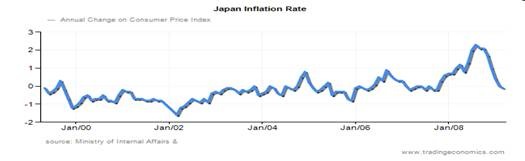
Hence the Obama Federal Reserve appointees emphasis on job creation, rather than fighting inflation. The inflation numbers bear this out. We are approaching the danger zone of deflation, resulting in a vicious downward spiral of prices with stagnant growth, or stagdeflation, if you will.

clip_image002

Lower energy costs tugged down on the consumer price index in June, resulting in a third consecutive decline in the headline number. In June overall CPI inflation dipped 0.1 percent, following a 0.2 percent decline in May. The latest month matched the market projection for a 0.1 percent decline. Excluding food and energy, the CPI edged up to 0.2 percent after a 0.1 percent uptick in May.

Why the probability of deflation, when the economy seems to be recovering, with GDP growth positive over the last 3 quarters? The Japanese experience of deflation for 2 decades that set back their economic growth (and position in the world) is the best example. It portrayed the classic liquidity trap. No matter how much money was created by its central bank, investors and consumers refused to spend it. And so once the deflationary spiral downward began, it took decades to arrest. Their central bank did not react quickly enough to the bursting of both stock market and real estate bubbles that had reached record highs in 1990-01.

clip_image004

The problem by Japanese economist Richard Koo is that this is a ‘balance sheet’ recession. I.e., so much U.S. debt was piled up in the last decade with 2 wars and tax cuts to pay for, that both consumers and government must bring their balance sheets back into balance before what is called aggregate demand increases substantially.

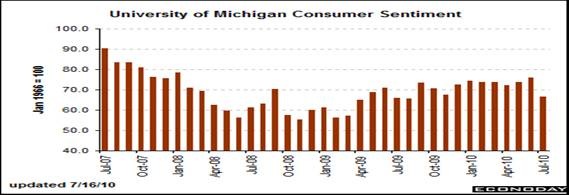
The U. of Michigan had a record plunge in its sentiment survey, as if to emphasize the precariousness of consumers’ balance sheets. The economic recovery is slowing and consumer spirits are falling. Consumer sentiment literally plunged in the mid-July reading, down nearly 10 points to a 66.5 reading that pushes this index back to the lows of last year. Both the expectations and current-conditions components show roughly 10 point drops.

clip_image006

Even the minutes to the Federal Reserve’s last FOMC meeting emphasized the fragility of this recover. Fed officials noted that “the committee would need to consider whether further policy stimulus might become appropriate if the outlook were to worsen appreciably,” according to the minutes. So emphasizing jobs formation is a must for the Fed’s monetary policy.

Harlan Green © 2010

Posted in Keynesian economics, Macro Economics, Weekly Financial News | Tagged , , , , | Leave a comment

Where is Harry Truman—Part II?

Popular Economics Weekly

What is the case for not providing more additional stimulus spending to boost economic growth? Harvard Econ Prof Gregory Mankiw, former Bush White House economic advisor, gave this rather bizarre prediction for the future behavior of employers on his Blog. It seems that more stimulus spending creates more debt, ergo raises the prospect of higher taxes.

So, “businesses may be reluctant to invest in an economy that they expect to be distorted by historically unprecedented levels of taxation in the future,” he says.  “The more the government borrows, the higher taxes will need to go, the more distorted the future economy will be, and the less attractive is investment today.”

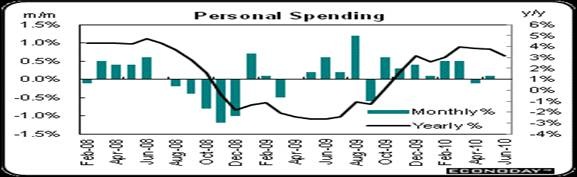
Yes, it is true that debt levels figure into both investment and spending decisions, but no one has been able to quantify how much. Consumers, for instance, are still paying down debt in record amounts. So much so that the personal savings rate has risen to 4 percent, from zero in the past decade. But consumer spending has also ramped up to almost 4 percent, which means incomes are increasing. Therefore, it doesn’t look like anyone is yet worried about higher future taxes.

clip_image002

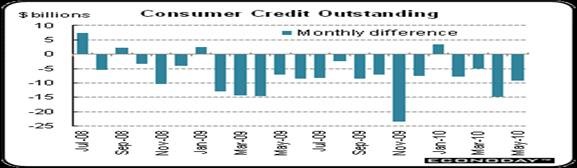
Consumer credit contracted a sharp $9.1 billion in May with April revised to show an even more severe $14.9 billion contraction, as we said last week. Revolving credit contracted $7.4 billion and contracted $8.3 billion in April. Non-revolving credit shows a $1.8 billion contraction in May on top of a $6.5 billion contraction in April. Neither category is likely to show much improvement in June given indications from retail sales and last week’s soft unit vehicle sales.

So, what’s going on—are consumers retrenching?  That might be part of the story.  Outstanding consumer credit can decline either due to consumers paying balances down or because banks and finance companies are charging off bad credit. But the charge offs are actually a positive for consumer spending—more discretionary income is freed.  The big picture is that the consumer is still cautious, says Econoday.

So why would such a reputable economist as Dr. Mankiw advance an unproved hypothesis? Some of it has to do with discredited economic theories that say our economy is a zero-sum game. When the government spends money, it takes away investment from the private sector. Households seem to operate that way, for instance. There is only so much money to go around, right?

But what happens when businesses hoard their cash, as they are doing now? The $1.8 trillion being held by the S&P 500 largest corporations are not being used—either in R&D that would create future products and services, studies show, or increasing their production capacity.

And so economic activity stagnates. Money sits at basically zero interest, earning zero returns—unless government steps in to borrow that money to directly create jobs, as it has been doing in green technologies, or to retain jobs with infrastructure investments.

That is the real debate. Conservatives want government to shrink spending, in order to shrink the amount of debt. This is because too much debt devalues the debts of creditors, which mostly reside on Wall Street. Whereas Keynesian economists believe in stimulating demand by putting more money into consumers’ hands that will stimulate more revenues going into the coffers of both government and private industry.

clip_image004

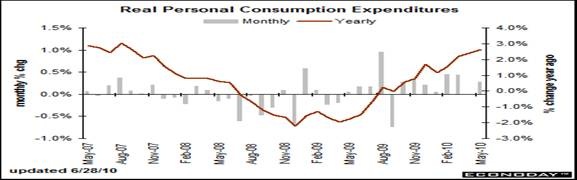
Year on year, personal income growth for May posted at 1.6 percent, easing from 2.6 percent in April. It became positive again in July 2009, at the end of the Great Recession. Year-ago headline PCE inflation edged down to 1.9 percent from 2.0 percent. Year-ago core PCE inflation firmed down to 1.3 percent from 1.2 percent in April. Falling prices might be the reason consumers remain cautious buyers.

But overall, the consumer sector is slowly gaining strength in terms of spending power, thanks in large part to government stimulus programs. Purchases have been a little erratic due to off and on auto and home buying incentives. But the consumer sector took one step forward in May, helping the recovery continue.

So what is the lesson from “give ‘em hell, Harry” that we asked last week? Econ Professor and columnist Paul Krugman thinks most who oppose government stimulus oppose government in general. President Truman believed in the New Deal, and the need for government support during tough economic times.

Those who worry about too much debt are worrying about the wrong debt. Stimulus spending creates short term debt that will come down when economic activity picks up. But longer term debt that will be carried by future generations comes from entitlements like social security and Medicare, which are projected to grow exponentially with retiring baby boomers. How to pay for those entitlements is a decision which should be faced by the present generation, rather than passed on to their children and grandchildren.

Harlan Green © 2010

Posted in Consumers, Keynesian economics, Weekly Financial News | Tagged , , , , , | Leave a comment

Housing Affordability Still Improving

The Mortgage Corner

A very pessimistic Harvard University Joint Center for Housing Studies’ 2010 annual report says with the job market in dire straits, household incomes declining and foreclosures dragging down home values, the housing market may take years to recover. But the Harvard study is already outdated. Affordability is much better in 2010, and jobs and incomes have improved substantially.

The Harvard study says affordability is still a problem because household incomes have been falling; though not as much as housing prices. Calculate in record low interest rates that are forecasted to last at least through 2011, and we see that affordability is in fact very high. The good news is that prices have fallen up to 50 percent in some regions since 2008, while household median income has fallen about 6 percent.

“Very low mortgage interest rates and recovering labor markets, however, should be enough to shore up sales and housing starts once an expected dip due to the expiration of the federal homebuyer tax credit passes. “If history is a guide, what happens with jobs will matter the most to the strength of the housing rebound,” says Eric S. Belsky, Executive Director of the Joint Center for Housing Studies. “Right now, economists expect the unemployment rate to stay high, but if employment growth surprises on the upside or downside, housing numbers could too.”

In fact, the National Association of Realtors (NAR) reports that the median existing-home price has actually risen 6 percent in 2010, while the median household income is hovering around $60,500. This has kept the NAR’s affordability index at 167 percent—a family with a median income can afford 167 percent of a median priced home. Whereas, it was as low as 115 percent in 2005 when housing prices were in bubble territory (and interest rates were 1.5 percent higher).

Consumers are paying down their debts, in part because of high mortgage debt levels. The year-over-year debt to household income measure that includes mortgage debt has fallen from 23.5 to 21.5 percent, while total outstanding credit is still contracting at slightly less then 4 percent per year, as we said last week.

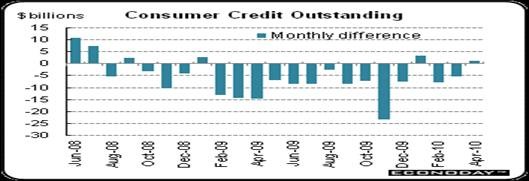
Consumer credit rose $1.0 billion in April in a gain far offset by a $7.4 billion downward revision to March which now shows a $5.4 billion contraction. Non-revolving credit, reflecting strong car sales, jumped $9.4 billion in April but was offset by a nearly as large of a fall in revolving credit. The drop in revolving credit reflects consumers’ reluctance to buy non-essential items.

.

clip_image002

What were consumers buying in May? Gasoline led the way because of higher gas prices, but the trend in overall sales is upward and healthy—in spite of the May decline.  Overall retail sales on a year-ago basis in May came in at 6.9 percent compared to 9.0 percent the month before.  Excluding motor vehicles, the year-on-year rate slipped to 6.1 percent from 7.8 percent in April. 

clip_image004

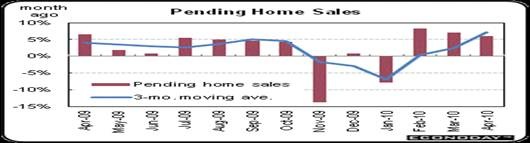
The other pleasant surprise was the continued rise in pending home sales. Already, February and March had spiked with help from last minute buyers wanting to ensure time to close before May 1. But apparently, many buyers decided to push their luck and buy during April in hopes of expedited paperwork by mortgage lenders. Pending home sales extended their surge through April, jumping 6.0 percent, following a 7.1 percent spike in March.  Year-on-year, pending home sales are up 22.4 percent.

clip_image006

The Harvard study seemed to concentrate on the bad news—an estimated one in seven homeowners has a home worth less than they owe on their mortgage, and 5 million need their home price to rebound by 25 percent before they are again above water. But there are more than 45 million outstanding home loans, and the inventory excess is in fact making home ownership more affordable—for those who can afford to buy.

Harlan Green © 2010

Posted in Consumers, Weekly Financial News | Tagged , , , | Leave a comment

Economic Interdependence Is Good

How interdependent we have become! The lessons of this recession and the ongoing recovery, is that going it alone won’t work—whether when drilling oil wells, or evading financial regulations. We even have to thank our dependence on foreign trade with Asia, and our government-aided auto industry, for what is leading this recovery—the manufacturing sector.

Economic interdependence is becoming the norm in this decade—private industry (via innovation) and governments (via regulation) are becoming more interdependent. One can no longer exist without the other. And what affects one sector now affects the overall economy.

The bursting housing bubble almost caused the worldwide collapse of the financial system because financial markets are now interconnected. The BP Gulf oil disaster is an example of nature’s interconnectedness. A toxic spill has become toxic to all states in the Gulf region.

Overall industrial production in May surged 1.2 percent, following a 0.7 percent boost the month before. The latest number was stronger than the consensus forecast for 1.0 percent. Manufacturing has been robust over the last three months with this component gaining 0.9 percent in the two latest months and jumping 1.2 percent in March.

clip_image002

A jump in motor vehicle production also added significantly to May’s overall production boost. Motor vehicle production jumped 5.5 percent, following a 1.4 percent dip in April. Nonetheless, gains were widespread in other industries, with business equipment up 1.3 percent, and consumer goods up 1.2 percent. Industrial production improved to 7.6 percent from 5.2 percent in April on a year-over-year basis.

The housing bubble has been a leading lesson in the recognition that housing is closely connected with other sectors; such as insurance, construction and finance.

And the construction industry is beginning to recover, a good sign for real estate. Expiring special tax credits for homebuyers and the recent surge in home sales have carried over to unexpected strength in construction activity. Apparently, this has cut into new home inventories enough to give homebuilders confidence to bump up the pace of new construction. However, gains are coming off low levels.

clip_image004

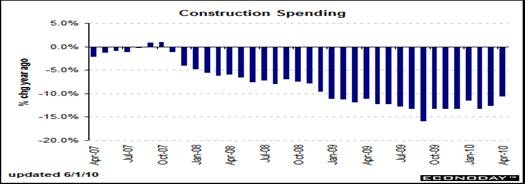
Construction outlays in April surged 2.7 percent, following a 0.4 percent rebound the month before, and rose to minus 10.5 percent in April from minus 12.5 percent in March, year-over-year. The April boost was led by a jump in private residential outlays which gained 4.4 percent after no change the prior month. Public outlays increased 2.4 percent in the latest month while private nonresidential construction rebounded 1.7 percent.

Lastly, and not so obvious, was the housing bubble’s effect on consumer confidence. It was probably a cascade effect—housing burst, then credit, which stopped both consumers and investors from borrowing. This resulted in the greatest credit contraction since WWII and the Great Depression that has now lasted 20 months.

clip_image006

Consumers appear to be focusing specifically on the health of the U.S. economy—shrugging off sovereign debt worries in Europe and the recent drop in stocks.  The Reuters/University of Michigan Consumer Sentiment Index rose to 75.5 in the mid-June reading versus 73.6 for the final reading of May. The nearly two-point gain was sizable and put the index at its best level since the January 2008 figure of 78.4.

There is a pent-up demand for housing. The Harvard Joint Housing study estimates 15 million new households will be formed in this decade 2010-2020. But there is uncertainty whether more will rent than own. Home ownership could also be a casualty of the housing bust, in other words. But that won’t hurt construction, as the latest housing starts numbers showed a big jump in rental construction (33 percent) vs. a 10 percent drop in single family housing starts.

Harlan Green © 2010

Posted in Macro Economics, Weekly Financial News | Tagged , , , | Leave a comment

May Employment Shows Sustainable Recovery

Popular Economics Weekly

The headline number for payrolls in May was disappointing, according to the media, because of anemic growth in the private sector. But in fact it is leading to a more sustainable recovery. Most were temp help workers hired for the U.S. Census, but this will lead to more permanent jobs as overall production continues to increase. Overall payroll jobs in May surged 431,000, following a 290,000 boost in April, and a 208,000 gain in March.

clip_image002

The positive news in the payroll survey was in earnings, the workweek, and production hours. Wages picked up with a 0.3 percent rise in May, following a 0.1 percent advance the month before. The average workweek for all workers edged up to 34.2 hours from 34.1 hours in April. Production hours overall advanced 0.3 percent in May after a 0.4 percent rise the month before. For manufacturing, the improvement was even more notable with a 1.1 percent jump after a 0.8 percent gain in April.

clip_image004

Year-on-year, labor productivity has soared, the 6.1 percent increase in the first quarter-up from 5.6 percent in the prior quarter, which means very healthy economic growth with almost no inflation worries. It is a major gauge of future inflation because wage costs, which account for two-thirds of product costs, are barely rising.

clip_image006

Manufacturing hiring is also robust. Growth in new orders and employment highlighted another very strong ISM manufacturing report in May. New orders held steady at 65.7, a reading well over breakeven 50 and the third in a row over 60. Employment index was last above 60 back in May in 2004. May’s reading came in at 59.8 for a 1.3 point gain to indicate significant acceleration in hiring.

In a sign that employers are hiring more permanent workers, the number of persons employed part time for economic reasons (some-times referred to as involuntary part-time workers) declined by 343,000 in May to 8.8 million. These individuals were working part time because their hours had been cut back or because they were unable to find a full-time job. This decline was more good news. The all time record of 9.24 million was set in October.

clip_image008

The unemployment rate decreased to 9.7 percent, and the lower number of part time workers (for economic reasons) helped to push down the total unemployed U-6 labor category to 16.6 percent (from 17.1 percent), which is still a large number.

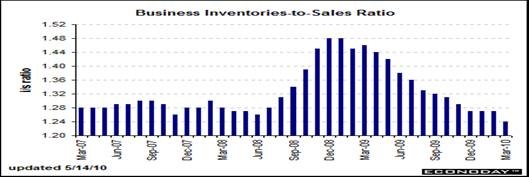
But the ultimate sign of a sustained recovery is a declining inventories-to-sales ratio, which signals that pent-up demand is growing; which is why production is growing, employers are hiring again.

clip_image010

And key sectors of the economy are lining up together in what hopefully will be a sustained cycle of inventory replenishment. Business inventories rose 0.4 percent in March on top of a 0.5 percent gain in February and a smaller gain in January. In what is especially good news, its components show nearly uniform increases in March: manufacturers up 0.3 percent, retailers up 0.4 percent, wholesalers up 0.4 percent. In fact, we are already in a sustainable recovery.

Harlan Green © 2010

Posted in Consumers, Weekly Financial News | Tagged , , , | Leave a comment