Antonin Scalia’s White, Male Legacy

Answering Kennedy’s Call

Supreme Court Justice Antonin Scalia’s passing is a shock to die-hard conservatives for good reason. He was the bastion and spokesperson of the originalist interpretation of the Constitution, which meant any law had to divine the original intentions of the founding white male fathers of our nation.

AK-47

The two students and two teachers at Appalachee High School were killed by a 14-year old student with an AR-15 assault rifle has brought back the debate on the causes of such gun violence than kills more than 30,000 Americans every year.

Wednesday’s mass shooting marked the 45th school shooting of 2024 and the deadliest US school shooting since the March 2023 massacre at The Covenant School in Nashville,” said CNN.

Military-style assault rifles had been banned for 10 years during the Clinton administration, but the Republican-led Bush administration didn’t renew the ban. Why? One man, SCOTUS Justice Antonin Scalia, was almost solely responsible for the Supreme Court ruling that legalized assault rifles for use by common citizens.

I wrote about it in Huffington Post at the time of Scalia’s death in 2016.

“Supreme Court Justice Antonin Scalia’s passing is a shock to die-hard conservatives for good reason. He was the bastion and spokesperson of the originalist interpretation of the Constitution, which meant any law had to divine the original intentions of the slave-owning, landowning, founding white male fathers of our nation, which excluded women and non-landowning males (and slaves, of course) from representation.”

So that meant turning the clock back at least one century to a time when the white male patriarchy still ruled, which was a much less democratic time. Scalia’s most noted opinion was to expand Second Amendment gun owners’ rights, which ‘protected’ every citizen’s right to own a gun almost without restriction, because he convinced the majority of SCOTUS that the Second Amendment right to bear arms also protected an individual’s right of self-defense.

The result has been record gun sales and gun deaths (30,000+ per year), as well as mass shootings, and no limit to the purchase of military-style assault rifles with unlimited magazines. Another little-noted result was the higher incidence of gun violence in households with guns, according to the Law Center to Prevent Gun Violence.

In fact, “Research published in the New England Journal of Medicine found that living in a home where guns are kept increased an individual’s risk of death by homicide by between 40 and 170 percent,” said the Law Center. “Another study published in the American Journal of Epidemiology similarly found that “persons with guns in the home were at greater risk of dying from a homicide in the home than those without guns in the home.”

This study determined that the presence of guns in the home increased an individual’s risk of death by homicide by 90 percent.

Whereas other developed countries without that Second Amendment ‘right’, such as Australia, do not allow the purchase of a gun for self-defense to be a sufficient reason for owning such a weapon. And Australia has not had a single incidence of mass shootings since 1996 and the passing of its gun control legislation.

Does it make sense for anyone to own a military-style assault rifle for self-defense when it was manufactured for wartime? The definition of the word, assault, means just that. It was made to assault an enemy during wartime. What purpose could it have in a home, even as a semi-automatic—where children live?

Harlan Green © 2024

Harlan Green on Twitter: https://twitter.com/HarlanGreen

Posted in gun violence | Leave a comment

Economy Has Landed–Part II

Popular Economics Weekly

Fed Chairman Powell finally admitted the U.S. economy has made a soft landing at this year’s Jackson Hole Federal Reserve Conference. “The labor market is no longer overheated, and conditions are now less tight than those that prevailed before the pandemic,” he said in his speech. 

FREDunemployment

It’s a very soft landing. The unemployment rate dropped back to 4.2 percent from 4.3 percent in July and just 142,000 nonfarm payroll jobs were created in August. U.S. job gains in July were also lowered to 89,000 from 114,000, and in June revised down to 118,000 from 179,000.

The Fed is now playing catchup in the opposite direction. They waited too long to begin to restrict credit when the inflation rate first shot up in 2020 and perhaps waited too long to cut interest rates, since the downward momentum of lower job creation has begun.

This doesn’t mean a looming recession, however. It’s possible that third quarter economic growth will remain positive. Most estimates for Q3 growth are in the 2 percent range, down from the 3 percent Q2 GDP growth rate.

The Atlanta Fed estimate of Q3 growth said, “The GDPNow model estimate for real GDP growth (seasonally adjusted annual rate) in the third quarter of 2024 is 2.1 percent on September 4, up from 2.0 percent on September 3,” because consumer spending has slowed but there was an increase in domestic investment.

The New York Fed’s ‘Nowcast’ growth estimate for Q3 is 2.6%.

The Fed’s tools to ‘brake’ inflation have always been crude since they must look in the rearview mirror for data to buttress their policies. They must convince the financial markets as well as the public that their moves are credible with data that measures past months to spot trends—mainly consumer spending and employment.

Better news is that the so-called yield curve (the relation of 2-year bond yields to 10-year bond yields) is no longer inverted. The 2-year bond yield has plunged to 3.67% and 10-year bond yield is 3.87% at this writing.

It has been a credible recession indicator when yields are inverted because banks can’t lend at a lower rate than their cost of money.

The yield curve is steepening again, in other words, because conditions are looking better for investors so that longer-term yields are higher than short-term bond yields, which is where they should be in more normal times.

Consumers must now adjust as well—and save a bit more for any future uncertainties. But they are still solvent and fully employed. And the fact that the Fed is now poised to loosen the credit tourniquet that has stifled growth in many sectors (such as housing and manufacturing) should mean several years of rising prosperity for most Americans.

Harlan Green © 2024

Follow Harlan Green on Twitter: https://twitter.com/HarlanGreen

Posted in Consumers, COVID-19, Economy, Housing, Weekly Financial News | Leave a comment

Why No Recession?

Financial FAQs

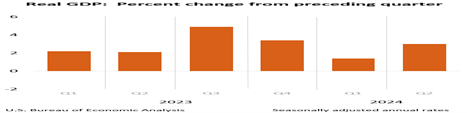
I said last month we know why the US economy is still growing. Consumers keep spending, and the unemployment rate, though rising, is just 4.2 percent. The second revision of second quarter economic growth confirms this as well, jumping from 2.4 to a 3.0 percent growth rate.

But the downward revision of -818,000 nonfarm payroll jobs by the BLS from March 2023 to March 2024 showed not as many jobs were created as originally estimated, and it has begun to panic the financial markets.

And if consumers don’t keep spending where they spend the most—leisure and healthcare—what will keep US from a recession? It’s government spending via Bidenomics, President Biden’s legislation to modernize the economy. We should ignore the protests from conservatives of too much government spending and too much public debt for the moment. It’s what is keeping us at full employment.

Paul Krugman opined earlier in the year on the particulars of President Biden’s ‘New’ New Deal legislation, which is investing as much in the US economy as Roosevelt’s New Deal.

“The fact, however, is that Biden has put in place a very ambitious agenda — major enhancements of Obamacare, student debt relief, big infrastructure spending, large-scale promotion of semiconductors and green energy that have led to a surge in manufacturing investment.”

FREDmanfacturing

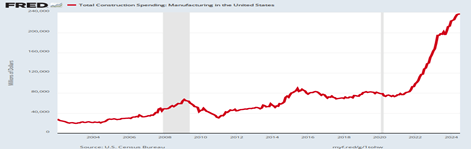
It has led to a very big jump in Manufacturing investment, for starters, that is creating more high-paying jobs—800,000 manufacturing jobs to date. Although overall manufacturing activity has been shrinking per the latest surveys—even with investments in the construction of new Manufacturing facilities having soared from $78 billion in 2020 to $237 billion this July—it should means better days ahead for the manufacturing sector.

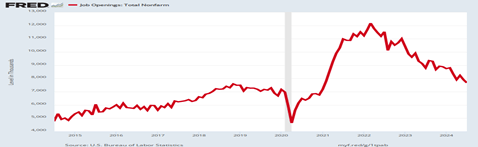
This is important because July’s BLS Job Openings and Labor Turnover Survey (JOLTS) report shows a weakening labor market. The number of job openings dropped to 7.7 million from its high of 11 million openings in 2022 as the economy rushed to recover from the COVID-19 pandemic. (That’s still a lot of jobs looking for workers.)

The number of job openings decreased in health care and social assistance (-187,000); state and local government, excluding education (-101,000); and transportation, warehousing, and utilities (-88,000). Job openings increased in professional and business services (+178,000) and in federal government (+28,000).

BLS.gov

This is further evidence that growth will continue and perhaps keep consumers shopping for bargains, which is why inflation and rising prices should no longer be a problem, even as the Fed begins to cut interest rates this month.

Consumer confidence is rising again as well, which should help sustain the rally, as consumers seem to be worrying less about their job, per the Conference Board survey, even though personal savings have declined to dangerous lows.

“The Conference Board Consumer Confidence Index® rose in August to 103.3 (1985=100), from an upwardly revised 101.9 in July. The Present Situation Index—based on consumers’ assessment of current business and labor market conditions—improved to 134.4 from 133.1 in July.”

So we still depend on consumers to carry most of the load to sustain the strong growth, but government has to give a hand to keep them “in the game,” as I’ve been saying.

We will know more come Friday’s unemployment report.

Harlan Green © 2024

Harlan Green on Twitter: https://twitter.com/HarlanGreen

Posted in Consumers, COVID-19, Economy, Weekly Financial News | Tagged , , , , , | Leave a comment

Consumers Barely Solvent

Financial FAQs

I said last month we know why the US economy is still growing. Consumers have kept spending. The second revision of second quarter economic growth confirmed this when Gross Domestic Product growth jumped from 2.4 to 3.0 percent!

BEA.gov

“Real gross domestic product (GDP) increased at an annual rate of 3.0 percent in the second quarter of 2024, according to the “second” estimate. In the first quarter, real GDP increased 1.4 percent.”

This is huge, but the question remains just how much longer consumers can ‘stay in the game’ before their chips run out, to parrot a well-known remark Roosevelt’s Fed Chairman Marriner Eccles made in testimony during the Great Depression.

Consumer spending was revised up to a 2.9% rate from the initial estimate of a 2.3% gain in the report. Whereas spending was up 1.5% in the first three months of the year, and such activity accounts for two-thirds of US economic activity these days. So, it’s extremely important to track how long they can continue to spend, as well as save.

Consumer confidence is rising again, which should help sustain the rally, as consumers seem to be worrying less about their job, per the Conference Board, even though personal savings have declined to dangerous lows.

“The Conference Board Consumer Confidence Index® rose in August to 103.3 (1985=100), from an upwardly revised 101.9 in July. The Present Situation Index—based on consumers’ assessment of current business and labor market conditions—improved to 134.4 from 133.1 in July.”

That’s a small improvement, but far below the 120 to 130 pt. index range prior to the pandemic. It says consumers are still shaking off the effects of the pandemic, for starters.

One reason for their uncertainty is household incomes have fluctuated wildly for decades due to the various recessions. Household income growth plunged to -0.1% at the beginning of the COVID-19 pandemic and was only back up to its +5% pre-pandemic highs in 2022, the last year it was calculated.

Household incomes have barely kept up with inflation, in other words, never able to get ahead of the longer term 2% average inflation rate that has prevailed since the Great Recession.

This in fact highlights the dangers consumers face going forward. They continue to borrow heavily, even with historic high interest rates, to ‘stay in the game’ to maintain their current lifestyles.

BEA.gov

Their personal savings rate has just plunged from 3.4 percent to 2.9 percent, according to the BEA. It was lower only once since 1960—to 1.4 percent in July 2005 during the housing bubble and runup to the Great Recession.

Is there any reason to believe things will improve for the majority, when the Fed does cut interest rates? There have been recommendations, such as the child tax credit that both parties want to reinstitute; also lowering taxes on middle incomes and raising it for corporations and the wealthiest; as well as taxing the earnings of hedge fund managers managing $trillions in public monies.

Let us see if more of the economic pie will be distributed to those that have no savings left. Otherwise, we already know what happens when consumers can no longer stay in the game and their chips run out.

Harlan Green © 2024

Harlan Green on Twitter: https://twitter.com/HarlanGreen

Posted in Consumers, COVID-19, Economy, Politics, Weekly Financial News | Leave a comment

When Will Housing Recover–Part II

The Mortgage Corner

Federal Reserve Chair Powell has said the Fed is about to cut interest rates, so I’ve been wondering if the housing industry can come out of its self-made recession?

One good sign is that existing-home sales ticked up for the first time in July, after falling steadily since the recent annual rate high of 4.4 million in February 2024.

The NAR said, “Total existing-home sales[1] – completed transactions that include single-family homes, townhomes, condominiums and co-ops – ascended 1.3% from June to a seasonally adjusted annual rate of 3.95 million in July.” (But) Year-over-year, sales fell 2.5% (down from 4.05 million in July 2023), so that’s not much of an improvement.

This could be the beginning of an upward trend in overall sales, but the question now is not so much about mortgage rates, which will help sales and affordability, but an adequate housing supply to get sales back to the 4-5 million sales that prevailed in decades past and kept a much higher supply of for sale housing on the market.

Cutting interest rates is a start but the building industry for various reasons has been reluctant to build enough new homes for decades—ever since the Great Recession of 2008-09 and busted housing bubble.

This is just one of the ways Americans have been paying for the excesses of the Great Recession since then. The housing shortage may be its most pernicious result.

Calculated Risk

Calculated Risk’s graph of existing sales portrays the damage done by the Great Recession (middle gray bar in graph). Sales had reached a 7 million annual rate in 2005 at the height of the housing bubble, then plunged to 4 million units during the Great Recession and slowly rose to more than 5 million units annually until the COVID-19 pandemic.

More than one million excess units were built during the bubble, as Greenspan’s Federal Reserve attempted to goose sales any way they could to stimulate slowing economic growth while the Bush administration was fighting the Iraq and Afghanistan wars on terror.

The housing supply should be improving in anticipation of the Fed’s rate cuts that would bring down the cost of everything that goes into building new homes.

Sales of newly built homes in the U.S. just increased 10.6% in July to an annual rate of 739,000, up from a revised 668,000 in the prior month, the Commerce Department reported Friday. It was the highest sales rate in more than one year.

For-sale inventories have also edged up some 40 percent this year, as existing homeowners now see a chance to either move to a smaller unit, or into a retirement home now that mortgage rates are declining..

We still have a housing shortage of somewhere between 1-3 million residential dwellings, including owner-occupied and rental units, without considering housing for the homeless.

Another culprit of the housing shortage has been lenders that have become more conservative since the housing bubble. A credit score of 680 was acceptable to Fannie and Freddie for their best conventional mortgage rates prior to the Great Recession, whereas it is above 720 today, which means fewer home buyers are eligible for good loans.

It is really the Fed’s job to require banks to ease their credit standards in this case. Its inaction has only made matters worse for homebuyers (and therefore renters) with the housing shortage.

Now that Chairman Powell just announced that rate cuts are in the works—probably to begin at the Fed’s September FOMC meeting—they should use some of the other tools within their powers—such as requiring more affordable loan programs for entry-level homebuyers, as well as easing banks’ credit standards.

“The time has come for policy to adjust. The direction of travel is clear,” Powell said in his speech to the central bank’s summer retreat in Jackson Hole.

Let’s see if Powell means what he says and the Fed really wants to help cure the housing shortage.

Harlan Green © 2024

Follow Harlan Green on Twitter: https://twitter.com/HarlanGreen

Posted in Consumers, COVID-19, Economy, Housing, housing market, Weekly Financial News | Leave a comment

Equality Is Good for Everyone!

Answering Kennedy’s Call

Vice Presidential candidate Kamala Harris made a promise at this year’s Democratic Convention. She would create programs that give every American the opportunity to better themselves.

“I see an America where we hold fast to the fearless belief that built our nation and inspired the world. That here, in this country, anything is possible. That nothing is out of reach. An America where we care for one another, look out for one another and recognize that we have so much more in common than what separates us. That none of us — none of us has to fail for all of us to succeed.”

Equal opportunity hasn’t been available to many Americans, even though it is part of the American Dream—America is the land of opportunity that is taught in schools and heard by immigrants.

Why? Because it is also part of a larger truism that not all Americans have accepted: Equality Is good for everyone. It should be self-evident, a statement of common sense. The more equality of opportunity among us, the more we can better ourselves, become more productive citizens, which in turn increases our national wealth (and lowers budget deficits).

It was certainly the dream of immigrants, such as my mother, a British citizen born in Jamaica.

But there are times, such as today, when many Americans don’t believe it is possible, which is why we are living in another Gilded Age with the worst income inequality of the developed world. It is on a par with developing countries in Africa and has been the major cause of recessions, including the Great Recession.

Many have bought the counter narrative by those that don’t like equality, the privileged few at the top of the income ladder who want us to believe they are the most qualified to create greater wealth for the rest of us.

This Gilded Age was formed from supply-side, trickle-down economic policies, because enough Americans believed it, believed government was the problem and cutting taxes the solution, believed that equality is not good for everyone because we live in a zero-sum world with limited resources. What is given to one must be taken from another.

The conservative position espoused by 1970s Economist Arthur Okun, for instance, was that greater equality meant less market efficiencies to produce and so fewer incentives for greater wealth, since leveling the playing field meant leveling out the opportunity for large profits. 

But that has never been the case. There has always been copious evidence that the opposite is true; that overly large profits have led to diminished household wealth.

One can measure inequality with such as the CIA’s World Factbook that ranks inequality among nations. Those with the greatest equality also have less violence, greater freedoms, greater health, and guaranteed vacations!

Richard Wilkinson’s TEDx lecture and book with Kate Pickett, “The Spirit Level” is one of the best studies of the dire effects of income inequality on the quality of life. The most important factor, and a sign of dire consequences when inequality has approached the level of the Great Depression, are the US violent crime and incarceration rates, which Wilkinson discusses at length. The U.S. is by far the most violent country in the world—worse than any other developed country with the highest incarceration rates.

Efforts to reverse such inequality have begun on the local levels, even if congressional conservatives have blocked raising the miniscule national minimum wage of $7.25 per hour.

I wrote in 2011 that the state of Massachusetts was the first to raise their minimum wage to $10 per hour, California is raising it to $8.25 over 2 years, with New Jersey and other states to follow. It was the beginning of a return to greater equality that has continued.

And there is an increasing awareness of the income disparities, such as the fact that corporate CEOs now earn more than 300 times the income of their employees, and certain hedge fund managers have reported an annual income of $1 billion.

The Center for American Progress launched the Washington Center For Equitable Growth, which aims to deepen the economic critique of inequality. It was set up by Berkeley economist Emmanuel Saez, among others, who is known with his partner Thomas Piketty as the first economists to historically research the history of income distribution over the past 100 years.

The mission statement of the Center explains why it is needed:

“New research suggests that growing inequality in the United States may have broad social and economic effects — by reducing stable demand for goods and services, dampening entrepreneurialism, undermining the inclusiveness and responsiveness of political and economic institutions, limiting access to education, and stunting individual development. Yet our understanding of how these mechanisms interact with the broader economy is limited.”

Kamala Harris said as much in her acceptance speech: “opportunity is not available to everyone. That’s why we will create what I call an opportunity economy, an opportunity economy where everyone has the chance to compete and a chance to succeed.”

A majority of Americans and a majority of Electoral College votes must agree with her for this to happen in November.

Harlan Green © 2024

Follow Harlan Green on Twitter: https://twitter.com/HarlanGreen

Posted in Consumers, Economy, Keynesian economics, Politics | Tagged , , , , | Leave a comment

U.S. Economy Has Landed

Popular Economics Weekly

GETTY

It’s about time. Fed Chairman Powell has finally admitted in so many words that the U.S. economy made a ‘soft landing’; economists’ term for inflation to have declined sufficiently that the Fed can begin to ease credit conditions by cutting their interest rates.

This will give a boost to the manufacturing sector that has been in recession, and many other sectors as well. It will most of all aid those consumers who had to borrow heavily just to maintain their lifestyle, and whose savings are exhausted. Most of all, it will avoid a recession that had probably begun in the housing and manufacturing industries.

“The time has come for policy to adjust. The direction of travel is clear,” Powell said in a speech to the central bank’s summer retreat in Jackson Hole. “The timing and pace of rate cuts will depend on incoming data, the evolving outlook and the balance of risks,” he said.

Even more importantly, he said we will “do everything we can to support a strong labor market.” That was a huge admission that rising wages and excessive consumer demand wasn’t the inflation culprit. It was the pandemic-induced shutdown that made everything more expensive.

What must have added urgency to his announcement was the Bureau of Labor Statistics downward revision of one year’s job formations by -818,000 nonfarm payroll jobs from March 2023 to March 2024. It turns out the labor market wasn’t as strong as originally thought.

It was mostly in the service sector, which had created the most jobs to date—professional and business services, where employment was revised down by 358,000 during the period. Leisure & hospitality had the second-largest downward revision of 150,000. And it is where consumers spent more of their hard-earned savings.

FREDpce

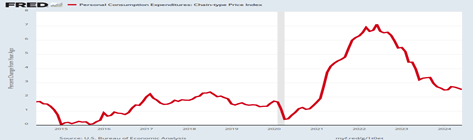
This is while the Federal Reserve’s preferred Personal Consumption Expenditure (PCE) inflation measure has remained at 2.5 percent ever since January 2024.

I have opined in past columns that inflation won’t go much lower, as long as we have decent economic growth. If prices do in fact turn negative, which is the meaning of deflation, then we will have a recession.

That is as good a definition of recession. One sees this clearly in the FRED graph above where PCE inflation dipped sharply at the 2020 recession (gray bar) and has fallen in every other recession since 1960.

There is little to fear from such an event at the moment, since predictions for third quarter economic growth are in the 2% range. Both the Atlanta Fed and New York Fed’s GDPNow estimates have dropped to 2%, because there is little investment in housing and manufacturing due the high cost of money. But that could change and boost third quarter growth with the Fed’s rate cuts.

The 30-year conventional fixed mortgage rate has dropped from 7.8% to 6.4% in less than one year. It didn’t impress the National Association of Home Builders, in part because there is still a 7.8-month buildup of new homes for sales.

There was a sudden bump in new-home sales in July, up 11 percent and 5.6 percent in a year because of the lower mortgage rates.

(But) “Despite the monthly bump in new home sales data, higher rates continue to sideline buyers as housing affordability challenges remain,” said Carl Harris, chairman of the National Association of Home Builders (NAHB) and a custom home builder from Wichita, Kan. “The only sustainable way to ease high housing costs is to implement policies that allow builders to construct more attainable, affordable housing.”

The Fed’s decision is huge on many fronts. Stock and bond prices should be able to regain the highs reached before the Fed began to raise interest rates, for starters.

Lower interest rates should also help to cure the housing shortage.

Harlan Green © 2024

Follow Harlan Green on Twitter: https://twitter.com/HarlanGreen

Posted in Consumers, COVID-19, Economy, Housing, housing market, Weekly Financial News | Tagged , , | Leave a comment

Why Is This Election Still a Tossup?

Answering Kennedy’s Call

What is the reason Republicans have become the party of anti-intellectuals? The danger is that it may drown out any intelligent discourse about the most important issues of our day. It’s driving at least one of our political parties into insanely ridiculous positions.

Barack and Michelle Obama warned last night at the Democratic Convention that it will still be an uphill slog to beat Donald Trump and his Republican Party. “Make no mistake, it will still be a fight,” said President Obama, even though Trump is now a convicted felon, and showing visible signs of mental deterioration.

This has become blatantly obvious now that a younger and vibrant Kamala Harris has replaced President Biden as his opponent, and Trump is no longer leading in the polls.

But it is still a contest for the same reason Trump won in 2016; when I first wrote about the presidential debates; he is leading a party that has intentionally been dumbed down since the 1970s, at least. And nothing has changed for them.

Huffington Post

We saw in the 2016 CNN Republican candidate debate the results of what seems to be a prolonged campaign to discount almost all scientific facts, as well as intelligent discussion of the most important issues of the day.

Especially scary was Donald Trump saying if we build up our military enough, we won’t have to negotiate with anybody. Or Marco Rubio, the seemingly most moderate Republican, endorsing a 1,900 mile fence along our entire border with Mexico (or double fence, says Dr. Ben Carson) over mountains and rivers, or Carli Fiorina saying that Planned Parenthood was aborting live babies to harvest their organs.

Global warming is one of the most important issues today, since there is almost unanimous agreement among scientists that it is man-made and rising alarmingly. Hence the record heatwaves, cold spells and catastrophic storms the world has been experiencing recently. Yet thanks to the funding of multi-billionaires like the Koch Brothers, none of the Republican Presidential candidates said they believe global warming is man-made, or even real.

What is the reason Republicans have become the party of anti-intellectuals–some members even want to abolish the Department of Education, and otherwise defund public education? Journalist Chris Hedges said in a PBS interview President Clinton in coopting moderate Republican positions, such as deregulation of the financial industry, putting 100,000 more cops on the street, and ‘reforming’ welfare, had driven the Republican Party to “insanity”

But the anti-intellectual, anti-science bias goes much further and deeper. It is in fact an almost totally American phenomenon that Republicans have taken advantage of, dumbing down the electorate to levels that would even deny evolution. Why would anyone not want to support public education, when it educates more than 80 percent of our students? The result is that higher education is also falling behind.

According to the National Research Council, only 28 percent of high school science teachers consistently follow the National Research Council guidelines on teaching evolution, and 13 percent of those teachers explicitly advocate creationism or “intelligent design,” said Psychology Today in a very damning 2014 article entitled, Anti-Intellectualism and the Dumbing Down of America:

“After leading the world for decades in 25-34 year olds with university degrees, the U.S. is now in 12th place,” said Psychology Today. “The World Economic Forum ranked the U.S. at 52nd among 139 nations in the quality of its university math and science instruction in 2010. Nearly 50 percent of all graduate students in the sciences in the U.S. are foreigners, most of whom are returning to their home countries”

Republican candidates were echoing the Republican platform that advocated the deportation of all illegal aliens, that would abolish or cripple whole government agencies (including the Environmental Protection Agency), shut down the federal government over Planned Parenthood funding, and maintain that a fertilized egg is a viable human being that can’t be aborted.

Pundits give other reasons for such a dumbing down of a segment of the electorate–such as social media and television replacing literacy, or education that no longer teaches math and science or even history. Maybe that has enabled the Donald Trumps of the world to shout louder.

The danger is that it may drown out any intelligent discourse. It’s driving at least one of our political parties into insanely ridiculous positions.

Harlan Green © 2024

Follow Harlan Green on Twitter: https://twitter.com/HarlanGreen

Posted in Economy, Politics | Tagged , , , , , | Leave a comment

Designing A New City

Chapter Thirteen

Goleta Old Town 1995 Flood

Many of us believed that a re-design of Old Town Goleta would be an ideal location to practice some of the precepts of True Urbanism, or Smart Planning, that could aid in the design for a new city. These were labels attached to what is now a worldwide movement.

The high crime rate in Old Town had been documented in the Redevelopment District Agency study. Environmental reports showed high traffic counts were causing air pollution, while successive floods following earlier drought periods required greater flood controls as well. We needed change.

We didn’t realize at the time that California’s Environmental Quality Act (CEQA) report would require flood improvements before anything could be done in Old Town.

The first step was to organize a design conference to provide design and planning alternatives for a new town center. We thought it obvious that without a community effort to create a community center with a unique identity that contrasted with neighboring Big Sister city Santa Barbara, Goleta’s cityhood might never succeed.

The American Institute of Architects co-sponsored eight simultaneous Design Charrettes across the country and in Hawaii. According to Wikipedia, Design Charrette is an architectural term that describes a gathering of designers and interested parties to create an innovative atmosphere in which a diverse group of stakeholders can collaborate to “generate visions for the future”. These weekend retreats brought professionals such as architects, designers, and urban planners together to envision and re-design a project area—such as a district or town center. All participants were interconnected via the Internet so we could report results to each other.

Design Charrettes originated with students of Paris’s Ecole des Beaux Arts, France’s major design school, in the 1800s. The students were used to cramming for exams at the last minute while riding in a charrette, or horse cart, to the exams. Our modern-day Design Charrette was an exciting chance for local students, environmentalists, and developers to participate in what might become a template for a future City of Goleta.

We assembled 100 design professionals and civic activists. It was a vehicle to begin the process of envisioning a future for the Goleta Valley community.

That weekend we “locked” ourselves into a large industrial building and broke into eight committees, each tasked to come up with a different design concept. The eight results covered the gamut of design ideas for Old Town, an area of no more than 20 city blocks and population of 5,000. Ideas ranged from a totally pedestrian environment accessible only to public transportation with room for pedestrian-oriented businesses and entertainment, to one that permitted automobile access, (which local business people badly wanted to sustain their businesses), but with more off-street parking and plenty of green landscaping.

Margaret Connell, Goleta’s first Mayor who supported the Old Town revitalization plan and wanted Old Town to be part of a new city center, voiced some of her concerns over the design problems:

. . . So Goleta Old Town feels more embedded than the more recent housing and worksites, and it also suffers from some disadvantages of being “old.” It lacks sidewalks through much of the older residential areas, though the city is taking steps to remedy this. There are many children who live here, but there are very few parks — a pocket park on Nectarine, a larger one on Armitos Avenue, and a four-acre, active-recreation park on Kellogg Street, which is still being developed.

The major environmental concerns were a lack of alternative transportation, such as buses and bike lanes, to manage traffic flow during peak rush hours and still service Old Town residents and businesses.

Flooding was also a major concern, despite periodic droughts. Santa Barbara and the South Coast had suffered several devastating floods during the 1990s that ended a prior 8-year drought.

The flood that broke the drought was called the March Miracle: in March 1991, 23 inches of rain fell, even flooding the Santa Barbara Municipal Airport and closing it for several days.

A second flood in 1995 caused another flooding of Old Town’s main street. A three-foot deep stream of water from a torrential rainfall overflowed San Jose creek at one end of Old Town’s boundaries. A climate scientist later said that the creek would no longer be adequate for containing flooding because the hard paved streets and roof surfaces in the surrounding neighborhoods had replaced the soil that had absorbed excess rainfall. Now the creek carried almost all of the rain’s runoff.

Hence flood control improvements, such as an enlarged creek bed to carry the increased runoff, were required in the CEQA report as the first step in any redevelopment effort.

The droughts and consequential flooding also made everyone aware of the limited water supplies in California, as well as the potentially devastating drought/flood cycle. In fact, California’s latest six-year drought ended with the greatest rainfall totals for Northern California since the 1880s.

Finally, Goleta achieved city status on February 1, 2002. It took four tries and a redrawing (several times) of city boundaries to gather in all of those who wanted to be part of the new city.

The work of the new City of Goleta has just begun. Its new community plan balances environmental with livable concerns, but there was another casualty of the Great Recession that caused an unexpected disruption of Goleta’s future infrastructure upgrades, especially in Old Town.

California, to solve its own budget problems caused by the Great Recession, dissolved all 404 Redevelopment District Agencies in 2011, which removed the tax financing that Old Town was counting on to fix some of its housing problems and relieve the traffic congestion.

Has Goleta become a more livable city? Its residents think so, though affordable housing will continue to be a problem. Most of its growth has been to the west, carefully planned to preserve a more rural atmosphere with numerous bike paths and a new train station to provide more transportation choices.

The Livable Cities movement has evolved into a ranking contest as cities compete to attract the best and the brightest people, as well as jobs for them. The annual rankings of the most livable cities are touted by several well-known lifestyle publications and organizations, including the AARP Livability Index, Monocle’s “Most Livable Cities Index”, the Economist Intelligence Unit’s “Global Livability Ranking”, and “Mercer Quality of Living Survey”.

Unfortunately, not a single U.S. city on the Economist’s list makes the top 10 in a study of the world’s 140 major cities. Melbourne, Australia, topped it in 2016, with Perth and Adelaide, Australia, also in the top ten. Honolulu, Hawaii, is the only American city mentioned at all. It makes the top ten list of most improved cities over the past 5 years.

It is safety of its residents and the threat of violence and terrorism that seems to have knocked American cities off the list and put Australia at the top of Most Livable Cities rankings.

How could Goleta solve the increasing dangers from violent extremism and domestic violence that make so many American cities unsafe?

Becoming a city enabled Goleta to contract with the County Sheriff to provide a neighborhood police service accountable solely to Goleta residents. It not only made Goleta safer for its residents, it was consequently listed as one of the 50 safest American cities in 2017, 15 years after its formation, according to a survey by Safewise, a security firm.

Goleta Old Town’s revitalization is still a work in progress. Goleta gave up on the idea of putting a new City Hall in Old Town. It instead purchased a new City Hall to the west amid commercial office complexes. But the new City of Goleta has adopted the Livable City planning principles that we envisioned in the Old Town Design Charrette.

As a postscript to Goleta’s story, I attended an event in 2019 that confirmed to me what a livable city meant to its residents. The City of Goleta Dam Dinner, a potluck dinner to which everyone contributed to celebrate their love of the city, was held on an earthen dam within the city limits that formed the small Lake Los Carneros. It was the “Love of the City” celebration.

The city described the celebration as “a free community dinner at the local dam where people brought picnics or bought dinner from food trucks and enjoyed their neighbors and the beautiful surroundings.”

It was the fifth annual Dam Dinner, an event Goletans first created in 2013 that was becoming increasingly popular among many cities wanting to honor their sense of community by making their city more lovable, as well as livable.

The happy faces of some 500 residents having a good time with friends and family while sitting side-by-side at tables strung along the length of the earthen dam was something to see.

It was evidence that the difficulties we encountered and obstacles we overcame to build such a community of happy people were worth it.

*     *     *

Posted in Consumers, COVID-19, Economy, Politics, Uncategorized | Tagged | Leave a comment

Consumers Are Still Solvent?

Popular Economics Weekly

FREDretailfoodservices

My recent blogs have been questioning how long consumers can keep shopping for good reason; their debts have been piling up, which seems to mean they have been able to borrow enough to stay in the game.

I occasionally quote Roosevelt’s very smart Federal Reserve Chairman Marriner Eccles who made an apocryphal statement on debt during the Great Depression—which in essence explained why it became the ‘Great’ Depression and explains every recession since then.

“The United States economy is like a poker game where the chips have become concentrated in fewer and fewer hands, and where the other fellows can stay in the game only by borrowing. When their credit runs out the game will stop.”

The credit of most Americans ran out during the Great Depression when their banks failed in the 1930s because they didn’t yet have federal deposit insurance or today’s capital requirements, and 25% were jobless.

It was also the end of the last Gilded Age, when the Morgans, Rockefellers, and Vanderbilts held most of the wealth and labor unions were much weaker.

We may not be in as much danger today though four large banks have already failed that carried too many deposits not insured by the FDIC, or other guarantors. And cracks are appearing in the credit markets where the loan default rates of lower income folk are rising who tend to spend most or all their incomes.

We are living in another Gilded Age with record income inequality and ordinary Americans having to pay higher tax rates that most of the millionaires and billionaires since the 1980s.

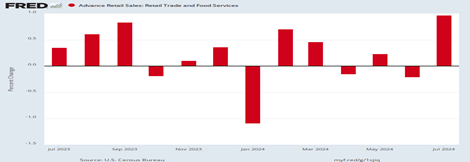
Retail and food sales are a good indicator of consumer health, and is subject to large fluctuations. That’s why just reported July retail sales jumped +1.0%, up from a -0.2% decline in June. (It also plunged -1.1% earlier this year in January.)

I believe the current and sudden jump in sales must be because of consumers’ hubris, a bit of irrational exuberance, because they feel their jobs remain safe and the US economy has been fully employed for the past two years, so they are saving very little of their income.

But full employment may not last much longer, and consumers might be sensing this in consumer confidence surveys. Consumer sentiment picked up slightly for the first time in five months, say the latest headlines.

But according to the latest University of Michigan survey, “For the second straight month, consumer sentiment is essentially unchanged. July’s reading was a statistically insignificant 2 index points below last month, well within the margin of error. Although sentiment is more than 30% above the trough from June 2022, it remains stubbornly subdued.”

The Conference Board’s confidence survey said as much: “Compared to last month, consumers were somewhat less pessimistic about the future. Expectations for future income improved slightly, but consumers remained generally negative about business and employment conditions ahead.”

So, the question remains how much longer can consumers keep spending as they have?

The unemployment rate has been steadily rising from its low in January 2023 of 3.4 percent to 4.3 percent in July 2024. And annual hourly wage increases have declined to 3.6 percent.

I said of last month’s unemployment report that it was alarming because most new jobs were in the lower paying service sector that had 80,000 of the 114,000 jobs total, mostly in Leisure activities, Education & health care.

This is where consumers spend most of their Dollars and so it means job growth is still dependent on consumer spending, and consumers have had to borrow like crazy to keep spending, which can’t go on forever.

That is why financial markets are now betting the Fed will begin to cut interest rates at its September FOMC meeting.

Retail inflation has dropped below 3 percent for the first time since 2022 as measured by the U.S. Consumer Price Index (CPI). It has had two months of zero price increases, which could have been predicted because consumers have known for months that stores were discounting and shopped more at big box retailers like Target, Walmart and Costco.

So there seems to be some cognitive dissonance between what consumers are doing (i.e., continuing to spend) and what they are saying in confidence polls. Is that a danger sign? Might they suddenly stop spending, because “the game will stop” in Fed Chair Eccles words?

It depends on the health of our banking system as well. We’ll have to wait and see.

Harlan Green © 2024

Follow Harlan Green on Twitter: https://twitter.com/HarlanGreen

Posted in Consumers, COVID-19, Economy, Weekly Financial News | Tagged , , , , , , , , | 2 Comments