When Will Housing Recover?

The Mortgage Corner

With the Federal Reserve saying it is about to cut rates, will the housing sector finally come out of its own recession? All the indicators of housing health—existing-home sales, new-home sales, construction, and for sale inventories—are at multiyear lows, mainly because the Fed believes its only inflation fighting tool is restricting credit via higher interest rates.

FREDexistinghomesales

For-sale inventories have edged up some 40 percent this year, as existing homeowners see a chance to either move to a smaller unit, or into a retirement home now that mortgage rates are plunging. But existing-home sales are currently just 3.89 million units, per the FRED graph, far from its longer-term 4-5 million unit average—as much as 7 million during the 2005 housing bubble.

We have a housing shortage of somewhere between 1-3 million residential dwellings, including owner-occupied and rental units, without considering housing for the homeless.

But what happens if the Fed waits too long to ease up on the brakes, job losses continue to climb and the overall economy goes into recession? That seems to be happening with last week’s bummer of an unemployment report, and financial market interest rates are reacting after more than two years of sky-high mortgage rates, for starters.

Mortgage rates decreased across the board last week and mortgage application volume reached its highest level since January of this year, according to the Mortgage Bankers Association (MBA).

“The 30-year fixed rate fell to 6.55 percent, reaching its lowest level since May 2023, following doveish communication from the Federal Reserve and a weak jobs report, which added to increased concerns of an economy slowing more rapidly than expected,” said Joel Kan, MBA’s Vice President and Deputy Chief Economist. 

FRED30yrfixed

The average rate for a 30-year mortgage backed by the Federal Housing Administration for entry-level and first-time homebuyers was 6.49% (that are backed by government-insured bonds), down from 6.69% the previous week, the 15-year was down to 6.03% from 6.27% the week before, and the rate for adjustable-rate mortgages was down to 5.91% from 6.22%, according to FNMA.

Most of the mortgage activity was in refinance, up 60 percent in a year, says the MBA. Homeowners have waited this long for the opportunity of a lower interest rate. Home purchases have barely budged; the MBA’s purchase index is down 11 percent in a year, mainly because home prices are still increasing 4-5 percent per year, and only the highest credit scores—upwards of 760—get the best rates.

Credit standards have barely eased, in a word. A score of 680 was acceptable to Fannie and Freddie for their best conventional mortgage rates prior to the Great Recession. The Fed’s inaction has only made matters worse for homebuyers (and therefore renters) due to the housing shortage.

What do I see for the rest of this year? It depends on the Fed’s actions. If it drops rates, then more homes become affordable, and more homes can be built because construction costs are controlled by the Fed’s short-term rates.

Fixed conventional 30-year mortgage rates set by Fannie Mae and Freddie Mac that guarantee most conventional loans (i.e., not government insured or privately held by banks) had been at or below 5 percent since the Great Recession of 2008-09 (gray bar in 30yrfixed graph is pandemic recession), before they began their upward spike in 2022.

It’s a long way back down that interest rate mountain for housing to become affordable again and many more homes built to ease the housing shortage. A Fed-engineered recession will bring down interest rates and housing prices sooner, but that also means fewer working folk can afford them, so who will it benefit?

Harlan Green © 2024

Follow Harlan Green on Twitter: https://twitter.com/HarlanGreen

Posted in Consumers, COVID-19, Housing, housing market, Weekly Financial News | Leave a comment

Federal Reserve Now Behind the Curve?

Popular Economics Weekly

FREDunemployment

Well, now it has happened. Powell’s Federal Reserve may have waited too long to begin the rate cuts. The financial markets think so, at least, as a stock selloff has begun and bonds are rallying in a flight to quality, as fears of a looming recession are now in the air.

It’s understandable, as the unemployment rate has been steadily rising from its low in January 2023 of 3.4 percent to 4.3 percent in July 2024–the beginning of a definite trend. Average hourly wage increases have declined to 3.6 percent, falling in line with the declining inflation figures that we reported last week.

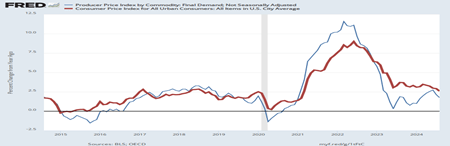
It is the first time since July 2022 that retail inflation as measured by the U.S. Consumer Price Index (CPI) has turned negative.

The Consumer Price Index has now had two months of zero price increases. It could have been predicted because consumers have known for months that stores were discounting and shopped more at big box retailers like Target, Walmart and Costco.

Most alarming isn’t the lower job creation total, though, but that most new jobs were in the lower paying service sector that had 80,000 of the 114,000 jobs total, mostly in Leisure activities, Education & health care. That means job growth is still dependent on consumer spending, and consumers have had to borrow like crazy to keep spending, which can’t go on forever.

The manufacturing sector, which depends on capital expenditures (i.e., investments), added just 1,000 jobs. The Institute for Supply Management’s manufacturing index slid to 46.8% last month from 48.5% in June. Numbers below 50% signal the manufacturing sector is shrinking.

“U.S. manufacturing activity entered deeper into contraction,” said Timothy Fiore, chairman of the ISM survey. “Demand remains subdued, as companies show an unwillingness to invest in capital and inventory due to current federal monetary policy and other conditions.”

Those remarks tell us exactly what is on the line. The Fed now must play catch up once again because of its fixation on theories that are not applicable to a post-pandemic economy which had a temporary inflation bulge due to COVID-19 caused supply shortages.

And U.S. factory orders fell 3.3% in June mostly because of weaker demand for passenger plans and military aircraft, but the ongoing slump in manufacturing showed no sign of ending.

The one bright spot in the report, according to MarketWatch’s Jeffry Bartash: So-called core orders, a measure of business investment, rose by a healthy 0.9%. Investment has barely risen in the past year, however.

The weak factory shipments in the past year reflect an ongoing slump among manufacturers due to high interest rates and lukewarm consumer demand for big-ticket items such as new cars.

But part of the car problem was a cyber-attack on car sales. Sales of new cars and trucks rebounded in July after auto dealers fixed their computer systems following a major cyberattack and were able to complete thousands of delayed purchases.

So auto sales increased at an annual rate of 15.8 million last month, up from 15.2 million in June, according to Ward’s Intelligence. An estimated 600,000 sales in June were affected by a criminal attack on dealers’ computer networks as part of an attempt at extortion, though sales of new cars and trucks in the U.S. are still being depressed by high interest rates.

The bottom line is that no country was exempted from the effects of the COVID-19 pandemic that killed some 6-7 million people.

Harlan Green © 2024

Follow Harlan Green on Twitter: https://twitter.com/HarlanGreen

Posted in Consumers, COVID-19, Economy, Weekly Financial News | Leave a comment

Let’s Make America More Equal Again!–Part 2

Answering Kennedy’s Call

Piketty-Saez

Why did our income inequality begin to worsen in 1980, as can be seen from the above graph? The Arab-OPEC oil embargo of 1973 was the first indication that Big Business under the newly created Business Roundtable of corporate executives wanted more of the national income pie.

No one liked the long gas station lines and fears America could run out of oil, so it was relatively easy for fear mongers to push through economic changes that lessened the incomes of working folk and increased the incomes of Big Business.

The fossil fuel industry needed more money to find new oil sources, and create new technologies such as fracking, so they wanted a larger income share, which was achieved by suppressing wages and cutting taxes without cutting spending. and it became a national security priority with the ongoing cold war and arms race that followed.

The Reagan administration ran up the first $400 billion federal budget deficit during his eight years in part because tax rates for the wealthiest were slashed. The highest personal income tax rate was first reduced from 70 to 50 percent in 1981, then down to a 28 percent maximum personal tax rate in 1986 when he was re-elected.

Because most of the income gain went to the top 10 percent, the Reagan tax cuts became known as ‘trickle-down” economics. It could also be called “stealth economics,” because Wikipedia cites at the time, “people weren’t substantially informed about the tax cuts, as an ABC News Poll in September 1986 showed that 63% of Americans didn’t know enough about the Tax Reform Act of 1986 to say if it was good or bad.”

Republicans sold it to the public with an unproven theory. A Doctoral student named Arthur Laffer in the 1970s had convinced conservative Republicans with a diagram on a napkin (the so-called Laffer Curve) that lower taxes gave people the incentive to work harder and earn more, whereas higher taxes discouraged work.

It’s hard to believe such a theory today because the federal budget deficit only grew under the Republicans’ trickle-down theory. GW Bush created the first $1 trillion deficit, and Donald Trump’s added another $5 trillion to the federal budget deficit with his tax cuts. That’s as good proof as any that lower taxation rates didn’t increase tax revenues enough to pay down the extra debt as promised.

Perhaps the most shameful result of the redistribution of Americans’ wealth, the richest country in the world, was we now had the worst income inequality of developed countries, as measured by the CIA’s authoritative World Factbook.

It measures the income inequality of countries with what is called the Gini Index that calculated the percentage of wealth held by a country’s different socio-economic brackets. A higher percentage means a larger share of a nation’s income is held by the wealthier segment of its population.

“The more nearly equal a country’s income distribution, the lower its Gini index, e.g., a Scandinavian country with an index of 25,” says the World Factbook. “The more unequal a country’s income distribution, the higher its Gini index, e.g., a Sub-Saharan country with an index of 50. If income were distributed with perfect equality the index would be zero; if income were distributed with perfect inequality, the index would be 100.”

The latest US Gini Index coefficient of family income was 39.8 percent, which is even higher than Russia’s, and close to that of African and South American Third World countries, whereas the European Union averaged 30.8 percent in its most recent report.

That is why two out of three Americans are dissatisfied with the way income and wealth are currently distributed in the U.S. This includes three-fourths of Democrats and 54 percent of Republicans, according to a Gallup poll, I said last week.

It is also why much of that inequality is in the Midwestern rust belt states that lost blue-collar manufacturing jobs during the globalization and multi-nationalization of US corporations that President Trump promised to bring back again.

It is also why an election-denier even won one term as President and can endanger our Democracy with a Supreme Court majority now giving him a helping hand.

The most efficient way to right the inequality is to bring back tax rates that prevailed during Americans’ most prosperous times, the 1950s to 1970s when the maximum personal tax rate was 70 percent, or even higher.

The maximum tax rate was 92 percent during President Eisenhower’s administration because we were building the nation’s post-WWII infrastructure and modern technologies, as well as going to the moon.

President Eisenhower was reputed to have said, “Because high corporate tax rates create incentives for big business to spend on things like new locations, new hires, new equipment and product research and development which are deducted from taxable earnings, in other words, it’s better to spend a majority of earnings on expansion than to horde it and pay Uncle Sam 90% of it.”

No one likes higher taxes, of course. And much of the middle class bought into Reagan’s myth of trickle-down economics that caused its demise and poverty levels we have today. But if Americans won’t pay the bill for modernizing the US economy, rather than put off payment with more borrowing, America’s record income inequality can only get worse.

Harlan Green © 2024

Follow Harlan Green on Twitter: https://twitter.com/HarlanGreen
Posted in Consumers, COVID-19, Economy, Keynesian economics, Politics | Tagged , , , , | Leave a comment

Plenty of Available Jobs!

Financial FAQs

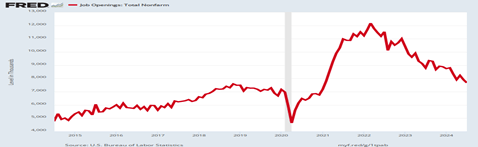
As a precursor to July’s unemployment report, the Labor Department’s JOLTS report that measures the number of job openings—jobs waiting to be filled—has just come out. The number of openings is still the highest in decades, per the FRED graph (it peaked during the pandemic shutdown).

“The number of job openings was unchanged at 8.2 million on the last business day of June, the U.S. Bureau of Labor Statistics reported. Over the month, both the number of hires and total separations were little changed at 5.3 million and 5.1 million, respectively.”

This means there aren’t enough workers to fill those 8.2 million job openings and 5.3 million hires in June. Our economy remains fully employed, despite the Fed’s attempts to restrict the number of hires by keeping interest rates high.

Why do they want higher unemployment when one of the Fed’s twin mandates is maximum employment (with stable inflation)? Because many of the Fed Governors seem to subscribe to an economic theory from the 1970s by the conservative Nobel Prize Economist Milton Friedman who postulated that the amount of money in circulation (monry supply) controls economic activity. Therefore the Fed has reasoned keeping interest rates high to restrict the money supply will slow growth enough to control inflation.

But this inflationary surge was caused by worldwide supply shortages from the pandemic shutdown that led to a temporary inflation surge, not too much money in circulation. Inflation has declined despite the abundance of money still in circulation to pay for our economic renewal— infrastructure projects and computer chip factories, for starters—for which $trillions are needed.

FREDjobopenings

The inflation decline has been corroborated while second quarter GDP growth doubled from 1.4 percent to 2.8 percent, I reported last week. Despite such a growth surge, its price index for gross domestic purchases increased just 2.3 percent in the second quarter, compared with an increase of 3.1 percent in the first quarter. The personal consumption expenditures (PCE) price index increased just 2.6 percent, compared with an increase of 3.4 percent in Q1.

These declining inflation rates are telling us it’s time for a rate drop. But are consumers getting the message? The Fed’s money tightening has been making consumers more cautious in their outlook but they aren’t seeing much light at the end of the inflation tunnel. The Conference Board’s latest Consumer Confidence Index is still showing pessimism.

Conference Board

Conference Board Chief Economist Dana Peterson said in its latest release, ““The proportion of consumers predicting a forthcoming recession ticked up in July but remains well below the 2023 peak. Consumers’ assessments of their Family’s Financial Situation—both currently and over the next six months—was less positive. Indeed, assessments of familial finances have deteriorated continuously since the beginning of 2024.”

Consumers shouldn’t be blamed for their pessimism, despite being fully employed. Prices are still 20 percent higher on average than before the pandemic. But their moods should considerably improve when the Fed finally begins to cut interest rates, and their fears lesson of an upcoming recession.

We are at the beginning, not the end of the post-pandemic recovery, in other words, which could continue for most of this decade and is generating many new high-paying jobs.

Harlan Green © 2024

Harlan Green on Twitter: https://twitter.com/HarlanGreen

Posted in Consumers, COVID-19, Economy, Keynesian economics, Weekly Financial News | Tagged , , , , | Leave a comment

Make America More Equal Again!

Answering Kennedy’s Call

Piketty-Saez

I have a suggestion for a campaign motto I first wrote about in a 2017 Huffington Post piece that could give a boost to VP Harris’s presidential campaign.

Instead of Trump’s slogan, “Make America Great Again.” let’s “Make America More Equal Again,” just as it was in the 1960’s and 70’s, when we had a thriving middle class in which children could hope to exceed their parents’ station in life.

It was our thriving middle class as portrayed in the above graph of pre-tax income that kept the more extreme elements of both political parties and persuasions at bay, so that Republicans and Democrats talked to each other. A middle class will only thrive where there is less income inequality, something that most well-meaning Americans support.

But that was then and we live now, when most children of retiring baby boomers do not hope to exceed the economic status of their parents, as income inequality has worsened to levels last seen in the 1920s.  Household incomes have stagnated since the 1970s, and the top income earners since the Great Recession now have garnered almost all the increase.

The Great Recession was brought on by the deregulation boom of the Clinton and GW Bush presidencies and a greater inequality that peaked in 2012 per the Piketty-Saez graph. So why not create programs that “Make America More Equal Again?”

That is why two out of three Americans are dissatisfied with the way income and wealth are currently distributed in the U.S. This includes three-fourths of Democrats and 54 percent of Republicans, according to a Gallup poll.

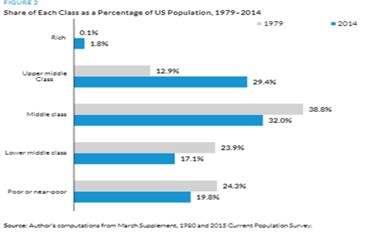
Overall, the share of Americans living in middle-class households has declined from 61 percent in 1971 to 50 percent, reported a 2015 Pew Research study. The hollowing out of the middle class has been a source of consternation among many economists, politicians and the public at large, says those surveyed. They say as Americans move toward the economic extremes it is harder to find common ground, and a common sense of what it means to be an American.

Much of that inequality is in the Midwestern rust belt states that lost blue-collar manufacturing jobs during the globalization and multi-nationalization of US corporations that President Trump promised to bring back again.

President Trump was no dummy in recognizing this fact. Then how could Democrats become so blasé and oblivious to this fact among their former supporters? Everyone saw it coming; the disenfranchisement of whole segments of working-class voters that had descended into depression and drug use in those formerly blue and Democrat-voting states.

There were many suggestions of how to bring back higher-paying jobs during Trump’s term, but he only succeeded in enriching the top 1 percent of income earners with his tax cuts. He couldn’t pass an infrastructure bill, did slightly alter NAFTA by drastically raising import tariffs (even on Canadian lumber and dairy products, which raised their prices); built very few walls but imprisoned immigrants seeking asylum at the southern border in camps, and separated immigrant mothers from their children.

Trumps was also unsuccessful in recalling Obamacare that has benefited more than 20 million Americans.

VP Harris has a much better record to run on. For instance, Biden’s Inflation Reduction act is expected to fund $800 billion in green-energy projects, invest $50 billion to foster building computer chip factories, and $1 trillion to fund infrastructure projects that modernizes our public infrastructure; from roads and bridges to our energy grid and water and sanitation facilities.

There are many reasons for Democrats and even truly populist Republicans to support programs that increase income equality in the coming years. But they can’t be about building more walls. A robust and more politically temperate American middle class must include Americans of all nationalities and ethnicities.

A good start would be to bring back the Child Tax Credit that was first enacted in 1997. A better version recently passed the House with a huge majority but its renewal is now stalled in the Senate by Republicans.

The American Rescue Plan Act of 2021 temporarily expanded the child tax credit for the 2021 tax year to $3,600 per child younger than age 6 and $3,000 per child up to age 17. The expanded child tax credit reached over 61 million children in more than 36 million households, and funds were primarily used for child care, food, housing and other basic needs. In 2021 child poverty fell to its lowest level ever in America, but in 2022 Congress did not renew CTC expansion, and child poverty surged by 41%.

Bringing back the middle class is a slogan of the Harris campaign. A corollary can be “Let’s Make America More Equal Again.” Renewal of the CTC that decreases child poverty is perhaps the best way to boost our middle class; by giving hope to our youngest that they might again be able to better their lives.

Harlan Green © 2024

Follow Harlan Green on Twitter: https://twitter.com/HarlanGreen
Posted in Consumers, COVID-19, Economy, Politics, Weekly Financial News | Tagged , , , , | Leave a comment

An End to the Greater Lawlessness?

Answering Kennedy’s Call

I believe we are at another turning point in history, a return to an era of lawfulness that one political party has ignored since the deaths of JFK, Brother Bobby Kennedy, and Martin Luther King, Jr.

And that’s for a few reasons. First was Joe Biden becoming our President, defeating the most lawless president in history, now a convicted felon, and enabling legislation that has given more rights to Americans, rather than taking them away.

Secondly, President Biden has chosen VP Kamala Harris to succeed him in the upcoming presidential election, a former District Attorney and California Attorney General, who understands lawlessness and lawbreakers.

Who would believe events could turn so quickly, from a MAGA Trumpocracy looking backward and promising to destroy our democracy, to a Black-Asian woman who is already exciting many of the younger generation by saying we should look forward to a brighter future?

The JFK assassination on December 22, 1963, was a turning point for me—from hope in Kennedy’s New Frontier to a better future and end to the Cold War, to the hopelessness of a Vietnam War and all that followed.

It reminded me in many ways of the 1960s when there was just as much social unrest and different ideas of democracy. This was the era of McCarthyism and communist witch-hunting, right wing against left wing political views, the civil rights movement, and an unpopular war in Vietnam that was fracturing American communities.

I coped with the dysfunction and cynicism then by searching for communities that could mirror my values and ideals by working in public service organizations and as a Peace Corps Volunteer.

It’s been a long wait for the return to the optimism and can-do spirit I experienced in the 1960s. I began to understand why when I began writing about what was then called the Age of Narcissism.

Social historian Christopher Lasch was perhaps the first to broach the subject in various critiques of modern American society. This included his 1979 best-seller, The Culture of Narcissism: American Life in an Age of Diminishing Expectations that took “what was still mainly a narrow clinical term and used it to diagnose a pathology that seemed to have spread to all corners of American life,” per a NY Times summary of his book.

Former President Trump is a man who epitomized such narcissism and has been diagnosed by multiple mental health professionals with a Narcissistic Personality Disorder (NPD), “using other people as instruments of gratification even while craving their love and approval,” in the words of Lasch.

Lasch saw this as a societal pathology that took individualism to its destructive extreme of ‘me first’ over any concern for others with the breakup of communities and headlong rush to a post-WWII, consumer-driven economy. The extended family was transformed into the nuclear family of a married couple with children; grandparents migrating to senior living centers; as the growing middle class moved to the suburbs and away from traditional family and community values.

“In Lasch’s definition (drawn from Freud), the narcissist, driven by repressed rage and self-hatred, escapes into a grandiose self-conception, using other people as instruments of gratification even while craving their love and approval,” said the review. “Lasch saw the echo of such qualities in “the fascination with fame and celebrity, the fear of competition, the inability to suspend disbelief, the shallowness and transitory quality of personal relations, the horror of death.”

Is this just the beginning of an end to the Age of Narcissism, a turning point away from the worship of celebrity? I believe so. And who better to turn that page than such a highly qualified woman, former Vice President, and maybe our first female president?

Harlan Green © 2024

Follow Harlan Green on Twitter: https://twitter.com/HarlanGreen

Posted in Politics, Uncategorized | Tagged , , , , | Leave a comment

Much Improved Q2 Economic Growth

Financial FAQs

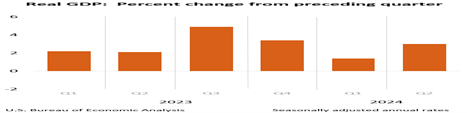
Today’s second quarter Gross Domestic Product (GDP) grew 2.8 percent, double first quarter’s 1.4 percent, which will give a huge boost to confidence that no recession is imminent, but also enough ammunition for the inflation hawks that say inflation is still too high.

BEA.gov

This is when the BEA said the price index for gross domestic purchases increased just 2.3 percent in the second quarter, compared with an increase of 3.1 percent in the first quarter. And the personal consumption expenditures (PCE) price index increased just 2.6 percent, compared with an increase of 3.4 percent.

These are declining inflation rates that affect consumers and tell us it’s time for a rate drop. Gas prices have plunged, as have grocery prices.

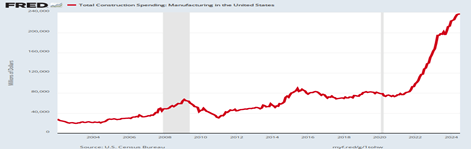
But I find it worrisome that manufacturing is still faltering. We won’t see a full recovery from the pandemic otherwise, because manufacturing is part of our infrastructure modernization, as well as the CHIPS Act renewal that is bringing back the microchip factories important to our national security.

The services sector is powering our growth at present, which includes health care, leisure and hospitality, and means consumers are still going on vacation, as can be seen from the crowded airports and highways.

MarketWatch’s Jeffry Bartash reports the first reading of the S&P U.S. services index of purchasing managers climbed to a 28-month high of 56.0 in July, from 55.3 in the prior month. Numbers above 50 signal growth.

The service side of the economy — retailers, banks, hospitals and the like — employs most Americans and has driven the expansion since the pandemic, said Bartash.

The preliminary U.S. manufacturing PMI, however, fell to a six-month low of 49.5, dipping back into contraction territory. Manufacturers are even more important today to win the cold war and actual wars that are a major reason authoritarian governments still exist.

What is powering most of the expansion? The Federal Reserve’s consumer credit measure for May—the 2nd month of the second quarter—just showed a big jump in consumer borrowing, I said last week. Total consumer credit rose $11.3 billion in May, up from a $6.5 billion gain in the prior month, per the Federal Reserve. 

Consumers’ personal savings have shrunk, which is why they are now even more dependent on credit, and why I’ve been saying such spending can’t continue with the sky-high 8.5 percent Prime Rate translating to 20 percent plus credit card rates.

And how about the housing market? Both existing and new-home sales are declining to post-pandemic lows because of excessively high construction costs and mortgage rates, at a time when we need more housing than ever.

When will the Fed get the message?

Harlan Green © 2024

Harlan Green on Twitter: https://twitter.com/HarlanGreen

Posted in Consumers, COVID-19, Economy, Housing, housing market, Weekly Financial News | Tagged , , , , | Leave a comment

More Greater Lawlessness–Republicans’ Climate Denial

Answering Kennedy’s Call

NYTimes

One year ago, on August 16, 2022, President Biden signed the Inflation Reduction Act into law – the largest investment in clean energy and climate action ever.

“The Inflation Reduction Act is a transformative law that is helping the United States meet its climate goals and strengthen energy security, investing in America to create good-paying jobs, reducing energy and health care costs for families, and making the tax code fairer,” the White House said in its latest update.

Whereas at the top of the Republican’s MAGA list in its 2024 platform is weaken as many environmental laws as possible in order to return fossil fuels and the non-renewable, most pollution intensive industries to dominance.

Trump’s acceptance speech said as much: “…And next we will add the actual and incredible waste of taxpayer dollars that is fueling the inflation crisis. They spent trillions of dollars on things doing with the green new scam. It’s a scam…We will not allow it to be spent on meaningless green new scam ideas.”

“And I will end the electric vehicle mandate on day one, thereby saving the US auto industry from complete obliteration, which is happening right now. And remember we have liquid gold under our feet, more than any other country by far. We are a nation that has the opportunity to make an absolute fortune with its energy. We have it and China doesn’t.”

This is after the last Trump administration spent four years dismantling major climate policies and rolling back many more rules governing clean air, water, wildlife and toxic chemicals.

In all, a New York Times analysis, based on research from Harvard Law SchoolColumbia Law School and other sources, counts nearly 100 environmental rules officially reversed, revoked or otherwise rolled back under Mr. Trump. More than a dozen other potential rollbacks remained in progress by the end but were not finalized by the end of the administration’s term.

President Biden’s four years have reversed such climate change denial. Just twelve months after the law was signed, the Inflation Reduction Act is already having a significant impact on American workers and families and “is delivering for underserved communities and those that have been too often left behind,” said the White House.

“Outside groups estimate the Inflation Reduction Act’s clean energy and climate provisions have created more than 170,000 clean energy jobs already, companies have announced over $110 billion in clean energy manufacturing investments in the last year alone, the law is delivering billions of dollars to protect communities from the impacts of climate change, and millions of seniors are saving money because their insulin is capped at $35 per month,” said the White House in its update.

The Republican Party’s attack on environmental regulations has been unrelenting in its support of the fossil fuel industry.

But in the early 1970s when I joined the U.S. Environmental Protection Agency, the Clean Air Act, the Clean Water Act, and the Endangered Species Act were all passed with broad bipartisan support and signed by Republican President Richard Nixon.

What happened? The 1973 Arab oil embargo shut off OPEC supplies and led to long car lines waiting at gas stations to fill their tanks, for those that remember.

It was a very traumatic decade of soaring inflation that caused Big Business to bankroll lobbyists to support Big Oil producers, which set the environmental movement back. Oil production became a national security priority; fracking was developed to make the US the largest oil producer in the world.

The result of that decade was the beginning of what became Reaganomics, or trickle-down economics. It wasn’t even an economic theory—just make the one precent wealthier and enough will trickle down to the other 99 percent to lift all boats.

Worldwide temperatures have been increasing ever since; tornadoes and hurricanes more frequent and damaging, wildfires and floods as well. Even the Pentagon has jumped on the environmental bandwagon with its reports that have said global warming now endangers our national security.

Even the Big Oil industry has admitted the danger in many studies. But not the Republican Party, apparently, which makes its climate denial platform a national security threat as well.

Harlan Green © 2024

Follow Harlan Green on Twitter: https://twitter.com/HarlanGreen
Posted in Consumers, COVID-19, Economy, Politics | Tagged , , , , | Leave a comment

The Greater Lawlessness–Republicans War on America

Answering Kennedy’s Call

Trump’s selection of J.D. Vance as Vice-President means the chaos of Trump’s first administration will continue on steroids, as Trump will have a VP who will assist him in continuing to tear down one institution after another that protects ordinary Americans.

JD Vance looked down on working class whites he grew up among when he wrote his memoir, “Hillbilly Elegy”. “You can walk through a town where 30 percent of the young men work fewer than 20 hours a week and find not a single person aware of his own laziness,” as cited by Paul Krugman in a recent NYTimes Op-ed.

“We don’t study as children, and we don’t make our kids study when we’re parents,” he said. But now that he’s the Republican Vice President candidate, those lazy males have suddenly become victims of the surge of illegal immigrants that are “poisoning the blood of Americans”, in Trump’s words, and taking their jobs Vance has said in numerous speeches and interviews.

But that’s not the case. The unemployment rate of adult white males is just 4 percent, below the current national unemployment rate, said Krugman, a Nobel prize winner in economics.

As an example of the chaos during his first administration when Trump was taking babies away from immigrant mothers and attempting to build a wall, I wrote this 2017 Huffington Post piece on how his immigration policies will damage the US economy.

“For most of the past half-century, adults in the U.S. Baby Boom generation – those born after World War II and before 1965 – have been the main driver of the nation’s expanding workforce, reports the PEW Research Center. But as this large generation heads into retirement, the increase in the potential labor force will slow markedly, and immigrants will play the primary role in the future growth of the working-age population (though they will remain a minority of it).

Huffington Post

“The stakes are enormous if Republicans succeed in removing most of the estimated 11 million undocumented worker (only half of which are from Mexico and the Latin countries), and cut legal immigration in half, as they have promised to do. Economic growth will plummet, since it is mainly based on growth of the working age population, as well as labor productivity, which has also fallen since 2000,” I wrote then.

It is one more example of the Bully Mentality I’ve been writing about ad nauseum that is particular to the Republican Party—the bullying behavior of the strongest preying on the weakest that has made citizens of the red states they control the poorest.

How much of a bully is JD Vance? He is now mimicking Donald Trump’s behavior. In an interview with ABC News “This Week” anchor George Stephanopoulos, Vance doubled down on his views of the 2020 election, saying the results shouldn’t have been immediately certified, and he went on to suggest Trump should ignore “illegitimate” U.S. Supreme Court rulings.

“If I had been vice president, I would have told the states, like Pennsylvania, Georgia and so many others, that we needed to have multiple slates of electors and I think the U.S. Congress should have fought over it from there,” he continued. “That is the legitimate way to deal with an election that a lot of folks, including me, think had a lot of problems in 2020. I think that’s what we should have done.”

This is returning US to the Law of the Jungle, the Darwinian struggle where the fittest survive and prosper, now with the assistance of his Vice Presidential candidate.

It is monumental hypocrisy of a man from Kentucky who grew up among the very people he has made into victims, a red state that has suffered so much from what is now the official policy of Donald Trump’s party.

Harlan Green © 2024

Follow Harlan Green on Twitter: https://twitter.com/HarlanGreen
Posted in Consumers, COVID-19, Economy, Politics | Tagged , , , , | Leave a comment

Retail Sales Falter

The Mortgage Corner

Fed Chair Powell has said it again. Second-quarter economic data including last week’s consumer price report “do add somewhat” to confidence that inflation is heading down to the central bank’s 2 percent goal at an Economic Club of Washington interview— a condition for rate cuts, report various media. He repeated that labor markets are now in a “better balance,” and an unexpected weakening in labor markets would also be a reason to adjust rates.

That is already happening with the latest revisions to unemployment data and the unemployment rate now up to 4.1 percent. It ticked up to 4.1 percent in June from 3.8 percent in March. The sudden rise in the unemployment rate in the middle of the work year should alarm Fed officials.

Further evidence of slowing job growth is that average hourly wage growth fell to 3.9 percent. It makes up to two-thirds of production costs for most businesses and is now the main driver of inflation.

1another reason a rate cut seems more likely is that retail sales were unchanged in June once again. It actually fell when inflation is factored. It’s now been flat for three consecutive months.

FREDretail

Advance of U.S. retail and food services sales for June 2024, adjusted for seasonal variation and holiday and trading-day differences, but not for price changes, were $704.3 billion, virtually unchanged (±0.5 percent)* from the previous month, but up 2.3 percent (±0.5 percent) above June 2023. Total sales for the April 2024 through June 2024 period were up 2.5 percent (±0.5 percent) from the same period a year ago.

Housing is another reason a rate cut is needed sooner. Though for sale inventories are up to a 3.7-month supply, according to Realtors, builders have been slashing prices because of the sky-high mortgage rates.

Nearly one third of home sellers in Sun Belt cities are slashing their asking prices as the number of properties for sale in those markets surges.

The share of home listings with a price cut was the highest in metropolitan areas across the South as homeowners competed to entice buyers, according to June monthly data from real-estate company Realtor.com. The report includes data for home listings in the 50 largest U.S. metropolitan areas going back to 2016, said the NAR.

Total existing-home sales1 – completed transactions that include single-family homes, townhomes, condominiums and co-ops – retreated 0.7% from April to a seasonally adjusted annual rate of 4.11 million in May. Year-over-year, sales were down from 4.23 million in May 2023.

“Eventually, more inventory will help boost home sales and tame home price gains in the upcoming months,” said NAR Chief Economist Lawrence Yun. “Increased housing supply spells good news for consumers who want to see more properties before making purchasing decisions.”

It is also putting more affordable housing on the market. In the NAR’s June report, as in the previous four months, the growth in homes particularly priced in the $200,000 to $350,000 range outpaced all other price categories, as home inventory in this range grew by 50.0 percent compared with last year, surpassing even last month’s high 45.1 percent growth rate. This increase is again primarily fueled by a greater availability of smaller and more affordable homes in the South.

Total housing inventory2 registered at the end of May was 1.28 million units, up 6.7 percent from April and 18.5 percent from one year ago (1.08 million). The 3.7-month supply at the current sales pace is up from 3.5 months in April and 3.1 months in May 2023.

All the discounting won’t cure the housing shortage but it will create more affordable housing.

Consumer spending itself has now slowed for three consecutive months because of too high interest rates, as has the job market, which has now taken a dangerous downturn.

So why wait for a September rate cut, as many are predicting? The Fed’s FOMC meets next in July.

Harlan Green © 2024

Follow Harlan Green on Twitter: https://twitter.com/HarlanGreen
.

Posted in Consumers, COVID-19, Economy, Housing, housing market, Weekly Financial News | Tagged , , , , | Leave a comment