Prices Are Falling!

Popular Economics Weekly

Today could be historic for inflation watchers. It’s the first time since July 2022 that retail prices as measured by the U.S. Consumer Price Index (CPI) have declined.

It will be history making and effect the financial markets, housing, and maybe the presidential election where inflation has seemed to be Americans’ major worry—at least according to the polls.

The easiest signs of actual deflation for consumers are seeing the decline in gas prices to pre-pandemic levels. Gas prices dropped 3.8% in June, the BLS said. And the cost of used cars and trucks fell 1.5%.

I said last month that it will probably be hard to believe for many scarred by the post-pandemic inflation scare that still believe inflation is too high, but there was no inflation increase in May for both wholesale (PPI) and retail (CPI) inflation indexes.

FREDcpi

The FRED graph illustrates that we now have had two months of no price increases. It could have been predicted because consumers have known for months that stores were discounting, and been frequenting big box retailers like Target, Walmart and Costco.

It also tells us that housing (rents) have been declining after an initial uptick in the first quarter due to various shortages. Housing inventories have increased some 40 percent year over year, per the National Association of Realtors.

This will cause bonds in particular to rally because interest rates, including mortgages, will finally begin to decline from their two-year highs.

San Francisco Fed Chairman Mary Daly was the first to jump on the rate cutting bandwagon this morning. She said she now supports lowering interest rates.

“With the information we have received today, which includes data on employment, inflation, GDP growth and the outlook for the economy, I see it as likely that some policy adjustments will be warranted,” Daly said in a roundtable with reporters cited my MarketWatch’s Greg Robb.

The increase in rents in the past 12 months slowed to 5.1% in June from 5.3% in the prior month and touched the lowest level since April 2022. Rents are expected to slow even further, but just how much is unclear. Before the pandemic, they were rising about 3.5% to 3.9% a year.

The cost of “imputed” housing, meanwhile, rose a scant 0.3% in June. That’s the smallest increase since July 2021. This category, known to economists as OER, is a indirect proxy for how much the cost of housing is rising.

The Biden administration’s Treasury Department is doing its part with funds to support building more affordable housing.

“Executive agencies have the power to act quickly to promote homeownership. We applaud the Biden Administration’s comprehensive, multi-agency response targeting solutions at every level of government. It will take an all-of-government approach to yield results in this fight,” said NAR’s Chief Advocacy Officer Shannon McGahn.

So, Fed Chair Powell was correct in saying at his latest congressional testimony that the Fed will not have to wait for inflation to decline to its 2 percent target rate before cutting interest rates

He was making a brave statement, because the inflation hawks will now say easing credit could stimulate another inflation surge, because consumers will therefore be able to borrow more, thus increasing the demand side of the supply-demand equation.

But lower interest rates will also stimulate more home building, increasing the supply side of the housing shortage that has kept most housing unaffordable for entry-level and first-time homebuyers.

The rather sudden drop in prices could mean more, maybe economic growth itself slowing further? Let’s wait and see.

Harlan Green © 2024

Follow Harlan Green on Twitter: https://twitter.com/HarlanGreen

Posted in Consumers, COVID-19, Economy, Housing, housing market, Weekly Financial News | Tagged , , , , | Leave a comment

Q2 Economic Growth Is…?

Financial FAQs

Estimates of 2024 second quarter economic growth have been all over the map, but I will attempt to separate the wheat from the chaff, so to speak.

Firstly, GDP growth is mostly dependent on consumer spending, which makes up some two-thirds of it. And right now, consumers continue to spend after hesitating in Q1 led to just 1.4 percent Q1 GDP growth. But I believe Q2 will be better, which will keep the budget deficit within an acceptable range. More on that later.

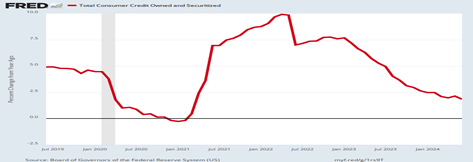
The Federal Reserve’s consumer credit measure for May—the 2nd month of the second quarter—just showed a big jump in consumer spending. Total consumer credit rose $11.3 billion in May, up from a $6.5 billion gain in the prior month, the Federal Reserve said Monday. 

The rise in May translates into a 2.7% annual rate says MarketWatch’s Jeffry Bartash, stronger than the 1.5% rise in the prior month. Revolving credit, like credit cards, jumped by a 6.3% annual rate in May after a rare 0.8 % fall in the prior month. Nonrevolving credit, typically auto and student loans, rose by a 1.4% rate after a 2.4% rise in the prior month.

Why is this important? Revolving credit (i.e., cards) is spent on everyday items as well as travel and leisure, and we are in the summer season of most travel. This jump is spending should mean a boost in consumer confidence going into the fall.

The Atlanta Fed GDPNow estimate of Q2 growth jumped today, which I believe is the best indicator of what the BEA’s Q2 initial estimate of growth might look like will be out in two weeks.

AtlfedGDPNow

“The GDPNow model estimate for real GDP growth (seasonally adjusted annual rate) in the second quarter of 2024 is 2.0 percent on July 10, up from 1.5 percent on July 3…after last Friday’s employment report from the Bureau of Labor Statistics and this morning’s wholesale trade report from the US Census Bureau…”

Real Domestic Private Investment, a major component of GDP growth, has also been surging. It is now growing at 5 percent in Q1 and is up a total 11 percent from Q1 2023 when it was shrinking. This is huge, because, remember I mentioned in a recent blog that more private investment in infrastructure as well as CHIPS and other manufacturing incentives built into Bidenomics lessens the need for taxpayer funding and hence lowers the budget deficit.

And in more good news, Fed Chair Powell remarked at today’s house congressional hearing that the Fed will not wait to reach its 2 percent target rate before beginning to cut rates.

This is the best of news, though it will now have investors worrying about some unseen dangers that may lie ahead that the Fed might be worrying about. What are they? Watch the news!

Harlan Green © 2024

Harlan Green on Twitter: https://twitter.com/HarlanGreen

Posted in Consumers, COVID-19, Economy, Keynesian economics, Weekly Financial News | Tagged , , , , | Leave a comment

The Irrelevance of MAGA Republicans

Answering Kennedy’s Call

This is another Huffington Post column I wrote in 2017 at the beginning of the Trump presidency. It’s about the irrelevance of his policies for most Americans that another Trump presidency would repeat, as well as further damaging our health and the environment, while making the world less safe.

“It’s sad that the President of the United States has become irrelevant to most of the problems facing Americans and the world. In choosing to return to a 1950’s that never was—the brief emergence of a white middle class—MAGA Trump is choosing to isolate himself and his constituency from the real world. Do we need a better definition of President Trump’s irrelevance?

Let’s start with his fiasco of an Asian trip, where he fawned over foreign leaders who gave him massive pageants, but no trade concessions, while abandoning the Trans- Pacific Partnership.

The remaining 11 countries, including Japan, Australia, Mexico and Malaysia, said they had revived the Trans-Pacific Partnership (TPP) deal, a multilateral agreement championed under the Obama administration.

The Guardian reported Ministers meeting in Danang, Vietnam agreed on the “core elements” of what was now called the comprehensive and progressive agreement for Trans-Pacific Partnership, a joint statement read.

And “American leaders from state capitals, city halls and businesses across the country have shown up in force” in Bonn, Germany, to discuss carrying out the 2015 Paris climate agreement,” said California Governor Jerry Brown and Michael Bloomberg in the New York Times.

This is when President Trump announced at the beginning of his Presidency that he was abandoning the Paris Accord in favor of supporting a return to coal and oil energy. But that isn’t happening for the rest of America, as some 50 percent of U.S. states and cities are represented in Bonn.

“California just extended its cap-and-trade emission program through 2030 and has adopted incentives that will help put 1.5 million electric vehicles on the road by 2025,’ said Jerry Brown, Governor of the sixth largest economy in the world.

Huffington Post

And the U.S. just released its latest congressionally mandated Climate Science Special Report that says 2017 wreaked the most catastrophic destruction in 90 years with an estimated $175 billion in property damage. Only the San Francisco Earthquake (1906), Chicago Fire (1871), and Great Flood (1927) caused more destruction.

What is Trump afraid of that he fawns over Chinese and Russian leaders, while extracting no concessions from them? He was seen to spend more time with Vladimir Putin at the Asia-Pacific Economic Cooperation summit in Vietnam than any other leader.

Even his support of Republicans’ so-call tax reform bills is irrelevant, as he wants Republicans once again to attempt to repeal the Obamacare mandate, when more than 50 percent of Americans now support Obamacare, according to the latest Kaiser Family Foundations Health Tracking Poll.

That is irrelevance of the highest order, and as many pundits have noted, it is also the definition of insanity: Republicans attempting to repeal Obamacare more than 30 times and expecting a different result.

Another feature of the tax reform bill is that it requires taking away approximately $1.5 trillion in Medicare and Medicaid benefits to give the wealthiest an unnecessary tax cut. Therefore, it won’t help the shrinking middle class, or any income class, except the top 1 percent.

Harold Myerson voiced recently in The American Prospect, “The United States now has the highest percentage of low-wage workers – that is workers who make less than two-thirds of the median wage- of any developed nation. Fully 25 percent of all American workers make no more than $17, 576 a year.”

The irrelevance of this President’s policies is therefore a real danger to our future health and standard of living in so many ways.

Harlan Green © 2024

Follow Harlan Green on Twitter: https://twitter.com/HarlanGreen

Posted in Consumers, COVID-19, Economy, Keynesian economics, Politics, Uncategorized | Tagged , , , , | Leave a comment

Fewer Jobs, Lower Rates?

Popular Economics Weekly

June’s unemployment report was weaker than expected. It looks like the labor market is slowing enough to convince the Fed that interest rates should come down. Not only fewer nonfarm payroll jobs were added to payrolls, but past months were revised downward because the Labor Department makes what are called seasonal adjustments, which are comparisons to past years’ job creation totals to create a more accurate picture of job growth.

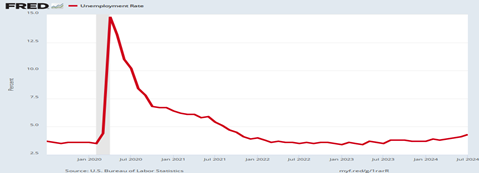
The FRED graph below gives the best picture of those adjustments. The unemployment rate ticked up to 4.1 percent in June from 3.8 percent in March. The sudden rise in the unemployment rate in the middle of the work year should alarm Fed officials.

Further evidence of slowing economic growth is that average hourly wage growth fell to 3.9 percent. It makes up to two-thirds of production costs for most businesses, and is now the main driver of inflation.

FREDunemployment 

Of the 206,000 jobs created, a 70,000 increase in new government jobs accounted for one-third of the total. Most were in state and local government, which is where most of the infrastructure modernization is happening.

Government hiring has surged over the past year as private-sector hiring has faltered. The private sector added just 136,000 in June. Health care, another fast-growing industry, created 49,000 new jobs. The construction industry increased payrolls by 27,000.

Yet leisure and hospitality, another industry that had been hiring lots of workers, only added 7,000 jobs. Such leisure activity employment has barely risen in the past three months. Employment also fell in professional and business services, retail, manufacturing and temporary work.

The slowdown in leisure and hospitality is the best sign that consumer spending has slowed, which will bring down Q2 economic growth. So, things are not looking so rosy for economic growth going forward.

It’s why many economists are calling for the Fed to now become proactive and mitigate any future slowdown. Cutting interest rates will first aid the severely constricted housing market with 30-year fixed rates now back above 7 percent. Manufacturing is barely staying afloat because investors are also waiting for lower borrowing costs.

This means the private-public projects in infrastructure and other parts of Bidenomics’ projects that are revitalizing the U.S. economy are mainly being paid for with taxpayer money. But the private sector will jump back in once the much-anticipated rate cuts begin.

And once a better private-public investment balance is restored, not as much taxpayer money will be needed to improve economic growth, and that is really the only way to bring down the federal debt. The annual increase in public federal debt to GDP ratio is just 4.1 percent in the first quarter 2024. It plunged -10 percent during the pandemic, per the FRED graph and returned to positive territory in Q2 2023, as spending on infrastructure projects picked up.

FREDpublicdebttoGDP

This truth will confound the budget hawks who want to cut spending to pay for the tax cuts Republican will keep proposing. But without such taxpayer investment in the future; (paying it forward, to quote Senator Elizabeth Warren), there is very little future growth. Nor is there a prosperous future in store for most Americans.

Harlan Green © 2024

Follow Harlan Green on Twitter: https://twitter.com/HarlanGreen

Posted in Consumers, COVID-19, Economy, Housing, housing market, Keynesian economics, Politics, Weekly Financial News | Tagged , , , , | 1 Comment

U.S. Economy Still Too Hot?

Financial FAQs

The battle is intensifying between the Fed Governors’ inflation doves and hawks as we approach November. Chairman Powell says inflation is getting closer to the Fed’s 2 percent target when we enter the 3rd quarter 2024, but he’s still not confident enough to advocate cutting interest rates.

This is while the Labor Department’s JOLTS report showed the number of job openings in the U.S. rebounded in May after falling to a more than three-year low, showing the demand for labor is still high.

It will only make the Fed’s decisions more difficult, since there is a lot of disagreement over how much the US economy will continue to grow (which the Fed worries might keep the inflation numbers too high).

Job postings rose to 8.1 million in May from 7.9 million in April, the Labor Department said Tuesday in its Job Opening and Labor Turnover Survey (JOLTS). Most of the increased hiring was in government. New openings have fallen from a record 12 million in 2022, but they are still higher than they were before the pandemic.

FREDjobopenings

An economic conference in Sintra, Portugal highlighted both sides of the inflation argument, with Chicago Fed President Goolsby saying Fed policy is now becoming too restrictive as the economy slows. It’s therefore time to consider cutting interest rates, though he didn’t want to “tie the Fed’s hand” by predicting when.

The best news was last week’s very weak Personal Consumption Expenditure (PCE) inflation index, which was flat. The Fed’s preferred inflation measure didn’t increase at all in June and annual inflation is now down to 2.6 percent.

And NYTimes Paul Krugman remarked in his latest Op-ed, “there’s a good case for arguing that inflation has been defeated, and that the Fed should start cutting interest rates.”

Friday will tell us another statistic the Fed looks at, the ‘official” US unemployment report, which will show how accurate are the job numbers.

Total nonfarm payroll employment increased by 272,000 in May, I wrote last month,, higher than the average monthly gain of 232,000 over the prior 12 months. The unemployment rate rose to 4.0 percent from 3.9 percent, slightly higher than the pre-pandemic levels of 3.5 percent when the average inflation rate was under 2 percent, as portrayed in the truncated FRED graph (gray line is 2020 pandemic recession), that many seem to remember so fondly.

The real argument is over who benefits from lower interest rates. Lower borrowing costs obviously benefit consumers in general; most in the middle and lower income brackets. But the Fed’s fear is that consumers will then spend more and thus drive up prices again, hence their hesitation in cutting interest rates just yet.

That in turn affects economic growth, which everyone wants, but not too much, if you can believe that. It stimulates more hires, which boosts wages, which the Fed believes is now the main inflation culprit.

The best predictor of economic growth has been the Atlanta Fed’s GDPNow estimate that gets revised at least twice a month. It has just been adjusted downward again in July1 to 1.7 percent, from as high in 3 percent one month ago.

It is now in line with the Blue Chip economists’ consensus of 2nd quarter growth, which should begin to worry Powell’s Federal Reserve. Real personal consumption and domestic investment have been falling, in line with last week’s PCE report I mentioned above.

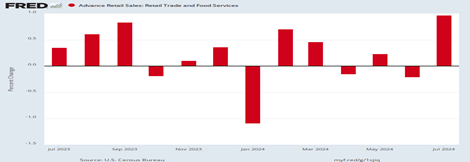
Retail sales last month were also flat, another concern as consumers look for more bargains and retailers such as Target and Walmart announce ever more discounts. The slowdown is now becoming a definite trend and better the Fed becomes proactive by nipping any downturn in the bud before the November election.

Harlan Green © 2024

Harlan Green on Twitter: https://twitter.com/HarlanGreen

Posted in Consumers, COVID-19, Economy, Weekly Financial News | Tagged , , , , | Leave a comment

The Bully Mentality–III

Answering Kennedy’s Call

JONATHAN ERNST / REUTERS

“Fostering a culture of fear and ignorance is not the way to run a political party, or country, if it would ever come to that.”

I wrote this in 2014 about what I have called the Bully Mentality pervading the Republican Party that has enabled it to coerce its own supporters to vote against their own self-interests, making Republican red states the poorest states in our country.

These are states that in the main have opposed a higher minimum wage, union organizing that would enable workers to bargain collectively, and rely on the richest states via transfer payments to fund much of their governments. (Red states such as Mississippi, W. Virginia, Montana and Kentucky receive more than 30 percent of their revenues from other states).

Why does the USA have such a problem with bullies? Whether in the schools, in politics, or on Internet social media? The result has been teenage suicides, horrendous school shootings by students who felt bullied or belittled, and now a whole political party that opposes anything that smacks of aiding the poorest, seniors, and less educated.

That possibility of becoming the Republican Party taking back the White House has come closer with former President Trump seeking a second term without ever conceding that he lost the last election.

The Bully Mentality is a state of mind that pervades those who are only good at one thing, preying on the weakest to empower themselves.

It is something Nobel Laureate Paul Krugman wrote about during the Obama administration when it created Obamacare.

“But nobody expects to see a lot of prominent Republicans declaring that rejecting Medicaid expansion is wrong, that caring for Americans in need is more important than scoring political points against the Obama administration. As I said, there’s an extraordinary ugliness of spirit abroad in today’s America, which health reform has brought out into the open.”

I said then the “ugliness” is really a textbook definition of bullying behavior

  • Derogatory name-calling and nicknaming
  • Spreading rumors or lying about someone
  • Threatening someone
  • Yelling at or talking to someone in a rude or unkind tone of voice, especially without justifiable cause
  • Mocking someone’s voice or style of speaking
  • Laughing at someone
  • Use of body language (i.e., the middle finger) to torment someone
  • Making insults or otherwise making fun of someone

The textbook definition fits former President Trump.

If the Republican Party can’t keep its constituents poor and less educated, then the Republican Party, now Trump’s party, would lose its hold over them. Conservatives oppose expanding educational opportunities such as Head Start and pre-school aid because it would encourage rational thinking, and an appreciation of science. Their constituents would then begin to understand global warming, and maybe evolution instead of creationist theories that the world was created by a God just 7,000 years ago!

The danger of such behavior is even greater today. We have a Republican presidential candidate who has no compunction about endangering our national security by wanting to weaken NATO and other alliances, been indicted and awaiting trial under the Espionage Act for his carelessness with Top Secret documents, and endangered our economic security with his tax cuts that have created record deficits.

How then have Republicans been given the edge in various polls on the economy and foreign policy? It is another attribute of bully behavior—the total disregard for truth and facts that is at the heart of their propaganda machine.

There are many ways to counter the bully mentality. Firstly, by recognizing that bullies are cowards at heart, which is why they avoid confronting those showing strength. It creates a pervasive culture of victimization, a feeling of powerlessness in which those so afflicted transfer their allegiance to a con artist such as Donald Trump.

That is how dictators all over the world have taken and maintained power. Can that happen to the world’s oldest democracy? It’s up to ordinary citizens to stand tall in opposing such behavior. It’s surprising how quickly bullies will disappear when citizens take back their own strength.

Harlan Green © 2024

Follow Harlan Green on Twitter: https://twitter.com/HarlanGreen

Posted in Economy, gun violence, Politics | Tagged , , , , | 1 Comment

Consumers Not So Confident?

The Mortgage Corner

What are we to make of the Conference Board’s latest confidence survey?

“The decline in confidence between May and June was centered on consumers aged 35-54. By contrast, those under 35 and those 55 and older saw confidence improve this month,” said Dana M. Peterson, Chief Economist at The Conference Board.

Conference Board

We are in the midst of one of the greatest economic recoveries in history—from the worst pandemic in more than 100 years. Yet most consumers lack confidence because they don’t know where to look for information on the real economy, as opposed to what is on social media or in mass media headlines.

“Confidence pulled back in June but remained within the same narrow range that’s held throughout the past two years, as strength in current labor market views continued to outweigh concerns about the future. However, if material weaknesses in the labor market appear, confidence could weaken as the year progresses,” said Peterson

I believe this reflects the fact that most consumers like their current circumstances, but not outside events that may forecast the future. Why isn’t the rest of the world doing as well as Americans, say the headlines?

A lot of the confusion unfortunately comes from social media which doesn’t differentiate fact from fiction. A recent poll maintained that 50 percent of those surveyed believe we are in a recession, when real GDP growth has averaged 2 percent since the pandemic, and we are at full employment.

It reflects what I have called irrational pessimism. The other side of the coin is irrational exuberance, when excessive optimism that prices will almost always rise can cause asset bubbles.

Nobel laureate economist Robert Shiller has written about it. That’s because most market investors rely on hearsay and word of mouth, rather than research that would paint a more accurate view of market conditions.

Much of Main Street, ordinary working adults in the main, have become irrationally pessimistic for that reason. Surveys such as a recent poll by PEW Research show this.

“About three-in-ten Americans (28%) currently rate national economic conditions as excellent or good, while a similar share (31%) say they are poor and about four-in-ten (41%) view them as “only fair.”

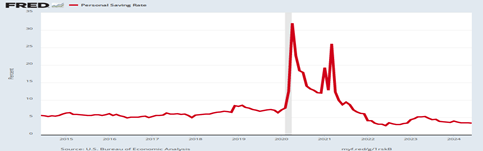
I also believe most Americans are emotionally exhausted and still recovering from the pandemic, so they are now spending less which is slowing economic growth.

BEA.gov/CRFB

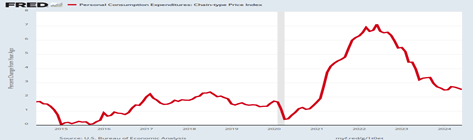
That is reflected in the major inflation indexes which were all flat in May. The Fed’s preferred Personal Consumption Expenditures (PCE) monthly inflation index didn’t rise at all on Friday in line with retail CPI prices (in blue line) reported earlier this month as seen in above graph.

When will consumers begin to realize this? Maybe in September when the Fed is now predicted to begin to lower their interest rates. That should make all of US happier!

Harlan Green © 2024

Follow Harlan Green on Twitter: https://twitter.com/HarlanGreen

Posted in Consumers, COVID-19, Economy, Uncategorized, Weekly Financial News | Tagged , , , , | Leave a comment

Our 2nd Amendment Doesn’t Protect Children

Answering Kennedy’s Call

Gun rights advocates, the NRA, and Republican Party have never been serious when calling for the enforcement of the 2nd Amendment, because they have never called for the enforcement of a child’s right of self-defense, the most vulnerable affected by gun violence, only adults’.

Otherwise, they would support U.S. Surgeon General Vivek Murthy’s first-of-its-kind advisory declaring gun violence a national public health crisis and recommending it be treated as such.

SFGate

The 40-page publication from U.S. Surgeon General Vivek Murthy released this week outlines the scope of firearm violence, its impact on victims and communities and a slew of policy suggestions for lawmakers, community leaders and health systems.

Dr. Murthy’s advisory said that firearm-related injury has been the leading cause of death for U.S. children and adolescents since 2020 — when it surpassed car accidents — and that ever-common instances of gun violence are taking not only a physical but also a mental toll on survivors, families and community members at large.

A recent national survey found that 54% of U.S. adults or their family members have experienced a firearm-related incident. And, linking gun violence to mental health, the advisory also notes that nearly 6 in 10 U.S. adults say they worry either sometimes, almost every day or daily about a loved one becoming a victim.

Some of the advisory’s recommendations — which are not enforceable — include increasing federal funding for gun violence prevention research, more community investment in educational programs and mental health resources and nationwide policy changes like an assault weapons ban and universal background checks.

AMA President Bruce A. Scott, M.D,, immediately responded to Dr. Murthy’s advisory: “Across the country, physicians everywhere treat patients and families afflicted by firearm violence. We see the physical and emotional harm firsthand, and we dread the too-often conversations with parents, spouses, and even children in which we tell them their loved one did not make it.

“Firearm violence is indeed a public health crisis in the United States, and the data now show it touches the majority of Americans. We applaud the Office of the Surgeon General for issuing this advisory and for outlining an evidence-based public health approach to addressing firearm violence,” said Dr. Scott.

I wrote a 2016 Huffington Post piece when the American Medical Association first adopted a policy calling gun violence in the United States “a public health crisis” requiring a comprehensive public health response and solution,” at their annual convention.

That was when the tide began turning in some states and a powerful new gun control group emerged called Everytown for Gun Safety, a combining of several smaller gun control groups, including Women Against Gun Violence and Mom’s Demand Action. It was when former New York Mayor Michael Bloomberg was about to launch Everytown for Gun Safety with a pledge of $50 million, but because it lacked foot soldiers merged with the women’s groups and now totals 3.5 million supporters.

Maybe that is why an eight-member Supreme Court at the time allowed a lower court ruling banning assault weapons to stand, which in effect means that the Second Amendment right to own guns does have limits. The U.S. Supreme Court left in place gun control laws in New York and Connecticut that ban military-style assault weapons like the one used in the massacre at an Orlando nightclub, rejecting a legal challenge by gun rights advocates at the time.

The New York and Connecticut laws, among the strictest in the nation, were in fact enacted after a gunman with a semiautomatic rifle killed 20 young children and six educators in 2012 at Sandy Hook Elementary School in Newtown, Connecticut. In total, seven states and the District of Columbia have banned semiautomatic rifles.

Among the stark statistics: 48,204 people have died from firearm-related injuries (including suicides, homicides and unintentional deaths) in 2022, after that number reached a near three-decade high the previous year, reports NPR.

The rate of firearm-related suicide grew by 20% between 2012 and 2022, with the highest increases among young people between 10 and 34 years old—our children!

And Nicholas Kristof wrote an earlier NYTimes Op-ed that said more Americans had died from gunfire since 1968 than in all the wars ever fought by the United States — a claim PolitiFact twice pronounced to be true.

A public health approach, Murthy said in the report, can guide the nation’s strategy and actions “as it has done in the past with successful efforts to address tobacco-related disease and motor vehicle crashes.”

Our Surgeon General has now begun a national discussion about the latest public safety menace, the epidemic of gun violence. It requires similar treatment as did the Ebola and Zika epidemics–eradication of the carriers of that violence, which means stricter licensing requirements for starters, and maybe the banning of military-style assault weapons in all states.

Can we hope as much, given the Republican Party has opposed almost any form of gun regulation, given the upcoming Presidential election?

Harlan Green © 2024

Harlan Green on Twitter: https://twitter.com/HarlanGreen

Posted in Consumers, gun violence, Politics | Tagged , , , , | Leave a comment

“Australians Not Like U.S.”

Answering Kennedy’s Call

Huffington Post

We happened to be in Australia in 2015 when this Sydney journalist voiced his reaction to another mass killing in America. “The US is too immature a society to be allowed to play with guns.”

And as I update this column today, there were four more mass shootings on the first weekend of summer, 2024—27 injured or killed this last weekend.

We are two countries with almost identical demographics, but where the Australian minimum wage for full-time, working adults is more than $16Aus per hour and Australian’s have created a health care system that pays for all normal health care costs (as opposed to catastrophic events), though hospital care is free for every Australian citizen.

Yet we cannot control the gun violence that Australians have been able to. It is a startling contrast that I first wrote about during the Obama administration.

“Australia is not like the U.S.” said commentator Michael Pascoe in the Sydney Morning Herald in response to President Obama’s remarks on the Umpqua Community College killings by a deranged killer, whose mother kept at least 8 guns at home, in addition to the 6 guns plus ammunition carried by the shooter in the slaughter of college students and a teacher.

“We know that other countries in response to one mass shooting have managed to craft laws that almost eliminate mass shootings,” said President Obama. “Friends of ours, allies of ours, Great Britain, Australia, countries like ours.”

In fact, the US now has a gun homicide rate 370 times that of Australia’s. “Unlike the US,” said Pascoe, “we collectively decided to have a decent social safety net, the concept of a living wage and make good education freely available. Most of us are wary of those with extreme views of any kind.”

Our gun problem of course extends beyond mass violence, says the LA Times. In 2014 alone, for example, the Centers for Disease Control and Prevention recorded 11,208 people shot to death, 33,636 injured by gunfire and 21,175 who killed themselves with a gun. That’s a total of 66,019 people who were killed or injured by a gun, which comes out to 1,269 per week, 180 a day or 7.5 per hour.

Current Australian gun laws were passed after 35 were killed and 23 wounded in 1996. There hasn’t been a mass shooting in Australia since. At the heart of the new laws was a massive buyback of more than 600,000 semi-automatic shotguns and rifles, or about one-fifth of all firearms in circulation in Australia. The country’s new gun laws prohibited private sales, required that all weapons be individually registered to their owners, and required that gun buyers present a “genuine reason” for needing each weapon at the time of the purchase, as well as a 28-day waiting period while backgrounds were checked. (Self-defense did not count.) In the wake of the tragedy, polls showed public support for these measures at upwards of 90 percent.

“The US is too immature a society to be allowed to play with guns,” said Pasco. “It has never shed its Wild West mythology. Americans still use their courts to kill people, which sends a message in its own way.”

It has been known for years by those who research gun violence that more gun killings occur in households owning guns. A new survey in the Annals of Internal Medicine narrows down some of the causal relationship between guns and death by finding conclusively that having a gun in your home makes you more likely to successfully attempt suicide. The authors of the survey also found with a lesser degree of certainty that people with guns in their home are more likely to be the victims of a homicide.

According to data gleaned from State and Justice departments for the period between 2001-2011, there have, in fact, been many, many more Americans killed by gun violence than by terrorism. During that 10-year period, some 130,347 have lost their lives to gun violence, compared to the approximately 3,000 Americans killed in acts of terrorism.

“It’s all fodder for the deranged fanatics of the American gun lobby, with a bible in one hand and an assault rifle in the other. It’s fuel for the paranoid interpretation of a line in the constitution that is a blatant anachronism,” said the study

We have to be a very sick society to have allowed this to happen. We are so good at preventing foreign terrorists from attacking us, but not protecting Americans from domestic terrorists. We should understand that gun violence itself is an act of terror. And those that support unrestricted use and purchase of guns are the sponsors of domestic terrorism.

Harlan Green © 2024

Follow Harlan Green on Twitter: https://twitter.com/HarlanGreen

Posted in COVID-19, Economy, gun violence, Politics | Tagged , , , , | Leave a comment

A Greater Lawlessness–On Tyranny

Answering Kennedy’s Call

Could we re-elect a tyrant as President? It’s hard to believe the clownish behavior and blatant lies of former President Donald Trump could again put him in the Whitehouse this November.

But author and history Professor Timothy Snyder says it has all the makings of a possible return in On Tyranny, a pamphlet-size book that I first wrote about in 2017.

On Tyranny

It has 20 valuable lessons on how to avoid tyrannical governments, such as almost happened in 2017 and could happen again in Washington with one political party possibly controlling all three branches of government, now that a conservative majority controls the Supreme Court, and a Republican Party is not only quiescent to his blatant lawbreaking but in some ways has aided and abetted it.

“As they know,” Snyder begins in his Prologue, “Aristotle warned that inequality brought instability, while Plato believed that demagogues exploited free speech to install themselves as tyrants.”

We now have the greatest income inequality since 1929, and it led to the Great Recession and political polarization we have today. A President Donald Trump would not have been possible if incomes hadn’t declined so drastically for those dissatisfied white male voters from the rustbelt.

And then there was the Russian meddling in our media with thousands of bots sending out fake social media news, Tweets, and Wikileaks exploiting the hacked Democrat’s emails, not to speak of Breitbart propaganda inflaming the alt-right, all white nationalists.

Professor Snyder listed three of the most important lessons on HBO’s Bill Maher show.

#1) “Don’t obey in advance—Most of the power of authoritarianism is freely given. In times like these, individuals think ahead about what a more repressive government will want, and then offer themselves without being asked.”

How could that happen? How could West Virginians in the heart of what was formerly coal country vote more than 2 to 1 for Donald Trump over Hillary Clinton in a historically Democratic state?

This led to the rollback of environmental laws during the last Trump administration that allowed more coal mining, as well as coal-powered plants, when more than 250 coal plants have already closed with cheaper natural gas replacing coal.

It is mainly out of ignorance of what was in their best interests. Coal now occupies but a minor position in W Virginia’s economy with natural gas and renewable energies having replaced it since 1980, according to Nobel Economist Paul Krugman.

#2) “Defend Institutions—It is institutions that help us to preserve decency. So choose an institution you care about—a court, a newspaper, a law, a labor union—and take its side.”

Sound familiar? What has Donald Trump been attacking—the courts, the media (“enemies of the people”), laws that prevent conflicts of interest, and labor union laws that protect worker safety. I might add scientific facts, as he has said he believes global warming is a “hoax”. Trump in effect is attacking all the institutions that preserve decency and a functioning democracy.

“Institutions do not protect themselves. They fall one after the other unless each is defended from the beginning,” said Professor Snyder.

#3) “Above all believe in truth,” because without truth there is no trust, and without trust there are no effective laws, which leads to tyranny. And Republican candidate Donald Trump has made a point of blatant lying, meaning he wants his followers to believe whatever he says rather than objective facts such as global warming, his loss to Joe Biden in 2020, even the size of the audience that attended his last inauguration.

This can only be because his followers have acquiesced in advance, either out of ignorance of the actual facts, or because they will follow him regardless of the consequences to themselves and the nation.

We can only preserve democracy and defeat tyranny in all its forms—including fascism, racism, discrimination, propaganda, and oligarchies, if we learn from history.

“History does not repeat, but it does instruct,” says Professor Snyder in On Tyranny, a must read for anyone wanting to understand the wholesale capitulation of the Republican Party to Donald Trump.

Harlan Green © 2024

Harlan Green on Twitter: https://twitter.com/HarlanGreen

Posted in Consumers, COVID-19, Economy, Politics, Weekly Financial News | Tagged , , , , | Leave a comment