How Do We Solve It?

The Mortgage Corner

I speak of the housing shortage, as much as 2 million residential units—owner-occupied and rental units—according to housing economists. What is to be done with mortgage rates at historic highs and material shortages everywhere?

Much of it was the result of the busted housing bubble, and the overbuilding of some one million housing units in the early 2000s. The Great Recession followed, when millions more lost their homes. Construction activity ground to a halt and we are still playing catchup.

Calculated Risk

Sales of previously owned homes in May fell 0.7% to a seasonally adjusted annual rate of 4.11 million. The stronger-than-anticipated result was still the lowest rate since January and about 20% below the long-term average for May of more than 5 million sales said Calculated Risk. It was the lowest May number since the housing market was recovering from the immediate shock of the Covid-19 pandemic in 2020.

The supply of existing homes for sale is growing slowly. At May’s sales pace, it would take 3.7 months to sell every home on the market. That is the highest in four years, according to Lawrence Yun, the Realtor’s chief economist.

“Eventually, more inventory will help boost home sales and tame home price gains in the upcoming months,” Yun said in a statement. “Increased housing supply spells good news for consumers who want to see more properties before making purchasing decisions.”

Just looking at the existing home sales graph, as many as 7 million homes were sold in early 2000 when the housing bubble peaked. Irrational exuberance reigned, and consumers thought housing prices could never fall. Sales rose again to more than 6 million units in early 2020 when interest rates plunged again during the pandemic.

Zillow the real estate data company, maintains from 2021 to 2022, the U.S. housing shortage grew to 4.5 million homes, up from 4.3 million, while in 2022 the number of U.S. families increased by 1.8 million, while only 1.4 million housing units were built.

It’s the same problem today. Privately‐owned housing starts (i.e., under construction) in May 2024 were at a seasonally adjusted annual rate of just 1,277,000. This is 5.5 percent below the revised April estimate of 1,352,000 and is 19.3 percent below the May 2023 rate of 1,583,000.

Today it is the direct result of the Fed’s inflation fight. High interest rates have driven up the cost of everything, since real estate is dependent on borrowing large sums of money, as any homebuyer can tell you.

It’s also hurting home builders, as Builder confidence in the market for newly built single-family homes was 43 in June, down two points from May, according to the National Association of Home Builders (NAHB)/Wells Fargo Housing Market Index (HMI). This is the lowest reading since December 2023.

“We are in an unusual situation because a lack of progress on reducing shelter inflation, which is currently running at a 5.4% year-over-year rate, is making it difficult for the Federal Reserve to achieve its target inflation rate of 2%,” said NAHB Chief Economist Robert Dietz.

The best way to bring down shelter inflation and push the overall inflation rate down to the 2% range is to increase the nation’s housing supply, say the builders. “A more favorable interest rate environment for construction and development loans would help to achieve this aim,” said Dietz.

The Fed can see that inflation has been tamed, as much as possible, given their predictions for strong economic growth the rest of this year. I may be overdoing the bold lettering to make such an obvious truth but what else would boost the housing supply and so reduce inflation?

Harlan Green © 2024

Follow Harlan Green on Twitter: https://twitter.com/HarlanGreen

Posted in Consumers, COVID-19, Economy, Housing, housing market, Weekly Financial News | Tagged , , , , | Leave a comment

Retail Sales Falter–What May Follow?

Financial FAQs

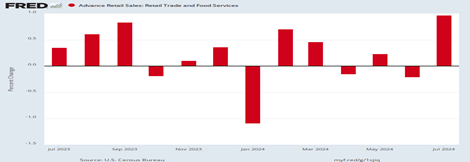
American consumers are tiring after two years of no relief from higher prices and interest rates. They are now looking for bargains everywhere in the latest retail sales report from the Census Bureau.

It’s the second month of the second quarter that sales have disappointed, and consumer spending is a large part of Q2 growth.

FREDretailsales

“Advance estimates of U.S. retail and food services sales for May 2024, adjusted for seasonal variation and holiday and trading-day differences, but not for price changes, were $703.1 billion, up 0.1 percent (±0.4 percent) * from the previous month, and up 2.3 percent (±0.5 percent) above May 2023,” said the U.S. Census Bureau.

This was in part because gas prices had declined -2.2 percent. Revised April retail sales declined -0.2 percent. The retail report is going to boost both stock and bond prices, which means interest rates should continue to decline. It also means consumers are spending less on travel and entertainment, parts of the service sector that have been powering most of the economic growth to date.

The biggest negative in the May retail report was a 0.4% decline in spending at restaurants. Restaurant spending has fallen in four of the past six months for the first time since the pandemic. Sales also fell at home centers, grocery stores and stores that sell furniture — a residue of rising housing prices and high mortgage rates.

Yet sales rose at internet retailers, clothing outlets and big-box electronics stores, suggesting Americans still have some money left over to pay for so-called discretionary goods, or things people want, rather than need, to buy.

But manufacturing is taking up some of the slack as overall industrial production rose 0.9% in May, the Federal Reserve also reported on Tuesday. That is the biggest gain since last July. The manufacturing component rose 0.9% in May after a 0.4% fall in the prior month. 

Part of the boost was from motor vehicles and parts output that jumped 0.6% after a 1.9% drop in the prior month. Excluding cars, total industrial output increased 0.7%, so auto sales are helping to boost growth.

What does it mean for Q2 economic growth? Estimates are still all over the map. The latest data was good enough to keep the Atlanta Fed’s GDPNow estimate of Q2 growth at 3.1 percent, up from 2.6 percent on June 6. It remained above 3 percent because a drop in PCE (consumer spending) was outweighed by a rise in second-quarter real gross private domestic investment growth (i.e., replacing inventory and buying new equipment) and second-quarter real government spending growth (on such as combatting climate change and modernizing the American economy).

Fed officials now must decide if they want to slow economic growth even more, and maybe risk a downturn come the fall. Do they want to spoil the holidays? I wonder if they will dare in this election year.

Harlan Green © 2024

Harlan Green on Twitter: https://twitter.com/HarlanGreen

Posted in Consumers, COVID-19, Economy, Politics, Weekly Financial News | Tagged , , , , | 1 Comment

Greater Lawlessness Causes Greater Gun Violence

Answering Kennedy’s Call

I first wrote this Huffington Post piece in 2017 after the October 1 killing of 58 people with bump stock-equipped assault rifles at a Las Vegas music festival. It was one of a series on the growing lawlessness that is tearing US apart.

Nothing has changed with the Supreme Court now deciding the executive government, in the form of its ATF agency, did not have the power to outlaw bump stocks because when equipped with same, an assault rifle didn’t fit the exact definition of a machine gun, which is illegal for civilian use.

The SCOTUS majority has caused a greater lawlessness because there is now no law or regulation to prevent the use of bump stocks in more mass killings.

“Guns don’t kill people, people kill people” has been the credo of NRA, gun lobby and most Republicans since the 1980s when gun manufacturers came up with automatic pistols, so that guns could fire more rapidly.

But Las Vegas shooter Stephan Paddock had no discernible mental illness, criminal record — or anger problems, according to his brothers. The NRA will try in vain to find a reason this inhuman act was committed when there is no reason, other than the fact that military-style weapons are legal in most of America and easily obtainable.

Paddock’s assault rifles reportedly fired 1,000 rounds in 11 minutes, which is more than one round per second (1.5 rounds, actually). How is that not a machine gun?

Only guns can kill that many people — always the most vulnerable unable to defend themselves. His brothers didn’t even know he was a gun nut who owned more than 30 weapons and was able to smuggle in 10 suitcases containing 23 of those weapons without any Mandalay Bay Hotel staff even noticing such an oddity. Who needs that many suitcases in a hotel room?

President Trump’s administration did ban bump stocks at the time. But not for long with the Supreme Court majority now stepping in to make them legal again.

No existing laws now protect children in elementary and high schools from military-style assault rifles because in Justice Alito’s words, congress must decide, which said congress hasn’t been able to do.

For shame on the conservative SCOTUS majority.

Australia, the country most like US in population, had a similar gun problem until 36 people were killed in Port Arthur, and Prime Minister John Howard was able to pass strict gun control laws in 1996, the same year of the Port Arthur massacre. There hasn’t been a mass killing since then in Australia.

Australians apparently don’t believe owning an assault rifle is the ticket to manhood. Their gun control laws are maintained by weapon buyback programs and the requirement that gun owners must belong to a certified gun club.

How did our gun laws become so lax that military-style weapons are this easy to obtain? It was a little-known Supreme Court decision authored by its most extreme ideologue, Justice Antonin Scalia, in the 1980s which said that said gun owners no longer must heed the constitutional Second Amendment stricture that owners of such guns be members of a well-regulated militia.

Our founding fathers must have put the works, “a well-regulated militia” in the Second Amendment for a reason. Las Vegas shooter Stephen Paddock was not a member of a well-regulated militia.

Harlan Green © 2024

Follow Harlan Green on Twitter: https://twitter.com/HarlanGreen
Posted in gun violence, Politics, Uncategorized | Tagged , , , , | Leave a comment

No More Inflation?

Popular Economics Weekly

It will probably be hard to believe for those scarred by the post-pandemic inflation scare that inflation isn’t declining, but there was no inflation increase in May for both wholesale (PPI) and retail (CPI) inflation indexes.

Yes, for the first time in two years the Consumer Prices Index was unchanged, a zero-point inflation rise. Wholesale inflation, the Producer Price Index out the next day was unchanged for the first time in one year.

FREDcpi

What does that tell us? Firstly, gas prices and housing (rents) have been declining of late after an initial uptick in the first quarter due to various shortages. Consumers are also becoming more cautious when they shop with major retailers like Target, Walmart, and grocery chains that are beginning to discount their products as shoppers look for bargains.

It will cause bonds in particular to rally because interest rates, including mortgages, finally begin to decline from their two-year highs.

FREDppi

U.S. wholesale (PPI) prices fell in May for the second time in three months — thanks partly to lower gas prices — in perhaps another sign an upturn in inflation earlier this year is fading. The producer price index actually fell 0.2% last month, the government said Thursday.

The retail and wholesale graphs illustrate the sudden drop in inflation, and the fact that the Q1 shortages were temporary. So, now it’s largely leisure activities—e.g., dining out, travel—in the service sector of the American economy, and housing rents that have kept consumers spending and the overall inflation rates higher.

This all fits in neatly with why the Fed believes it must keep interest rates high enough to slow down consumer spending even more, so that borrowing costs, for instance, remain intolerably high (i.e., with 8.5% Prime Rate). And that’s probably why last month’s retail sales were flat.

The cost of goods dropped 0.8 percent largely because of falling gas prices. Food prices also declined. The cost of services, the biggest driver of inflation, was unchanged in May after a big increase in the prior month.

The gradual slowdown in activity is obviously working. Weekly initial claims for unemployment insurance have been rising, signaling a slowdown in hiring. Initial jobless claims rose 13,000 — to 242,000 — in the week ending June 8, the Labor Department said also on Thursday.  That’s the highest level of claims since last August.

What’s keeping the Fed from cutting rates is that wages are still climbing 4.1 percent and Fed officials believe, for some reason, that the unemployment rate should rise above 4 percent—i.e., more employees must lose their jobs for inflation to decline further.

Housing rents, the main ingredient of retail CPI inflation, won’t come down until more housing is built. But that can’t happen until lower interest rates stimulate both the construction and sales of more homes!

That’s playing brinkmanship, in my opinion. It’s not taking into account the possibility of a major geopolitical surprise spooking financial markets, or consumers who are no longer flush with savings from the pandemic aid.

It could be China invading Taiwan, for instance? One can also imagine what might happen if North Korea accidentally sets off a nuclear confrontation. The Russian Navy is now also making regular visits to Cuba, and President Kennedy’s Russian missile crisis is not a very distant memory.

Harlan Green © 2024

Follow Harlan Green on Twitter: https://twitter.com/HarlanGreen
Posted in Consumers, COVID-19, Economy, Housing, housing market, Politics, Weekly Financial News | Tagged , , , , | Leave a comment

Greater Lawlessness Causes Great Recessions

Financial FAQs

I began writing about Republicans’ disregard for laws in 2012 after the Great Recession of 2007-09, in which as many as 8 million jobs were lost. But not the Republican Party’s lawlessness, though it has always been the party of the wealthiest oligarchs fighting for lower taxes and downsizing of the IRS that monitors their tax shelters.

There were always lawbreakers in both political parties, but I never thought it possible that Republicans would allow a convicted felon to take over their party, who is now their presidential candidate, and who advocates programs that could cause another Great Recession.

Larry Summers, former treasury secretary under the Bill Clinton administration who also has served as the top White House economic adviser for former President Barack Obama, told The Atlantic as cited in MSN.com, of economic policies Trump wants to enact that could increase inflation, if re-elected, and perhaps lay the groundwork for another recession.

“These included compromising the independence of the Federal Reserve Board, enlarging the federal budget deficit by extending his 2017 tax cuts, raising tariffs, rescinding Biden policies designed to promote competition and reduce ‘junk fees,’ and squeezing the labor supply by restricting new immigration and deporting undocumented migrants already here,” The Atlantic wrote in an article published last Sunday.

But that is just the beginning. Trump wants to weaken regulatory oversight by appointing more political appointees if elected that would carry out his agenda, a major cause of the Great Recession, who could neutralize officials and whole departments that enforce regulations, a major cause of the Great Recession under President GW Bush.

There were many causes of the Great Recession, but front and center were the GW Bush administration appointing officials who consciously downgraded governmental powers of enforcement so that regulators such as the SEC looked the other way when Goldman Sachs, for instance, sold funds that they then secretly bet against would fail.

Real laws were broken then — from conflicts of interest to outright fraud that were never prosecuted. The 2010 congressional hearings unveiled much of the double dealing that was rationalized by Goldman Sachs’ buyer-beware code — its clients should be sophisticated enough to know that Goldman would try to maximize its own profits, before those of its clients.

Saez/Piketty

A culture of greater lawlessness can be traced back to the early 1980s when President Ronald Reagan trumpeted that government was the problem and more private enterprise the solution for greater prosperity.

The number of convicted criminals in those administrations tells part of the story. President Reagan’s administration was marked by multiple scandals, resulting in the investigation, indictment, or conviction of over 138 administration officials, the largest number for any U.S. president.

And Salon.com had documented 34 incidents of law-breaking in just the first 4 years of G.W. Bush’s Presidency, the most blatant being unmasking covert CIA operative Valerie Plame, and its fabricated claims that Iraq had weapons of mass destruction.

Former President Trump is the latest example with dozens of convicted felons in his administration that he pardoned while still President.

“Deficits don’t matter” was the infamous chant of Bush VP Dick Cheney. At a time when economic inequality had risen to levels last seen in the 1920s, these administrations wanted to divert attention from a vanishing social safety net by proposing the ago-old Darwinian solution — the free market. For only the fittest will survive in a world ruled by self-interest, rather than laws and regulations.

The United States, beginning in the 1980s once again became the most ardent advocate and practitioner of the oldest form of capitalism, now a primitive relic of 18th century enlightenment. This is but one part of our aging democracy that U.S. hegemonists put up as the model for western civilization. But it is a very imperfect model for the rest of the world as well.

A 2002 survey of 38,000 people in 44 countries by the Pew Center for the People and the Press found what they think of our American Way. “Since 2000, favorability ratings for the U.S. have fallen in 19 of the 27 countries where trend benchmarks are available … pluralities in most of the nations surveyed complain about American unilateralism,” says the study. They think we disregard their interests in pursuit of our own self-interest.

Few dispute that our capitalistic economic system has won the day. It produces great wealth, particularly for those at the top of the wealth pyramid. Robert Reich’s book, The Future of Success said it best: “By the end of the (20th) century, the richest 1 percent of American families, comprising 2.7 million people, had as many dollars to spend after taxes as the bottom 100 million.”

It is also no coincidence 25 states have now passed anti-union Right to Work laws that are also the poorest states with the highest income inequality, lowest educational achievement, and receive the most in public subsidies. Taking incomes and wealth away from those states’ workers can only make them poorer in relation to other states and regions that is a continuing drain on public finances.

It is the real lesson of our greater lawlessness. By choosing to break laws and regulations that govern economic activity, some regiond are being pushed back to levels of past centuries, including holding the minimum wage at $7.25 per hour. Workers will only produce more and better products and services when they have the incentive to do so.

In the end, such greater lawlessness means a disregard for everyone but one’s own clan or tribe, a greater selfishness. No country can remain prosperous with such a breakdown in social welfare. That is the lesson learned from the Great Depression and Great Recession. Policies that ignore economic as well as civil laws and well-being, that continue to divert incomes and wealth to the wealthiest, impoverish all of US.

Harlan Green © 2024

Harlan Green on Twitter: https://twitter.com/HarlanGreen
Posted in Consumers, COVID-19, Economy, Keynesian economics, Politics | Tagged , , , , | Leave a comment

Where’s the Recession–Part II?

Financial FAQs

The unemployment report for May had little weakness, further evidence that the recent Harris poll results—in which 55 percent of those surveyed believed the US is in a recession—doesn’t reflect reality.

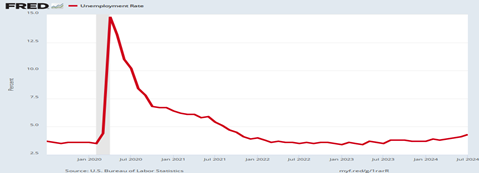
In fact, total nonfarm payroll employment increased by 272,000 in May, higher than the average monthly gain of 232,000 over the prior 12 months. The unemployment rate rose to 4.0 percent from 3.9 percent, slightly higher than the pre-pandemic levels of 3.5 percent when the average inflation rate was under 2 percent, as portrayed in the truncated FRED graph below (gray line is 2020 pandemic recession), that many seem to remember so fondly .

More jobs were added to payrolls in almost all sectors. Health-care providers added 68,000 jobs last month, hotel, restaurants and other leisure companies hired 42,00 new workers, and government employment rose by 42,000.

It’s more evidence, in my opinion, of a collective amnesia that several historians have maintained. Many Americans don’t want to remember the horrors of one million dead from COVID-19; and haven’t been able to move on in one of the greatest economic recoveries since the Great Depression.

It’s the main reason government employment has risen for state and local jurisdictions as well where most of the infrastructure modernization is taking place.

FREDunemployment

There were some signs of a weakening labor market. A survey of households showed a 408,000 decline in the number of people who said they were employed, the biggest drop since the end of 2023. The size of the labor force also shrank by 250,000 for the first time in four months. That explains why the jobless rate hit 4 percent after 27 straight months below that number.

But that doesn’t explain the Harris results, whereas prices remaining high and inflation still hovering in the 3 percent might. No one likes rising prices that boost the cost of everything, and the shock of the sudden rise in prices after the pandemic had to be almost as traumatic as the pandemic itself.

But it was mostly due to the worldwide shutdown of supply chains. Long Beach, California once had more than 50 container ships waiting offshore to unload their cargo that totaled as much as $2 trillion in value during the shutdown. That’s a lot of goods that couldn’t get to markets, a supply shortage that is the major reason for the price shocks. So the Harris poll may be measuring the effects of that emotional shock.

What else can explain its divergence from how the US economy is behaving in the post pandemic recovery with its record job creation? More Americans are working than ever.

Professional, scientific, and technical services added 32,000 jobs in May, higher than the average monthly gain of 19,000 over the prior 12 months, said the report. Employment increased in management, scientific, and technical consulting services (+14,000) and in architectural, engineering, and related services (+10,000). Specialized design services lost 3,000 jobs.

To repeat, the Harris poll said:

· 55% believe the economy is shrinking, and 56% think the US is experiencing a recession, though the broadest measure of the economy, gross domestic product (GDP), has been growing.

· 49% believe the S&P 500 stock market index is down for the year, though the index went up about 24% in 2023 and is up more than 12% this year.

· 49% believe that unemployment is at a 50-year high, though the unemployment rate has been under 4%, a near 50-year low.

“What Americans are saying in this data is: ‘Economists may say things are getting better, but we’re not feeling it where I live,’” said John Gerzema, CEO of the Harris Poll. “Unwinding four years of uncertainty takes time. Leaders have to understand this and bring the public along.”

What will it take for more Americans to accept the fact that the US economy is doing very well and more Americans are working then ever? It probably doesn’t help that a very divisive presidential campaign is beginning to heat up.

Harlan Green © 2024

Harlan Green on Twitter: https://twitter.com/HarlanGreen

Posted in Consumers, COVID-19, Economy, Keynesian economics, Politics, Weekly Financial News | Tagged , , , , | 1 Comment

Fed’s Preferred Inflation Indicator Softens

Popular Economics Weekly

The latest economic data show the US economy slowed in Q1 2024, but economic growth should increase in the second quarter because consumers will continue to spend.

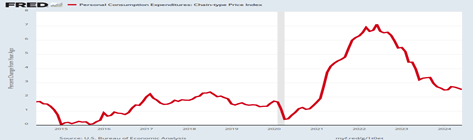
Personal Consumption Expenditures (PCE), the best measure of overall consumer spending, fell slightly to a 2.7 percent annual rate in April but is still higher than pre-pandemic levels.

This is apparently still too high for Fed officials, who believe PCE must come down to pre-pandemic levels of approximately 2 percent to bring down inflation to its 2 percent target rate. But that pre-pandemic inflation rate held for almost 10 years, so is that what Fed officials believe is a sustainable possibility?

The US economy was recovering from the Great recession then, which was a worldwide recession almost as damaging as the Great Depression of the 1930s. And the just-ended COVID-19 pandemic has been just as damaging, which is why the federal government came to the rescue so quickly with the various bipartisan legislation that is now being called Bidenomics.

BEA.gov

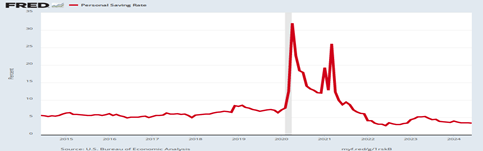
The BEA graph shows both Disposable Personal Income (after taxes) and Outlays (the sum of PCE, personal interest payments, and personal current transfer payments) increased just 1 percent in April. The personal savings rate held at 3.6 percent.

And the second estimate of first quarter GDP growth was revised down to 1.3 percent from 1.6 percent. The decline in both PCE and Q1 economic growth has revived hopes in the financial sector that two or three rate cuts might still happen this year.

And another report, the JOLTS report that shows the number of job vacancies (i.e., unfilled job needs reported by businesses), dropped to 8.1 million openings. It is probably the most accurate predictor of future employment (or unemployment) since it measures a slightly lower demand for new jobs.

We therefore hope that Fed Chair Powell might continue to sound dovish about inflation prospects since the last FOMC meeting.

“I think it is unlikely that the next rate move would be a hike,” Powell recently said. “The Committee judges that the risks to achieving its employment and inflation goals have moved toward better balance over the past year.”

The US economy is still moving towards the Fed’s desired goal of slightly higher unemployment and lower inflation, in other words, which economists are saying was the ‘goldilocks’ condition of the last decade before the pandemic—not too hot (inflation) nor too cold (employment).

Q2 growth estimates have been declining lately. The Atlanta Fed just revised their GDPNow model estimate for real GDP growth (seasonally adjusted annual rate) in the second quarter of 2024 to 2.7 percent on May 31, down from 3.5 percent on May 24. It was mainly after a decrease in the nowcast of the second-quarter real personal consumption expenditures (PCE)growth that was reported above.

So there is little consensus on what Q2 growth from April to June may look like. The battle over what is acceptable inflation is between businesses and retailers, I said recently. The Atlanta Fed reported in a recent survey that consumer prices are rising faster than business costs because retailers must add in the costs of distribution and profits to their prices.

And consumers are finally reacting to the higher retail prices, which has the likes of Target and Walmart finally cutting prices. This should start a trend of lower retail prices matching more closely to the wholesale costs businesses must cover.

But the real problem is that the Fed’s reluctance to drop their rates has hurt manufacturing, which continues to contract. The Institute for Supply Managers (ISM) manufacturing index contracted again, just when it is most needed to rebuild our infrastructure, the 18th time in the last 19 months, say the nation’s supply executives in the latest Manufacturing ISM® Report On Business®.

“The Manufacturing PMI® registered 48.7 percent in May, down 0.5 percentage point from the 49.2 percent recorded in April. The overall economy continued in expansion for the 49th month after one month of contraction in April 2020. (A Manufacturing PMI® above 42.5 percent, over a period, generally indicates an expansion of the overall economy.)”

So we hope the Fed may not be tempted to try for an unattainable goal; a decade-long inflation rate that prevailed prior to the pandemic when higher economic growth is now more important than ever to modernize the American economy.

Harlan Green © 2024

Follow Harlan Green on Twitter: https://twitter.com/HarlanGreen
Posted in Consumers, COVID-19, Economy, Macro Economics, Weekly Financial News | Tagged , , , , | Leave a comment

The Republican Party’s Growing Lawlessness

Popular Economics Weekly

Many Republicans continue to maintain the innocence of former President Donald Trump after his conviction on 34 counts of tax fraud by a New York jury. It confirms what I have written about over more than a decade, the growing lawlessness of one of our political parties.

I wrote about it last in a 2017 Huffington Post article when Donald Trump was first elected President, and his past continues to haunt him.

JONATHAN ERNST / REUTERS

We knew as far back as Nixon’s Watergate that the Republican party harbors a lawless tendency when it suits them. Why else would President Reagan engineer the illicit Iran contra arms deal with Khomeini, or, President GW Bush invade Iraq when UN inspectors already knew Saddam Hussein had destroyed his weapons of mass destruction a decade earlier?

The lawlessness of Republicans’ hunger for power has now reached such a point that they have selected and continue to support a president who has lied and cheated his whole adult life; from Trump Casinos to Trump Towers, from stiffing bankers and his workers to cooking the books. This has been documented in many of the 3,500 plus lawsuits Trump has been involved in, and the reason he settled the Trump University lawsuits, one of which alleged he ran a fraudulent enterprise under RICO, the Racketeer Influenced and Corrupt Organizations Act.

The sins of Hillary or Bill pale, yet Republicans impeached Bill for lying about a sexual encounter and continue to hound Hillary over lost emails. So why aren’t they impeaching Donald Trump who hasn’t divested himself of his assets to avoid conflicts of interest and continues to profit and even solicit favors from foreign governments in direct violation of the constitution?

His current 34 percent Gallup popularity rating is testimony that his support is now only restricted to those that would support him, even if, ““I could stand in the middle of Fifth Avenue and shoot somebody, and I wouldn’t lose any voters,” said at a January 2016 Iowa campaign rally.And now we have President Trump condoning the lawlessness of his neo-nazi and white nationalist supporters holding a torchlight parade in Charlottesville, Virginia, Jefferson’s hometown.

CNN commentator David Gergen, advisor to four presidents, chastised Trump yesterday in commenting on the Charlottesville riot and death of a counter-demonstrator. “He said he wants to bring love, not hatred to the country,” Gergen said. “Good. We need to deal with hatred, but he needs to deal with the hatred in his own heart if he wants to bring more love to the country.”

When will the Republican party stand up to such blatant lawlessness? Only when they can deal with the lawlessness in their own hearts. In selecting an autocrat to further their agenda, they are in effect saying freedom means anarchy, rather than living within a democracy of laws based on the world’s first constitution that guarantees equal rights for all of its citizens.

Which is why I now say, Trump’s conviction is an opportunity for the Republican Party to recognize the lawlessness that is in the hearts of Trump’s supporters who have reviled and even threatened trial Judge Juan Merchan’s family—it is a losing proposition.

Harlan Green © 2024

Follow Harlan Green on Twitter: https://twitter.com/HarlanGreen

Posted in Politics, Uncategorized | Tagged , , , , | Leave a comment

Where’s the Recession?

Financial FAQs

The most recent Harris-Guardian poll found 56 percent of those surveyed thought the US was in a recession. And 49 percent believed unemployment was at a 50-year high.

How is that possible when the economic facts are exactly the opposite? Unemployment is at a 50-year low, and there hasn’t been a recession since the short-lived 2-month COVID-19 recession in March-April 2020.

The Harris poll said:

· 55% believe the economy is shrinking, and 56% think the US is experiencing a recession, though the broadest measure of the economy, gross domestic product (GDP), has been growing

. 49% believe the S&P 500 stock market index is down for the year, though the index went up about 24% in 2023 and is up more than 12% this year.

· 49% believe that unemployment is at a 50-year high, though the unemployment rate has been under 4%, a near 50-year low.

“What Americans are saying in this data is: ‘Economists may say things are getting better, but we’re not feeling it where I live,’” said John Gerzema, CEO of the Harris Poll. “Unwinding four years of uncertainty takes time. Leaders have to understand this and bring the public along.”

There may be a lot of confusion over what exactly defines a recession, but I believe there’s a better explanation for the pervading pessimism among those surveyed. Many polls have found that most Americans do in fact feel good about their own financial circumstances, but not so good about where the US economy is heading.

Then what must those surveyed compare today’s economy to, since public news reports document that the US has recovered the quickest from the pandemic with the fastest growing economy among developed countries in the world?

FREDcpi

Maybe they remember the pre-pandemic economy of the prior decade when both the unemployment and inflation rates (see cpi graph) were at or below 3 percent. It was a goldilocks time, while choosing to forget the severe trauma from two years of lockdowns that began in 2020 with images of refrigerator trucks lined up in the larger cities to hold many of the one million dead that mortuaries couldn’t hold.

Such a collective amnesia has happened before, more than 100 years ago during the Spanish flu pandemic. The Roaring Twenties excess that followed may have helped to erase those horrific memories when more than 675,000 died, say historians.

A Smithsonian Magazine article highlights some of the Roaring Twenties’ history of the 1920s that could confirm my thesis.

The Smithsonian article mentions Harper’s editor Frederick Lewis Allen’s 1931 account of the previous decade, Only Yesterday. Allen labels the Twenties as the “post-war decade” (of World War One) and mentions the pandemic a grand total of once.

“My guess is it did not sit with the story that Americans tell about themselves in public. It’s not the story that they want to put in fifth-grade U.S. history textbooks, which is about us being born perfect and always getting better,” says Bristow, who wrote American Pandemic: The Lost Worlds of the 1918 Influenza Epidemic.”

“Americans believed themselves “on the verge of putting infections disease to rest forever,” she explains, and instead, “We couldn’t do anything more about it than anybody else.” Indeed, President Woodrow Wilson, who held the office throughout the multi-year pandemic, never once mentioned it in his public comments,” said Allen.

The Smithsonian also cites Yale sociologist and physician Nicholas Christakis who hypothesizes that the 1918 pandemic falls into an ages-old pandemic pattern, one that our Covid-19 present may mimic, too.

In his 2020 book, Apollo’s Arrow: The Profound and Enduring Impact of Coronavirus on the Way We Live, he argues that increasing religiosityrisk aversion and financial saving characterize times of widespread illness. Christakis expects the Covid-19 crisis to have a long tail, in terms of case numbers and social and economic impacts.

“People are going to want to make sense of what happened,” he says, positing that “we’ll likely see an efflorescence of the arts” post-pandemic. That’s not to say our A.C. (After Covid-19) reality will be all rosy. “We’ll be living in a changed world.”

A majority of Americans polled also believe Republicans are better stewards of their wealth. Yet the COVID-19 pandemic occurred during the Trump administration, and its one million death toll might have been lower if Trump hadn’t denigrated scientists and encouraged anti-mask and anti-vaccine doubts among his followers.

Certainly many Republicans might then want to dwell on the years just before the pandemic and erase their memories of the ineptness of the Trump administration when their President suggested injecting chlorine into their veins as a cure.

My thesis is up for discussion as are all theses, of course. I welcome comments on what is still a puzzle to most economists. How can opinions differ so much from public facts? Maybe lasting memories of a more peaceful decade still dominate over our vastly changed, post-pandemic world?

Harlan Green © 2024

Harlan Green on Twitter: https://twitter.com/HarlanGreen

Posted in Consumers, COVID-19, Economy, Politics, Weekly Financial News | Tagged , , , , | Leave a comment

Whose Inflation Is Too High?

The Mortgage Corner

Declining inflation has stalled in the first quarter, which is hurting prospects for any Fed rate cuts, and causing consumers to buy less. The inflation rate is currently stuck in the 3 percent range, though much lower for goods earlier in the supply chain, so large retailers like Walmart and Target are having to cut prices.

Monthly retail sales didn’t increase at all in May, after two consecutive months of 0.8 percent growth and almost 3 percent annual growth.

Walmart said on May 16 that it has rolled back prices on nearly 7,000 items in its stores, reports CNN, noting deflationary trends in general merchandise.

“Our combination of everyday low prices plus a large number of rollbacks is resonating” with consumers, Walmart CEO Doug McMillon said on a call with analysts.

CNN also reported that Target slashed prices on more than 1,500 items, ranging from laundry detergent to cat food to sunscreen, with thousands more price cuts expected over the summer.

It’s a sign that’s made Federal Reserve Governors more hopeful inflation will continue to decline, and prices even begin to fall, rather than continue to rise more slowly.

Federal Reserve officials at their last policy meeting indicated they still had faith price pressures would ease, if only slowly, according to the minutes of the central bank’s April 30-May 1 session.

“Participants … noted that they continued to expect that inflation would return to 2% over the medium term,” the minutes said, but “the disinflation would likely take longer than previously thought.”

AtlantaFed

Inflation trends seem to be in the eye of the beholder. Businesses are now seeing much lower inflation, according to recent surveys. Year-ahead inflation expectations had fallen to 2.3 percent in May 2024 from as high as 3.8 percent in March 2022 for businesses, according to the Atlanta Federal Reserve.

Whereas the Federal Reserve Bank of New York’s Center for Microeconomic Data today released the April 2024 Survey of Consumer Expectations, which went in the opposite direction.

It shows that inflation expectations increased at the short-term and longer-term horizons, while decreasing at the medium-term horizon: to 3.3% from 3.0% at the one-year horizon (remaining below its 12-month trailing average of 3.5%).

The main culprit seems to be housing prices. “Median home price growth expectations increased to 3.3% after remaining unchanged at 3.0% for seven consecutive months. This is the highest reading of the series since July 2022,” said the NY Fed. 

Year-ahead consumer commodity price expectations also rose across the board in April for gas, food, medical care, and college education.

Why aren’t consumers seeing the lower inflation expectations of businesses? Target and Walmart are telling us why. Simply put, retail prices are much higher than the raw cost of goods and services charged to businesses for several reasons. There’s the transportation and distribution costs, for starters, and profit margin that retailers must retain to stay in business.

The truth is that consumers are seeing higher costs than businesses and are beginning to rebel by choosing cheaper products. It also refutes an economic maxim about consumer behavior that higher inflation expectations will cause consumers to spend more, not less.

There is some good news for consumers. New-home prices are falling as the supply of new homes has increased.

Sales of newly built, single-family homes in April fell 4.7% to a 634,000 seasonally adjusted annual rate from a downwardly revised reading in March, according to newly released data from the U.S. Department of Housing and Urban Development and the U.S. Census Bureau. The pace of new home sales in April is down 7.7% from a year earlier.

The median new home sale price in April was $433,500, down 1.4% from March, and up 3.9% compared to a year ago. This is because of the increased supply. There’s a 9.1-month supply of new homes for sale.

Dear US Fed Governors, please pay attention to this. Shoppers can act rationally when their pocketbook size is at risk!

Harlan Green © 2024

Follow Harlan Green on Twitter: https://twitter.com/HarlanGreen
Posted in Consumers, COVID-19, Economy, Housing, housing market, Weekly Financial News | Tagged , , , , | 2 Comments