Retail Sales Boost Q1 Growth

Financial FAQs

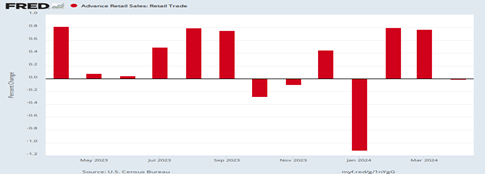
Consumers haven’t slowed shopping, even during tax season. They keep boosting economic growth which is edging above annual predictions of 2 percent again.

FREDretailsales

Retail trade sales were up 0.8 percent (±0.5 percent) from February 2024, and up 3.6 percent (±0.5 percent) above last year, said the US Census Bureau. Nonstore retailers were up 11.3 percent (±1.6 percent) from last year, while food services and drinking places were up 6.5 percent (±2.1 percent) from March 2023.

The Atlanta Fed’s GDPNow model estimate for real GDP growth (seasonally adjusted annual rate) in the first quarter of 2024 rose 2.8 percent on April 15, up from 2.4 percent on April 10, “…after increases in nowcasts of first-quarter real personal consumption expenditures growth and first-quarter real gross private domestic investment growth.”

This is at the high end of Blue-Chip economists’ estimates; no wonder with such robust consumer spending, but this confuses the inflation picture.

It is an economic fact that indicates the US economy is doing very well, and that Main Streeters should believe it, contrary to the polls, I said last week. But will economic facts win out over the irrational pessimism showing up in consumer polls? The facts win out in retail sales.

The problem with the irrational pessimism measured by polls is that it seems to be largely based on the inflation picture. The fluctuating inflation indexes are higher at the moment because of housing rents that are adjusted once per year.

FREDHICP

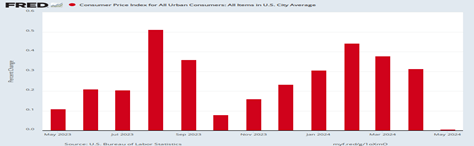
But another inflation index, core CPI inflation without food, energy, tobacco or alcohol, the Harmonized Index of Consumer Prices (HICP) used by Europeans as a more accurate indicator of longer term inflation, indicates the inflation rate has been at or below 2 percent since June 2023, like the Producer Price Index.

Then why does the Fed keep saying they are unsure inflation has been tamed when rents are outside of their control? Because of “unknown knowns,” to paraphrase former Bush Defense Secretary Donald Rumsfeld when he was attempting to justify the invasion of Iraq?

He said in attempting to justify the unknown fact that Saddam Hussein had weapons of mass destruction that: “There are known knowns, things we know that we know; and there are known unknowns, things that we know we don’t know. But there are also unknown unknowns, things we do not know we don’t know.”

How is that a justification for anything? The same uncertainty can be said of unknown future economic events, so keeping interest rates at their maximum 5.25 percent and the Wall Street Prime Rate at 8.5 percent to suppress consumer borrowing when not knowing what are the future shocks that could again disrupt supply change, like the Covid pandemic and Ukraine war, are “things we do not know we don’t know.”

But with fixed 30-year mortgage rates again above 7 percent, we know it is hurting the housing market at a time when more housing is desperately needed.

Atlanta Fed President Rafael Bostick has been sounding the alarm on the housing shortage yet has been one of the Fed Governors reluctant to support lowering the Fed’s interest rates.

Bostic said in a recent conference, “Nationally, a household that earns the median income—roughly $75,000 a year—must spend 41 percent of that just to own the median-priced home, which would cost about $359,000. That percentage far exceeds the standard threshold for affordability, which is 30 percent.”

This is not an ‘unknown known’, since we know that lower interest rates would boost housing construction and hence supply, thereby bringing down rents and housing prices.

Privately‐owned housing starts in March were at a seasonally adjusted annual rate of 1,321,000. This is 14.7 percent below the revised February estimate of 1,549,000 and is 4.3 percent below the March 2023 rate of 1,380,000. Single‐family housing starts in March were at a rate of 1,022,000; this is 12.4 percent below the revised February figure of 1,167,000. The March rate for units in buildings with five units or more was 290,000.

Can we blame consumers for doubting the sincerity of the Fed Governors about inflation when they contradict themselves?

Harlan Green © 2024

Harlan Green on Twitter: https://twitter.com/HarlanGreen
Posted in Consumers, COVID-19, Economy, Housing, housing market, Weekly Financial News | Tagged , , , , | Leave a comment

Inflation Still Declining

Popular Economics Weekly

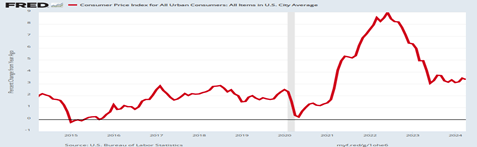
The inflation rate for wholesale goods and services (PPI) is still declining, which will hearten the inflation doves after yesterday’s Consumer Price Index (CPI) seems to be stuck in a 3 percent range. So, the Fed has a dilemma, which one to choose and use to forecast future inflation?

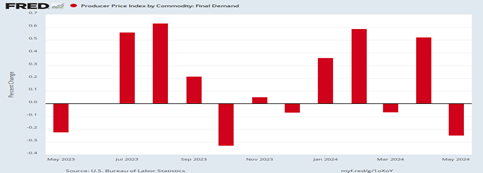
The Producer Price Index for final demand rose 0.2 percent in March, seasonally adjusted, the U.S. Bureau of Labor Statistics reported today. The index for final demand increased 2.1 percent for the 12 months ended in March, the largest advance since rising 2.3 percent for the 12 months ended April 2023.

FREDppifinaldemand

What? You mean wholesale inflation is already down to 2 percent? This annual cost of raw materials and services has been at or below 2 percent for a year and hit zero percent in June 2023 as the supply chains recovered.

So, where’s the inflation the Fed is worried about? It’s because rising wages and the higher profits of producers (corporations) and distributors that took advantage of the supply shortages during the Covid pandemic are added into the Consumer Price Index.

So-called equivalent rents are also incorporated into the CPI. And that is a lagging indicator that is based on last year’s rents, which aggravates Realtors, because one reason for the housing shortage (and higher rents) is fewer new homes are being built, largely because of higher construction costs from the very high interest rates engineered by the Federal Reserve!

The NAR’s chief economist Lawrence Yun has been loudly complaining about this anomaly:

“March inflation figures were very bad, which also means bad news for interest rates. Consumer prices reaccelerated to 3.5%,” said Yun. “This is higher than the 2% target inflation, which raises eyebrows regarding the Federal Reserve’s delay in cutting interest rates. The bond market immediately responded with high yields to compensate for the loss in purchasing power.”

“One strange data point is rent, Yun continued, “which the official data shows at 5.8%. The unofficial data from the apartment industry indicates falling rent due to over-construction. If rent data calms, then overall inflation will automatically be lower. It is, therefore, possible to get to the 2% inflation target by year’s end, even with bumps and delays.”

Said rising wages are also one reason our economy is doing so well. Consumers continuing to shop is a sign of continuing prosperity, is it not?

So why do so many Fed Governors remain hawkish and want to continue the inflation fight, instead of dropping interest rates? It could push economic growth down to no growth territory, as economists and some Fed Governors are warning.

New York Fed President John Williams said Thursday that monetary policy “is in a good place,” helping to restore supply and demand balance to the economy.

“There’s no clear need to adjust monetary policy in the very near term,” Williams told reporters after a speech in New York.

The Fed therefore has a dilemma, as I said—when to drop their interest rates without losing their credibility in fighting inflation?

Willem Buitner and Ebrahim Rehbari, two English economists, say first improve their forecasting methodology, in a Project Syndicate article:

“There is a vibrant debate about whether firms abnormally raised their profit margins in recent years. A recent Fed study finds that nonfinancial corporate profits rose to 19% over gross value-added in the second quarter of 2021, up from 13% in the fourth quarter of 2019. But once prices have risen and profit margins are high, they are less – not more – likely to rise further than before the large price adjustments. Normalizing energy prices, supply chains, and profit margins all contributed to the faster-than-expected decline in inflation in the second half of 2023.”

They then cite Fed Chair Jerome Powell, paraphrasing Winston Churchill, recently called forecasters “a humble lot – with much to be humble about.” 

It may be the opposite lesson from the Great Recession when CPI retail prices plunged to a negative 2 percent in July 2009, in part because the Fed held their 5.25% maximum rate too long.

Inflation remained in the 2 percent target range for the next 10 years, but also did GDP growth, as budget debates and a government shutdown plagued the Obama administration, which meant badly needed infrastructure, technology and climate change legislation wasn’t passed until the Biden administration.

So, the Fed should pay more attention to PPI wholesale inflation that indicates the Fed is close to its inflation target, since even slightly higher inflation is helpful when higher growth is necessary to modernize the US economy.

Harlan Green © 2024

Follow Harlan Green on Twitter: https://twitter.com/HarlanGreen
Posted in Consumers, COVID-19, Economy, Keynesian economics, Politics, Weekly Financial News | Tagged , , , , | Leave a comment

Return of the Bully Mentality

The Mortgage Corner

The NYTimes Bret Stephens lamented the “bullying mentality” at the heart of the pro-Hamas movement in a recent Op-ed that lamented their attempts to shut down pro-Israeli speakers. Hamas is a movement that wants to completely eliminate the state of Israel.

Such protests have even permeated UC Berkeley, my alma mater. It’s shades of the 1960s and 70s anti-Vietnam protests, but instead of peace loving and ultra-liberal protestors, many of the protests seem to be supporting violence and Hamas terrorists.

Such a mentality, or bullying behavior to use its more common term, is once again affecting the budget battles we still have today, especially concerning aid to Israel and Ukraine, with some Republicans attempting to even block debate on a bill, after the Biden administration was able to pass many bipartisan bills that supported the post-pandemic recovery.

It mirrors bullying behavior I wrote about in a 2014 contributor column for Huffington Post during earlier budget battles, in which I quoted Paul Krugman:

“But nobody expects to see a lot of prominent Republicans declaring that rejecting Medicaid expansion is wrong, that caring for Americans in need is more important than scoring political points against the Obama administration. As I said, there’s an extraordinary ugliness of spirit abroad in today’s America, which health reform has brought out into the open.”

The “ugliness” he speaks of is really a bully mentality. Bullies prey on those weaker than them, and so the most conservative Republicans have tried every trick in the book to oppose any programs that smack of aiding those most in need.

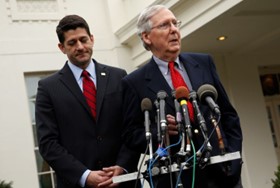
“Not all Republicans are bullies, and not all Democrats enlightened progressives,” I said then. “But the bully mentality of House Speaker John Boehner’s “no compromise” tactics, or Senator Mitch McConnell’s filibustering of even the most innocuous Obama administration appointments have been the reason recovery from the Great Recession hasn’t been stronger.”

And it continues with the attempts to bully House Speaker Mike Johnson into not advancing a desperately needed aid package that MAGA Republicans oppose by threatening to unseat the House Speaker.

Who are the bullies? Republican House members from conservative Red states, in the main that oppose almost any form of government aid—even for border protection that passed with bipartisan support in the Senate.

They belong to the states most dependent on government support. Smart Asset conducted a research on the states most dependent on the Federal government, and found they were Republican governments, with Red states making up 8 out of top 10 dependent states.

GeorgetownPPR

The result of such bullying behavior is easy to see from this Georgetown public Policy Review graph. Beginning 20 years ago median household annual incomes between red and blue states began to diverge—rising per annum to $60,000 in 2018 in Republican-led states vs. some $72,000 in Democratic-led states.

The divergence between Red and Blue states began in 2000 when the Bush administration passed massive tax cuts that took away the 4 years of budget surpluses created by the Clinton administration and cut back many social programs; at the same time it began the wars on terror.

The Center on Budget and Policy Priorities (CBPP), a non-partisan think tank, said at the time, “Despite promises from proponents of the tax cuts, evidence suggests that they did not improve economic growth or pay for themselves, but instead ballooned deficits and debt and contributed to a rise in income inequality.”

It also led to the largest federal budget deficit; in fact, the first one $trillion federal deficit in US history. And “the Bush tax cuts (including those that policymakers made permanent) would add $5.6 trillion to deficits from 2001 to 2018,” said the CBPP.

It began an alarming trend, the “no compromise” behavior that the Biden administrations has attempted to alleviate with such as its New New, Deal Infrastructure and Inflation Reduction Acts that are bringing back good jobs to those Red states.

Such bullying behavior has intentionally impoverished many, and this might be the best of times to study and counteract its effects with a bipartisan spirit that younger generations are keen to support in many polls.

A recent PEW Research poll, for instance, tells us why Gen Z’ers in particular support compromise over no compromise: “…members of Gen Z are more likely than older generations to look to government to solve problems, rather than businesses and individuals. Fully seven-in-ten Gen Zers say the government should do more to solve problems, while 29% say government is doing too many things better left to businesses and individuals.”

Can today’s younger generations overcome such a bullying mentality that has also permeated university campuses and fulfill the promise of a greater bipartisanship they say their prefer?

Harlan Green © 2024

Follow Harlan Green on Twitter: https://twitter.com/HarlanGreen

Posted in Consumers, COVID-19, Economy, Politics, Weekly Financial News | Tagged , , , , | Leave a comment

March Payrolls Soaring

Popular Economics Weekly

I said last week I don’t believe Wall Street investors are irrationally exuberant at present, contrary to those that say we are now in a stock market bubble with the record level S&P and DOW indexes.

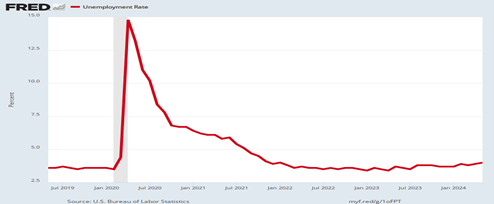
That’s because March nonfarm payrolls increased 303,000, far above the 200,000 average poll of economists, and the unemployment rate fell slightly from 3.9 percent to 3.8 percent. This may finally put a dent in those pessimists polled that would deny the US economy is continuing its surprising surge.

FREDnonfarmpayrolls

Why? Government employment increased by 71,000, higher than the average monthly gain of 54,000 over the prior 12 months. It was mostly in local government (+49,000) and federal government (+9,000). Construction added 39,000 jobs in March, about double the average monthly gain of 19,000 over the prior 12 months.

This is largely because of President Biden’s New New Deal legislation such as the Infrastructure and Inflation Reduction Acts, but also expanding CHIPS production and a host of health care addons, all government largess that is boosting overall economic growth.

Health care added 72,000 jobs, as Biden has expanded healthcare coverages, while Obamacare enrollment is up 21 million this year.

Will this finally begin to change the irrational pessimism of Main Street, in the main ordinary working adults in the PEW study I’ve been highlighting?

In a poll by PEW Research, “About three-in-ten Americans (28%) currently rate national economic conditions as excellent or good, while a similar share (31%) say they are poor and about four-in-ten (41%) view them as “only fair.”

There’s still the inflation worry, which combined with the 8.5 percent Prime Rate that sets credit card and installment loan interest rates is making consumers nervous.

So the key to trends are short and long term inflation expectations measured in the various surveys. And consumers don’t see inflation improving in the near term, which I maintain is in part due to the too-high Prime Rate.

I highlighted a recent National Bureau of Economic (NBER) working paper that concluded one reason consumers remain unconvinced that economic conditions have improved is because if borrowing costs were included in the inflation data, the inflation rate would be much higher.

The Federal Reserve Bank of New York’s Center for Microeconomic Data released the February 2024 Survey of Consumer Expectations, for instance, which shows that inflation expectations remained unchanged at the short-term horizon, while increasing at the medium- and longer-term horizons. 

The Conference Board is similarly less sanguine about inflation: “Consumers remained concerned with elevated price levels, which predominated write-in responses, said Dana Peterson, its Chief Economist. “March’s write-in responses showed an uptick in concerns about food and gas prices, but in general complaints about gas prices have been trending downward.”

Most Americans are exhausted and still recovering from the pandemic. And they rely on their immediate experience; much of it due to the post-COVID gyrations of the economy.

PEW in the recent poll said, however, expectations for future economic conditions are more positive than they were last spring: Today, roughly a quarter say that they expect economic conditions will be better a year from now (26%) – up from 17% in April 2023.

There is hope, in other words, the pessimists will eventually realize a surging stock market means higher corporate profits, so stocks aren’t yet overvalued. Companies wouldn’t be hiring this many workers if profits weren’t growing, so their jobs are safe.

Harlan Green © 2024

Follow Harlan Green on Twitter: https://twitter.com/HarlanGreen
Posted in Consumers, COVID-19, Economy, Weekly Financial News | Tagged , , , , | Leave a comment

First Quarter Growth Even Better?

The Mortgage Corner

The post-pandemic recovery is looking better this year, as higher estimates for 2024 economic growth come in.

The job market is still hot, which is why consumers keep shopping until they drop, to use a common expression for their stalwart behavior in the face of sky-high interest rates.

But there are danger signs if the Fed doesn’t begin to drop their short-term rates sooner rather than later, with just three 0.25 percent rate cuts predicted this year. This will not do much to alleviate a looming credit crunch, and effects on borrowers of the current 8.5 percent Wall Street Prime Rate.

But first the good news. The Atlanta Fed’s GDPNow estimate of first quarter GDP growth is updated regularly, and it’s improved again after some fluctuations.

AtlantaFederalReserve

“The GDPNow model estimate for real GDP growth (seasonally adjusted annual rate) in the first quarter of 2024 is 2.8 percent on April 1, up from 2.3 percent on March 29. The uptick was mainly due to gains in nowcasts of first-quarter real personal consumption expenditures (PCE) growth and first-quarter real gross private domestic growth.”

The so-called Blue Chip Consensus estimate of GDP growth shaded gray in the graph that ranges from 1 to 2.5 percent has also been trending upward.

And the final reading of Q4 2023 U.S. Gross Domestic Product growth adjusted for inflation (real GDP) was raised slightly to a 3.4% annual pace, reflecting strong consumer spending.

FRED/CalculatedRisk

Why the happier numbers? The US economy keeps creating more jobs, hence the large number of job vacancies in the JOLTS report. This is a gauge of the demand for labor. It changed little from January at 8.8 million job openings employers say they want to fill on the last business day of February, the U.S. Bureau of Labor Statistics reported today.

The Calculated Risk graph of the JOLTS report shows job openings (black line), hires (dark blue), Layoff, Discharges and other (red column), and Quits (light blue column). There were 5.8 million hires and 5.6 million separations, so the 200,000 difference approximates the net number of new jobs filled.

This will help us to estimate this Friday’s unemployment rate published by the Bureau of Labor Statistics. Since JOLTS was little changed, the unemployment report should be about the same as last Month’s 225,000 nonfarm payroll jobs increase, though the unemployment rate rose to 3.9 percent.

The University of Michigan sentiment survey also showed consumers see better days ahead.

“Expected business conditions remained substantially higher than last autumn, with short-run expectations now 63% above and long run expectations 46% above November 2023 readings. For all but one index component, readings this month were higher than all values between mid-2021 and the end of 2023.”

Now the bad news. The question is, will the Fed heed the warning of a rising unemployment rate? Fed Governors still seem convinced that the key to reaching their 2 percent inflation target rate is to cool the hot labor market. That means waiting for the unemployment rate to rise even higher than 3.9 percent, and the loss of maybe millions of jobs.

Economists are beginning to stress the urgency of future Fed rate cuts. I mentioned last week that Claudia Sahm a former Federal Reserve economist noted for creating a formula for predicting upcoming recessions, is one such calling for the Fed to cut rates sooner.

“But recessions are like snowballs, Sahm said: They start very small but can grow big enough to trigger avalanches, which can then sweep down on the economy — wiping away jobs, economic growth and income for millions of people.”

The 8.5 percent Prime Rate will eventually begin to toll on consumers pocketbooks, since most rely on some form of credit. The question is not if, but when the recession bell will toll if Fed officials react too slowly to the warnings.

Harlan Green © 2024

Follow Harlan Green on Twitter: https://twitter.com/HarlanGreen
Posted in Consumers, COVID-19, Economy, Weekly Financial News | Tagged , , , , | Leave a comment

Economic Facts Can Win

Financial FAQs

Here’s another reason we have avoided a recession. Regardless of the looming tax bills due in April that traditionally causes consumers to save more and spend less, consumers are spending more and saving less, per the BEA’s Personal Consumption Expenditure release.

It’s another economic fact that indicates the US economy is doing very well, and that Main Streeters should believe, contrary to what many seem to say per the polls. But will economic facts win out over the irrational pessimism showing up in consumer polls?

In a poll by PEW Research I wrote about last week, “About three-in-ten Americans (28%) currently rate national economic conditions as excellent or good, while a similar share (31%) say they are poor and about four-in-ten (41%) view them as “only fair.”

BEA.gov

Consumers are spending more than they earn because they feel better about their own situation, in spite of what they say about economic conditions. The government’s Personal Consumption Expenditures (PCE) data that the Fed watches closely in February showed consumers’ disposable income (after taxes) increasing 1.0 percent while spending had increased 4.0 percent. The personal savings rate therefore slipped from 4 percent to 3.8 percent.

Fourth quarter economic growth was just upgraded to 3.4 percent from 3.2 percent, and consumer spending, the main engine of the economy, was revised up to a 3.3% increase in the fourth quarter instead of 3% annually as well.

Why the pessimism by ordinary consumers? Because most economic data is basically unintelligible to Main Street consumers. Duncan Foley, an economics Professor at NYU’s New School maintains that the economics profession has become so complex that economists are “becoming priestly figures, with arcane knowledge and special powers” in his book, Adams Fallacy: A Guide to Economic Theory.

He asserts economics is as much philosophy as a social science, since it attempts to measure financial behavior with economic data and formulas, many of which are understandable only by economists.

More importantly “Thinking like an economist comes hard to many people…the economic way of thinking is just as value laden as any other way of thinking and can foster dangerous mistakes of judgement.”

What is hurting consumer finances the most? The Wall Street Prime Rate has risen to 8.5 percent because the Funds rate is 5.25 percent. Consumers must spend more than they save because borrowing costs have soared for those with credit card debt and installment loans.

FREDprimerate

How much longer can consumers spend as they have, as their personal savings continue to be depleted? A recent National Bureau of Economic (NBER) working paper concludes that one reason consumers remain unconvinced that economic conditions have improved, is because if borrowing costs were included in the inflation data, the inflation rate would be much higher.

“Consumers, unlike modern economists, consider the cost of money part of their cost of living. Interest rates have reached 20-year highs in the wake of the pandemic. With higher rates, mortgage payments, car payments, and other credit payments required to finance everyday purchases have risen as well.”

So that makes the Federal Reserve part of the problem since the Prime Rate is directly keyed to the Fed Funds rate, and why wouldn’t the price of things be controlled by the cost of said things??

That could be why we see so much irrational exuberance, to use former Fed Chair Greenspan’s term, in which decisions are made via hearsay and word of mouth rather than economic facts.

Consumers must deal with the cost of money when they look at their financial condition, which should mean their mood will improve when the Fed finally decides to cut interest rates.

Harlan Green © 2024

Harlan Green on Twitter: https://twitter.com/HarlanGreen

Posted in Consumers, COVID-19, Economy, Weekly Financial News | Tagged , , , , | Leave a comment

Fourth Quarter Growth Even Better

The Mortgage Corner

Economic growth is picking up and the housing market is following suit, which means the post-pandemic recovery is looking even better this year.

The final reading of Q4 2023 U.S. Gross Domestic Product growth adjusted for inflation (real GDP) was raised slightly to a 3.4% annual pace, reflecting strong consumer spending and a surprisingly resilient economy. The government’s second estimate of GDP had forecast a 3.2% rate in the final three months of last year.

This will no doubt call for a slowdown in the Fed’s rate cuts by those worried about inflation, but will that matter when housing in particular needs to recover? Everyone should be happy, in other words.

Adjusted pretax corporate profits surged in the fourth quarter at an annual 4.1% rate, indicating that businesses are in good shape. Consumer spending, the main engine of the economy, was revised up to a 3.3% increase in the fourth quarter instead of 3%.

And inflation using the personal-consumption expenditure — or PCE — rose at a mild 1.8% annual rate in the fourth quarter, unchanged from the prior estimate. The more closely followed core rate was lowered a tick to a 2.0% annual rate — matching the Fed’s 2% inflation goal.

BEA.gov

Inflation expectations measured by the University of Michigan sentiment survey also showed inflation expectations continue to decline.

“Year-ahead inflation inched down from 3.0% last month to 2.9% this month,” said survey Director Joanne Hsu. “For the third straight month, short-run inflation expectations have fallen within the 2.3-3.0% range seen in 2018 and 2019. Long-run inflation expectations also inched down, from 2.9% to 2.8%, and remain modestly elevated relative to the 2.2-2.6% range seen in the two years pre-pandemic.”

Even better news was that the number of Americans who applied for unemployment benefits last week fell slightly to 210,000 and continued to hover at very low levels in a sign of strength for the economy. There were 212,000 unemployment filings, according to government figures.

Jobless claims tend to rise steadily when the economy gets worse. They’ve held fast this year in a narrow range of 194,000 to 225,000 — an extremely low level historically.

Claudia Sahm a former Federal Reserve economist noted for creating a formula that predicted upcoming recessions, is bucking the trend of economists worried about inflation by calling for the Fed to cut rates sooner.

In a series of conversations with MarketWatch over the past month, Sahm said she wants the Fed to ease rates — which are currently in the range of 5.25% to 5.5% — ASAP, according to MarketWatch’s Greg Robb. She’s not advocating for a dramatic cut but says the Fed needs to get the ball rolling on easing the tight monetary policy it has implemented over the past two years to help cool the economy and quash out-of-control inflation. 

“But recessions are like snowballs, Sahm said: They start very small but can grow big enough to trigger avalanches, which can then sweep down on the economy — wiping away jobs, economic growth and income for millions of people.”

There’s another reason to begin to cut interest rates ASAP. The housing market needs a boost. Existing-home sales jumped in February and a survey of future home sales is also increasing, but might not last long if the sky-high mortgage rates don’t decline.

Pending home sales in February grew 1.6%, according to the National Association of Realtors®. The Midwest and South posted monthly gains in transactions while the Northeast and West recorded losses. All four U.S. regions registered year-over-year decreases.

The Pending Home Sales Index (PHSI)* – a forward-looking indicator of home sales based on contract signings – increased to 75.6 in February. Year over year, pending transactions were down 7.0%. An index of 100 is equal to the level of contract activity in 2001.

“While modest sales growth might not stir excitement, it shows slow and steady progress from the lows of late last year,” said NAR Chief Economist Lawrence Yun. “Ongoing job gains are clearly increasing demand along with more inventory.”

Could economic growth be firing on all cylinders this year if the housing market recovers? It would be for the first time and a sign that we are finally over the COVID pandemic.

Harlan Green © 2024

Follow Harlan Green on Twitter: https://twitter.com/HarlanGreen
Posted in Consumers, COVID-19, Economy, Housing, housing market, Weekly Financial News | Tagged , , , , | Leave a comment

Irrational Exuberance vs. Irrational Pessimism?

Popular Economics Weekly

I don’t believe Wall Street investors are irrationally exuberant at present, contrary to those that say we are now in a stock market bubble with the record level S&P and DOW indexes.

It’s as easy to be irrationally pessimistic about the future as are many Main Streeters that don’t feel so good about themselves or the US economy.

The indexes are high because corporations show record profits, in part thanks to the $trillions in pandemic aid, but also because of the excessive profit-taking by major retailers that took advantage of the product shortages caused by the COVID pandemic shutdowns, which has been confirmed by the FTC.

Large grocery store chains exploited product shortages during the pandemic by raising prices significantly more than needed to cover their added costs and they continue to reap excessive profits, according to a Federal Trade Commission report.

Much of Main Street, ordinary working adults in the main, have become the opposite, irrationally pessimistic, in my opinion. Surveys such as a recent PEW Research survey I highlighted last week show this is so.

In a poll by PEW Research, “About three-in-ten Americans (28%) currently rate national economic conditions as excellent or good, while a similar share (31%) say they are poor and about four-in-ten (41%) view them as “only fair.”

PEW

Why such divergent opinions when we are fully employed and have surging economic growth? The most recent Conference Board’s Consumer Confidence survey helps to explain it.

Right and left wing partisans are now controlling the debate. Middle-income Americans, which are most working Americans, as I said, are exhausted and pay little attention to economic data, which is difficult to understand even by economists.

Most consumers remain concerned about high inflation, the contentious budget debate, and partisan bickering of the Presidential election campaign.

“Consumers remained concerned with elevated price levels, which predominated write-in responses, said Dana Peterson, its Chief Economist. “March’s write-in responses showed an uptick in concerns about food and gas prices, but in general complaints about gas prices have been trending downward. Indeed, average 12-month inflation expectations came in at 5.3 percent—barely changed from February’s four-year low of 5.2 percent.”

“Recession fears continued to trend downward both in write-in responses and as measured by consumers’ Perceived Likelihood of a US Recession over the Next 12 Months,” he continued. “Meanwhile, consumers expressed more concern about the US political environment compared to prior months.”

The PEW survey chart above shows the tug-of-war between extreme right and left political factions controlling the debate, while 41% of the Americans surveyed viewed economic conditions as “only fair”.

Why? Most Americans are exhausted and still recovering from the pandemic. There is a divergence between those experiencing irrational exuberance vs. irrational pessimism because most of those polled aren’t as knowledgeable about real economic data and business cycles that are published by the government and private providers. So they must rely on their immediate experience; much of it due to the trauma caused by the COVID pandemic that killed one million Americans.

PEW said, however, expectations for future economic conditions are more positive than they were last spring: Today, roughly a quarter say that they expect economic conditions will be better a year from now (26%) – up from 17% in April 2023.

There is hope, in other words, because of a resurgent US economy, the strongest economy in the world, that they will eventually realize their jobs are safe and secure in such an environment.

Harlan Green © 2024

Follow Harlan Green on Twitter: https://twitter.com/HarlanGreen

Posted in Consumers, COVID-19, Economy, Weekly Financial News | Tagged , , , , | Leave a comment

New Home Sales Boost Housing Market

The Mortgage Corner

The sale of new homes is boosting housing and the economy at a very opportune time—the beginning of a New Year when it’s still uncertain when the Fed will begin to cut their interest rates.

This is a heartening sign that consumers are not waiting longer for mortgage rates to fall. So far, 30-year conventional fixed rates are staying close to their high of 7 percent, so that some one-third of sales are all cash transactions.

Sales of new single‐family houses in February 2024 were at a seasonally adjusted annual rate of 662,000, according to estimates released jointly today by the U.S. Census Bureau and the Department of Housing and Urban Development. This is 0.3 percent (±16.2 percent)* below the revised January rate of 664,000, but is 5.9 percent (±14.3 percent)* above the February 2023 estimate of 625,000.

USCensusBureau

The median sales price of a new home sold in February fell to $400,500 from $414,900 in the prior month. The seasonally‐adjusted estimate of new-home supply was 8.4 months at the current sales rate. The growing supply of new homes is bringing down prices.

Overall, home buying demand for newly built homes remains strong because resale home inventory is still low, though existing home sales are also rising.

Sales are likely to pick up further as mortgage rates are expected to decline through the rest of the year. Fannie Mae expects the 30-year mortgage to end the year at 6.4%, versus the 6.87% as of March 21, per Freddie Mac data.

This must be why builder confidence rose for the fourth month in row in March, in line with growing buyer demand.

The expectations of a jump in demand in the coming months pushed the National Association of Home Builders’ (NAHB) monthly confidence index up 3 points to 51 in March, the trade group said on Monday.

That’s also why housing starts jumped in February as well, I said last week. Construction of new U.S. homes rebounded 10.7% in February to an annual pace of 1.52 million units, reported the Commerce Department last Tuesday. Single Family Starts are up 35% Year-over-year in February; though Multi-Family Starts were down sharply, said the NAHB. That is the biggest gain in nine months.

“The solid level of single-family production in February tracks closely with rising builder sentiment, and with mortgage rates expected to moderate further this year, this will provide an added boost for single-family building,” said Carl Harris, chairman of the National Association of Home Builders (NAHB). “But policymakers need to help the industry’s supply-chains in order to protect housing affordability and add much needed supply to boost inventory.”

Might a proposed settlement by the National Association of Realtors (NAR) to bring down the standard commission paid by Sellers speed up home sales this year by reducing sale costs?

The settlement proposed by the National Association of Realtors, which will go into effect in mid-July if it’s approved, would require that listings on the NAR-run Multiple Listing Service — a database of homes for sale — no longer have a field showing how much buyer’s agents will earn in commissions on the sale.

Although fees for real-estate agents are technically negotiable, they typically run from 4% to 6% of a home’s sale price, depending on local market customs. Home sellers traditionally pay these commissions, which are then typically split between the buyer’s and seller’s agents. 

This might make a difference in prices for entry-level homes, where the profit margins are lower, and buyers more price-conscious. Anything that reduces costs is welcome in a reviving housing market.

New-home construction is an important segment of our economy because it employs many in sectors other than construction, such as finance, insurance, and advertising. So when positive and growing it boosts overall economic growth as well.

Harlan Green © 2024

Follow Harlan Green on Twitter: https://twitter.com/HarlanGreen
Posted in Consumers, COVID-19, Economy, Housing, housing market, Weekly Financial News | Tagged , , , , | Leave a comment

Too Much Irrational Exuberance?

Popular Economics Weekly

Are Wall Street investors irrationality exuberant? Former Bond King and CEO of the PIMCO bond fund Bill Gross thinks so.

Irrational exuberance is a term coined by former Fed Chairman Alan Greenspan in 1996 to describe the stock rallies of that decade that pushed stock prices so high that they earned less than one percent annually in capital gains and dividends by 2000, the year his warning come to roost when the Dot-com bubble burst.

Gross has been maintaining that today’s stock market rally that has pushed the S&P and DOW Jones indexes to record highs is due to a similar irrational exuberance.

“It tells me that fiscal deficit spending and AI enthusiasm have been overriding factors and momentum and ‘irrational’ exuberance have dominated markets since 2022,” he said in said in a recent MarketWatch interview.

All this exuberance has been due to several reasons; among them the US government stimulus spending that has pushed growth higher than in all other developed countries.

Americans have now been fully employed for more than two years, with more than 20 million new jobs created during that time. And real GDP growth is surging, as are corporate profits.

Irrational Exuberance may also explain the divergence of Wall Street investors with the current irrational pessimism among Main Street voters that is at odds with actual economic events.

In polls, such as by PEW Research, “About three-in-ten Americans (28%) currently rate national economic conditions as excellent or good, while a similar share (31%) say they are poor and about four-in-ten (41%) view them as “only fair.”

PEW

The polls are saying there has been a marked divergence not only between how Main Streeters feel about the economy, but also about their own financial circumstances. Overall, most Americans feel good about their personal finances but not about where the US economy is heading.

PEW added expectations for future economic conditions are more positive than they were last spring: Today, roughly a quarter say that they expect economic conditions will be better a year from now (26%) – up from 17% in April 2023.

I maintain this divergence between irrational exuberance and irrational pessimism is because most of the polled aren’t as knowledgeable about real economic data and business cycles that are published by the government and private providers, so they must rely on their immediate and experience; much of it is due to the trauma caused by the COVID pandemic that killed one million Americans.

Nobel Laureate Robert Shiller won the Nobel Prize in 2013 for his research on the causes of irrational exuberance.

Dr. Shiller said irrational exuberance is about “How errors of human judgment can infect even the smartest people, thanks to overconfidence, lack of attention to details, and excessive trust in the judgments of others, stemming from a failure to understand that others are not making independent judgments but are themselves following still others—the blind leading the blind.”

Can we blame those still hurting from the pandemic, as well as loss of blue-collar jobs in major parts of the Midwest, for not believing how quickly this economy has recovered?

Harlan Green © 2024

Follow Harlan Green on Twitter: https://twitter.com/HarlanGreen

Posted in Consumers, COVID-19, Economy, Politics, Weekly Financial News | Tagged , , , , | Leave a comment