Strong Growth Will Continue

Financial FAQs

There’s a good reason we have avoided a recession, I said last week. Consumers’ personal financial conditions have improved, so they continue to shop, and they are responsible for 70 percent of economic activity.

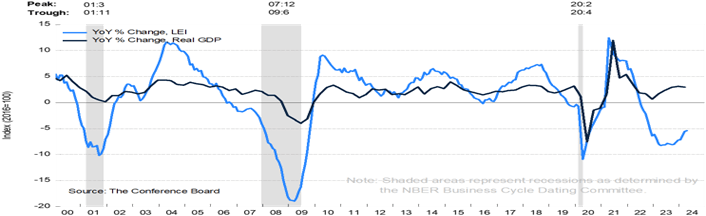
Now the Conference Board’s Index of Leading Economic Indicators (LEI) is agreeing with them for the first time in six months. It is one of the few indexes that attempts to predict future growth but has been stagnant for two years and showed negative GDP growth since August 2023.

“The U.S. LEI rose in February 2024 for the first time since February 2022,” said Justyna Zabinska-La Monica, Senior Manager, Business Cycle Indicators, at The Conference Board. “Strength in weekly hours worked in manufacturing, stock prices, the Leading Credit Index™, and residential construction drove the LEI’s first monthly increase in two years…Despite February’s increase, the Index still suggests some headwinds to growth going forward. The Conference Board expects annualized US GDP growth to slow over the Q2 to Q3 2024 period, as rising consumer debt and elevated interest rates weigh on consumer spending.”

It uses indicators such as the direction of interest rates and workers’ hours to gauge future trends. The LEI is still lagging real GDP growth, per the below graph of both.

Conference Board

Because the main contributors to manufacturing’s current growth are a roaring stock market and increased working hours in manufacturing, will manufacturing finally come to life this year?

Preliminary S&P indexes for manufacturing and the service sector are both ‘flashing’ green lights. The flash U.S. manufacturing purchasing managers index climbed to a 22-month high of 52.5 this month from 52.2 in February. The S&P flash U.S. services PMI slipped to a three-month low of 51.7 in March from 52.3 in the prior month, but numbers above 50 signal growth in the economy.

The Atlanta Fed puts out another predictor of future growth. Its GDPNow Q1 estimate is 2.1 percent on March 19, down from 2.3 percent from March 14 after slowing first-quarter personal consumption expenditures growth and first-quarter real gross private domestic investment growth.

This may be temporary, however, as consumers and businesses are usually cautious at this time of the year while they attempt to assess their future.

The good news is that Wall Street is booming and even the housing market seems to be recovering, in spite of the Fed’s inaction on interest rates.

Stock indexes are at record highs, and existing-home sales surged 9.5% in February to a seasonally adjusted annual rate of 4.38 million, the largest monthly increase since February 2023. And the inventory of unsold existing homes increased 5.9% from one month ago to 1.07 million at the end of February, or the equivalent of 2.9 months’ supply at the current monthly sales pace, which will further boost sales.

Federal Reserve Chairman Powell said they are in no hurry to cut interest rates because the US economy is meeting the Fed’s twin mandates of stabile price and maximum employment in his latest congressional testimony.

This should reassure Americans that strong growth will continue.

Harlan Green © 2024

Harlan Green on Twitter: https://twitter.com/HarlanGreen

Posted in Consumers, COVID-19, Economy, housing market, Keynesian economics, Weekly Financial News | Tagged , , , , | Leave a comment

Consumers Want More Stability

The Mortgage Corner

More consumers, and most Americans, are deciding they want calm after the instability of the Pandemic era. They are craving fewer economic disruptions for starters, such as the partisan wars that have stymied budget negotiations.

Nearly three-quarters of Americans (73%) rate strengthening the economy as a top priority. That is considerably larger than the shares citing any other policy goal,” reports a recent PEW Research poll.

With Americans fully employed for more than two years and average wages rising faster than inflation, it is boosting consumer confidence and hence consumer spending. This is in turn boosting economic growth.

The US economy averaged 2.5 percent real GDP growth last year, and predictions are for 2-3 percent average GDP growth this year.

The latest University of Michigan sentiment survey highlights their wish for stability.

“Consumer sentiment moved little this month with a 0.4 index point decrease that is well within the margin of error, and thus sentiment has been steady and essentially unchanged since January 2024…After strong gains between November 2023 and January 2024, consumer views have stabilized into a holding pattern; consumers perceived few signals that the economy is currently improving or deteriorating. Indeed, many are withholding judgment about the trajectory of the economy, particularly in the long term, pending the results of this November’s election.”

Conferenceboard.org

The other Conference Board confidence survey was similar with overall inflation remaining the main preoccupation of consumers, and are a bit less concerned about food and gas prices, which have eased in recent months. But they still concerned about the labor market situation and the US political environment.

Stability is what Americans crave after COVID and two ongoing wars. Americans reacted similarly once before, during the Great Depression in the 1930s that resulted in 25 percent of working Americans unemployed.

FDR was then elected that brought in a New Deal. This time it’s the Biden creating the bipartisan new, New Deal that is spending $billions on renewing our infrastructure, manufacturing with the CHIPS Act, in social services, and combating climate change with the Inflation Reduction Act. It will boost economic growth for the rest of this decade.

Further signs of a strengthening economy are in the housing industry. Builder confidence rose for the fourth month in row in March, as buyer demand remained strong.

The expectations of a jump in demand in the coming months pushed the National Association of Home Builders’ (NAHB) monthly confidence index up 3 points to 51 in March, the trade group said on Monday.

Calculated Risk

Housing starts jumped in February as well. Construction of new U.S. homes rebounded 10.7% in February to an annual pace of 1.52 million units, the Commerce Department reported Tuesday. Single Family Starts are up 35% Year-over-year in February; Multi-Family Starts Down Sharply, said the NAHB. That is the biggest gain in nine months.

“The solid level of single-family production in February tracks closely with rising builder sentiment, and with mortgage rates expected to moderate further this year, this will provide an added boost for single-family building,” said Carl Harris, chairman of the National Association of Home Builders (NAHB). “But policymakers need to help the industry’s supply-chains in order to protect housing affordability and add much needed supply to boost inventory.”

That means interest rates must come down this year to continue to support housing affordability, in particular. Housing has traditionally led economic recoveries, so it is an important indicator of when we will break out of the current holding pattern.

Congress has just reached final agreement on the federal budget for the rest of this year, which will further enhance economic stability during the election season.

Harlan Green © 2024

Follow Harlan Green on Twitter: https://twitter.com/HarlanGreen

Posted in Consumers, COVID-19, Economy, Housing, housing market, Politics, Weekly Financial News | Tagged , , , , | Leave a comment

Retail Inflation Is the Problem

Popular Economics Weekly

There is a reason the Biden administration wants to prevent the merger of Kroger and Albertsons Supermarket chains. It lowers competition at a time when the largest retailers are now responsible for much of the inflation that has fueled the Fed’s reluctance to lower interest rates.

How do we know that? Retail companies such as Walmart, Home Depot, Costco, Lowes, CVS, and Target have reported record profits since the Pandemic, according to a recent report by Accountable.us, a nonpartisan 501(c)3 organization that reports on “special interests that too often wield unchecked power and influence in Washington and beyond.”

It reports that “a new analysis of earnings data of the ten largest U.S. retailers by market capitalization finding that they all raised consumer prices while collectively reporting $24.6 billion in increased profits during their most recent fiscal years. These same companies also ramped up spending on shareholder handouts by nearly $45 billion year-over-year for a total of $79.1 billion.”

FREDppi

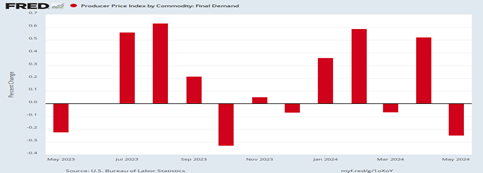
This is while wholesale PPI price inflation for the raw materials that go into retail products is close to zero. The PPI approached zero percent in June 2023 and has remained below 2 percent annually since then. Supply may become oversupply, in other words, continuing to bring down wholesale prices.

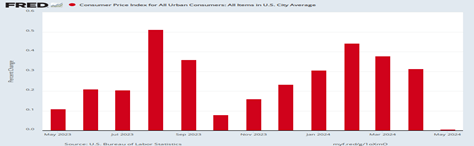
This is opposed to the most recent Consumer Price Index of retail prices that is still hot, with annual inflation rate up slightly from 3.1 to 3.2 percent in February, and core inflation less food and energy prices is now 3.8 percent.

It highlights the chasm between wholesale and retail prices that must factor in labor and capital costs. But those costs remain largely constant, so much of the difference must come from higher profit margins of retailers.

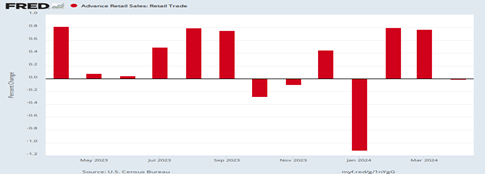
Voices are now growing louder for an earlier rate cut than in June that markets have currently predicted, in part because retail sales are faltering. Retail sales rose 0.6% in February from the previous month, according to Census Bureau data, but January retail sales previously posted a surprise -1.1% decrease. They have been trending downward since September 2023.

FREDretailsales

Retail inflation is largely due to corporate greed, which is out of the Fed’s control.

So there are now voices saying the Fed should pay less attention to its target rate of 2 percent and reduce interest rates sooner. “Given that the labor market is tight, the economy is running well and corporate fundamentals are looking pretty good, I’m not sure we need 2% inflation,” said another economist in a MarketWatch interview.

The chorus for rate cuts will grow louder as further weaknesses in retail sales appear in coming months.

Harlan Green © 2024

Follow Harlan Green on Twitter: https://twitter.com/HarlanGreen

Posted in Consumers, COVID-19, Economy, Weekly Financial News | Tagged , , , , | Leave a comment

Consumers Confident No Recession

Financial FAQs

There is a good reason why we have avoided a recession. Consumers don’t believe it will happen. And consumers drive some 70 percent of US economic activity. So their attitudes tend to make or break economic growth. When they decide conditions are worsening, they save more and spend less.

But that isn’t happening today. Consumers continue to spend into the New Year, and surveys that measure their attitudes show they feel good enough to continue to spend.

I like the Conference Board’s confidence survey that states it “…reflects prevailing business conditions and likely developments for the months ahead. This monthly report details consumer attitudes, buying intentions, vacation plans, and consumer expectations for inflation, stock prices, and interest rates.”

And this is also reflected in their “perceived likelihood” that a recession is less likely this year.

Conference Board

“February’s write-in responses revealed that while overall inflation remained the main preoccupation of consumers, they are now a bit less concerned about food and gas prices, which have eased in recent months. But they are more concerned about the labor market situation and the US political environment,” saidits Chief EconomistDana Peterson.

Their main concern seems caused by the primary elections and sloganeering that goes with the election season. But consumers are beginning to realize they have benefited from the record number of jobs created over the past two years.

Consumer spending is the main reason growth has been so strong. Spending was revised upward from 2.8 percent to 3 percent annually in last week’s Personal Consumption Expenditure survey.

The University of Michigan’s sentiment survey also followed by economists (and pundits) is even more upbeat.

Survey Director Joanne Hsu commented, “Consumer sentiment moved sideways this month, slipping just two index points below January and holding the gains in sentiment seen over the past three months. Expected business conditions remained substantially higher than last autumn, with short-run expectations now 63% above and long-run expectations 46% above November 2023 readings.”

Consumers seem to remain one step ahead of the pundits and pay less attention to the headlines and hysteria generated by mass media and more attention to their personal financial wellbeing.

This is a heartening sign that facts can win over fiction and consumers will keep the post-pandemic recovery alive.

Harlan Green © 2024

Harlan Green on Twitter: https://twitter.com/HarlanGreen

Posted in Consumers, COVID-19, Economy, Macro Economics, Weekly Financial News | Tagged , , , , | Leave a comment

It’s A Soft Landing

Popular Economics Weekly

A terrific February employment report is further evidence the US economy has made a soft landing.

FREDemployment

Total nonfarm payroll employment rose by 275,000 in February, and the unemployment rate ticked up slightly to 3.9 percent from 3.7 percent, the U.S. Bureau of Labor Statistics reported today. Job gains occurred in health care, in government, in food services and drinking places, in social assistance, and in transportation and warehousing.

Education and Health created 85,000 new jobs, Leisure & Hospitality 58,000, and Government 52,000 more jobs. Construction, Retail trade, and Transportation- warehousing created another 62,000 jobs in February.

What does this really mean? That employment and economic growth have stabilized in a very good place, with more good new jobs created, the unemployment rate still below 4 percent and average hourly ages rising faster than inflation.

American consumers and Fed officials can breathe easier this year, and the Fed can begin to lower interest rates to hedge against the damage from future shocks to the economy, rather than worry about higher inflation ahead (i.e., the danger of deflation rather than inflation).

Former St Louis Fed President James Bullard believes Chairman Powell’s Fed will now lower interest rates sooner. Otherwise the Fed may get behind on rate cuts if the economy normalizes over the second half of the year, he said in an interview with MarketWatch’s Greg Robb. It would be awkward for the Fed to have inflation close to 2% with the Fed’s benchmark policy rate in the range of 5.25%-5.5%, Bullard said.

This is while “The price index for gross domestic purchases (GDP) increased 1.9 percent in the fourth quarter, compared with an increase of 2.9 percent in the third quarter. The personal consumption expenditures (PCE) price index increased 1.7 percent, compared with an increase of 2.6 percent. Excluding food and energy prices, the PCE price index increased 2.0 percent, the same change as the third quarter.”

Why has inflation fallen so dramatically? I’ve been saying there are a number of reasons, beginning with the fact that the supply chain of goods and services has caught up to the demand by consumers and companies after the pandemic. But also, labor productivity, the amount of goods produced per worker-hour, has risen sharply, largely because of new technologies such as AI, which has stream-lined supply chains and shortened delivery times.

FREDlaborproductivity

The productivity of American workers rose at a 3.2 percent annual rate in the fourth quarter. Year over year, productivity has increased by a revised 2.6 percent. That’s the largest increase since the first quarter of 2021.

This will keep inflation low for the rest of this year, maybe too low if the Fed doesn’t listen to Bullard, and the unemployment rate continues to tick higher in months ahead.

Harlan Green © 2024

Follow Harlan Green on Twitter: https://twitter.com/HarlanGreen

Posted in Consumers, COVID-19, Economy, Macro Economics, Weekly Financial News | Tagged , , , , | Leave a comment

More Jobs Ahead?

Financial FAQs

 The US economy hasn’t slowed. Fourth quarter Gross Domestic Product (GDP) growth was revised downward from 3.3 percent to 3.2 percent in the second estimate, and predictions for first quarter 2024 GDP growth are hovering between 2-3 percent.

The focus now shifts to Friday’s upcoming unemployment report. Today’s Job Openings and Labor Turnover Survey (JOLTS) will help to fill out the jobs picture. The JOLTS report is holding at 8.9 million job openings, same as last month, so Friday’s unemployment rate should remain at a very low 3.7 percent.

Calculated Risk’s wonderful graph gives us the best visual portrayal of monthly changes in job creation. The black line portrays job openings, dark blue line portrays hires, and red bars show total separations. Net job formation has been in a downward trend since the Fed began to raise interest rates.

“The number of job openings changed little at 8.9 million on the last business day of January, the U.S. Bureau of Labor Statistics reported today. Over the month, the number of hires and total separations were little changed at 5.7 million and 5.3 million, respectively.”

The difference between hires and job separations is closer to the actual number of new jobs created in February—400,000 in this case. But after seasonal adjustments that attempt to ascertain the increase over last year at this time, new nonfarm payrolls jobs should be around 200,000 in Friday’s report, a very strong jobs report.

Calculate Risk

It shows us why there has been a record number of jobs created over the past two years.

Consumer spending is the main reason growth has been so strong. It was revised upward from 2.8 percent to 3 percent annually in last week’s Personal Consumption Expenditure’s report.

Inflation has been tamed as well. The personal consumption expenditures (PCE) price index increased just 1.8 percent, an upward revision of 0.1 percentage point. Excluding food and energy prices, the PCE price index increased 2.1 percent, an upward revision of 0.1 percentage point.

So why is the Fed waiting any longer to drop interest rates? They seem to be wanting consumers to spend less. Yet regional banks that specialize in commercial loans have been hurting since commercial office vacancy rates have soared. They need lower interest rates so they can refinance all those commercial loans about to come due.

Fed Chair Powell in his latest congressional testimony, said “What we want is just more evidence that will give us more confidence that inflation is on a path down to 2% sustainably.”

But annual inflation is already below 2 percent with the PCE and wholesale Producer Price Indexes. What more evidence do they need?

The Fed is again playing its historical role of being the last to react to changing economic conditions—in this case the possibility of more bank failures if they don’t begin to lower short term interest rates soon.

Harlan Green © 2024

Harlan Green on Twitter: https://twitter.com/HarlanGreen

Posted in Consumers, COVID-19, Economy, Weekly Financial News | Tagged , , , , | Leave a comment

Inflation Is Going Nowhere

Popular Economics Weekly

I said recently that the US economy has made a soft landing. Here is further proof with the release of the government’s Personal Consumption Expenditure Index (PCE) that measures consumer spending.

Inflation has flattened and been stuck close to the Fed’s 2% target rate for months. This has reassured consumers enough as measured by consumer sentiment surveys that they have kept up their spending patterns, giving a boost to strong first quarter growth.

The January PCE price index increased 2.4 percent year-over-year (YoY), down from 2.6 percent YoY in December, and down from the recent peak of 7.1 percent in June 2022.

The PCE price index, excluding food and energy, increased 2.8 percent YoY, down from 2.9 percent in December, and down from the recent peak of 5.6 percent in February 2022.

FRED/CalculatedRisk

And the 6-month index PCE Price Index is up 2.5%, Core PCE Prices: 2.5%
Core minus Housing: 1.8%. That means inflation will probably remain stuck somewhere between 2 to 2.5% for the foreseeable future.

American workers are fully employed, and wages are rising slightly faster than inflation. Next week’s release of the monthly unemployment report should confirm nothing has changed.

This is why consumers remain optimistic, per the University of Michigan’s consumer sentiment survey:

Consumer sentiment moved sideways this month, slipping just two index points below January and holding the gains in sentiment seen over the past three months,” said survey director Joanne Hsu. “Expected business conditions remained substantially higher than last autumn, with short-run expectations now 63% above and long-run expectations 46% above November 2023 readings.”

This should also answer the question why fourth quarter 2023 GDP growth was holding at 3.2 percent in its second reading. 

The price index for gross domestic purchases (GDP) increased (just) 1.9 percent in the fourth quarter, compared with an increase of 2.9 percent in the third quarter. The personal consumption expenditures (PCE) price index increased 1.7 percent, compared with an increase of 2.6 percent. Excluding food and energy prices, the PCE price index increased 2.0 percent, the same change as the third quarter.

Inflation has fallen dramatically, in other words. The supply chain of goods and services has caught up to demand. But also, labor productivity, the amount of goods produced per worker-hour, has risen sharply in the last 12 months.

And, though I’m repeating myself, health care spending is soaring, as a record 21.3 million people have officially signed up for healthcare insurance through the HealthCare.gov Marketplace for 2024, marking a third consecutive banner year for the program.

HHS Secretary Xavier Becerra said, “Once again, a record-breaking number of Americans have signed up for affordable health care coverage through the Affordable Care Act’s Marketplace, and now they and their families have the peace of mind that comes with coverage.”

So, I would add another reason for the improving mood of consumers: a healthier workforce is a more productive workforce.

Maybe economic stability at home is what we need with the rest of the world in turmoil.

Harlan Green © 2024

Follow Harlan Green on Twitter: https://twitter.com/HarlanGreen

Posted in Consumers, COVID-19, Economy, Macro Economics, Weekly Financial News | Tagged , , , , | Leave a comment

Higher Growth Ahead?

Financial FAQs

The US economy hasn’t slowed. Fourth quarter Gross Domestic Product (GDP) growth was down slightly from 3.3 percent to 3.2 percent in the second estimate, but predictions for first quarter 2024 growth have increased.

BEAgdp

“The increase in real GDP (in Q4) reflected increases in consumer spending, exports, state and local government spending, nonresidential fixed investment, federal government spending, and residential fixed investment that were partly offset by a decrease in private inventory investment. Imports, which are a subtraction in the calculation of GDP, increased,” said the BEA.

Consumer spending is the main reason growth was so strong. It was revised upward from 2.8 percent to 3 percent annually.

Inflation has been tamed as well. The personal consumption expenditures (PCE) price index increased just 1.8 percent, an upward revision of 0.1 percentage point. Excluding food and energy prices, the PCE price index increased 2.1 percent, an upward revision of 0.1 percentage point.

The PCE price index is the best measure of inflation, since the GDP covers total domestic economic output.

AtlantaFed

And the Atlanta Federal Reserve’s GDPNow estimate of first quarter 2024 growth was just raised. This has proven to be one of the most accurate future growth predictors, as I’ve been saying.

“The GDPNow model estimate for real GDP growth (seasonally adjusted annual rate) in the first quarter of 2024 is 3.2 percent on February 27, up from 2.9 percent on February 16,” said the Atlanta Fed. “After recent releases from the US Census Bureau and the National Association of Realtors, the nowcast of first-quarter real gross private domestic investment growth increased from 2.5 percent to 4.6 percent.”

Gross domestic private investment is the other driver of growth, as the Inflation Reduction and Infrastructure Act $billions in government spending have seeded the increase in private investments.

And the US economy has been fully employed for more than two years, so there’s a scarcity of workers. Employers have needed to invest more in capital expenditures—whether its AI or more efficient factories—to meet the demand for their products.

This translates to workers being more productive, as I said recently.

Average employee salaries are also higher, and are now rising faster than inflation—as much as 2 percent above inflation in some sectors—which means even more demand for products, thus creating a positive loop. Higher salaried employees spend more, so companies will produce more.

That is why the cost of money has to come down, so companies can finance their projects. I said last week that James Bullard, former St. Louis Fed President, believes Powell’s Fed Governors need to begin to shrink interest rates sooner rather than later.

Bullard, in an interview with MarketWatch’s Greg Robb I’ve mentioned before, said Powell doesn’t want to wait until inflation is actually at the 2% rate. “That would be the ‘Honey I forgot to shrink the policy rate’.” It is a phrase credited to Chairman Powell, who feared that the Fed would react too slowly to the rapidly plunging inflation rate, causing perhaps a recession.

The Fed’s benchmark rate is now in the range of 5.25%-5.5%. The neutral rate is below 4%. There are only three Fed policy meetings before the third quarter of the year. “The math is not adding up that the [interest rate] is going to be at the right level,” said Bullard.

And we have an upcoming budget crunch and possible government shutdown if our political parties can’t agree on next year’s budget in the next couple of weeks! That is the major uncertainty that could inhibit growth this year.

Harlan Green © 2024

Harlan Green on Twitter: https://twitter.com/HarlanGreen

Posted in Consumers, COVID-19, Economy, Politics, Weekly Financial News | Tagged , , , , | 1 Comment

Global Connections TV Interview

Answering Kennedy’s Call

Here is Global Connections Television interview about Building Community: Answering Kennedy’s Call, a memoir of my years of public service.

Global Connections Television (GCTV), the only talk show of its type in the world, has featured a myriad of guests ranging from leaders at the UN to the private sector to academics to non-governmental organizations.

Harlan Russell Green, a former Peace Corps Volunteer in Turkey, is the 2023 Winner of the Peace Corps Writers’ Publisher’s Award for his latest book on “Building Community: Answering Kennedy’s Call.” Mr. Green is a Rotarian, retired Mortgage Banker, and Editor/Publisher of Popular Economics Weekly, a financial wire service he began in 2000.

The US Peace Corps put him on an international trajectory that provided unique opportunities to work with the US Environmental Protection Agency, Caesar Chavez’s United Farm Workers of America, and several community development projects to create sustainable, livable areas.

One of his award-winning films was the “The Great Clean Air Debate.” With the UFWA, he produced “Fighting for Our Lives” and “Why We Boycott.” He also worked on projects with Rotary International and Partnering for Peace, an organization of Returned Peace Corps Volunteers who are now Rotarians that strive to connect Rotary Clubs with Peace Corps Projects.

I began writing this memoir in 2017, after wondering how it was possible that Americans had elected a president suffering a severe mental disorder. Did it mean our democracy was dying or already dead, and Americans now wanted a demagogue as president who believed that he was above all laws and the constitution?

It reminded me in many ways of the 1960s when there was just as much social unrest and different ideas of democracy. This was the era of McCarthyism and communist witch-hunting, right wing against left wing political views, the civil rights movement, and an unpopular war in Vietnam that was fracturing American communities.

We coped with the dysfunction and cynicism then by searching for communities that could mirror our values and ideals, and when we found them, to contribute to their growth.

Former President Obama challenged Americans to inspire the youth to a life of service in 2017 after he left the presidency; and the youth he talked about are my target audience. He said then:

“We have some of the lowest voting rates of any democracy and low participation rates that translate into a further gap between who’s governing us and what we believe. The only folks who are going to be able to solve that problem are going to be young people, the next generation. And I have been encouraged everywhere I go in the United States, but also everywhere around the world to see how sharp and astute and tolerant and thoughtful and entrepreneurial our young people are. A lot more sophisticated than I was at their age. And so the question then becomes what are the ways in which we can create pathways for them to take? Working to develop successful communities is as important today because of the deep divisions and the possibility of future wars, leadership, for them to get involved?”

Building successful communities will enable us to heal those divisions and create a more peaceful world.

Harlan Green © 2024

Harlan Green on Twitter: https://twitter.com/HarlanGreen
Posted in Politics, Uncategorized | Tagged , , , , | Leave a comment

Another Housing Recession?

The Mortgage Corner

The 30-year conforming fixed rate has again risen above 7 percent in just one month, and the effect is immediate. Housing construction has slowed once again, in spite of the severe housing shortage. Construction is 14.8 percent below the revised December estimate of 1,562,000 and is 0.7 percent below the January 2023 rate of 1,340,000, according to the National Association of Home Builders, and we know why.

The just-released Fed minutes from January’s FOMC meeting showed how timid the Fed Governors have become. They want a complete surrender of any inflation before declaring victory. Inflation will only be conquered in their eyes when it has already surrendered.

“In discussing risk-management considerations that could bear on the policy outlook, participants remarked that while the risks to achieving the Committee’s employment and inflation goals were moving into better balance, they remained highly attentive to inflation risks. In particular, they saw upside risks to inflation as having diminished but noted that inflation was still above the Committee’s longer-run goal.”

Calculated Risk

Wholesale prices tell us which direction inflation is trending and service inflation has slowed considerably in the past year, with wholesale service prices rising by 2.2 percent in 12 months.

The cost of wholesale goods, meanwhile, fell for the fourth month in a row and is down 1.7 percent in the past 12 months. The decline was led by gasoline. The wholesale cost of partly finished goods fell slightly last month and is 3.8 percent lower compared with a year ago. The cost of raw materials is down an even sharper 15 percent compared with a year earlier.

This indicates inflation that continues to trend down, rather than “stubborn” inflation. And that is puzzling many economists, because the retail CPI focuses on rents, for instance, some 40 percent of it, and is making an outsize influence on the inflation index when there are other more balanced inflation indicators that we have been talking about.

This particularly irks Realtors and the National Association of Realtors since high interest rates are the main cause of the housing shortage, with housing barely out of its own recession.

“One big source of stubbornness to further calmness is that housing shelter inflation is rising at 6% (per the CPI). That’s a bit of a mystery since apartment rents are no longer rising and single-family rent growth is at low single-digits,” said Lawrence Yun, chief economist at the National Association of Realtors, in a statement.

January existing-home sales aren’t heartening. Home sales rose slightly because home buyers jumped on mortgage rates that were below 7% at the start of the year, says the NAR.

Sales activity rose to the highest level since August 2023 as total existing-home sales[1] – completed transactions that include single-family homes, townhomes, condominiums and co-ops – elevated 3.1% from December to a seasonally adjusted annual rate of 4.00 million in January. Year-over-year, sales slipped 1.7% (down from 4.07 million in January 2023).

“While home sales remain sizably lower than a couple of years ago, January’s monthly gain is the start of more supply and demand,” said NAR Chief Economist Lawrence Yun. “Listings were modestly higher, and home buyers are taking advantage of lower mortgage rates compared to late last year.”

But how long will the Fed’s intransigence last if Chair Powell keeps repeating his mantra that they “remained highly attentive to inflation risks?” The risk could be a collapsing housing market that is just beginning to recover.

The Fed wants to keep up the inflation battle even after the inflation dragon has been slain. In their fear that they won’t be taken seriously, they risk not being taken seriously if their efforts cause another housing recession.

This happened once before and caused a busted housing bubble and the Great Recession. I am hopeful Chair Powell, et. al., is about to see a hopeful light at the end of the inflation tunnel.

Harlan Green © 2024

Follow Harlan Green on Twitter: https://twitter.com/HarlanGreen
Posted in Consumers, COVID-19, Economy, Housing, housing market, Weekly Financial News | Tagged , , , , | Leave a comment