Interest Rates About To Fall?

Financial FAQs

Fed Chair Jerome Powell was as ambiguous as ever at yesterday’s post-FOMC press conference. He reported the Fed Governors decided no more rate hikes were warranted, but they needed to be more confident that inflation had been tamed before actually cutting their Fed Funds rate.

When asked by several reporters how much confidence was needed, he responded they needed “greater confidence” but couldn’t be pinned down on what that meant.

In fact, Powell’s Fed Governors don’t seem to understand the main cause of post-pandemic inflation. Most economists today attribute it to the worldwide economic shutdown that stopped production, which took years to recover, contributing to the scarcities that scared consumers—remember the toilet paper shortage?

So what caused such a precipitous drop in inflation, the fastest drop in post-WWII history? Supply-chains have recovered, and we are beginning to see a large jump in labor productivity, which is a significant increase in the amount of goods and services produced per worker-hour.

FREDproductivity

I maintain a major reason supply chains have recovered so quickly is the surge in labor productivity that began in the first quarter of 2023. And why not? There had been a large increase in capital expenditures in the second quarter of 2021 as companies ramped up production after the shutdown.

Capital expenditures, or CAPEX, is the seed-money that increases productivity by investing in new technologies and factories. It fell as per the above FRED graph when the Fed began to raise interest rates, but corporations were able to absorb the interest rate increases as their profits soared and the various PPE and PPI aid money began to filter into the equation.

“Nonfarm business sector labor productivity increased 3.2 percent in the fourth quarter of 2023, the U.S. Bureau of Labor Statistics reported today, as output increased 3.7 percent and hours worked increased 0.4 percent.”

This is why financial markets are now beginning to push back at Powell’s Fed Governors seeming indecision on when to cut interest rates.

MarketWatch reported that Mohamed El-Erian, chief economic adviser at Allianz, said in a post on X, the social-media platform formerly known as Twitter, Powell’s decision to push back against a March cut “is fueling more questions about the risks of the Fed being late again, albeit in a different direction.”

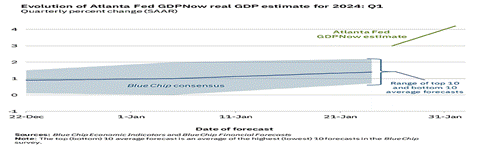
But the markets like to respond to facts rather than hearsay and we now have a huge revision to the GDPNow growth estimate from the Atlanta Fed that I’ve been following. In fact, GDP growth may be accelerating in 2024.
AtlantaFed

It’s revision said: “The GDPNow model estimate for real GDP growth (seasonally adjusted annual rate) in the first quarter of 2024 is 4.2 percent on February 1, up from 3.0 percent on January 26.” 

The revision came after this morning’s construction spending release from the US Census Bureau and the Manufacturing ISM Report On Business from the Institute for Supply Management, as well as first-quarter real gross private domestic investment growth—all showed sharp increases.

So, is the large jump in the Q1 GDP forecast too outrageous? Maybe not, because construction spending is soaring from the various government initiatives, such as the Infrastructure and Inflation Reduction Acts, and the Manufacturing ISM report has turned slightly positive after one year of decline.

Spending just on construction projects rose 0.9% in December to $2.1 trillion, the Commerce Department reported Thursday. It has risen every month in 2023. It is what the government and private companies spend on projects, from housing to highways.

And I also reported on the strong Q1 real gross domestic investment (Capex) growth above.

So, what will higher economic growth do to inflation? It hasn’t hurt the inflation decline to date. Why, because so much of the spending that goes into the GDP is on modernizing the US economy, further increasing US labor productivity.

Harlan Green © 2024

Harlan Green on Twitter: https://twitter.com/HarlanGreen

Posted in Consumers, COVID-19, Economy, Macro Economics, Weekly Financial News | Tagged , , , , | Leave a comment

Will 2024 Be Even Better?

The Mortgage Corner

The US economy grew either 2.5 percent or 3.1 percent annually in 2023, whichever GDP growth indicator you choose.

Why such strong growth when the rest of the world is still recovering from the COVID pandemic? Even China is struggling from its mishandling of COVID-19, after literally locking people in their buildings for weeks to prevent its spread.

USTreasury.gov

The US recovered more quickly because of the various, bipartisan aid packages that quickly created vaccines and dumped some $5 trillion in cash into consumer and business pockets—such as the PPI and PPE payments to cover losses incurred by the pandemic.

This is portrayed in the US Treasury graph of developed countries’ jobless rates. Only Japan and Germany have unemployment rates below our 3.7 percent, which has held now for two years.

That means ‘Helicopter’ Ben Bernanke, Fed Chair Alan Greenspan’s successor during the Great Recession, was right. He was nicknamed such because he was first to advocate the various Quantitative Easing packages that showered (oops, I mean injected) enormous amounts of cash into the US economy and brought US out of the Great Recession of 2007-2009, so named because it caused almost as much damage as the Great Depression.

The Biden administration is doing the same with joint government-private investments in infrastructure and the mitigation of climate change that are injecting $ trillions more into the economy in productive ways that will pay for themselves and more.

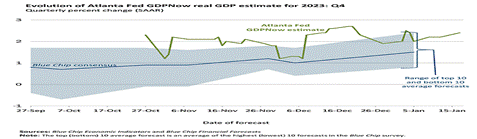
Now a first look at 2024 is the Atlanta Fed’s GDPNow estimate of first quarter growth. It sees a continuing recovery.

AtlantaFed

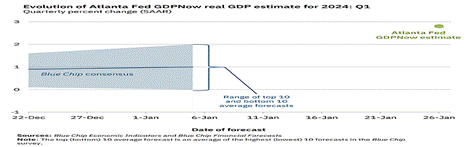
“The initial GDPNow model estimate for real GDP growth (seasonally adjusted annual rate) in the first quarter of 2024 is 3.0 percent on January 26. The initial estimate of fourth-quarter real GDP growth released by the US Bureau of Economic Analysis on January 25 was 3.3 percent, 0.9 percentage points above the final GDPNow model nowcast released on January 19.”

The Atlanta Fed’s estimate of future GDP growth has been surprisingly accurate, in other words, and more positive than that of most Blue Chip economists surveyed as shown in the Atlanta Fed graph.

Further evidence of a surging economy is rising consumer confidence. The Conference Board’s Consumer Confidence Index® rose in January to 114.8 (1985=100), up from a revised 108.0 in December. It was the highest since December 2021, and marked the third straight monthly increase.

“January’s increase in consumer confidence likely reflected slower inflation, anticipation of lower interest rates ahead, and generally favorable employment conditions as companies continue to hoard labor,” said Dana Peterson, Chief Economist at The Conference Board. “The gain was seen across all age groups, but largest for consumers 55 and over.”

And lastly, Pending Home Sales Index (PHSI)* – a forward-looking indicator of home sales based on contract signings – increased to 77.3 in December. Year over year, pending transactions were up 1.3%. An index of 100 is equal to the level of contract activity in 2001.

“The housing market is off to a good start this year, as consumers benefit from falling mortgage rates and stable home prices,” said Lawrence Yun, NAR chief economist. “Job additions and income growth will further help with housing affordability, but increased supply will be essential to satisfying all potential demand.”

Lower interest rates will be the key to further recovery. Consumers are saying they are happier and a strong employment report on Friday should confirm 2024 may be an even better year.

Harlan Green © 2024

Follow Harlan Green on Twitter: https://twitter.com/HarlanGreen
Posted in Consumers, COVID-19, Economy, Housing, housing market, Macro Economics, Weekly Financial News | Tagged , , , , | Leave a comment

US Economy Has Landed

Popular Economics Weekly

There is no longer any doubt with the initial estimate of fourth quarter GDP growth just in. The US economy has made a soft landing. The economy grew 3.3 percent in Q4 after a 4.9 percent increase in Q3, and 2.5 percent for the full year.

This is while inflation, as measured by the most comprehensive inflation indicator for Personal Consumption Expenditures (PCE), has been rising at just 2 percent for the past two months!

Consumer spending was the main engine of growth, which “reflected increases in services (led by health care) and goods (led by recreational goods and vehicles),” said the BEA.

BEA.gov

This is while “The price index for gross domestic purchases (GDP) increased 1.9 percent in the fourth quarter, compared with an increase of 2.9 percent in the third quarter. The personal consumption expenditures (PCE) price index increased 1.7 percent, compared with an increase of 2.6 percent. Excluding food and energy prices, the PCE price index increased 2.0 percent, the same change as the third quarter.”

Why has inflation fallen so dramatically? There are a number of reasons, beginning with the fact that the supply chain of goods and services has caught up to the demand by consumers and companies for goods and services. But also, labor productivity, the amount of goods produced per worker-hour, has risen sharply in the last 12 months, largely because of new technologies such as AI, which has stream-lined supply chains, shortening delivery times.

Real GDP also reflected increased spending in exports, state and local government spending, nonresidential fixed investment, federal government spending, private inventory investment, and residential fixed investment. Spending and investing has increased across the board.

Why wouldn’t consumers keep buying? Americans are fully employed, and average hourly wages are rising faster than inflation (+4.1%). Inflation has been falling particularly sharply over the past 6 months (1.9%-2.5%, depending on which inflation measure we look at), I said last week.

And health care spending is soaring, as a record 21.3 million people have officially signed up for healthcare insurance through the HealthCare.gov Marketplace for 2024, marking a third consecutive banner year for the program, per the press release.

HHS Secretary Xavier Becerra said, “Once again, a record-breaking number of Americans have signed up for affordable health care coverage through the Affordable Care Act’s Marketplace, and now they and their families have the peace of mind that comes with coverage.”

So I would add another reason for the improving mood of consumers: a healthier workforce is a more productive workforce.

Oh yes, and U.S. new-home sales rose 8 percent to an annual rate of 664,000 in December from a revised 615,000 in the prior month, the Commerce Department reported Thursday; even with very high interest rates.

The median sales price of a new home sold in December fell to $413,200 from $426,000 in the prior month partly because for sales inventories have risen to an 8-month supply.

These are all signs of recovery that will accelerate when the Fed governors finally decide inflation is no longer a danger and begin to lower their interest rates.

Harlan Green © 2024

Follow Harlan Green on Twitter: https://twitter.com/HarlanGreen

Posted in Consumers, COVID-19, Economy, Housing, housing market, Macro Economics, Weekly Financial News | Tagged , , , , | Leave a comment

Much Less Pessimism

Financial FAQs

Is the Irrational Pessimism I’ve been writing about finally turning into a more rational optimism that reflects how consumers see the current economy?

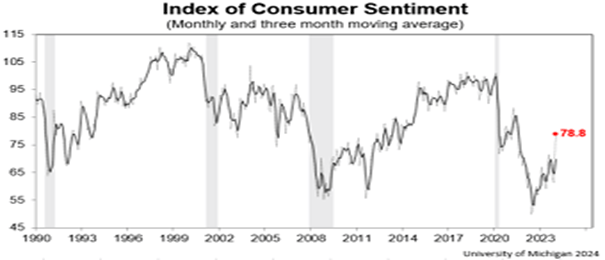
The two major measures of consumer confidence—the Conference Board’s Confidence Index and University of Michigan’s Consumer Sentiment Index are showing the mood of most Americans is improving, after the sudden inflation shock brought on by the COVID pandemic.

Yet there are still doubters that 2024 will cement the recovery. Why?

It’s mainly due to geopolitical uncertainties from regional wars and the lagging recoveries of EU countries and China still suffering the aftereffects of the pandemic.

The most recent predictions of the Conference Board’s Index of Leading Economic Indicators that is supposed to predict future activity is one example.

“The US LEI fell slightly in December, continuing to signal underlying weakness in the US economy,” said Justyna Zabinska-La Monica, Senior Manager, Business Cycle Indicators, at The Conference Board, though six of the ten indicators have turned positive.

“Nonetheless, these improvements were more than offset by weak conditions in manufacturing, the high interest-rate environment, and low consumer confidence. As the magnitude of monthly declines has lessened, the LEI’s six-month and twelve-month growth rates have turned upward but remain negative, continuing to signal the risk of recession ahead.”

But interest rates have fallen sharply, manufacturing is showing signs of recovery, and consumer confidence has just shot up. So maybe the LEI is now looking through the rear-view mirror, just as consumers still in a foul mood have been doing because of damage done from the pandemic.

UofMichigan

The University of Michigan’s survey jump was huge: “Consumer sentiment soared 13% in January to reach its highest level since July 2021, showing that the sharp increase in December was no fluke,” said Survey Director Joanne Hsu. “Consumer views were supported by confidence that inflation has turned a corner and strengthening income expectations. Over the last two months, sentiment has climbed a cumulative 29%, the largest two-month increase since 1991 as a recession ended. (my emphasis)

SFFed

Nobelist Paul Krugman in a recent NYTimes Opinion also points out another sentiment index by the San Francisco Fed, its Daily News Sentiment Index that looks at 200 publications for favorable/unfavorable coverage of economic news.

It has been trending positive since mid-year 2023.

Such surveys don’t portend a looming recession, rather the end of one. Shouldn’t we be listening to consumers that are the final arbiter of business cycles since they account for 70 percent of economic activity?

Harlan Green © 2024

Harlan Green on Twitter: https://twitter.com/HarlanGreen
Posted in Consumers, COVID-19, Economy, Macro Economics, Politics, Weekly Financial News | Tagged , , , , | Leave a comment

Housing Recession Over?

The Mortgage Corner

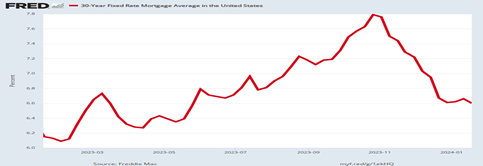
Is the housing recession over? The conforming 30-year fixed rate dropped to 6.60 percent this week, according to Freddie Mac. The fixed 30-year mortgage rate rose to its maximum 7.8 percent in October 2023 before gradually descending to the current rate.

FRED30yearfixed

It had reached this height largely because bond traders had bought the Fed’s story that inflation was still out of control and would take years to return to more normal levels.

This has not been the case. Bond markets are belatedly discovering that inflation has subsided much more quickly, so that it is already close to the Fed’s 2 percent target rate. Even New York Fed President Waller has said the balance between the Fed’s twin mandates of maximum employment with stable prices is “just about right”.

This will bring down mortgage rates even further. The main effect of declining interest rates will be to benefit the housing market that is faced with a severe shortage. This year may see a full-blown housing recovery after a false start in 2020 during the COVID pandemic when fixed mortgage rates briefly dipped to 3 percent.

NAR’s chief economist Lawrence Yun had even announced the housing recession was over last year.

Yun said at the time, “The recovery has not taken place, but the housing recession is over. The presence of multiple offers implies that housing demand is not being satisfied due to lack of supply. Homebuilders are ramping up production and hiring workers.”

Yun was perhaps making a rash prediction because pending home sales at the time, an indicator of homes in escrow but not closed, had risen for the first time in 4 months.

Home sales are continuing to rise ever so slowly this year, and single-family starts that power the housing market have been increasing since January 2023 per Calculated Risk’s graph.

So I believe this year will be the beginning of a real housing recovery, and perhaps signal that overall economic growth will remain strong, since a housing recovery has signaled such in the past.

Calculated Risk

Privately‐owned housing starts in December were at a seasonally adjusted annual rate of 1,460,000. This is 4.3 percent below the revised November estimate of 1,525,000, but is 7.6 percent above the December 2022 rate of 1,357,000, said the US Census Buteau.

Single-family starts increased 15.8% on a year-on-year basis. Permits for future construction of single-family homes increased 1.7% to a pace of 994,000 units last month, the highest level since May 2022. 

Another reason the housing recession may be over. Consumers are becoming more upbeat with the University of Michigan’s consumer sentiment survey jumping a record 13 percent.

“Consumer sentiment soared 13% in January to reach its highest level since July 2021, showing that the sharp increase in December was no fluke,” said survey Director Joanne Hsu. “Consumer views were supported by confidence that inflation has turned a corner and strengthening income expectations. Over the last two months, sentiment has climbed a cumulative 29%, the largest two-month increase since 1991 as a recession ended.” (my emphasis)

It looks like consumers and homebuyers won’t wait longer for this recovery to begin.

Harlan Green © 2024

Follow Harlan Green on Twitter: https://twitter.com/HarlanGreen

Posted in Consumers, COVID-19, Economy, Housing, housing market, Weekly Financial News | Tagged , , , , | Leave a comment

No Recession At All?

Popular Economics Weekly

Ho hum, another good economic number. December retail sales are telling us why we have avoided a recession this year. It’s because consumers have increased rather than reduced their spending ways.

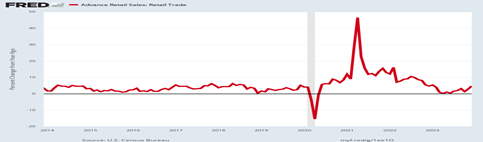
Sales at retailers jumped +0.6 percent in December, 4.8 percent annually, to cap off a very good holiday shopping season and underscore the resilience of the U.S. economy in 2023. November sales had risen +0.3 percent, 3 percent annually.

How is that possible with Fed officials still refusing to say exactly when they will even begin to cut rates this year? Retail sales aren’t adjusted for inflation, so it means consumers are able to spend just ahead of inflation, which is running approximately 3 percent annually.

FREDretailtradesales

Why then are consumers still shopping? Americans are fully employed, and average hourly wages are rising faster than inflation (+4.1%). Inflation has been falling particularly sharply over the past 6 months (1.9%-2.5%, depending on which inflation measure we look at).

In fact, the Producer Price Index for wholesale goods (e.g., raw materials) shows that inflation has become deflation (i.e., turned negative) over the past 2 months.

The Conference Board reported spending on motor vehicles and parts rose a huge 1.1% in December from November. Spending at gasoline stations fell 1.3% from the month prior due to further declines in oil prices. Nonstore retail sales rose a very large 1.5% from the month prior while spending at department store rose 3.0%, which tells us how much brick-and-mortar retail sales have declined.

I reported earlier consumer confidence had also improved, another indication that consumers don’t see a danger ahead for their pocketbooks. The Conference Board’s confidence index was up 10 points in December.

“December’s increase in consumer confidence reflected more positive ratings of current business conditions and job availability, as well as less pessimistic views of business, labor market, and personal income prospects over the next six months,” said Dana Peterson, Chief Economist at The Conference Board.

AtlantaFed

And we now have the Atlanta Fed’s GDPNow model bumping up Q4 GDP growth to 2.4 percent once more, from 2.2 percent due to “fourth-quarter real personal consumption expenditures growth and fourth-quarter real gross private domestic investment growth.”

This shows how much consumer spending and retail sales are driving economic growth.

The Federal Reserve’s survey of anecdotal evidence for November, known as the Beige Book, said the economy has softened since the previous report at the end of summer, which covers the period of Oct. 6 to Nov. 17.

This could mean the odds have improved for the Fed to begin to drop interest rates sooner, maybe in the spring. It would almost guarantee healthy economic growth this year. And wouldn’t consumers like that!

 Harlan Green © 2023

Follow Harlan Green on Twitter: https://twitter.com/HarlanGreen
Posted in Consumers, COVID-19, Economy, Macro Economics, Weekly Financial News | Tagged , , , , | Leave a comment

Why the Irrational Pessimism–Part II

Financial FAQs

I said a week ago that public polls seem to be saying one thing, economic facts another. Real Clear Politics’ compendium of 11 opinion polls on whether participants approve or disapprove of President Biden’s handling of the economy show a negative -22.5 percent spread (pro Trump, contra Biden).

But as Paul Krugman pointed out more recently, it’s Republicans driving that narrative, not U.S. adult citizens or Democrats.

Krugman/YouGov

Why? The big difference is that Republicans feel much worse for a number of reasons and that can skew the results.

Krugman cited a YouGov survey showing that overall 33% of U.S. adult citizens felt great-to-good personally about 2023 while 27% felt bad-terrible about 2023 for the country—pretty balanced.

With Democrats, however, 44% felt great-good while just 16% felt bad-terrible personally, whereas just 29% of Republicans felt great-good vs. 31% felt bad-terrible. You can begin to see the trend.

But there’s a bigger difference over how constituents felt overall about the country in 2023. Democrats felt much better about 2023—35% to 6% for Republicans, while a whopping 76 percent of Republicans thought 2023 was a bad or terrible year for the country, vs. 35 % of Democrats.

What does that tell us? Mainly that the two parties must get their information from different sources, which speaks to either the fact that the economic benefits of record low unemployment and economic growth in 2023 haven’t filtered down to the red states where Republicans dominate, or a willful ignorance about the facts.

It goes back to Nobel Laureate Robert Shiller’s thesis in his book, Irrational Exuberance; that most economic decisions are formed not by researching the facts but hearsay, word-of-mouth stories, or lazy thinking—i.e., not thinking through the hard news but following the stories that make them feel comfortable.

But it also heavily weights surveys such as Real Clear towards the dominant results—in this case the 76 percent of Republicans who believe 2023 was a terrible year.

Or, perhaps the negative opinions of Republicans about the economy have nothing to do with the economy or their personal well-being.

Maybe it has to do with deep-seated prejudices such as an inherent belief that new immigrants don’t benefit them; or females shouldn’t be allowed to control their own health, a very skewed belief system that babies lives take precedence over their mothers’?

It also calls into question what was once our storied educational system. We were the first country to institute universal K-12 education. But now our K-12 system ranks at the bottom of developed countries in the latest surveys.

Some red states are also banning books from school curriculums and libraries, even persecuting librarians and K-12 teachers for advocating them. Is our public K-12 educational system no longer adequate to maintain a Democracy?

Harlan Green © 2024

Harlan Green on Twitter: https://twitter.com/HarlanGreen

Posted in Consumers, COVID-19, Economy, Macro Economics, Politics, Weekly Financial News | Tagged , , , , | 1 Comment

First Signs of Deflation Appearing

The Mortgage Corner

Today’s Producer Price Index for Final Demand, a measure of the cost of wholesale prices, provides the first concrete evidence that we may be entering a period of deflation this New Year.

And, perhaps require the Fed to begin to lower interest rates as soon as in March. Though ongoing wars may cause future shortages but that isn’t happening at present.

Why? Raw material costs are declining into deflation territory, a sign of overproduction, which means prices that consumers must pay for the finished product or service will possibly decline into negative territory as well—when the excess profit margins of distributors and retail sellers that took advantage of the pandemic shortages also subsides.

Overproduction last happened in the 2007-09 Great Recession, as I’ve said, and began a period of Quantitative Easing requiring the Fed to buy massive amounts of securities to increase liquidity enough to boost the inflation rate back to the 2 percent range.

Wholesale prices this round first went into negative territory in July 2022 (-0.28%) per the FRED PPI graph, then fluctuated wildly for several months as supply chains recovered. But the PPI has been negative for the past 3 months, which is a sign that most supply chains have more than recovered.

FREDppi

The danger of overproduction has happened many times in the past and been a major cause of recessions. The Great Recession was caused by the overproduction of housing, for example; some one million excess units.

We saw signs of this in yesterday’s Consumer Price Index as well, when the so-called core index without food and energy prices declined to 3.9 percent for the first time since May 2021, mainly due to lower energy, healthcare, and used car prices.

Energy prices are declining because non-OPEC countries are now outproducing OPEC oil producing countries, for starters, and food prices have softened. The food category was up 2.7% year-over-year, with food away from home up 5.2% during the month and food at home up just 1.3%.

The FAO Food Price Index, which tracks monthly changes in the international prices of commonly traded food commodities, was 13.7% lower last year than the 2022 average, but measures of sugar and rice prices growing in that time.

The pace of inflation for food at home has now been below the Federal Reserve’s overall target rate of 2 percent for three straight months, although the overall level of food prices is still elevated compared to two and three years ago.

Another reason for the deflation concern is consumers usually cut back their spending in the spring. The holiday spending spree is over, and tax season is approaching, which makes personal savings a priority.

In fact, we are already in the Fed’s 2 percent target range. The Personal Consumption Expenditure Price (PCE) Index is already at 1.9% and Core CPI Prices at 2.0% over the past 6 months.

What Fed officials seldom admit is the 2 percent inflation target isn’t a reliable target because there is no accurate measure of inflation as economists such as former Fed Chairman Ben Bernanke have admitted.

Overproduction can become a serious problem as it was during the Great Recession, but the possibility of supply disruptions because of the ongoing Ukraine and Middle East conflicts have made financial analysts leery of even mentioning the possibility of deflation.

The possibility of deflation scared the Fed enough under former Chairman Ben Bernanke to cut the Fed Funds rate to zero percent for a prolonged period—from December 2008 to February 2016.

Can that happen again if the Fed doesn’t begin to lower interest rates sooner?

Harlan Green © 2024

Follow Harlan Green on Twitter: https://twitter.com/HarlanGreen
Posted in Consumers, COVID-19, Economy, Macro Economics, Weekly Financial News | Tagged , , , , | Leave a comment

Please Get Inflation Picture Right!

Financial FAQs

Today’s news that the Consumer Price Index (CPI) was “slightly hotter than expected”, per the Wall Street Journal, caused financial markets to plunge on the assumption the Fed will reduce interest rates more slowly than markets would like to reach its 2 percent inflation target rate.

FREDcpi

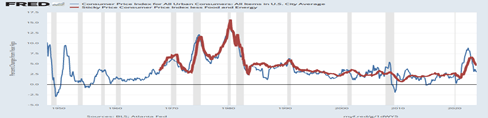
Yet if we look at past history in the above FRED cpi graph dating from 1950, the only time the Fed reached its target rate of 2 percent inflation for any length of time was right after WWII into the 1960s, and after the Great Recession of 2007-2009!

So, what does that tell us about monetary policy that is the Feds playing field? It has taken great recessions or WWII (i.e., widest gray bars in graph) to bring down inflation to the Fed’s 2 percent target.

Wow, can acceptable inflation levels only be achieved via recessions? That’s a terrible way to control inflation, in my opinion.

In fact, after 1980 and the Paul Volcker Fed era of sky-high interest rates, the US economy grew very well while averaging 2.5 to 5 percent inflation, until December of 2007 and the start of the Great Recession, which was worldwide let us not forget.

We even had four years of budget surpluses from 1996 to 2000 during the Clinton administration, and the longest period of prosperity (10 years) without a recession.

Yet a few Fed Governors are proving reluctant to accept the fact that inflation is in a prolonged down swing, when today’s ‘slightly hotter’ CPI was almost solely due to sticky used car prices and rental rates.

The above  official BLS graph explains the ingredients of CPI inflation best. The biggest inflation drop was energy (black bar), along with food (blue bar), though its Core index (green bar) was above the All Items index.

“In December, the Consumer Price Index for All Urban Consumers increased 0.3 percent, seasonally adjusted, and rose 3.4 percent over the last 12 months, not seasonally adjusted.”

What is the real cause of the inflationary surge? Most economists now say it was suddenly interrupted supply-chains caused by the pandemic that returned to normal, thus increasing the supply of things and services, not excessive demand because of suddenly wealthy consumer spending too much due to all the pandemic recovery aid.

Economics Professor James Galbraith, son of New Deal Economist John Kenneth Galbraith said, “There is a wave of reporting to the effect that the Fed deserves credit [for the drop in inflation]. But the fact is that the peak in rising prices occurred in June 2022, and that was only three months after the Fed started raising interest rates.”

Average hourly private sector wages are the main driver of demand-side inflation (via consumer spending) and they peaked in March 2022 at 5.9 percent. Average earnings had already dropped to 5.4 percent in June 2022, continuing their decline to 4.1 percent in December 2023.

So why do Fed Governors keep saying that the unemployment rate must rise to lower inflation? New York Federal Reserve President John Williams, one of the most influential Governors, was cited recently at a White Plains, NY speech per MarketWatch saying U.S. interest rates will likely need to stay high “for some time” until senior central bank officials are confident the rate of inflation is returning to 2 percent. He said the labor market would need to soften a bit more, potentially bumping up the unemployment rate to 4 percent from the current level of 3.7 percent.

We have had the unemployment rate below 4 percent for two years, current 6-month inflation is hovering at 2.5 percent and still declining, and consumers continue in record numbers to travel and enjoy leisure activities, I said recently.

Why spoil the party unnecessarily with another recession?

Harlan Green © 2024

Harlan Green on Twitter: https://twitter.com/HarlanGreen
Posted in Consumers, COVID-19, Economy, Macro Economics, Weekly Financial News | Tagged , , , , | Leave a comment

When Has Inflation Declined This Quickly?

The Mortgage Corner

When was the last time inflation rates declined this steeply? You guessed right if you said the Great Recession.

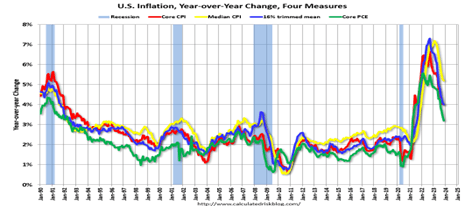
Calculated Risk’s colorful graph of various inflation indicators (gray bars are recessions) shows the history of Core CPI (red line) and Core PCE (green line) inflation from January 1990, among others. Core prices are without more volatile food and energy prices.

What does that tell us about the current drop in inflation? Maybe there’s a danger of it falling too far, too fast, fulfilling the prophecies of some that still see a looming recession. This inflation surge was worse than during the Great Recession (thickest blue bar) because of the COVID pandemic, per the graphic picture.

Calculated Risk Blog

Only the 1980-81 recessions caused a sharper inflation decline. But that was because then Fed Chair Paul Volcker raised interest rates into the double digits to combat double-digit inflation caused by the 1970’s oil crisis-fed stagflationary spiral.

In fact, we are already in the Fed’s 2 percent target range. The Personal Consumption Expenditure Price (PCE) Index is already at 1.9% and Core CPI Prices at 2.0% over the past 6 months.

And what Fed officials seldom admit is the 2 percent inflation target isn’t a dependable target. Why? Because no one really knows what the true inflation rate is! Yes, there is no measure among the vari-colored measures above that is an accurate indicator of inflation as economists such as former Fed Chairman Ben Bernanke have admitted. It could have already hit zero percent in some sectors of our economy. Hence economists consult many different indexes to arrive at a mean value.

And consumers may already believe this, since the most recent inflation assessment coming from the New York Fed says their expectations are declining fast as well.

Consumers expect the inflation rate to fall to 3 percent, according to the Federal Reserve Bank of New York. That’s the lowest anticipated one-year ahead inflation rate since January 2021, in the NY Fed’s ongoing survey of consumer expectations.

Median inflation expectations declined at all horizons, falling to 3.0 percent from 3.4 percent at the one-year ahead horizon, to 2.6 percent from 3.0 percent at the three-year ahead horizon, and to 2.5 percent from 2.7 percent at the five-year ahead horizon. 

Maybe some Fed Governors, such as Michele Bowman are beginning to believe this as well who have studied the history of inflation.

Energy and food prices are falling, for starters. The U.S. is even outproducing the OPEC countries and Russia, which may not be the best way to win the inflation war. But it could convince the Fed to begin to lower short term rates sooner and preserve this recovery.

No one really wants to cause another recession, right?.

Harlan Green © 2024

Follow Harlan Green on Twitter: https://twitter.com/HarlanGreen

Posted in Consumers, COVID-19, Weekly Financial News | Tagged , , , , | Leave a comment