
Peacemaking in E. Congo

Answering Kennedy’s Call

What could be more important than supporting projects in the Democratic Republic of Congo? Santa Barbara Rotarians have been supporting projects such as the Congo Peace School in conjunction with an eastern Congo Rotary Club since 2010.

“There are few worse places, if any, to be a child,” said Amani Matabaro, former President of the Bukavu Mwangaza Rotary Club of E. Congo.

While we love to share the amazing impact your giving makes in the lives of the children and adults we partner with in eastern Congo, we also know it is important to share the horrific context in which these children we serve are not only surviving but thriving.

As noted in the September 2023 press briefing from the UN’s children’s agency UNICEF on Congo (DRC) and specifically the eastern part of the country where we are located, “the war-torn country had the world’s highest number of UN-verified violations against children in armed conflict.”

The violence “has reached unprecedented levels,” said Grant Leaity, UNICEF’s representative in the country. “There are few worse places, if any, to be a child.”

“The east of the Democratic Republic of the Congo (DRC) is facing one of the world’s most complex and forgotten crises. Around 2.8 million children are bearing the brunt of violent conflict, being recruited by armed groups, losing their families and homes, and being exposed to ever-growing levels of sexual- and gender-based violence.” (ReliefWeb infographic here)

It’s a harrowing and difficult report to read, a content warning for sexual assault and violence against young children.

In this space where so many use violence to control innocent civilians, our Founding Director Amani Matabaro’s vision for active peace is revolutionary. Each week at the Congo Peace School, the students and staff focus on a principle of peace and nonviolence as taught by Martin Luther King, Jr.

This last week the focus was the development and interpretation of Principle Three of Kingian Nonviolence: Nonviolence Seeks to Defeat Injustice, or Evil, Not People.

Training the teachers, Amani helped them put the concept into vocabulary that is easier for the students to understand – to attack the forces of evil, not the persons doing evil, so the students and staff could focus on how to practice the principle in the context of eastern DRC.

Amani spoke to some of the Peace School students to ask how they understood the principle, and how they are putting it into practice in their own lives.

As it is not located in a mining area, The Congo Peace School is in a place of relative peace, but the students and staff and community are surrounded by the violence of militias and war, the threat of being recruited as a child soldier, and the extreme poverty that leads to malnutrition, child marriages, and gender-based violence.

From the UNICEF summary of remarks: “In the first three months of 2023, in North Kivu alone, more than 38,000 cases of sexual- and gender-based violence were reported. That’s a 37 per cent increase compared to the same time period in 2022. Said another way: in just one year, there have been 10,000 additional reports of sexual- and gender-based violence. Those are the ones reported. And in North Kivu alone.”

“As well as unprecedented levels of violence, the lives of children in eastern Congo are threatened by epidemics and malnutrition. Around 1.2 million children under five in the east are facing the risk of acute malnutrition.

UNICEF’s Leaity warned about the risk of “acceptance of something which is unacceptable.”

“As the world looks away, we are failing the children of DRC,” he said.

Harlan Green © 2020

Follow Harlan Green on Twitter: https://twitter.com/HarlanGreen
Posted in Uncategorized | Tagged , , | Leave a comment

What Happens Next?

Popular Economics Weekly

What does the future foretell? Everyone wants to know what will happen next year now that the Fed is on hold and inflation continues to decline.

I believe the construction industry is telling us the economy will continue to expand next year, despite the Fed’s intransigence on dropping interest rates. Plunging bond yields are signaling inflation will continue to decline, so why wouldn’t the Fed follow?

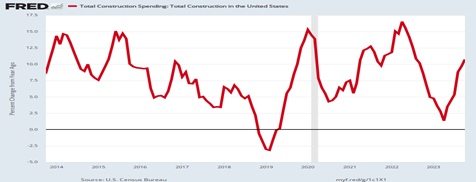
Construction spending rose in October for the 10th month in a row, largely because of work on commercial buildings and government-funded public projects.

FREDconstruction

Spending on construction increased 0.6 percent in October to just over a $2 billion annual rate, up 11 percent annually, the Commerce Department reported Friday, and per the FRED graph on construction spending.

 Much of it comes from the ‘new’ New Deal bipartisan Bidenomics bills that are modernizing the American economy as well as fighting climate change.

And inflation as measured by the Fed’s preferred PCE price index, or personal consumption expenditures price index, was unchanged in November. It was held down in part by a decline in oil prices. The increase in inflation over the past year decelerated to 3.0 percent from 3.4 percent in the prior month and 6.4 percent one year ago. That’s the lowest level since February 2021.

And construction spending could even accelerate as interest rates drop further. Bonds in particular have rallied, as the 10-year Treasury note yield declined more than 0.5 percent in November igniting a huge bond rally after briefly touching 5 percent.

What is being constructed? Everything from roads (public) to commercial properties (private). Private construction spending was almost $1.5 billion of the total.

In October, the estimated seasonally adjusted annual rate of public construction spending was $447.8 billion, 0.2 percent (±2.0 percent) above the revised September estimate of $446.9 billion. Public construction is building for the future that only governments can do.

Educational construction was at a seasonally adjusted annual rate of $97.2 billion, 0.4 percent (±2.3 percent) above the revised September estimate of $96.7 billion.

Highway construction was at a seasonally adjusted annual rate of $132.0 billion, 0.3 percent (±4.8 percent) below the revised September estimate of $132.4 billion.

Since Biden took office, employers have created 14 million jobs, and the unemployment rate has been hovering around a 50-year-low for months, said the NYTimes Ross Serkin.

The president has also been talking up signature economic accomplishments like the Infrastructure Investment and Jobs Act, which he argues have helped rebuild rural America and invigorated the economy.

“Bidenomics is just another way of saying the American dream,” he said in a speech. It’s not a stretch. The economy grew last quarter at 5.2 percent, belying a global slowdown.

President Biden will convene the first meeting of his supply-chain resilience council, using the event to announce 30 actions to improve access to medicine and needed economic data and other programs tied to the production and shipment of goods.

“We’re determined to keep working to bring down prices for American consumers and ensure the resilience of our supply chains for the future,” said Lael Brainard, director of the White House National Economic Council and a co-chair of the new supply chain council.

Working to increase the supply of everything is the best way to bring down prices, and inflation.

Harlan Green © 2023

Follow Harlan Green on Twitter: https://twitter.com/HarlanGreen
Posted in Consumers, COVID-19, Economy, Uncategorized, Weekly Financial News | Tagged , , , , , , | Leave a comment

Shoppers Happy, Lower Inflation

Financial FAQs

There are two indicators that show consumers will continue to support economic growth this year, (and hence avoid a recession), while inflation is continuing to decline.

Firstly, Thanksgiving, the biggest shopping holiday, lured in more shoppers than ever. A record number of people showed up in stores or online to spend money over Thanksgiving, but their spending on holiday-related items ticked lower as they looked for more bargains, according to data from the National Retail Federation released Tuesday.

The industry group said that 200.4 million customers shopped between Thanksgiving Day and Cyber Monday. That’s above the record 196.7 million that turned out last year.

“The five-day period between Thanksgiving and Cyber Monday represents some of the busiest shopping days of the year and reflects the continued resilience of consumers and strength of the economy,” said NRF President and CEO Matthew Shay. “Shoppers exceeded our expectations with a robust turnout. Retailers large and small were prepared to deliver safe, convenient, and affordable shopping experiences with the products and services consumers needed, and at great prices.”

Consumer confidence also increased. The Conference Board Consumer Confidence Index® increased in November to 102.0 (1985=100), up from a downwardly revised 99.1 in October. The Present Situation Index—based on consumers’ assessment of current business and labor market conditions—ticked down slightly to 138.2 (1985=100), from 138.6. The Expectations Index—based on consumers’ short-term outlook for income, business, and labor market conditions—rose to 77.8 (1985=100) in November, up from its downwardly revised reading of 72.7 in October.

“Consumer confidence increased in November, following three consecutive months of decline,” said Dana Peterson, Chief Economist at The Conference Board. “This improvement reflected a recovery in the Expectations Index, while the Present Situation Index was largely unchanged.”

Higher confidence was concentrated primarily among householders aged 55 and up though confidence among householders aged 35-54 declined slightly.

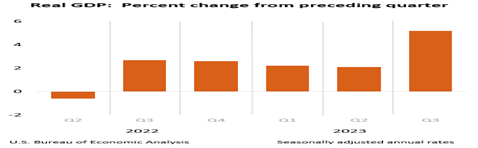
Top this off with a revised estimate of third quarter Real GDP growth that rose to 5.2 percent from its initial estimate of 4.9 percent.

BEA.gov

But households spending rose 3.6 percent in the third quarter, down from an original 4 percent, which was a sign of slowing inflation. And Personal Consumption Expenditure (PCE) prices that are part of the GDP growth estimate rose just 2.8 percent, 2.3 percent with food and energy prices excluded.

Business profits, meanwhile, increased for the second quarter in a row. They rose 3.3 percent to mark the largest gain in five quarters, suggesting that higher labor costs are not weighing much on earnings. Government spending was also a strong contributor as spending rose at a 5.5% rate, versus 4.6% initially.

All of this news has stocks and bonds rallying—stocks because business profits have increased, and bonds because interest rates have declined precipitously.

The yield on the 10-year Benchmark Treasury note that sets mortgage rates retreated 4.7 basis points to 4.288% from 4.335% Tuesday afternoon. This will give a huge boost to the housing market in the coming months.

So why shouldn’t we be enjoying the holidays? Just maybe the Fed will stop worrying that it isn’t being taken seriously. Inflation is being tamed without causing a recession!

Harlan Green © 2023

Follow Harlan Green on Twitter: https://twitter.com/HarlanGreen

Posted in Consumers, COVID-19, Economy, Weekly Financial News | Leave a comment

Building Community at Home–Part II

Answering Kennedy’s Call

(Cont’d Building Community at Home) Old Town, with its own past, could give Goleta Valley residents a sense of their own history and separate community identity. It even had a Community Center that hosted many community activities. The Community Planning Director at that time, Dan Gira, also thought Goleta should become a city able to determine its future as part of the County’s General Development Plan update.

The update was required by the state of California to accommodate the changes necessitated by a growing population. I was one of many moving to this beautiful area of the South Coast with its unique climate sheltered by east-west mountains and south facing beaches. Santa Barbara and the South Coast has always been a beautiful and very desirable place to live, and the people kept coming.

The County would apply to the state of California for the formation of a Goleta Old Town Redevelopment District, which would allow some tax monies to be withheld for use in Old Town to upgrade its housing and infrastructure. While I loved the beautiful outdoors and the nature that surrounded us, more housing was needed in Old Town. Many Mexican agricultural workers—mostly undocumented—were living in Old Town because of its cheap rents, but landlords were taking advantage by housing ten to twenty of them in a single dilapidated housing unit.

I had to raise $50,000 in the community: 50 percent of the expense the County would incur to do the studies necessary to classify Goleta Old Town as a redevelopment district. Dan Gira and I agreed the County would chip in its 50 percent in the form of time and labor, and whatever was needed for the feasibility study that would determine if Goleta Old Town fulfilled the state requirements for a redevelopment district.

The study would include a report on degraded infrastructure, such as inadequate surface transportation, and the number of bars and other “nonproductive” businesses in Old Town. The point was to determine the extent of blight, or physical deterioration, of the Old Town community, and a cost estimate for fixing those problems.

There was plenty of blight. Goleta’s Old Town had become run down in the 1980s as competing malls were built elsewhere to accommodate the new auto-dependent subdivisions built to hold the growing population. Bars had proliferated as businesses left Old Town. A fire partially destroyed a ten-unit apartment building. A Santa Barbara News-Press reporter covering the fire reported that residents thought the popping noise from breaking windows sounded like gunfire from gang warfare.

We raised $50,000, the County Planning Department hired a consultant to write the feasibility study, and it was approved within a year.

Old Town’s Revival

Thoughts of forming a new city of Goleta were now revived, and the actual planning of Old Town’s future began. There had been several unsuccessful efforts to form a city since the 1970s. The Goleta Old Town Revitalization Committee, a mix of local officials and residents that wanted Old Town’s infrastructure and services upgraded, was now created, and I was appointed its chairman. Hearings were held in Old Town’s Community Center so county planners could learn what Goleta’s residents wanted for a future town center. We were following the precepts of community organizing in bringing citizens together to solve some of the problems afflicting such a diverse community.

Follow Harlan Green on Twitter: https://twitter.com/HarlanGreen
Posted in Economy, Housing, Politics | Leave a comment

Housing Starts Up, Recession Worries Over?

Financial FAQs

The best indicator of a looming recession is to watch how consumers behave. And this will be a record year for travel on the ground and in the air. So, would consumers continue travelling if they saw financial trouble ahead? Of course not.

Gas Buddy, for one, says gas prices are down. For the ninth consecutive week, the nation’s average price of gasoline has declined, falling 6.2 cents from a week ago to $3.27 per gallon according to GasBuddy data compiled from more than 12 million individual price reports covering over 150,000 gas stations across the country.

And AAA is predicting a record number of cars on the road. the third highest since 2000. AAA projects 55.4 million travelers will head 50 miles or more from home over the Thanksgiving holiday travel period.

Housing construction and Pending Home sales numbers were also up in October. This may be an indication that the housing market slowdown may have bottomed, another sign of a resurgence.

That’s in part because mortgage rates have dropped suddenly to the low 7 percent range, 15-year fixed to mid-6 percent, and homebuyers will know this. The bond market has been rallying of late, in line with optimism that the Fed may be done with its rate hikes and even begin to ease rates early next year.

The National Association of Realtors Pending Home Sales Index (PHSI)* – a forward-looking indicator of home sales based on contract signings – rose 1.1 percent to 72.6 in September. Pending transactions had declined 11% in a year.

The NAR forecasts that the 30-year fixed mortgage rate will average 6.9 percent for 2023 and decrease to an average of 6.3 percent in 2024, as markets unwind from the Fed’s rate hikes.

I can see blue skies ahead for housing as interest rates continue to decline. More existing homes for sale are needed, which are at historic lows because of the interest rate disparities from the COVID pandemic (see red line in below Calculated Risk graph).

Calculated Risk

Overall housing starts (new construction) increased 1.9 percent in October as well to a seasonally adjusted annual rate of 1.37 million units, according to a report from the U.S. Department of Housing and Urban Development and the U.S. Census Bureau.

The October reading of 1.37 million starts is the number of housing units builders would begin if development kept this pace for the next 12 months. Within this overall number, single-family starts increased 0.2 percent to a 970,000 seasonally adjusted annual rate.

However, single-family starts are down 10.6 percent year-to-date. The multifamily sector, where demand is greatest and includes apartment buildings and condos, increased 6.3 percent to an annualized 402,000 pace.

“The construction data in October continue to reflect that despite multidecade lows for housing affordability, the market continues to lack attainable inventory that only the home building industry can provide,” said NAHB Chief Economist Robert Dietz. “And with the 10-year Treasury rate now back in the 4.5% range, we are forecasting gains for single-family home building in the months ahead and an outright gain for construction in 2024.”

What are consumers thinking at the moment? Many have been discouraged from even looking for homes because of such high interest rates.

Overall, lower-income consumers and younger consumers exhibited the strongest declines in sentiment, said Joanne Hsu, Director of the University of Michigan sentiment survey. In contrast, sentiment of the top tercile of property owners improved 10 percent, reflecting the recent strengthening in equity markets.

It’s a reflection of the 37 percent increase in wealth of mostly homeowners from 2019 to 2022, according to a new survey from the Federal Reserve. The average family’s net worth jumped 37 percent between 2019 and 2022. That’s the largest three-year increase since the Fed began conducting the survey more than three decades ago.

The bottom line is with so much pent up demand brought on by the Fed’s inflation fight, consumers still want to spend, especially with interest rates on the decline.

Harlan Green © 2023

Follow Harlan Green on Twitter: https://twitter.com/HarlanGreen
Posted in Consumers, COVID-19, Economy, Housing, housing market, Weekly Financial News | Leave a comment

Building Community at Home

Answering Kennedy’s Call

Fulfilling the third goal of my Peace Corps service, “to help promote a better understanding of other peoples on the part of Americans,” wasn’t as easy to do. My PCV service was implementing a rural community development program in a Turkish village for two years in the 1960s. I partially fulfilled it on my return home by organizing tours of Turkey that was full of Greek and Roman tourist sites for Americans.

But I also found ways to bring back the knowledge I had learned in rural community development to my home community, an unincorporated area of Santa Barbara County that ultimately resulted in the formation of a new city.

What could be more community developing than that? This is an excerpt from my memoir published by peacecorpsworldwide.org › 2023-winner-of-the-peace2023 Winner of the Peace Corps Writers’ Publisher’s Award.

As a bedroom community to Santa Barbara, the Goleta Valley had no real community organization of its own other than the Goleta Valley Chamber of Commerce. It needed an established entity to ask for what was needed to improve the valley’s aging and dilapidated infrastructure, and to reduce chaotic development. More public transportation, water resources, and just smart community planning were needed to mitigate the effects of a growing population.

There was much opposition to any organizing effort that would create more than a bedroom community in the Goleta Valley. There were those who wanted to “belong” to the City of Santa Barbara so their property values would be the beneficiary of Santa Barbara property values. They wanted no part of a new, more rural city. Then there were the environmentalists that tended to cluster around UC Santa Barbara with its strong environmental studies program. They were afraid a new city would encourage more development.

But in fact, being unincorporated didn’t prevent development: property owners and developers had only to convince one County Supervisor that represented a larger area, rather than a city council responsible for the entire community.

Goletans couldn’t agree on what was unique about their own community. Was it a farming culture, bedroom community, or just funky adjunct to UC Santa Barbara? Many thought that, with prosperous Santa Barbara next door, what was the need for another city on the already crowded South Coast? Hence the impasse that had defeated earlier cityhood attempts.

The first step in building a livable community, in my view, had to be creating a town center that could focus planning efforts, and Old Town Goleta seemed just the place to do it. Old Town had been the historical center of the Goleta Valley with stores, a saloon, and a blacksmith for farmers in the early days.

It took two years’ of planning to accomplish just the first step that was formally approved by County Supervisors—The Goleta Old Town Revitalization Plan.

Follow Harlan Green on Twitter: https://twitter.com/HarlanGreen
Posted in Macro Economics, Politics, Uncategorized | 1 Comment

Where’s the Inflation–Part II?

Popular Economics Weekly

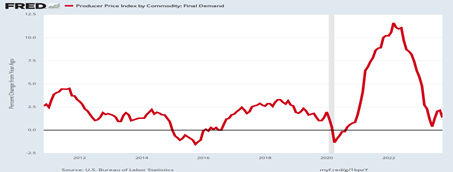
We can also look at the behavior of wholesale prices to see if inflation has been conquered. The Producer Price Index has been at or below the Fed’s target 2 percent since May 2023. It’s the cost of raw materials that go into finished products, so it should have told Fed officials that retail inflation will soon follow that is now rising at 3.2 percent.

What is holding up retail CPI prices? Market scarcities that have enabled producers to temporarily boost their profit margins. But the PPI tells us that scarcities are quickly disappearing; in autos and gas, for instance, where prices had the largest drop in the PPI.

FREDppifinaldemand

“The Producer Price Index for final demand fell 0.5 percent in October, seasonally adjusted, after advancing 0.4 percent in September, the U.S. Bureau of Labor Statistics reported today. The October decline is the largest decrease in final demand prices since a 1.2-percent drop in April 2020.”

What more proof does the Fed need to begin thinking about dropping interest rates? Corporations are reporting record profits in the third quarter due to those pandemic-induced scarcities and 98 percent reporting in the third quarter say they are increasing their dividends, a sure sign of increased profits.

The PPI is slightly higher without volatile foods, energy, and trade services, advancing +0.1 percent in October, the fifth consecutive rise. For the 12 months ended in October, prices for final demand less foods, energy, and trade services moved up 2.9 percent.

This may be the ‘head fake’ that Chairman Powell was talking about at a recent conference. What if food and energy scarcities surface again with all the geopolitical uncertainty?

If it wasn’t for the huge 4.9 percent Q3 GDP growth, economists will begin to worry that falling inflation shows a drop in the demand for goods and services, which does signal a slowdown.

Slowing retain sales can be the first sign of any slowdown in activity. Are shoppers already shopped out for the holidays? Retail sales have declined, falling 0.1 percent in October for the first time in seven months, but the decline is unlikely to last as Americans enter the holiday-shopping season, especially if prices are no longer rising.

There was better news with housing. The 30-year fixed-rate mortgage dropped a quarter of a percent to 7.50%, the largest one-week decrease since last November, according to Freddie Mac, the guarantor of mortgages.

It should kick start more housing sales, according to Lawrence Yun, the NAR’s chief economist. Yun forecasts that interest rates will drop to between 6-7% by the spring buying season and anticipates that more sellers will enter the market.

“Builders are back on their feet, up 5% in newly constructed home sales year to date,” said Yun. “Builders can simply create inventory. In a housing shortage environment, builders are really benefiting.”

What happens next year may depend on the housing market, which traditionally takes up approximately 7 percent of GDP activity, but is also a leading indicator of market direction.

The overall decline in interest rates we are already seeing will give a boost to almost every sector of economic activity going into next year.

Harlan Green © 2023

Follow Harlan Green on Twitter: https://twitter.com/HarlanGreen
Posted in Consumers, COVID-19, Economy, Housing, housing market, Weekly Financial News | Leave a comment

Where’s the Inflation?

Financial FAQs

What if there’s too little inflation? That’s actually the definition of a recession. It seems unlikely at the moment and inflation is still a major upset for consumers. But it could happen if the Fed doesn’t ease up on its hawkish position that inflation has yet to be tamed.

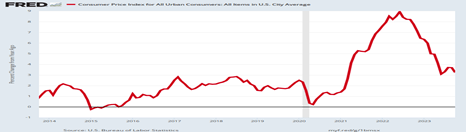
It hasn’t happened yet, but if inflation should drop below the 2 percent Fed target, it has generally meant recession. The CPI plunged to -1.96 percent annually in July 2009 at the end of the Great Recession and dropped to +0.22 percent in May 2020 (gray bar in graph) at the end of the short-lived COVID recession.

Economists are becoming alarmed that the Fed has boosted interest rates too high and too fast. The Fed has raised short-term rates a record 11 times since early 2022, from effectively 0 percent to around 5.25 percent.

Another Nobel Laureate, Joseph Stiglitz, is now added to the list of major economists giving warning. In a study co-authored by Ira Regmi, he believes the Fed is in danger of precipitating another recession if it holds its interest rates too high for too long.

“The pandemic-induced inflation was exacerbated further by Russia’s invasion of Ukraine, which caused a spike in energy and food prices,” said Stiglitz. “But, again, it was clear that prices could not continue to rise at such a rate, and many of us predicted that there would be disinflation — or even deflation (a decline in prices) in the case of oil.”

FREDcpi

And that is happening. The Consumer Price Index for All Urban Consumers (CPI-U) was unchanged in October on a seasonally adjusted basis, after increasing 0.4 percent in September, the U.S. Bureau of Labor Statistics reported today. It dropped to 3.2 percent from 3.7 percent in August. It was as high as 8.9 percent in June 2022.

In fact, the consensus of 34 economists surveyed by the Philadelphia Fed and released Monday is that there may not be any soft landing of the economy at all, but economic growth continuing into next year.

The Survey of Professional Forecasters is the oldest quarterly survey of macroeconomic forecasts in the U.S., having started in 1968.

“The outlook for the U.S. economy looks somewhat better now than it did three months ago,” the survey found, according to a MarketWatch article.

On an annual-average over annual average basis, the forecasters expect real GDP to increase at a 2.4 percent rate this year and slow only marginally to a 1.7 percent rate in 2024.

So the din is growing for the Fed to begin to cut rates early next year, though we wouldn’t know it from Fed Chair Powell’s remarks that the falling inflation numbers might be a ‘head fake’.

Why would Powell want to spoil the party celebrating continued growth? He must still have the 1970’s wage-price inflationary spiral in mind. It was a time of the Arab oil embargo and long lines at American gas stations, with unions attempting to keep up with the wildly fluctuating energy prices.

But Siglitz and Regmi addressed that as well in their study.

“We conclude that with nominal wages already tempered, this does not seem likely. Moreover, declining real wages are typically not a sign of a tight labor market. Weak unions, globalization, and changes in the structure of the economy provide part of the explanation for why wage-price dynamics today may be markedly different from 50 years ago.”

Stocks and bonds are rallying because of today’s good news on inflation, especially REITs (Real Estate Investment Trusts). This is a sign that the real estate market and housing in particular may be on the mend as well.

It also says there is growing optimism among investors that the Fed is done and will not want to obstruct future growth

Harlan Green © 2023

Follow Harlan Green on Twitter: https://twitter.com/HarlanGreen

Posted in Consumers, COVID-19, Economy, Housing, housing market, Weekly Financial News | Leave a comment

Why Not A Return to the ‘Roaring Twenties’?

The Mortgage Corner

“The Roaring Twenties was a decade of economic growth and widespread prosperity, driven by recovery from wartime devastation and deferred spending, a boom in construction, and the rapid growth of consumer goods such as automobiles and electricity in North America and Europe and a few other developed countries such as Australia.”

Does this sound familiar to history buffs? It’s Wikipedia’s take on the ‘Roaring 1920s’, the era of widespread prosperity and women’s rights as the US recovered from World War One and the Spanish Flu pandemic, in which some 650,000 Americans died.

I know I may be way out on a limb but there could be a repeat in this decade, which I’ve been calling the ‘Roaring Twenty-Twenties.’

There are similarities today. We are still recovering from the COVID pandemic that killed one million Americans, for starters. And consumers are spending like there’s no tomorrow.

The Trump and Biden administrations have passed spending bills of more than $6 trillion to aid the recovery and modernize the American economy, which will boost higher growth and household incomes for the rest of this decade.

And while we’re not fighting a world war, spending has picked up because of the Middle East and Ukrainian conflicts, just as it did fighting world wars.

Such unprecedented spending is producing results. Third quarter US economic growth has soared to 4.9 percent after just 2 percent real growth in the first two quarters of 2023.

Predictions of Q4 growth are all over the map, in part because few believe that consumers can keep shopping at the current rate. Maybe not, but does that mean massive layoffs and an abrupt halt to the huge construction boom in infrastructure, the environment and expansion of the social safety net going forward?

No, because the Biden administration has focused on infrastructure, clean energy and semiconductor manufacturing, sectors that produce more high paying jobs, Lael Brainard, director of the National Economic Council, said at a White House press briefing.

“Despite repeated forecasts that recession is just around the corner, the U.S. recovery is solid, and inflation is down. Unemployment has fluctuated in a narrow band below 4 percent for 17 months in a row—the longest stretch in 50 years (my emphasis),” said Brainard.

And since Biden took office in 2021 it has already spurred nearly $500 billion in private-sector commitments.

Critics, mostly conservatives that want smaller government say, however, that it is the major reason inflation isn’t coming down faster. But Brainard counters that annual core CPI inflation has now fallen and is projected to decline further as rents decelerate.

The closely watched category of core non-housing services CPI that Fed Chair Powell has said is most important has run at annualized rate of 3.3 percent over the last six months, close to the 3.2 percent average from the three decades before the pandemic and excluding the financial crisis.

FREDpceinflation

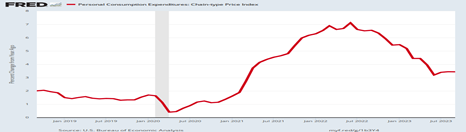
The more general Personal Consumption Expenditure (PCE) inflation indicator, another favored Fed price index is running at 3.4 percent annually per above FRED graph .

The latest economic data confirm the good news. Labor productivity in Q3 jumped to 4.9 percent, the highest in three years, according to the Bureau of Labor Statistics, in part because of more investment in new technologies such as AI, which means an increased supply of things. Production output in the third quarter rose 5.9 percent, hours worked rose just 1.1 percent. 

This is while unit-labor costs, a key measure of wage growth, fell 0.8 percent in the third quarter, the first decline since the fourth quarter of last year, which is another sign of falling inflation since labor costs make up two-thirds of production costs.

So why all the public pessimism that seems to prevail? Economics is a very opaque window to look through in understanding the American economy. The public looks at the cost of everything, and the Fed has raised interest rates at a record pace to slow inflation.

That’s why most Americans are focused on the past and present rather than the future, but this decade has just begun. The Roaring 20’s was a wild ride then, and it will be a wild ride again.

Harlan Green © 2023

Follow Harlan Green on Twitter: https://twitter.com/HarlanGreen

Posted in Consumers, COVID-19, Economy, Keynesian economics, Weekly Financial News | Leave a comment

Where’s the Recession-Part II?

Popular Economics Weekly

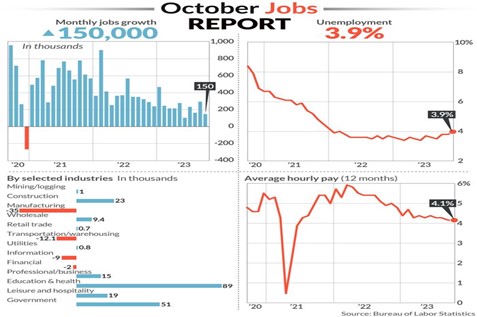
We will have to wait longer for a recession. October’s Jobs report showed even the unsettled labor strikes didn’t make much of a dent in the labor market. The usual suspects—leisure activities, healthcare, and a booming construction industry gave the most boost to hiring, but new government jobs were one third of the total 150,00 nonfarm payroll jobs created.

The loss of 33,000 in manufacturing was largely due to the UAW strikes, said the BLS.

MarketWatch.com

The financial markets are loving the slowdown in hiring. Even the past two months were adjusted lower in the report. The change in total nonfarm payroll employment for August was revised down by 62,000, from +227,000 to +165,000, and the change for September was revised down by 39,000, from +336,000 to +297,000.

The Fed likes the report because since their recent lows in April the unemployment rate is rising. The unemployment rate is up by 0.5 percentage point and there are 849,000 more unemployed persons.

Yet calls for an imminent recession are still in the air. Why still?? Firstly, it takes months, sometimes more than one year to call a recession, because a downturn must be long enough that there is a prolonged decline in demand from consumers as well as employers.

Most of the pessimists are taking the Fed’s word that they will keep rates high enough until they reach the 2 percent inflation target. What if that takes another year? Then all bets are off on when a recession might happen.

And this month’s jobs report can’t be taken too seriously on what might happen next because of the ongoing labor strikes, including SAG-AFTRA’s 130,000 members.

And NPR reports, “Altogether, there have been 312 strikes involving roughly 453,000 workers so far in 2023, compared with 180 strikes involving 43,700 workers over the same period two years ago, according to data by Johnnie Kallas, a PhD candidate at Cornell University’s School of Industrial and Labor Relations, and the project director of the ILR Labor Action Tracker.”

Putting most of the striking workers back to work could bring the unemployment rate back down, and the higher wages goose the inflation rate again.

So, who really knows where we will land next year?

Harlan Green © 2023

Follow Harlan Green on Twitter: https://twitter.com/HarlanGreen

Posted in Consumers, COVID-19, Economy, Macro Economics, Weekly Financial News | Leave a comment