It Wasn’t the Fed

Popular Economics Weekly

What more does Chairman Powell and the Federal Reserve Governors need to know to announce the inflation battle has been won? Its preferred inflation indicator has shown zero monthly increases for two months.

The rate of U.S. inflation based on the Federal Reserve’s preferred PCE index actually fell in November for the first time since 2020 and indicated that price pressures continue to subside. The PCE index dipped – 0.1 percent last month, the government said Friday. Inflation was unchanged in October.

FREDpce

This is what is called a ‘soft landing’, I said last week when the unemployment rate dropped back to 3.7 percent. More jobs are being created in November’s unemployment report, though some 50,000 of the 199,000 new nonfarm payroll jobs are strikers returning to work in Hollywood productions and auto factories.

So the Fed’s actions in raising interest rates to multi-decade highs wasn’t the proximate cause of bringing down inflation in what was an overaction to the effects of the COVID pandemic.

High inflation wasn’t the fault of rising wages, either, when job openings are still at record highs so that everyone who wants a job can find one.

Workers are getting terrific raises now that the strikes have been settled, yet inflation keeps declining. No, broken supply chains were the major culprit. It’s taken almost three years to ramp up enough production to bring down prices.

We are now seeing the results as shoppers have shown in the latest retail sales figures that they are finding more bargains during this record holiday shopping season.

Even industrial production is ramping up; so much so that Q4 projections of growth are rising again.

Orders for durable goods for products that last more than three years (cars, appliances, etc.) rose 5.4 percent in November, the U.S. government said Friday. This is the largest gain since July 2020. It is the second gain in the past three months. Transportation orders had the largest increase, rising 15.3 percent in November. This was in part because orders for motor vehicles and parts jumped 2.8 percent after the end of the UAW strike. Orders for commercial aircraft also soared but tend to fluctuate wildly month-to-month.

The Atlanta Fed raised its estimate of fourth quarter GDP growth as high as 3.0 percent and it could go higher with today’s robust durable orders release by the Commerce Department.

The U.S. Federal Reserve Board suggested that interest rates would be cut by 75 basis points in 2024 after it last FOMC meeting of 2023 in December. Can we now be in what is called a Goldilocks economy?

That is when the Fed’s interest rate isn’t so low that it ushers in inflation, yet not so high that it tips the economy into a recession. Maybe we’ve reached that point.

Once again, consumers will decide on the direction of economic growth. And holiday travel shows they haven’t slowed down much.

Auto club AAA forecasts that 115 million people in the U.S. will go 50 miles or more from home between Saturday and New Year’s Day. That’s up 2% over last year. The busiest days on the road will be Saturday and next Thursday, Dec. 28, according to transportation data provider INRIX.

And MarketWatch reports the Transportation Security Administration screened more than 2.6 million passengers on Thursday, which had been projected to be one of the busiest travel days, along with Friday and New Year’s Day. That’s short of the record 2.9 million that agents screened on the Sunday after Thanksgiving, since travel tends to be more spread over Christmas and New Year’s.

The Chorus is growing on the need to begin dropping interest rates. That’s all we need to sustain this recovery.

Harlan Green © 2023

Follow Harlan Green on Twitter: https://twitter.com/HarlanGreen
Posted in Consumers, COVID-19, Economy, Weekly Financial News | Tagged , , , | Leave a comment

Consumers Much Happier This Season

Financial FAQs

Consumer confidence in December as measured by the Conference Board’s Consumer Confidence Index is rising again; it jumped 10 points to 110.7 from 101. Why should that be, with all the doom and gloom and geopolitical uncertainty bombarding us daily?

I think it’s because consumers are seeing falling prices and lower inflation, especially gasoline prices with average gas prices approaching $3 per gallon for the first time in years. And consumers continue to shop both online and in stores because they are finding more bargains, with retail sales surging.

“December’s increase in consumer confidence reflected more positive ratings of current business conditions and job availability, as well as less pessimistic views of business, labor market, and personal income prospects over the next six months,” said Dana Peterson, Chief Economist at The Conference Board.

And the unemployment rate has fallen back to 3.7 percent with more workers than ever joining the workforce. Why shouldn’t consumers’ temperaments improve?

Conference Board

While December’s renewed optimism was seen across all ages and household income levels, the gains were largest among householders aged 35-54 and households with income levels of $125,000 and above, said the Conference Board.

This is also understandable as they comprise the largest percentage of the adult-age workforce with average hourly waging rising 4.0 percent—at least 1 percent above a falling inflation rate.

More good news is a recovery in the housing market. Single-family construction is soaring. Why? These adult-age consumers believe it’s time to own a home.

Overall housing starts increased 14.8 percent in November to a seasonally adjusted annual rate of 1.56 million units, according to a report from the U.S. Department of Housing and Urban Development and the U.S. Census Bureau.

“The single-family starts figure is remarkably strong, and we would not be surprised to see this figure revised lower or fall back slightly in the next month, given the nearly 20 % rise in November,” said NAHB Chief Economist Robert Dietz. “NAHB is forecasting an approximate 4 % gain for single-family starts in 2024, as mortgage rates settle lower, economic growth slows and inflation moves lower.”

If I were the Fed Governors, I wouldn’t wait for inflation to drop further to begin to lower interest rates, I said last week. The inflation rate has been falling steadily for more than a year and we could be in a deflationary spiral. Sound impossible? It might happen if the Fed doesn’t see the writing on the wall.

Nobel Laureate Paul Krugman has been scolding certain economists of late in a NYTimes Op-ed who don’t believe what is happening.

“From an economic point of view, 2023 will go down in the record books as one of the best years ever—a year in which inflation came down amazingly fast at no visible cost, defying the predictions of many economists that disinflation would require years of high unemployment.”

The cost of living measured by the Consumer Price Index rose just 0.1 percent in November thanks to lower oil prices. Without food and gas prices, so-called core consumer prices rose a somewhat sharper 0.3 percent last month and matched the Wall Street forecast. And the annual rate of inflation slowed to 3.1 percent in November from 3.2 percent in the prior month, matching the lowest level since early 2021.

Consumers are starting to believe what they are experiencing, in other words. Gas prices are at the top of the list, but how about dining out?

There was a 11 percent increase in dining out sales, and Christmas may equal Thanksgiving as the highest travel month ever. Don’t consumers carry the most weight on which direction this economy is heading?

Harlan Green © 2023

Follow Harlan Green on Twitter: https://twitter.com/HarlanGreen

Posted in Consumers, COVID-19, Economy, Housing, housing market, Weekly Financial News | Tagged , , , , | Leave a comment

How Low Can Interest Rates Go?

The Mortgage Corner

Stocks and bonds are rallying after Chairman Powell sounded dovish for the first time at his December press conference following their last FOMC meeting of the year.

“The question of when it will be appropriate to begin dialing back the policy restraint” was clearly “a discussion for us at our meeting today,” Powell said. The Fed is “likely at or near the peak rate for this cycle.”

Plunging interest rates are best illustrated by the 10-year benchmark fixed rate Treasury note yield that sets mortgage rates. It has plunged below 4 percent for the first time since the pandemic.

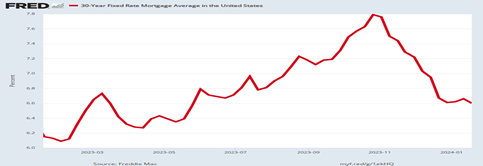
And the 30-year fixed-rate mortgage fell for the seventh week in a row, averaging 6.95 percent as of Dec. 14, according to data released by Freddie Mac on Thursday. A year ago, the 30-year fixed-rate mortgage was averaging at 6.31 percent.

It remained below 5 percent from the end of the Great Recession until May 2022 when the Fed began to raise interest rates. I predict it should drop below 5 percent sometime next year as inflation continues to decline and the Fed begins its rate dropping schedule.

FRED30yrfixed

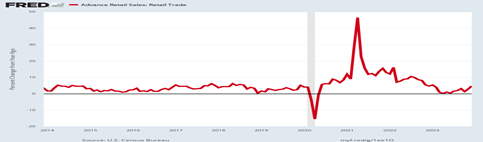
We are already seeing the results—holiday sales are booming. Retail sales are surging now, up 4.1 percent annually both online and in stores. Dining out is up 11 percent annually.

Advance estimates of U.S. retail and food services sales for November 2023, adjusted for seasonal variation and holiday and trading-day differences, but not for price changes, were $705.7 billion, up 0.3 percent (±0.5 percent)* from the previous month, and up 4.1 percent (±0.7 percent) above November 2022.”

The housing market is on hold until mortgage rates fall more.

NAR Chief Economist Lawrence Yun forecasts that 4.71 million existing homes will be sold, the housing market is expected to grow, and Austin, Texas will be the top real estate market to watch in 2024 and beyond.

Yun predicts home sales will begin to rise next year – by 13.5 percent compared to 2023, and the median home price will reach $389,500 – an increase of 0.9 percent from this year.

Builder confidence in the market for newly built single-family homes is improving slightly. It rose three points to 37 in December, according to the National Association of Home Builders (NAHB)/Wells Fargo Housing Market Index (HMI) released today.

“With mortgage rates down roughly 50 basis points over the past month, builders are reporting an uptick in traffic as some prospective buyers who previously felt priced out of the market are taking a second look,” said NAHB Chairman Alicia Huey. “With the nation facing a considerable housing shortage, boosting new home production is the best way to ease the affordability crisis, expand housing inventory and lower inflation.”

AtlantaFed

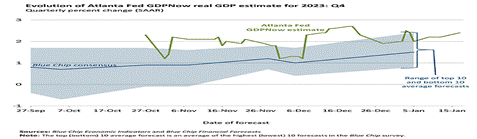
The Fed’s abrupt change in course has also boosted Q4 economic growth prospects. The Atlanta Fed’s GDPNow growth estimate just leaped from 1.2 percent to 2.6 percent, due to “…fourth quarter real personal consumption expenditures growth, fourth-quarter real gross private domestic investment growth, and fourth-quarter real government spending growth.”

So I don’t believe it’s too early to predict a better New Year for investors and homeowners!

Harlan Green © 2023

Follow Harlan Green on Twitter: https://twitter.com/HarlanGreen
Posted in Consumers, COVID-19, Economy, Housing, housing market, Weekly Financial News | Tagged , , , , | 1 Comment

Please Drop Interest Rates Sooner!

Financial FAQs

If I were the Fed Governors, I wouldn’t wait for inflation to drop further to begin lowering interest rates. The inflation rate has been falling steadily for more than a year and we might be in the midst of a deflationary spiral. Sound impossible? It could be if the Fed doesn’t see the writing on the wall.

The cost of living measured by the Consumer Price Index rose just 0.1 percent in November thanks to lower oil prices. Without food and gas prices, so-called core consumer prices rose a somewhat sharper 0.3 percent last month and matched the Wall Street forecast. And the annual rate of inflation slowed to 3.1 percent in November from 3.2 percent in the prior month, matching the lowest level since early 2021.

The next stage could be outright deflation, which nobody wants because it has spelled recession in the past. Why? Because the steep decline in inflation over a short period means a looming oversupply of things at the same time as sky-high interest rates, and that was the cause of past recessions.

The first indication of oversupply is gas prices, which are falling fast. As of Monday, the average national price for regular unleaded gasoline stood at $3.153 a gallon, down from $3.242 a week ago, and down from $3.376 a month ago, according to AAA.

AAA.com

The main reason is a weaker cost for oil, which is struggling to stay above $70 per barrel.  The falling price comes just a week after OPEC+ announced voluntary production cuts of about 2 million barrels daily. 

“Historically, crude oil tends to drop nearly 30 percent from late September into early winter with gasoline prices trailing the play,” said Andrew Gross, AAA spokesperson. “More than half of all US fuel locations have gasoline below $3 per gallon. By the end of the year, the national average may dip that low as well.”

Inflation is falling fast with the 6-month CPI already down to 2.5 percent, yet unit wages are rising 4.0 percent annually in November’s unemployment report. So inflation today is being caused by higher rents and used cars, not oil prices as happened in the 1970s or rising wages.

We now know why inflation is falling. Nonfarm labor productivity is soaring, up 5.2 percent in the third quarter of 2023 as output increased 6.1 percent and hours worked increased 0.9 percent.

The increase in labor productivity is the highest rate since the third quarter of 2020, when productivity increased 5.7 percent. From the same quarter a year ago, nonfarm business sector labor productivity increased 2.4 percent.

The last time we approached bubble territory was an oversupply of housing in early 2000 that led to the housing bubble and Great Recession. Labor productivity was as high in Q1 2002 at 5.8 percent annually.

Under Fed Chairman Alan Greenspan, the Fed didn’t recognize the housing bubble until it was too late (In part due to lax supervision by the GW Bush administration Treasury and Greenspan’s Fed). In fact, he even encouraged homebuyers to take out adjustable-rate mortgages to prolong the housing market rally.

He then held the same 5.25 percent Fed Funds rate too long—10 months from August 2006 to June 2007—before the fed began to drop rates.

But by then it was too late. The Great Recession began in December 2007. Housing values had already begun to plunge due to a one-million-unit oversupply and the mortgages tied to them became worthless because they could no longer be serviced due to soaring mortgage rates that followed the Fed’s rate hikes.

Can this happen again? There is a pronounced undersupply of housing today with builders racing to catch up, so there is little danger of a housing bubble. Instead of looking backwards to the 1970s when oil shortages led to the inflationary spiral, the Fed should be focusing on possible oversupply today and falling prices as the production of things continues to ramp up.

There could be an oversupply in the industrial sector, for instance—of computer chips in particular as new factories begin to produce, and ordinary commodities as labor productivity stays high with AI and supply-chains continue to improve.

And let’s not forget the four bank failures to date due to the Fed’s rate hikes. The Fed should not forget the failure of Lehman Brothers and many other financial institutions that was also part of the Great Recession.

Harlan Green © 2023

Follow Harlan Green on Twitter: https://twitter.com/HarlanGreen

Posted in Consumers, COVID-19, Economy, Housing, housing market, Politics, Weekly Financial News | Tagged , , , , , , | 1 Comment

More Jobs Than Ever!

Popular Economics Weekly

This is what is called a ‘soft landing’. More jobs are being created in November’s unemployment report, though some 50,000 of the 199,000 new nonfarm payroll jobs are strikers returning to work in Hollywood productions and auto factories

And they got terrific raises. Yet average hourly pay fell to 4.0 percent, which should please the Fed. How can that be? Because workers are producing more in less time with labor productivity now soaring.

Unit labor costs (i.e., wages) fell at a 1.2 percent annualized rate in the third quarter, I reported recently. Unit labor costs rose at a 1.6 percent rate from a year ago, the smallest year-on-year increase since the second quarter of 2021.

MarketWatch.com

“Total nonfarm payroll employment increased by 199,000 in November, and the unemployment rate edged down to 3.7 percent, the U.S. Bureau of Labor Statistics reported today. Job gains occurred in health care and government. Employment also increased in manufacturing, reflecting the return of workers from a strike. Employment in retail trade declined.”

The unemployment rate fell from 3.9 percent to 3.7 percent because half a million new workers entered the workforce. Education, Leisure/Hospitality, and Government added 188,000 of those new hires. The mining and manufacturing sectors added an additional 57,000 jobs.

This is the best of all worlds for the American economy. The share of the population working or looking for work even matched a post pandemic high of 62.8 percent.

Another sign of a soft landing was that consumer spending has slowed, which puts less pressure on prices, and so a reason that the inflation rate continues to decline.

Total consumer credit rose $5.2 billion in October, down from a $12.2 billion gain in the prior month, the Federal Reserve said Thursday. That translates into credit growth in both credit cards and installment loans at a 1.2 percent annual rate, down from a 3 percent rate in the prior month. Revolving credit (cards) increased at an annual rate of 2.7 percent, while nonrevolving credit (installment loans) increased at an annual rate of 0.7 percent.

I reported last week that Paul Krugman in a recent NYTimes Op-ed said the personal consumption expenditure deflator (PCE) excluding food and energy—the Fed’s preferred inflation indicator—has risen at an annual rate of just 2.5 percent over the past six months, down from 5.7 percent in March 2022. When food and energy prices are added it still rose just 2.5 percent.

More Americans want to work because of higher pay and it’s easy to find a job, so miracle of miracles, and congratulations to Fed officials, we have achieved a soft landing in time for the holidays and a more hopeful New Year.

Harlan Green © 2023

Follow Harlan Green on Twitter: https://twitter.com/HarlanGreen
Posted in Consumers, COVID-19, Economy, Politics, Weekly Financial News | Tagged , | Leave a comment

Higher Productivity Lowers Inflation

Financial FAQs

Why has the Fed got it so wrong with inflation, even though the inflation rate has been falling steadily for more than a year?

Paul Krugman in a recent NYTimes Op-ed said the personal consumption expenditure deflator (PCE) excluding food and energy—the Fed’s preferred inflation indicator—has risen at an annual rate of just 2.5 percent over the past six months, down from 5.7 percent in March 2022. When food and energy prices are added it still rose just 2.5 percent.

Even U.S. unit labor costs were much weaker than initially thought in the third quarter amid surging labor productivity, which meant unit labor costs (i.e., wages) weren’t pushing inflation higher. So-called ‘sticky wages’ were the main reason the Fed kept saying inflation would remain high, hence their refusal to say when they would begin to drop interest rates.

The markets now believe they could begin as early as in March next year.

FREDproductivity

“Unit labor costs fell at a 1.2% annualized rate in the third quarter, the Labor Department’s Bureau of Labor Statistics said, revised down from the previously reported 0.8% pace of decline. Unit labor costs rose at a 1.6% rate from a year ago, the smallest year-on-year increase since the second quarter of 2021.”

Slowing wage pressures were underscored by the ADP National Employment Report, which showed that private payrolls increased by just 103,000 jobs in November after rising 106,000 in October. ADP said almost all the new jobs were created in transportation, education, and health care.

There is another obscure economic statistic that can show a better next year. It’s the Labor Department’s JOLTS report that counts the number of job openings each month. The number of openings was sky-high after the COVID pandemic as evidenced by the black line in Calculated Risk’s graph because employers wanted to re-hire workers as the economy recovered so quickly.

Calculated Risk/BLS.gov

It has been steadily declining since then, as has the number of hires (blue line).

But the unemployment rate is still below 4 percent (currently 3.9%) and has been since December 2021. Americans are fully employed, and companies are wanting to hire more despite inflation and soaring interest rates.

“The number of job openings decreased to 8.7 million on the last business day of October, the U.S. Bureau of Labor Statistics reported today. Over the month, the number of hires and total separations changed little at 5.9 million and 5.6 million, respectively. Within separations, quits (3.6 million) and layoffs and discharges (1.6 million) changed little.”

The difference between hires (5.9 million) and separations (5.6 million) in the JOLTS report means approximately 300,000 new jobs were created in November, changing little in the employment picture.

That should tell us there will be a strong November unemployment report on Friday, though slower GDP growth is forecast for the fourth quarter. Americans are experiencing an incredible recovery, fastest in the developed world, including China.

Harlan Green © 2023

Follow Harlan Green on Twitter: https://twitter.com/HarlanGreen

Posted in Consumers, COVID-19, Economy, Weekly Financial News | Tagged , , , , , | 1 Comment

Peacemaking in E. Congo

Answering Kennedy’s Call

What could be more important than supporting projects in the Democratic Republic of Congo? Santa Barbara Rotarians have been supporting projects such as the Congo Peace School in conjunction with an eastern Congo Rotary Club since 2010.

“There are few worse places, if any, to be a child,” said Amani Matabaro, former President of the Bukavu Mwangaza Rotary Club of E. Congo.

While we love to share the amazing impact your giving makes in the lives of the children and adults we partner with in eastern Congo, we also know it is important to share the horrific context in which these children we serve are not only surviving but thriving.

As noted in the September 2023 press briefing from the UN’s children’s agency UNICEF on Congo (DRC) and specifically the eastern part of the country where we are located, “the war-torn country had the world’s highest number of UN-verified violations against children in armed conflict.”

The violence “has reached unprecedented levels,” said Grant Leaity, UNICEF’s representative in the country. “There are few worse places, if any, to be a child.”

“The east of the Democratic Republic of the Congo (DRC) is facing one of the world’s most complex and forgotten crises. Around 2.8 million children are bearing the brunt of violent conflict, being recruited by armed groups, losing their families and homes, and being exposed to ever-growing levels of sexual- and gender-based violence.” (ReliefWeb infographic here)

It’s a harrowing and difficult report to read, a content warning for sexual assault and violence against young children.

In this space where so many use violence to control innocent civilians, our Founding Director Amani Matabaro’s vision for active peace is revolutionary. Each week at the Congo Peace School, the students and staff focus on a principle of peace and nonviolence as taught by Martin Luther King, Jr.

This last week the focus was the development and interpretation of Principle Three of Kingian Nonviolence: Nonviolence Seeks to Defeat Injustice, or Evil, Not People.

Training the teachers, Amani helped them put the concept into vocabulary that is easier for the students to understand – to attack the forces of evil, not the persons doing evil, so the students and staff could focus on how to practice the principle in the context of eastern DRC.

Amani spoke to some of the Peace School students to ask how they understood the principle, and how they are putting it into practice in their own lives.

As it is not located in a mining area, The Congo Peace School is in a place of relative peace, but the students and staff and community are surrounded by the violence of militias and war, the threat of being recruited as a child soldier, and the extreme poverty that leads to malnutrition, child marriages, and gender-based violence.

From the UNICEF summary of remarks: “In the first three months of 2023, in North Kivu alone, more than 38,000 cases of sexual- and gender-based violence were reported. That’s a 37 per cent increase compared to the same time period in 2022. Said another way: in just one year, there have been 10,000 additional reports of sexual- and gender-based violence. Those are the ones reported. And in North Kivu alone.”

“As well as unprecedented levels of violence, the lives of children in eastern Congo are threatened by epidemics and malnutrition. Around 1.2 million children under five in the east are facing the risk of acute malnutrition.

UNICEF’s Leaity warned about the risk of “acceptance of something which is unacceptable.”

“As the world looks away, we are failing the children of DRC,” he said.

Harlan Green © 2020

Follow Harlan Green on Twitter: https://twitter.com/HarlanGreen
Posted in Uncategorized | Tagged , , | Leave a comment

What Happens Next?

Popular Economics Weekly

What does the future foretell? Everyone wants to know what will happen next year now that the Fed is on hold and inflation continues to decline.

I believe the construction industry is telling us the economy will continue to expand next year, despite the Fed’s intransigence on dropping interest rates. Plunging bond yields are signaling inflation will continue to decline, so why wouldn’t the Fed follow?

Construction spending rose in October for the 10th month in a row, largely because of work on commercial buildings and government-funded public projects.

FREDconstruction

Spending on construction increased 0.6 percent in October to just over a $2 billion annual rate, up 11 percent annually, the Commerce Department reported Friday, and per the FRED graph on construction spending.

 Much of it comes from the ‘new’ New Deal bipartisan Bidenomics bills that are modernizing the American economy as well as fighting climate change.

And inflation as measured by the Fed’s preferred PCE price index, or personal consumption expenditures price index, was unchanged in November. It was held down in part by a decline in oil prices. The increase in inflation over the past year decelerated to 3.0 percent from 3.4 percent in the prior month and 6.4 percent one year ago. That’s the lowest level since February 2021.

And construction spending could even accelerate as interest rates drop further. Bonds in particular have rallied, as the 10-year Treasury note yield declined more than 0.5 percent in November igniting a huge bond rally after briefly touching 5 percent.

What is being constructed? Everything from roads (public) to commercial properties (private). Private construction spending was almost $1.5 billion of the total.

In October, the estimated seasonally adjusted annual rate of public construction spending was $447.8 billion, 0.2 percent (±2.0 percent) above the revised September estimate of $446.9 billion. Public construction is building for the future that only governments can do.

Educational construction was at a seasonally adjusted annual rate of $97.2 billion, 0.4 percent (±2.3 percent) above the revised September estimate of $96.7 billion.

Highway construction was at a seasonally adjusted annual rate of $132.0 billion, 0.3 percent (±4.8 percent) below the revised September estimate of $132.4 billion.

Since Biden took office, employers have created 14 million jobs, and the unemployment rate has been hovering around a 50-year-low for months, said the NYTimes Ross Serkin.

The president has also been talking up signature economic accomplishments like the Infrastructure Investment and Jobs Act, which he argues have helped rebuild rural America and invigorated the economy.

“Bidenomics is just another way of saying the American dream,” he said in a speech. It’s not a stretch. The economy grew last quarter at 5.2 percent, belying a global slowdown.

President Biden will convene the first meeting of his supply-chain resilience council, using the event to announce 30 actions to improve access to medicine and needed economic data and other programs tied to the production and shipment of goods.

“We’re determined to keep working to bring down prices for American consumers and ensure the resilience of our supply chains for the future,” said Lael Brainard, director of the White House National Economic Council and a co-chair of the new supply chain council.

Working to increase the supply of everything is the best way to bring down prices, and inflation.

Harlan Green © 2023

Follow Harlan Green on Twitter: https://twitter.com/HarlanGreen

Posted in Consumers, COVID-19, Economy, Uncategorized, Weekly Financial News | Tagged , , , , , , | Leave a comment

Shoppers Happy, Lower Inflation

Financial FAQs

There are two indicators that show consumers will continue to support economic growth this year, (and hence avoid a recession), while inflation is continuing to decline.

Firstly, Thanksgiving, the biggest shopping holiday, lured in more shoppers than ever. A record number of people showed up in stores or online to spend money over Thanksgiving, but their spending on holiday-related items ticked lower as they looked for more bargains, according to data from the National Retail Federation released Tuesday.

The industry group said that 200.4 million customers shopped between Thanksgiving Day and Cyber Monday. That’s above the record 196.7 million that turned out last year.

“The five-day period between Thanksgiving and Cyber Monday represents some of the busiest shopping days of the year and reflects the continued resilience of consumers and strength of the economy,” said NRF President and CEO Matthew Shay. “Shoppers exceeded our expectations with a robust turnout. Retailers large and small were prepared to deliver safe, convenient, and affordable shopping experiences with the products and services consumers needed, and at great prices.”

Consumer confidence also increased. The Conference Board Consumer Confidence Index® increased in November to 102.0 (1985=100), up from a downwardly revised 99.1 in October. The Present Situation Index—based on consumers’ assessment of current business and labor market conditions—ticked down slightly to 138.2 (1985=100), from 138.6. The Expectations Index—based on consumers’ short-term outlook for income, business, and labor market conditions—rose to 77.8 (1985=100) in November, up from its downwardly revised reading of 72.7 in October.

“Consumer confidence increased in November, following three consecutive months of decline,” said Dana Peterson, Chief Economist at The Conference Board. “This improvement reflected a recovery in the Expectations Index, while the Present Situation Index was largely unchanged.”

Higher confidence was concentrated primarily among householders aged 55 and up though confidence among householders aged 35-54 declined slightly.

Top this off with a revised estimate of third quarter Real GDP growth that rose to 5.2 percent from its initial estimate of 4.9 percent.

BEA.gov

But households spending rose 3.6 percent in the third quarter, down from an original 4 percent, which was a sign of slowing inflation. And Personal Consumption Expenditure (PCE) prices that are part of the GDP growth estimate rose just 2.8 percent, 2.3 percent with food and energy prices excluded.

Business profits, meanwhile, increased for the second quarter in a row. They rose 3.3 percent to mark the largest gain in five quarters, suggesting that higher labor costs are not weighing much on earnings. Government spending was also a strong contributor as spending rose at a 5.5% rate, versus 4.6% initially.

All of this news has stocks and bonds rallying—stocks because business profits have increased, and bonds because interest rates have declined precipitously.

The yield on the 10-year Benchmark Treasury note that sets mortgage rates retreated 4.7 basis points to 4.288% from 4.335% Tuesday afternoon. This will give a huge boost to the housing market in the coming months.

So why shouldn’t we be enjoying the holidays? Just maybe the Fed will stop worrying that it isn’t being taken seriously. Inflation is being tamed without causing a recession!

Harlan Green © 2023

Follow Harlan Green on Twitter: https://twitter.com/HarlanGreen
Posted in Consumers, COVID-19, Economy, Weekly Financial News | Leave a comment

Building Community at Home–Part II

Answering Kennedy’s Call

(Cont’d Building Community at Home) Old Town, with its own past, could give Goleta Valley residents a sense of their own history and separate community identity. It even had a Community Center that hosted many community activities. The Community Planning Director at that time, Dan Gira, also thought Goleta should become a city able to determine its future as part of the County’s General Development Plan update.

The update was required by the state of California to accommodate the changes necessitated by a growing population. I was one of many moving to this beautiful area of the South Coast with its unique climate sheltered by east-west mountains and south facing beaches. Santa Barbara and the South Coast has always been a beautiful and very desirable place to live, and the people kept coming.

The County would apply to the state of California for the formation of a Goleta Old Town Redevelopment District, which would allow some tax monies to be withheld for use in Old Town to upgrade its housing and infrastructure. While I loved the beautiful outdoors and the nature that surrounded us, more housing was needed in Old Town. Many Mexican agricultural workers—mostly undocumented—were living in Old Town because of its cheap rents, but landlords were taking advantage by housing ten to twenty of them in a single dilapidated housing unit.

I had to raise $50,000 in the community: 50 percent of the expense the County would incur to do the studies necessary to classify Goleta Old Town as a redevelopment district. Dan Gira and I agreed the County would chip in its 50 percent in the form of time and labor, and whatever was needed for the feasibility study that would determine if Goleta Old Town fulfilled the state requirements for a redevelopment district.

The study would include a report on degraded infrastructure, such as inadequate surface transportation, and the number of bars and other “nonproductive” businesses in Old Town. The point was to determine the extent of blight, or physical deterioration, of the Old Town community, and a cost estimate for fixing those problems.

There was plenty of blight. Goleta’s Old Town had become run down in the 1980s as competing malls were built elsewhere to accommodate the new auto-dependent subdivisions built to hold the growing population. Bars had proliferated as businesses left Old Town. A fire partially destroyed a ten-unit apartment building. A Santa Barbara News-Press reporter covering the fire reported that residents thought the popping noise from breaking windows sounded like gunfire from gang warfare.

We raised $50,000, the County Planning Department hired a consultant to write the feasibility study, and it was approved within a year.

Old Town’s Revival

Thoughts of forming a new city of Goleta were now revived, and the actual planning of Old Town’s future began. There had been several unsuccessful efforts to form a city since the 1970s. The Goleta Old Town Revitalization Committee, a mix of local officials and residents that wanted Old Town’s infrastructure and services upgraded, was now created, and I was appointed its chairman. Hearings were held in Old Town’s Community Center so county planners could learn what Goleta’s residents wanted for a future town center. We were following the precepts of community organizing in bringing citizens together to solve some of the problems afflicting such a diverse community.

Follow Harlan Green on Twitter: https://twitter.com/HarlanGreen

Posted in Economy, Housing, Politics | Leave a comment