New Year GDP Looking Better

Financial FAQs

AtlantaFedGDPNow

Because of January’s gangbusters unemployment report of 517,000 new payroll jobs and the unemployment rate decline to an all-time low of 3.4 percent, consensus is growing that the US may avoid a recession.

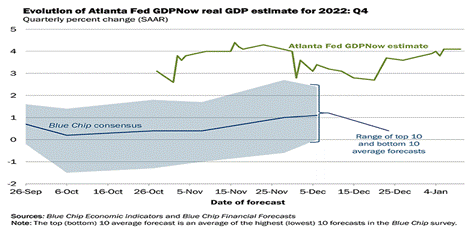
One indicator of a more optimistic outcome is the Atlanta Federal Reserve GDPNow estimate of economic growth that I have been reporting. It has been close to correct over the past two quarters. For instance, it predicted 3.2 percent growth for Q4 2022 and the official final estimate of Q4 from the US Bureau of Economic Analysis (BEA) came in at 2.9 percent.

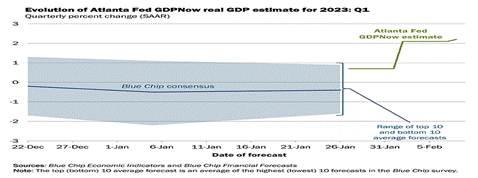
It is predicting 2.2 percent growth for the first quarter 2023, when last year’s first and second quarter growth was negative (though there was no recession). The GDPNow model estimate for real GDP growth (seasonally adjusted annual rate) in the first quarter of 2023 is 2.2 percent on February 8, up from 2.1 percent on February 7, said its press release.

Why is the Atlanta Fed’s GDPNow estimate of Q1 2023 so optimistic?

Its estimate highlighted increased foreign trade because supply chains that have been able to circumvent the Ukraine war and a host of other supply constraints so that US consumers continue to buy cheaper foreign goods, which is also holding down inflation.

The New York Fed has a new Global Supply Chain Pressure Index that tells us supply prices have eased substantially because Asian countries are recovering quickly. For instance, Chinese imports have recovered, as they work out of their COVID-induced slowdown.

Bank of America and Goldman Sachs fund managers are finding their clients also see less chance of a recession, as reported on MarketWatch.

The B of A’s latest global fund manager survey found forecasts of a recession have massively dropped since its November 2022 peak, where 77 percent of fund managers said a recession was likely, to 24 percent in February.

“Most fund managers are optimistic on inflation; 83% anticipate lower global CPI in the next year and 47% expect to see lower short-term rates in the next 12 months, the most since March 2020,” said the B of A survey.

Similarly, Goldman Sachs research analysts led by David Kostin, said in a client note on Tuesday that companies in the Russell 3000 index are talking less about an oncoming recession. Their analysis of corporate earnings calls found just 12 percent mentioning the R word.

Speaking of inflation, the well-regarded New York Fed’s consumer expectations report shows inflation expectations in particular ‘well anchored’, i.e., consumers are expecting no surprises.

“Median inflation expectations remained unchanged at the one-year-ahead horizon,” said the NYFed, “decreased by 0.2 percentage point at the three-year-ahead horizon, and increased by 0.1 percentage point at the five-year-ahead horizon, to 5.0%, 2.7% and 2.5%, respectively.”

So we still have an inflation problem. U.S. Treasury Secretary Janet Yellen last week said she saw a path for avoiding a U.S. recession, with inflation coming down significantly and the economy remaining strong, given the strength of the U.S. labor market.

“You don’t have a recession when you have 500,000 jobs and the lowest unemployment rate in more than 50 years,” Yellen told ABC’s Good Morning America program.

Who is right in this crazy year? The developed world has proved resilient in easing supply chains, which will bring down inflation even faster.

Harlan Green © 2023

Follow Harlan Green on Twitter: https://twitter.com/HarlanGreen

Posted in Consumers, COVID-19, Economy, Weekly Financial News | Leave a comment

What Interest Rates Are Declining?

The Mortgage Corner

FRED30yr

The average 30-year fixed rate conforming mortgage has declined almost one percent since November 2022 to the current 6.12 percent as of February 2023, per the St. Louis Fed.

The housing sector has been a leading edge of economic recoveries historically, and declining interest rates have led housing recoveries, so we can make an educated guess that a recovering housing and the real estate sector in general is indicating an economic recovery this year.

A leading indicator of home sales is the NAR’s Pending Home Sales survey that measures contracts signed with closings occurring usually in 30 to 60 days.

Pending home sales increased in December for the first time since May 2022 — following six consecutive months of declines — according to the National Association of Realtors press release.

The Pending Home Sales Index (PHSI)* — a forward-looking indicator of home sales based on contract signings — improved 2.5% to 76.9 in December. Year-over-year, pending transactions dropped by 33.8%. An index of 100 is equal to the level of contract activity in 2001.

“This recent low point in home sales activity is likely over,” said NAR Chief Economist Lawrence Yun. “Mortgage rates are the dominant factor driving home sales, and recent declines in rates are clearly helping to stabilize the market.”

Why is this a contra-indicator to rising interest rates engineered by the Fed? Because mortgage loans are longer-term products controlled by bond traders looking at longer-term inflation, which has been declining precipitously.

Retail CPI inflation, for instance, declined from 9 percent to 6.4 percent just since last June. Housing sales will take a bit longer to recover from the December lows, since housing prices are also part of the recovery formula.

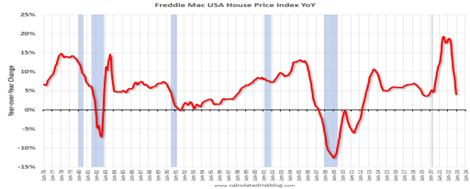
And price increases are returning to a more historical level of +5 percent per annum as well.

Calculated Risk

Per Calculated Risk, Freddie Mac recently reported that its “National” Home Price Index (FMHPI) declined for the seventh consecutive month on a seasonally adjusted basis in December, putting the National FNHPI down 2.5% from its May 2022 peak, and down 5.0% Not Seasonally Adjusted (NSA) from the peak.

Mortgage applications have therefore increased as well. Mortgage applications increased 7.4 percent from one week earlier, according to data from the Mortgage Bankers Association’s (MBA) Weekly Mortgage Applications Survey for the week ending February 3, 2023.

“Applications rose last week as the 30-year fixed mortgage rate inched lower to 6.18 percent, its fifth consecutive weekly decline. The 30-year fixed rate is almost a percentage point below its recent high of 7.16 percent in October 2022,” said Joel Kan, MBA’s Vice President, and Deputy Chief Economist. “

Both purchase and refinance applications increased last week and have shown gains in three of the past four weeks because of lower rates.

So, it looks like head winds created by the Fed’s rate hikes that brought home sales to their lows in December are slowly turning into tail winds pushing housing sales higher as inflation and longer-term, fixed interest rates continue to decline.

Harlan Green © 2023

Follow Harlan Green on Twitter: https://twitter.com/HarlanGreen
Posted in Consumers, COVID-19, Economy, Housing, housing market, Weekly Financial News | Leave a comment

To A Better State of the Union

Financial FAQs

Reuters

Reuters just reported that U.S. Treasury Secretary Janet Yellen on Monday said she saw a path for avoiding a U.S. recession, with inflation coming down significantly and the economy remaining strong, given the strength of the U.S. labor market.

“You don’t have a recession when you have 500,000 jobs and the lowest unemployment rate in more than 50 years,” Yellen told ABC’s Good Morning America program.

Why is she being optimistic about a so-called soft landing for our economy? It would raise the importance of our annual State of the Union report that President Biden will present to Congress and Americans on Tuesday.

It’s not only the incredibly strong unemployment report, but service sector businesses that employ most Americans as measured by the Institute for Supply Management (ISM) Non-manufacturing Index soared in January from its December lows; another huge surprise.

It’s as if Americans have changed their minds en masse about the possibility of a recession in January. And that could mean a much better performing ‘state of the union’ this year.

“Ten industries reported growth in January,” said Anthony Nieves, Chair of the Institute for Supply Management®, “according to the Services PMI®, which was in expansion territory after a single month of contraction and the prior 30-month period of growth. The composite index has indicated expansion for all but three of the previous 155 months.”

And former Treasury Secretary Larry Summers is also tapering his hawkishness and seeing the possibility of a better future for the U.S. economy.

Summers said on Fareed Zakaria’s GPS Sunday that it “looks more possible that we’ll have a soft landing than it did a few months ago,” but he has continued fears about inflation indicators that have come back to earth, but are still too high for his liking.

“They’re still unimaginably high from the perspective of two or three years ago, and that getting the rest of the way back to target inflation may still prove to be quite difficult,” Summers said.

The manufacturing sector hasn’t done so well per the ISM Manufacturing Index. Economic activity in the manufacturing sector contracted in January for the third consecutive month following a 28-month period of growth, say the nation’s supply executives in the latest Manufacturing ISM® Report On Business®.

The report was issued today by Timothy R. Fiore, Chair of the Institute for Supply Management® (ISM®) Manufacturing Business Survey Committee:

“The January Manufacturing PMI® registered 47.4 percent, 1 percentage point lower than the seasonally adjusted 48.4 percent recorded in December. Regarding the overall economy, this figure indicates a second month of contraction after a 30-month period of expansion.”

Why has manufacturing activity contracted? It seems to have been most affected by higher prices for raw materials, or, “due to buyer and supplier disagreements regarding price levels,” in Fiore’s words.

So more economists are lining up behind the inflation doves, who see inflation as a temporary phenomenon, with consumers’ longer term inflation expectations continuing to be “well-anchored” around 3 percent.

Maybe that’s why the Fed raised the overnight interest rate it charges banks just a quarter-percent to 4.5 percent, and why it bespeaks a better state of our union.

Harlan Green © 2023

Follow Harlan Green on Twitter: https://twitter.com/HarlanGreen

Posted in Consumers, COVID-19, Economy, Politics, Weekly Financial News | Leave a comment

No More Inflation Worries, Period

Popular Economics Weekly

MarketWatch

I said last week, the U.S. economy has done it again with stronger than predicted fourth quarter GDP growth. This week a record employment gain should shock most economists and professional prognosticators to their roots.

Total nonfarm payroll employment rose by 517,000 in January, and the unemployment rate dropped to 3.4 percent, the U.S. Bureau of Labor Statistics reported today. It was double the estimates of job growth for January; whereas just 223,000 nonfarm payroll jobs were created in December.

President Biden gave a short announcement this morning that a total 12 million jobs were created in his first two years in office, also a record. It’s now looking like we should anticipate a record year of recovery rather than worry about an incipient recession, with economic growth continuing as the $trillions in government spending over the past two years gets put into a more productive economy.

“Job growth was widespread, led by gains in leisure and hospitality, professional and business services, and health care. Employment also increased in government, partially reflecting the return of workers from a strike,” said the BLS.

In fact, all sectors had job growth except for the information services. Is Silicon Valley cutting jobs because its revenues are shrinking? Apple, Google, Microsoft have all announced layoffs.

The drop from 3.5 percent to 3.4 percent unemployment was the lowest level since 1969 and the number of hours people work jumped 0.3 hours to 34.7 hours, matching the highest level in a year.

Why wouldn’t this be with a five-year allocation of $550 billion in federal investments in America’s infrastructure to upgrade highways and major roads, bridges, airports, ports, and water systems?

Additional investments cover expansions and improvements to the nation’s broadband access, public transportation systems, and energy grid infrastructure, as I said last week, all boosters to economic growth.

The fall in wage inflation will upset the Fed most, since the report showed that average annual hourly wage growth had dropped to 4.4 percent. I.e., it is falling with a stronger job market.

So, inflation isn’t endangering job growth; the opposite is happening. The most important figure in the Q4 GDP report was the inflation rate rose at an annual 3.2 percent pace in Q4, falling from a 4.3 percent advance in the prior three-month period.

The so-called inflation deflator used in the Bureau of Economic Analysis that measures the aggregate prices for all goods and services transacted domestically signals inflation will continue to decline. So why shouldn’t we be hopeful that 2023 might be a better year for Americans?

The fastest job growth was in sectors that most benefit the public—Education & Health, Leisure/Hospitality, Professional/Business, and Government.

In the face of a rising tide of prosperity for all, does the Fed dare to raise interest rates much further?

Harlan Green © 2023

Follow Harlan Green on Twitter: https://twitter.com/HarlanGreen

Posted in Consumers, COVID-19, Economy, Weekly Financial News | Leave a comment

More Jobs Available Than Ever

The Mortgage Corner

BLS.gov

A preview of December’s official unemployment report was given today. Employers continued to fight the Fed by offering more jobs in the December Bureau of Labor Statistics JOLTS report, its Job Openings and Labor Turnover Survey.

The number of job openings increased to 11 million from 10.4 million in November, signaling employers still see a huge demand for their products and services—mainly in retail and leisure activities.

“On the last business day of December, the number and rate of job openings increased to 11.0 million and 6.7 percent, respectively,” said the BLS. “In December, the largest increases in job openings were in accommodation and food services (+409,000), retail trade (+134,000), and construction (+82,000). The number of job openings decreased in information (-107,000).”

The Fed Governors probably won’t like the JOLTS report, as they believe it means inflation won’t continue to decline—or will decline too slowly. They seem to believe almost religiously that full employment is synonymous with high inflation.

So does former Treasury Secretary Larry Summers, apparently, on Bloomberg News, who has been leading the inflation hawks.

“We need five years of unemployment above 5% to contain inflation — in other words, we need two years of 7.5% unemployment or five years of 6% unemployment or one year of 10% unemployment,” said Summers said in a speech in London Monday. “There are numbers that are remarkably discouraging relative to the Fed Reserve view.”

His remarks are based on s a horrific thesis of so-called classical economic theory that no longer applies, and which even some Fed Governors are saying they no longer believe.

In fact, the swift decline in inflation since last June occurred in the face of continuing full employment and a record-low unemployment rate.

Then why is inflation now declining so fast? Lets’ return to an even more basic economic theorem: the Law of Supply and Demand. Supplies are now catching up to said demand for goods and services, which is reflected in falling commodity (like oil and food grain) prices.

Inflation came from the aftereffects of accelerating growth after the COVID shutdowns in early 2020 getting ahead of supply-chains, hence the sudden shortages were due to the pandemic shutdowns, the Ukraine war, and China’s ongoing COVID problems.

And because world trade has become global, we are finding alternatives to these shortages.

EPI.org

So rising wages of employees are no longer the major inflation threat. The Economic Policy Institute, a labor think tank, provides a simple graphic to explain why—the widening gap between what employees produce and what they earn from their labor since 1980.

Until 1979, labor’s compensation rose in tandem with labor productivity. But then the gap widened so that labor productivity has increased 64.7 percent from 1979 to 2021, whereas a typical worker’s compensation increased just 17.3 percent, not even keeping up with inflation.

Where did the rest of the wealth end up that has been generated since 1979? It’s the reason corporate profits as a percentage of GDP were the highest ever in the summer of 2022.

The good news is that Fed Chairman Powell’s remarks after this Wednesday’s announcement of its one-quarter percent rate hike is indicating that the Fed Governors are not listening to Larry Summers.

But are they listening to wage-earners who will suffer most from a recession?

Harlan Green © 2023

Follow Harlan Green on Twitter: https://twitter.com/HarlanGreen

Posted in Consumers, COVID-19, Economy, Weekly Financial News | Leave a comment

Beware of Consumers Losing Confidence

Financial FAQs

Conference-Board.org

The Federal Reserve is about to raise the overnight interest rate another quarter-percent to 4.5 percent that it charges banks, hence banks will pass on the increased rate to their borrowers.

So, it shouldn’t be a surprise this is affecting the lowest income earners’ confidence in their jobs and hence future prospects, i.e., those who borrow most heavily against their incomes.

Will it also bring on a recession if they behave accordingly and stop shopping, since such consumers spend the largest share of their incomes?

Those in the lowest income brackets have been profiting the most from the pandemic-induced shortage of workers until now, but no more, which is reflected in the latest Conference Board’s Confidence Survey that declined slightly from 109 to 107.1.

“Consumer confidence declined in January, but it remains above the level seen last July, lowest in 2022,” said Ataman Ozyildirim, Senior Director, Economics at The Conference Board. “Consumer confidence fell the most for households earning less than $15,000 and for households aged under 35.”

Why? Average hourly wages of all employees are plunging after inflation despite the tight labor market, worsening the wage inequality of those workers that the Fed says it wants most to help.

This was reinforced by the Labor Department’s quarterly Employment Cost Index that measures overall labor costs incurred by employers. It rose less than expected, up 1 percent in Q4, so wage costs are still not keeping up with inflation.

Actual hourly wages and salaries declined 1.2 percent after inflation last year. Wage costs were down 3 percent in September Q3 after inflation, so workers’ incomes have improved since then as inflation has subsided.

But this doesn’t solve the problem of a hyperactive Fed still obsessed with higher wages as the inflation culprit, when it is mostly factors beyond their control causing the stubbornly high inflation rate.

As was discussed in a recent CNBC TV panel, the real culprit is an ongoing labor shortage. One million working-age workers have died, many baby boomers born 1946-64 have retired, and even working-age adults are retiring sooner.

Meanwhile, congress has not yet found a way to solve the immigration problem(s), since the U.S. economy has historically relied upon new immigrants to supply the worker shortfall.

And the Fed keeps looking in the rear view mirror of the 1970s when the inflation rate soared into double digits in an economy constrained by our dependence upon oil and OPEC. But we didn’t have international supply-chains then to cure the supply shortages more quickly, another factor affecting inflation, opined CNBC’s chief economist Steve Liesman in the same panel discussion.

These are all factors beyond the control of the Fed Governors, who only have two tools in their inflation-fighting tool box—interest rates and lots of jawboning to tame the inflation dragon.

So consumers’ confidence in the economy and their future expectations should be another factor the Fed Governors look at, if they want to generate that soft landing everyone is hoping for.

Harlan Green © 2023

Follow Harlan Green on Twitter: https://twitter.com/HarlanGreen

Posted in Consumers, COVID-19, Economy, Politics, Weekly Financial News | Leave a comment

No More Recession Worries?

Popular Economics Weekly

BEA.gov

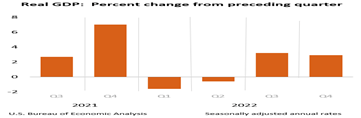
The U.S. economy has done it again. The ‘advance’ estimate (1 of 3) of fourth quarter Gross Domestic Product growth of all things bought and sold domestically grew 2.9 percent, down slightly from 3.2 percent in Q3.

Consumer spending that accounts for some 70 percent of activity gave it the biggest boost, up 2.1 percent, while government spending rose 3.7 percent for the second quarter in a row.

Consumers and governments (state and federal) will continue spending in 2023 because there is so much money in circulation, as much as the Fed is attempting to shrink the money supply with its credit tightening moves.

The most important figure was inflation that rose at an annual 3.2 percent rate in Q4, falling from a 4.3 percent advance in the prior three-month period.

The so-called inflation deflator used in the Bureau of Economic Analysis measures the aggregate prices for all goods and services transacted domestically is signalinf that inflation will continue to decline. So why shouldn’t we be hopeful that 2023 might be a better year for Americans?

Enough with the numbers. The financial markets are rallying on the good inflation news and interest rates are tumbling.

“The increase in real GDP reflected increases in private inventory investment, consumer spending, federal government spending, state and local government spending, and nonresidential fixed investment that were partly offset by decreases in residential fixed investment and exports,” said the BEA.

Manufacturing isn’t doing so well, but it makes up much less of GDP. New orders for manufactured goods jumped 5.6 percent in December because of a huge number of new contracts for Boeing passenger planes, but business investment was weak again in another sign of a slowing U.S. economy in the New Year.

If transportation is set aside, new orders fell 0.1 percent last month. What’s more, a key measure of business investment also declined for the second time in four months.

What are the possibilities for growth in 2023? Two S&P surveys showed the U.S. economy got off to a weak start in 2023. Business conditions contracted again in January for the fourth month in a row, but showed signs of improvement,

The S&P Global “flash” U.S. services sector index rose to a three-month high of 46.6 from 44.7 in December, which employs most Americans. The S&P Global U.S. manufacturing sector index, meanwhile, edged up to 46.7 from a 31-month low of 46.2 at the end of last year.

In other words, U.S. consumers are keeping the economy chugging along. Both personal incomes and personal savings are keeping up with inflation, according to the BEA.

Current-dollar personal income increased $311.0 billion in the fourth quarter, compared with an increase of $283.1 billion in the third quarter. The increase primarily reflected increases in compensation (led by private wages and salaries), government social benefits, and personal interest income.

Disposable personal income increased $297.0 billion, or 6.5 percent, in the fourth quarter, compared with an increase of $242.4 billion, or 5.4 percent, in the third quarter. Real disposable personal income increased 3.3 percent, compared with an increase of 1.0 percent.

And the main ingredients of consumer prices continue to decline—gas, food, and housing prices (or equivalent rents, in the case of housing)—which should make disposable incomes go further in household budgets.

This means consumers can maintain their spending ways as inflation continues to decline, particularly in travel and leisure activities, perhaps dodging a recession.

Harlan Green © 2023

Follow Harlan Green on Twitter: https://twitter.com/HarlanGreen
Posted in Consumers, COVID-19, Economy, Weekly Financial News | Leave a comment

Real Earnings Still Shrinking

Financial FAQs

Bls.govearnings

The chorus is growing for the Fed to cease and desist from raising short-term interest rates any further that have raised the borrowing costs of ordinary folk who depend on credit cards and auto loans for most of their purchases.

Why? Average hourly wages of employees are plunging after inflation in spite of the tight labor market, worsening the wage inequality of those workers that the Fed says it wants most to help.

Real average hourly earnings for all employees on private nonfarm payrolls decreased -3.0 percent from May 2021 to May 2022. The change in real average hourly earnings combined with a decrease of 0.9 percent in the average workweek resulted in a –3.9-percent decrease in real average weekly earnings (after inflation is factored in) over this period.

This is while the Consumer Price Index for All Urban Consumers (CPI-U) rose 8.5 percent for the year ending May 2022.

The reality wage-earners face is portrayed in the Bureau of Labor Relations average hourly earnings graph above. Average hourly earnings had soared to +7.6 percent in April 2020 at the beginning of the pandemic, which is what panicked the Fed since they maintain wage costs make up a major part of inflation.

But the inflation problem is due as much to continuing supply shortages, that periodically empty store shelves attest to.

The Fed Governors should recognize that businesses are hiring to meet the need for workers caused in part by the $1.2 trillion infrastructure bill, and Inflation Reduction Act, both designed to increase the supply of things needed in our growing economy.

So two arms of our government are in conflict, and it will be harder today to equalize the demand and supply equation than in past decades. The world was flooded with excess supply from Asian countries for decades that produced more than they could consume under the old free trade policies.

But protectionist policies are growing with post-pandemic economies wanting to protect their domestic producers with higher trade tariffs and lower import quotas. Now many of those cheap imports American consumers relied on will disappear, boosting consumer prices.

Nobel laureate Paul Krugman, who won his Nobel Price on the advantages of comparative trade policies—by countries concentrating on what they produce best—is even sounding the alarm that further rate increases could exacerbate wage inequality.

He cites Princeton economist David Autor’s recent study:

“For the first time in decades, wage inequality is falling. Real wages are rising among young, low-skilled workers and workers at the bottom of the wage distribution. While it is tempting to attribute the change to tighter labor markets, this may be an oversimplification.”

Given that the Fed Governors are saying they want to dampen hiring in the red-hot labor market, wage-earners will continue to take the hit.

And what are we to make of a predicted jump in fourth quarter GDP growth? We will know Thursday with the initial estimate of fourth quarter GDP growth is released.

The Atlanta Fed’s GDPNow prediction of Q4 growth was just increased to 3.5 percent and had been holding steady as more positive economic data came in. This could mean much stronger growth in early 2023 as I said in earlier blogs.

US economic growth is leading the recovery from the COVID pandemic. With the Ukraine War, declining world trade due to supply bottlenecks and growing protectionist trade policies, is the Fed doing the right thing?

Harlan Green © 2023

Follow Harlan Green on Twitter: https://twitter.com/HarlanGreen
Posted in Consumers, COVID-19, Economy, Weekly Financial News | Leave a comment

Housing Market Swoon–Part II

The Mortgage Corner

CalculatedRisk

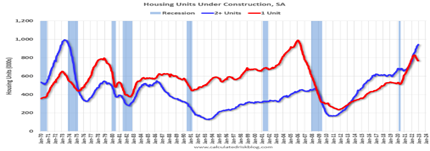
Despite improved builder sentiments, privately‐owned housing starts were down in December at a seasonally adjusted annual rate of 1,382,000. This is 1.4 percent below the revised November estimate of 1,401,000 and is 21.8 percent below the December 2021 rate of 1,768,000.

An estimated 1,553,300 housing units were started in 2022 (red line single unit, blue line 2+nnits in above graph). This is 3.0 percent below the 2021 figure of 1,601,000, so housing construction is also in a “swoon”.

And existing-home sales faded for the eleventh straight month to a seasonally adjusted annual rate of 4.02 million. Existing-home sales totaled 5.03 million in 2022, down 17.8 percent from 2021, as last year’s rapidly escalating interest rate environment weighed on the residential real estate market.

“December was another difficult month for buyers, who continue to face limited inventory and high mortgage rates,” said NAR Chief Economist Lawrence Yun. “However, expect sales to pick up again soon since mortgage rates have markedly declined after peaking late last year.”

The 30-year fixed-rate mortgage averaged 6.15 percent as of Jan. 19, according to data released by Freddie Mac on Thursday. That’s down 18 basis points from the previous week — one basis point is equal to one hundredth of a percentage point. 

Last week, the 30-year was at 6.33 percent Last year the 30-year was averaging at 3.56%. Rates are now at the lowest level since September 2022.

It is causing a surge in mortgage applications, according to the Mortgage Bankers Association.

The MBA reported its Market Composite Index, a measure of mortgage loan application volume, increased 27.9 percent on a seasonally adjusted basis from one week earlier.  The Refinance Index increased 34 percent from the previous week and was 81 percent lower than the same week one year ago. The seasonally adjusted Purchase Index increased 25 percent from one week earlier.

The modest drop in interest rates also helped to end a string of 12 straight monthly declines in builder confidence levels, although sentiment remains in bearish territory as builders continue to grapple with elevated construction costs, building material supply chain disruptions and challenging affordability conditions, per Bill McBride, author of the Calculated Risk blog.

Joel Kan, MBA’s Vice President and Deputy Chief Economist, said “This week’s builder sentiment index from the NAHB reflected an improving outlook and increased buyer traffic, as mortgage rates have backed off from recent highs. The housing market is still in need of more starter and entry-level homes, especially when current demographic trends point to the potential for more younger households to enter homeownership in the near future. New construction of these units will help these buyers entering the housing market.”

Mortgage rates should continue to decline, aided by homebuilders who are now offering initial interest rates as slow a 4 percent to entice buyers. They can do this by buying down a fixed rate and adding its costs to the purchase price, or offering shorter term fixed rates or even an adjustable rate loan.

Will this end the housing “swoon”? There is lots of pent-up demand, and we still have a housing shortage.

Harlan Green © 2023

Follow Harlan Green on Twitter: https://twitter.com/HarlanGreen

Posted in Consumers, Economy, Housing, housing market, Weekly Financial News | Leave a comment

Fourth Quarter Showing Stronger Growth

Financial FAQs

AtlantaGDPNow

What are we to make of a predicted jump in fourth quarter GDP growth? The Atlanta Fed’s GDPNow prediction of Q4 growth was just increased to 3.5 percent and had been creeping upward as more positive economic data came in. This is a huge increase and could mean much stronger growth in early 2023 as well.

That should mitigate recession fears in the face of just released data of declining retail sales and industrial production for December. And it is intensifying debate on whether the Federal Reserve has done enough to restrict credit with its interest rate hikes and reduced security holdings discussed in my last blog piece.

Sales at U.S. retailers sank -1.1 percent in December, largely because of falling gasoline prices and fewer purchases of new cars. U.S. industrial production fell -0.7 percent in December, reported the Federal Reserve. It is the biggest monthly decline since September 2021.

This was mostly due to a accelerating decline in inflation that isn’t adjusted for in the retail data. U.S. wholesale prices sank 0.5 percent in December due to cheaper food and gasoline prices, according to the government’s Produce Price Index. It was the biggest decline since April 2020, when the U.S. economy shut down to try to contain the coronavirus outbreak.

These are sure signs of slowing growth that Fed Governors should heed but are yet reluctant to do so.

The more dovish Fed Governor Richmond Fed President Tom Barkin said in a recent speech that the Fed has raised interest rates to a level where “our foot [is] unequivocally on the brake” so “it makes sense to steer more deliberately as we work to bring inflation down.”

Whereas the Federal Reserve should not “stall” on raising its benchmark rates until they are above 5 percent, said a more hawkish St. Louis Fed President James Bullard on Wednesday.

“I like the front-loading story,” Bullard said in an interview with the Wall Street Journal that was streamed live. The Fed should move as rapidly as it can to get its policy rate over 5 percent and then it can react to the data, he said.

The conflicting signals from Fed Governors aren’t good for the financial markets, which is why only bonds are rallying at the moment, since mortgage rates have declined sharply, boosting mortgage applications and perhaps the housing market.

The Atlanta Fed ‘s GDPNow report was more optimistic for several reasons.

The GDPNow model estimate for real GDP growth (seasonally adjusted annual rate) in the fourth quarter of 2022 is 3.5 percent on January 19, unchanged from January 18 after rounding. After this morning’s housing starts report from the US Census Bureau, the nowcast of fourth-quarter real residential investment growth increased from -24.6 percent to -24.0 percent.”

We shouldn’t take such predictions too literally, but the Atlanta Fed was close to right in predicting Q3 growth at 3.2 percent. And we still have full employment, despite the Fed’s threat to quash job growth with even higher interest rates.

Whatever the basis for the Fed Governor’s fears of inflation—whether it be that so-called inflation expectations are too high, or product costs (such as worker’s wages) rise too fast, as I’ve said earlier, the result of their credit-tightening measures is already causing a growth slowdown.

So, what to make of the fourth quarter jump in GDP growth predictions? Consumers are already spending less in part because of price discounting by retailers as consumers become more cautious because of higher borrowing costs.

The prices of everything are beginning to decline as well, while 770,000 new workers entered the workforce in November per the unemployment report. Everyone that wants to work can work, an optimistic sign of a better future.

But the Federal Reserve Governors haven’t shown signs that they believe what they are seeing, and is now confirmed by the bond market—inflation has been steadily declining.

Harlan Green © 2023

Follow Harlan Green on Twitter: https://twitter.com/HarlanGreen
Posted in Consumers, COVID-19, Economy, Housing, Weekly Financial News | Leave a comment