Inflation is Now Tamed?

Popular Economics Weekly

FREDcpi

Has Chairman Jerome Powell’s Federal Reserve been suffering from a giant inferiority complex, from the fear that its actions are not being taken seriously enough and so it tends to overreact to crises?

That seems to be the case today. As the Federal Reserve of St. Louis (FRED) graph that dates from 1950 and WWII makes plain, the inflation rate had been on a steady downward trend since its 1980 peak of 14 plus percent and five subsequent recessions (gray bars in graph) since then.

Each Fed nudge of higher rates when inflation spiked since then caused those subsequent mild recessions, until the COVID-19 recession that lasted just two months. Instead of plunging after the COVID-induced recession as had the others, inflation soared because the whole world’s economies were shut down while still growing at full throttle. And with the aid of governments’ largesse demand returned to pre-COVID levels, though its supply-chains had dried up.

Hence the sudden rise in inflation, which is subsiding as supply-chains have begun to play catch up. So it’s easy to see from the graph how unique has been this pandemic-fueled inflation surge that panicked the Fed to raise interest rates quickly, and is only now easing off the credit brakes with several bank failures.

Wall Street markets rallied this Wednesday with heartening news. Retail inflation dropped to 4.9 percent, the lowest in two years. The Consumer Price Index inflation rate was last at 4.9 percent in May 2021.

“The Consumer Price Index for All Urban Consumers (CPI-U) rose 0.4 percent in April on a seasonally adjusted basis, after increasing 0.1 percent in March, the U.S. Bureau of Labor Statistics reported today. Over the last 12 months, the all items index increased 4.9 percent before seasonal adjustment.”

It is still high and consumers’ main concern while weathering the pandemic with its shortages of everything. But FRED’s graph shows clearly it was caused by the pandemic and two-month recession of April 2020, but will continue to abate as we recover from the longer-term effects of COVID-19.

It has now become the concern of the housing industry as well, with a very extreme housing shortage. The NAR’s chief economist Lawrence Yun explained in a recent interview that the Fed’s aggressive rate hikes have hurt regional banks and the housing market. He noted that inflation has already started to calm, but rents on apartments and single-family homes remain elevated that comprise 40 percent of the CPI inflation index.

“Inflation will not reignite – inflation will come down closer to 3% by the year’s end,” Yun stated. “Inflation has calmed down while rents are still accelerating.”

Yun said apartment construction has reached a 40- to 50-year high.

“Rent growth will decrease because apartment construction – entry units coming on the market – is already in the pipeline,” Yun added. “We are already moving in the right direction towards consumer price inflation.”

The inflation rate reached its 9 percent high in June of 2020, when markets began to begin to replenish what was lost with the supply-chain disruptions to food supplies, available housing, and resources in general.

Why does the Fed still think its actions aren’t being taken seriously enough? Wall Street is taking it seriously, which is why financial markets have lost so much value over this year as the Fed continued to raise short-term rates.

With financial markets back in line, the Fed is now picking on the rest of the economy—consumers that make up two-thirds of all economic activity. Consumers don’t seem to be taking the Fed seriously, because they haven’t substantially cut back their spending ways, so must be punished by targeting their wage increases as too excessive.

Maybe if the Fed took itself more seriously, believed that its actions have real consequences for all Americans, it might instead pat itself on the back and say it was a job well done.

Harlan Green © 2023

Follow Harlan Green on Twitter: https://twitter.com/HarlanGreen

Posted in Consumers, COVID-19, Economy, Housing, housing market, Weekly Financial News | Leave a comment

Where’s the Recession?

Popular Economics Weekly

MarketWatch

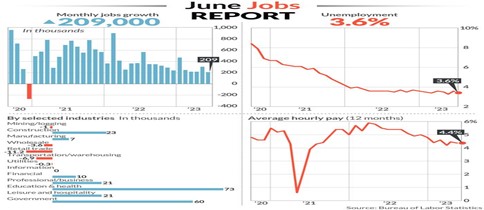
Surprise, surprise. Americans remain fully employed, in spite of the Fed’s efforts to slow economic growth. The ‘official’ unemployment rate dropped to 3.4 percent in April. The last time it was this low was in 1968.

It is raising hopes we may avoid a recession.

“Total nonfarm payroll employment rose by 253,000 in April, and the unemployment rate changed little at 3.4 percent, the U.S. Bureau of Labor Statistics reported today Employment continued to trend up in professional and business services, health care, leisure and hospitality, and social assistance.”

What is going on? It peaked at 14 percent in April 2020 then plunged incredibly quickly after what was just a two month recession. This had never happened since World War Two.

Could it be the COVID-19 pandemic, the first worldwide pandemic in 100 years that has killed more then seven million citizens of the world?

Of course it was the pandemic, which has upset everyone’s prognostications, especially the Fed’s economists, because so much has changed in 100 years. But there are some similarities. The Spanish flu lasted from 1920-22, and then the Roaring Twenties kicked in that was the greatest economic expansion in history at the time.

And then came the Great Depression and a New Deal when Roosevelt’s government became the solution rather than the problem.

The same is happening today. Both Democrats and Republicans raised $trillions to pay for the COVID-19 recovery, putting actual checks in consumers’ pockets so that they still have some $1 trillion in savings, which has kept them spending, and employers hiring ever more employees.

Everyone seems to be working that wants to work. The BLS said among major worker groups, the unemployment rates for adult men (3.3 percent), adult women (3.1 percent), teenagers (9.2 percent), Whites (3.1 percent), Blacks (4.7 percent), Asians (2.8 percent), and Hispanics (4.4 percent) were at record lows.

Education and Health added 77,000 jobs, followed by Professional/Business and Leisure and Hospitality; all in the service sector. Governments added 23,000 jobs, which highlighted just how government spending has boosted growth.

The one factor that worries Fed governors most is that average hourly wages rose slightly to 4.4 percent, though it has fallen sharply from its high last year.

Stocks are rallying because it has reduced fears of an imminent recession. In fact, how is that possible now?

Consumer spending is the main engine of U.S. growth and grew 3.7 percent last month, I wrote last week. It was the biggest increase in almost two years. Businesses are now aggravating the inflation problem by not meeting consumers’ needs, reducing investments and production at a time when consumers are still consuming, thus keeping prices from declining more quickly.

What is the Fed to do that just raised their rate another 0.25 percent? Former Fed Chair Greenspan made the mistake of continuing to raise the Fed Funds rate 16 consecutive times over two years, this causing the housing bubble to bust and the Great Recession in 2008-09.

How can Chairman Powell avoid making the same mistake?

Harlan Green © 2023

Follow Harlan Green on Twitter: https://twitter.com/HarlanGreen

Posted in Consumers, COVID-19, Economy, Weekly Financial News | Leave a comment

More Housing Sorely Needed

The Mortgage Corner

I said last week that higher new home sales and rising homebuilders’ optimism foretells a strong summer sales season if builders and existing-home inventories don’t run out of housing stock.

The construction industry is responding. Spending in March 2023 rose 0.3 percent above the revised February estimate of $1,829.6 billion, according to the Census Bureau. The March figure is 3.8 percent above the March 2022 estimate of $1,768.2 billion.

This is even with the Fed’s latest 0.25 percent hike that means higher construction costs.

Why? We know there is a tremendous housing shortage. There are 63,000 homeless in Los Angeles alone, more than 150,000 nationally, and rental rates aren’t coming down because of low vacancy rates. People have to live somewhere: for too many it’s on the streets.

Calculated Risk

Calculated Risk’s Bill McBride reports private residential construction spending is down 10.0 percent. Non-residential spending is up 21.3 percent year-over-year. Public spending is up 15.0 percent year-over-year.

That is because of the $ trillions being fed into the economy with the Infrastructure and Inflation Reduction Acts. It’s what governments—both state and federal—are supposed to do doing recessions and other uncertain times (such as wars, pandemics, global warming, etc.).

So, it’s a very good sign for our economic future and the reason I believe what some economists are calling a ‘rolling recession’ will be short-lived.

But that’s not helping the homeless. States like California are addressing the problem, but a national survey reports that NIMBY zoning laws and local governments’ recalcitrance to rezone for denser housing is the main reason residential construction isn’t meeting this demand.

Surveys have shown time and again the reluctance of communities to build more affordable housing, since residents believe it harms their own housing values. The answer must be the better design of neighborhoods that improve accessibility to jobs as well as affordable housing.

A recent Stanford University study of California’s homeless problem highlighted its complexity. Twenty-five percent of the homeless have either drug addiction or mental health problems that could be mitigated with better treatment centers.

Single-family zoning and local opposition to housing, often embodied by the “not in my backyard,” or NIMBY, sentiment makes neighborhoods more expensive. Each additional growth control policy a community added was associated with a 3-5 percent increase in home prices (Taylor 2015; Rothell 2019), said the study. 

The construction industry is also playing catchup, as new construction almost ceased during and after the Great Recession. The aftermath of the busted housing bubble produced an excess of one million homes, which large corporations and hedge funds snapped up at rock bottom prices, which took many homes off the housing market.

The Biden administration has chipped in more than $250 million to subsidize more affordable housing, but $ billions more will be needed to encourage more such developments.

The Great Recession caused almost as much economic damage as the Great Depression. Great Depression programs in the 1930s subsidized homeownership during record unemployment of that time.

More government support will be needed to support such efforts once again.

Harlan Green © 2023

Follow Harlan Green on Twitter: https://twitter.com/HarlanGreen

Posted in Consumers, COVID-19, Economy, Housing, housing market, Politics, Weekly Financial News | Leave a comment

Fed Should Call a Truce

Financial FAQs

CalculatedRisk

First Republic Bank’s takeover by the FDIC highlighted just how vulnerable our banking system is to higher interest rates. It had more than 80 percent uninsured deposits, just like the other failed banks vulnerable to higher interest rates that reduced the value of their assets.

So even though higher interest rates have been causing most harm to the banking system, causing panicky depositors to withdraw their funds, the Fed Governors don’t seem ready to quit raising interest rates. We will know more tomorrow at the end of their two-day FOMC meeting.

The Fed should call a truce in its battle to tame inflation. It is focusing on the job market, believing rising wages are the main inflation culprit, and higher interest rates will slow employers’ demand for more workers.

That is already happening, as the Labor Department’s Job Opening and Labor Turnover Survey (JOLTS) March report showed a softening labor market.

The JOLTS report said layoffs jumped by 248,000 to 1.8 million, the highest level since December 2020. The increase was led by the construction industry, which shed 112,000 positions. The decline likely reflected the job losses in the housing market, which has been hammered by higher mortgage rates.

Accommodation and food services lost 63,000 jobs, while the health care and social assistance category reported 42,000 layoffs. Employment in the leisure and hospitality sector remains below its pre-pandemic levels.

And wage increases are also lessening as economic growth has slowed to 1.1 percent in the first quarter 2023 from 2.6 percent growth in last quarter of 2022.

Yet the real inflation culprit is lack of adequate goods and services that has been unable to meet such a soaring demand for more supplies, exacerbated by higher borrowing costs. Factory orders, for instance, have already weakened. U.S. manufactured goods rose just 0.9 percent in March, the Commerce Department said Tuesday. The increase followed two months of decline.

The Fed isn’t helping matters by wanting to raise interest rates enough to boost unemployment from the current 3.5 percent to 4 to 5 percent. Fewer working employees also reduces said supply.

Which brings us to other reasons supply chains aren’t producing more—higher energy prices and higher tariffs that raise import costs, and a rising tide of economic nationalism that encourages more to be ‘Made in USA’ and less foreign trade that also disrupts supply-chains.

Nobel Prize-winner Joseph Stiglitz has been most vocal on the harm continuing rate increases are causing in a recent Project-Syndicate article.

“The Fed, like other independent central banks, jealously guards its credibility. The risk of losing it has been cited as the reason for the Fed’s interest-rate hikes of the past year, which went far beyond normalizing the ultra-low rates that characterized the post-2008 era. But by failing to recognize the risks posed by its rapid rate increases, and how more than a decade of near-zero interest rates had exacerbated these risks, the Fed undermined its own credibility – precisely the outcome it sought to avoid.”

I said last week Treasury Secretary Janet Yellen in a recent Fareed Zakariah interview on CNN thought an economic soft landing was possible, despite warnings that the recent bank failures could cause banks to tighten in their lending criteria, contributing to a slowing economy.

It is now obvious that higher interest rates are harming the banking system. Leading economists are also worrying. Will Chairman Powell and the Fed Governors listen?

Harlan Green © 2022

Follow Harlan Green on Twitter: https://twitter.com/HarlanGreen

Posted in Consumers, COVID-19, Economy, Macro Economics, Politics | Leave a comment

More Housing Needed

The Mortgage Corner

Higher new home sales and rising homebuilders’ optimism foretells a strong summer sales season if builders and existing-home inventories don’t run out of housing stock. More new homes could also soften what is being termed a rolling recession with some sectors (such as manufacturing) faltering and other sectors (e.g, services ) still growing.

Homebuilders must pick up the pace for that to happen, however.

Sales of new single‐family houses in March 2023 were at a seasonally adjusted annual rate of 683,000, according to estimates released jointly today by the U.S. Census Bureau and the Department of Housing and Urban Development.

“This is 9.6 percent (±15.2 percent) * above the revised February rate of 623,000, but is 3.4 percent (±12.7 percent)* below the March 2022 estimate of 707,000. The seasonally‐adjusted estimate of new houses for sale at the end of March was 432,000. This represents a supply of 7.6 months at the current sales rate.”

Census.gov

Builders remained cautiously optimistic in April, as limited resale inventory helped to increase demand in the new home market. Single-family builder confidence in April rose one point to 45, according to the NAHB/Wells Fargo Housing Market Index.

Currently, one-third of housing inventory is new construction, compared to historical norms of around 10%. More buyers looking at new homes, along with the use of sales incentives, have supported new home sales since the start of 2023. Builders note that additional declines in mortgage rates (to below 6%) will further boost demand.

“A lack of resale inventory combined with many builders offering price incentives helped to push new home sales higher in March,” said Alicia Huey, chairman of the National Association of Home Builders (NAHB). “However, sales are down 3.4% compared to a year ago because of the shortage of electrical transformer equipment and building material price volatility.”

Whereas pending home sales of homes under contract but not closed edged down. The Pending Home Sales Index (PHSI)* – a forward-looking indicator of home sales based on contract signings – waned by 5.2% to 78.9 in March. Year over year, pending transactions dropped by 23.2%. An index of 100 is equal to the level of contract activity in 2001.

“The lack of housing inventory is a major constraint to rising sales,” said NAR Chief Economist Lawrence Yun. “Multiple offers are still occurring on about a third of all listings, and 28% of homes are selling above list price. Limited housing supply is simply not meeting demand nationally.”

Chief economist Yun believes mortgage rates will improve the sales outlook by continuing to decline below 6 percent into next year. The 30-year conforming fixed rate is even obtainable at 5.75 percent for one origination point in California.

This is while the initial estimate of first quarter 2023 GDP growth was 1.1 percent, close to the consensus by economists. The problem is demand has far exceeded supplies, keeping housing prices and inflation too high and the Fed unhappy.

The lack of existing supply is a problem in all economics sectors, which may mean the Fed will continue to boost interest rates until markets catch up, though they’ve said they will pause for the rest of the year after another May 0.25 percent increase.

So a rolling recession could mean a bumpy ride for consumers who now must choose whether to buy now or wait until interest rates and inflation continue to moderate.

Harlan Green © 2023

Follow Harlan Green on Twitter: https://twitter.com/HarlanGreen
Posted in Consumers, COVID-19, Economy, Housing, Weekly Financial News | Leave a comment

US Economy Already In Recession

Popular Economics Weekly

BEA.gov

First quarter 2023 economic growth was not good, after all the conjecture over where US growth is headed. U.S. Gross Domestic Product grew at just a 1.1 percent annual rate in the first three months of this year, as declining business investment offset strong consumer spending causing the slower growth.

Consumer spending kept US economic growth barely positive. So the Fed’s rate hikes are making a difference. But it was businesses cutting back on spending and stocking inventories, not consumers that slowed Q1 growth.

Consumer spending is the main engine of U.S. growth and grew 3.7 percent, the government said Thursday. It was the biggest increase in almost two years. Businesses are now aggravating the inflation problem by not meeting consumers’ needs, reducing investments and production at a time when consumers are still consuming, thus keeping prices from declining more quickly.

What is the Fed to do with one more rate hike scheduled? They are harming future growth six month to a year ahead, while consumers want to spend because they are still fully employed.

One economist believes we are already in a rolling recession, with some sectors still growing while others are shrinking. Consumers still love leisure activities like dining out and travel, for instance, but are buying fewer things like cars and other durable goods.

Businesses like manufacturing see this as recessionary and so have cut back on investments, and hence future growth.

“The strong and healthy job market is one of the reasons we’re not seeing every sector declining simultaneously as we do in a classical recession,” said Sung Won Suhn, an economist at Loyola Marymount University. “This is the bedrock of the economy that’s enabled a more moderate rolling recession,” who was cited in the Washington Post.

We can therefore say the Fed has already induced a recession, but a mild one if the Fed will now pause in its rate hikes. They should pause because the simple fact is regional banks are still in trouble, such as First Republic that has seen another multi-billion dollar withdrawal of deposits that sent its stock plunging 50 percent recently.

So the Fed maintains it is now the job market that is causing stubborn inflation because Americans are still fully employed!

But is it wise for the Fed to now want to put workers out of work at a time when banks are faltering, there is a major European war, and there is still a scramble for available resources?

Harlan Green © 2023

Follow Harlan Green on Twitter: https://twitter.com/HarlanGreen

Posted in Consumers, COVID-19, Economy, Weekly Financial News | Leave a comment

New Home Sales Increasing

The Mortgage Corner

Census.gov

Sales of new single‐family houses in March 2023 were at a seasonally adjusted annual rate of 683,000, according to estimates released jointly today by the U.S. Census Bureau and the Department of Housing and Urban Development.

This is 9.6 percent (±15.2 percent)* above the revised February rate of 623,000, but is 3.4 percent (±12.7 percent)* below the March 2022 estimate of 707,000. The seasonally‐adjusted estimate of new houses for sale at the end of March was 432,000. This represents a supply of 7.6 months at the current sales rate.

That and rising homebuilder’s optimism foretells a strong summer sales season. And it could also mean no imminent recession, since rising sales are largely because mortgage rates have fallen roughly one-half percent.

Builders remained cautiously optimistic in April, as limited resale inventory helped to increase demand in the new home market. Single-family builder confidence in April rose one point to 45, according to the NAHB/Wells Fargo Housing Market Index.

Currently, one-third of housing inventory is new construction, compared to historical norms of around 10%. More buyers looking at new homes, along with the use of sales incentives, have supported new home sales since the start of 2023. Builders note that additional declines in mortgage rates (to below 6%) will further boost demand.

“A lack of resale inventory combined with many builders offering price incentives helped to push new home sales higher in March,” said Alicia Huey, chairman of the National Association of Home Builders (NAHB) and a builder and developer from Birmingham, Ala. “However, sales are down 3.4% compared to a year ago because of the shortage of electrical transformer equipment and building material price volatility.”

“The months of supply decreased in March to 7.6 months from 8.4 months in February,” says Calculated Risk’s Bill McBride. “The all-time record high was 12.2 months of supply in January 2009. The all-time record low was 3.3 months in August 2020.”

And the 30-year conforming fixed rate is still obtainable at 5.75 percent for one origination point in California.

Estimates of first quarter 2023 GDP growth are all over the map, from 0.0 to 2.0 percent. The first estimate comes out this Thursday, which will tell us whether Q1 starts out this year on a positive note.

Harlan Green © 2023

Follow Harlan Green on Twitter: https://twitter.com/HarlanGreen

Posted in Consumers, COVID-19, Economy, Housing, housing market, Weekly Financial News | Leave a comment

Softer Retail Sales Mean What?

Financial FAQs

FREDretailsales

Treasury Secretary Janet Yellen said in a recent Fareed Zakariah interview on CNN that she thought an economic soft landing was possible, despite warnings that the recent bank failures could cause banks to tighten in their lending criteria, contributing to a slowing economy.

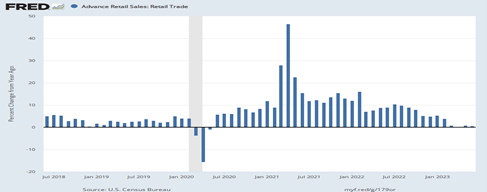
That is already happening. Retail sales in March posted the biggest decline in four months, largely because of lower auto and gasoline sales. Rising interest rates make car loans more expensive, for starters.

Retail sales aren’t inflation adjusted, so it means an even larger drop if inflation is factored in. Restaurants and bar sales also declined, a sign that consumers are spending less on leisure activities.

In fact, the decline in retail sales was widespread. Receipts at auto dealers dropped 1.6 percent. Furniture store sales fell 1.2 percent, while receipts at electronics and appliance stores tumbled 2.1 percent. Sales at building material and garden equipment supplies dealers plummeted 2.1 percent.

It is a sign that consumers are beginning to seriously cut back on spending, which affects other sectors. The Fed showed manufacturing production dropped 0.5 percent in March after increasing 0.6 percent in February. Durable goods lasting more than three years have been down the past two months.

All of this has been hurting consumer sentiment, despite Americans being fully employed and the percentage of working-age adults entering the workforce are back up to pre-pandemic levels. The index, produced by the University of Michigan, rose from 62 in March to 63.5 in April, from a four-month low.

“While consumers have noted the easing of inflation among durable goods and cars, they still expect high inflation to persist, at least in the short run,” said survey director Joanna Hsu.

Inflation is beginning to seriously worry consumers, in other words. One-year inflation expectations increased 4.6 percent in the year ahead, up from 3.6 percent in the prior month, said the Univ. Michigan survey. But in the longer run, expectations were unchanged. Americans think inflation will average 2.9 percent annually in the next five years.

So, when will the Fed pause in its rate hikes? Inflation is now plunging, so effective have been rate hikes from essentially zero percent just one year ago to 4.75 percent today.

In fact, the Producer Price Index for final demand that measures wholesale goods and services declined -0.5 percent in March, as reported last week. Prices for final demand have risen just 2.7 percent for the 12 months ended in March, from 4.6 percent the previous month. It is now approaching the Fed goal of a 2 percent inflation rate for wholesales goods that end up as consumer products.

Is Janet Yellen right, and will it be a soft landing?

Harlan Green © 2022

Follow Harlan Green on Twitter: https://twitter.com/HarlanGreen
Posted in Consumers, COVID-19, Economy, Politics, Weekly Financial News | Leave a comment

Fed Now Fears a Recession

Financial FAQs

BEA.gov

It is no longer lost on the Fed Governors that the record speed they have raised short-term interest is causing a possible recession. They have even said so in their just released minutes from the latest FOMC minutes.

Three medium-sized regional banks have already failed and several dozen are on the FDIC watchlist, who have overinvested in uninsured assets that are devaluing fast as interest rates have risen.

And inflation is now plunging, so effective have been rate hikes from essentially zero percent just one year ago to 4.75 percent today.

In fact, the Producer Price Index for final demand that measures wholesale goods and services declined -0.5 percent in March. Prices for final demand goods decreased -1.0 percent, and the index for final demand services moved down -0.3 percent—all plunging the largest monthly amount in three years.

So, alarm bells are sounding for the Fed to move in the opposite direction—to not only pause but reverse course, if they believe what they say—and inflation is no longer a problem.

Prices for final demand have risen just 2.7 percent for the 12 months ended in March, from 4.6 percent the previous month. It is now approaching the Fed goal of a 2 percent inflation rate for wholesales goods that end up as consumer products.

It turns out the Fed Governors have been too good at their job, catching banks and regulators flat-footed from the effects of their rate hikes and a probable cause of a recession sometime later this year.

Why? Because Fed officials are now seeing signs that banks are tightening their credit standards as well, following the Fed’s guidance, which will harm business investments and even homebuyers who will find it more difficult to qualify for a loan or mortgage.

“Financial conditions tightened considerably over the intermeeting period as a whole,” said the minutes. “Market contacts observed that the recent developments in the banking system will likely result in a pullback in bank lending, which would not be reflected in most common financial conditions indexes.”

Given their assessment of the potential economic effects of the recent banking-sector developments, the Fed’s staff now sees “a mild recession starting later this year with a recovery over the subsequent two years.”

The minutes also show that “many” officials said that the likely effects of the banking stress had led them to lower their estimate of the peak rate that would be needed to bring inflation under control, according to the minutes of the March 21-22 meeting.

With such fears it would be far wiser to anticipate other inflation indicators plunging as fast. And once that happens what other dominoes may fall?

But instead, FOMC officials ultimately voted to increase the benchmark borrowing rate by 0.25 percentage point, the ninth increase over the past year. That brought the fed funds rate to a target range of 4.75%-5%, its highest level since late 2007.

Other economic sectors are beginning to plunge as well. Sales at retailers dropped 1 percent in March and declined for the fourth time in the past five months, said the Census Bureau. Watch out below if this reflects consumers beginning to close their wallets.

The problem the Fed Governors haven’t understood in their panicked reaction to the initial inflation surge was that conditions outside of the Fed’s control have caused most of the inflation. A historic pandemic that shut down worldwide economic activity and a European war have been the main cause shrinking world-wide production, while governments pumped in excess liquidity to keep their economies afloat.

There is now the real possibility that the Fed intends to cause a recession, which is the only result that will bring down the inflation rate to 2 percent, which they seem fixated on doing, despite the possibility of more bank failures.

Harlan Green © 2022

Follow Harlan Green on Twitter: https://twitter.com/HarlanGreen
Posted in Consumers, COVID-19, Economy, Weekly Financial News | Leave a comment

Americans Still Fully Employed

Popular Economics Weekly

MarketWatch

The MarketWatch graph above shows why the US Federal Reserve keeps raising interest rates. The US unemployment rate dropped from 3.6 to 3.5 percent in March. It was 14.7 percent in April 2020. It was last 3.5 percent in February 2020 at the on set of COVID-19.

The U.S. added a robust 236,000 new jobs in March, defying the Federal Reserve’s hopes for a big slowdown in hiring as the central bank struggles to tame high inflation. We have never before seen such a precipitous drop in unemployment. It took ten years—from 2010 to 2020—to reach 3.5 percent after the Great Recession. It took slightly more than two years to return to 3.5 percent again, in July 2022.

Average hourly wages are rising at 4.2 percent, and the labor participation rate of working-age adults is 80.7 percent, back to pre-pandemic levels. Where are more workers to be found to keep up with employers’ job openings?

The decline in the unemployment rate to 3.5 percent was despite 480,000 entering the labor force. The separate Household survey from which the unemployment rate is derived showed employment increasing 577,000 last month.

While the increase in payrolls was the smallest in more than two years, the number of new jobs created last month was still stronger than is normal for this time of year.

Leisure and hospitality added 72,000 jobs in March, lower than the average monthly gain of 95,000 over the prior 6 months. Most of the job growth occurred in food services and drinking places, where employment rose by 50,000 in March.

Government employment increased by 47,000 in March, the same as the average monthly gain over the prior 6 months. Only two sectors shrank in jobs—retail trade and construction services.

If the Fed continues to raise interest rates, those workers in the lowest paying restaurant and leisure sectors will suffer the most, who spend most of their incomes.

The standard Fed mantra is that higher inflation harms low-paying sector workers the most. Really? The Fed’s current stated goal is to raise the unemployment rate at least 1 percent. That means the loss of 1-2 million jobs.

I believe workers, given the choice, would rather pay slightly more for their goods and services than lose their jobs!

Harlan Green © 2023

Follow Harlan Green on Twitter: https://twitter.com/HarlanGreen
Posted in Consumers, COVID-19, Economy, Politics, Weekly Financial News | Leave a comment