
More Soft Landing News!

The Mortgage Corner

The banking failures have begun to raise hopes the Fed will take a pause in its rate hikes. Now more signs of a weakening economy have added to that possibility, a real possibility the Fed will cease and desist with its obsession that inflation is still out of control. If so, a so-called ‘soft landing’—the economy slowing, but not entering a recession—is possible.

Calculated Risk

The latest JOLTS report of fewer job vacancies and a shrinking manufacturing sector are two such signs.

“The number of job openings decreased to 9.9 million on the last business day of February, the U.S. Bureau of Labor Statistics reported today. Over the month, the number of hires and total separations changed little at 6.2 million and 5.8 million, respectively. Within separations, quits (4.0 million) edged up, while layoffs and discharges (1.5 million) decreased.”

The gap has therefore narrowed between the number of jobs available (vacancies) and actual hires. There were as many as 11.8 million job vacancies in early 2022.

Another sign of a slowdown is the faltering manufacturing sector. Per the Institute for Supply Management’s manufacturing survey, it dropped to 46.3 percent from 47.7 percent in the prior month. That’s the lowest level since May 2020, when the pandemic slowed down much of the U.S. economy.

The ISM’s service sector has slowed as well from 55.1 but remained positive at 51.2. It has contracted just once in the past 34 months, this past December.

“There has been a pullback in the rate of growth for the services sector,’ said survey director Anthony Nieves, “attributed mainly to (1) a cooling off in the new orders growth rate, (2) an employment environment that varies by industry and (3) continued improvements in capacity and logistics, a positive impact on supplier performance. The majority of respondents report a positive outlook on business conditions.”

And interest rates are finally beginning to decline after their record rise from essentially zero for short-term rates. Falling mortgage rates in particular are boosting the housing market.

The most popular 30-year conforming fixed rate is now down to 5.625 percent for 1 origination point, and 6.0 percent for 0 points for borrowers with excellent credit. That’s a full percentage point drop from its highs.

I reported in a recent blog that housing prices are finally declining in some regions in concert with lower mortgage rates, which has led to an early buying season.

“I’m quite surprised,” Lawrence Yun, chief economist at the National Association of Realtors said. “The recovery is coming stronger, [but] maybe it will deflate again if the mortgage rates get too high… [and] mortgage rates have a very big influence.”

Signs of lower inflation are now cropping up everywhere, which should help the Fed Governors to decide it is a good time for a time out in raising interest rates further.

Harlan Green © 2023

Follow Harlan Green on Twitter: https://twitter.com/HarlanGreen

Posted in Consumers, COVID-19, Economy, housing market, Weekly Financial News | Leave a comment

Big Jump in 2023 Economic Growth?

Financial FAQs

BEA.gov

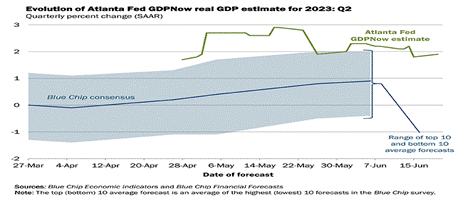
Why the talk of a recession when predictions are for first quarter GDP growth as high as +3.2 percent?

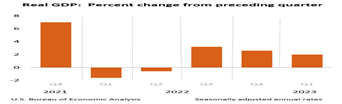
After fourth quarter 2022 GDP growth came in at 2.6 percent in the government’s final estimate (see graph), economists are now predicting higher 2023 growth, despite talk the Fed may raise their fed funds rate another +0.25 percent.

Why? Firstly, the banking crisis is lowering the odds of any ‘hard’ landing this year caused by the Fed, because pushing interest rates any higher could cause more banks to fail that have loaded up with either Treasury or Mortgage-backed securities that lost value when rates rose.

And real consumer spending surged 1.5 percent in January, which makes up 70 percent of GDP growth (see below graph). Personal income (blue bar) has been exceeding outlays (orange bar) since last November, so personal savings have increased, meaning consumers can continue to spend.

Even if real consumer spending remained soft in March, that would not change its sharp upward trajectory for the first quarter, economists said. JPMorgan raised its first-quarter GDP growth estimate to a 3.25 percent rate from a 2.5 percent pace. Goldman Sachs bumped up its estimate by 0.2 percentage points to 2.4 percent.

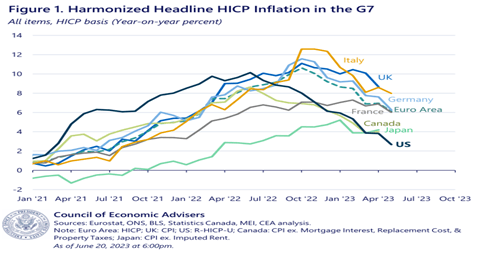
There was also some good news on inflation, as the Fed’s preferred inflation statistic, the Personal Consumption Expenditures Index (PCE), slipped from 5.3 to 5.0 percent in February, its core rate without food and energy prices falling from 4.7 to 4.6 percent.

It isn’t just interest rates that control growth, but consumers’ confidence in their jobs and future prospects. Both the Conference Board and University of Michigan surveys remain slightly positive in their outlook.

“Driven by an uptick in expectations, consumer confidence improved somewhat in March, but remains below the average level seen in 2022 (104.5). The gain reflects an improved outlook for consumers under 55 years of age and for households earning $50,000 and over,” said Ataman Ozyildirim, Senior Director, Economics at The Conference Board.

The University of Michigan’s survey was slightly less sanguine. “Consumer sentiment fell for the first time in four months, dropping about 8% below February but remaining 4% above a year ago,” said survey director Joanne Hsu. “This month’s turmoil in the banking sector had limited impact on consumer sentiment, which was already exhibiting downward momentum prior to the collapse of Silicon Valley Bank.” 

Other inflation indicators are showing similar declines, so there is hope the inflation scare that has affected confidence in our banking system may soon be over. And once again, the necessity of supporting our banking system should help wage earners, since it will trump any desire by the Fed to harm wage earners by pushing interest rates even higher.

Harlan Green © 2023

Follow Harlan Green on Twitter: https://twitter.com/HarlanGreen
Posted in Consumers, COVID-19, Economy, Weekly Financial News | Leave a comment

Homebuyers on the Move Early

The Mortgage Corner

The home-buying season has begun earlier this year from a large rise in existing-home and new-home sales. It looks like families are already on the move, including retirees and seniors downsizing to more humble quarters.

Calculated Risk

Why? Housing pricing are finally declining in some regions in concert with lower mortgage rates (see above Case-Shiller graph). Homebuyers must be thinking interest rates have topped and the Fed rate hikes will end sometime this summer.

“I’m quite surprised,” Lawrence Yun, chief economist at the National Association of Realtors said. “The recovery is coming stronger, [but] maybe it will deflate again if the mortgage rates get too high… [and] mortgage rates have a very big influence.”

Baby boomers now make up 39 percent of home buyers (ages 58 to 76 years old) – the most of any generation – an increase from 29 percent last year, said the NAR, in its press release.

Maybe rising consumer confidence is another reason home sales are up. The Conference Board’s consumer confidence index rose to 104.2 this month from a reading of 103.4 in February.

The cutoff date for the confidence survey was March 20, 10 days after California-based Silicon Valley Bank collapsed. New York-based Signature Bank failed on March 12, said the Conference Board, so the fact that jobs were plentiful seemed to outweigh banking worries.

And housing prices are stabilizing. “The MoM decrease in the seasonally adjusted Case-Shiller National Price Index was -0.25%. This was the seventh consecutive MoM decrease, and a slightly smaller decrease than in December,” said Bill McBride, quoting its press release.

The biggest surprise was that existing-home sales jumped 14.5 percent in February to a seasonally adjusted annual rate of 4.58 million, snapping a 12-month slide and representing the largest monthly percentage increase since July 2020 (+22.4 percent). Compared to one year ago, however, sales will still down 22.6 percent.

Calculated Risk

Downward price pressure also came from increasing inventories of for sale residences. The total existing-home inventory registered at the end of February grew to 980,000 units, identical to January and up 15.3 percent from one year ago (850,000). Unsold inventory sits at a 2.6-month supply at the current sales pace, up from 1.7 months in February 2022 when the price surge began.

Mortgage rates are also declining along with Treasury security yields, down approximately down -0.50 percent. I spotted a 6 percent rate on a 30-year conforming fixed rate mortgage with low origination points recently, down from 6.50 two weeks ago.

Not so surprising is that twenty-six percent of all buyers were first-time buyers, the lowest since NAR began tracking the data and a decrease from 34 percent last year.

Another sign that the selling season has begun was pending home sales that measure contracts signed but not closed, increased for the third month in a row.

“After nearly a year, the housing sector’s contraction is coming to an end,” said chief economist Yun. “Existing-home sales, pending contracts and new-home construction pending contracts have turned the corner and climbed for the past three months.”

So when will conditions improve for first-timers again? When the Fed reverses course and interest rates decline for real, which I’ve been calling for. New-home inventory is now matching existing-home inventory, which means builders are catching up, maybe in preparation for a more hopeful summer season.

Harlan Green © 2023

Follow Harlan Green on Twitter: https://twitter.com/HarlanGreen
Posted in Consumers, COVID-19, Economy, Housing, housing market, Weekly Financial News | Leave a comment

It’s Time to Raise Fed Inflation Target

Popular Economics Weekly

FREDavghrlypay

In the light of the recent bank failures, and the Fed’s own missteps in fighting inflation, history is telling us that the Fed’s current 2 percent target rate for inflation is too low.

Why? Because Federal Reserve policy since the 1970s has mostly benefited banks and other financial institutions that manage money.

It’s easy to see why. The Fed is in charge of keeping our banking system sound, which is implied in its mandate to maintain price stability and maximum employment. So its primary focus has always been to defend the value of their assets, and inflation diminishes asset values.

But the Fed hasn’t maintained price stability as evidenced by the recent inflation surge and was surprised by three US bank failures, causing doubts as to the soundness of our banking system.

Former FDIC Chairman Sheila Bair highlighted the dangers of such inattention in a MarketWatch interview.

“This is a risk confronting all banks,” she said. “All examiners need to be on alert for how interest-rate risk is being managed. If there is a run, they will need to sell these securities. Those are the kinds of things all-size banks, and all examiners should be worried about in our banking system.”

Current monetary policy has not improved workers’ wages, either, which haven’t kept up with inflation with the wild gyrations caused by the COVID pandemic and some $6 trillion in pandemic aid.

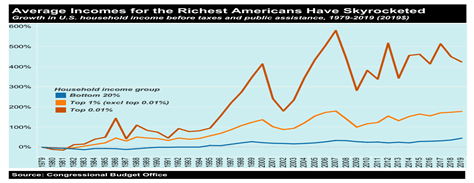
So isn’t it time for Fed monetary policies to focus on bringing down the record income inequality that has prevailed since then and ranked US income inequality the same as Haiti, far below that of other developed countries. per the CIA’s World-Factbook?

Why do we have red and blue states and a divided country, otherwise? Many Americans feel disenfranchised who no longer have jobs that earn what they did in the 1970s when we still had a manufacturing base in the rust belt.

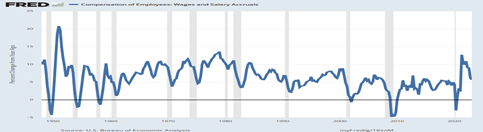
The average hourly earnings of employees has never risen above the 2-3 percent range, per the St. Louis Fed’s above graph of average hourly wages dating from the 2008 Great Recession.

Chairman Powell was explicit in his press conference after the conclusion of the latest FOMC meeting, at which another 0.25 percent rate increase was announced. The labor market is still too hot, he said, and has caused wage growth to accelerate rather than decline, which the Fed deemed was necessary to bring down inflation.

So employees’ earnings have now become the culprit keeping inflation too high, when the latest research has shown excess corporate profits and the Ukraine war jump-started the current inflation surge.

In other words, the Fed has been most successful at keeping employees’ wages at or below the inflation rate since the 1970s as they labored to keep inflation in the 2 percent target range.

This is not a coincidence. Fed Governors since former Fed Chair Paul Volcker have believed conditions that prevailed since the 1970s still rule that caused the wage-price spiral and double-digit inflation of that time.

But globalization policies expanded world trade and developed just-in-time supply-chains that brought in cheaper consumer goods and exported manufacturing jobs to low wage-earning countries. Inflation became so tame during the 1990s that it was termed the Great Moderation.

So why does our Fed have a 2 percent inflation target?

Progressive labor economist Jared Bernstein opined on this matter in the Washington Post shortly after first Bernanke announced the Fed’s decision of a 2 percent target rate.

“The fact is that the target is 2 percent because the target is 2 percent. Were the target 3 percent or 4 percent, you’d be reasonably asking me, why 3 or 4? To the extent that there’s an anti-inflation bias among economic elites (and thus an anti-full-employment bias), and I think that’s often the case, I’d reiterate arguments I made here…that the debates over full employment and Federal Reserve policy are generally dominated by the interests of the minority who worry more about inflation and asset values than those who worry about jobs and paychecks.”

Is there real evidence the current 4.4-4.6 percent average hourly wage increases employees are enjoying that was reported in the February unemployment report inflationary?

No, average hourly wages could be contributing as little as 8 percent to product costs in one recent paper by EPI economist Josh Bivens that I cited above.

There is much that government can do to lessen income inequality, which would in turn lessen the yawning gap between the Haves and Havenots in this country. The Federal Reserve can do its part by lessening the inherent bias of a low inflation target that mainly targets wage earners, which includes 32 million Americans that still live below the poverty line.

Harlan Green © 2023

Follow Harlan Green on Twitter: https://twitter.com/HarlanGreen
Posted in Consumers, COVID-19, Economy, Politics, Weekly Financial News | Leave a comment

The Fed Should Reverse Course

Financial FAQs

FRED10yr

The wild fluctuations of the 10-year Constant Maturity Treasury yield portrayed in the above St. Louis Fed graph should have alerted Federal Governors and Chairman Powell to the dangers of raising interest rates too precipitously.

It is the reason three US banks have failed, who wouldn’t either hedge against or reduce their holdings backed by Treasury securities that lost value as interest rates rose.

It’s also why the Fed should begin to reverse course to lower their overnight rate target that is now at 4.5-4.75 percent.

The decline in confidence of our banking system can in part be attributed to the Fed Governors naiveté, or maybe outright ignorance, of the US banking system they are supposed to regulate.

For instance, Fed Governors did not seem to realize the risk to depositors of banks holding deposits worth more than the $250,000 ceiling set by the FDIC for insured deposits. It was 97 percent in the case of Silicon Valley Bank.

The Fed seems to have been its own worst enemy in not realizing the effect of its policy actions, as evidenced by February’s FOMC minutes.

“With respect to the relationship between monetary policy and financial stability, some participants noted that evidence regarding the link between the policy stance and elevated financial vulnerabilities was limited, with a couple of participants further observing that there were not many episodes of persistently low interest rates.”

Yet Silicon Valley Bank had been on the San Francisco Fed’s watch list for more than one year as the Fed Governors charged ahead with their rate hike policy. “By July 2022,” as reported by the NYTimes, “Silicon Valley Bank was in full supervisory review, and was ultimately rated deficient for governance and controls.”

“In addition,” continued the FOMC minutes, “some past episodes of heightened financial vulnerabilities were associated with excessive risk-taking behavior that did not seem to be very responsive to typical changes in interest rates.”

Really? The NY Times and others have reported on the hands-off attitude of Fed regulators in not doing more to demand that banks—particularly those vulnerable to large uninsured deposits—crack down on such risky behavior.

So the Fed might call a halt to its policy of taming an inflation that is mostly caused by factors outside of the Fed’s control, and focus more on banking supervision that is under its direct control.

A 2022 Gallup survey found that just 27 percent of Americans had a “great deal/quite a lot” of confidence in our banks.

At the very least, the Fed should reverse course and begin to bring down interest rates before more banks fail, and more Americans lose faith in our banking system.

Harlan Green © 2023

Follow Harlan Green on Twitter: https://twitter.com/HarlanGreen
Posted in Consumers, COVID-19, Economy, Politics, Weekly Financial News | Leave a comment

Housing Market Recovery–Part II

The Mortgage Corner

Calculate Risk

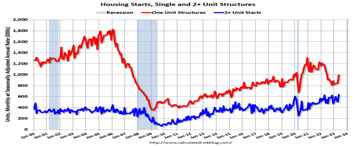
Real estate continues its slight recovery with housing starts and new residential permits on the rise in February. Most of the action was in rental housing, as apartment construction is up 9.9 percent YoY in February. Whereas February single-family construction has been falling and is now down 31.6 percent YoY.

It’s easy to see why more multi-family housing is under construction. Single-family affordability has plunged with 30-year conforming fixed rates still around 6.75 percent.

The NAR’s Housing Affordability Index showed that from 2020 to 2022 the income required to qualify for a 90 percent LTV mortgage on an entry-level home had doubled from $49,008 to $92,688 while the 30-year fixed rate rose from 3.17 percent to 6.77 percent.

This puts many more first-time buyers out of the market. Their share of purchases has fallen to 30 percent of existing-home sales, when it was as much as 40 percent before housing prices accelerated in 2021.

Calculated Risk

The Case-Shiller Home Price Index also highlights the price fluctuations in existing-home prices that made affordability such a problem in Calculated Risk’s above graph of the Case-Shiller Index dating from 1988.

Price rises peaked in January 2004 and January 2023 when they were rising as much as 20 percent YoY before declining sharply. It was a time of multiple offers and ultra-low interest rates that crowded out first-timers.

The sharp declines in price inflation that followed both times were precipitated by the Federal Reserve’s actions to tighten credit, and the lack of entry-level housing.

One reason that builders are building again is the slow down in inflation, with the S&P Composite Home Price Index now rising in the 4 percent range. There are also a record 1.7 million homes still under construction, which is a tremendous backlog also bringing down prices.

“The cooling in home prices that began in June 2022 continued through year end, as December marked the sixth consecutive month of declines for our National Composite Index,” says Craig J. Lazzara, Managing Director at S&P DJI.

Mortgage rates have been up and down but won’t give much boost to housing until the Fed decides to ease up on the rate increases. Still, signs of life this early in the selling season and without any indication the feds will pause in their rate hikes is difficult to ignore.

Harlan Green © 2023

Follow Harlan Green on Twitter: https://twitter.com/HarlanGreen
Posted in Consumers, COVID-19, Economy, Housing, housing market, Weekly Financial News | 1 Comment

What Is the Fed’s Next Move?

Popular Economics Weekly

FREDcpi

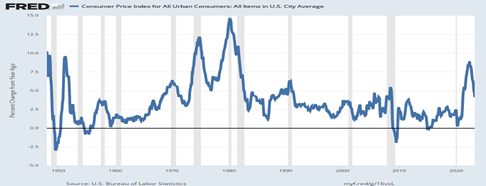
The retail Consumer Price Index rose from essentially zero in May 2020 to 8.9 percent YoY in June 2022. It has dropped to 6 percent in February, per the US Census Bureau’s latest inflation report.

This is what panicked Federal Reserve officials to begin the draconion interest rate increases that have caused at least two bank failures, and maybe more, of mid-size banks whose oversight was weakened with a modification of the Dodd-Frank legislation in 2018.

The largest failure to date is the Silicon Valley Bank, whose depositors withdrew a record $42 billion in a matter of days. Taxpayers might now be picking up the tab because of the promise by the US Treasury and FDIC to make all depositers whole (but not stock and bond holders).

The rising costs of renting and homeownership accounted for more than 70 percent of the increase in consumer prices last month due to the well-documented housing shortage.

The cost of recreation, plane tickets, auto insurance and furniture also rose sharply because the service sector is booming. Leisure/Hospitality, Education & Health had the fastest job growth in last Friday’s February unemployment report.

More good news was that the cost of energy, including gas and natural gas, declined in February. And grocery prices rose 0.3 percent to mark the smallest increase in 21 months. They are still up 10.2 percent in the past year, however.

The wholesale cost of goods also fell last month in the Bureau of Labor Statistic’s Producer Price Index as well, led by the third straight decline in food prices. Notably, wholesale egg prices sank 41 percent. The cost of eggs had soared since the fall, doubling in price in some parts of the country.

The PPI report captures what companies pay for supplies such as fuel, metals, packaging and so forth. These costs are often passed on to customers at the retail level and give an idea of whether inflation is rising or falling.

Crunching the numbers, it has taken nine months for CPI inflation to drop to 6 percent from its peak last June. It should take approximately six months to return to the Fed’s 2 percent inflation target, if it continues to decline at the same rate that it rose, which is sometime in the fall.

But supply chains are taking longer to recover because of China’s COVID missteps and the Ukraine war that has no end in sight.

So what is the Fed to do? It would be a good time to pause and see if inflation continues to decline, as well as to ascertain whether higher interest rates do more damage to the banking industry that may have invested too heavily in certain assets.

Harlan Green © 2023

Follow Harlan Green on Twitter: https://twitter.com/HarlanGreen
Posted in Consumers, COVID-19, Economy, Politics, Weekly Financial News | Leave a comment

Will the Fed Pause Rates Sooner?

Popular Economics Weekly

MarketWatch

February’s very strong unemployment report has raised fears the Fed may go back to 0.50 percent rate hikes, or even 0.75 percent (which it did four times), because of the continuing strength of the labor market.

But maybe not, because the failure of the Silicon Valley Bank and several smaller banks may set off alarm bells at the Fed that they might have raised interest rates too fast, catching some smaller banks off guard that invested heavily in Treasury and Mortgage-backed securities when rates were at rock bottom.

Job strength was mainly in the service sector, according to the Labor Department’s unemployment report. Leisure/Hospitality and Education/Health once again added most new payroll jobs in February followed by retail trade, professional services and government, as we recover from COVID-19.

The U.S, has created 4,349,000 jobs since February 2022, so quickly has been the recovery. That’s more than 362,000 jobs per month, unheard of in a post-WWII recovery, and the rest of the world is playing catch-up.

Calculated Risk

In fact, February 2022 to February 2023 has been the best 12 month period of job creation since 1980 per the Calculated Risk graph.

So the pandemic has been a two-edged sword, killing more than one million Americans and seven million worldwide, but causing governments to spend freely to speed the recovery.

It now looks like the sudden rise in inflation since the pandemic has panicked Fed officials into raising interest rates too quickly—4.5 percent since last May. The result may cause more small banks to fail, which might cause the Fed in turn to pause their rate hikes, or even reverse course.

It’s becoming evident that the sudden rate increases have caught some banks flatfooted. Barron’s Magazine has just listed 20 banks in a similar position to fail, if the bad news precipitates more depositor withdrawals.

Greenspan’s Fed boosted its rate 4 percent more gradually in 0.25 percent increments over two years. Yet it still precipitated the Great Recession, in part because the GW Bush administration stopped regulating Wall Street firms, which permitted the liar loans that ultimately failed and caused the busted housing bubble.

The Trump administration has acted similarly by easing oversight on mid-sized banks that could have precipitated the current missteps.

So are we looking at another banking crisis, such as occurred during Alan Greenspan’s Fed and the Bush administration?

We should be in a different world because of the banking reforms post-Great Recession. Banks’ balance sheets have been greatly strengthened and financial markets are more tightly regulated.

There are many inflation elements outside of the Fed’s control that should continue to bring down inflation. Supply chains are returning to normal, and corporate profits are coming down from the stratosphere. The Biden administration is also attempting to reduce trade tariffs to bring down import costs that businesses pass on to consumers.

But the Fed has never raised interest rates so quickly before in their history. The latest failures should be a lesson that might change some minds at the Fed.

Harlan Green © 2023

Follow Harlan Green on Twitter: https://twitter.com/HarlanGreen

Posted in Consumers, COVID-19, Economy, Politics, Weekly Financial News | Leave a comment

The Fed May Cause Another Recession

Financial FAQs

EPI.org

A headline reporting on Fed Chairman Powell’s latest testimony to congress said the Fed will battle inflation until it is subdued, sounding more hawkish because January numbers for retail spending, employment and inflation were stronger than expected.

The problem is most inflation is being caused by factors outside of the Fed’s control.

So good luck, I say, in continuing to boost interest rates without causing a recession. The last time the Fed was in such a position—battling surging inflation in early 2000 that brought on the housing bubble and was due to circumstances largely beyond its control (The War on Terror)—it resulted in the Great Recession.

The Fed had so over-reacted by raising interest rates 16 consecutive times under Fed Chair Alan Greenspan that it took his successor Ben Bernanke’s emergency Quantitative Easing policies to keep the U.S. and world economies from turning it into a second Great Depression.

The cost this time of the Fed holding to its 2 percent inflation target could be 2 million workers losing their jobs, according to Massachusetts Senator Elizabeth Warren.

Today’s Fed hasn’t seemed to even acknowledge that a major component of the current inflation is record corporate profits from the post-pandemic recovery when corporations took advantage of the supply shortages to goose their profit margins.

Economic Policy Institute economist Josh Bivens estimates that at least half of the current inflation was caused by said increase in corporate profits in a study out last year (see EPI graph).

“Since the trough of the COVID-19 recession in the second quarter of 2020, overall prices in the NFCorporate sector have risen at an annualized rate of 6.1%—a pronounced acceleration over the 1.8% price growth that characterized the pre-pandemic business cycle of 2007–2019. Strikingly, over half of this increase (53.9%) can be attributed to fatter profit margins, with labor costs contributing less than 8% of this increase.”

January’s consumer spending was also boosted by the 8 percent inflation-adjusted rise in Social Security payments in the New Year.

Consumers reacted accordingly with January consumer spending up 1.8 percent, while personal incomes rose 0.6 percent in the BEA’s latest personal income (PCE) report.

Fear of what Fed Chair Powell may say and do next is already affecting what consumers and businesses may do next. The Conference Board Index of Leading Economic Indicators (LEI) already predicts a recession sometime this year.

Conference Board

“Among the leading indicators, deteriorating manufacturing new orders, consumers’ expectations of business conditions, and credit conditions more than offset strengths in labor markets and stock prices to drive the index lower in the month,” said said Ataman Ozyildirim, Senior Director, Economics, at The Conference Board.

Maybe Powell’s Fed is just playing it safe in hinting that more pain is possible if January’s boost in spending and inflation isn’t a temporary glitch as more data from February come in.

Friday’s upcoming unemployment report is one such sign, since January’s red-hot employment report of 537,000 new jobs scared the Fed into believing higher inflation could be prolonged.

Harlan Green © 2023

Follow Harlan Green on Twitter: https://twitter.com/HarlanGreen

Posted in Consumers, COVID-19, Economy, Politics, Weekly Financial News | Leave a comment

Housing Market Is Recovering

The Mortgage Corner

Census.gov

Real estate is the industry most affected by rising interest rates, so it’s encouraging to see that housing sales are showing signs of a revival. Both new-home and pending home sales jumped in January, even with still expensive mortgage rates.

One reason: builders are buying down those mortgage rates.

Sales of newly built, single-family homes in January increased 7.2 percent to a 670,000 seasonally adjusted annual rate from an upwardly revised reading in December, according to newly released data by the U.S. Department of Housing and Urban Development and the U.S. Census Bureau.

And it’s not that expensive for a builder to offer an affordable mortgage rate—just 4 points (%) to buy down a conforming 30-year fixed rate mortgage to 4.875%; not that much to tack onto a sales price.

“The latest HMI survey shows 57% of builders are using incentives to bolster sales, including providing mortgage rate buy-downs, paying points for buyers and offering price reductions,” said Alicia Huey, chairman of the National Association of Home Builders (NAHB). “Buyer incentives, along with stabilizing mortgage rates during the month of January, increased the pace of new home sales for the month. However, in a sign of current market weakness, sales are down 19.4% compared to a year ago.”

Pending home sales also improved in January for the second consecutive month, according to the National Association of RealtorsÒ.

The Pending Home Sales Index (PHSI)* — a forward-looking indicator of home sales based on contract signings — improved 8.1 percent to 82.5 in January. (But) Year-over-year, pending transactions dropped by 24.1 percent.

“Buyers responded to better affordability from falling mortgage rates in December and January,” said NAR Chief Economist Lawrence Yun.

What is causing more optimism among homebuyers? Builders are seeing more traffic from new-home wannabes, for starters.

The National Association of Builders reports two consecutive solid monthly gains for builder confidence, spurred in part by easing mortgage rates, signal that the housing market may be turning a corner even as builders continue to contend with high construction costs and building material supply chain logjams.

A more immediate reason for the improvements is an acute housing shortage. Builders essentially stopped building new homes for a decade after the Great Recession and busted housing bubble.

“With the largest monthly increase for builder sentiment since June 2013, excluding the period immediately after the onset of the pandemic, the HMI indicates that incremental gains for housing affordability have the ability to price-in buyers to the market,” said NAHB Chairman Alicia Huey. “The nation continues to face a sizeable housing shortage that can only be closed by building more affordable, attainable housing.”

The NAR anticipates the economy will continue to add jobs throughout 2023 and 2024, with the 30-year fixed mortgage rate steadily dropping to an average of 6.1% in 2023 and 5.4% in 2024. 

Most prospective homebuyers are still on the sidelines, however. The Conference Board reported a further decline in consumer confidence reflecting large drops in confidence for households aged 35 to 54 and for households earning $35,000 or more,” said Ataman Ozyildirim, Senior Director, Economics at The Conference Board.

“While consumers’ view of current business conditions worsened in February, the Present Situation Index still ticked up slightly based on a more favorable view of the availability of jobs. In fact, the proportion of consumers saying jobs are ‘plentiful’ climbed to 52.0 percent—back to levels seen in the spring of last year.”

So what are homebuyers to do? Should they look for homebuilders willing to buy down that mortgage to 4.875%, or wait while housing prices continue to climb?

Harlan Green © 2023

Follow Harlan Green on Twitter: https://twitter.com/HarlanGreen

Posted in Consumers, COVID-19, Economy, Housing, housing market, Weekly Financial News | 1 Comment