Fed’s Inflation Target Too Low

Financial FAQs

FREDhourlywages

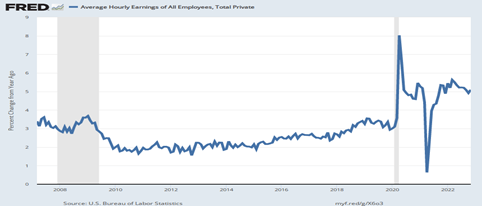
Why is the Federal Reserve enforcing a 2 percent inflation rate target? Such a monetary policy has meant Fed Governors have endangered economic growth by holding to a target rate that I believe is too low.

Whatever the basis for their fears of inflation—whether it be that so-called inflation expectations are too high, or product costs (such as worker’s wages) rise too fast, the result of their credit[-tightening measures has been that household incomes have been kept lower than inflation historically, increasing income and wealth inequality.

It has thus denied workers earning hourly wages as shown in the above FRED graph (gray bars inflation) the chance to ever catch up to historical inflation and better their financial well-being.

But shouldn’t the prime goal of a well-functioning Democracy be to decrease income inequality? Especially when there are so many American voters—especially high-school educated wage earners–questioning whether American-style democracy is serving their needs.

Former Chairman Ben Bernanke said in 2012 keeping a 2 percent cap enabled the Federal Reserve to better balance its twin mandates to maintain stable prices with maximum employment.

Why? It seems 2 percent is a common target throughout advanced economies, rather than based on empirical studies that verified it in fact maintained stable inflation and maximum employment, the Fed’s twin mandates.

Economists will tell you the 2 percent figure is based on their belief that the measured inflation rate overshoots actual inflation by something like 2 percent, which means they were really trying to get back to zero inflation! If so, that sounds like a great way to tempt actual deflation and a serious recession.

Brookings

This is what happened in the Great Recession that lasted from 2007-09. The Fed had jacked up their fed funds overnight rate charged to banks to 5 percent. It was when Fed Chair Alan Greenspan killed the housing market by the Chinese drip torture method, raising the fed funds rate by one-quarter percent 16 consecutive times, thus busting the housing bubble and causing the Great Recession (after Greenspan suggested that an adjustable-rate mortgage might be desirable in such times).

Greenspan’s Federal Reserve busted the housing bubble and inflation for sure. CPI inflation dropped to 0 percent by 2015, and EU countries such as Denmark had to offer negative interest rates on home mortgages to revive their housing market. This meant that a mortgage lender had to literally subsidize the mortgage borrower to induce them to take out a mortgage loan.

Household incomes suffered even more during this time. Average hourly wages didn’t begin to increase until 2015 and inflation return to its longer-term 2 percent range in 2017 when new Fed Chair Ben Bernanke began the Fed’s policy of buying treasury and mortgage securities to inject liquidity back into the markets to stimulate growth. (He was nicknamed ‘helicopter Ben’ for the huge boost it gave to the money supply).

This is but one example of what happened when the Fed clamped down too hard on inflation. It has been the Fed’s bias since the 1970s that resulted in keeping household income from ever catching up to inflation.

Progressive labor economist Jared Bernstein opined on this matter in the Washington Post shortly after Bernanke announced the Fed’s decision.

“The fact is that the target is 2 percent because the target is 2 percent. Were the target 3 percent or 4 percent, you’d be reasonably asking me, why 3 or 4? To the extent that there’s an anti-inflation bias among economic elites (and thus an anti-full-employment bias), and I think that’s often the case, I’d reiterate arguments I made here…that the debates over full employment and Federal Reserve policy are generally dominated by the interests of the minority who worry more about inflation and asset values than those who worry about jobs and paychecks.”

It has in fact become a tool to suppress the incomes of average households and worsen income inequality; just as hourly wages are accelerating. But will that change their minds?

Harlan Green © 2023

Follow Harlan Green on Twitter: https://twitter.com/HarlanGreen

Posted in Consumers, COVID-19, Economy, Politics, Weekly Financial News | Leave a comment

No More Inflation Worries?

Popular Economics Weekly

FREDcpi

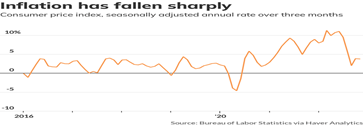
The Fed seems to have done it, raising interest rates enough to break the back of the highest inflation rate in 40 years. But will it be enough to stop the Fed Governors from continuing to raise their interest rates and cause a recession?

Let us hope so, as financial markets are rallying on the news and interest rates are tumbling. The Fed looks at the rate of inflation that is a different animal from day-to-day prices seen by consumers and producers, which are tumbling faster

I hope the Fed has done enough, as the main ingredients of consumer prices—gas, food, and housing prices (or equivalent rents, in the case of housing)—have been declinng of late. And this is reflected in longer-term interest rates, but not in the Fed’s short-term rates that determine credit card and auto loans.

The U.S. consumer-price index (CPI) reflected in the above FRED graph fell 0.1 percent in December and posted the first decline since the onset of the pandemic in 2020, pointing to a further slowdown inflation after it hit a 40-year peak last summer.

The annual rate of inflation fell for the sixth month in a row to 6.5 percent from 7.1 percent. Its 40-year peak was 9.1 percent last summer. The so-called core rate of inflation, which omits food and energy, rose 0.3 percent. The core rate over the past 12 months dropped to 5.7 percent from 6 percent to mark the lowest level in a year.

This is what pandemics and wars do—create shortages of such essential items, hence the panicked Fed Governors who were fearing a repeat of the 1970s inflation surge when OPEC oil embargos and a war between Eqypt and Israel broke out.

The so-called Middle East war was quickly over, but because we were still dependent on fossil fuels and hadn’t yet developed domestic production with the infamous fracking boom, we needed OPEC supplies. So it took longer for inflation to subside; almost 10 years during the 1980s, in fact.

The developed countries are bringing down energy prices with alternative fuel supplies and a price cap on Russian oil.

Housing prices (and equivalent rents) will subside as interest rates continue falling. And economists are beginning to notice the decline in inflation.

One economist quoted by MarketWatch said, “The 3-month annualized core CPI is down to 3.1% and at least another 1% lower if using new leases versus existing leases that have a six to twelve month lag. We continue to expect the Fed to only raise rates two more times as CPI continues to moderate,” said Bryce Doty, senior portfolio manager at Sit Investment Associates, in emailed comments.

Food prices may be the most difficult component of the CPI to bring down with the current shortages of such essentials as wheat and corn.

But help might be on the way come Spring, since California supplies a large part of US food supplies. The prolonged drought has caused California state crop production to drop some 50 percent.

According to the California Department of Food and Agriculture, California’s Central Valley supplies eight percent of U.S. agricultural output and produces 1/4 of the Nation’s food, including 40 percent of the Nation’s fruits, nuts and other table foods.

But the Pineapple Express, named because an almost endless stream of atmospheric rivers originating near Hawaii have hit California this winter, may have broken the latest drought. So there is some hope for lower food prices as well.

One homeowner who was recently interviewed by a local Santa Barbara TV station said he wasn’t surprised by the latest floods affecting California because they occurred after almost every drought period.

Maybe most US consumers know this as well, and will be able to weather the latest inflation cycle without too much damage to their pocketbooks, if the Fed Governors understand such natural phenomena as well and don’t cause a recession. Inflation seems to occur in cycles due to events the Fed has little power to control, as do droughts and floods.

Harlan Green © 2023

Follow Harlan Green on Twitter: https://twitter.com/HarlanGreen

Posted in Consumers, COVID-19, Economy, Weekly Financial News | Leave a comment

Job Market Defies the Fed

Popular Economics Weekly

MarketWatch

All eyes are now on the Federal Reserve and Chairman Powell. Companies are daring Powell and his Governors to crimp their profits by threatening dire consequences (i.e., a recession) if they don’t slow down hiring at the current pace.

But corporations are not listening as the demand for workers far exceeds the aupply, so that 223,000 new nonfarm payroll jobs were created in December, per the US Bureau of Labor Statistics. This is still above the so-called replacement rate of jobs created to accommodate new job seekers.

And the unemployment rate dropped back to 3.5 percent, signaling that the 10.5 million job vacancies just reported in November was no fluke. But wages aren’t rising as fast, probably because most of the hiring is now in the lower paying service industries, with 145,000 jobs added just in Education/Health and Leisure/Hospitality.

The 28,000 added jobs in construction is probably because construction is beginning that is funded by the $1.2 trillion Infrastructure Investment and Jobs Act.

The Whitehouse says it includes a five-year allocation of $550 billion in federal investments in America’s infrastructure to upgrade highways and major roads, bridges, airports, ports, and water systems. Additional investments cover expansions and improvements to the nation’s broadband access, public transportation systems, and energy grid infrastructure.

Will US economic growth fall off a cliff in January? Maybe not, as I said in my last blog. The Atlanta Federal Reserves’ GDPNow estimate has just raised their estimate of fourth quarter GDP growth to 3.7 percent and it was right on predicting higher Q3 growth.

And at least one Fed Governor is sounding more dovish on inflatiion, reports MarketWatch. James Bullard, president of the St. Louis Federal Reserve, said on Thursday, the odds of so-called soft landing have gone up in part because of the sturdy labor market.

The Fed may find some solace in the declining job numbers. Hiring in November and October was much higher after being revised. The economy added 256,000 jobs in November and 263,000 in October.

So we need a few more dovish Governors on the Federal Reserve Board to agree with Bullard, and maybe persuade Chairman Powell to soften his anti-inflation rhetoric.

Harlan Green © 2023

Follow Harlan Green on Twitter: https://twitter.com/HarlanGreen
Posted in Consumers, COVID-19, Economy, Politics, Weekly Financial News | Leave a comment

Is Job Market Still Too Hot?

Financial FAQs

CalculatedRisk

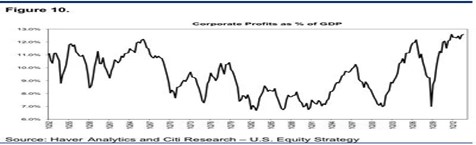
No matter how hard it tries, the Fed hasn’t been able to slow hiring in the hopes that it will bring down inflation—because corporations have record profits and are only beginning to lay off workers.

But watch out this year as the $trillions in New Deal spending of bipartisan bills just passed is funding projects that need good jobs, such as the Infrastructure and Inflation Reduction Acts.

So what is the Fed to do, discourage the long overdue modernization of the American economy?

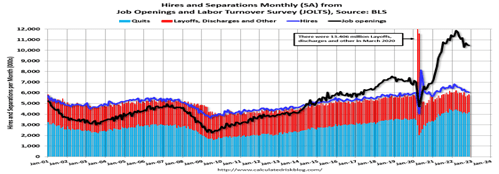
The Bureau of Labor Statistics JOLTS report showed 10.5 million job openings and was “little changed” from past months.The above graph shows job openings (black line), hires (dark blue), Layoff, Discharges and other (red column), and Quits (light blue column) from the JOLTS.

“The number of job openings was little changed at 10.5 million on the last business day of November, the U.S. Bureau of Labor Statistics reported today. Over the month, the number of hires and total separations changed little at 6.1 million and 5.9 million, respectively. Within separations, quits (4.2 million) and layoffs and discharges (1.4 million) changed little.”

That means approximately 400,000 jobs were created in November—the difference between hires and total separations.

BusinessInsider

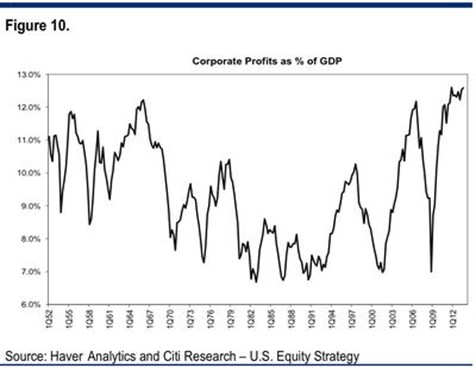
And here’s a graph once again of corporate profits that fell to their lows in the 1980s before soaring to new heights.

So this Friday’s unemployment report will be closely watched by Fed officials, with few giving any indication that they want to slow down their rate increases.

Minutes released Wednesday from the Fed’s Dec. 13-14 meeting showed the central bank’s policymaking arm recognizes that inflation has begun to cool somewhat but its participants still view price growth as “unacceptably high”.

Wow, this is while the overall picture is of a slowing economy, with the ISM’s manufacturing survey showing contraction. U.S. manufacturing activity slipped to 48.4 in December from 49 in the prior month, according to the Institute for Supply Management on Wednesday. This is the lowest level since May 2020.

And job layoffs have increased sharply before the holidays. The worker-friendly Guardian was not slow to react.

“After corporations complained of labor shortages through 2021 and 2022, several companies have shed workers in mass layoffs as 2022 comes to a close. Job cuts in the US have risen this year, with a 6% increase for the first 11 months of 2022 in comparison to last year.”

Consumers are already cutting back spending as retail inventories pile up and more stores begin to discount. That will become more serious now that the holidays are over, as I’ve been saying. So it would be nice if there was more consistency in federal policies!

So my answer is the job market is not too hot. Many more jobs will be needed to aid our economic recovery as well as modernize those regions that have fallen behind at a time when we need all Americans to participate in the recovery.

Harlan Green © 2023

Follow Harlan Green on Twitter: https://twitter.com/HarlanGreen
Posted in Consumers, COVID-19, Economy, Keynesian economics, Politics, Weekly Financial News | Leave a comment

To A Happier New Year!

Popular Economics Weekly

AtlantaGDPNow

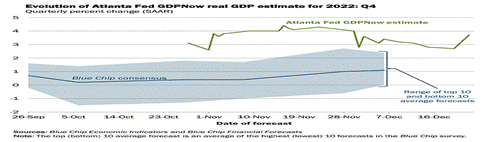
Will US economic growth fall off a cliff in January? Maybe not. The Atlanta Federal Reserves’ GDPNow estimate has just raised their estimate of fourth quarter GDP growth to 3.7 percent and it was right on predicting higher Q3 growth.

Yet the pundit chorus is growing for at least two quarters of negative growth in 2023 due to the Fed’s hawkish stance on inflation.

The GDPNow model estimate for real GDP growth (seasonally adjusted annual rate) in the fourth quarter of 2022 is 3.7 percent on December 23, up from 2.7 percent on December 20,” said the GDPNow report.

After recent releases from the US Census Bureau, the US Bureau of Economic Analysis, and the National Association of Realtors, the nowcasts of fourth-quarter real personal consumption expenditures growth and fourth-quarter real gross private domestic investment growth increased from 3.4 percent and -0.2 percent, respectively, to 3.6 percent and 3.8 percent, respectively.

One reliable indicator, the Conference Board’s Index of leading Indicators (LEI), is predicting a recession next year.

Ataman Ozyildirim, Senior Director, Economics, at The Conference Board said: “Despite the current resilience of the labor market—as revealed by the US CEI in November—and consumer confidence improving in December, the US LEI suggests the Federal Reserve’s monetary tightening cycle is curtailing aspects of economic activity, especially housing. As a result, we project a US recession is likely to start around the beginning of 2023 and last through mid-year.”

But the jury is still out among economists on what may happen next year. Harvard economist Jeffery Frankel, a leading growth expert, believes it’s not so inevitable in a Project Syndicate column.

“Clearly, the reports that the United States was in recession during the first half of the year were premature, especially given how tight the US labor market is. And, despite the confidence with which many again proclaim the inevitability of a downturn, the chances of one in the coming year are well below 100%.”

In fact, there are too many ‘known unknowns’ to paraphrase Bush Defense Secretary Donald Rumsfeld.

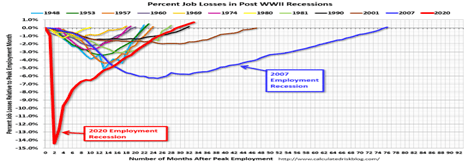
Let’s take the unemployment situation for starters. The unemployment rate is still at post-World War II lows, and 4.9 million jobs were created in 12 months, the fastest jobs recovery since the 1990 “Desert Storm” recession (black line in graph).

Calculated Risk

Why are we still at fill employment? There were record levels of government spending, to not only to aid the pandemic recovery but modernize our infrastructure, upgrade our healthcare system and the environment. This is New Deal level spending such as brought us out of the Great Depression.

The $1 trillion infrastructure bill is the largest in history. And it was needed since we had just survived the Great Recession that almost repeated the Great Depression as well as a pandemic that killed more than one million Americans.

Government came to the rescue then, as it is doing now.

The increase in real GDP for the third quarter reflected increases in exports, consumer spending, nonresidential fixed investment, state and local government spending, and federal government spending, per the BEA.

It will do so again, and we have record corporate profits—still the highest as a percentage of GDP ever.

“Consumer confidence bounced back in December, reversing consecutive declines in October and November to reach its highest level since April 2022,” said Lynn Franco, Senior Director of Economic Indicators at The Conference Board. “The Present Situation and Expectations Indexes improved due to consumers’ more favorable view regarding the economy and jobs. Inflation expectations retreated in December to their lowest level since September 2021, with recent declines in gas prices a major impetus. Vacation intentions improved but plans to purchase homes and big-ticket appliances cooled further. “

Consumers, at least, haven’t got the message that a recession is immanent. With so much government support, maybe they see another New Deal in the New Year.

Harlan Green © 2022

Follow Harlan Green on Twitter: https://twitter.com/HarlanGreen
Posted in Consumers, COVID-19, Economy, Keynesian economics, Weekly Financial News | Leave a comment

US Economy Still Surging

Popular Economics Weekly

BEA.gov

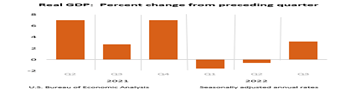
Surprise, surprise. Third quarter GDP growth was revised upward in the government’s third estimate. How can we be thinking of a recession next year? Oh yes, because it increases the likelihood that the Federal Reserve will continue to raise interest rates.

But US economic growth is surging now. What was originally the BEA’s initial estimate of growth was revised from 2.6 percent to 2.9 percent, and now in its third and final estimate is 3.2 percent, largely because consumers are continuing to spend into the holidays.

That should have been an easy call for economists, at least, who are supposed to understand what ingredients make up growth.

“The “third” estimate of GDP released today is based on more complete source data than were available for the “second” estimate issued last month,” said the BEA’s press release.  “In the second estimate, the increase in real GDP was 2.9 percent. The updated estimates primarily reflected upward revisions to consumer spending and nonresidential fixed investment that were partly offset by a downward revision to private inventory investment.”

The increase in real GDP for the third quarter reflected increases in exports, consumer spending, nonresidential fixed investment, state and local government spending, and federal government spending, per the BEA.

The main engine of the economy, consumer spending, increased at a very good 2.3 percent annual rate in the third quarter. Previously the increase was reported at 1.7 percent.

There are other factors showing strong growth as well. Corporate profits were not as weak in the third quarter as initially reported. Adjusted pretax earnings were flat instead of down 1.1 percent, which means corporate profits are holding at the highest level as a percentage of GDP since 1950.

And initial jobless claims have sunk back to post-pandemic lows, signaling corporations are not yet downsizing their payrolls. The number of Americans who applied for unemployment benefits in the week before Christmas rose slightly to 216,000, but new filings remained low and show the labor market is still strong.

Why? Consumers are more optimistic about their future, as I reported recently, and it’s the holidays!

“Consumer confidence bounced back in December, reversing consecutive declines in October and November to reach its highest level since April 2022,” said Lynn Franco, Senior Director of Economic Indicators at The Conference Board. “The Present Situation and Expectations Indexes improved due to consumers’ more favorable view regarding the economy and jobs. Inflation expectations retreated in December to their lowest level since September 2021, with recent declines in gas prices a major impetus. Vacation intentions improved but plans to purchase homes and big-ticket appliances cooled further. “

Disposable personal income increased as well, by $242.4 billion, or 5.4 percent, in the third quarter, an upward revision of $6.6 billion from the previous estimate. Real disposable personal income increased 1.0 percent, an upward revision of 0.1 percentage point.

GDPNow

And lastly, the Atlanta Fed’s GPNow estimate of fourth quarter growth has been steadily revised downward, mostly because the housing market is already in recession, particularly due to lower new home sales and housing construction.

“The GDPNow model estimate for real GDP growth (seasonally adjusted annual rate) in the fourth quarter of 2022 is 2.7 percent on December 20, down from 2.8 percent on December 15. After this morning’s housing starts report from the US Census Bureau, the nowcast of fourth quarter real residential investment growth decreased from -21.2 percent to -21.5 percent.”

The engines of growth are still in place, but stocks are plunging again. The good news is seen as bad news by financial markets because the Fed isn’t looking at the real economy.

Harlan Green © 2022

Follow Harlan Green on Twitter: https://twitter.com/HarlanGreen
Posted in Consumers, COVID-19, Economy, Weekly Financial News | Leave a comment

Housing Market Swoons

The Mortgage Corner

Confidence among U.S. single-family home builders fell for a record 12th straight month in December as even a scramble to offer incentives for prospective buyers failed to boost traffic and lift sales in today’s high-inflation, high-interest rate environment.

The housing market is in a “sales swoon”. Sales are poor but not as bad as past recession levels (gray bars in the Reuters graph).

Yet among actual consumers, “Consumer confidence bounced back in December, reversing consecutive declines in October and November to reach its highest level since April 2022,” said Lynn Franco, Senior Director of Economic Indicators at The Conference Board.

This tells us what is happening in our economy is totally at odds with current Federal Reserve policy. The public sees good times ahead, in part because inflation has been declining.

The Present Situation and Expectations Indexes improved due to consumers’ more favorable view regarding the economy and jobs, said Franco. Inflation expectations retreated in December to their lowest level since September 2021, with recent declines in gas prices a major impetus.

There were some indications the decline in builder confidence is nearing a bottom, as the gauge of sales expectations over the next six months rose four points to 35.

“The silver lining in this HMI report is that it is the smallest drop in the index in the past six months, indicating that we are possibly nearing the bottom of the cycle for builder sentiment,” said Robert Dietz, NAHB’s chief economist. “Mortgage rates are down from above 7% in recent weeks to about 6.3% today, and for the first time since April, builders registered an increase in future sales expectations.”

Reuters

Existing-home sales also declined for the tenth month in a row in November, according to the National Association of Realtors®. All four major U.S. regions recorded month-over-month and year-over-year declines.

This is with sky-high interest rates just in the past six months.

“In essence, the residential real estate market was frozen in November, resembling the sales activity seen during the COVID-19 economic lockdowns in 2020,” said NAR Chief Economist Lawrence Yun. “The principal factor was the rapid increase in mortgage rates, which hurt housing affordability and reduced incentives for homeowners to list their homes. Plus, available housing inventory remains near historic lows.”

The demand for housing continues to outpace supply, Yun said. Half of the country may experience small price gains, while the other half may see slight price declines, Sales through October of this year are just shy of 4.4 million, and Yun estimates the 2022 total will reach 5.13 million units when November and December data are reported, down by more than 16% from 2021’s 6.12 million.

Economists and pundits are sounding the alarm concerning a Federal Reserve-induced recession if it won’t start looking at the future instead of the past, since future inflation expectations, a key indicator, have been declining rapidly, “to the lowest level since September 2021”, per the Conference Board survey.

NYFederalReserve

Even Nobel Laureate Paul Krugman remarked on this recently.

“What many economists probably have in mind, however, is something else: They’re worried about inflation getting “entrenched” in the economy. Textbook models of inflation say that once businesses and workers have come to expect persistent inflation, that inflation becomes self-perpetuating, because people set prices and wages based on the belief that everyone else will be raising prices and wages in the future. And once inflation has become entrenched, the story goes, getting it down again requires a nasty economic slump.”

People do expect elevated inflation over the next year, probably because they’re extrapolating from elevated gas prices earlier this year, said Krugman. But medium-term inflation expectations are quite low. There’s just no sign of inflation getting entrenched.

So Fed Governors beware. Look to the future if you want a picture of the real economy.

Harlan Green © 2022

Follow Harlan Green on Twitter: https://twitter.com/HarlanGreen
Posted in Consumers, COVID-19, Economy, Housing, housing market, Weekly Financial News | Leave a comment

Don’t Blame the Workers

Popular Economics Weekly

FREDavghourlywages

What are we to make of Senator Elizabeth Warren’s reaction to Fed Chair Powell’s recent remarks on inflation?

“He’s pushing hard to get more people fired because he thinks that is one way to help bring down inflation,” Sen. Elizabeth Warren (D-Mass.) told HuffPost on Wednesday. “But it’s sure painful for the families who lose their jobs.”

But that is not the only way to bring down inflation, because a tight labor market is not even the major cause of current inflation.

Powell had said in his press conference after last Wednesday’s FOMC meeting, “Really there’s an imbalance in the labor market between supply and demand so that part of it, which is the biggest part, is likely to take a substantial period to get down.”

The Fed Governors didn’t like the November unemployment report that 263,000 nonfarm payroll jobs were created, and average hourly wages are still rising 5.1 percent annually. Jobs were created in every job category except retail/trade and transportation/warehousing.

In other words, the Fed Governors have been saying they won’t know if inflation has been conquered without higher unemployment, which means the unemployment rate rising to 5 or 6 percent from its current 3.7 percent.

Why? Because they believe rising wages are a major cause of inflation since wages and salaries make up two-thirds of product costs. But that doesn’t mean it makes up two-thirds of the current inflationary surge.

The Fed has made workers’ wages the culprit of high inflation since the wage-price spiral of the 1970s, when an overly accommodative Federal Reserve kept the credit spigot open to combat soaring oil prices. Unions had bargaining power then and it resulted in wages keeping up with inflation.

So top business leaders formed the Business Roundtable and began spending Big Bucks on lobbying and campaign contributions to weaken labor unions and introduce legislation that cut taxes, resulting in ‘trickle-down’ economic policies that lowered taxes for the wealthiest while asserting that some of their wealth would trickle down to workers.

It was the beginning of an economic counter-revolution, instituted to counter the influence of Keynesian, New Deal, economics that had prevailed since the Great Depression.

But we know that not much trickled down, in part because newly enacted laws not only restricted unions’ bargaining power but cut social programs as well.

We also know that prices have been rising even faster than production costs since the pandemic in various studies, including one such I reported by Nobel Laureate  Joe Stiglitz that showed corporate profit margins are the highest since 1950, and as a percentage of Gross Domestic Product.

This is while the current 5.1 percent average hourly wage rise of employees doesn’t even match the current annual inflation rate of 7.1 percent. Wages after inflation have been falling 1.9 percent annually since the pandemic, so they now make up a smaller portion of costs.

Wages and household incomes haven’t kept up with inflation since the 1970s. So Big Business did its job of suppressing the incomes of salaried workers during all those years of trickle-down economics.

It was also the beginning of record budget deficits, since Big Business justified the tax cuts by invoking President Reagan’s famous assertion that “deficits don’t matter”.

But deficits matter now because of record spending needed to vanquish COVID and assist the Ukraine in its war with Russia. So this is the wrong time to be penalizing workers and shrinking the American economy into a probably recession.

Harlan Green © 2022

Follow Harlan Green on Twitter: https://twitter.com/HarlanGreen

Posted in Consumers, COVID-19, Economy, Keynesian economics, Weekly Financial News | 1 Comment

What Is the Real Inflation Rate?

The Mortgage Corner

MarketWatch

Nobel Prize-winner Joe Stiglitz has weighed in once more against Chairman Powell’s Federal Reserve boost of short-term interest rates further; because curent short-term rates have almost returned to the 2 percent target range—if we consider what has occurred since the Fed began raising their rates.

And raising rates any higher harms wage-earners in the bottom income range, as well as homeowners and homebuyers watching soaring mortgage rates.

In March 2022, when the Fed first raised rates, inflation was accelerating. From January to March, the CPI had risen at an 11.3% annual rate. But then the Fed raised interest rates at six straight meetings, going from near zero to near 4% (see MarketWatch graph above) and now inflation is decelerating. From September to November, inflation rose at a 3.7% annual rate.

Professor Stiglitz highlights a new Roosevelt Institute report he co-authored that shows any benefits from the extra interest-rate-driven reduction in inflation will be minimal, compared to what would have happened anyway.

So, if the ‘real’ inflation rate has fallen so fast due to Fed actions, what is keeping prices high? Excessive corporate profits, in a nutshell, due to their pricing power; particularly in the petroleum sector that is dominated by just five major U.S. oil companies.

The Roosevelt report dispenses with the argument that today’s inflation is due to excessive pandemic spending, he said, and that bringing it back down requires a long period of high unemployment. Demand-driven inflation occurs when aggregate demand exceeds potential aggregate supply. But that, for the most part, has not been happening, as consumers have spent much of their savings and wage gains haven’t kept up with inflation.

Instead, the pandemic gave rise to numerous sectoral supply constraints and demand shifts that became the primary drivers of price growth, said the report.

Reproducing and updating the analysis of Jan De Loecker, Jan Eeckhout, and Gabriel Unger’s The Rise of Market Power and the Macroeconomic Implications,” Stiglitz said, “we find that markups and profits skyrocketed in 2021 to their highest recorded level since the 1950s. Further, firms in the US increased their markups and profits in 2021 at the fastest annual pace since 1955.”

Inflation has been easing, in other words, even though food prices remain elevated with Russia’s war in Ukraine, and auto prices caused by a shortage of computer chips. But auto prices have been falling as car inventories have been rising.

MarketWatch economist Rex Nutting maintains actual inflation has fallen even further. If rental rates, which make up 40 percent of the Consumer Price Index and lag other CPI data because rental rates are usually fixed one year in advance, are removed from the retail inflation report, CPI inflation will have risen just 1.3 percent annually.

“Using rents to measure homeowners’ costs might be an acceptable methodology in normal times, but not now,” says Nutting. “Based on the increase in rents, the CPI showed that shelter costs for homeowners rose at a 8% annual rate in November. No one believes that’s true. Most homeowners have a fixed-rate mortgage, so their principal and interest payments haven’t gone up at all.”

So, we don’t need more rate hikes to vanquish the headline inflation rate broadcast to the public that masks its underlying cause, and which isn’t allowing the Fed Governors to ease up on their credit tightening, thus harming future economic growth.

Look to those companies taking advantage of the inflation surge (and suffering it is causing) to fatten their own profit margins.

Harlan Green © 2022

Follow Harlan Green on Twitter: https://twitter.com/HarlanGreen

Posted in Consumers, COVID-19, Economy, housing market, Politics, Weekly Financial News | Leave a comment

Corporate Profits the Inflation Culprit?

Financial FAQs

BusinessInsider

Another just published economic indicator predicts inflation could be moderating faster than predicted by most analysts.

The New York Fed’s consumer expectation survey just out reported median one-, three-, and five-year-ahead inflation expectations decreased to 5.2 percent, 3.0 percent, and 2.3 percent, respectively, according to the November Survey of Consumer Expectations. Median inflation uncertainty—or the uncertainty expressed regarding future inflation outcomes—decreased at the short-term and medium-term horizons and is way done over the longer 5-year term.

This should hearten inflation doves, including Treasury Secretary Janet Yellen, who said in a 60 Minutes CBS TV interview that “I believe by the end of next year, you will see much lower inflation, if there’s not an unanticipated shock.”

It looks increasingly like the economy is doing the Federal Reserve’s work in bringing down inflation, as I said recently with gas prices now below pre-pandemic levels, and shipping and raw material costs declining.

But there is still a major roadblock to be considered—record corporate profits, the highest in history as a percentage of Gross Domestic Product (see above graph). And it tells us why producers can raise prices faster than the inflation rate. It reached its high point of 14.8 percent of GDP in July 2021.

More than half of the companies surveyed by the small business services reviews website Digital.com reported raising prices beyond what was required to offset rising input costs, said Business Insider.

“What’s interesting about our findings is that more than half of respondents say that while they used inflation as a reason for price increases, they expect higher profits as a result,” says Digital.com’s small business expert, Dennis Consorte.

Food prices are now the biggest worry for inflation watchers. The government will release October figures for food and other costs in its Consumer Price Index report Tuesday.

Food prices rose 10.9 percent year-over-year in October’s CPI report. Food at home — grocery store or supermarket purchases — increased by 12.4 percent, ticking down from 13 percent in September, and rose 0.4 percent on the month, the smallest monthly increase in the category since last December.

But several categories rose far more than the overall rate of inflation. Egg prices rose 43 percent year-over-year in October, butter increased by 26.7 percent, and flour and prepared flour mixes were up 24.6 percent. Lettuce prices rose 17.7 percent year-over-year, while bread and milk prices rose by 14.8 percent and 14 percent, respectively.

Let us see if tomorrow’s CPI inflation report continues to indicate inflation declining.

What to do about corporate profits? That’s a long story, a very long story. The Business Insider graph shows it started its record climb in 2009 when recovering from the Great Recession.

Harlan Green © 2022

Follow Harlan Green on Twitter: https://twitter.com/HarlanGreen

Posted in Consumers, COVID-19, Economy, Macro Economics, Weekly Financial News | Leave a comment