Home Construction Catching Up

The Mortgage Corner

Calculated Risk

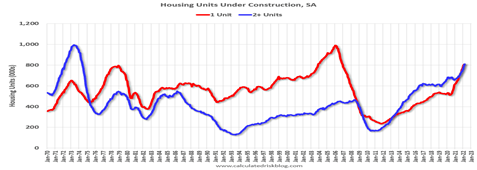
Calculated Risk’s Bill McBride says the most residential units are under construction since 1973, as can be seen in his Calculated Risk graph.

“Combined, there are 1.622 million units under construction. It is the most since February 1973, when a record 1.628 million units were under construction (mostly apartments in 1973 for the baby boom generation).”

And privately‐owned housing starts (new construction) in March of this year were at a seasonally adjusted annual rate of 1,793,000, which should keep builders and homebuyers satisfied for the rest of this year, at least.  

New starts are 0.3 percent above the revised February estimate of 1,788,000 and 3.9 percent above the March 2021 rate of 1,725,000.  Single‐family housing starts in March were at a rate of 1,200,000; this is 1.7 percent below the revised February figure of 1,221,000. The March rate for units in buildings with five units or more was 574,000.

Housing construction should now begin to catch up to demand. Many of the single-family and rental unit completions were held up by supply delays during the pandemic that are finally beginning to ease as the pandemic has eased.

Builder confidence is still high for newly built single-family homes, though it moved two points lower to 77 in April, according to the National Association of Home Builders (NAHB)/Wells Fargo Housing Market Index (HMI) released today. This is the fourth straight month that builder sentiment has declined, but it is still above the 60s index confidence levels that prevailed in earlier decades.

But there are still problems with rising interest rates that makes everything more expensive and knocks many first-time buyers out of the housing market with limited incomes.

“The housing market faces an inflection point as an unexpectedly quick rise in interest rates, rising home prices and escalating material costs have significantly decreased housing affordability conditions, particularly in the crucial entry-level market,” said NAHB Chief Economist Robert Dietz.

Mortgage interest rates have jumped more than 1.9 percentage points since the start of the year and currently stand at 5 percent, the highest level in more than a decade, as can be seen with the FRED graph of historical 30-yr conforming fixed rates. They were as low as 2.5 percent in the past 2 years during the pandemic.

FRED30yrfixed

This is while existing-home sales decreased 2.7 percent between February and March, dropping to a seasonally-adjusted, annual rate of 5.77 million, the National Association of Realtors said Wednesday. It was the second consecutive month in which sales fell. Compared to a year ago, sales were down 4.5 percent.

“The housing market is starting to feel the impact of sharply rising mortgage rates and higher inflation taking a hit on purchasing power,” Lawrence Yun, chief economist for the National Association of Realtors, said in the report. “Still, homes are selling rapidly, and home price gains remain in the double-digits.”

Yun now predicts that home sales will contract by 10 percent in 2022, as surging mortgage rates curb home-buying demand and home-price growth. With slower demand, the inventory of unsold existing homes increased to 950,000 as of the end of March. That would support 2.0 months at the monthly sales pace, which is still way below the 4-6 month supply available, historically.

So, we will depend on the construction of more rental units, apartments, to satisfy the continued demand for housing in years to come, just as we did in the 1970s for the growing population of baby boomers.

Harlan Green © 2021

Follow Harlan Green on Twitter: https://twitter.com/HarlanGreen
Posted in Consumers, COVID-19, Housing, housing market, Weekly Financial News | Leave a comment

What Recession?

Financial FAQs

FREDretailsales

Retail sales are rising 5.5 percent YoY, which is a sign that the economy is still booming, and the possibility of a recession years away. That is, if inflation begins to taper of its own accord, which consumers think it will, despite the Ukraine war-induced sanctions.

Former Treasury Secretary Larry Summers doesn’t think it will, which is why he says a recession is “the most likely thing” partly because the Federal Reserve “is going to have to keep going [in its effort to subdue inflation] until we see disinflation.”

Summers has been the main inflation hawk, whereas Janet Yellen the current Treasury Secretary and past Chair of the Federal Reserve was more upbeat that the U.S. economy could escape a recession as it begins to raise interest rates.

Half of the inflation number is volatile gas prices. Gas sales rose 8.9 percent in the retail report, pushing up gas prices more than 8 percent, while auto sales fell -1.9 percent, signaling that car makers are catching up to demand and car prices moderating.

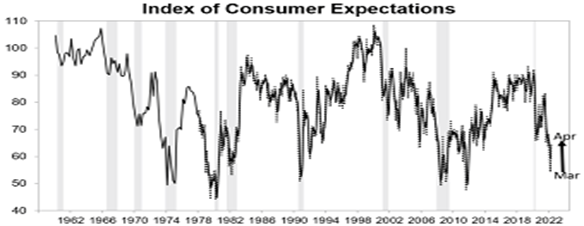
Even though the inflation rate has soared to 8.5 percent, consumers are increasingly optimistic about their future. The University of Michigan’s gauge of consumer sentiment rose in April to 65.7, a more than 10 percent increase from March’s reading of 59.4,

UofMichigan

Consumer Sentiment jumped by a surprising 10.6% in early April, although it remained below January’s reading and lower than in any prior month in the past decade, said the University of Michigan’s press release. Nearly the entire gain was in the Expectations Index, which posted a monthly gain of 18.0%, including a leap of 29.4% in the year-ahead outlook for the economy and a 17.2% jump in personal financial expectations. 

The reason for their increasing optimism was plentiful jobs and rising wages. Consumers under the age of 45 expect a 5.3 percent increase in their wages this year, almost enough to keep up with inflation expectations.

“Consumers still anticipate that the national unemployment rate will inch downward, acting to improve consumers’ outlook for the national economy,” Richard Curtin, the survey’s chief economist wrote. 

U.S. Treasury Secretary Janet Yellen is also more cautiously optimistic than Larry Summers re the inflation outlook. She said on Wednesday the Federal Reserve would need luck and skill to maintain a strong labor market while bringing inflation down, or in economists’ terms to engineer a “soft landing.”

“It has been done in the past. It’s not an impossible combination,” Yellen said, during a talk at the Atlantic Council. Yellen said she was more worried about the prospects of a recession in Europe given the impact of the war in Ukraine than one in the U.S..

Americans anticipated gasoline prices to remain steady over the next year, which is in line with their overall outlook that inflation will moderate, said the sentiment survey. Americans’ expectations for overall inflation over the next year held steady at a 5.4 percent inflation rate in March while expectations for inflation longer term over the next five years has remained at 3.0 percent for many months.

Another reason for optimism concerning a “soft landing” as the Fed begins to raise interest rates, is that industrial production is soaring, which also helps bring down inflation.

The Federal Reserve just reported that industrial production jumped 0.9 percent in March. and February’s gain was revised up to 0.9 percent from the initial estimate of a 0.5 percent increase. For the first quarter, output was up at an 8.1 percent annual pace, with the output of motor vehicles and parts up 7.8 percent in March.

Supply chains are beginning to catch up to demand, another reason that inflation may moderate, and consumers’ optimism is warranted. But it will require considerable  “luck and skill” to avoid a recession, as well as a favorable outcome to the war in Ukraine.

Harlan Green © 2022

Follow Harlan Green on Twitter: https://twitter.com/HarlanGreen
Posted in Consumers, COVID-19, Economy, Weekly Financial News | Leave a comment

What Is the New Normal?

Popular Economics Weekly

FREDcpi

What will the future look like with the COVID-19 pandemic about to end, and a possible new cold war with Russia just beginning? It is a time when governments come to the rescue. We’ve seen it happening with the demise of COVID-19 due to the development of miraculous vaccines that only governments can research and fund.

But it also means consumers have been given more money to spend, which has resulted in the highest monthly inflation numbers since 2005.

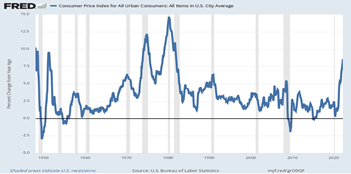
The consumer price index jumped 1.2% last month, driven by the higher cost of gasoline, food and housing,  the government said Tuesday. It was the largest monthly gain since Hurricane Katrina in 2005 and resulted in the highest annual increase in 40 years, crimping the spending of consumers and investments of producers.

Scary as that may be, the FRED graph shows that it has been higher in 1974 and 1980 during the Arab oil embargos when it rose to 14 percent, per the FRED graph. Inflation is also happening with commodities such as wheat and oil because of the sanctions against Russia for invading Ukraine and threatening the West with nuclear weapons if NATO interfered with Putin’s wholesale destruction of another country.

We are also seeing how the EU, US and Japanese governments have come together to aid Ukraine. But all of this takes lots of money, which only governments can spend, as I said. It took $trillions to vanquish the pandemic, and we see with the proposed 2022-23 fiscal year budget of $5.8 trillion what must be done to keep the US on a strong growth path.

It really means the transfer of more wealth from the private sector via higher taxes to pay for programs that promote more jobs and protect Americans from economic disruptions that may be caused by the Ukraine war.

For instance, the proposed budget includes a so-called “billionaire tax” that would apply a minimum tax rate of 20 percent to both the income and unrealized capital gains of households with a net worth over $100 million. The tax is projected to raise $360 billion over 10 years — more than half of it from billionaires that have prospered the most since the Great Recession of 2007-09.

To emphasize that wealthy Americans can afford higher taxes, the Times interviewer mentioned that some 130 new American billionaires were created just from 2020 to 2021.

French economist Thomas Piketty, author of the best-selling Capital in the Twenty-First Century, and sure to be a future Nobel Prize-winner in Economics, stated recently in a NY Times Magazine interview, “…the period of maximum prosperity of the U.S. economy in the middle of the century was a period where you had a top income tax rate of 90 percent, 80 percent, and this was not a problem because income gaps of 1 to 100 and1 to 200 are not necessary for growth.”

The income gaps have risen to more than 300 to 1 for CEOs vs. their employees during the 1980s as inequality levels grew to what they are today. We cannot possibly pay for the programs needed to protect Americans if such levels of inequality continue. That is already happening with the 5.6 percent annual rise in average hourly wages, with transportation, leisure and retail trade employees’ average wages rising even faster, as we said last week.

I said last week that now isn’t the time to worry about inflation or the Fed engineering a soft landing, or any ‘landing’ at all. It is precisely during such uncertain times that we need elevated growth and a government that steps up, while partisan politics step down, even with an upcoming election in November.

Harlan Green © 2022

Follow Harlan Green on Twitter: https://twitter.com/HarlanGreen
Posted in COVID-19, Economy, Weekly Financial News | Leave a comment

What Stagflation?

Financial FAQs

TradingEconomics

U.S. service sector activity that powers two-thirds of economic activity above graph) is surging more than ever, according to the Institute of Supply Management non-manufacturing survey. It is growing per 58.3 percent of managers surveyed, with the index for employment and new orders even higher. New orders rose 4 points to 60.1 percent, and production activity also edged higher.

“In March, the Services PMI® registered 58.3 percent, a 1.8-percentage point increase compared to the February reading of 56.5 percent. The 12-month average is 62.3percent, which reflects consistently strong growth in the services sector. The March reading indicates the services sector grew for the 22nd consecutive month after two months of contraction and 122 months of growth before that. A reading above 50 percent indicates the services sector economy is generally expanding; below 50 percent indicates the services sector is generally contracting.”

So this doesn’t look like impending stagflation, the wage-price spiral that happened in the 1970s and pushed inflation to record highs, while growth came to a standstill.

Pundits and some banks that forecast a future wage-price spiral seem to have forgotten that it took consecutive Arab (OPEC) oil embargos in the 1970s causing gasoline shortages and long lines at gas stations for almost a decade to make that happen.

Whereas the Ukraine war and its concomitant sanctions are less than two months old. Why should we even be worrying about prolonged inflation, and what the Fed might do to tame it, when we don’t know whether this war will last for months, or years, and what will be needed to win it?

Predictions of a looming recession are premature, so say the least. Both the service and manufacturing sectors are booming, while supply chains are struggling to catch up and replenish inventories.

This is while the jobs market is red hot with more returning to work. New U.S. jobless claims matched a 54-year low of 166,000 in early April, for instance — the second lowest reading in history— during a period of remarkably strong hiring and the lowest layoffs on record.

The ISM’s service sector employment index increased to 54% from 48.5%. Businesses got no relief from inflation, however. The prices-paid index moved up to 83.8% from 83.1%, just a tick below a record high.

What will help to tame the inflation tiger? More workers returning to work will increase production, replenishing inventories. And governments will be increasing their spending, as well, due to the Ukraine war. This will stimulate further production increases.

MarketWatch columnist Jeffry Bartash maintains what was called the “Great Resignation” is over, a time since the pandemic when workers were reluctant to return to work.

“To be sure, Americans have been saying “I quit” in record numbers,” said Bartash. “Almost 57 million people left jobs — many more than once — in the 14-month period from January 2021 to February 2022. That’s a 25% spike vs. a similar time span before the pandemic.”

The hiring wave began more than a year ago. The U.S. added 431,000 new jobs in March, the government said last week, extending a streak of large job gains going back to the start of 2021. The unemployment rate also sank to 3.6 percent last month — just a tick above a 53-year-low — from nearly 15 percent just two years ago.

“All of the hiring took place against the backdrop of high covid cases and the reluctance of millions of formerly employed people to return to the labor market. Hiring might have taken place even faster, economists say, if the pandemic had petered out and generous government unemployment benefits were ended sooner,” continued Bartash.

So maybe we can endure a bit more inflation if the red hot demand that’s causing it is bringing more people into the workforce and helping Ukraine to win its war?

Harlan Green © 2022

Follow Harlan Green on Twitter: https://twitter.com/HarlanGreen

Posted in Consumers, COVID-19, Economy, Weekly Financial News | Leave a comment

Tapestry

“Tapestry”

Every thread of creation is held in position
by still other strands of things living.
In an earthly tapestry hung from the skyline
of smouldering cities so gray and so vulgar,
as not to be satisfied with their own negativity
but needing to touch all the living as well.

Every breeze that blows kindly is one crystal breath
we exhale on the blue diamond heaven.
As gentle to touch as the hands of the healer.
As soft as farewells whispered over the coffin.
We’re poisoned by venom with each breath we take,
from the brown sulphur chimney and the black highway snake.

Every dawn that breaks golden is held in suspension
like the yoke of the egg in albumen.
Where the birth and the death of unseen generations
are interdependent in vast orchestration
and painted in colors of tapestry thread.
When the dying are born and the living are dead.

Every pulse of your heartbeat is one liquid moment
that flows through the veins of your being.
Like a river of life flowing on since creation.
Approaching the sea with each new generation.
You’re now just a stagnant and rancid disgrace
that is rapidly drowning the whole human race.

Every fish that swims silent, every bird that flies freely,
every doe that steps softly.
Every crisp leaf that falls, all the flowers that grow
on this colourful tapestry, somehow they know.
That if man is allowed to destroy all they need.
He will soon have to pay with his life, for his greed.

Posted in Uncategorized | Leave a comment

Strong Job Growth Continues

Popular Economics Weekly

MarketWatch

The unemployment rate slid to 3.6 percent in March from 3.8 percent in February, the government said Friday. The big news was that with an additional 431,000 nonfarm payroll jobs added in March, a total of 2.273 million jobs have been created over the past four months. This is the fastest payroll increase since 1939.

I find little that foretells trouble ahead in the Labor Department’s survey. Job growth is surging, and this will help bring down inflation because more people are returning to work, so more will be produced, easing supply-chain worries.

Rising wages are also helping consumers—the annual average is up 5.6 percent—since most of the wage increase is for service workers that need it the most.

MarketWatch’s Andew Keshner listed those sectors where wages rose faster than the inflation rate:

  • In transportation and warehousing jobs, the year-over-year growth rate in hourly earnings was 7.9%. Paying an average hourly rate of $27.79, these workers have been much-needed with e-commerce sales booming and supply chains trying to unsnarl.
  • In leisure and hospitality jobs, the year-over-year growth was even higher, at 11.8%. Hotels, restaurants and bars kept staffing up, accounting for roughly one-quarter of all the March jobs gains and paying an average $19.68 an hour in March.
  • Jobs in retail trade saw 6.5% average hourly earnings growth, paying an average $22.89 per hour. This sector includes work in everything from grocery stores to gas stations, clothing, hardware and more.
  • Jobs in “professional and business services” had a 6.6% increase, paying an average $38.18 an hour. In March, this sector — covering all sorts of white-collar work from accountants and lawyers to call centers and administrative staff — added 102,000 jobs.

Calculated Risk

It has been one of the fastest recoveries since the 1981 recession per Calculated Risk’s graph (red line on graph), despite the one-month-old Ukraine war. The U.S. economy was going strong before the pandemic and has almost returned to its pre-pandemic level of February 2020; in part because the recession lasted just two months—March to April 2020.

We are already seeing what a ‘new normal’ might look like in the years to come. Government has had to step up spending to tame the pandemic, just as it did during Roosevelt’s New Deal to recover from the Great Depression. Now, President Biden’s proposed $5.8 trillion budget for the 2023 fiscal year must address what might become a prolonged European war.

“Budgets are statements of values, and the budget I am releasing today sends a clear message that we value fiscal responsibility, safety and security at home and around the world, and the investments needed to continue our equitable growth and build a better America,” said President Biden on its release.

Now isn’t the time to worry about inflation or the Fed engineering a soft landing, or any ‘landing’ at all. It is is precisely during such uncertain times that we need elevated growth, and a government that steps up while partisan politics step down, even with an upcoming election in November.

Harlan Green © 2022

Follow Harlan Green on Twitter: https://twitter.com/HarlanGreen

Posted in Consumers, COVID-19, Economy, Keynesian economics, Politics, Weekly Financial News | 3 Comments

Consumers Still Optimistic (Long-Term)

Popular Economics Weekly

What should we be looking for in Friday’s upcoming unemployment report? We hope that the torrid hiring pace—1.7 million nonfarm payroll jobs created in just the last three months—will continue a bit longer, despite the Ukraine invasion and high inflation that might cause consumers to cut back on their spending ways.

Calculated Risk

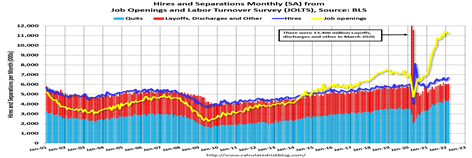
Tuesday’s JOLTS survey of available jobs reported there were still 11.3 million job openings. Hires edged up to 6.7 million while total separations were little changed at 6.1 million. The number of job openings (yellow) were up 43% year-over-year, a very good sign. 

This should tell us there will be a strong official employment number Friday, because so-called quits were up 27% year-over-year, which is a sign that workers are finding better jobs. These are voluntary separations. (See light blue columns at bottom of graph for trend for “quits”).

How much longer will inflation be a problem with the Ukraine invasion and soaring gas prices? The two major consumer confidence indexes give us a hint of what inflation level consumers are expecting. But there’s a difference in their thinking—short term pessimism that inflation is too high vs. long term optimism that it will come back down. This is one read that says consumers are expecting the U.S. economy longer term is going in the right direction.

Conference-Board.org

The Conference Board’s monthly confidence survey was the most upbeat.

“Consumer confidence was up slightly in March after declines in February and January,” said Lynn Franco, Senior Director of Economic Indicators at The Conference Board. “The Present Situation Index rose substantially, suggesting economic growth continued into late Q1. Expectations, on the other hand, weakened further with consumers citing rising prices, especially at the gas pump, and the war in Ukraine as factors. Meanwhile, purchasing intentions for big-ticket items like automobiles have softened somewhat over the past few months as expectations for interest rates have risen.”

The ‘other’, University of Michigan consumer sentiment survey was not so upbeat. It said its respondents think inflation will remain high over the next year but come down to a more normal level over the next 5 years.

“Consumer Sentiment remained largely unchanged in late March at the same diminished level recorded at mid-month,” said U of Michigan chief economist Richard Curtin. “Inflation has been the primary cause of rising pessimism, with an expected year-ahead inflation rate at 5.4%, the highest since November 1981.”

The difference in short and long term outlooks is remarkable and why the Federal Reserve believes higher inflation is transitory, based more on a shortage of products rather than soaring wage inflation, which would be a sign of the dreaded stagflation that occurred during the 1970s.

So, should policy makers be worried more about the short-term, rather than long-term inflation outlook?

Worrying too much about near term trends can lead to hasty actions, like raising interest rates prematurely to restrict available credit when there’s the possibility of a prolonged war in the Ukraine and we need markets to be as liquid as possible to weather the storm.

Harlan Green © 2022

Follow Harlan Green on Twitter: https://twitter.com/HarlanGreen

Posted in Consumers, COVID-19, Economy, Politics, Weekly Financial News | Leave a comment

A Soft Landing For Energy?

Financial FAQs

eia.gov

Should Americans worry about the price of gas and oil in coming months because of Russia’s invasion of Ukraine? And might it ultimately cause a recession if energy prices remain elevated?

That is what some economists seem to believe, such as former Treasury Secretary Larry Summers.

Professor Summers in a recent Wash Post Op-ed, said “I believe the Fed has not internalized the magnitude of its errors over the past year, is operating with an inappropriate and dangerous framework, and needs to take far stronger action to support price stability than appears likely. The Fed’s current policy trajectory is likely to lead to stagflation, with average unemployment and inflation both averaging over 5 percent over the next few years — and ultimately to a major recession.”

Yet the current unemployment rate is 3.8 percent, and more that 1,747,000 jobs created over just the past three months, so it’s hard to imagine a recession is anywhere on the horizon, unless the Ukraine invasion turns into something more.

In fact, our current inflation surge is due to our very robust economic growth, more than 3 percent above the prepandemic level, and at a 40-year high.

The U.S. Energy Information Agency says we have plenty gas and oil reserves, in fact a surplus which we can export to the EU, if necessary, to help maintain the sanctions until Putin cries Uncle on his Tsarist fantasy of a greater Russian empire.

“After record-high U.S. energy production and consumption in 2018, energy production grew by nearly 6% in 2019 while energy consumption decreased by about 1%, with production exceeding consumption on an annual basis for the first time since 1957. Total energy production declined by about 5% in 2020 but was still about 3% greater than consumption: production equaled 95.75 quads and consumption equaled 92.94 quads.”

Unfortunately, we are still over dependent on fossil fuels: “petroleum, natural gas, and coal—accounted for about 79% of total U.S. primary energy production in 2020,” said the USEIA.

It is leading to prolonged inflation for American drivers and is worrying Fed Chair Jerome Powell in his latest congressional hearings. So he is now sounding more hawkish re the need to raise interest rates faster.

“We will take the necessary steps to ensure a return to price stability. In particular, if we conclude that it is appropriate to move more aggressively by raising the federal funds rate by more than 25 basis points at a meeting or meetings, we will do so,” Powell said in a speech to the National Association for Business Economics.

So who is right, Summers or a prolonged trajectory of U.S. economic growth?

Nobelist Paul Krugman gets the last word in a recent NY Times Op-ed: “We recovered fast from the pandemic recession and seem to have avoided the long-term “scarring” effects that many feared. Most though not all of the inflation we’re experiencing reflects probably temporary global forces, and multiple indicators — consumer surveys, professional forecasters and financial markets — suggest that longer-term expectations of inflation remain “anchored,” that is, inflation isn’t getting entrenched in the economy.”

I believe we shouldn’t overlook the newfound unity of western, democratic nations that oppose Putin’s wars. How long can Putin and Russian citizens tolerate their economy reverting back to the size it was in 1980, as Daleep Singh, one sanctions expert interviewed on the TV news show Sixty Minutes put it?

Harlan Green © 2022

Follow Harlan Green on Twitter: https://twitter.com/HarlanGreen
Posted in Consumers, COVID-19, Economy, Politics, Weekly Financial News | Leave a comment

Home Sales Playing Catchup

The Mortgage Corner

Rising interest rates are slowing housing sales, with interest rates up more than one percent since last year, though still in the affordable range.This is while inventories can’t keep up with the red-hot demand from home buyers.

“Total housing inventory at the end of February totaled 870,000 units, up 2.4% from January and down 15.5 percent from one year ago (1.03 million). Unsold inventory sits at a 1.7-month supply at the current sales pace, up from the record-low supply in January of 1.6 months and down from 2.0 months in February 2021,” said Calculated Risk’s Bill McBride.

The combination of record demand and record low interest rates since 2018 (see below FRED Graph) has caused prices to soar in double digits, making home buying less affordable for many first-time home buyers and exacerbating the housing shortage.

FRED30yrfixed

However, the 30-year conforming fixed rate is still at 4.0 percent, and 4.25 percent for super-conforming 30-year fixed, which means financing is still affordable for middle-class households.

Fixed rates began their decline below 6 percent at the end of the Great Recession and housing bubble (gray bar in graph) thanks mainly to former Fed Chair Ben Bernanke’s QE policy of purchasing Treasury and mortgage-backed securities.

The Fed is now reversing that policy to combat inflation, hence the rising interest rates. And builders aren’t yet catching up to demand because too few homes have been built since the end of the housing bubble and Great Recession.

FRED/Calculated Risk

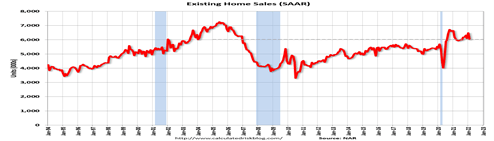
This is while existing-home sales dipped in February, continuing a seesawing pattern of gains and declines over the last few months, according to the National Association of Realtors®, though they have remained above 6 million annual units. The last time sales reached 6 million annual units was during the housing bubble 2004-2007 when sales were as high as 7 million housing units, per Calculated Risk’s graph.

Total existing-home sales,1 https://www.nar.realtor/existing-home-sales, completed transactions that include single-family homes, townhomes, condominiums and co-ops, sank 7.2% from January to a seasonally adjusted annual rate of 6.02 million in February. Year-over-year, sales decreased 2.4% (6.17 million in February 2021).

“Housing affordability continues to be a major challenge, as buyers are getting a double whammy: rising mortgage rates and sustained price increases,” said Lawrence Yun, NAR’s chief economist. “Some who had previously qualified at a 3% mortgage rate are no longer able to buy at the 4% rate.”

Home builders are working hard to catch up to demand, and now have the most homes under construction since 1973, according to Bill McBride’s Calculated Risk Newsletter.

McBride asserts with 4% 30-year mortgage rates, “…we will likely see a slowdown in both new and existing home sales (based on previous periods of rising rates). It also seems likely house price growth will slow. However, the impact on inventory is unclear.

So rising interest rates will slow down this red-hot housing market, but until inventories return to a more normal 4-6 months of supply (from the current 1.7 months), inventories won’t catch up to the demand for housing and significantly moderate prices.

Harlan Green © 2021

Follow Harlan Green on Twitter: https://twitter.com/HarlanGreen

Posted in Consumers, COVID-19, Housing, housing market, Weekly Financial News | Leave a comment

Retail Sales Slow, But Will Inflation?

Popular Economics Weekly

FREDretailsales

How much longer will inflation be a problem, even with the Ukraine invasion and soaring gas prices? Retail sales can tell us something about inflation because it powers a major part of economic activity.

February retail sales increased just 0.3 percent, after rising 4.9 percent in January, because consumers cut back on spending. This is what consumers tend to do when things get more expensive, which helps to bring down overall inflation.

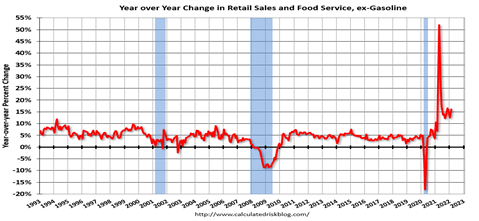
Retail sales have risen 15.9 percent YoY, as consumers with lots of savings have been demanding more than supply-chains can provide, hence the soaring inflation rate of late. But, sure enough, once consumers felt pinched, they cut back in February, which should cause inflation to fall below the current 7.5 percent annual rate that is making everything more expensive.

In fact, the wholesale Producer Price Index of materials that go into finished products in the Consumer Price Index has weakened. The so-called core rate without surging gas and auto prices rose just 0.2 percent in February, the lowest climb in 15 months, which might be a sign that supply chains are opening up.

This should also dampen speculation of an abrupt halt to economic growth, which some pundits believe will occur because the Fed is beginning to raise interest rates at the same time as the Ukraine invasion sanctions on everything Russian-owned are also boosting commodity prices.

Consumers believe prices will continue to rise sharply over the next year, which should continue to restrain spending, with inflation averaging 6 percent, according to a survey by the New York Federal Reserve. That’s up from 5.8 percent in January and matches the highest level on record.

But median three-year ahead inflation expectations ticked up just 0.3 percentage point to 3.8 percent, while remaining below its November and December 2021 levels of 4.2 percent and 4.0 percent, per the NY Fed

So how could the incoming sanctions bring on another recession, so soon after the pandemic recovery? Former Treasury Secretary Larry Summers believes the Federal Reserve has waited too long to raise interest rates, and so must now overreact to play catch up and bring down soaring inflation, but also halt economic growth. And Canadian economist David Rosenberg believes Fed Chair Powell will turn into another Paul Volcker, who raised interest rates into double digits in the early 1980s that brought on two recessions.

However, I am in former Fed Chair Ben Bernanke’s camp, who successfully led us out of the Great Recession in 2009 by not raising interest rates too quickly, and in fact increased liquidity for businesses and individuals with the various Quantitative Easing programs while keeping inflation in the 2 percent range.

So who is right? Should we be tightening credit with the looming commodity shortages and even higher prices? I don’t think so, as it only lessens demand rather than stimulates the supply side shortage that is the core problem.

We must find replacements for the loss of Russian oil and commodities, such as wheat and corn. It means following Ben Bernanke’s lead by keeping interest rates low to give consumers and businesses the cushion they will need to weather the latest economic storm

Harlan Green © 2022

Follow Harlan Green on Twitter: https://twitter.com/HarlanGreen

Posted in Consumers, COVID-19, Economy, Weekly Financial News | Leave a comment