U.S. Economy Resumes Growth in Q2

Popular Economics Weekly

The panic selling in financial markets of late is in part because first quarter 2022 GDP growth contracted after last year’s huge 5.6 percent growth surge, triggering worries of an imminent recession.

The U.S. economy shrank by a 1.5 percent annual rate in Q1, new government figures show, largely because of a record trade deficit. And corporate profits fell for the first time in five quarters.

But corporate profits are still at record levels, up 12.5 percent YoY, and GDP is still growing 10.5 percent annually. So quarterly statistics that financial markets follow can fluctuate wildly, which isn’t very helpful in looking at longer term trends.

BEA.gov

The BEA attributes the first quarter decline in GDP to temporary factors and most economists predict a second quarter resumption in economic activity.

“In the first quarter, an increase in COVID-19 cases related to the Omicron variant resulted in continued restrictions and disruptions in the operations of establishments in some parts of the country,” said the BEA. “Government assistance payments in the form of forgivable loans to businesses, grants to state and local governments, and social benefits to households all decreased as provisions of several federal programs expired or tapered off.”. 

In fact, the non-partisan Congressional Budget Office (CBO) that ‘scores’ current legislation for its effect on economic activity said U.S. economic growth will exceed 3 percent in 2022, while “roaring inflation has topped and will cool each month to around 2 percent by some point in 2024,” according to a government forecast published Wednesday.

The CBO estimated that real gross domestic product, or GDP, will be driven by consumer spending and demand for services, according to the report. It revised its estimates for GDP growth in 2023 and 2024 upward to 2.2 percent and 1.5 percent, respectively.

“In CBO’s projections, the current economic expansion continues, and economic output grows rapidly over the next year,” the CBO said in its report. “To fulfill the elevated demand for goods and services, businesses increase both investment and hiring, although supply disruptions hinder that growth in 2022.”

One reason the CBO has become more optimistic about stronger growth—the shrinking budget deficit from the increased activity.

The U.S. budget deficit will shrink dramatically to $1.036 trillion for fiscal 2022 from $2.775 trillion last year as a strong recovery prompts a surge in revenues and lower outlays, but slowing growth will start to reverse the trend due to higher inflation and rising interest rates, the Congressional Budget Office said.

FREDcorpprofits

U.S. corporations are making record profits as a percentage of GDP—in fact, the highest profits since World War Two, per the St Louis FRED historical graph from 1950 that I discussed in my last blog. During the pandemic it dropped briefly to 8 percent of GDP, but quickly rose to its current 11.2 percent, the best on record.

And consumers are still shopping as if there’s no tomorrow, so the saying goes, that make up some 70 percent of economic activity. So once again, why should investors be held hostage by shorter-term, quarterly projections that only become valid over the longer term, anyway?

Harlan Green © 2022

Follow Harlan Green on Twitter: https://twitter.com/HarlanGreen

Posted in Consumers, COVID-19, Economy, Weekly Financial News | 1 Comment

Leading Indicators Show Moderate Growth

Popular Economics Weekly

ConferenceBoardLEI

The Conference Board Leading Economic Index® (LEI) for the U.S. decreased by 0.3 percent in April to 119.2 (2016 = 100), following a 0.1 percent increase in March. (But) The LEI is now up 0.9 percent over the six-month period from October 2021 to April 2022.

Not many economists cite the Conference Board’s Index of Leading Economic Indicators (LEI) that are good at predicting future economic activity. It’s much better than the projected earnings estimates Wall Street traders tend to follow who are pressing the panic button that a recession in imminent.

So why the current doom and gloom with corporations still making record profits and unemployment at record lows?

The LEI is a good predictor of recessions as the above graph shows, with gray bars indicating past recessions and the LEI’s immediate up trend at the end of each recession.

“The US LEI declined in April largely due to weak consumer expectations and a drop in residential building permits,” said Ataman Ozyildirim, Senior Director of Economic Research at The Conference Board…A range of downside risks—including inflation, rising interest rates, supply chain disruptions, and pandemic-related shutdowns, particularly in China—continue to weigh on the outlook. Nevertheless…The Conference Board still projects 2.3 percent year-over-year US GDP growth in 2022.”

FREDcorpprofits

U.S. corporations are making record profits as a percentage of GDP—in fact, the highest profits since World War Two, as the St Louis FRED historical graph from 1950 shows. During the COVID pandemic it dropped briefly to 8 percent of GDP, but quickly rose to its current 11.2 percent, the best on record.

And because corporations made record profits over the past year, earnings growth will slow to more historical levels this year, as the law of averages requires. So rather than focus on quarterly trends (i.e., short-term profits), serious investors and fund managers need to focus on the long term, when their investors approach retirement age.

U.S. economic growth must also come down from its 5.6 percent high last year when consumers and businesses burst out of the pandemic; essentially starting from a ground zero of economic shutdowns during March-April 2020.

The flood of new money from the $trillions in aid and record rescue packages have goosed that growth, causing the current inflationary surge. But such spending and inflation will also slow for the same reason.

Prices had stalled at ground zero back then, even fallen into negative territory. So, the law of averages rules once again—demand will slow from its artificially boosted high, while supplies will catch up from their artificially-induced scarcities.

Fed Chair Powell has been attempting to tell us that in his latest press conferences, so why won’t the financial markets believe him? Settling for moderate growth means sustainable longer term growth.

Harlan Green © 2022

Follow Harlan Green on Twitter: https://twitter.com/HarlanGreen
Posted in Consumers, COVID-19, Economy, Macro Economics, Weekly Financial News | Leave a comment

Booming Retail Sales Belie Recession Worries

Financial FAQs

FREDretailsales

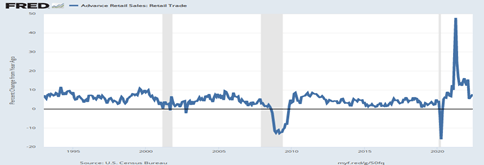
The St Louis Federal Reserve graph of April retail sales tells us more than a thousand words that there is no imminent recession. Maybe not even next year either, because consumers continue to shop, with auto sales up 2.2%, restaurants and bar sales up 2% in the month.

Gas station sales were down -2.7% because gas prices eased during a war that is about energy supplies. Consumers are shopping as if there is no war or another COVID scare., or supply shortages

The gray bar in the graph is the very short March-April 2020 recession. Consumers have ignored the pundits and doom-sayers since then, ans the inflation hawks that said consumers wouldn’t continue to boost economic growth, which now looks to be on the upswing after the Q1 plunge in Gross Domestic Product.

Sales at U.S. retailers rose a huge 0.9% in April. And the increase in sales in March, was raised to 1.4% from an original 0.7%, the government reported Tuesday.

What does the surge in auto sales and leisure activities tell us? There’s a lot of pent up demand from Americans that don’t want to stay at home any longer with jobs plentiful and salaries surging. Why should they?

Consumers also seem to be ignoring their own consumer confidence surveys, which say they are pessimistic about the future. Both the Conference Board and University of Michigan indexes have been trending downward, of late, because of the fears of rising inflation.

“Consumer sentiment declined by 9.4% from April, reversing gains realized that month,” said Richard Curtin, Director of the U. of Michigan survey. “These declines were broad based–for current economic conditions as well as consumer expectations, and visible across income, age, education, geography, and political affiliation–continuing the general downward trend in sentiment over the past year.”

The Conference Board’s was more in line with actual behaviors. ““Consumer confidence fell slightly in April, after a modest increase in March,” said Lynn Franco, Senior Director of Economic Indicators at The Conference Board. “The Present Situation Index declined, but remains quite high, suggesting the economy continued to expand in early Q2. Expectations, while still weak, did not deteriorate further amid high prices, especially at the gas pump, and the war in Ukraine.”

But both surveys don’t seem to reflect the ebullient behavior of actual consumers. So once again, we have to take any survey with that grain or two of salt by looking at actual behavior.

We are at a classic top of the business cycle when the demand for products and services is sky high and all the factors that restrict supply are causing red hot inflation numbers, as I said last week.

That hasn’t changed, but with summer and vacation travel looming, it doesn’t look like consumers are bothered by rising prices. That could change, of course, as the Fed begins to raise interest rates further.

So why are consumers misbehaving, ignoring their own sentiment surveys? The most obvious answer is we are at full employment and salaries are rising, as I said.

The unemployment rate remained unchanged at 3.6 percent and 428,000 more jobs were created in April, according to the US Labor Dept. so no real sign of weakening employment, one of the first signs of a recession. Industrial production and business investments are also high and show little signs of slowing.

Recessions take a long time to happen, I also said last week, so we need to read what consumers do, if we want to know more, rather than what they say.

Harlan Green © 2022

Follow Harlan Green on Twitter: https://twitter.com/HarlanGreen

Posted in Consumers, COVID-19, Economy, Weekly Financial News | Leave a comment

What Really Caused This Terrible Inflation?

Popular Economics Weekly

FREDcpiindex

The St Louis Federal Reserve graph tells us what is going on with April’s plunge in the Consumer Price Index. It’s due to a moderation of soaring gas prices. But food, shelter, and supply shortages haven’t moderated that have also pushed prices higher.

So, how long will such inflation persist that is terrifying everyone?

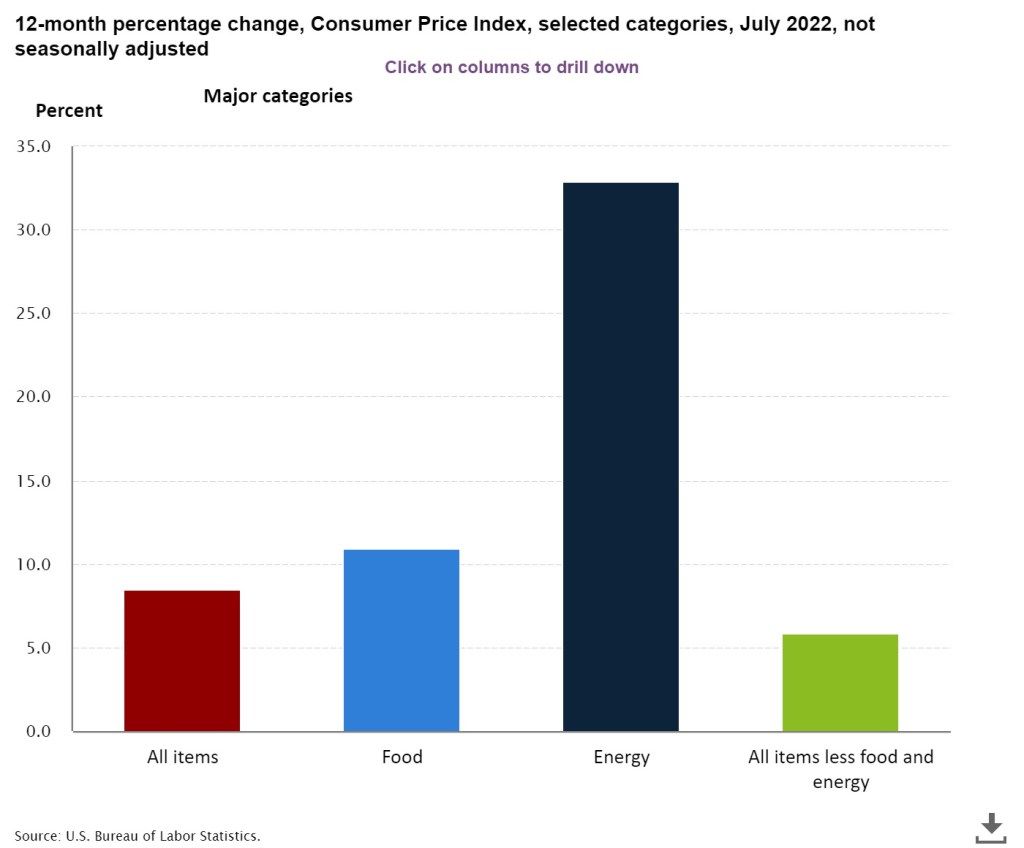
The consumer price index rose just 0.3 percent last month, the government said Wednesday, matching the smallest increase in eight months. The yearly rate of U.S. inflation fell to 8.3 percent in April to mark the first decline in eight months.

Grocery prices have increased 10.8 percent in the past year, the biggest surge since 1981.The cost of rent and housing both rose sharply again in April and helped explain the big increase in the core rate of inflation.

Over the past year the cost of shelter has climbed 5.1 percent to mark the largest gain in 40 years. Shelter costs account for a third or more of a typical household budget. There are shortages everywhere, and such so-called ‘supply shocks’ are the cause of soaring inflation, mainly caused by the pandemic. Another ‘supply shock’ has been the reluctance of workers to return to work after the pandemic, causing a slowdown in production.

One year ago prices were at rock bottom, as were interest rates. Today, the demand by consumers and businesses (flush with cash and cheap loans) for goods and services has gotten ahead of supply chains, in other words. But sooner or later supply will catch up as businesses recover from the pandemic, and demand will slow because rising prices cause spending to slow.

So, is this panic time for the Fed to be jacking up interest rates drastically? No, as I said recently. The Ukraine war and China’s COVID are adding to the supply shocks as well, which is another temporary phenomenon.

Too much government aid that is putting too much money in consumers’ pockets is the conservative answer to bring down inflation, which means they really want to cut back on government spending, in spite of the voting for all the aid packages, including the latest infrastructure bill that will create more high wage jobs.

It is the wrong thing to do at this time, since more government spending is spurring higher production, as well. That’s why Fed Chair Powell said recently he was confident that just two rate hikes of 50 basis points each should be enough to slow inflation for the rest of this year. It should also tame fears about future rate increases, by assuring their predictability.

It also looks like the cost of wholesale goods and services has also peaked, as it rose a milder 0.5% in April vs the prior month. In March, wholesale prices had jumped 1.6% largely because of a surge in oil prices. The increase in wholesale prices over the past year, meanwhile, slowed to 11% from 11.5%, the government said Thursday.

So why the sudden recession fears? Such fears defy both logic and history. Serious recessions take a long time to manifest, as I also said recently.

It took two years under Chairman Greenspan to ring on a recession. The Fed raised its rates 16 times over that term after holding rates below the inflation rate for too long in early 2000, causing the Great Recession. The so-called stagflation wage-price spiral of the 1970s was 10-year period when energy prices soared. That took more years and multiple recessions before Fed Chair Volker brought down inflation by raising interest rates into the double digits.

No one wants that to happen now, of course. Even more important is the recovery from a lingering pandemic, and aiding Europeans in winning their war in Ukraine. Russia is in many ways a failed state with a steadily shrinking economy, a massive brain drain of its best and brightest, and a dictator who believes he is reviving a Czarist Empire from another century.

The world’s economies are still rehabilitating and the patient will require considerable longer term care to bring it to a full recovery.

Harlan Green © 2022

Follow Harlan Green on Twitter: https://twitter.com/HarlanGreen

Posted in Consumers, COVID-19, Economy, Weekly Financial News | Leave a comment

Why Call A Recession Now??

Popular Economics Weekly

NBER.org

We are at a classic top of the business cycle when the demand for products is sky high and all the factors that restrict supply are causing red hot inflation numbers. The Federal Reserve then must per its mandate to balance employment with price stability step in to restrict credit by raising short-term interest rates, among other measures.

What happens next will determine how high the Fed pushes interest rates to ‘tame’ the inflation tiger, and whether it causes another recession.

What the pundits who predict such things seem not to keep in mind is there are many parts that make a recession, which take a lot of time to happen (see wide spacing between gray bars that indicate recessions in NBER employment graph.).

For instance, there was no recession between 1983 to 1991, and a record 10-year expansion from 1991 to 2001.

The National Bureau of Economic (NBER) is the actual arbiter of recessions, and it says: “The determination of the months of peaks and troughs is based on a range of monthly measures of aggregate real economic activity published by the federal statistical agencies.”

Most of the indicators, including employment, consumer spending and industrial production, don’t indicate much of an impending slowdown.

MarketWatch

The unemployment rate remained unchanged at 3.6 percent and 428,000 more jobs were created in April, according to the US Labor Dept., so no real sign of weakening employment, one of the first signs of a recession. Industrial production and business investments are also high and show little signs of slowing. Consumer spending is red hot and may suffer most from rising interest rates.

But the real test will be if many of the supply chain shortages can be circumvented, from chip makers who failed to predict the soaring demand for motor vehicles, to a war in Ukraine causing food shortages. And we still have the tail end of the coronavirus pandemic affecting China, a supplier of much of the world’s cheap products.

Under Chairman Greenspan, the Fed raised its rates 16 times over two years, after holding rates below the inflation rate for too long in early 2000, causing in part the housing bubble while allowing the negative interest ‘liar’ mortgages that brought down Lehman Brothers and caused the Great Recession.

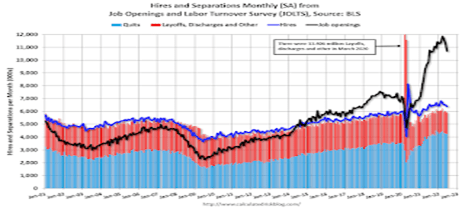
And the number of job openings is at a series high of 11.5 million on the last business day of March, although little changed over the month, the U.S. Bureau of Labor Statistics reported on Tuesday. Hires, at 6.7 million, were also little changed while total separations edged up to 6.3 million.

So recessions take a long time to happen, in general, and there are much more important priorities now, including aiding Ukraine in its war with Russia and continuing to fight the pandemic.

Harlan Green © 2022

Follow Harlan Green on Twitter: https://twitter.com/HarlanGreen

Posted in Consumers, COVID-19, Economy, Weekly Financial News | Leave a comment

What Recession–Part II

Financial FAQs

Orders for U.S. durable goods—long-lasting goods such as computers and cars rose in March, and business investment rebounded after the first decline in a year, signaling that the U.S. economic activity is still on a growth path, despite the Ukraine invasion and record inflation. Who knows what will happen with energy prices?

Orders advanced for the sixth time in the last seven months. What’s more, the initially reported 2.2 percent decline in new orders in February was revised to show a smaller 1.7 percent drop, the government said Tuesday.

Businesses are investing more (see graph) because they are upbeat about future growth.

FREDBusinessinvestment

And inflation may be peaking with the Federal Reserve’s preferred inflation gauge—the PCE index. Over the past 12 months, the personal consumption price index has climbed 6.6 percent, up from 6.4 percent in February, the government said Friday. That’s the steepest increase since 1981.

Yet a narrower measure of inflation that omits volatile food and energy costs, known as the core PCE, rose by just 0.3 percent in March for the second month in a row. That matched the Wall Street forecast. What’s more, the rate of core inflation in the past year slipped to 5.2 percent from 5.3 percent, marking the first month-to-month decline in more than a year.

This is huge folks. It’s almost as if U.S. businesses don’t see problems ahead with energy shortages because of a prolonged Ukrainian war—for the U.S. economy, at least. Business investment has increased 10 percent in the past year and there’s little evidence that companies are sharply cutting back.

And consumers’ strong demand for durable goods is a sign they are not so pessimistic. While some data from the Conference Board’s consumer confidence survey showed a dip in consumer confidence this month, households were eager to buy big-ticket items like motor vehicles, television sets and clothing dryers within six months.

Consumers were also inclined to buy a house, despite surging mortgage rates and record home prices.

“Consumer confidence fell slightly in April, after a modest increase in March,” said Lynn Franco, Senior Director of Economic Indicators at The Conference Board. “The Present Situation Index declined, but remains quite high, suggesting the economy continued to expand in early Q2. Expectations, while still weak, did not deteriorate further amid high prices, especially at the gas pump, and the war in Ukraine. Vacation intentions cooled but intentions to buy big-ticket items like automobiles and many appliances rose somewhat.”

The Conference Board’s Index of Leading Economic Indicators (LEI) is another measure that is showing strong growth ahead, despite the growing pessimism among economists that those ‘headwinds’ we’ve talked about (interest rates, energy shortages, inflation, war, etc.) could slowdown growth or bring it to a screeching halt sometime next year.

The ten components of The Conference Board Leading Economic Index® for the U.S. cover a broad swath of economic activity, including: Average weekly hours in manufacturing; Average weekly initial claims for unemployment insurance; Manufacturers’ new orders for consumer goods and materials; ISM® Index of New Orders; and even Building permits for new private housing units. 

And all components continue to trend upward.

ConferenceBoard.org

“The US LEI rose again in March despite headwinds from the war in Ukraine,” said Ataman Ozyildirim, Senior Director of Economic Research at The Conference Board. “This broad-based improvement signals economic growth is likely to continue through 2022 despite volatile stock prices and weakening business and consumer expectations. The Conference Board projects 3.0 percent year-over-year US GDP growth in 2022, which is slower than the 5.6 percent pace of 2021, but still well above pre-covid trend.”

So, by investing in their future, businesses are betting on a better future for Americans.

Harlan Green © 2022

Follow Harlan Green on Twitter: https://twitter.com/HarlanGreen
Posted in Consumers, Economy, Weekly Financial News | Leave a comment

Home Construction Catching Up

The Mortgage Corner

Calculated Risk

Calculated Risk’s Bill McBride says the most residential units are under construction since 1973, as can be seen in his Calculated Risk graph.

“Combined, there are 1.622 million units under construction. It is the most since February 1973, when a record 1.628 million units were under construction (mostly apartments in 1973 for the baby boom generation).”

And privately‐owned housing starts (new construction) in March of this year were at a seasonally adjusted annual rate of 1,793,000, which should keep builders and homebuyers satisfied for the rest of this year, at least.  

New starts are 0.3 percent above the revised February estimate of 1,788,000 and 3.9 percent above the March 2021 rate of 1,725,000.  Single‐family housing starts in March were at a rate of 1,200,000; this is 1.7 percent below the revised February figure of 1,221,000. The March rate for units in buildings with five units or more was 574,000.

Housing construction should now begin to catch up to demand. Many of the single-family and rental unit completions were held up by supply delays during the pandemic that are finally beginning to ease as the pandemic has eased.

Builder confidence is still high for newly built single-family homes, though it moved two points lower to 77 in April, according to the National Association of Home Builders (NAHB)/Wells Fargo Housing Market Index (HMI) released today. This is the fourth straight month that builder sentiment has declined, but it is still above the 60s index confidence levels that prevailed in earlier decades.

But there are still problems with rising interest rates that makes everything more expensive and knocks many first-time buyers out of the housing market with limited incomes.

“The housing market faces an inflection point as an unexpectedly quick rise in interest rates, rising home prices and escalating material costs have significantly decreased housing affordability conditions, particularly in the crucial entry-level market,” said NAHB Chief Economist Robert Dietz.

Mortgage interest rates have jumped more than 1.9 percentage points since the start of the year and currently stand at 5 percent, the highest level in more than a decade, as can be seen with the FRED graph of historical 30-yr conforming fixed rates. They were as low as 2.5 percent in the past 2 years during the pandemic.

FRED30yrfixed

This is while existing-home sales decreased 2.7 percent between February and March, dropping to a seasonally-adjusted, annual rate of 5.77 million, the National Association of Realtors said Wednesday. It was the second consecutive month in which sales fell. Compared to a year ago, sales were down 4.5 percent.

“The housing market is starting to feel the impact of sharply rising mortgage rates and higher inflation taking a hit on purchasing power,” Lawrence Yun, chief economist for the National Association of Realtors, said in the report. “Still, homes are selling rapidly, and home price gains remain in the double-digits.”

Yun now predicts that home sales will contract by 10 percent in 2022, as surging mortgage rates curb home-buying demand and home-price growth. With slower demand, the inventory of unsold existing homes increased to 950,000 as of the end of March. That would support 2.0 months at the monthly sales pace, which is still way below the 4-6 month supply available, historically.

So, we will depend on the construction of more rental units, apartments, to satisfy the continued demand for housing in years to come, just as we did in the 1970s for the growing population of baby boomers.

Harlan Green © 2021

Follow Harlan Green on Twitter: https://twitter.com/HarlanGreen
Posted in Consumers, COVID-19, Housing, housing market, Weekly Financial News | Leave a comment

What Recession?

Financial FAQs

FREDretailsales

Retail sales are rising 5.5 percent YoY, which is a sign that the economy is still booming, and the possibility of a recession years away. That is, if inflation begins to taper of its own accord, which consumers think it will, despite the Ukraine war-induced sanctions.

Former Treasury Secretary Larry Summers doesn’t think it will, which is why he says a recession is “the most likely thing” partly because the Federal Reserve “is going to have to keep going [in its effort to subdue inflation] until we see disinflation.”

Summers has been the main inflation hawk, whereas Janet Yellen the current Treasury Secretary and past Chair of the Federal Reserve was more upbeat that the U.S. economy could escape a recession as it begins to raise interest rates.

Half of the inflation number is volatile gas prices. Gas sales rose 8.9 percent in the retail report, pushing up gas prices more than 8 percent, while auto sales fell -1.9 percent, signaling that car makers are catching up to demand and car prices moderating.

Even though the inflation rate has soared to 8.5 percent, consumers are increasingly optimistic about their future. The University of Michigan’s gauge of consumer sentiment rose in April to 65.7, a more than 10 percent increase from March’s reading of 59.4,

UofMichigan

Consumer Sentiment jumped by a surprising 10.6% in early April, although it remained below January’s reading and lower than in any prior month in the past decade, said the University of Michigan’s press release. Nearly the entire gain was in the Expectations Index, which posted a monthly gain of 18.0%, including a leap of 29.4% in the year-ahead outlook for the economy and a 17.2% jump in personal financial expectations. 

The reason for their increasing optimism was plentiful jobs and rising wages. Consumers under the age of 45 expect a 5.3 percent increase in their wages this year, almost enough to keep up with inflation expectations.

“Consumers still anticipate that the national unemployment rate will inch downward, acting to improve consumers’ outlook for the national economy,” Richard Curtin, the survey’s chief economist wrote. 

U.S. Treasury Secretary Janet Yellen is also more cautiously optimistic than Larry Summers re the inflation outlook. She said on Wednesday the Federal Reserve would need luck and skill to maintain a strong labor market while bringing inflation down, or in economists’ terms to engineer a “soft landing.”

“It has been done in the past. It’s not an impossible combination,” Yellen said, during a talk at the Atlantic Council. Yellen said she was more worried about the prospects of a recession in Europe given the impact of the war in Ukraine than one in the U.S..

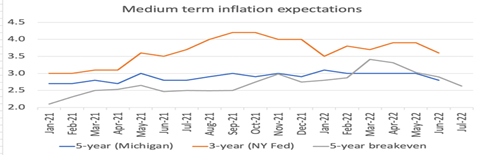
Americans anticipated gasoline prices to remain steady over the next year, which is in line with their overall outlook that inflation will moderate, said the sentiment survey. Americans’ expectations for overall inflation over the next year held steady at a 5.4 percent inflation rate in March while expectations for inflation longer term over the next five years has remained at 3.0 percent for many months.

Another reason for optimism concerning a “soft landing” as the Fed begins to raise interest rates, is that industrial production is soaring, which also helps bring down inflation.

The Federal Reserve just reported that industrial production jumped 0.9 percent in March. and February’s gain was revised up to 0.9 percent from the initial estimate of a 0.5 percent increase. For the first quarter, output was up at an 8.1 percent annual pace, with the output of motor vehicles and parts up 7.8 percent in March.

Supply chains are beginning to catch up to demand, another reason that inflation may moderate, and consumers’ optimism is warranted. But it will require considerable  “luck and skill” to avoid a recession, as well as a favorable outcome to the war in Ukraine.

Harlan Green © 2022

Follow Harlan Green on Twitter: https://twitter.com/HarlanGreen

Posted in Consumers, COVID-19, Economy, Weekly Financial News | Leave a comment

What Is the New Normal?

Popular Economics Weekly

FREDcpi

What will the future look like with the COVID-19 pandemic about to end, and a possible new cold war with Russia just beginning? It is a time when governments come to the rescue. We’ve seen it happening with the demise of COVID-19 due to the development of miraculous vaccines that only governments can research and fund.

But it also means consumers have been given more money to spend, which has resulted in the highest monthly inflation numbers since 2005.

The consumer price index jumped 1.2% last month, driven by the higher cost of gasoline, food and housing,  the government said Tuesday. It was the largest monthly gain since Hurricane Katrina in 2005 and resulted in the highest annual increase in 40 years, crimping the spending of consumers and investments of producers.

Scary as that may be, the FRED graph shows that it has been higher in 1974 and 1980 during the Arab oil embargos when it rose to 14 percent, per the FRED graph. Inflation is also happening with commodities such as wheat and oil because of the sanctions against Russia for invading Ukraine and threatening the West with nuclear weapons if NATO interfered with Putin’s wholesale destruction of another country.

We are also seeing how the EU, US and Japanese governments have come together to aid Ukraine. But all of this takes lots of money, which only governments can spend, as I said. It took $trillions to vanquish the pandemic, and we see with the proposed 2022-23 fiscal year budget of $5.8 trillion what must be done to keep the US on a strong growth path.

It really means the transfer of more wealth from the private sector via higher taxes to pay for programs that promote more jobs and protect Americans from economic disruptions that may be caused by the Ukraine war.

For instance, the proposed budget includes a so-called “billionaire tax” that would apply a minimum tax rate of 20 percent to both the income and unrealized capital gains of households with a net worth over $100 million. The tax is projected to raise $360 billion over 10 years — more than half of it from billionaires that have prospered the most since the Great Recession of 2007-09.

To emphasize that wealthy Americans can afford higher taxes, the Times interviewer mentioned that some 130 new American billionaires were created just from 2020 to 2021.

French economist Thomas Piketty, author of the best-selling Capital in the Twenty-First Century, and sure to be a future Nobel Prize-winner in Economics, stated recently in a NY Times Magazine interview, “…the period of maximum prosperity of the U.S. economy in the middle of the century was a period where you had a top income tax rate of 90 percent, 80 percent, and this was not a problem because income gaps of 1 to 100 and1 to 200 are not necessary for growth.”

The income gaps have risen to more than 300 to 1 for CEOs vs. their employees during the 1980s as inequality levels grew to what they are today. We cannot possibly pay for the programs needed to protect Americans if such levels of inequality continue. That is already happening with the 5.6 percent annual rise in average hourly wages, with transportation, leisure and retail trade employees’ average wages rising even faster, as we said last week.

I said last week that now isn’t the time to worry about inflation or the Fed engineering a soft landing, or any ‘landing’ at all. It is precisely during such uncertain times that we need elevated growth and a government that steps up, while partisan politics step down, even with an upcoming election in November.

Harlan Green © 2022

Follow Harlan Green on Twitter: https://twitter.com/HarlanGreen

Posted in COVID-19, Economy, Weekly Financial News | Leave a comment

What Stagflation?

Financial FAQs

TradingEconomics

U.S. service sector activity that powers two-thirds of economic activity above graph) is surging more than ever, according to the Institute of Supply Management non-manufacturing survey. It is growing per 58.3 percent of managers surveyed, with the index for employment and new orders even higher. New orders rose 4 points to 60.1 percent, and production activity also edged higher.

“In March, the Services PMI® registered 58.3 percent, a 1.8-percentage point increase compared to the February reading of 56.5 percent. The 12-month average is 62.3percent, which reflects consistently strong growth in the services sector. The March reading indicates the services sector grew for the 22nd consecutive month after two months of contraction and 122 months of growth before that. A reading above 50 percent indicates the services sector economy is generally expanding; below 50 percent indicates the services sector is generally contracting.”

So this doesn’t look like impending stagflation, the wage-price spiral that happened in the 1970s and pushed inflation to record highs, while growth came to a standstill.

Pundits and some banks that forecast a future wage-price spiral seem to have forgotten that it took consecutive Arab (OPEC) oil embargos in the 1970s causing gasoline shortages and long lines at gas stations for almost a decade to make that happen.

Whereas the Ukraine war and its concomitant sanctions are less than two months old. Why should we even be worrying about prolonged inflation, and what the Fed might do to tame it, when we don’t know whether this war will last for months, or years, and what will be needed to win it?

Predictions of a looming recession are premature, so say the least. Both the service and manufacturing sectors are booming, while supply chains are struggling to catch up and replenish inventories.

This is while the jobs market is red hot with more returning to work. New U.S. jobless claims matched a 54-year low of 166,000 in early April, for instance — the second lowest reading in history— during a period of remarkably strong hiring and the lowest layoffs on record.

The ISM’s service sector employment index increased to 54% from 48.5%. Businesses got no relief from inflation, however. The prices-paid index moved up to 83.8% from 83.1%, just a tick below a record high.

What will help to tame the inflation tiger? More workers returning to work will increase production, replenishing inventories. And governments will be increasing their spending, as well, due to the Ukraine war. This will stimulate further production increases.

MarketWatch columnist Jeffry Bartash maintains what was called the “Great Resignation” is over, a time since the pandemic when workers were reluctant to return to work.

“To be sure, Americans have been saying “I quit” in record numbers,” said Bartash. “Almost 57 million people left jobs — many more than once — in the 14-month period from January 2021 to February 2022. That’s a 25% spike vs. a similar time span before the pandemic.”

The hiring wave began more than a year ago. The U.S. added 431,000 new jobs in March, the government said last week, extending a streak of large job gains going back to the start of 2021. The unemployment rate also sank to 3.6 percent last month — just a tick above a 53-year-low — from nearly 15 percent just two years ago.

“All of the hiring took place against the backdrop of high covid cases and the reluctance of millions of formerly employed people to return to the labor market. Hiring might have taken place even faster, economists say, if the pandemic had petered out and generous government unemployment benefits were ended sooner,” continued Bartash.

So maybe we can endure a bit more inflation if the red hot demand that’s causing it is bringing more people into the workforce and helping Ukraine to win its war?

Harlan Green © 2022

Follow Harlan Green on Twitter: https://twitter.com/HarlanGreen
Posted in Consumers, COVID-19, Economy, Weekly Financial News | Leave a comment