A disappointing Jobs Report

Popular Economics Weekly

MarketWatch.com

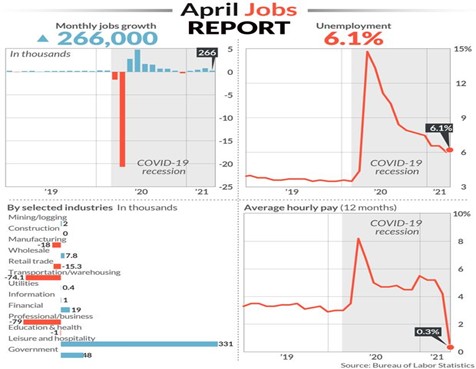
Not everyone is eager to go back to work, according to this morning’s unemployment report. The US economy added just 266,000 new nonfarm payroll jobs in April. Leisure and hospitality led the way with 331,000 jobs and governments added 48,000 new jobs.

“Both the unemployment rate, at 6.1 percent, and the number of unemployed persons, at 9.8 million, were little changed in April,” said the US Bureau of Labor Statistics. “These measures are down considerably from their recent highs in April 2020 but remain well above their levels prior to the coronavirus (COVID-19) pandemic (3.5 percent and 5.7 million, respectively, in February 2020).”

Transportation/warehousing and Professional/business sectors had 153,000 fewer jobs that would be normal for this time of year, since the jobs numbers are adjusted for seasonal factors. There was a pause in hiring in those sectors probably because they couldn’t find enough workers, since there has been no slowdown in business activity in both the manufacturing and service sectors of the economy.

This is in part because the government’s various aid programs are enabling more women to stay at home until their children go back to the slowly opening schools, and many of the 8 million that were laid off are still receiving good unemployment benefits.

The good news is that the size of the labor force grew by 430,000 in April to 161 million, close to the 164.5 million working before the pandemic when the unemployment rate was 3.6 percent.

“The shortfall in new jobs in April is likely just temporary,” said MarketWatch’s Jeffry Bartash in his comments on this morning’s disappointing nonfarm payroll report. “Falling coronavirus cases and massive federal stimulus have turbocharged the economy and job openings have surged. The U.S. is still set up for a summer of strong economic growth, especially if the coronavirus is mostly squelched.”

Employment by local governments also rose 31,000 in April as more schools reopened. Some very essential workers neglected until now—bus drivers, cafeteria workers and other personnel had been unable to work with schools closed, while employment declined in retail, health care, transportation and manufacturing, as I said.

Reuters’ ICAP says “The deceleration in payroll growth this month is not an argument for easier monetary policy.  As Chair Powell keeps reminding everyone, virus-related constraints are the key variable in the outlook.  For much of the past year, the major effect of those constraints was to restrict demand. Given the large number of employers who say they cannot find enough new workers, it is clear that the deceleration in hiring in April was not due to insufficient demand.”

This is only the beginning of what will be a decade-long recovery, with much of it to come from the just-passed American Recovery Act, and upcoming American Jobs Plan, a requested total of more than $4 trillion in additional government spending that will create even more good jobs.

The real question with all this stimulus spending is what will full employment look like in the years to come? Will there continue to be a labor shortage, for instance, with the current declining US birth rate and lower immigration numbers?

It must be one reason the financial markets are boosting tech companies’ stock values (i.e., NASDAQ). They are betting on a big 5G future need for more robots and Artificial Intelligence that will be needed to supplement what could be a looming labor shortage.

Harlan Green © 2021

Follow Harlan Green on Twitter: https://twitter.com/HarlanGreen
Posted in COVID-19, Economy, Keynesian economics, Weekly Financial News | Leave a comment

The Age of Narcissism is Ending

Answering the Kennedys’ Call

PEWResearch

The election of President Biden is bringing an end to the age of narcissism, or as Tom Wolfe titled it in 1976, “The ‘Me’ Decade”. Only 30 percent of adult Americans say they still like our former Narcissist-in-Chief in the latest polls since Donald Trump’s defeat in November.

Donald Trump epitomized what psychologists have described as a Narcissistic Personality Disorder (NPR). Psychologists Jean Twenge and W. Keith Campbell described in their 2009 book, “The Narcissism Epidemic”, the destructive effects of narcissistic behavior: the breakdown of institutions that bind families and communities, thus encouraging divisive and antisocial, short-term behaviors over long-term, collective decision-making.

There is much more to the definition, of course, but psychologists are in general agreement a person with NPR, such as former President Trump, has sociopathic behavior with an almost complete lack of empathy, or regard for others.

Dennis Shen, in a London School of Economics article maintains narcissistic behavior became prevalent in baby boomers and millennials, the Gen X and Y’ers born approximately between 1946 to 1980, as they focused on their own needs rather than the needs of others.

It was a sharp divergence from the post-Depression and World War II generations, when a rare consensus within America emerged, the result of existential crises in the form of the World War and looming Cold War.

“This post-war era of togetherness saw unprecedented economic stability and trust in the state as the steward of the people,” said Shen., “The nation backed global reciprocity, exemplified during the founding of the United Nations, Bretton Woods institutions and Marshall Plan.”

And we now have a president who is explicitly restarting global reciprocity by rejoining alliances such as the Paris Accord on climate change and restoring economic stability with a ‘new’ New Deal of Rooseveltian proportions—more than $6 trillion in government spending to ‘build back’ American institutions and programs designed to heal communities and families.

And we now have a younger generation facing serious existential crises in their lives—diminished economic and educational opportunities, a deteriorating physical environment and polarized political environment that has endangered our constitutional-based democratic system.

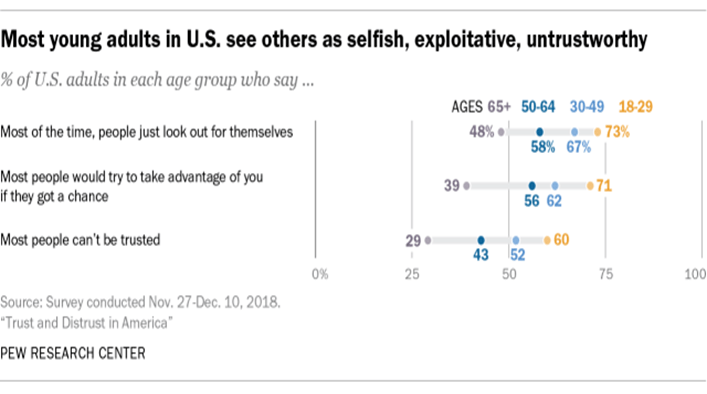
They don’t like what America has become.  Gen Zer’s (born after 1996) are more progressive and pro-government, most see the country’s growing racial and ethnic diversity as a good thing, and they’re less likely than older generations to see the United States as superior to other nations, said a recent PEW survey.

A look at how Gen Z voters view the Trump presidency provides further insight into their political beliefs. A Pew Research Center survey conducted in January of this year (2020) found that about a quarter of registered voters ages 18 to 23 (22%) approved of how Donald Trump is handling his job as president, while about three-quarters disapproved (77%).

Millennial voters were only slightly more likely to approve of Trump (32%) while 42% of Gen X voters, 48% of Baby Boomers and 57% of those in the Silent Generation approved of the job he is doing as president.

So Americans are coming together again with the election of President Biden, who has asked “that we all do our part”. And it is the younger generations in particular that are reacting as did those of the Great Depression and World II when faced with existential threats.

Harlan Green © 2021

Follow Harlan Green on Twitter: https://twitter.com/HarlanGreen

Posted in Consumers, COVID-19, Economy, Keynesian economics, Politics, Uncategorized, Weekly Financial News | Leave a comment

American Economy Gets a New Deal

Popular Economics Weekly

BEA.gov

President Biden announced in his first ‘non-State of the Union’ address that “America is on the move again,” saying in effect that government isn’t the problem but the solution to today’s problems, including the horrific events of the past year.

We are seeing the effects of those solutions in today’s first estimate of Q1 Gross Domestic Product growth: Real gross domestic product (GDP) increased at an annual rate of 6.4 percent in the first quarter of 2021, said the BEA, reflecting the continued economic recovery, reopening of establishments, and continued government response related to the COVID-19 pandemic.

All sectors expanded, with consumer spending surging 10.7 percent, the economy adding`1.5 million new jobs. business investment jumped up 10 percent and housing investments up 11 percent in the ongoing housing boom.

Much of this is possible because of the still record low interest rates that the Fed has promised to maintain al least through next year. But consumers have benefited the most with the assistance payments, of course, so much so that disposable personal income increased $2.36 trillion, or 67.0 percent, in the first quarter, compared with a decrease of $402.1 billion, or 8.8 percent, in the fourth quarter. 

And personal saving was $4.12 trillion in the first quarter, compared with $2.25 trillion in the fourth quarter, which has boosted the personal saving rate—personal saving as a percentage of disposable personal income—to a huge 21.0 percent in the first quarter, compared with 13.0 percent in the fourth quarter, and 3-5 percent historically.

Consumers with more money in their pockets means the economic recovery has just begun and businesses will be playing catchup to the increased demand for the rest of this year, further boosting economic growth.

The American public seems to like governmental solutions to our problems, says Gallup’s Frank Newport:

“The latest update (of polling data) shows that 54% of Americans say the government should do more to solve our country’s problems, while 41% say the government is trying to do too many things that should be left to individuals and businesses. This is the highest percentage choosing the “government should do more” option since Gallup began asking the question in 1992.”

But will the rising sentiment for big government continue as President Biden asks for more spending?

President Biden outlined his American Families Plan at last night’s address that is summarized by the White House announcement:

“The American Families Plan is an investment in our children and our families—helping families cover the basic expenses that so many struggle with now, lowering health insurance premiums, and continuing the American Rescue Plan’s historic reductions in child poverty. Together, these plans reinvest in the future of the American economy and American workers and will help us out-compete China and other countries around the world.”

It is a ‘new’ New Deal that brings us out of this pandemic and the deterioration of American education, infrastructure, research & development, and environmental protection that is despoiling the planet and our ability to survive as a democracy.

“History shows that Americans tend to adopt big government initiatives when there are big problems facing the nation,” Gallup’s Newport continued. “including COVID-19, the Great Recession, 9/11, World War II and the Great Depression.”

But there has been too little agreement on how we should be paying for future generations since World War II, I said in my last column.

Let us hope we are willing to pay enough forward to win this world war against COVID-19 that is also a battle to save the liberal democracy our constitution has envisioned.

Harlan Green © 2021

Follow Harlan Green on Twitter: https://twitter.com/HarlanGreen
Posted in Consumers, COVID-19, Economy, Keynesian economics, Politics, Weekly Financial News | Leave a comment

A Better Use of Economic Growth

Popular Economics Weekly

AtlantaFed

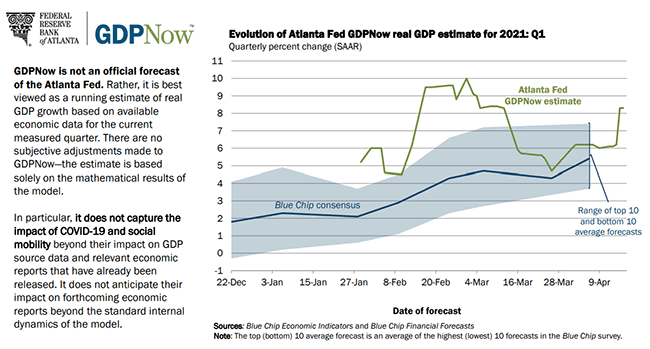
The Atlanta Federal Reserve Bank puts out a GDP now forecast of upcoming monthly GDP growth, and its latest estimate puts growth at the highest level since the 1980s, as we recover from the COVID-19 pandemic.

“The GDPNow model estimate for real GDP growth (seasonally adjusted annual rate) in the first quarter of 2021 is 8.3 percent on April 16, unchanged from April 15 after rounding,” say the Atlanta Fed. “After this morning’s housing starts report (last week) from the U.S. Census Bureau, the nowcast of first-quarter real residential investment growth decreased from 10.6 percent to 10.2 percent.

However, new-home sales’ figures Friday showed even faster residential investment growth ahead, reports the US Census Bureau. Sales of new single-family houses in March 2021 were at a seasonally adjusted annual rate of 1,021,000, according to estimates released jointly today by the U.S. Census Bureau and the Department of Housing and Urban Development. This is 20.7 percent (±23.7 percent) above the revised February rate of 846,000 and is 66.8 percent (±36.7 percent) above the March 2020 estimate of 612,000.

The problem is not finding more ways to boost GDP growth, per se, but how it will be utilized. Since the 1980s, a growing percentage of the Gross National Income derived from GDP growth has gone to ‘rentiers’, i.e., people that derive income from their assets rather than wages.

That is in part due to the huge decline in personal and corporate taxation of said wealth that has allowed rentiers to accumulate more private wealth, rather than investing in productive enterprises.

What creates GDP? The aggregate, or effective demand of all goods and services produced domestically. Economists have broken it into four components, of which consumer spending is the largest portion. The rest is made up of net exports, government expenditures, and investments.

Consumers spend on private consumer goods, so it is up to investment and government spending to build for future growth, and that has not happened because corporations haven’t been maintaining a decent level of capital expenditures, and government investments in infrastructure, education, R&D, and our social safety net that would keep workers healthy enough to be more productive have been cut sharply since the 1970s.

GDP growth has been paying too little forward for future generations since then, in other words, so taxing some of the wealth accumulated since 1980 is needed to pay it forward for future generations.

President Biden’s $2.3 trillion American Jobs Plan is meant to correct the underinvestment in the public good. He is calling for more than $1 trillion to be invested just in the various components of infrastructure, including better roads, bridges, public transportation, expanding broadband and electric grids, as well as electric vehicle use.

He is also calling for more spending on health care and the national housing shortage—more than $213 billion to “build, preserve and retrofit more than 2 million homes and commercial buildings to address the affordable housing crisis,” $100 billion to modernize public schools and early learning facilities, $180 billion in research and development of future technologies, and more.

This supports much more than infrastructure, as it fulfills every person’s basic need of food, shelter, and security.

Initial first quarter GDP comes out Thursday, and consensus predictions are for 7 percent growth. Whatever it will be, it is important that it be used in productive ways, and the just-passed American Recovery Act and upcoming American Jobs Plan begin that process of utilizing America’s GDP to support a better future for all Americans.

Harlan Green © 2021

Follow Harlan Green on Twitter: https://twitter.com/HarlanGreen
Posted in Consumers, COVID-19, Economy, Keynesian economics, Weekly Financial News | Leave a comment

How High Go Housing Prices?

The Mortgage Corner

Calculatedriskblog

How high can housing prices go? They rose in double digits annually in the early 2000s during the housing bubble. But that was when the housing supply could not keep up with the demand for housing, and interest rates were low, a demand inflated by so-called ‘liar’ loans requiring no verification of income.

Housing is one of society’s basic needs, along with food and clothing. So we must pay attention to what happens to housing if we want a functioning democracy.

Demand for housing isn’t being inflated by loose credit conditions today, but housing construction hasn’t kept up with demand since the housing bubble for a number of reasons, including the pandemic.

The result is housing prices are rising fast again in states like California with its rising homeless population.

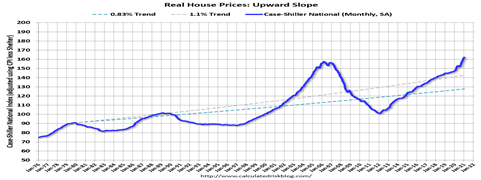
The Calculated Risk graph dating from 1976 shows the various price bubbles in the 1970s, 80s, 2007 housing bubble, and today. It shows prices rising again at almost the same clip as during the housing bubble.

A federal judge overseeing a sprawling lawsuit about homelessness in Los Angeles has even ordered the city and county Tuesday to offer some form of shelter or housing to the entire homeless population of skid row by October, according to the LA Times.

In the last homeless count in January 2020, more than 4,600 unhoused people were found to be living on skid row — about 2,500 in large shelters and 2,093 on the streets, according to the LA Times. They account for only slightly more than 10% of the city’s overall homeless population, and it’s not clear what presiding Judge Carter’s order might mean for other parts of the city.

America’s lack of adequate housing has reached crisis levels, in other words, with so many losing their homes and livelihoods during and the pandemic.

It is the reason some $213 billion of the American Jobs Act is being allotted “to produce, preserve, and retrofit more than two million affordable and sustainable places to live.”

The While House website says it pairs this investment with “an innovative new approach to eliminate state and local exclusionary zoning laws, which drive up the cost of construction and keep families from moving to neighborhoods with more opportunities for them and their kids.”

It will also help address the growing cost of rent and create jobs that pay prevailing wages, including through project labor agreements with a free and fair choice to join a union and bargain collectively.

The reasons for our housing crisis are too many to list at once. It has as much to do with income inequality as with NIMBY exclusionary zoning regulations that segregate communities.

It also has to do with our outmoded infrastructure that lacks improved roads, bridges, and mass transit systems to get to and from work centers. So outlying communities become detached from inner cities, creating high-priced gentrified ghettos.

Housing construction and sales have been the first to rally after the pandemic. Demand is so hot that the median existing-home sales price rose to $303,900, 14.1 percent higher from one year ago, I said in January. And as of the end of January, existing-home inventory fell to a record-low of 1.04 million units, down by 25.7 percent year-over-year – a record decline.

Total existing-home sales,1 https://www.nar.realtor/existing-home-sales, completed transactions that include single-family homes, townhomes, condominiums and co-ops, decreased 6.6% from January to a seasonally-adjusted annual rate of 6.22 million in February. Sales in total climbed year-over-year, up 9.1% from a year ago (5.70 million in February 2020).

“Despite the drop in home sales for February – which I would attribute to historically-low inventory – the market is still outperforming pre-pandemic levels,” said Lawrence Yun, NAR’s chief economist.

And now the US Census Bureau is saying privately-owned housing starts (construction) in March were at a seasonally adjusted annual rate of 1,739,000. This is 19.4 percent (±13.7 percent) above the revised February estimate of 1,457,000 and is 37.0 percent (±15.2 percent) above the March 2020 rate of 1,269,000.

That is a return to boom times for homeowners and buyers, but not for renters and the growing homeless population.

So governments, and the legal system in some cases, must step in to care for those that private industry cannot—since our general welfare is as important for a healthy democracy.

Harlan Green © 2020

Follow Harlan Green on Twitter: https://twitter.com/HarlanGreen

Posted in Consumers, COVID-19, Economy, housing market, Politics, Weekly Financial News | Leave a comment

A Debt-Fueled Recovery Needed

Popular Economics Weekly

To: Barron’s Letters

Published: April 19, 2021

Barron’s Lisa Beilfuss cites David Rosenberg’s worries about hyperinflation (because of the Federal Reserve’s inability to keep inflation within acceptable rates), as the reason to worry about a sustainable “debt-fueled” recovery.

But rather than compare the current economic recovery from the COVID-19 pandemic to the ‘roaring 20’s’ recovery from the Spanish flu pandemic, why not compare it to our recovery from World War Two?  Fighting that war required record debt-to-GDP levels that were brought down by record growth and consumer prosperity after the war, because there was agreement that high government and private spending geared to future growth was necessary with the building of American modern infrastructure and higher education system.

Our capitalist system has always required debt to leverage higher growth and the result has been accelerated growth to reduce said debt to the historical level.  Even the CBO in a recent report stated that “Between 1946 and 2019, the deficit as a share of GDP has been larger than that (3.0 %) only twice.”

A major goal of the Biden spending bills is to reverse the record income inequality that has reduced consumers’ ability to spend without higher debt levels since 1980.  The COVID-19 pandemic has cost more lives than World War Two and devastated economic growth worldwide.  So President Biden’s focus on not only rebuilding infrastructure, but improving our social safety net and reducing the record income inequality of working families will create a more sustainable recovery. 

Harlan Green © 2021

Follow Harlan Green on Twitter: https://twitter.com/HarlanGreen

Posted in Consumers, COVID-19, Economy, Keynesian economics, Weekly Financial News | Leave a comment

Debt-Fueled Recovery Needed

Popular Economics Weekly's avatarPopulareconomicsblog

Popular Economics Weekly

To: Barron’s Letters

Published: April 19, 2021

Barron’s Lisa Beilfuss cites David Rosenberg’s worries about hyperinflation (because of the Federal Reserve’s inability to keep inflation within acceptable rates), as the reason to worry about a sustainable “debt-fueled” recovery.

But rather than compare the current economic recovery from the COVID-19 pandemic to the ‘roaring 20’s’ recovery from the Spanish flu pandemic, why not compare it to our recovery from World War Two? Fighting that war required record debt-to-GDP levels that were brought down by record growth and consumer prosperity after the war, because there was agreement that high government and private spending geared to future growth was necessary with the building of American modern infrastructure and higher education system.

Our capitalist system has always required debt to leverage higher growth and the result has been accelerated growth to reduce said debt to the historical level. Even the CBO…

View original post 110 more words

Posted in Uncategorized | Leave a comment

Debt-Fueled Recovery Needed

Popular Economics Weekly

To: Barron’s Letters

Published: April 19, 2021

Barron’s Lisa Beilfuss cites David Rosenberg’s worries about hyperinflation (because of the Federal Reserve’s inability to keep inflation within acceptable rates), as the reason to worry about a sustainable “debt-fueled” recovery.

But rather than compare the current economic recovery from the COVID-19 pandemic to the ‘roaring 20’s’ recovery from the Spanish flu pandemic, why not compare it to our recovery from World War Two?  Fighting that war required record debt-to-GDP levels that were brought down by record growth and consumer prosperity after the war, because there was agreement that high government and private spending geared to future growth was necessary with the building of American modern infrastructure and higher education system.

Our capitalist system has always required debt to leverage higher growth and the result has been accelerated growth to reduce said debt to the historical level.  Even the CBO in a recent report stated that “Between 1946 and 2019, the deficit as a share of GDP has been larger than that (3.0 %) only twice.”

A major goal of the Biden spending bills is to reverse the record income inequality that has reduced consumers’ ability to spend without higher debt levels since 1980.  The COVID-19 pandemic has cost more lives than World War Two and devastated economic growth worldwide.  So President Biden’s focus on not only rebuilding infrastructure, but improving our social safety net and reducing the record income inequality of working families will create a more sustainable recovery. 

Harlan Green © 2021

Follow Harlan Green on Twitter: https://twitter.com/HarlanGreen

Posted in Consumers, COVID-19, Economy, Keynesian economics, Macro Economics | 1 Comment

Soaring Retail Sales Begin the 2020’s Recovery

Financial FAQs

FREDretailsales

Sales at U.S. retailers rose 9.8 percent in March, the government said Thursday, in part because of the additional $1,400 stimulus checks for consumers from the federal government, accelerating economic growth, and declining COVID death rates.

This confirms that the 2020’s economic recovery has begun, as more businesses open and consumers grow confident that the worst of the pandemic is over. The sales gain was the second largest on record, exceeded only by an 18 percent spike last May when the U.S. lockdown was first lifted.

Stock market indexes also reached new highs, which does bring back hints of the original roaring 1920’s—excessive exuberance in the financial markets and eight years of prosperity—but then came the 1930s when outmoded economic verities (and few regulations) turned it into the Great Depression.

However, I would compare this recovery to that after World War Two, which necessitated programs enabling government to invest heavily in the future—in infrastructure, education, and housing, as is being proposed today.

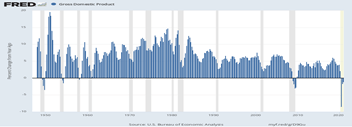
We achieved much higher annual GDP growth rates post-WWII, as high as 14 percent (see below graph dating from 1948), which can happen again with the right public and private investments.

FREDgdpgrowth

Retail sales revved up 15 percent in March at car dealers even as automakers struggled to procure enough computer chips to maintain production, per MarketWatch’s Jeffry Bartash. Auto sales account for about 20 percent of all retail sales.

Sales at gas stations also rose nearly 11 percent, reflecting rising oil prices and more Americans taking to the road as government coronavirus restrictions are lifted. If autos and gas are set aside, retail sales still jumped 8.2 percent.

Almost every major retail group shared in the benefits of the federal aid payments. Receipts leaped 13.4 percent for bars and restaurants, 18 percent for clothing stores, 23.5 percent for sporting goods and other recreational items.

What about COVID-19 and future viruses that must be vanquished to continue this recovery? Better public health care spending is also needed and is contained in the just passed American Jobs Act. Hospitalization rates have plateaued at too high a level. The current 7-day average is 36,941, up from 36,257 reported yesterday, and well above the post-summer surge low of 23,000.

So we do need post-WWII-size public spending to create a real recovery.

Harlan Green © 2021

Follow Harlan Green on Twitter: https://twitter.com/HarlanGreen

Posted in Consumers, COVID-19, Economy, Weekly Financial News | Leave a comment

Equitable Wealth = Equitable Growth

Answering the Kennedys’ Call

Equitablegrowth.com

We must cure the record income inequality if we are to re-unite the United States into a country that serves Americans in both red and blue states.

The current disunity is a result of whole swaths of the country losing out on economic opportunity. Our modern, tech-based capitalism has raced ahead, rewarding those that can keep up.

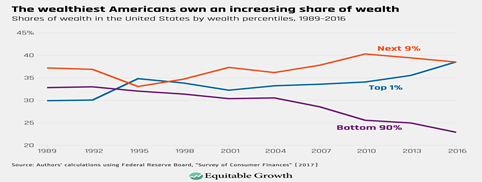
The wealth is distributed in a highly unequal fashion, says the Center for Equitable Growth, a progressive think tank, with the wealthiest 1 percent of families in the United States holding about 40 percent of all wealth and the bottom 90 percent of families holding less than one-quarter of all wealth.

The result has been that the top 20 percent of America’s educated class are winning the race with educational opportunities that have enabled them to take advantage of modern technologies.

And what happens to people who feel left behind—in education, good jobs, and adequate housing? They find a way to protest, and Donald Trump became their voice of protest.

They protest against immigrants because they believe their jobs have been stolen. They protest against open borders because they see those jobs fleeing to other countries with cheaper wages.

They are so angry they will believe any theory confirming their suspicions that the educated elites with the best jobs are abridging their freedoms.

That is why President Biden’s plan to return US to full employment by the end of 2022 is so important.

The just passed $1.9 trillion American Rescue Plan will boost benefits of lower and middle income consumers, raising incomes for the poorest 20 percent of families by an average of 20 percent, according to the Tax Policy Center’s analysis, and create 7 million jobs by the end of 2021 while top earners would see their income rise less than 1 percent, according to the CBO.

The proposed $2 trillion plus infrastructure bill will create more good jobs by requiring the development of universal broadband, such as 5G networks that China is already building on a grand scale, a major issue in rural communities.

Documents suggest it will also include nearly $1 trillion in spending on the construction of roads, bridges, rail lines, ports, electric vehicle charging stations, and improvements to the electric grid and other parts of the power sector, all requiring higher paying jobs.

“I think a package that consists of investments in people, investments in infrastructure, will help to create good jobs in the American economy,” testified Treasury Secretary Janet Yellen in congressional hearings recently, “and changes in the tax structure will help to pay for those programs (and also reduce income inequality).”

The investments in people is even more important to lift the spirits of the 13 million that still have no jobs or would like full time jobs, including greater access to Obamacare and Medicaid, aid that the Trump administration had been drastically reducing.

Bringing back trust in government will do the most to boost public spirits. And that means spending on programs that make life easier for most Americans.

There is no easy path to a greater equality of opportunity in the richest country in the world, because we must first restore our faith in the ability to help each other with programs that benefit all Americans.

Harlan Green © 2021

Follow Harlan Green on Twitter: https://twitter.com/HarlanGreen
Posted in Consumers, Economy, Keynesian economics, Politics, Weekly Financial News | Leave a comment