A Disappointing Jobs Report

Popular Economics Weekly

Calculated Risk

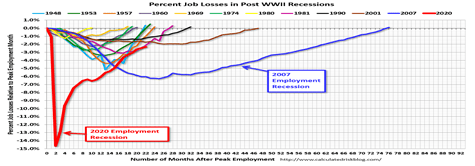
When will they come back to work? That is the question economists are asking with the August unemployment report out today. Although the Calculated Risk graph shows how quickly job creation has recovered in comparison with past recessions (red line) there are still some 5.3 million fewer jobs since February 2020.

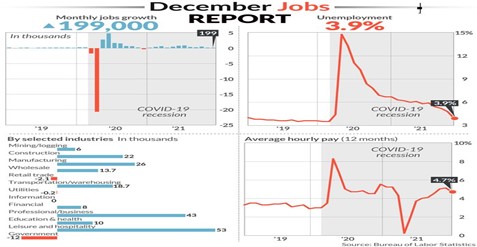
Total nonfarm payroll employment rose by 235,000 in August, and the unemployment rate declined by 0.2 percentage point to 5.2 percent, the U.S. Bureau of Labor Statistics reported today. So far this year, monthly job growth has averaged 586,000. In August, notable job gains occurred in professional and business services, transportation and warehousing, private education, manufacturing, and other services. Employment in retail trade declined over the month.

“There was some good news – the decline in the unemployment rate, the decline in permanent job losers, and the decline in long term unemployed – however, there are still 5.3 million fewer jobs than prior to the recession,” said Calculated Risk’s Bill McBride, “and overall this was a disappointing report, probably due to the sharp increase in COVID cases.”

A major reason for the lackluster jobs report is the seasonal adjustment that BLS makes, which means there were just 235,000 more jobs created this time of year than is ‘normal’. In ‘normal’ years there is usually a hiring surge for schools in the fall, but many schools aren’t opening or are slow to open because of the tiff over mask mandates, particularly in the red states.

And the Delta variant of SARS-CoV2 is surging. Mask mandates are a crucial question, because students wearing masks are less likely to have to quarantine under the U.S. Centers for Disease Control and Prevention protocols.

“If a classroom of 25 students is masked and one of them comes down with COVID-19, no one but the sick student has to stay home. If children in the classroom are not masked, anyone in close contact with someone who tests positive must stay home for at least 7 days,” said the Baltimore Sun recently.

It cites several examples: Mississippi has 20,000 students quarantined and South Carolina and Arkansas also had hundreds out of school. Several districts have shut schools down as cases of the virus surged. And by Thursday, five Florida school districts were defying their governor’s order and instituting mask mandates after thousands of their students were quarantined. Hillsborough County alone had sent home about 10,000 students in the first week of school, the Tampa Bay Times reported.

In other words, the unemployment picture is chaotic because red states have chosen to make mask mandates a political issue that will hamper school openings perhaps for months, harming the health of K-12 students unnecessarily. Red-leaning states are doing this really for one reason only—they believe it will rally their troops for the 2022 election.

“The good news is that the change in total nonfarm payroll employment for June was revised up by 24,000, from +938,000 to +962,000, and the change for July was revised up by 110,000, from +943,000 to +1,053,000. With these revisions, employment in June and July combined is 134,000 higher than previously reported,” said McBride.

The BLS reported that in May 2017, the 5.5 million teachers and instructors make up 65 percent of employment in elementary, middle, and secondary schools nationwide. There are over 2 million elementary and middle school teachers, representing 24 percent of total school employment. There are nearly 1.1 million secondary school teachers. And add to that 550,000 janitors and school administrators employed.

So it is not so good news that the red states are having so much trouble with mask mandates. Do they really believe endangering the health of children is a winning political issue?

Harlan Green © 2021

Follow Harlan Green on Twitter: https://twitter.com/HarlanGreen
Posted in Consumers, COVID-19, Economy, Politics, Weekly Financial News | Leave a comment

California’s NIMBY Problem

The Mortgage Corner

Calculated Risk

It’s no secret that California has a housing problem. Its bias for single-family, ‘not-in-my-backyard’ (NIMBY) zoning since the 1960s has finally caught up with reality—in the form of more than 150,000 residents homeless and some 700,000 new homes built last year in California, whereas 1,500,000 new jobs were created.

Where are these people expected to live? It’s no secret that the real problem is affordability. Commuters that work in Silicon Valley, for instance, must travel up to two hours per day to reach their jobs, because homes they can afford are on the farthest outreaches of metropolitan areas, with little mass transit yet planned to speed up the commute.

COVID-19 exacerbates the problem with existing-home inventories dropping to their lowest level in 2020, and annual prices then rising at double-digit rates when consumers came out of their stay-at-home shells looking for too few available to purchase.

The Calculated Risk graph dating from January 2002 shows that existing-home inventories in YoY change (blue line) and months of supply (red line) reached their low in January 2021 and have been rising fairly sharply since then.

Gov. Gavin Newsom, who came into office with bold pronouncements about a “Marshall Plan for Housing,” said he supported plans to increase density near transit, but never endorsed an individual bill that would implement that goal.

California legislators just took a huge step to address the state’s housing crisis by allowing homeowners to double up.  The state assembly passed a bill last week (Aug. 26) that allows for two-unit buildings to be built on lots previously zoned for single-family homes.

It’s a significant reversal of decades of policy built around restrictive single-family zoning. In California, as across the US, allowing for one housing unit to be built per parcel of land has been standard. It’s what gave rise the suburbs as we know them, but has also been used as a tool in racist housing policies that have excluded Black, brown, and Native Americans from homeownership. In recent years, restrictive zoning has been a primary driver of the state’s affordable housing shortage. The median home price in California has risen 27% in the past year alone, and currently sits at more than $800,000.

The bill would allow more building where it’s now illegal, with the intent of reducing California’s fast-rising home prices and increasing access to homeownership through a greater variety of options, according to state Senate leader Toni Atkins, D-San Diego, who introduced the bill and similar versions in the past.

To lessen concerns from more than 100 cities and neighborhood groups that oppose the bill, Atkins on Monday added a few amendments that give local jurisdictions some veto power over units that threaten public health and safety and curtail potential speculation. The bill — approved by the Senate in May and two Assembly policy committees in June — made it out of the Assembly Appropriations Committee Monday and was approved by the full Assembly Thursday on a 45-19 vote.

I reported last week that there is not enough housing to meet soaring demand. The national existing-home housing inventory at the end of July totaled 1.32 million units, up 7.3 percent from June’s supply and down 12.0 percent from one year ago (1.50 million) according to the NAR. Unsold inventory sits at a 2.6-month supply at the present sales pace, up slightly from the 2.5-month figure recorded in June but down from 3.1 months in July 2020, a historic low.

The housing market is so hot that individual investors or second-home buyers, who account for many cash sales, purchased 15 percent of homes in July. All-cash sales accounted for 23 percent of transactions in July, and up from 16 percent in July 2020.

But first-time buyers purchased just 30 percent of existing sales, which means most young adults leaving school and/or their parents’ home may find rental housing to a more viable option for the foreseeable future.

Much more must be done, in other words. And it will take years for this to happen with much more multi-family housing amid denser zoning in the cards. And it will be closer to needed public transportation hubs, whether the NIMBYs like it or not.

Harlan Green © 2021

Follow Harlan Green on Twitter: https://twitter.com/HarlanGreen
Posted in Consumers, COVID-19, Housing, housing market, Politics | Leave a comment

July Housing Sales Stay Strong

The Mortgage Corner

Calculated Risk

WASHINGTON (August 23, 2021) – Existing-home sales rose in July, marking two consecutive months of increases, according to the National Association of Realtors®. Three of the four major U.S. regions recorded modest month-over-month gains, and the fourth remained level.

New-home sales also increased, signaling that soaring home prices haven’t discouraged buyers who are migrating to the suburbs and hinterlands as more work from home in the new gig economy. We have seen digital workers migrating from their offices in Seattle and other major cities to smaller towns in the Midwest and New England to live in more comfortable surroundings, thanks to the Internet.

FREDCaseShiller

The S&P CoreLogic Case-Shiller U.S. National Home Price NSA Index, covering existing-home sales in all nine U.S. census divisions, reported a 16.6 percent annual gain in May, up from 14.8 percent in the previous month.

The median existing-home pricetallied by the NAR for all housing types in July was $359,900, up 17.8 percent from July 2020 ($305,600), which differs from Case-Shiller because CS uses a 3-month trailing average to make it more statistically valid. Each region saw prices climb. This marks 113 straight months of year-over-year gains, say the Realtors.

Total existing-home sales,1 https://www.nar.realtor/existing-home-sales, completed transactions that include single-family homes, townhomes, condominiums and co-ops, grew 2.0 percent from June to a seasonally adjusted annual rate of 5.99 million in July. Sales inched up year-over-year, increasing 1.5 percent from a year ago (5.90 million in July 2020).

“We see inventory beginning to tick up, which will lessen the intensity of multiple offers,” said Lawrence Yun, NAR’s chief economist. “Much of the home sales growth is still occurring in the upper-end markets, while the mid- to lower-tier areas aren’t seeing as much growth because there are still too few starter homes available.”

The months of supply increased in July to 6.2 months from 6.0 months in June, with inventories returning to normal levels. The all-time high was 12.1 months of supply in January 2009. The all-time low was 3.5 months, most recently in October 2020.

There is still not enough housing to meet soaring demand. Total existing-home housing inventory at the end of July totaled 1.32 million units, up 7.3 percent from June’s supply and down 12.0 percent from one year ago (1.50 million). Unsold inventory sits at a 2.6-month supply at the present sales pace, up slightly from the 2.5-month figure recorded in June but down from 3.1 months in July 2020, a historic low.

The housing market is so hot that individual investors or second-home buyers, who account for many cash sales, purchased 15 percent of homes in July. All-cash sales accounted for 23 percent of transactions in July, and up from 16 percent in July 2020.

But first-time buyers purchased just 30 percent of existing sales, which means the rest of the young adults leaving school and/or their parents may find rental housing to be a more viable option for the foreseeable future. How long is that—who knows?

Harlan Green © 2021

Follow Harlan Green on Twitter: https://twitter.com/HarlanGreen
Posted in COVID-19, Housing, housing market | Leave a comment

Strong July Retail Sales

Financial FAQs

FREDretailsales

The DOW plunged more than 400 points at Tuesday’s opening, because retail sales were “weaker” say the pundits. But it was in large part because of lower new car sales, due to a shortage of computer chips.

In fact, the demand for both new and used cars is soaring, and retail sales are holding up. The average new car price hit a record $38,255 in May, according to JD Power, up 12 percent from the same period a year ago, and the cost of used cars and trucks has soared by 32 percent in the first six months of 2021. By contrast, their prices fell by an average of 0.6 percent a year from 2009 to 2019.which is a better way to look at sales activity, says MarketWatch.

And if the pundits looked just a bit further, they would know that auto manufactures are racing to meet the demand by not taking the normal summer factory shutdown to retool for new models. So it is really good news that demand is running so high for autos, and restaurants and gasoline products, as consumers are traveling more in the summer months.

Overall U.S. industrial production rose a seasonally adjusted 0.9 percent in July, the Federal Reserve reported Tuesday, and manufacturing activity alone rose 1.4 percent in July, boosted by an 11.2 percent jump in output of those motor vehicles and parts.

Even then auto production remains about 3.5 percent below its recent peak in January. It will take several months to play catchup, when additional computer chips used in autos are manufactured. US chip manufacturers such as Intel are part of the chip shortage caught by the surprise surge in demand.

But as the long-term FRED graph shows, retail sales are still far above the historical five percent annual increase.

“Advance estimates of U.S. retail and food services sales for July 2021, adjusted for seasonal variation and holiday and trading-day differences, but not for price changes, were $617.7 billion, a decrease of 1.1 percent from the previous month, but 15.8 percent above July 2020, reported the US Census Bureau.

Market investors in particular should take a step back from the unrelenting news headlines that react to every piece of bad and good news without looking between the lines.

The U.S. economy grew at a blistering pace in the spring and repaired most of the damage caused by the pandemic thanks to widespread coronavirus vaccinations and a nearly full reopening of the economy, as I said recently.

The Q2 GDP report verifies that the American economy is capable of easily accomodating the Biden administration’s proposed infrastructure and American Family plan spending of some $4 trillion in additonal government investments should they be passed in their present form.

We still cannot ignore the soaring hospitalizations from the Delta variant that will slow down some economic activity through the fall. We won’t know until school openings how the Delta variant will affect school children and teaching staff, for starters. And many essential workers are hanging back because of the variant’s surge as well.

Covid Tracker

The CDC says, “The current 7-day moving average of daily new cases (114,190) increased 18.4% compared with the previous 7-day moving average (96,454). The current 7-day moving average is 66.3% higher compared to the peak observed on July 20, 2020 (68,685). (But) The current 7-day moving average is 65.0% lower than the peak observed on January 10, 2021 (254,023).”

So we can only hope that the latest rise in vaccinations and addition of a third booster shot for the most vulnerable that is already widely available in pharmacies will prevent further damage.

Harlan Green © 2021

Follow Harlan Green on Twitter: https://twitter.com/HarlanGreen

Posted in Consumers, COVID-19, Economy | Leave a comment

Job Openings At Record High

Popular Economics Weekly

Calculated Risk

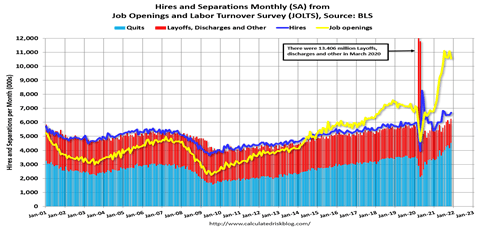
The number of job openings increased to a series high of 10.1 million on the last business day of June (yellow line on CR graph), the U.S. Bureau of Labor Statistics reported on Monday.

It seems many working-age adults aren’t ready to return to work for several reasons, based on early data from Ziprecruiter, an online employment agency. About 13 million Americans are currently receiving unemployment benefits. In some states, they stand to lose them if they don’t actively search for work. That’s because some states have reimposed work search requirements that were waived in the early days of the Covid-19 pandemic.

Ziprecruiter lists which states are terminating unemployment benefits early. “Early indications are that (unemployment) benefits have had some effect on job search,” says Julia Pollak, chief economist at Santa Monica, California-based Ziprecruiter, “but the effect is likely rather small because there are other things that are keeping people out of the labor force,” cited in a MarketWatch article.

She also lists some obvious reasons: The pandemic, which is resurgent in much of the country, and childcare, which has caused droves of workers — largely women — to stop working. Data from the Federal Reserve Bank of Dallas puts this number at 1.3 million. 

The Dallas Fed says 31 percent of workers are reluctant, for whatever reason, to return to their previous job. It’s a data point that has increased slowly but steadily for more than a year.

Hires rose to 6.7 million and total separations edged up to 5.6 million in the JOLTS report, which tells us there were one million new hires in July, which then is seasonally adjusted to give the actual unemployment report. Within separations, the quits rate increased to 2.7 percent. The layoffs and discharges rate was unchanged at 0.9 percent, matching the series low reached last month, which tells us that employers are reluctant to lay off anybody with the current labor shortage.

Could record high consumer confidence be another reason employees are reluctant to return to work during the ongoing pandemic? They feel flush with the $4 trillion in pandemic aid already flowing through the economy, so they can afford to look for better job choices with higher pay and benefits.

The Conference Board’s jobs-plentiful index increased to a 21-year high of 54.9, for starters, and wages and salaries at the bottom end of salaried workers are rising at the fastest clip since the pandemic.

“Consumers’ appraisal of present-day conditions held steady, suggesting economic growth in Q3 is off to a strong start,” said Lynn Franco, Senior Director of Economic Indicators at The Conference Board. “Consumers’ optimism about the short-term outlook didn’t waver, and they continued to expect that business conditions, jobs, and personal financial prospects will improve.”

American workers are perhaps in the best place in decades to take advantage of this economic recovery.

Harlan Green © 2021

Follow Harlan Green on Twitter: https://twitter.com/HarlanGreen

Posted in Consumers, COVID-19, Economy, Weekly Financial News | Leave a comment

Another Strong Jobs Report

Popular Economics Weekly

MarketWatch.com

This was another very strong unemployment report by the Bureau of Labor Statisticss (BLS) with 943,000 new nonfarm payroll jobs added in July and most of it in the service industries. Leisure/Hospitality, Government, Education/Health, and Professional/Business added 767,000 of those jobs.

“The unemployment rate declined by 0.5 percentage point to 5.4 percent in July, and the number of unemployed persons fell by 782,000 to 8.7 million,” said the BLS Household Survey. “These measures are down considerably from their highs at the end of the February-April 2020 recession. However, they remain well above their levels prior to the coronavirus (COVID-19) pandemic (3.5 percent and 5.7 million, respectively, in February 2020.”

This is why consumers remain so optimistic, even with alarm bells ringing that economic activity may slow due to the pandemic’s latest surge, as I said last week. Because July’s unemployment report confirms it’s not hurting the jobs market with the 6 million plus job vacancies and employers practically begging their employees to return to work.

Another reason for consumers’ optimism is that average hourly pay rose 4.0 percent and is now above the pre-pandemic level. No wonder, with the 8.7 million still unemployed, many of which maybe holding out for better pay and working conditions!

“At the current rate of hiring, the U.S. won’t regain all the lost jobs at least until early 2021 — and it could even take a lot longer than that,” says MarketWatch’s Jeffry Bartash.

How much longer it will take might depend on COVID-19, and the Delta Variant, which is causing a fourth surge in infections, overwhelming some hospitals in Texas, Florida, and other red states that aren’t enforcing a mask mandate.

CDC

“The current 7-day moving average of daily new cases (66,606) increased 64.1% compared with the previous 7-day moving average (40,597),” reports the CDC. “The current 7-day moving average is 73.8% lower than the peak observed on January 10, 2021 (254,063) and is 480.1% higher than the lowest value observed on June 19, 2021 (11,483). A total of 34,722,631 COVID-19 cases have been reported as of July 28.”

That is huge, folks, and even throws into doubt just when and how schools will open this fall. To see the level of community transmission in your county, visit COVID Data Tracker.

Harlan Green © 2021

Follow Harlan Green on Twitter: https://twitter.com/HarlanGreen
Posted in Consumers, COVID-19, Economy, Weekly Financial News | 1 Comment

Can We Have a Soft Landing?

The Mortgage Corner

CBO

Fed Chair Alan Greenspan in early 2000 convinced GW Bush that he could finance GW’s war on terror without raising taxes by borrowing money at ultra-low interest rates. America’s sovereign debt had AAA credit rating at the time, and still does with two of the three major accreditation agencies. Greenspan maintained we could have a “soft landing” if the US economy overheated by tightening credit gradually without causing a recession.

Problem was the Fed under Greenspan held rates down too long with too easy credit as inflation began to rise and the economy overheated, resulting in too much irrational exuberance by banks and lenders that resulted in the Great Recession.

Does that sound familiar? Economists are beginning to wonder if the Fed under Jerome Powell to making the same mistake in financing our recovery from the COVID-19 pandemic.

However, the US economy is in a much better place now to tame economic activity—i.e., can create a soft landing without causing an ensuing recession—if the Biden administration and congress will pay for the investments we are making in our public improvements with the current infrastructure and family plan bills working through congress.

This is in addition to the already passed $trillions to pay for the pandemic. The new legislation will increase productivity by giving Americans earning wages and salaries better working conditions, and families a better education, including paid childcare and family leave that will lift many families with young children out of poverty.

The benefits of putting Americans back on a footing with other developed countries in the 38-member Organization of Economic Co-operation and Development (OECD) are almost incalculable, most of whose citizens work fewer hours for the same or better pay while producing the same amount of goods and services.

The bipartisan infrastructure deal reached by President Joe Biden and a group of senators would not only add to economic growth, but also lower the national debt, according to a new study from the University of Pennsylvania’s Wharton School.

“Over time, as the new spending declines, IRS enforcement continues, and revenue grows from higher output, the government debt declines relative to baseline by 0.4 percent and 0.9 percent in 2040 and 2050 respectively,” said Wharton team as cited by CNBC in June.

The problem has never been what policies would improve the lives on America’s Main Street, but how to pay for them, and it will take additional legislation under the budget reconciliation process to boost taxes. Over the past 40-odd years government-is-the-problem policies instigated in 1980 by conservative Democrats and Republicans had cut taxes and whittled down government programs that would benefit Main Street.

The solution is more progressive taxation enacted that would divert profits from corporations and investors not investing in America’s future to where it will do the most good—in our sadly neglected infrastructure and social safety net.

There are many more safeguards in place that should cushion a soft landing if inflation becomes worrisome because of safeguards put in place since the Great Recession; such as requiring banks and other lending institutions to maintain higher reserves.

The Biden administration wants to pay for future, more equitable economic growth by raising taxes on the wealthiest and corporations, rather than borrowing more that would increase the federal debt. The problem will be to refute the reigning economic orthodoxy that says higher taxes inhibit growth and investment.

However, the lower tax rates that have prevailed since 1980 have increased income inequality rather than boosting long term growth rates,

The best ways to deal with inflation and any possible overheating is to invest in the health and economic security of future generations rather than those of past generations that haven’t done enough to pay for the future.

Harlan Green © 2021

Follow Harlan Green on Twitter: https://twitter.com/HarlanGreen
Posted in Consumers, COVID-19, Economy, Politics, Weekly Financial News | Leave a comment

Second Quarter Economic Growth Explodes

Financial FAQs

BEA.gov

The U.S. economy grew at a blistering pace in the spring and repaired most of the damage caused by the pandemic thanks to widespread coronavirus vaccinations and a nearly full reopening of the economy.

The Q2 GDP report verifies that the American economy is capable of easily accommodating the Biden administration’s proposed infrastructure and American Family plan spending of some $4 trillion in additional government investments, should they be passed in their present form.

“Real gross domestic product (GDP) increased at an annual rate of 6.5 percent in the second quarter of 2021, reflecting the continued economic recovery, reopening of establishments, and continued government response related to the COVID-19 pandemic,” according to the Bureau of Economic Analysis (BEA).

This is huge after the first quarter’s 6.3 percent growth and shows both consumers and businesses are spending enough to boost GDP growth past the pre-pandemic level.

The increase in real GDP in the second quarter reflected increases in personal consumption expenditures (PCE), nonresidential fixed investment, exports, and state and local government spending that were partly offset by decreases in private inventory investment, residential fixed investment, and federal government spending. Imports, which are a subtraction in the calculation of GDP, increased.

Such growth should continue in the third quarter with agreement being reached on the $1 trillion national infrastructure plan after weeks of fits and starts, once the White House and a bipartisan group of senators agreed on major provisions of the package that’s key to President Joe Biden’s agenda.

The package includes $110 billion for highways, $65 billion for broadband and $73 billion to modernize the nation’s electric grid, according to a White House fact sheet. Additionally, there’s $25 billion for airports, $55 billion for waterworks and more than $50 billion to bolster infrastructure against cyber attacks and climate change. There’s also $7.5 billion for electric vehicle charging stations.

Government assistance payments in the form of loans to businesses and grants to state and local governments increased in Q2, while social benefits to households, such as the direct economic impact payments, declined. In the first quarter of 2021, real GDP increased 6.3 percent (revised), as I said.

“The $1.2 trillion Bipartisan Infrastructure Framework is a critical step in implementing President Biden’s Build Back Better vision,” said the White House fact sheet. “The Plan makes transformational and historic investments in clean transportation infrastructure, clean water infrastructure, universal broadband infrastructure, clean power infrastructure, remediation of legacy pollution, and resilience to the changing climate. Cumulatively across these areas, the Framework invests two-thirds of the resources that the President proposed in his American Jobs Plan.”

Inflation is running hot, as was expected from the sudden surge in demand that has GDP growth exceeding its pre-pandemic level. The PCE price index that the Fed prefers to measure inflation increased 6.4 percent, compared with an increase of 3.8 percent (revised). Excluding food and energy prices, the PCE price index increased 6.1 percent, compared with an increase of 2.7 percent (revised).

This level of inflation is worrisome if prolonged, but the Federal Reserve believes supply bottlenecks are causing the price rises that should subside once industry activity returns to normal and the 7 million workers still unemployed due to the pandemic return to work.

This is the biggest investment in America’s future since the Eisenhower and Kennedy days more than two generations ago when our tax monies were spent on real things; like our interstate highway system, moon landings, and development of the Internet.

These new government spending initiatives will find new ways to benefit workers in this new economy as other developed countries are doing—i.e., with governments working to pay it forward for future generations.

Harlan Green © 2021

Follow Harlan Green on Twitter: https://twitter.com/HarlanGreen

Posted in Consumers, COVID-19, Economy, Politics, Weekly Financial News | Leave a comment

Why Are Consumers So Confident?

Popular Economics Weekly

Conference Board

Rather than retreating mildly this month as expected, the Conference Board’s consumer confidence index edged up slightly from an upward-revised June level to stand at 129.1,” said Reuters.  That was a new pandemic-era high, although still slightly below the pre-pandemic (February 2020) level of 132.6. 

Why are consumers so optimistic with alarm bells ringing that economic activity may slow due to the pandemic’s latest surge? Because it’s not hurting the jobs market with the 6 million plus job vacancies and employers practically begging their employees to return to work.

The Conference Board’s jobs-plentiful index increased to a 21-year high of 54.9, for starters, and wages and salaries at the bottom end of salaried workers are rising at the fastest clip since the pandemic.

“Consumers’ appraisal of present-day conditions held steady, suggesting economic growth in Q3 is off to a strong start,” said Lynn Franco, Senior Director of Economic Indicators at The Conference Board. “Consumers’ optimism about the short-term outlook didn’t waver, and they continued to expect that business conditions, jobs, and personal financial prospects will improve.”

Consumers have been spending like there’s no tomorrow since January, as I’ve said. The question remains just how long can that continue with the coronavirus Delta variant causing infection rates to soar among the unvaccinated, but rising prices aren’t fazing consumers with so much disposable income at their disposal to spend.

Short-term inflation expectations eased slightly but remained elevated., said Franco. “Spending intentions picked up in July, with a larger percentage of consumers saying they planned to purchase homes, automobiles, and major appliances in the coming months. Thus, consumer spending should continue to support robust economic growth in the second half of 2021.

The IMF among other authorities believes worldwide GDP will expand 6 percent this year. That is huge, up from 2-3 percent in recent years.

Households are still buying plenty of goods, but they have shifted their spending toward services they avoided during the pandemic, “dining out, entertainment, travel, vacation trips and so forth,” reported MarketWatch in last week’s retail sales report.

And this is where any future super-spreader events will occur. It is why the US Surgeon General is saying masks should again be worn in crowded indoor locations with poor ventilation—such as bars and restaurants. This may certainly cause consumers to take notice, but not yet per consumer confidence surveys.

COVIDTracker

Take bars and restaurants, the only category in the monthly retail report that involves services. Retail sales jumped 2.3 percent in June, the government said Friday, and rose sharply for the fourth month in a row. And through the first six months of 2021 receipts are up almost 38 percent.

We know consumers also would have bought more new cars and trucks last month, but automakers cannot produce enough of them because of a shortage of computer chips. Semiconductors are now a critical component in modern vehicles.

There is still a reluctance for some workers to return to work. I reported last week that the job-listing site Indeed did a 5,000 person survey that gave an additional reason why workers are reluctant to return to work.

“Among the unemployed, concern about COVID-19 is the most commonly cited reason for a lack of urgency in looking for work,” wrote Nick Bunker, the economic research director for North America at the Indeed Hiring Lab, in a blog post on the survey results. Some 23% of unemployed people said fear of the virus was keeping their job search “non-urgent.”

This doesn’t seem to have dimmed consumer confidence or spending habits now. But the current 7-day moving average of daily new cases (40,246) increased 46.7% compared with the previous 7-day moving average (27,443), says the CDC(see graph). The current 7-day moving average is 84.2% lower than the peak observed on January 10, 2021 (254,052) and is 250.6% higher than the lowest value observed on June 19, 2021 (11,480). 

Although pundits some economists are concerned about the Delta variant and rising prices, it has not dented consumers’ confidence in their future.

Harlan Green © 2021

Follow Harlan Green on Twitter: https://twitter.com/HarlanGreen
Posted in Consumers, COVID-19, Economy, Uncategorized, Weekly Financial News | Leave a comment

Can We Fix the Housing Shortage–Part II?

The Mortgage Corner

Calculated Risk

WASHINGTON (July 22, 2021) – Existing-home sales increased in June, snapping four consecutive months of declines, according to the National Association of Realtors®.

But it’s not enough to bridge the supply-demand gap, especially for those entry-level homebuyers in their thirties with families that have lower incomes and credit scores. Lenders haven’t reduced the very stringent credit standards in place since the Great Recession and busted housing bubble that would allow more first-time homebuyers to take advantage of record-low interest rates.

“Total existing-home sales,1 https://www.nar.realtor/existing-home-sales, completed transactions that include single-family homes, townhomes, condominiums and co-ops, grew 1.4% from May to a seasonally adjusted annual rate of 5.86 million in June. Sales climbed year-over-year, up 22.9% from a year ago (4.77 million in June 2020).”

Will housing construction be able to bridge the huge gap between what is needed and what is available? Not in the near term, as there are too many labor and material shortages, say the homebuilders. Demand is so hot for housing with a limited supply that homes typically sold within 17 days (24 days one year ago), say the Realtors in the NAR’s most recent Buyer Traffic Index.

U.S. home builders started construction on homes at a seasonally-adjusted annual rate of 1.64 million in June, representing a 6.3 percent increase from the previous month’s downwardly-revised figure, the U.S. Census Bureau reported this week. Compared with June 2020, housing starts were up 29 percent, though the year-over-year comparison is skewed somewhat by the effects of the COVID-19.

FREDhousestarts

But that is nowhere near the 2 million residential units under construction in the mid-2000s (see FRED graph), which brought on the housing bubble. But times are much different today, as housing construction almost ground to a halt from the housing bubble and Great Recession that followed. Population growth continued, however, so growth today’s builders are playing catchup.

The June reading of 1.64 million starts is the number of housing units builders would begin if development kept this pace for the next 12 months, says the National Association of Home Builders. Within this overall number, single-family starts increased 4.2 percent to a 1.10 million seasonally adjusted annual rate. The multifamily sector, which includes apartment buildings and condos, increased 2.4 percent to a 474,000 pace.

So how can we increase production? “We’ll need to do something dramatic to close this gap,” said Yun in a press release. And that gap is mainly affordability, as housing prices are increasing in double-digits, while real personal income has averaged some five percent per year.

First-time buyers accounted for just 31 percent of sales in June, also even with May but down from 35 percent in June 2020. This is far below past history when 40 percent were first-timers. Part of the problem is that entry-level buyers tend to have lower credit scores when lenders have maintained very high credit score criteria, averaging above 750 at last report, whereas homebuyers with scores between 680-720 were considered good credit borrowers before the Great Recession and housing bubble.

Realtors have proposed increasing the housing supply by creating or expanding tax credits, loans or grants for builders who renovate or build new housing in low-income areas and who convert old malls and factories into homes. They also asked for incentives for cities to allow denser zoning, an approach that President Biden included in his infrastructure proposal, Reuters reported, as I said last week.

But pressure has to be put on lenders to reduce their sky-high credit standards, as well, to allow those entry-level homebuyers with less available cash and slightly lower credit scores back into the housing market.

Harlan Green © 2021

Follow Harlan Green on Twitter: https://twitter.com/HarlanGreen
Posted in Uncategorized | 2 Comments